Android Best
Practices
José Manuel Ortega
DroidCon July 2014
https://techfest.uc3m.es/programa/android-in-practice/
Index
 UI DESIGN
 INCLUDES / REUSING LAYOUTS
 STYLES
 ACTION BAR SEARCH VIEW / PROGRESS BAR
 ACCESSIBILITY / TALLBACK
 NETWORK CONNECTION
 ASYNCTASK / SERVICES
 FRAGMENTS
 NAVIGATION PATTERNS
 GEOLOCATION / PERFORMANCE
 DEPENDENCY INYECTION / ANNOTATIONS
 TOOLS / VOLLEY / LIBRARIES / /BOOKS
http://developer.android.com/intl/es/training/index.html
UI Design
 http://developer.android.com/design/index.html
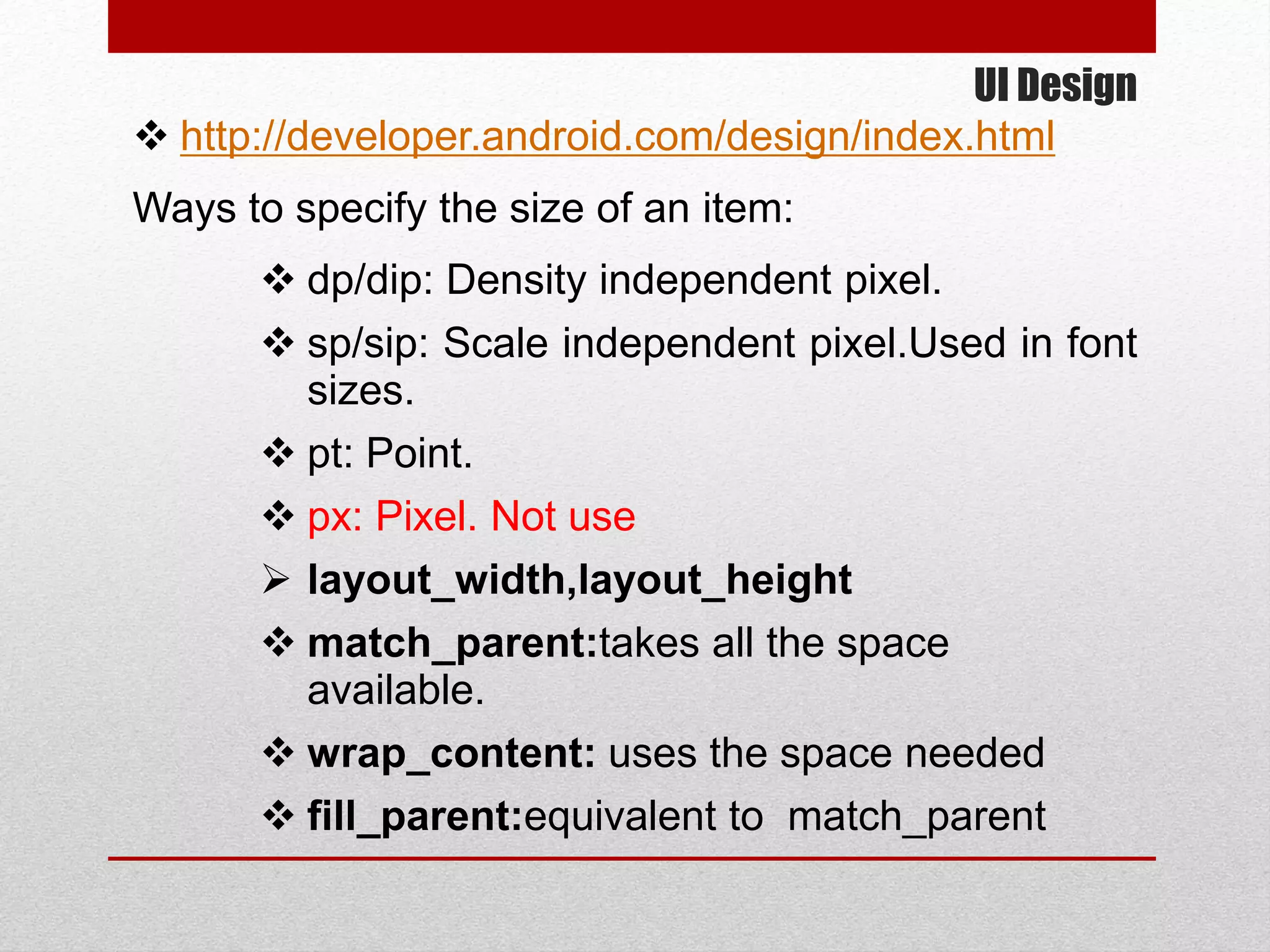
Ways to specify the size of an item:
 dp/dip: Density independent pixel.
 sp/sip: Scale independent pixel.Used in font
sizes.
 pt: Point.
 px: Pixel. Not use
 layout_width,layout_height
 match_parent:takes all the space
available.
 wrap_content: uses the space needed
 fill_parent:equivalent to match_parent
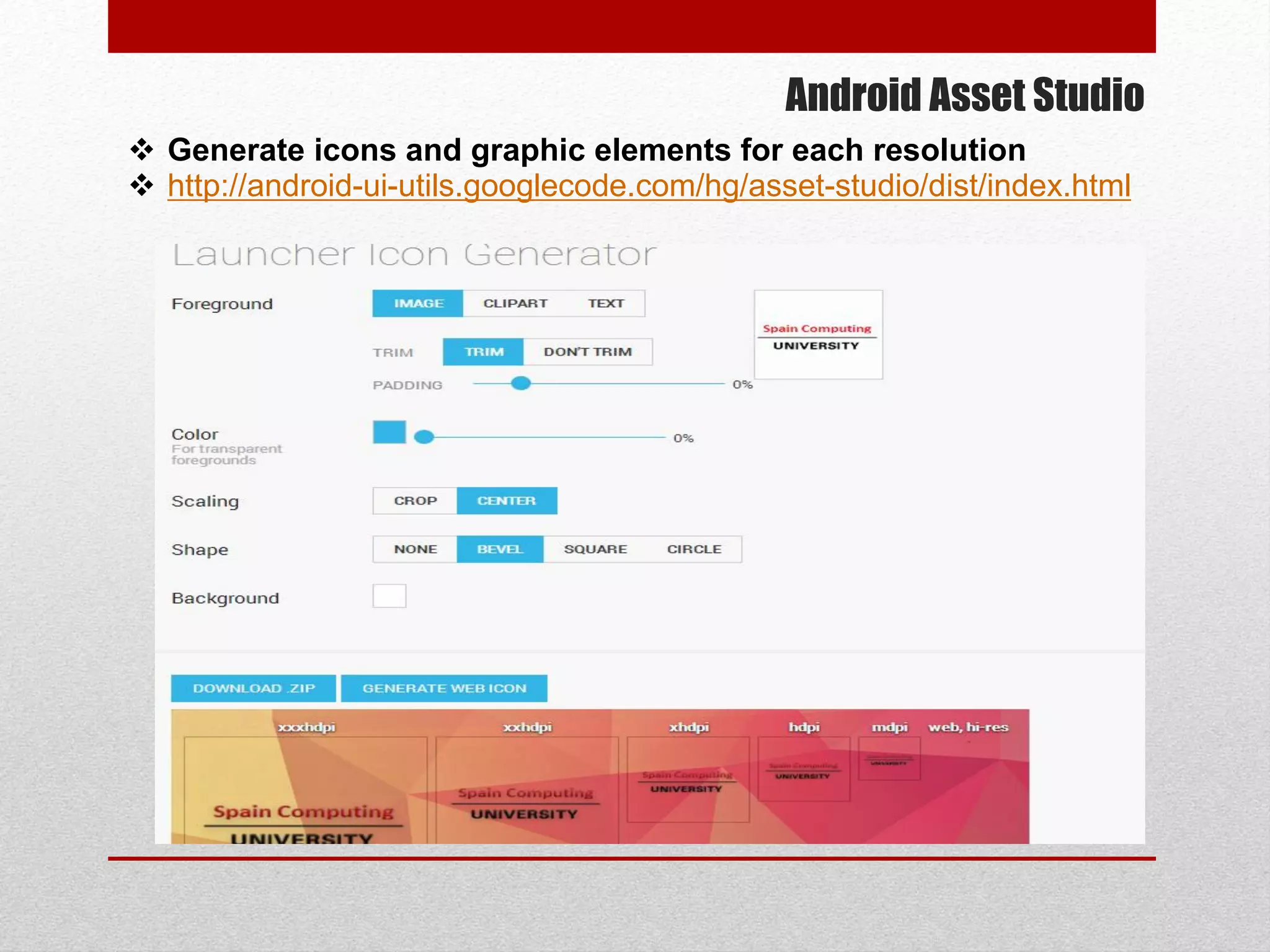
Android Asset Studio
 Generate icons and graphic elements for each resolution
 http://android-ui-utils.googlecode.com/hg/asset-studio/dist/index.html
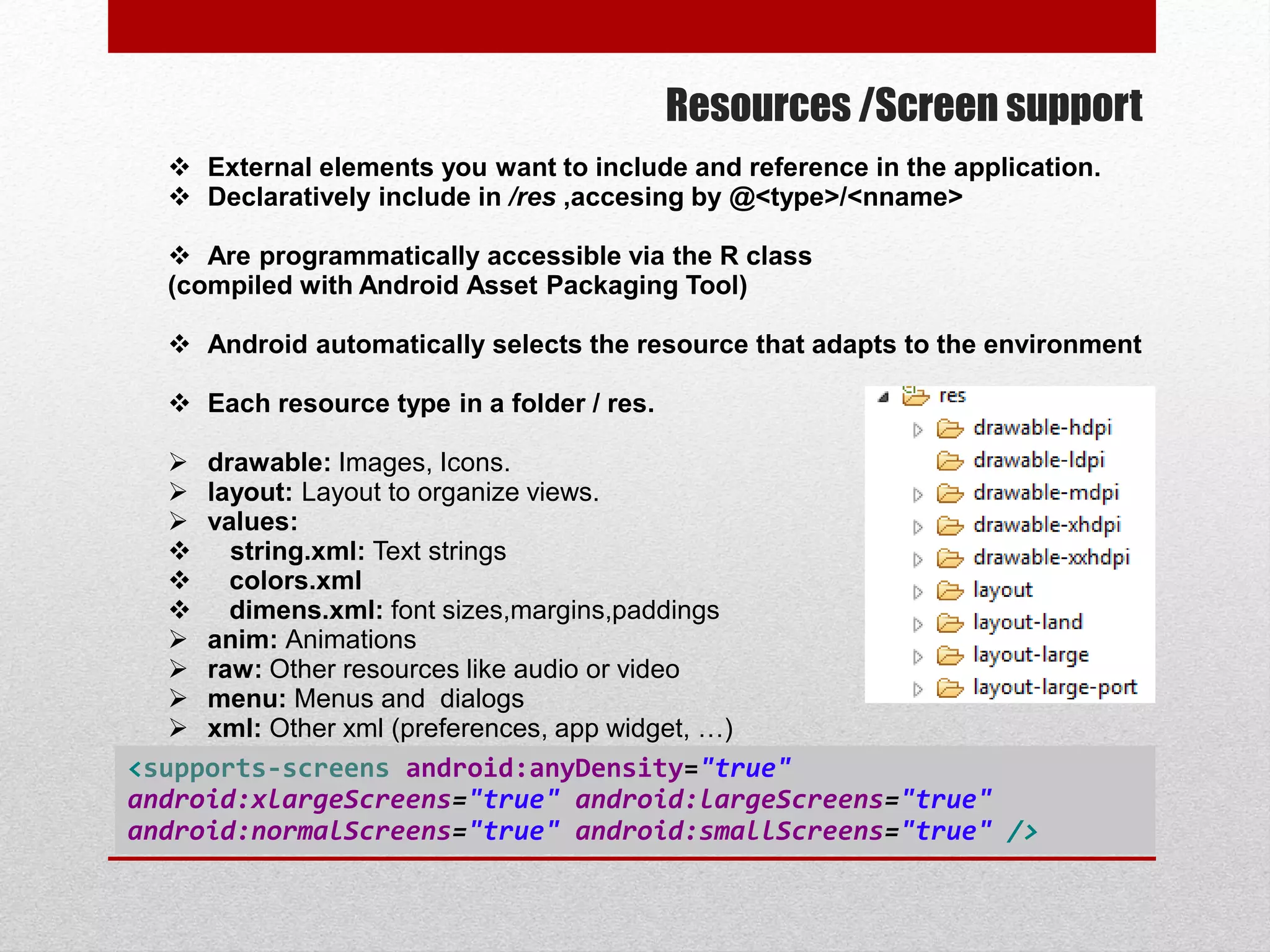
Resources /Screen support
 External elements you want to include and reference in the application.
 Declaratively include in /res ,accesing by @<type>/<nname>
 Are programmatically accessible via the R class
(compiled with Android Asset Packaging Tool)
 Android automatically selects the resource that adapts to the environment
 Each resource type in a folder / res.
 drawable: Images, Icons.
 layout: Layout to organize views.
 values:
 string.xml: Text strings
 colors.xml
 dimens.xml: font sizes,margins,paddings
 anim: Animations
 raw: Other resources like audio or video
 menu: Menus and dialogs
 xml: Other xml (preferences, app widget, …)
<supports-screens android:anyDensity="true"
android:xlargeScreens="true" android:largeScreens="true"
android:normalScreens="true" android:smallScreens="true" />
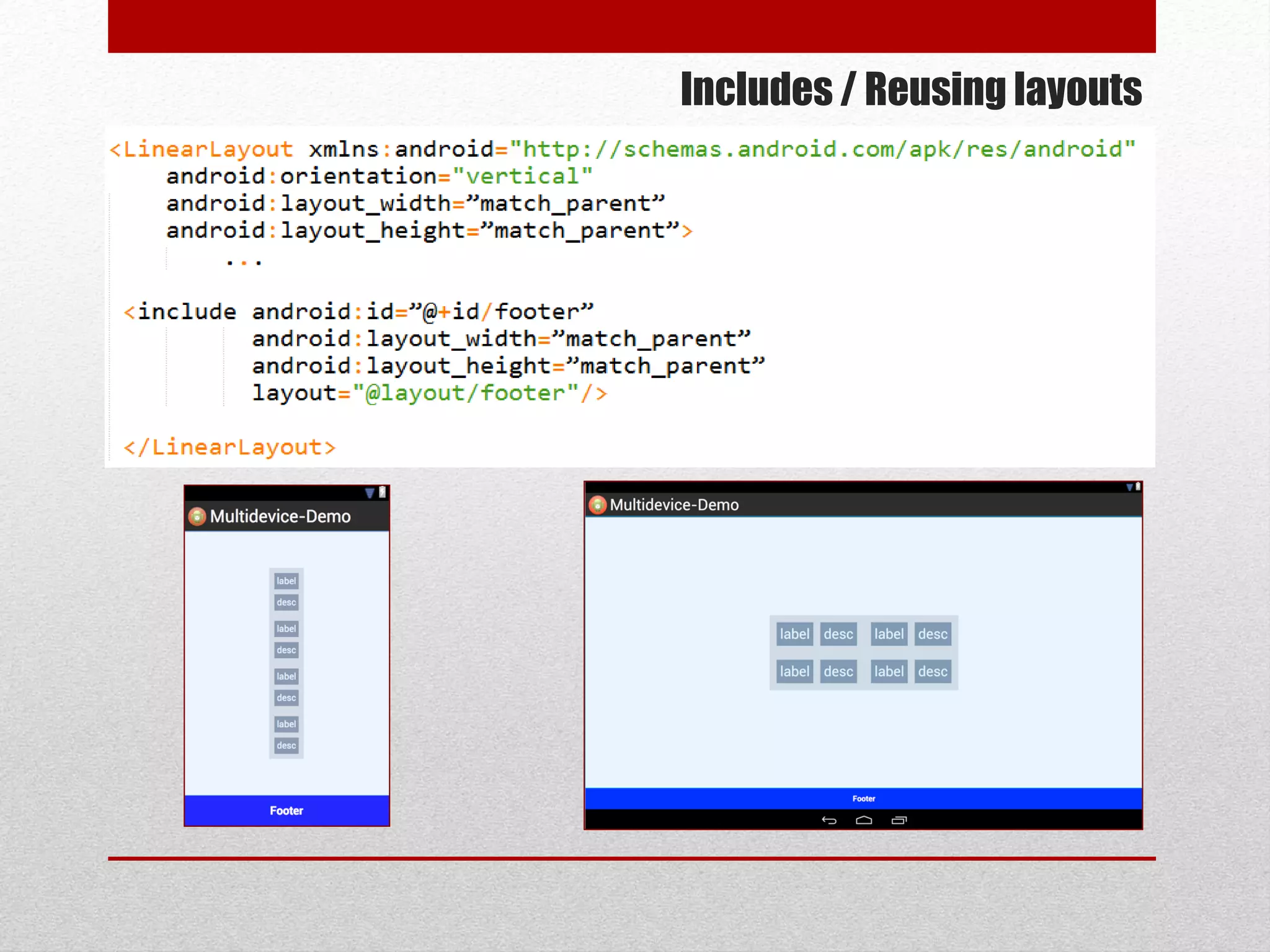
Includes / Reusing layouts
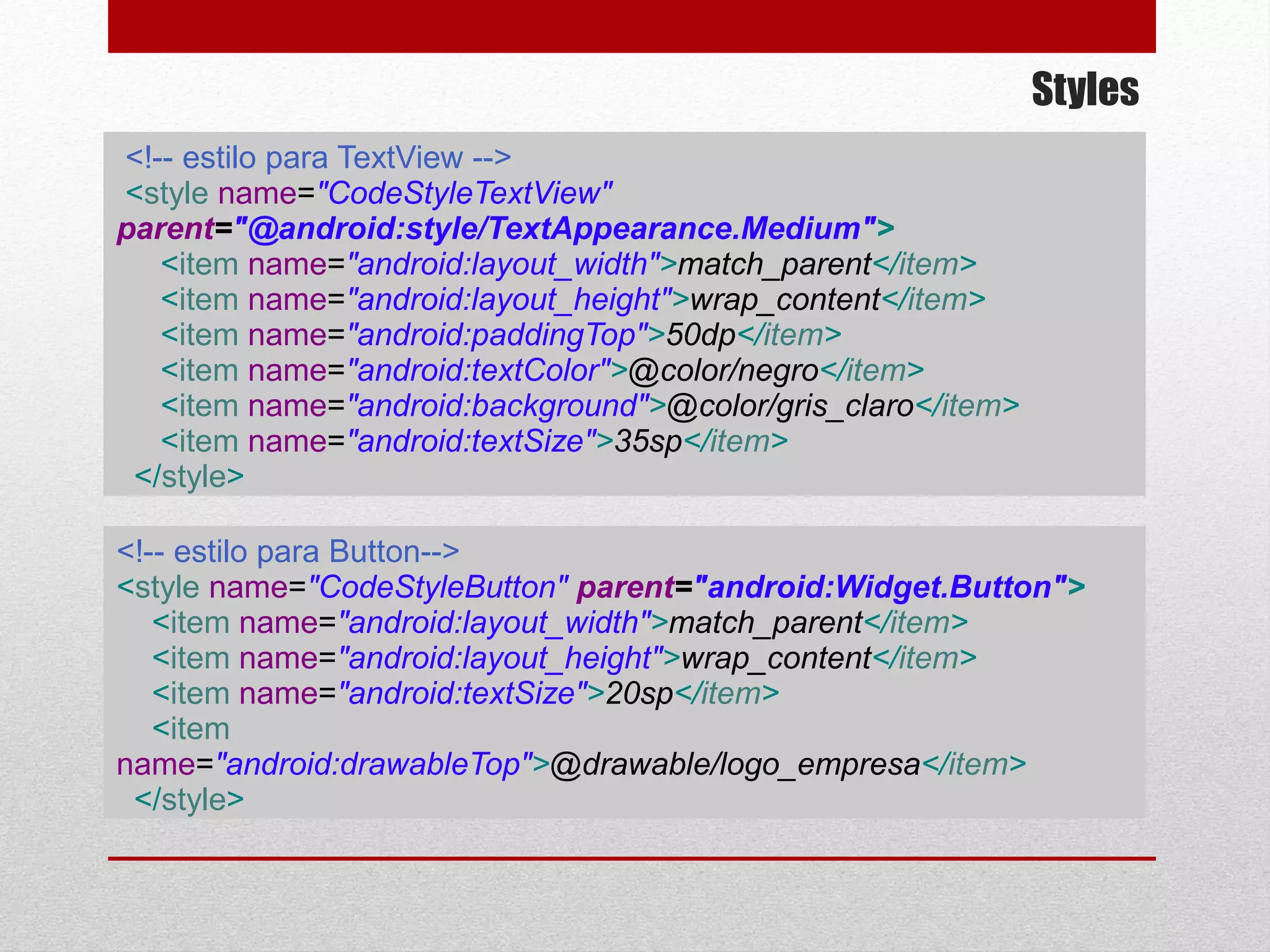
Styles
<!-- estilo para TextView -->
<style name="CodeStyleTextView"
parent="@android:style/TextAppearance.Medium">
<item name="android:layout_width">match_parent</item>
<item name="android:layout_height">wrap_content</item>
<item name="android:paddingTop">50dp</item>
<item name="android:textColor">@color/negro</item>
<item name="android:background">@color/gris_claro</item>
<item name="android:textSize">35sp</item>
</style>
<!-- estilo para Button-->
<style name="CodeStyleButton" parent="android:Widget.Button">
<item name="android:layout_width">match_parent</item>
<item name="android:layout_height">wrap_content</item>
<item name="android:textSize">20sp</item>
<item
name="android:drawableTop">@drawable/logo_empresa</item>
</style>
Styles
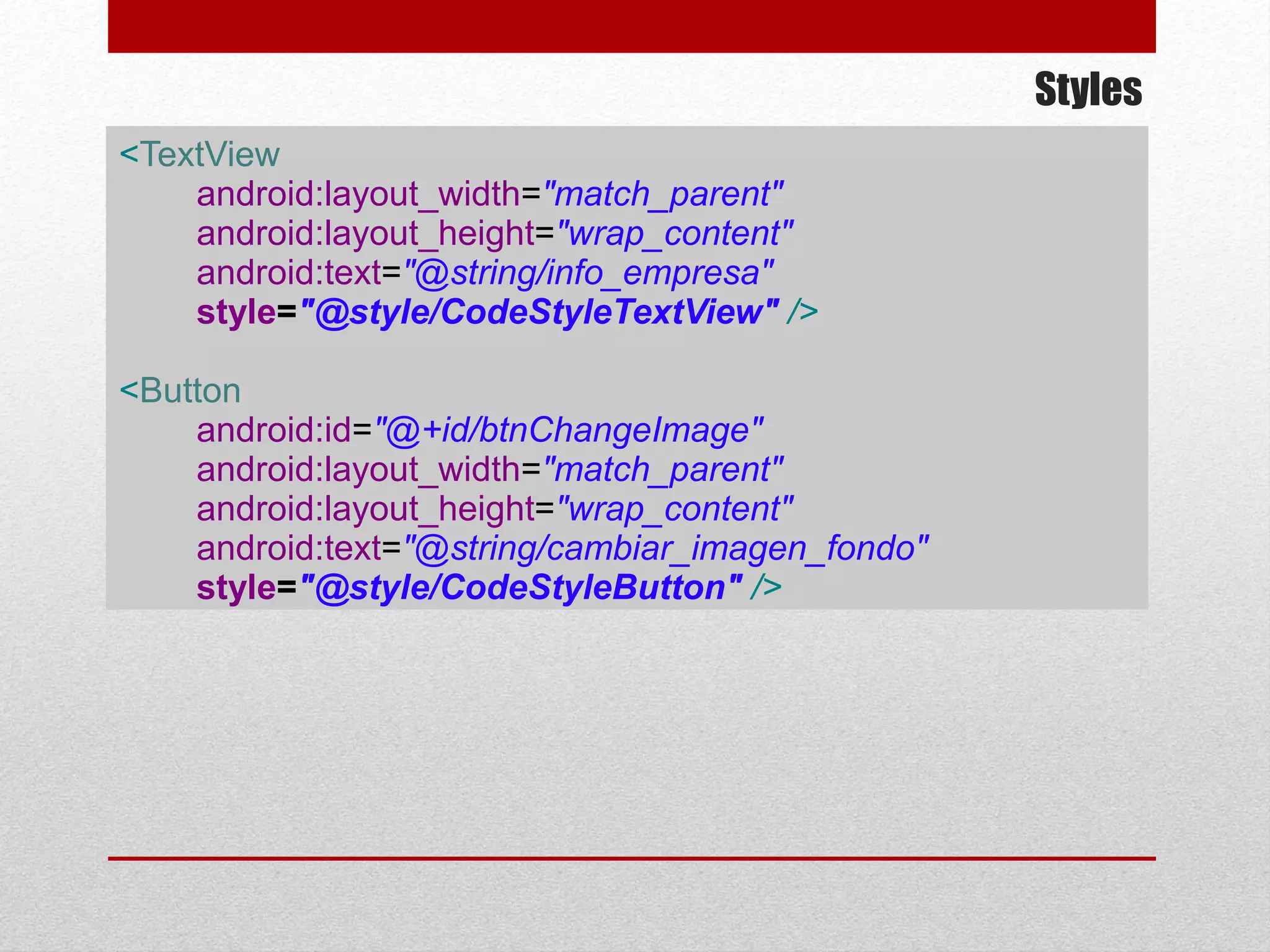
<TextView
android:layout_width="match_parent"
android:layout_height="wrap_content"
android:text="@string/info_empresa"
style="@style/CodeStyleTextView" />
<Button
android:id="@+id/btnChangeImage"
android:layout_width="match_parent"
android:layout_height="wrap_content"
android:text="@string/cambiar_imagen_fondo"
style="@style/CodeStyleButton" />
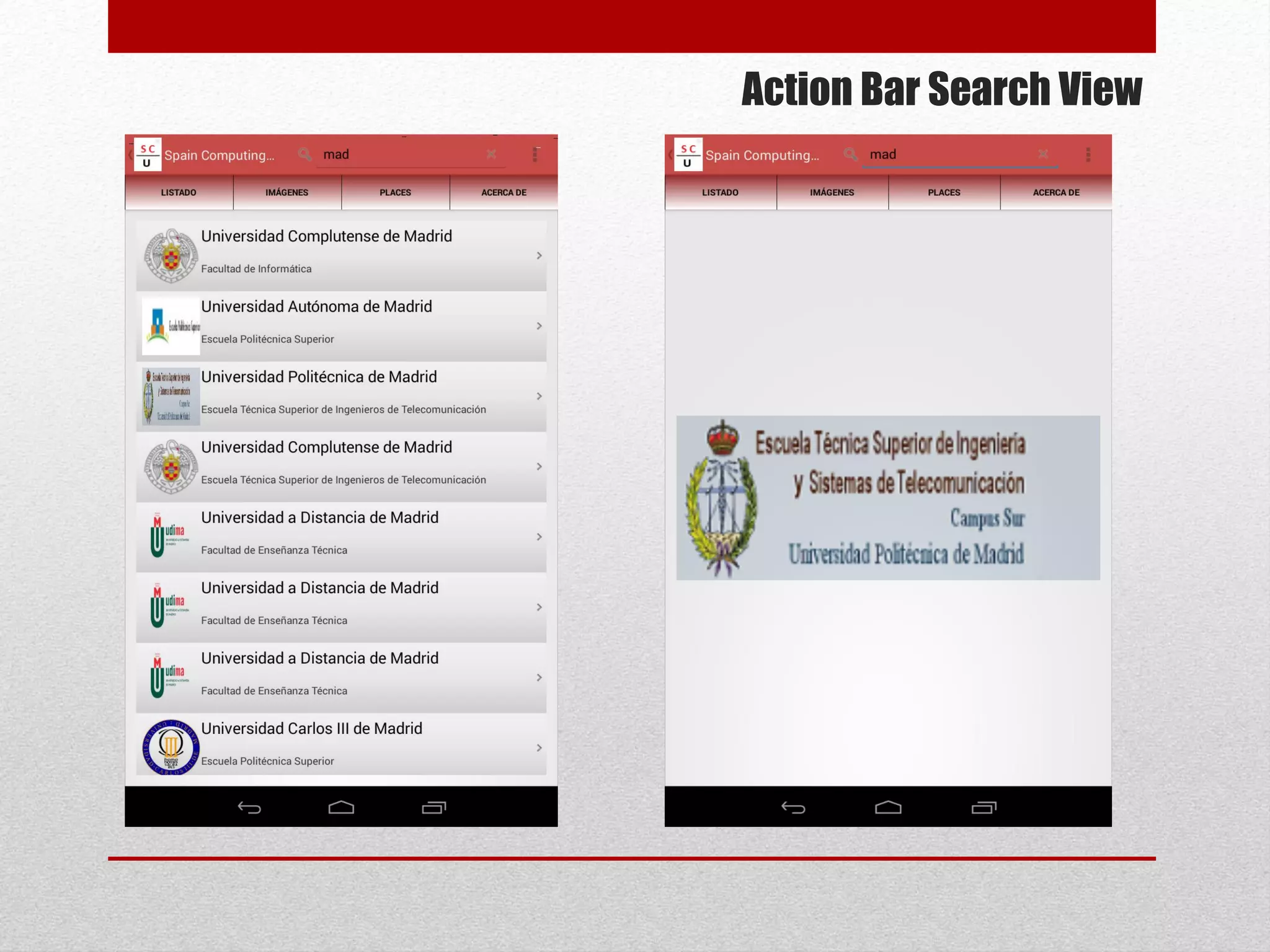
Action Bar Search View
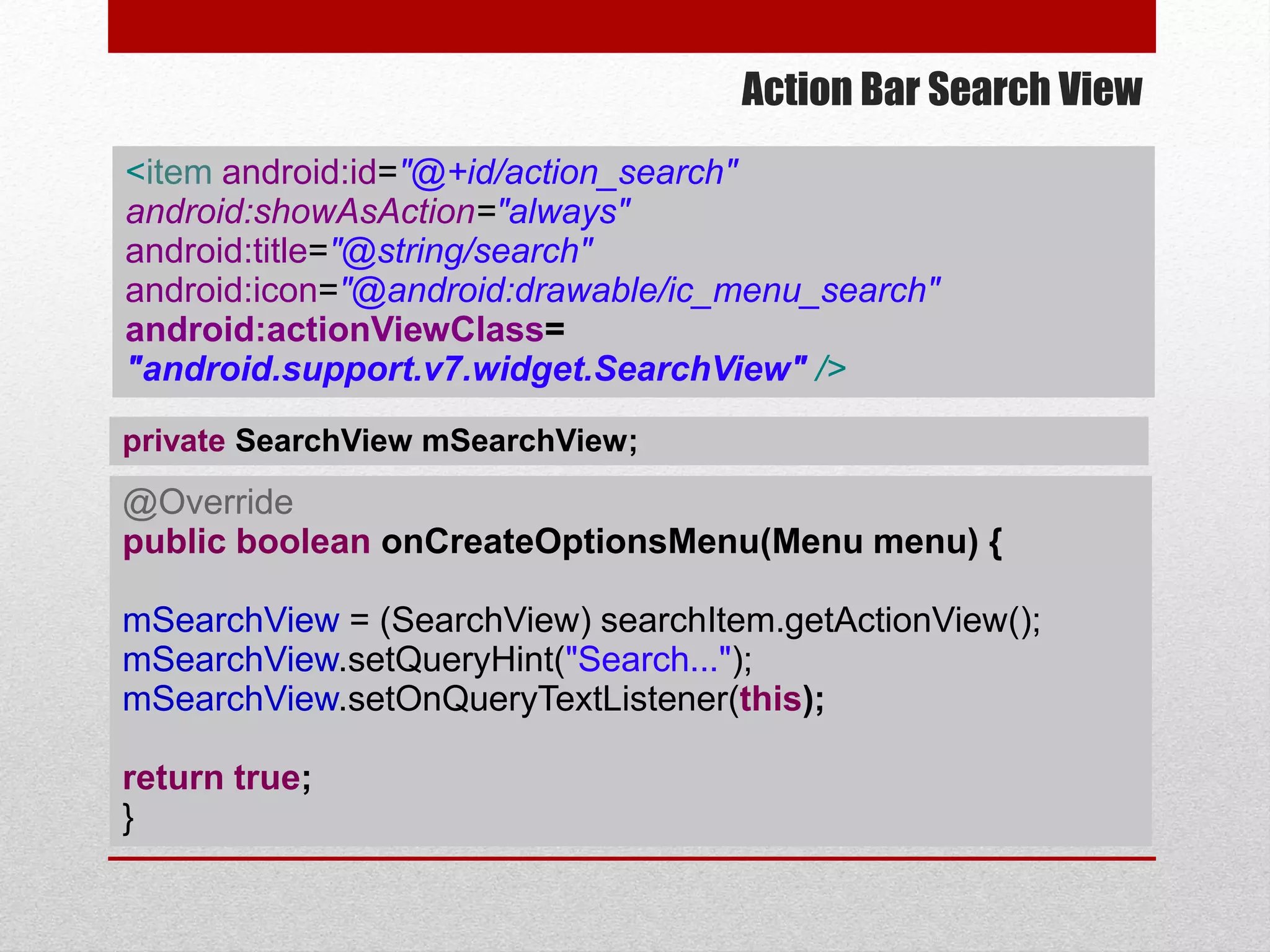
@Override
public boolean onCreateOptionsMenu(Menu menu) {
mSearchView = (SearchView) searchItem.getActionView();
mSearchView.setQueryHint("Search...");
mSearchView.setOnQueryTextListener(this);
return true;
}
<item android:id="@+id/action_search"
android:showAsAction="always"
android:title="@string/search"
android:icon="@android:drawable/ic_menu_search"
android:actionViewClass=
"android.support.v7.widget.SearchView" />
private SearchView mSearchView;
Action Bar Search View
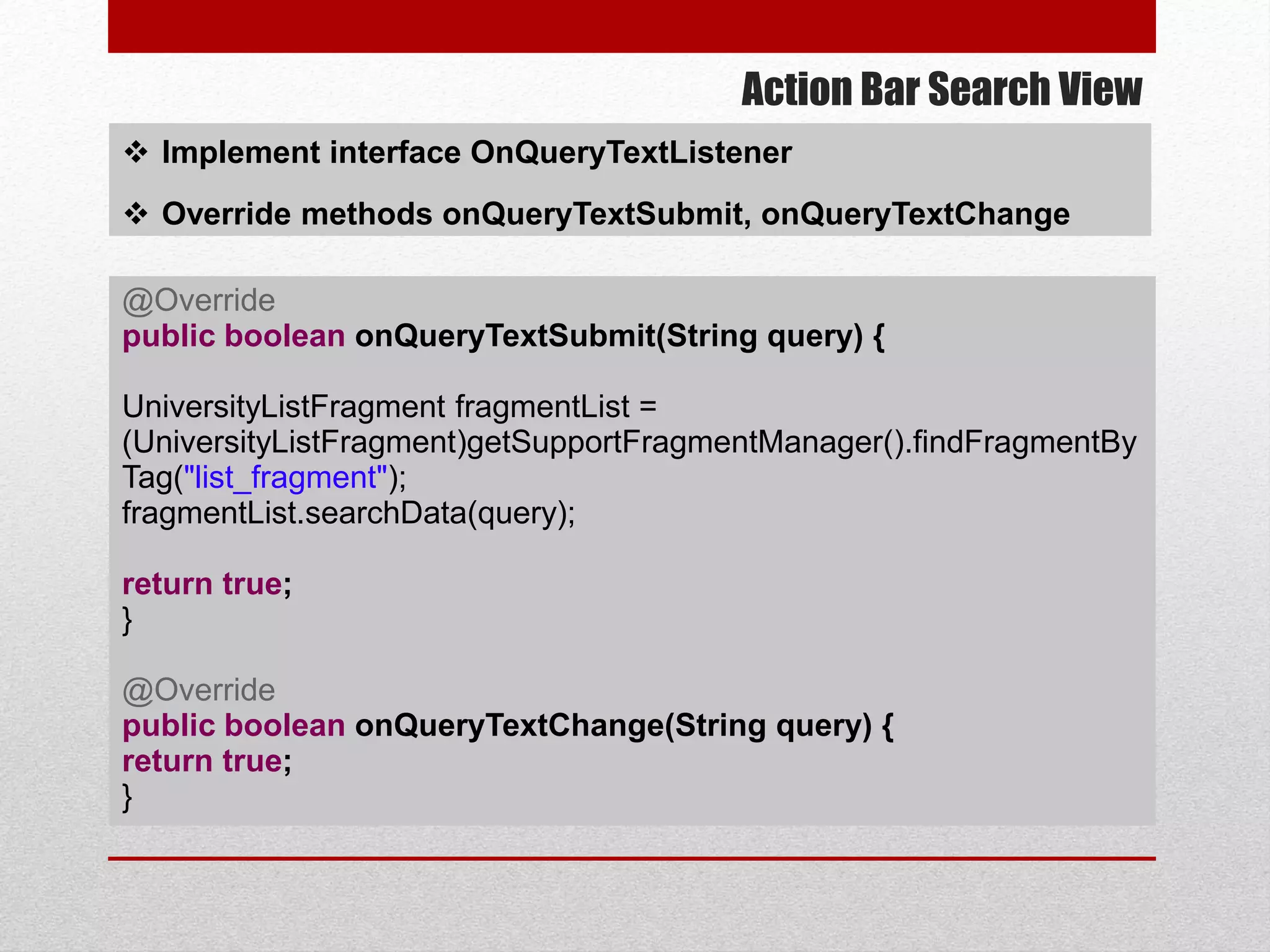
 Implement interface OnQueryTextListener
 Override methods onQueryTextSubmit, onQueryTextChange
@Override
public boolean onQueryTextSubmit(String query) {
UniversityListFragment fragmentList =
(UniversityListFragment)getSupportFragmentManager().findFragmentBy
Tag("list_fragment");
fragmentList.searchData(query);
return true;
}
@Override
public boolean onQueryTextChange(String query) {
return true;
}
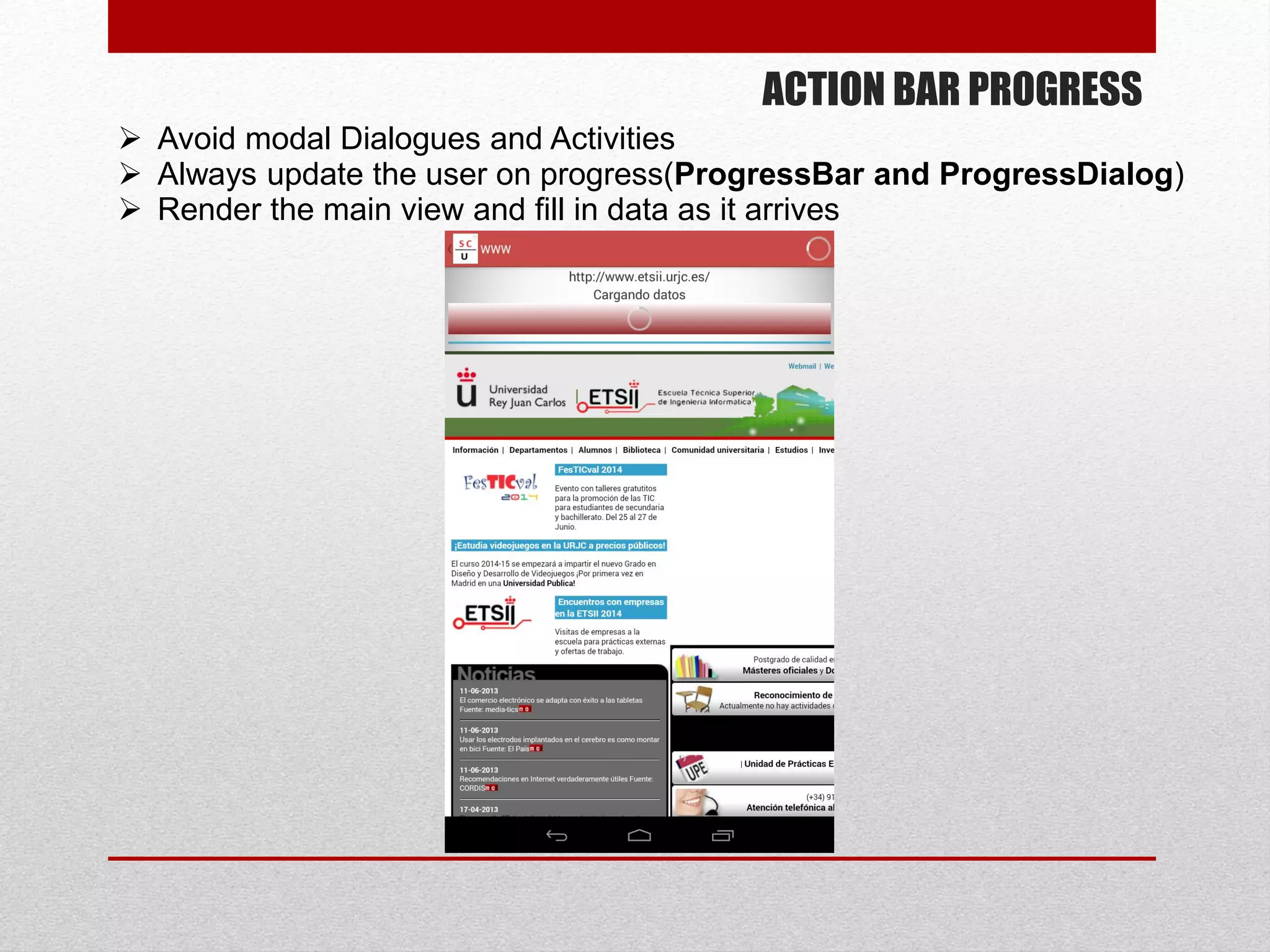
ACTION BAR PROGRESS
 Avoid modal Dialogues and Activities
 Always update the user on progress(ProgressBar and ProgressDialog)
 Render the main view and fill in data as it arrives
ACTION BAR PROGRESS
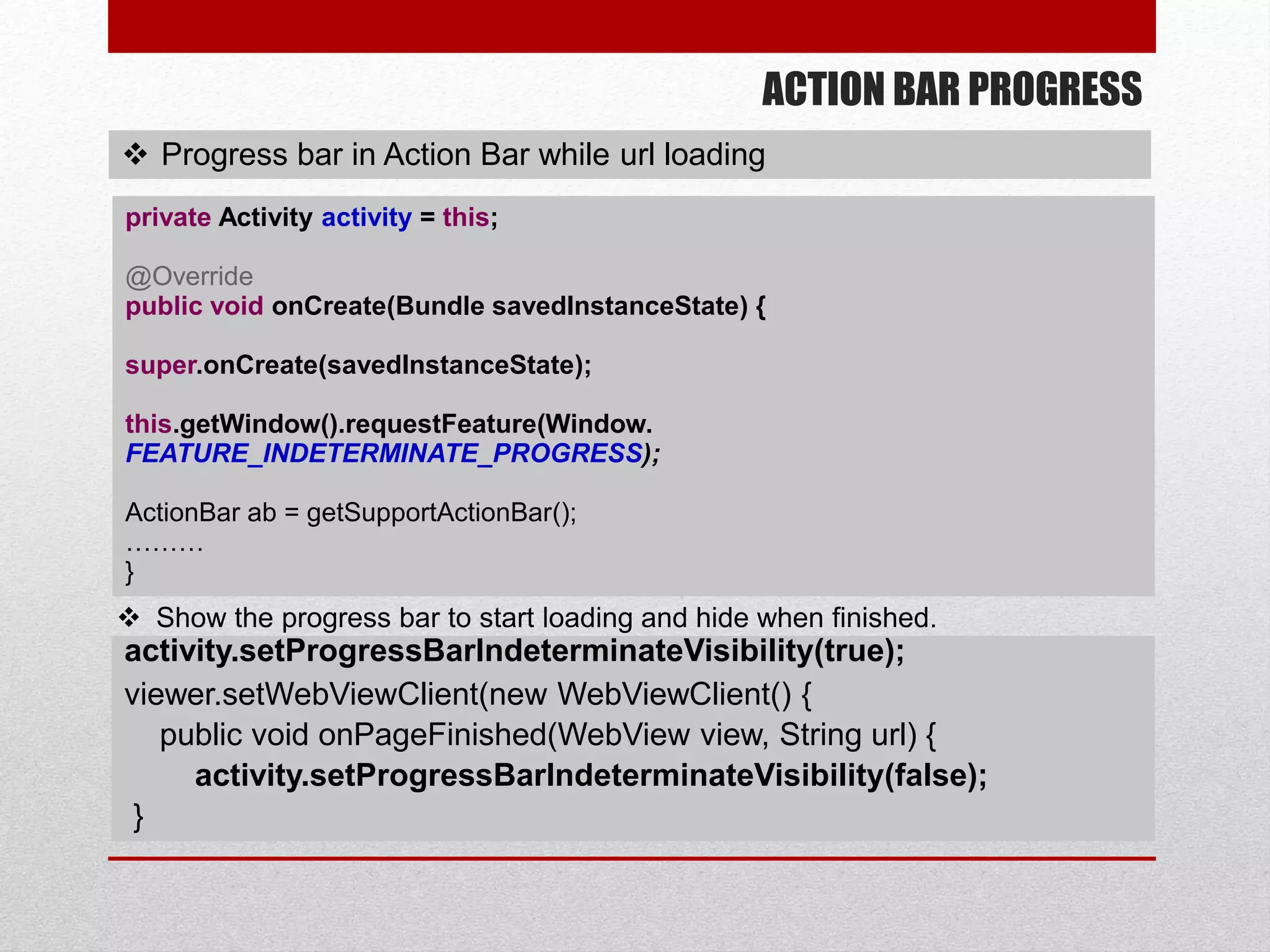
 Progress bar in Action Bar while url loading
private Activity activity = this;
@Override
public void onCreate(Bundle savedInstanceState) {
super.onCreate(savedInstanceState);
this.getWindow().requestFeature(Window.
FEATURE_INDETERMINATE_PROGRESS);
ActionBar ab = getSupportActionBar();
………
}
activity.setProgressBarIndeterminateVisibility(true);
viewer.setWebViewClient(new WebViewClient() {
public void onPageFinished(WebView view, String url) {
activity.setProgressBarIndeterminateVisibility(false);
}
 Show the progress bar to start loading and hide when finished.
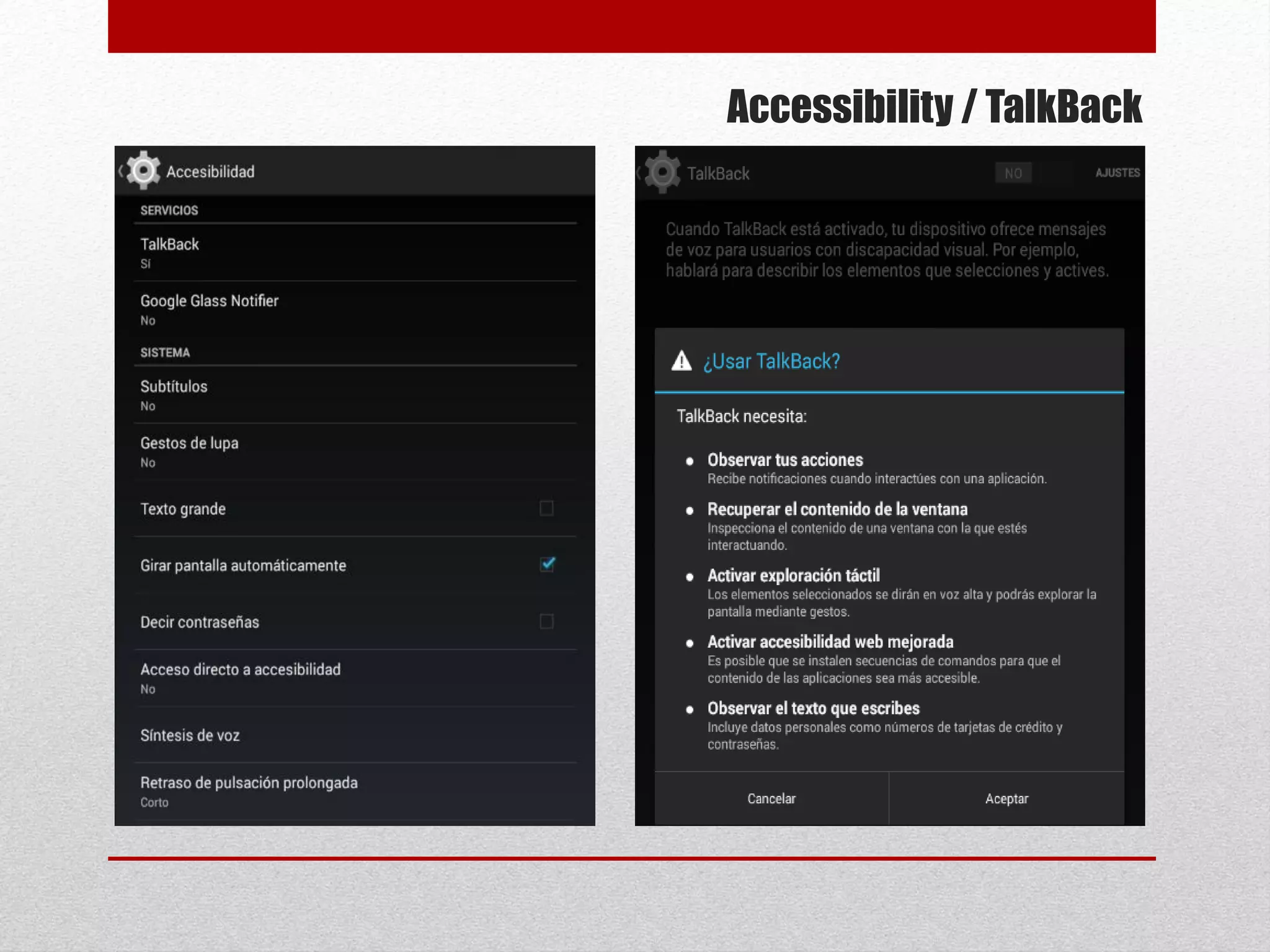
Accessibility / TalkBack
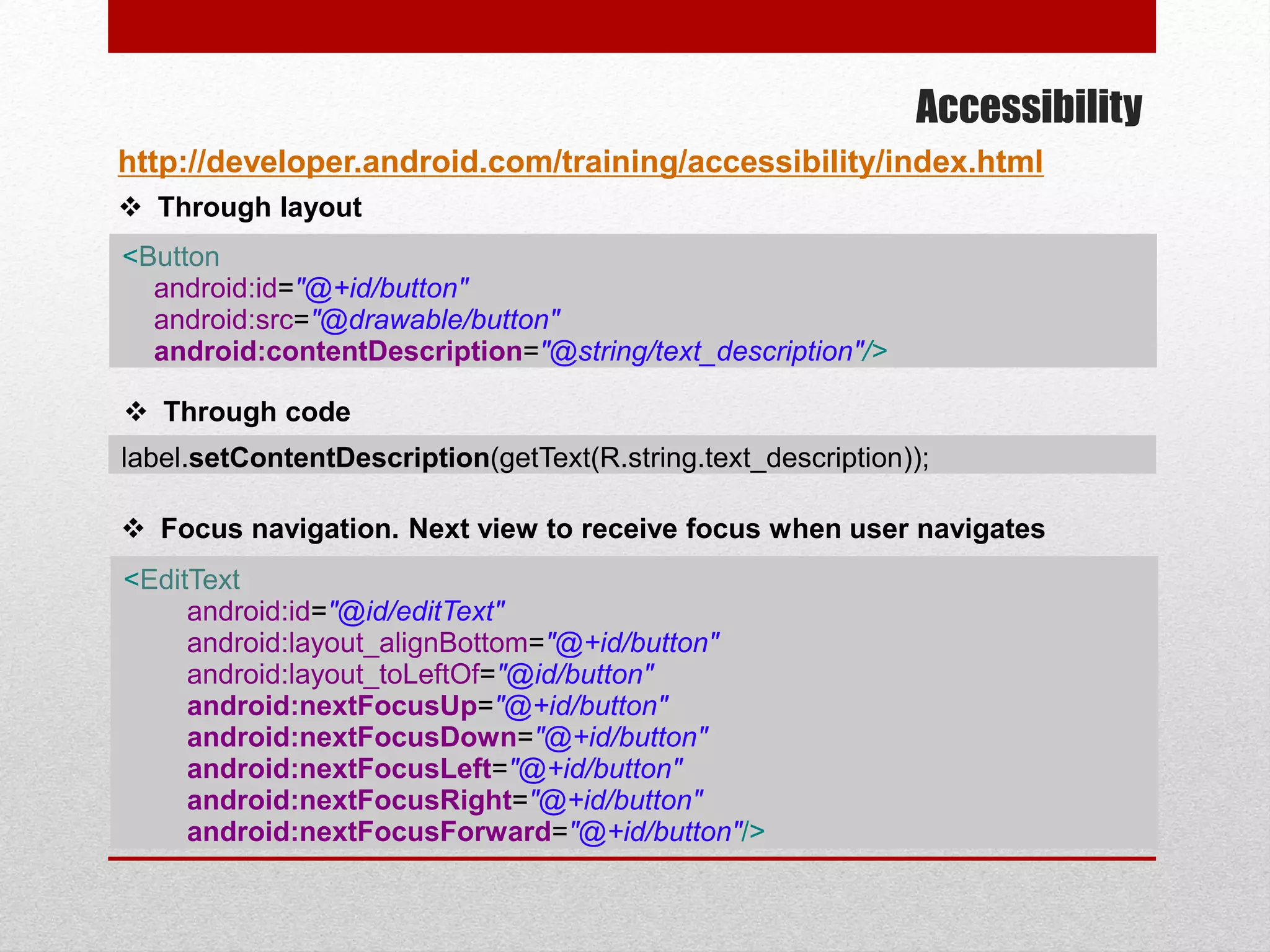
Accessibility
http://developer.android.com/training/accessibility/index.html
<Button
android:id="@+id/button"
android:src="@drawable/button"
android:contentDescription="@string/text_description"/>
 Through layout
 Through code
label.setContentDescription(getText(R.string.text_description));
 Focus navigation. Next view to receive focus when user navigates
<EditText
android:id="@id/editText"
android:layout_alignBottom="@+id/button"
android:layout_toLeftOf="@id/button"
android:nextFocusUp="@+id/button"
android:nextFocusDown="@+id/button"
android:nextFocusLeft="@+id/button"
android:nextFocusRight="@+id/button"
android:nextFocusForward="@+id/button"/>
Network connection
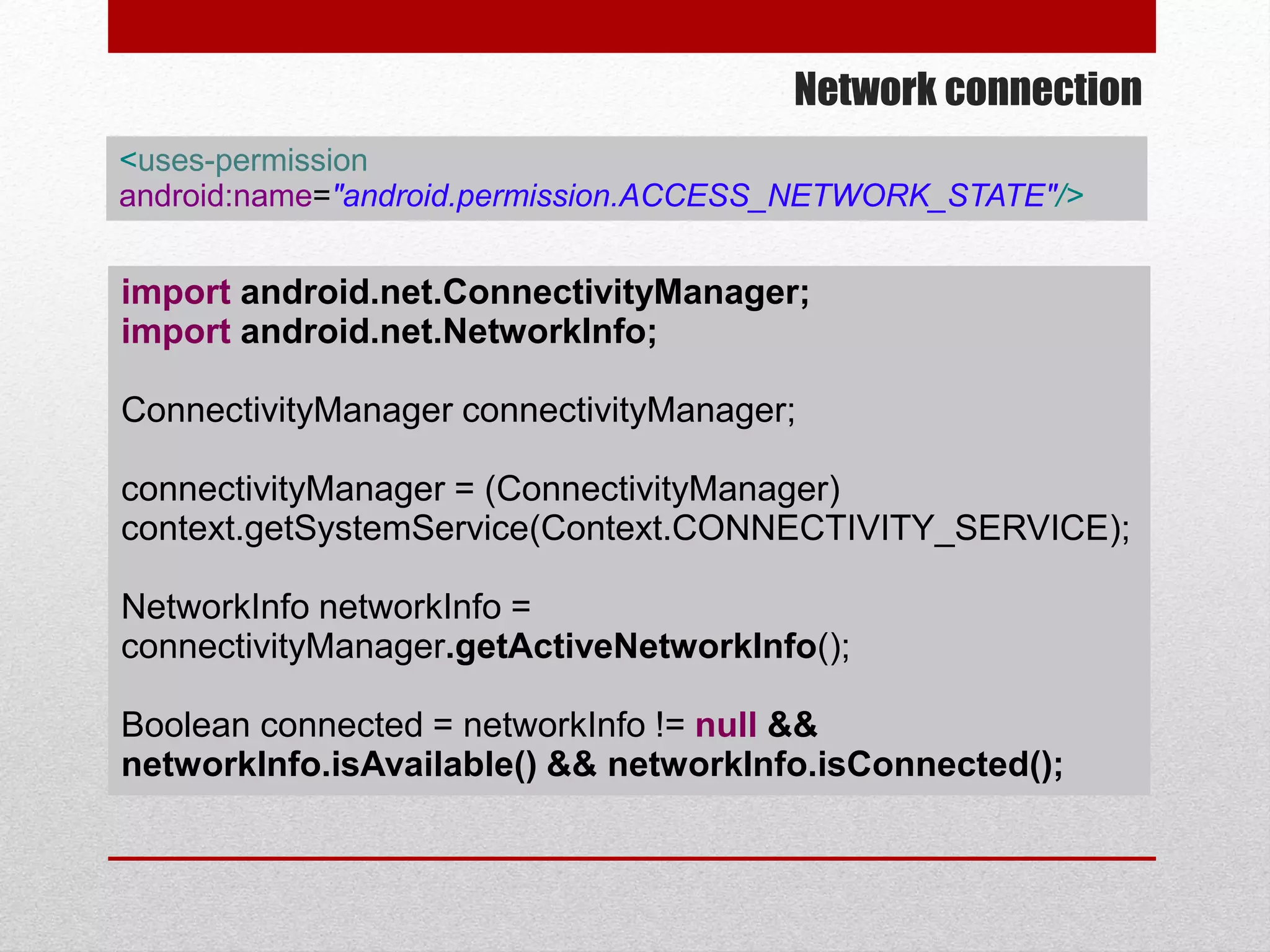
import android.net.ConnectivityManager;
import android.net.NetworkInfo;
ConnectivityManager connectivityManager;
connectivityManager = (ConnectivityManager)
context.getSystemService(Context.CONNECTIVITY_SERVICE);
NetworkInfo networkInfo =
connectivityManager.getActiveNetworkInfo();
Boolean connected = networkInfo != null &&
networkInfo.isAvailable() && networkInfo.isConnected();
<uses-permission
android:name="android.permission.ACCESS_NETWORK_STATE"/>
Network connection
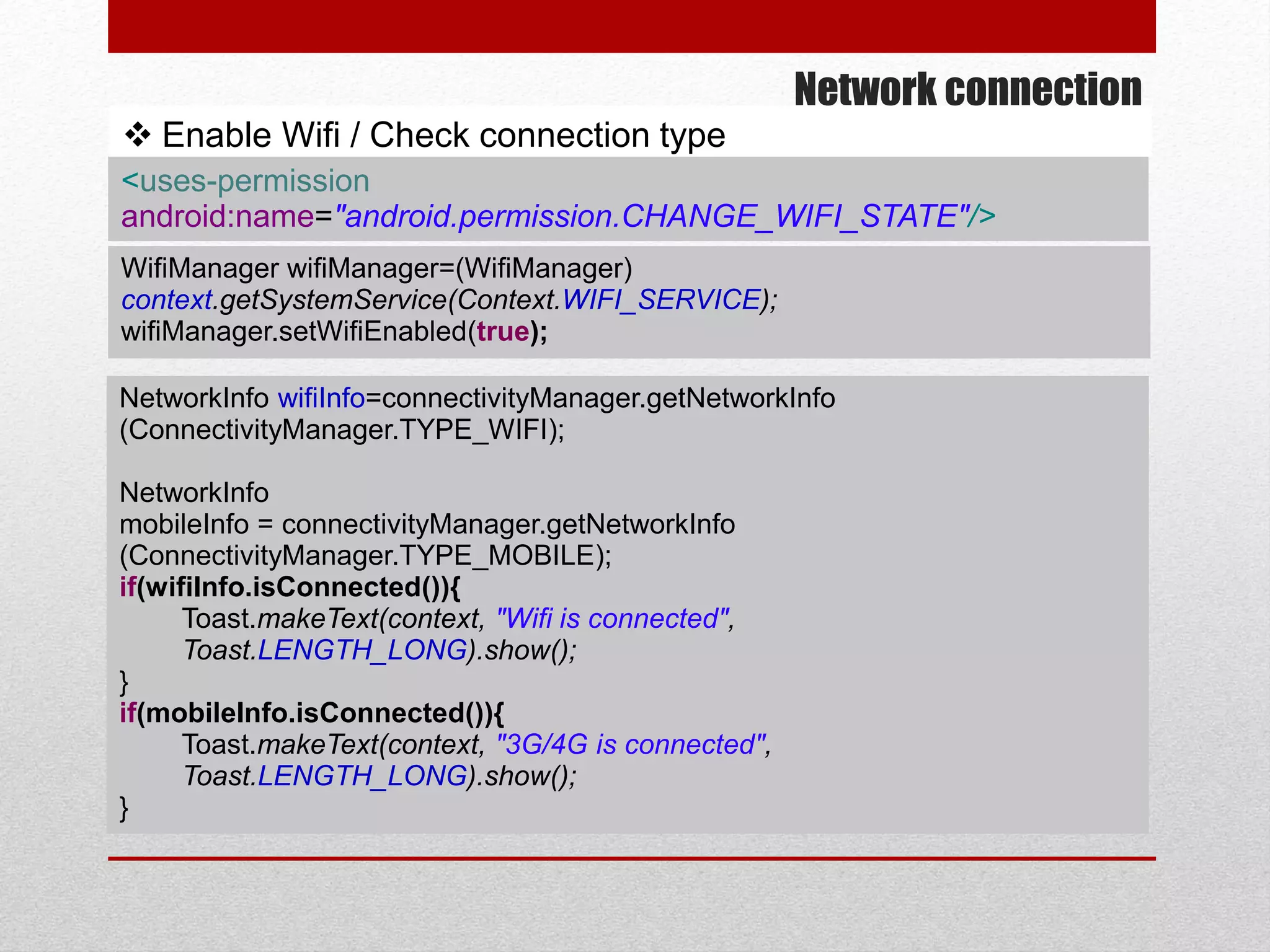
 Enable Wifi / Check connection type
NetworkInfo wifiInfo=connectivityManager.getNetworkInfo
(ConnectivityManager.TYPE_WIFI);
NetworkInfo
mobileInfo = connectivityManager.getNetworkInfo
(ConnectivityManager.TYPE_MOBILE);
if(wifiInfo.isConnected()){
Toast.makeText(context, "Wifi is connected",
Toast.LENGTH_LONG).show();
}
if(mobileInfo.isConnected()){
Toast.makeText(context, "3G/4G is connected",
Toast.LENGTH_LONG).show();
}
WifiManager wifiManager=(WifiManager)
context.getSystemService(Context.WIFI_SERVICE);
wifiManager.setWifiEnabled(true);
<uses-permission
android:name="android.permission.CHANGE_WIFI_STATE"/>
Network connection
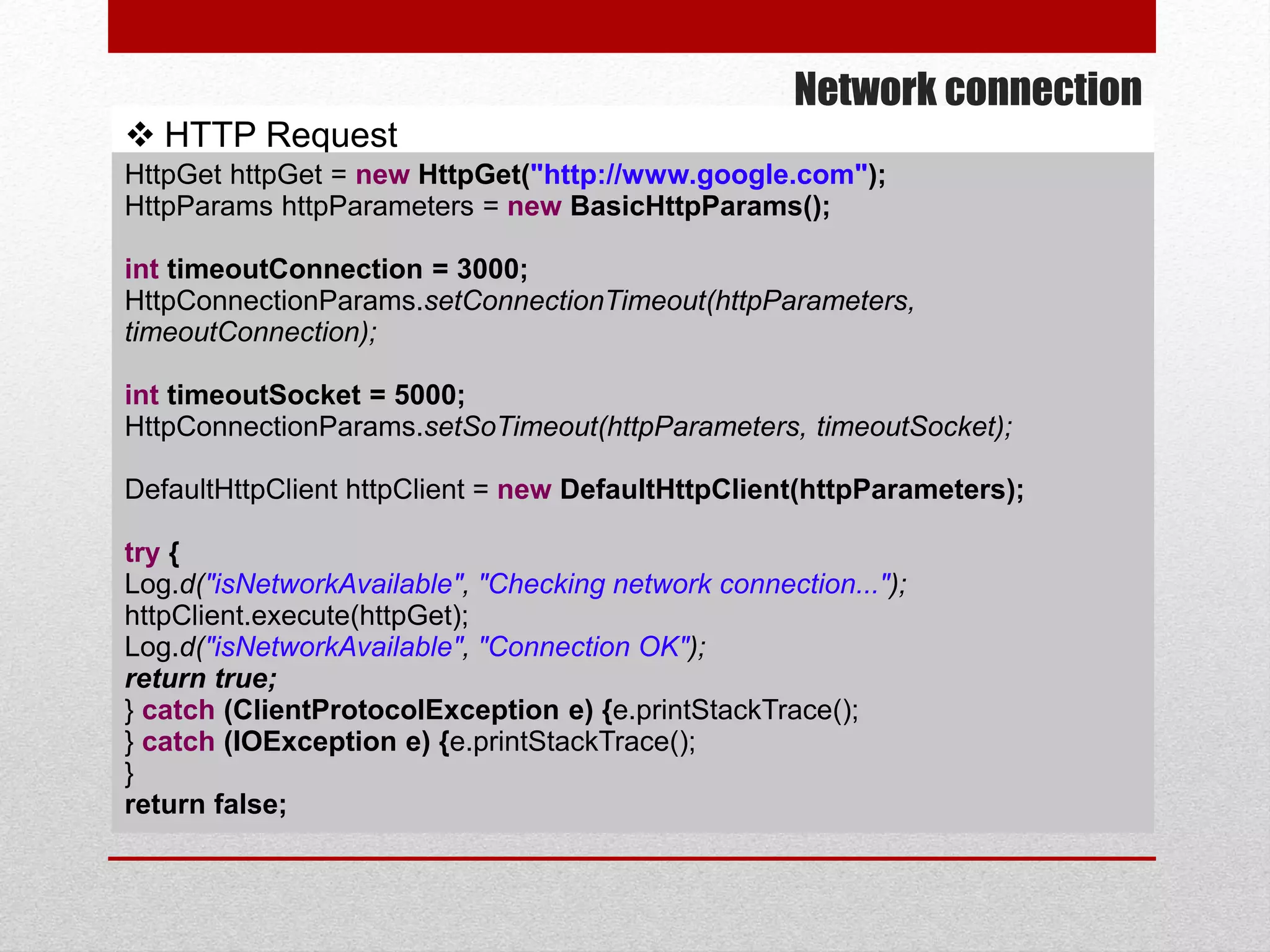
 HTTP Request
HttpGet httpGet = new HttpGet("http://www.google.com");
HttpParams httpParameters = new BasicHttpParams();
int timeoutConnection = 3000;
HttpConnectionParams.setConnectionTimeout(httpParameters,
timeoutConnection);
int timeoutSocket = 5000;
HttpConnectionParams.setSoTimeout(httpParameters, timeoutSocket);
DefaultHttpClient httpClient = new DefaultHttpClient(httpParameters);
try {
Log.d("isNetworkAvailable", "Checking network connection...");
httpClient.execute(httpGet);
Log.d("isNetworkAvailable", "Connection OK");
return true;
} catch (ClientProtocolException e) {e.printStackTrace();
} catch (IOException e) {e.printStackTrace();
}
return false;
Responsive
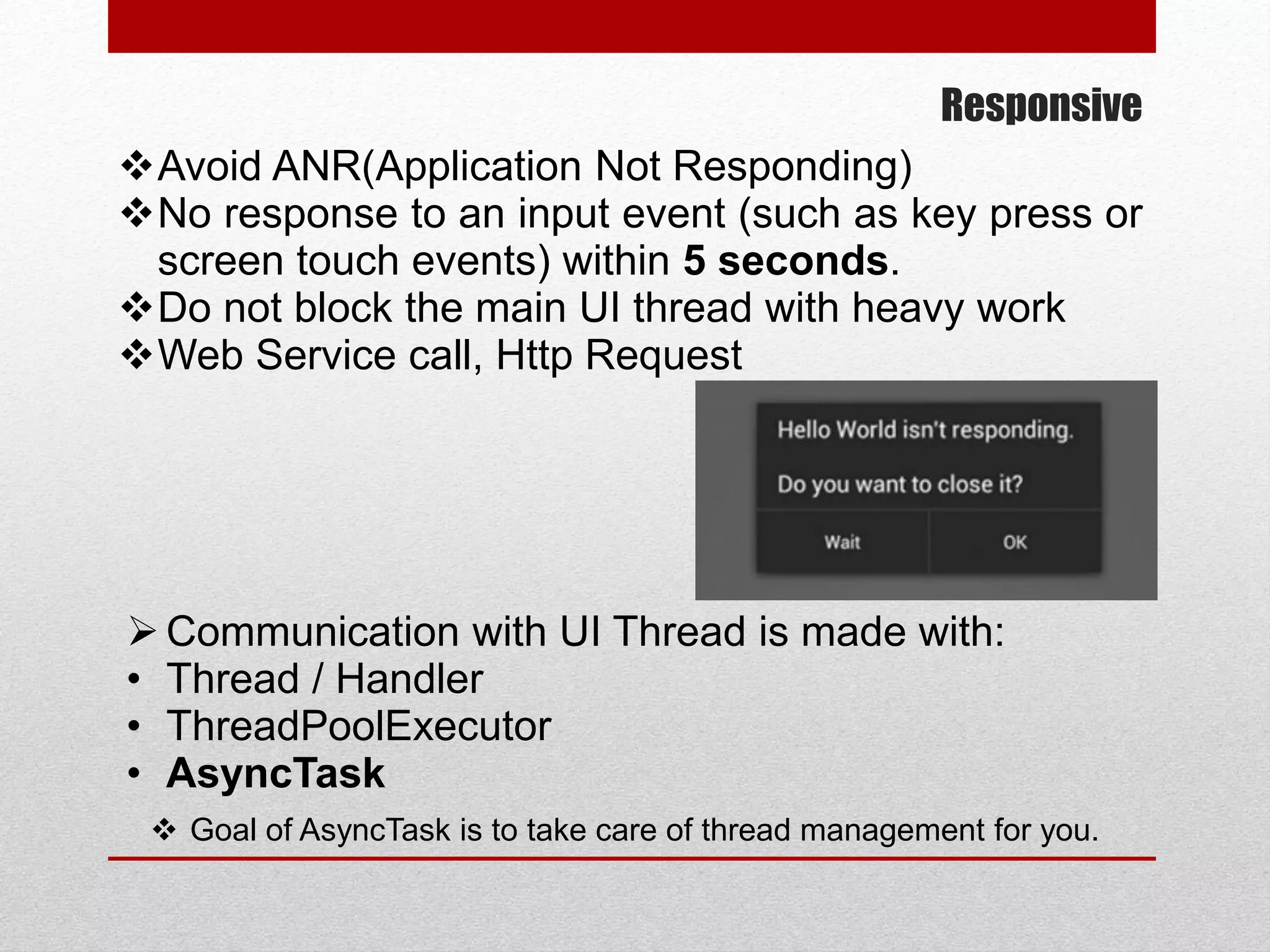
Avoid ANR(Application Not Responding)
No response to an input event (such as key press or
screen touch events) within 5 seconds.
Do not block the main UI thread with heavy work
Web Service call, Http Request
Communication with UI Thread is made with:
• Thread / Handler
• ThreadPoolExecutor
• AsyncTask
 Goal of AsyncTask is to take care of thread management for you.
Asynctask
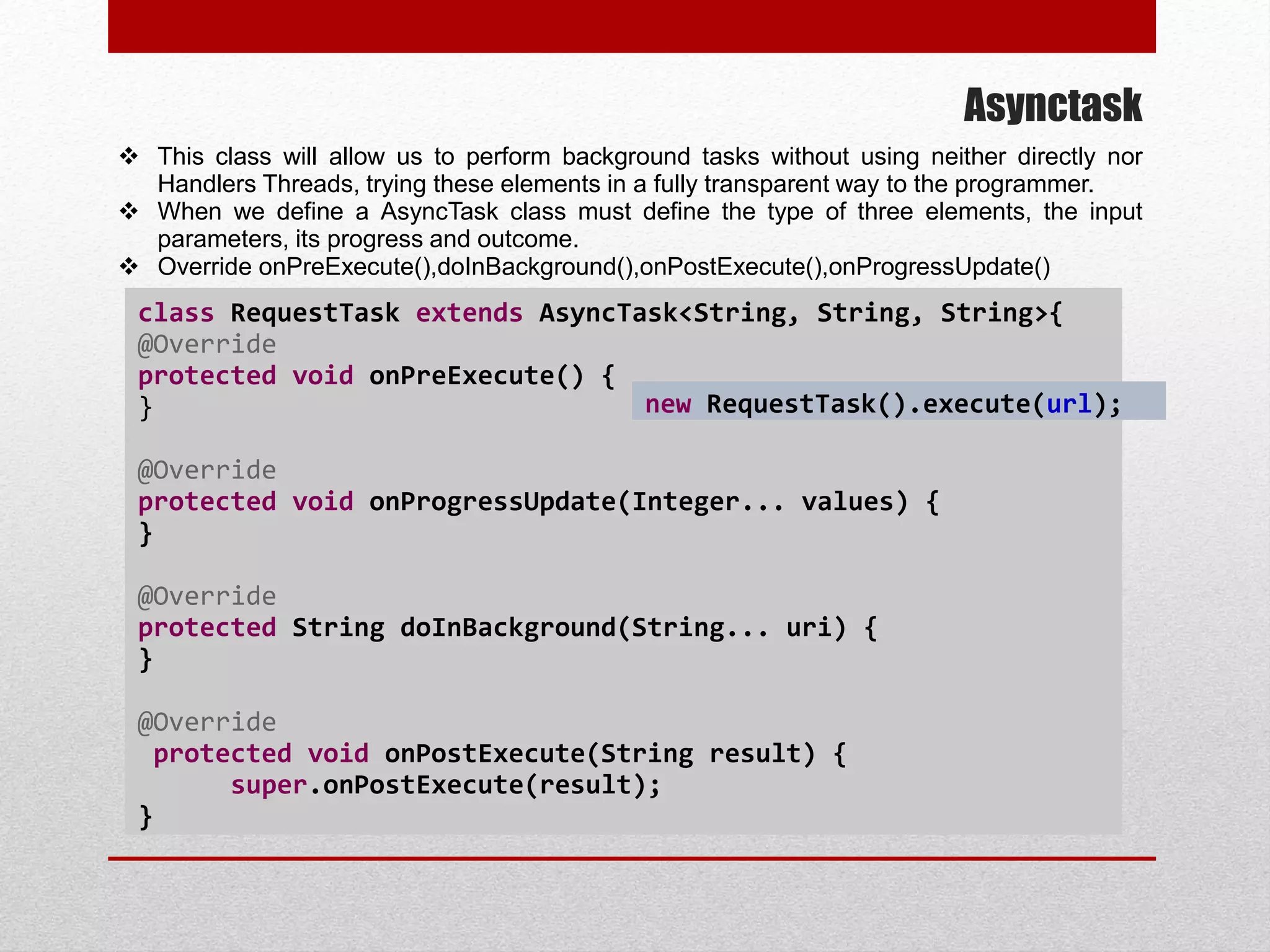
 This class will allow us to perform background tasks without using neither directly nor
Handlers Threads, trying these elements in a fully transparent way to the programmer.
 When we define a AsyncTask class must define the type of three elements, the input
parameters, its progress and outcome.
 Override onPreExecute(),doInBackground(),onPostExecute(),onProgressUpdate()
class RequestTask extends AsyncTask<String, String, String>{
@Override
protected void onPreExecute() {
}
@Override
protected void onProgressUpdate(Integer... values) {
}
@Override
protected String doInBackground(String... uri) {
}
@Override
protected void onPostExecute(String result) {
super.onPostExecute(result);
}
new RequestTask().execute(url);
Services
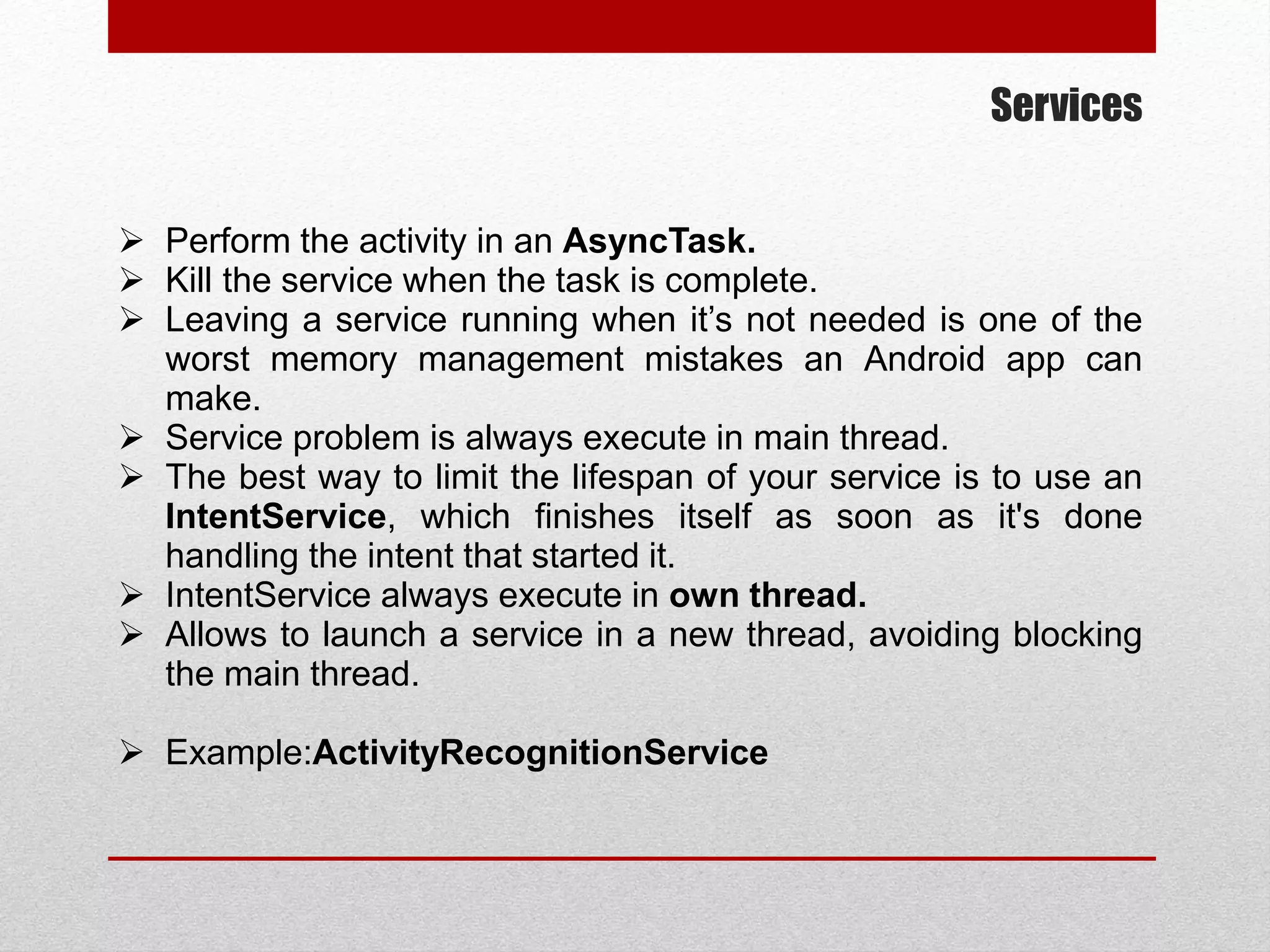
 Perform the activity in an AsyncTask.
 Kill the service when the task is complete.
 Leaving a service running when it’s not needed is one of the
worst memory management mistakes an Android app can
make.
 Service problem is always execute in main thread.
 The best way to limit the lifespan of your service is to use an
IntentService, which finishes itself as soon as it's done
handling the intent that started it.
 IntentService always execute in own thread.
 Allows to launch a service in a new thread, avoiding blocking
the main thread.
 Example:ActivityRecognitionService
Fragments
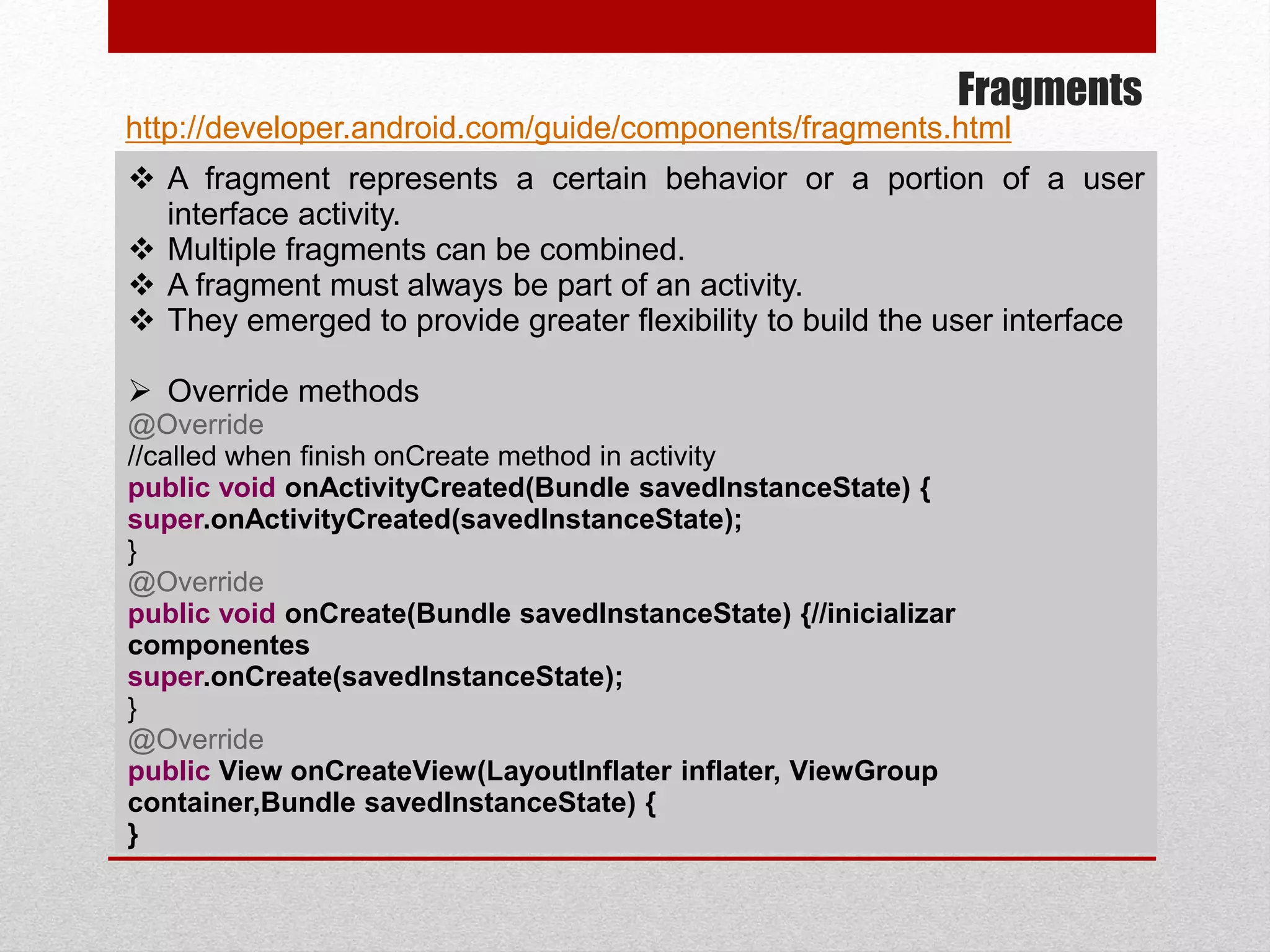
 A fragment represents a certain behavior or a portion of a user
interface activity.
 Multiple fragments can be combined.
 A fragment must always be part of an activity.
 They emerged to provide greater flexibility to build the user interface
 Override methods
@Override
//called when finish onCreate method in activity
public void onActivityCreated(Bundle savedInstanceState) {
super.onActivityCreated(savedInstanceState);
}
@Override
public void onCreate(Bundle savedInstanceState) {//inicializar
componentes
super.onCreate(savedInstanceState);
}
@Override
public View onCreateView(LayoutInflater inflater, ViewGroup
container,Bundle savedInstanceState) {
}
http://developer.android.com/guide/components/fragments.html
Fragments
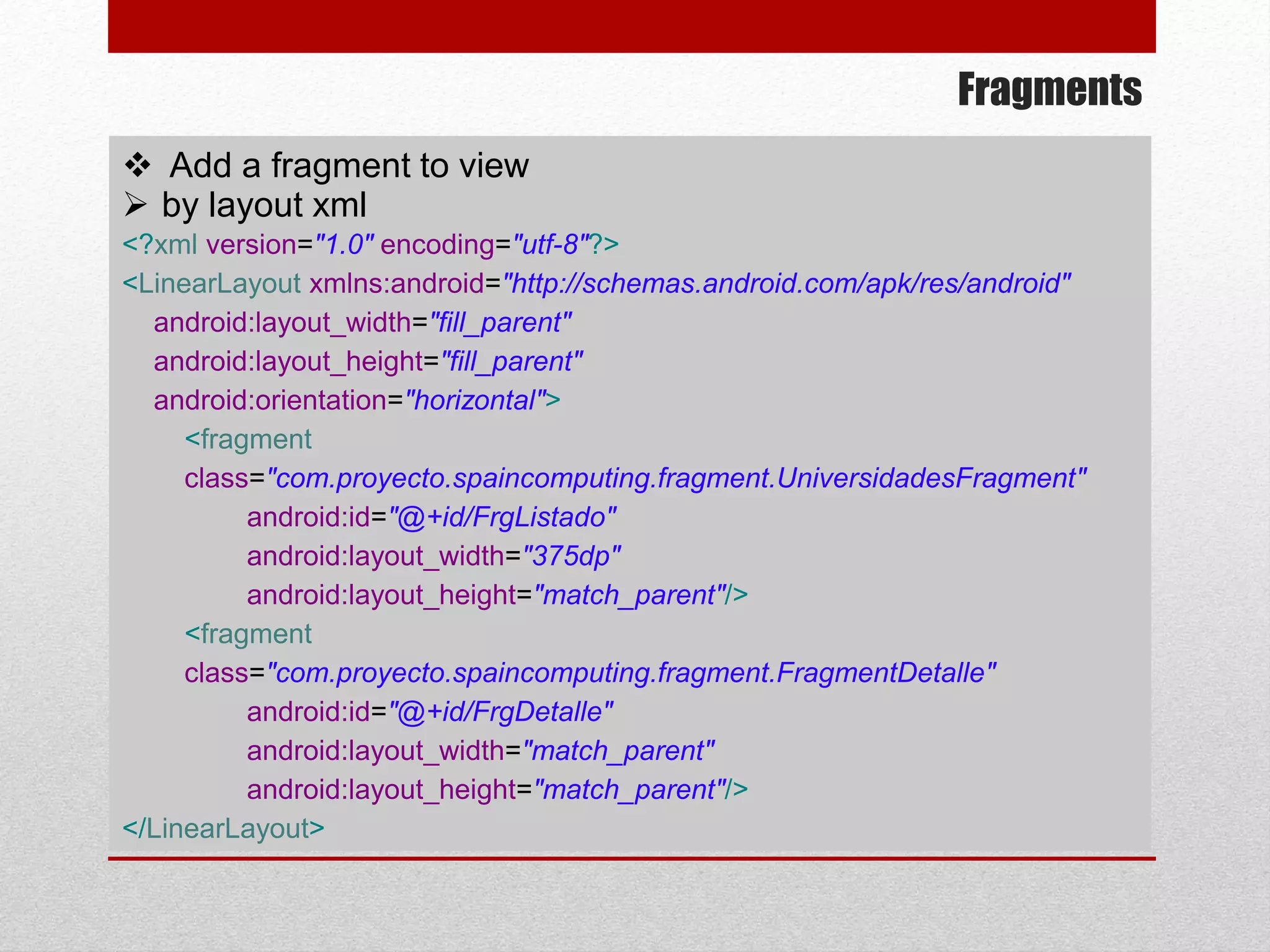
 Add a fragment to view
 by layout xml
<?xml version="1.0" encoding="utf-8"?>
<LinearLayout xmlns:android="http://schemas.android.com/apk/res/android"
android:layout_width="fill_parent"
android:layout_height="fill_parent"
android:orientation="horizontal">
<fragment
class="com.proyecto.spaincomputing.fragment.UniversidadesFragment"
android:id="@+id/FrgListado"
android:layout_width="375dp"
android:layout_height="match_parent"/>
<fragment
class="com.proyecto.spaincomputing.fragment.FragmentDetalle"
android:id="@+id/FrgDetalle"
android:layout_width="match_parent"
android:layout_height="match_parent"/>
</LinearLayout>
Fragments
 Add a fragment to view
 By code
//Fragments array
Fragment[] fragments = new Fragment[]{new PortadaFragment(),
new UniversityListFragment(),new
UniversidadesImagesFragment()};
FragmentManager manager = getSupportFragmentManager();
manager.beginTransaction()
.add(R.id.contentFrame, fragments[0])
.add(R.id.contentFrame, fragments[1])
.add(R.id.contentFrame, fragments[2])
.commit();
//show/hide
manager.beginTransaction().show(fragments[0]).commit();
manager.beginTransaction().hide(fragments[1]).commit();
manager.beginTransaction().hide(fragments[2]).commit();
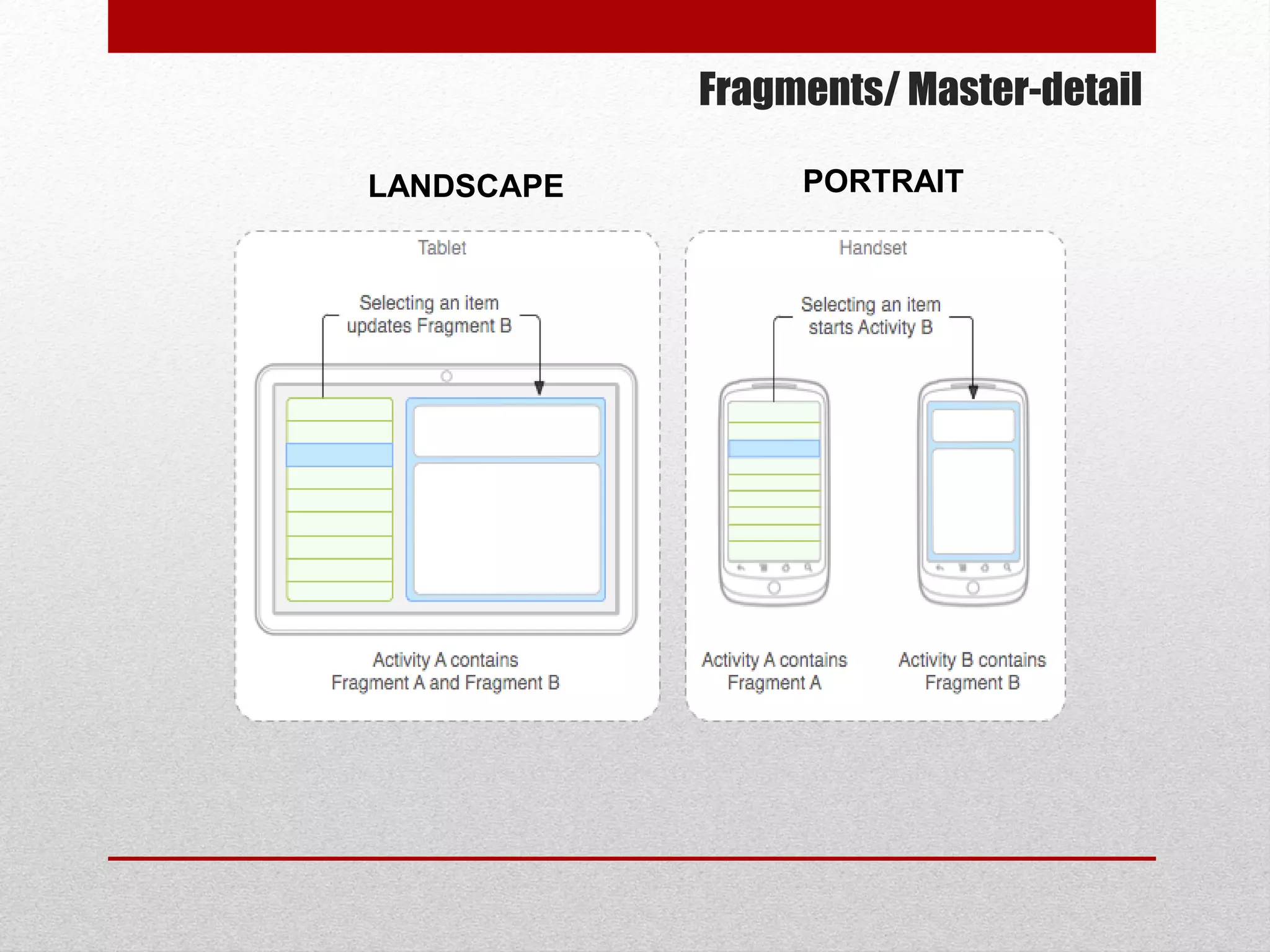
Fragments/ Master-detail
PORTRAITLANDSCAPE
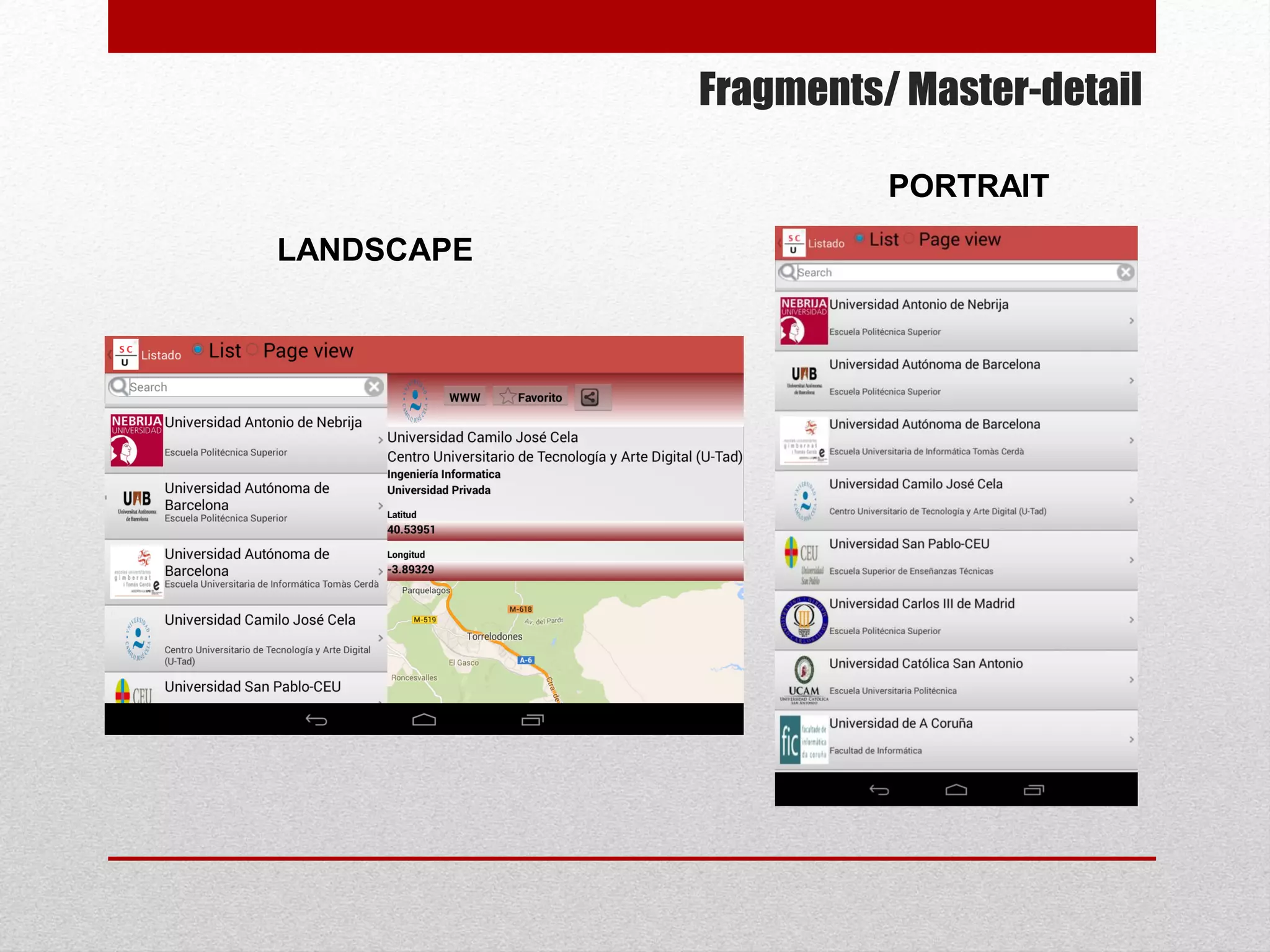
Fragments/ Master-detail
PORTRAIT
LANDSCAPE
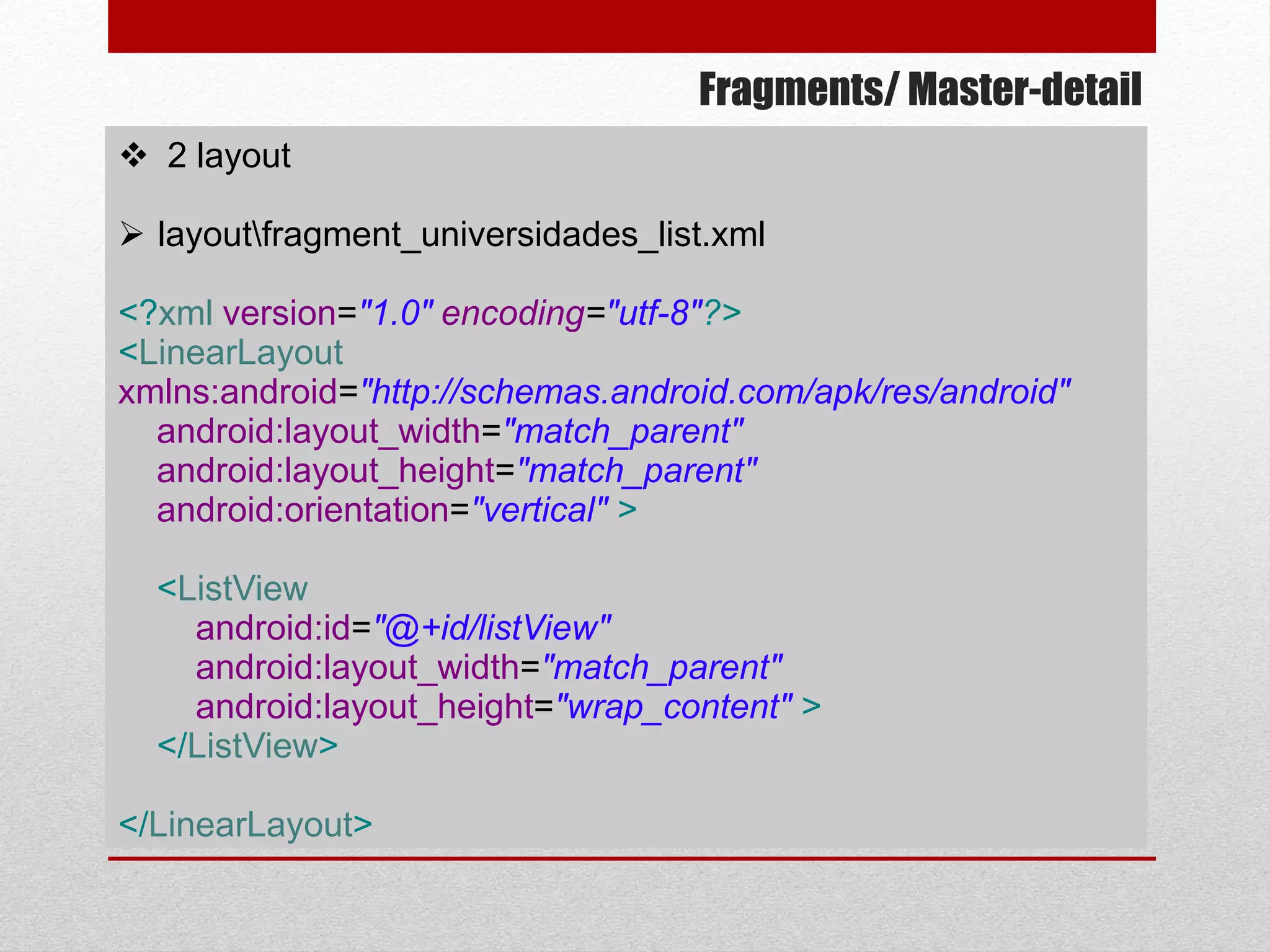
Fragments/ Master-detail
 2 layout
 layoutfragment_universidades_list.xml
<?xml version="1.0" encoding="utf-8"?>
<LinearLayout
xmlns:android="http://schemas.android.com/apk/res/android"
android:layout_width="match_parent"
android:layout_height="match_parent"
android:orientation="vertical" >
<ListView
android:id="@+id/listView"
android:layout_width="match_parent"
android:layout_height="wrap_content" >
</ListView>
</LinearLayout>
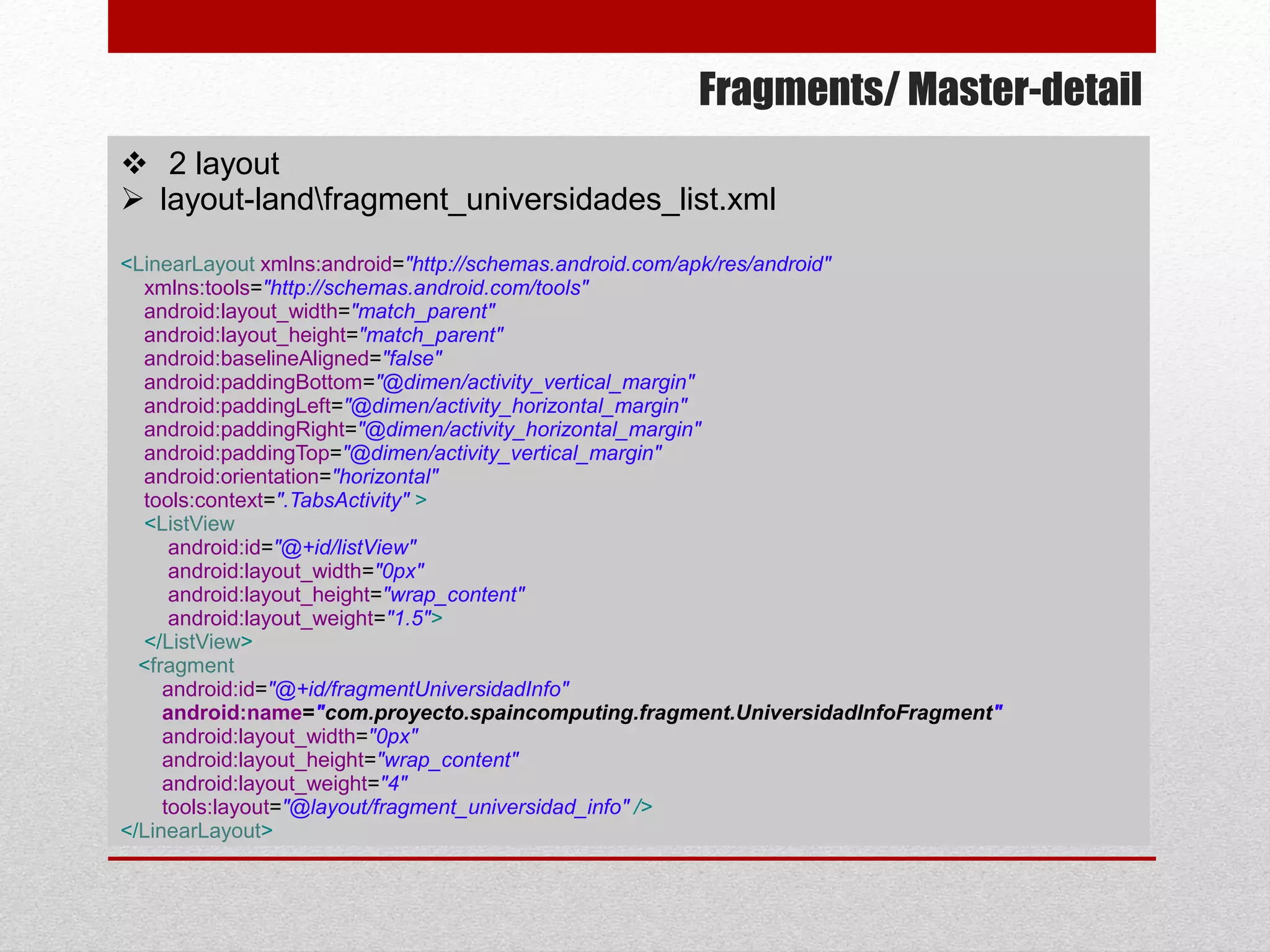
Fragments/ Master-detail
 2 layout
 layout-landfragment_universidades_list.xml
<LinearLayout xmlns:android="http://schemas.android.com/apk/res/android"
xmlns:tools="http://schemas.android.com/tools"
android:layout_width="match_parent"
android:layout_height="match_parent"
android:baselineAligned="false"
android:paddingBottom="@dimen/activity_vertical_margin"
android:paddingLeft="@dimen/activity_horizontal_margin"
android:paddingRight="@dimen/activity_horizontal_margin"
android:paddingTop="@dimen/activity_vertical_margin"
android:orientation="horizontal"
tools:context=".TabsActivity" >
<ListView
android:id="@+id/listView"
android:layout_width="0px"
android:layout_height="wrap_content"
android:layout_weight="1.5">
</ListView>
<fragment
android:id="@+id/fragmentUniversidadInfo"
android:name="com.proyecto.spaincomputing.fragment.UniversidadInfoFragment"
android:layout_width="0px"
android:layout_height="wrap_content"
android:layout_weight="4"
tools:layout="@layout/fragment_universidad_info" />
</LinearLayout>
Fragments/ Master-detail
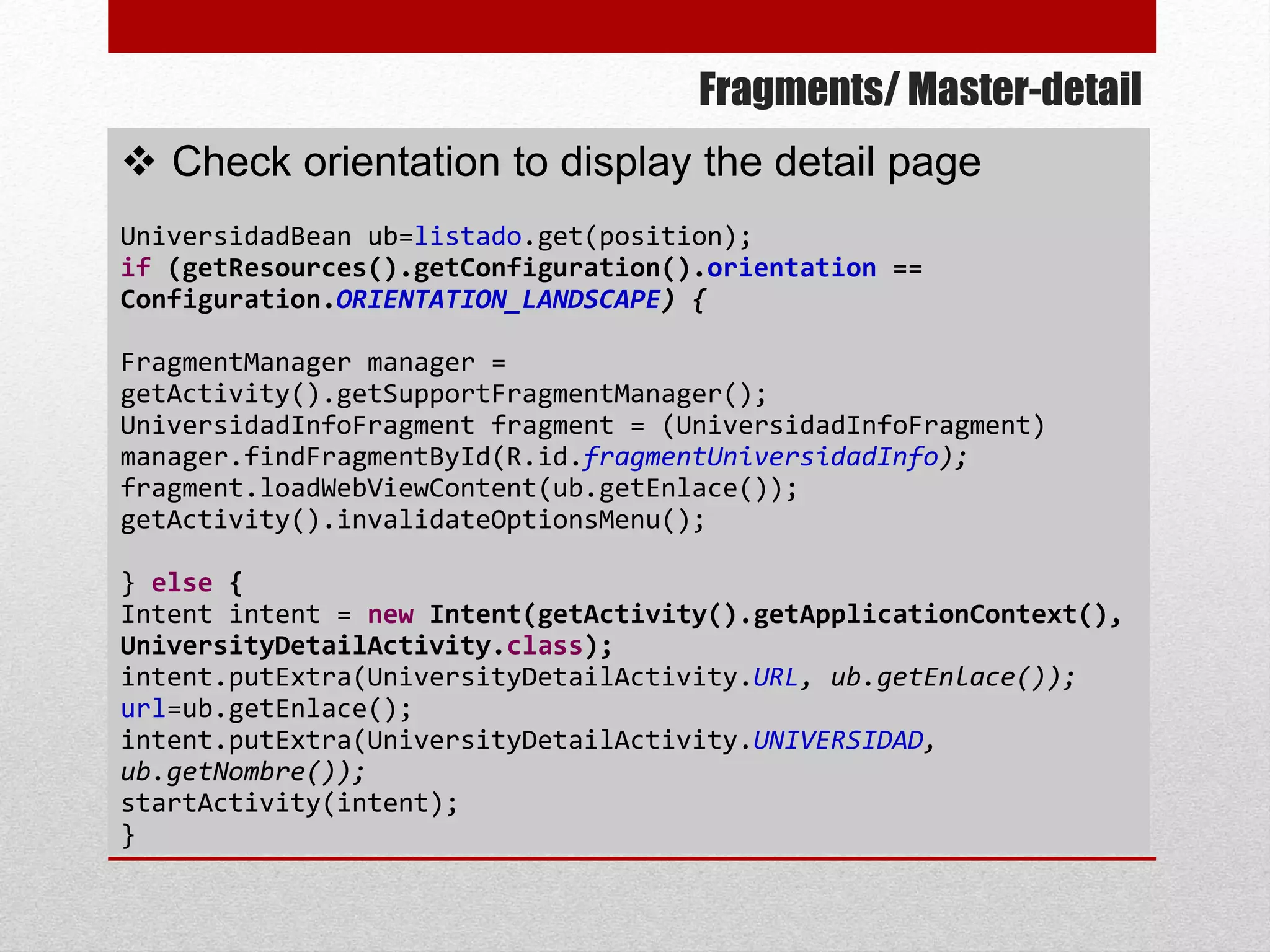
 Check orientation to display the detail page
UniversidadBean ub=listado.get(position);
if (getResources().getConfiguration().orientation ==
Configuration.ORIENTATION_LANDSCAPE) {
FragmentManager manager =
getActivity().getSupportFragmentManager();
UniversidadInfoFragment fragment = (UniversidadInfoFragment)
manager.findFragmentById(R.id.fragmentUniversidadInfo);
fragment.loadWebViewContent(ub.getEnlace());
getActivity().invalidateOptionsMenu();
} else {
Intent intent = new Intent(getActivity().getApplicationContext(),
UniversityDetailActivity.class);
intent.putExtra(UniversityDetailActivity.URL, ub.getEnlace());
url=ub.getEnlace();
intent.putExtra(UniversityDetailActivity.UNIVERSIDAD,
ub.getNombre());
startActivity(intent);
}
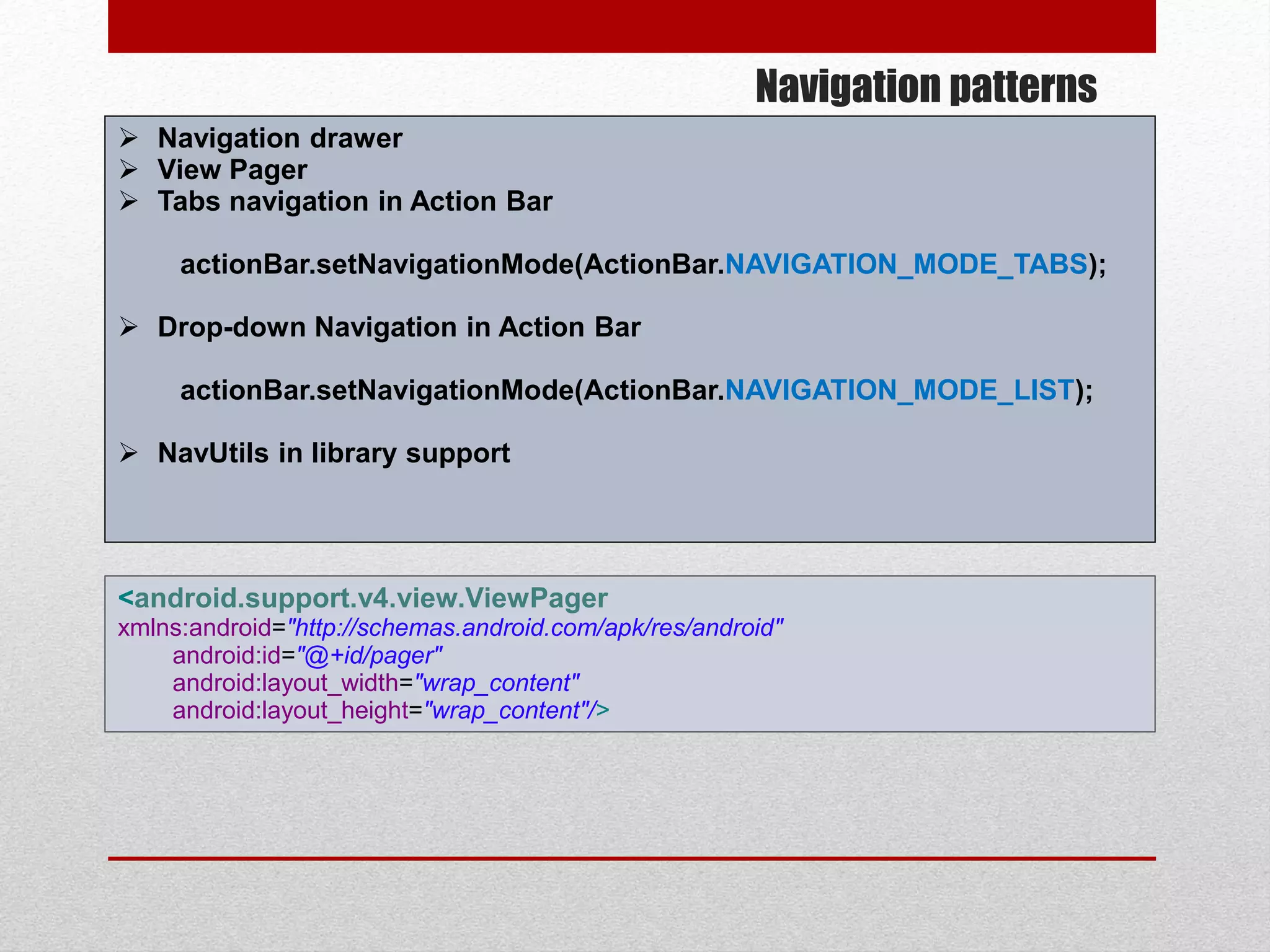
Navigation patterns
 Navigation drawer
 View Pager
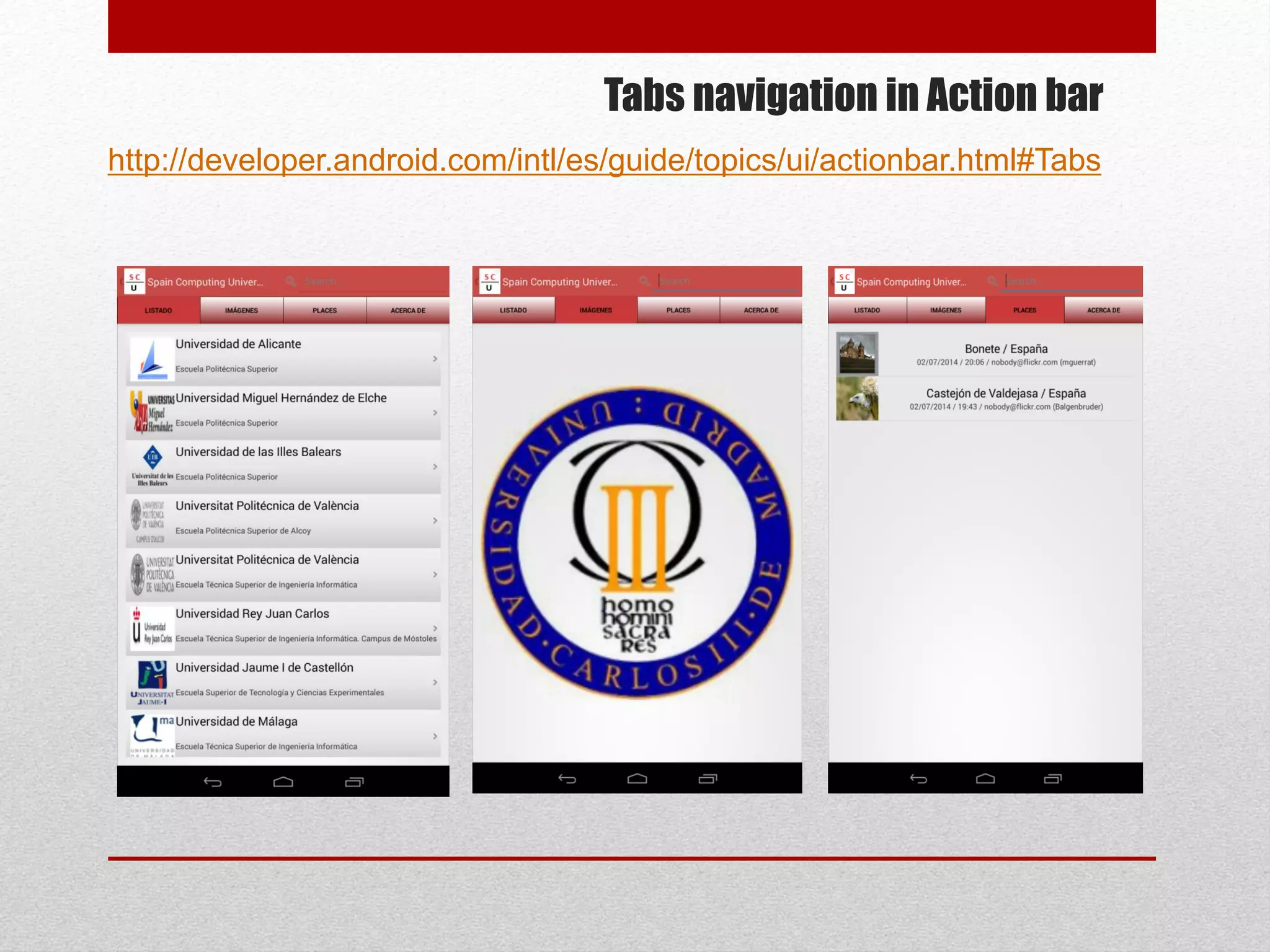
 Tabs navigation in Action Bar
actionBar.setNavigationMode(ActionBar.NAVIGATION_MODE_TABS);
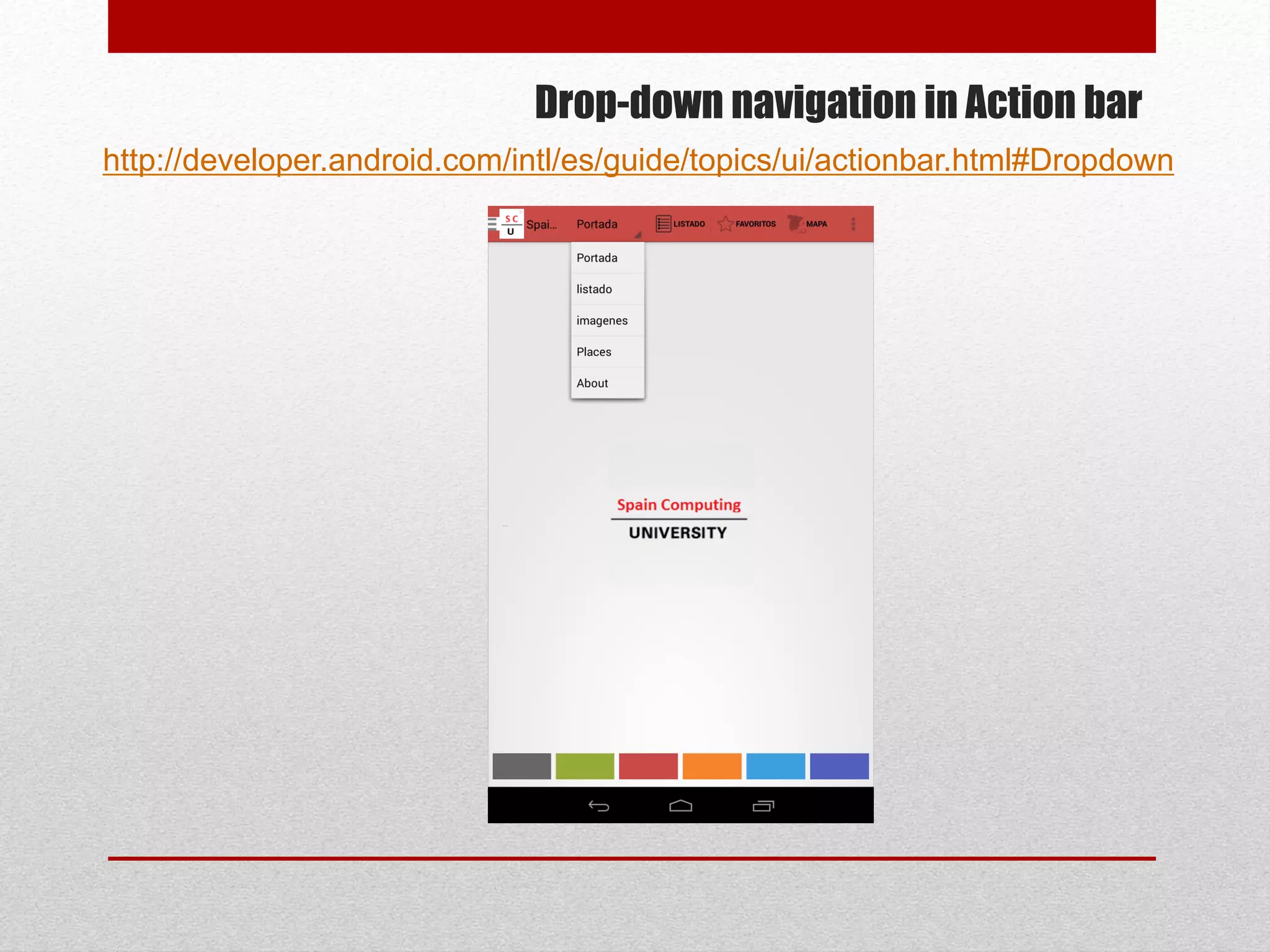
 Drop-down Navigation in Action Bar
actionBar.setNavigationMode(ActionBar.NAVIGATION_MODE_LIST);
 NavUtils in library support
<android.support.v4.view.ViewPager
xmlns:android="http://schemas.android.com/apk/res/android"
android:id="@+id/pager"
android:layout_width="wrap_content"
android:layout_height="wrap_content"/>
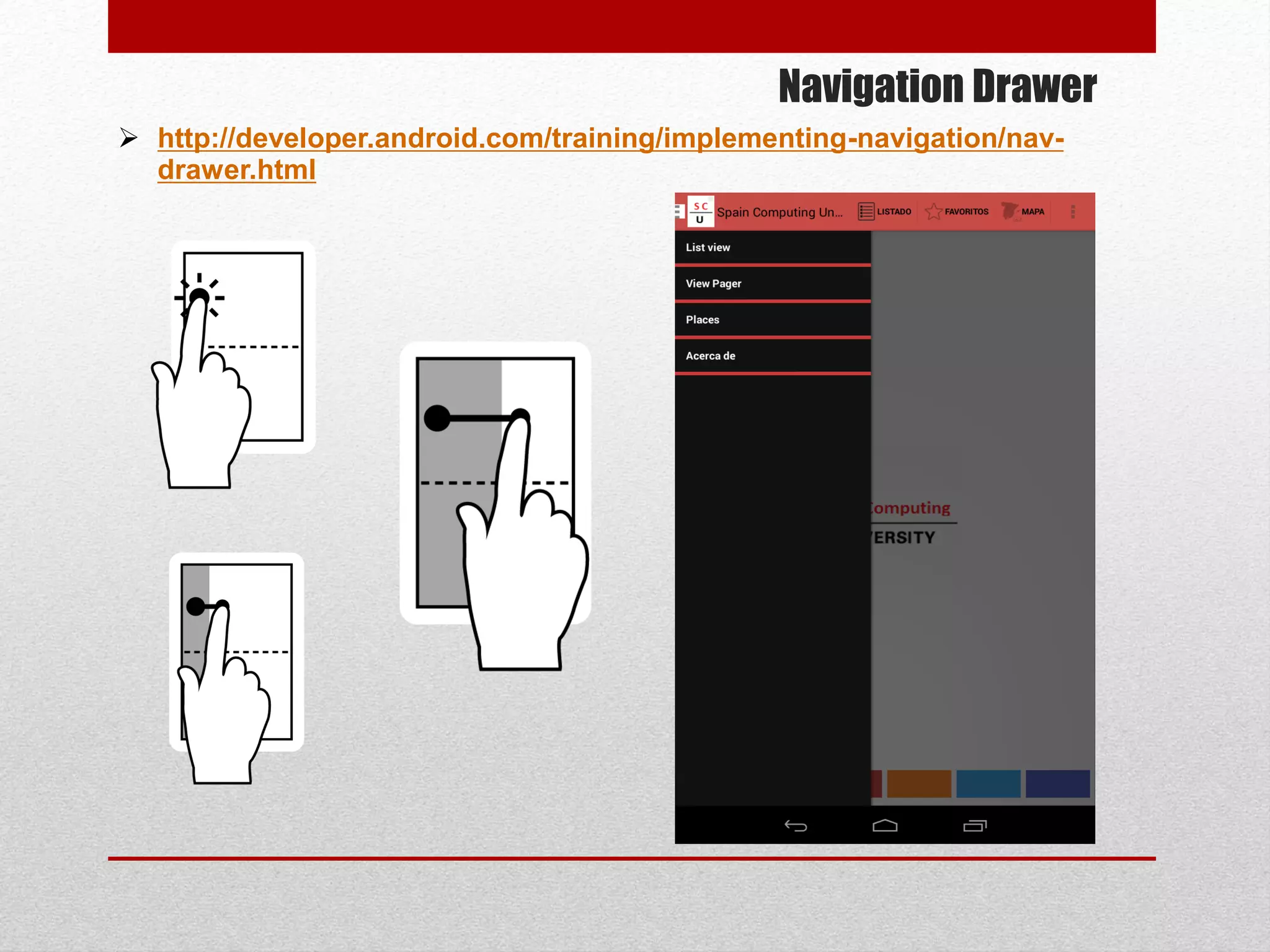
Navigation Drawer
 http://developer.android.com/training/implementing-navigation/nav-
drawer.html
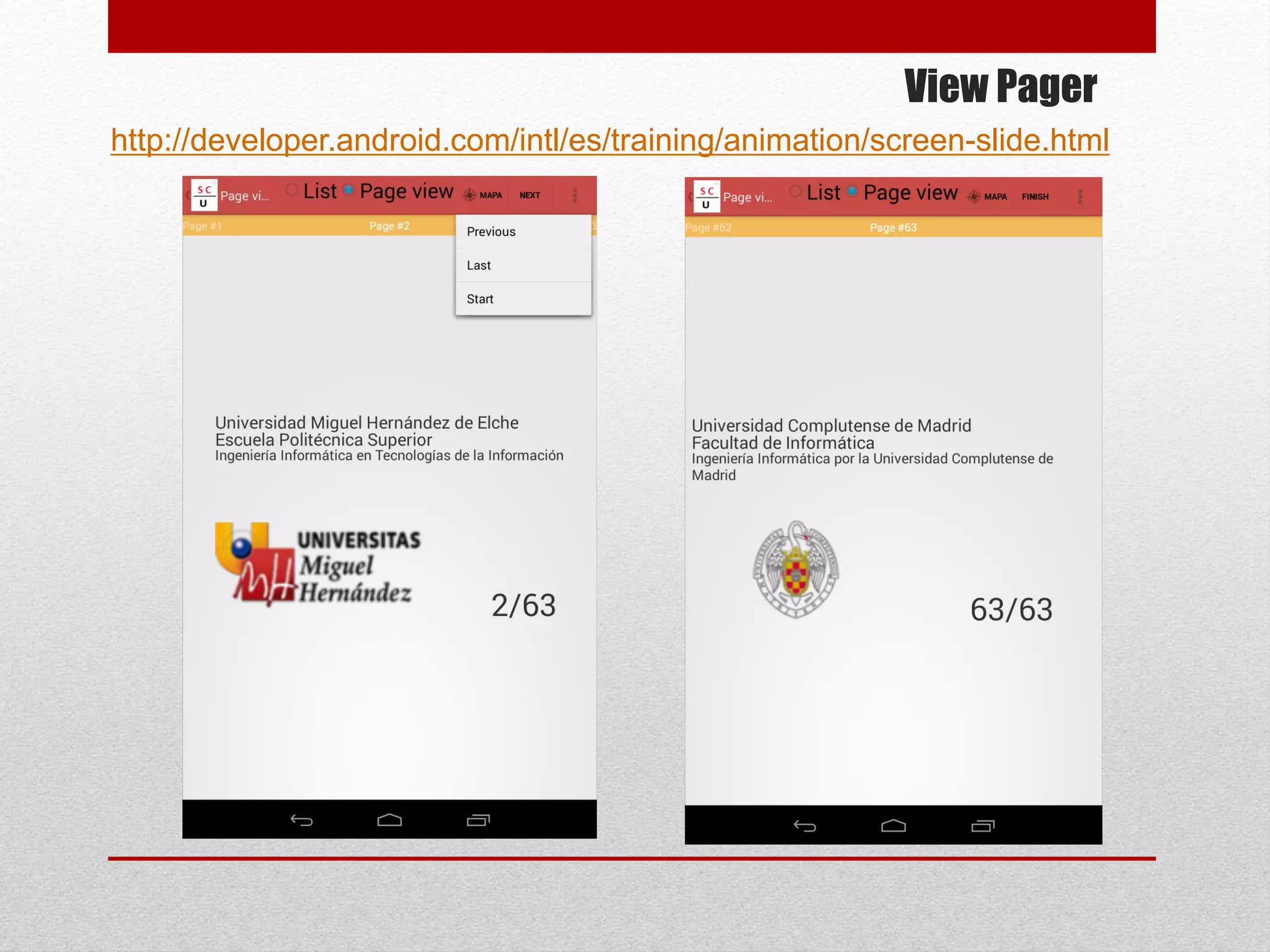
View Pager
http://developer.android.com/intl/es/training/animation/screen-slide.html
Tabs navigation in Action bar
http://developer.android.com/intl/es/guide/topics/ui/actionbar.html#Tabs
Drop-down navigation in Action bar
http://developer.android.com/intl/es/guide/topics/ui/actionbar.html#Dropdown
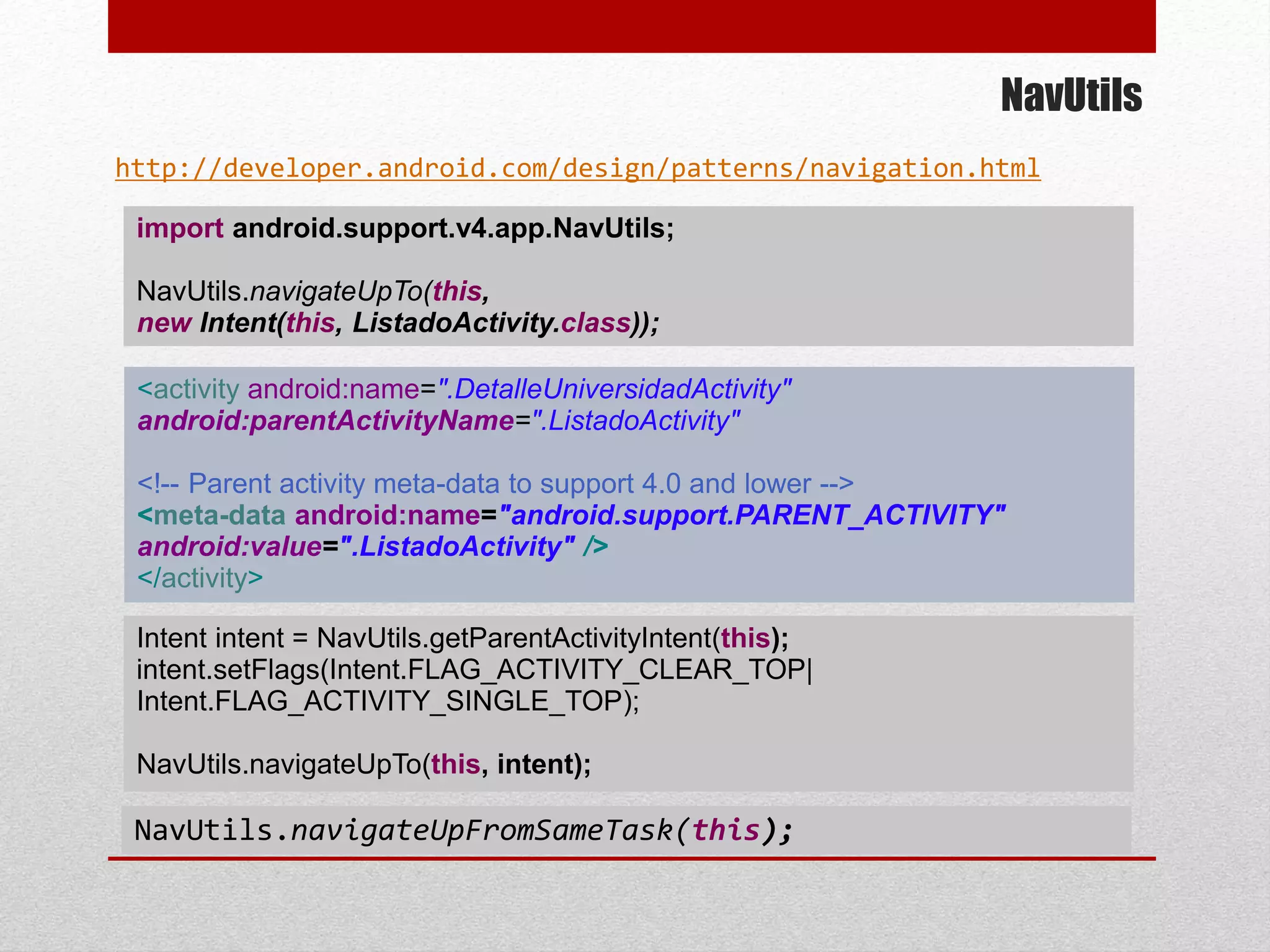
NavUtils
import android.support.v4.app.NavUtils;
NavUtils.navigateUpTo(this,
new Intent(this, ListadoActivity.class));
http://developer.android.com/design/patterns/navigation.html
Intent intent = NavUtils.getParentActivityIntent(this);
intent.setFlags(Intent.FLAG_ACTIVITY_CLEAR_TOP|
Intent.FLAG_ACTIVITY_SINGLE_TOP);
NavUtils.navigateUpTo(this, intent);
NavUtils.navigateUpFromSameTask(this);
<activity android:name=".DetalleUniversidadActivity"
android:parentActivityName=".ListadoActivity"
<!-- Parent activity meta-data to support 4.0 and lower -->
<meta-data android:name="android.support.PARENT_ACTIVITY"
android:value=".ListadoActivity" />
</activity>
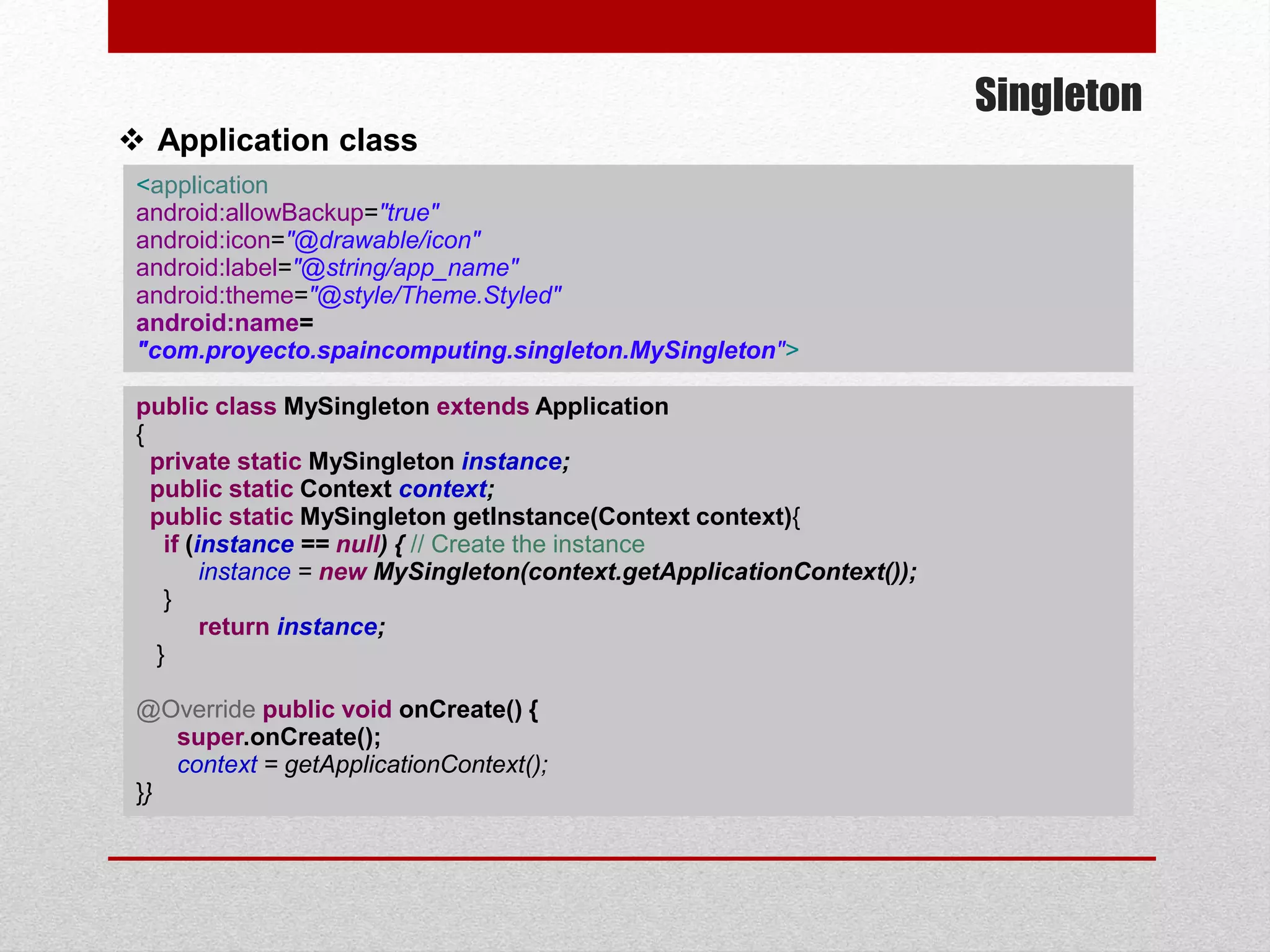
Singleton
 Application class
<application
android:allowBackup="true"
android:icon="@drawable/icon"
android:label="@string/app_name"
android:theme="@style/Theme.Styled"
android:name=
"com.proyecto.spaincomputing.singleton.MySingleton">
public class MySingleton extends Application
{
private static MySingleton instance;
public static Context context;
public static MySingleton getInstance(Context context){
if (instance == null) { // Create the instance
instance = new MySingleton(context.getApplicationContext());
}
return instance;
}
@Override public void onCreate() {
super.onCreate();
context = getApplicationContext();
}}
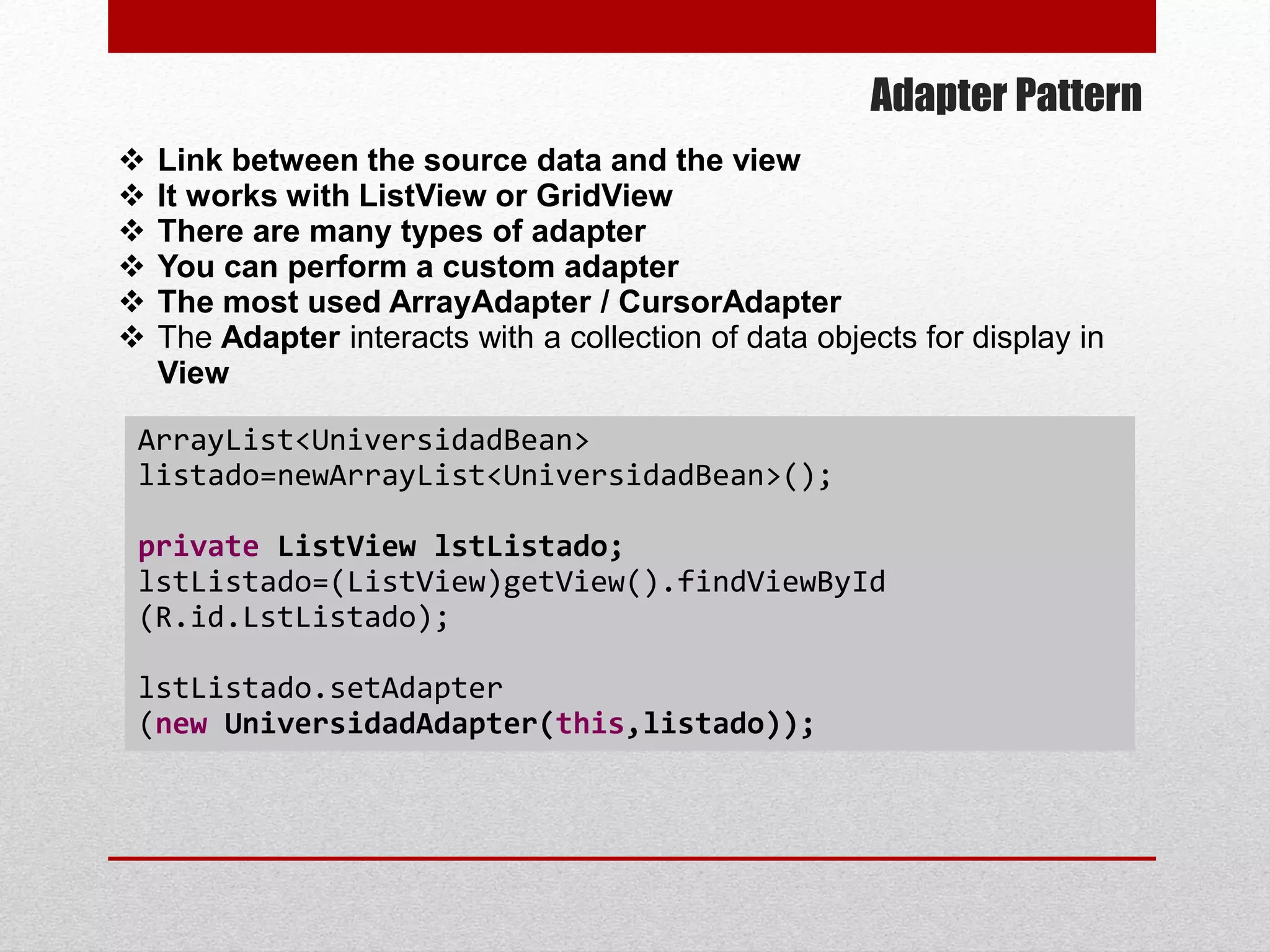
Adapter Pattern
 Link between the source data and the view
 It works with ListView or GridView
 There are many types of adapter
 You can perform a custom adapter
 The most used ArrayAdapter / CursorAdapter
 The Adapter interacts with a collection of data objects for display in
View
ArrayList<UniversidadBean>
listado=newArrayList<UniversidadBean>();
private ListView lstListado;
lstListado=(ListView)getView().findViewById
(R.id.LstListado);
lstListado.setAdapter
(new UniversidadAdapter(this,listado));
View Holder/View Container Pattern
 ViewContainer
static class ViewContainer{
public ImageView imagen;
public TextView nombre;
public TextView descripcion;
}
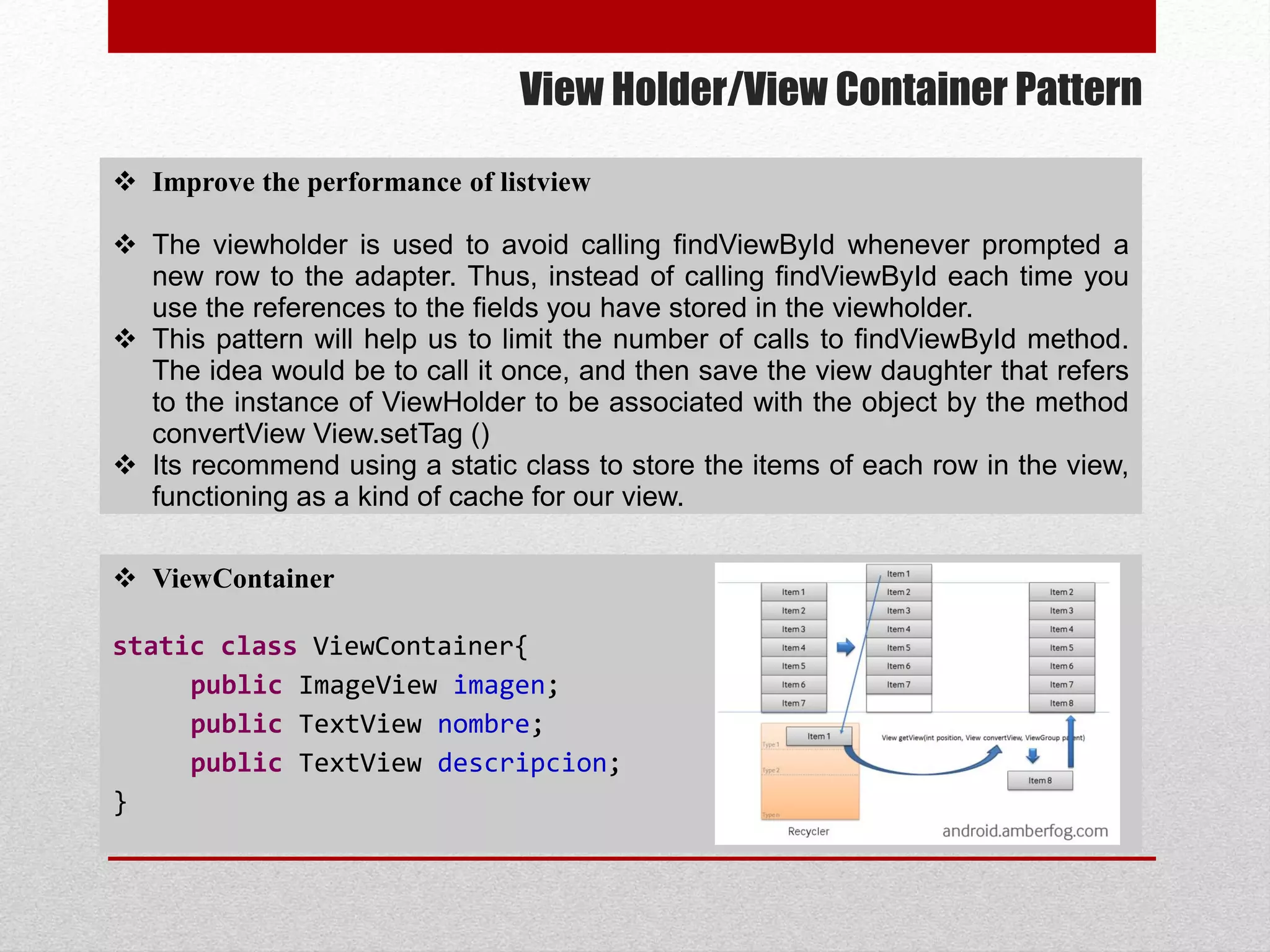
 Improve the performance of listview
 The viewholder is used to avoid calling findViewById whenever prompted a
new row to the adapter. Thus, instead of calling findViewById each time you
use the references to the fields you have stored in the viewholder.
 This pattern will help us to limit the number of calls to findViewById method.
The idea would be to call it once, and then save the view daughter that refers
to the instance of ViewHolder to be associated with the object by the method
convertView View.setTag ()
 Its recommend using a static class to store the items of each row in the view,
functioning as a kind of cache for our view.
View Holder/View Container Pattern
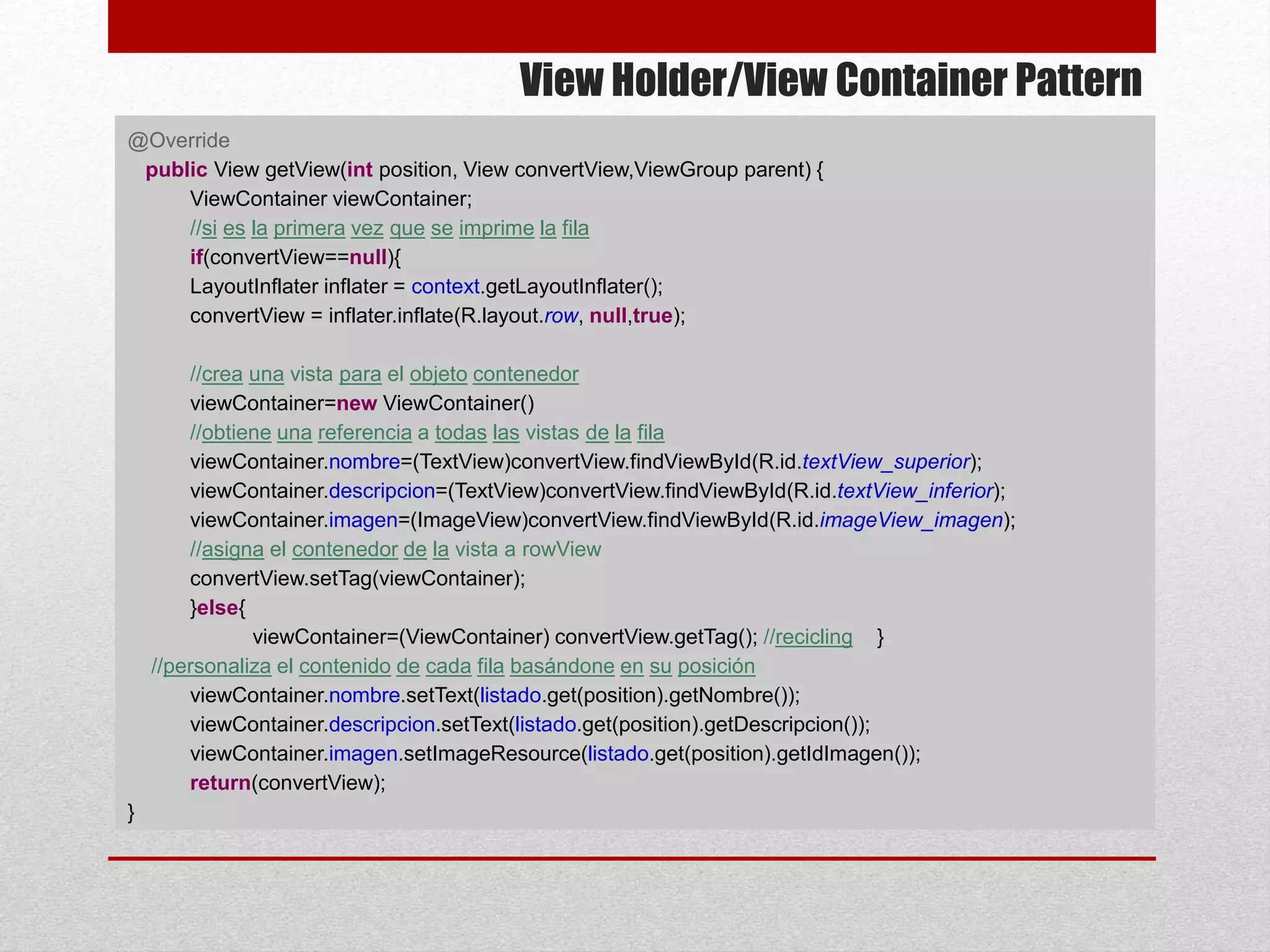
@Override
public View getView(int position, View convertView,ViewGroup parent) {
ViewContainer viewContainer;
//si es la primera vez que se imprime la fila
if(convertView==null){
LayoutInflater inflater = context.getLayoutInflater();
convertView = inflater.inflate(R.layout.row, null,true);
//crea una vista para el objeto contenedor
viewContainer=new ViewContainer()
//obtiene una referencia a todas las vistas de la fila
viewContainer.nombre=(TextView)convertView.findViewById(R.id.textView_superior);
viewContainer.descripcion=(TextView)convertView.findViewById(R.id.textView_inferior);
viewContainer.imagen=(ImageView)convertView.findViewById(R.id.imageView_imagen);
//asigna el contenedor de la vista a rowView
convertView.setTag(viewContainer);
}else{
viewContainer=(ViewContainer) convertView.getTag(); //recicling }
//personaliza el contenido de cada fila basándone en su posición
viewContainer.nombre.setText(listado.get(position).getNombre());
viewContainer.descripcion.setText(listado.get(position).getDescripcion());
viewContainer.imagen.setImageResource(listado.get(position).getIdImagen());
return(convertView);
}
View Holder/View Container Pattern
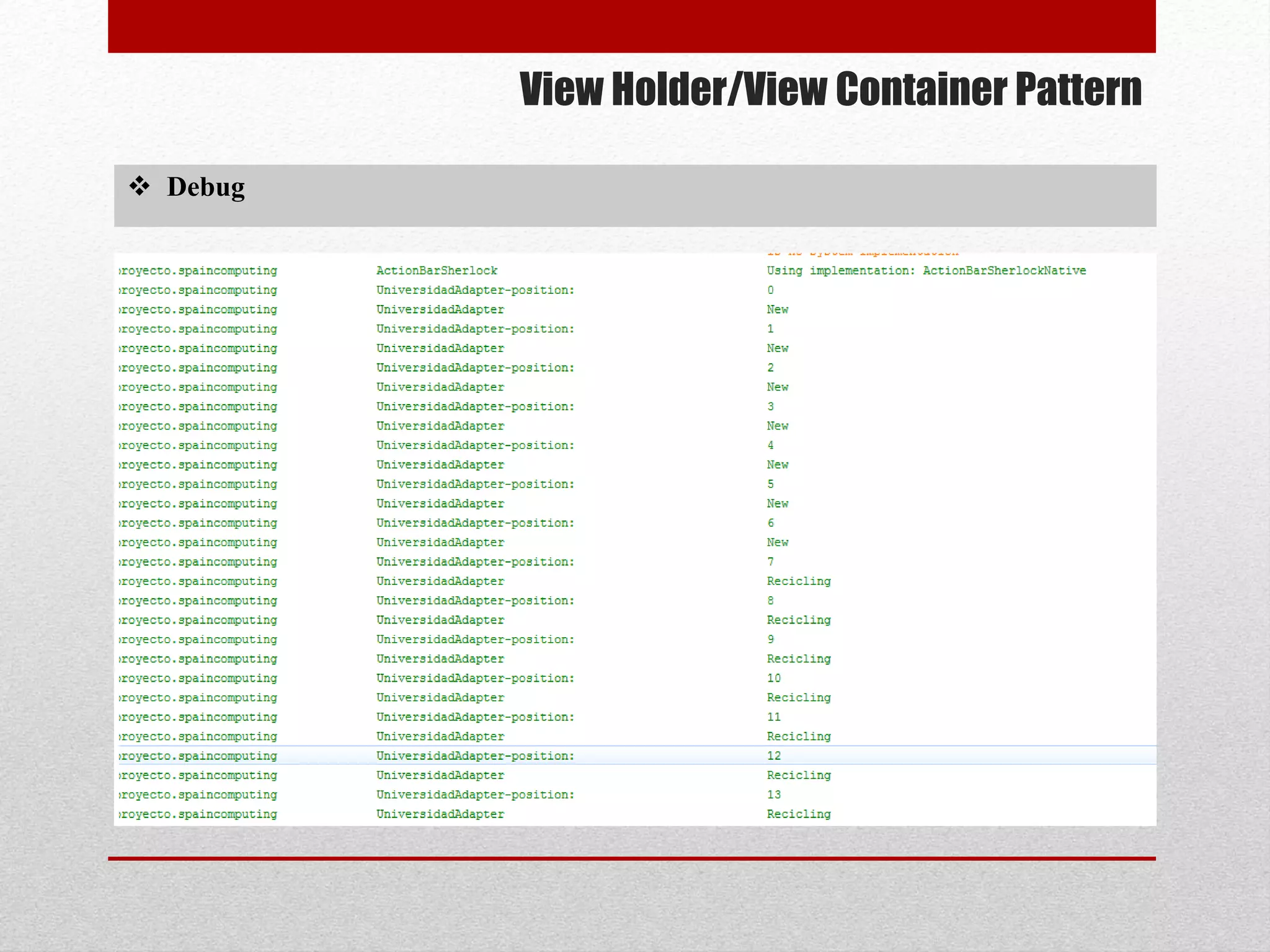
 Debug
Criteria Geolocation
 LocationManager / android.location package
 ACCESS_COARSE_LOCATION/ACCESS_FINE_LOCATION
//Obtain Location Manager
LocationManager locationManager = (LocationManager)this.getSystemService
(Context.LOCATION_SERVICE);
Criteria criteria = new Criteria();
//criteria.setAccuracy(Criteria.ACCURACY_FINE); //GPS
criteria.setAccuracy(Criteria.ACCURACY_COARSE); // WIFI
criteria.setPowerRequirement(Criteria.POWER_LOW);
criteria.setAltitudeRequired(false);
criteria.setBearingRequired(false);
criteria.setSpeedRequired(false);
criteria.setCostAllowed(false);
String provider = locationManager.getBestProvider(criteria, true);
// In order to make sure the device is getting the location, request
// updates [wakeup after changes of: 5 sec. or 10 meter]
locationManager.requestLocationUpdates(provider, 5, 10, this);
locationBridge.setNewLocation(locationManager.getLastKnownLocation(provider
));
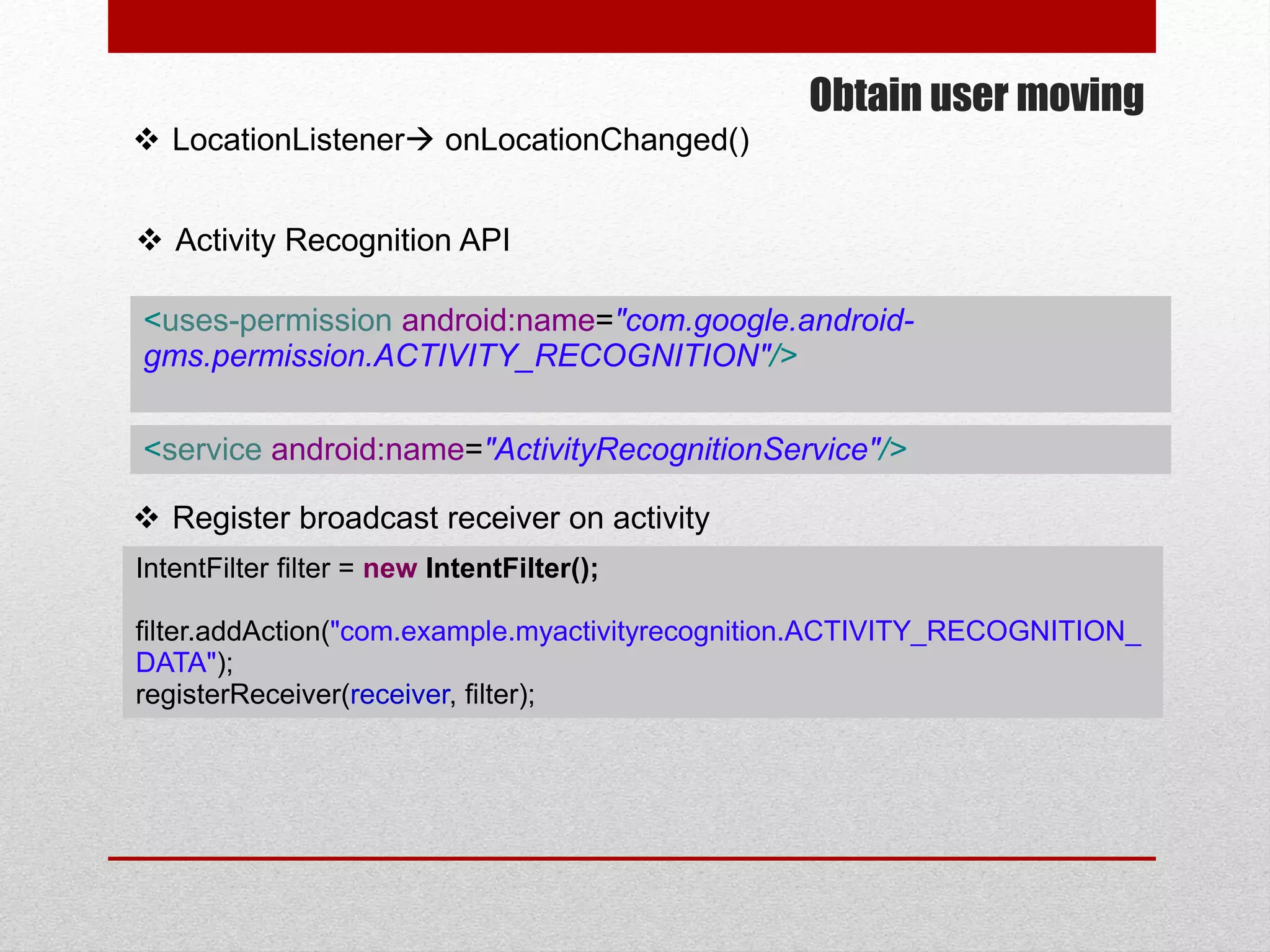
Obtain user moving
 LocationListener onLocationChanged()
 Activity Recognition API
<uses-permission android:name="com.google.android-
gms.permission.ACTIVITY_RECOGNITION"/>
<service android:name="ActivityRecognitionService"/>
IntentFilter filter = new IntentFilter();
filter.addAction("com.example.myactivityrecognition.ACTIVITY_RECOGNITION_
DATA");
registerReceiver(receiver, filter);
 Register broadcast receiver on activity
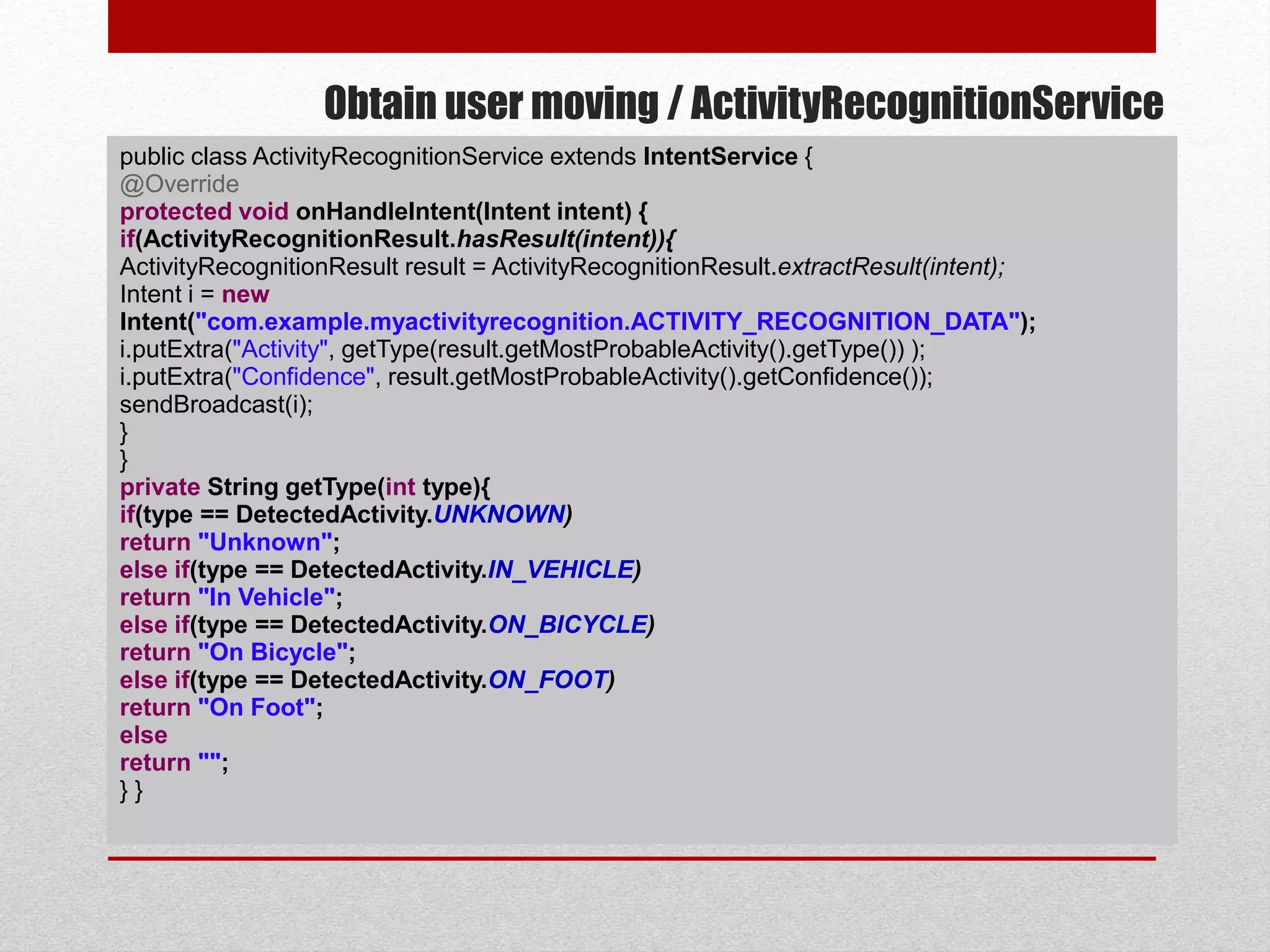
Obtain user moving / ActivityRecognitionService
public class ActivityRecognitionService extends IntentService {
@Override
protected void onHandleIntent(Intent intent) {
if(ActivityRecognitionResult.hasResult(intent)){
ActivityRecognitionResult result = ActivityRecognitionResult.extractResult(intent);
Intent i = new
Intent("com.example.myactivityrecognition.ACTIVITY_RECOGNITION_DATA");
i.putExtra("Activity", getType(result.getMostProbableActivity().getType()) );
i.putExtra("Confidence", result.getMostProbableActivity().getConfidence());
sendBroadcast(i);
}
}
private String getType(int type){
if(type == DetectedActivity.UNKNOWN)
return "Unknown";
else if(type == DetectedActivity.IN_VEHICLE)
return "In Vehicle";
else if(type == DetectedActivity.ON_BICYCLE)
return "On Bicycle";
else if(type == DetectedActivity.ON_FOOT)
return "On Foot";
else
return "";
} }
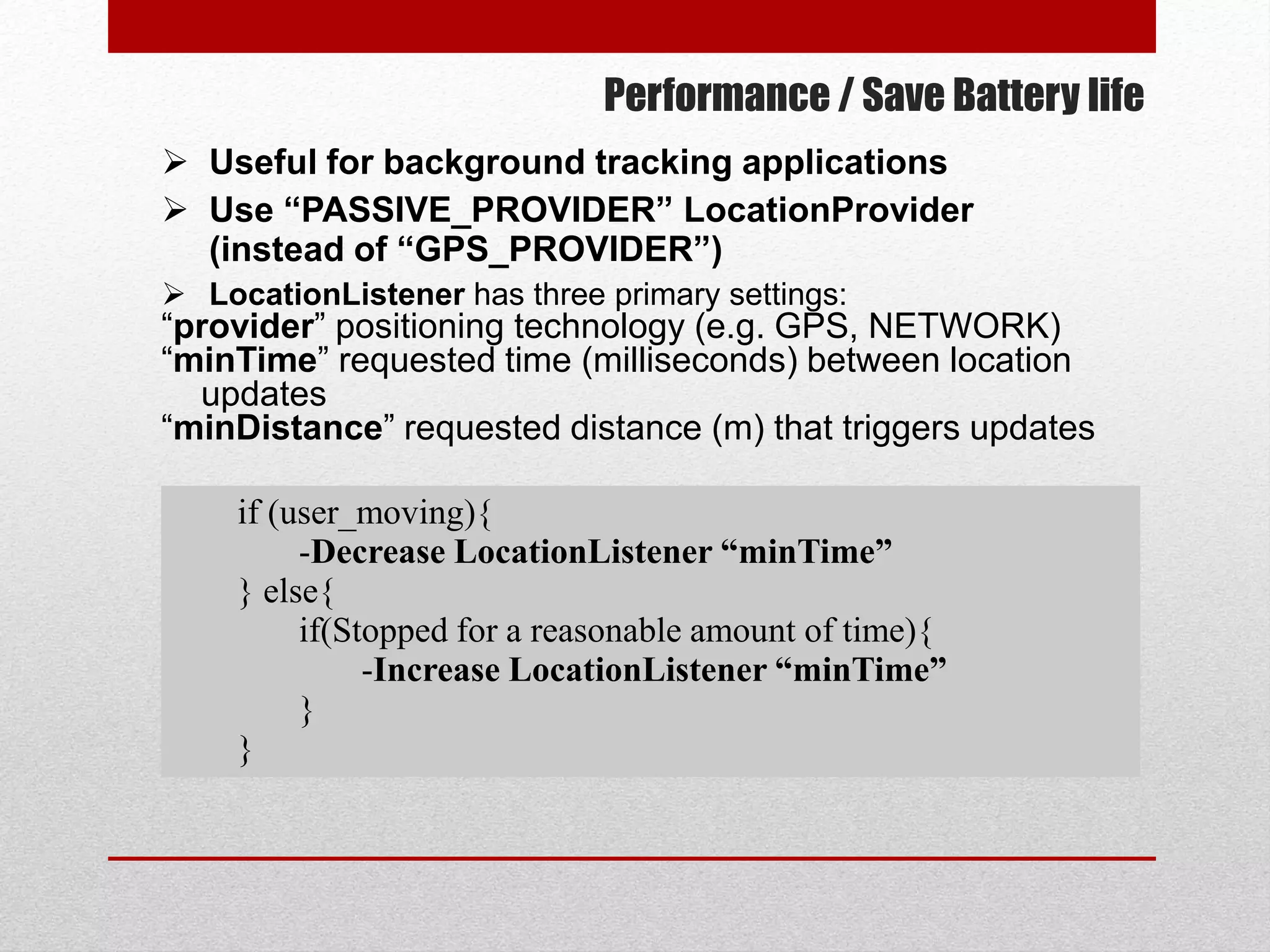
Performance / Save Battery life
 Useful for background tracking applications
 Use “PASSIVE_PROVIDER” LocationProvider
(instead of “GPS_PROVIDER”)
 LocationListener has three primary settings:
“provider” positioning technology (e.g. GPS, NETWORK)
“minTime” requested time (milliseconds) between location
updates
“minDistance” requested distance (m) that triggers updates
if (user_moving){
-Decrease LocationListener “minTime”
} else{
if(Stopped for a reasonable amount of time){
-Increase LocationListener “minTime”
}
}
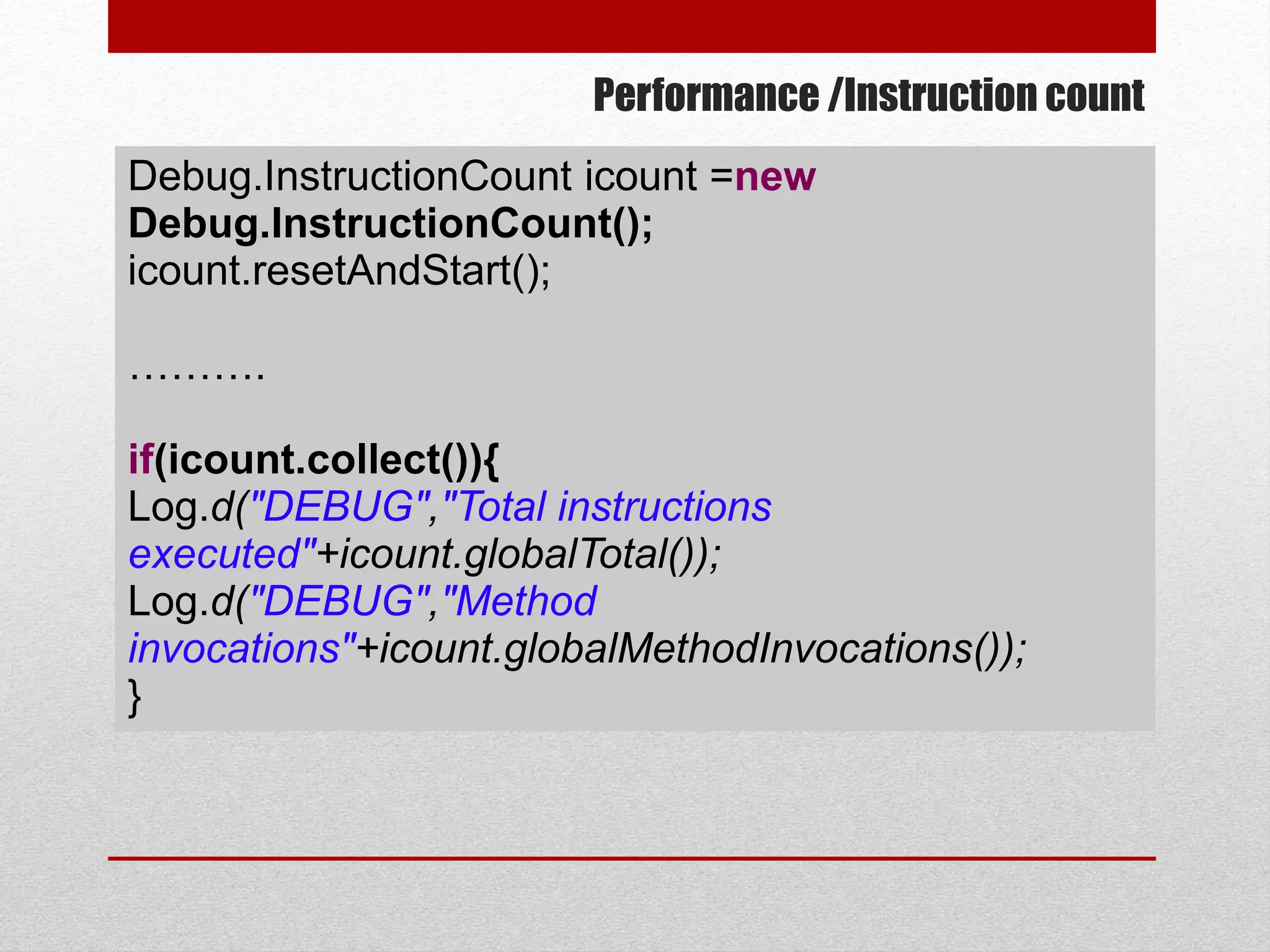
Performance /Instruction count
Debug.InstructionCount icount =new
Debug.InstructionCount();
icount.resetAndStart();
……….
if(icount.collect()){
Log.d("DEBUG","Total instructions
executed"+icount.globalTotal());
Log.d("DEBUG","Method
invocations"+icount.globalMethodInvocations());
}
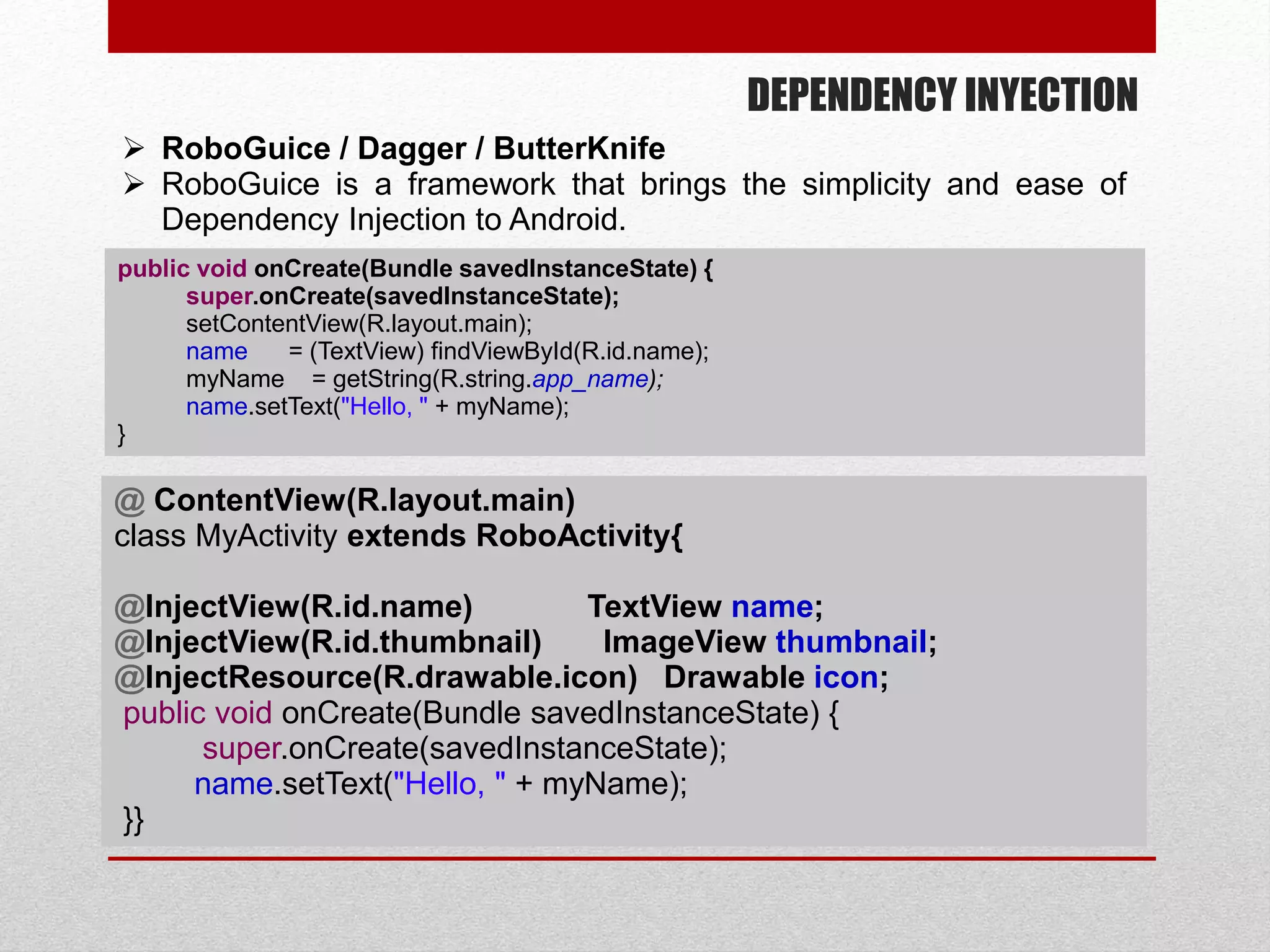
DEPENDENCY INYECTION
 RoboGuice / Dagger / ButterKnife
 RoboGuice is a framework that brings the simplicity and ease of
Dependency Injection to Android.
public void onCreate(Bundle savedInstanceState) {
super.onCreate(savedInstanceState);
setContentView(R.layout.main);
name = (TextView) findViewById(R.id.name);
myName = getString(R.string.app_name);
name.setText("Hello, " + myName);
}
@ ContentView(R.layout.main)
class MyActivity extends RoboActivity{
@InjectView(R.id.name) TextView name;
@InjectView(R.id.thumbnail) ImageView thumbnail;
@InjectResource(R.drawable.icon) Drawable icon;
public void onCreate(Bundle savedInstanceState) {
super.onCreate(savedInstanceState);
name.setText("Hello, " + myName);
}}
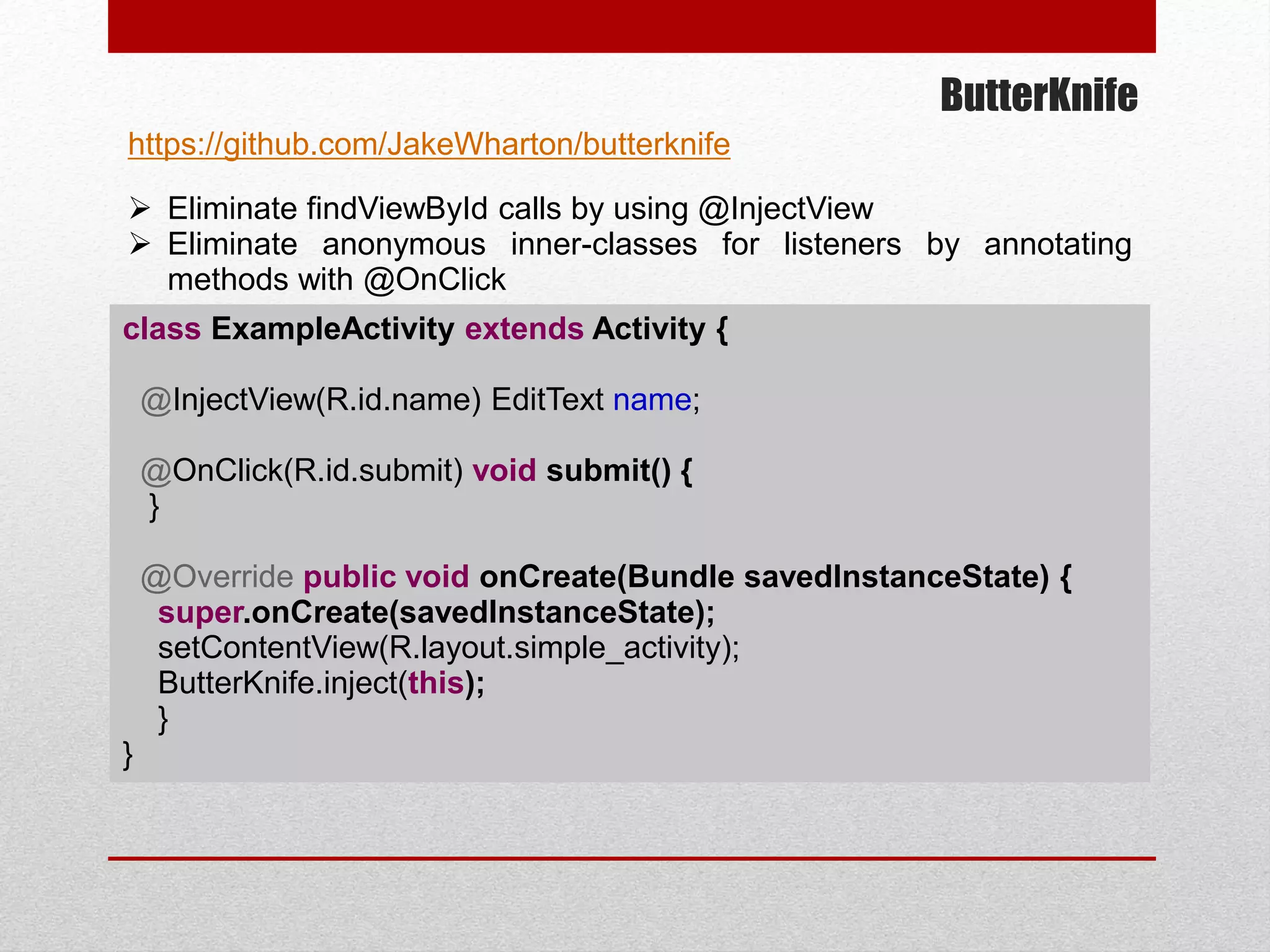
ButterKnife
 Eliminate findViewById calls by using @InjectView
 Eliminate anonymous inner-classes for listeners by annotating
methods with @OnClick
class ExampleActivity extends Activity {
@InjectView(R.id.name) EditText name;
@OnClick(R.id.submit) void submit() {
}
@Override public void onCreate(Bundle savedInstanceState) {
super.onCreate(savedInstanceState);
setContentView(R.layout.simple_activity);
ButterKnife.inject(this);
}
}
https://github.com/JakeWharton/butterknife
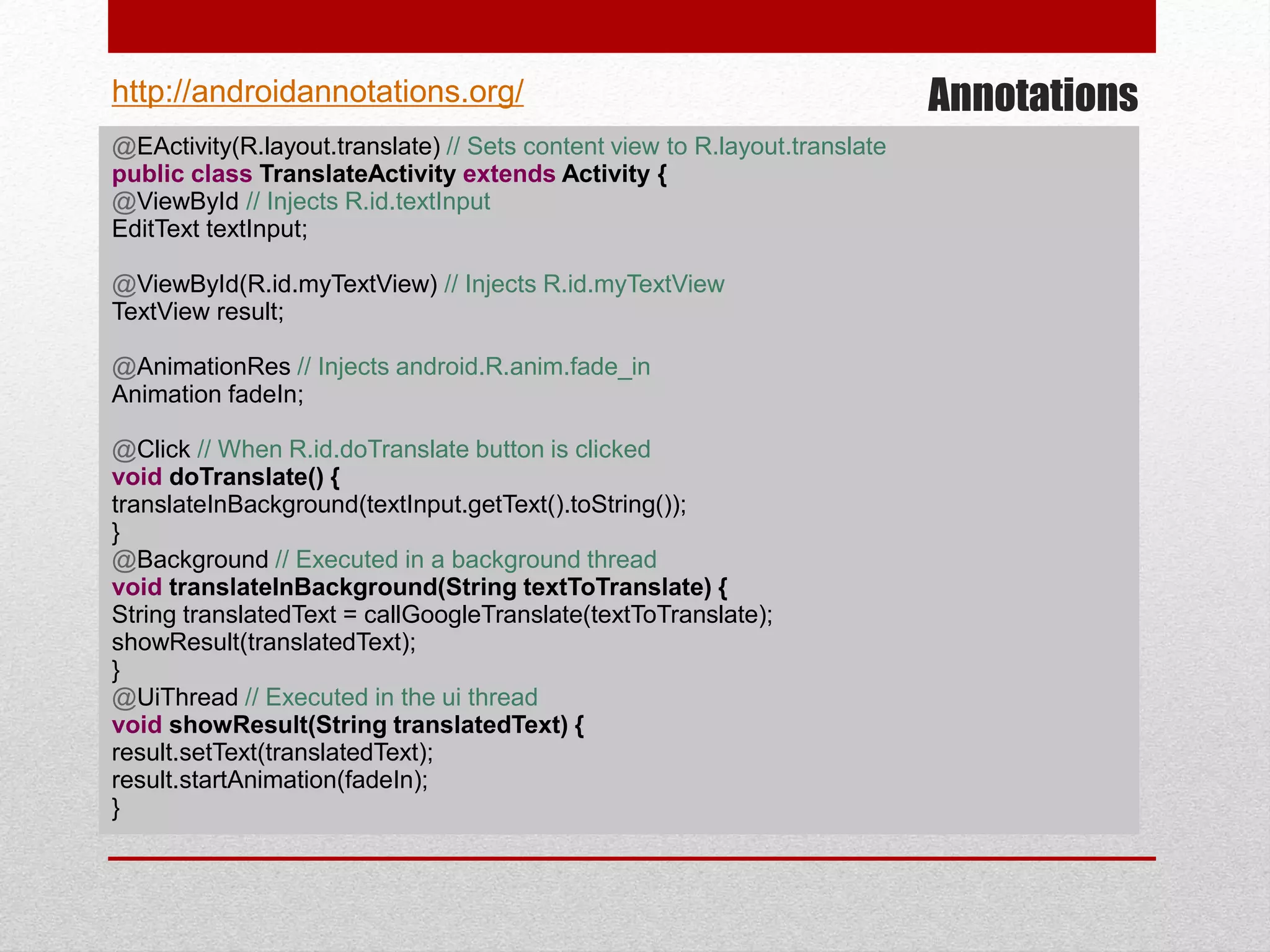
Annotations
@EActivity(R.layout.translate) // Sets content view to R.layout.translate
public class TranslateActivity extends Activity {
@ViewById // Injects R.id.textInput
EditText textInput;
@ViewById(R.id.myTextView) // Injects R.id.myTextView
TextView result;
@AnimationRes // Injects android.R.anim.fade_in
Animation fadeIn;
@Click // When R.id.doTranslate button is clicked
void doTranslate() {
translateInBackground(textInput.getText().toString());
}
@Background // Executed in a background thread
void translateInBackground(String textToTranslate) {
String translatedText = callGoogleTranslate(textToTranslate);
showResult(translatedText);
}
@UiThread // Executed in the ui thread
void showResult(String translatedText) {
result.setText(translatedText);
result.startAnimation(fadeIn);
}
http://androidannotations.org/
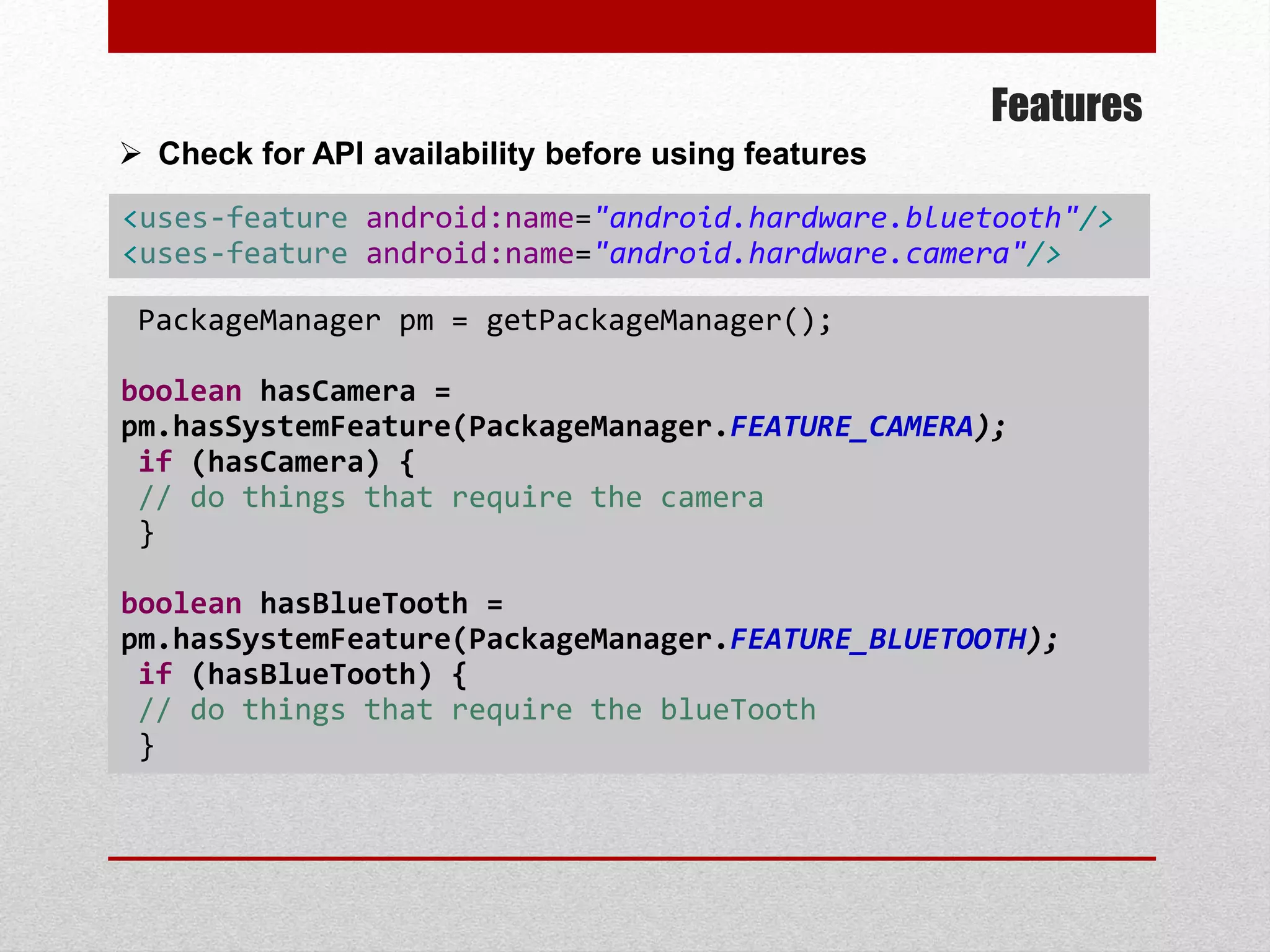
Features
 Check for API availability before using features
PackageManager pm = getPackageManager();
boolean hasCamera =
pm.hasSystemFeature(PackageManager.FEATURE_CAMERA);
if (hasCamera) {
// do things that require the camera
}
boolean hasBlueTooth =
pm.hasSystemFeature(PackageManager.FEATURE_BLUETOOTH);
if (hasBlueTooth) {
// do things that require the blueTooth
}
<uses-feature android:name="android.hardware.bluetooth"/>
<uses-feature android:name="android.hardware.camera"/>
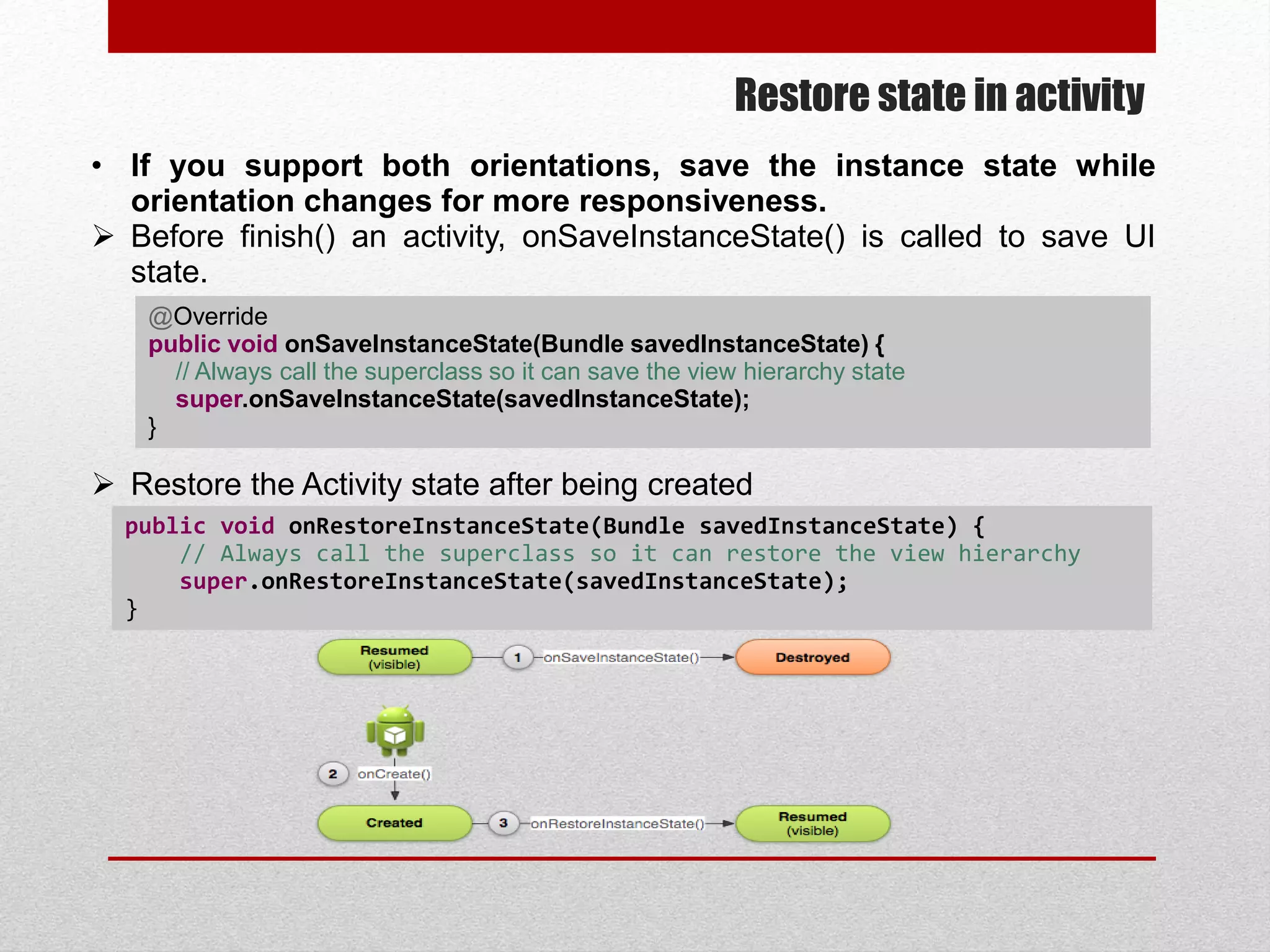
Restore state in activity
• If you support both orientations, save the instance state while
orientation changes for more responsiveness.
 Before finish() an activity, onSaveInstanceState() is called to save UI
state.
 Restore the Activity state after being created
@Override
public void onSaveInstanceState(Bundle savedInstanceState) {
// Always call the superclass so it can save the view hierarchy state
super.onSaveInstanceState(savedInstanceState);
}
public void onRestoreInstanceState(Bundle savedInstanceState) {
// Always call the superclass so it can restore the view hierarchy
super.onRestoreInstanceState(savedInstanceState);
}
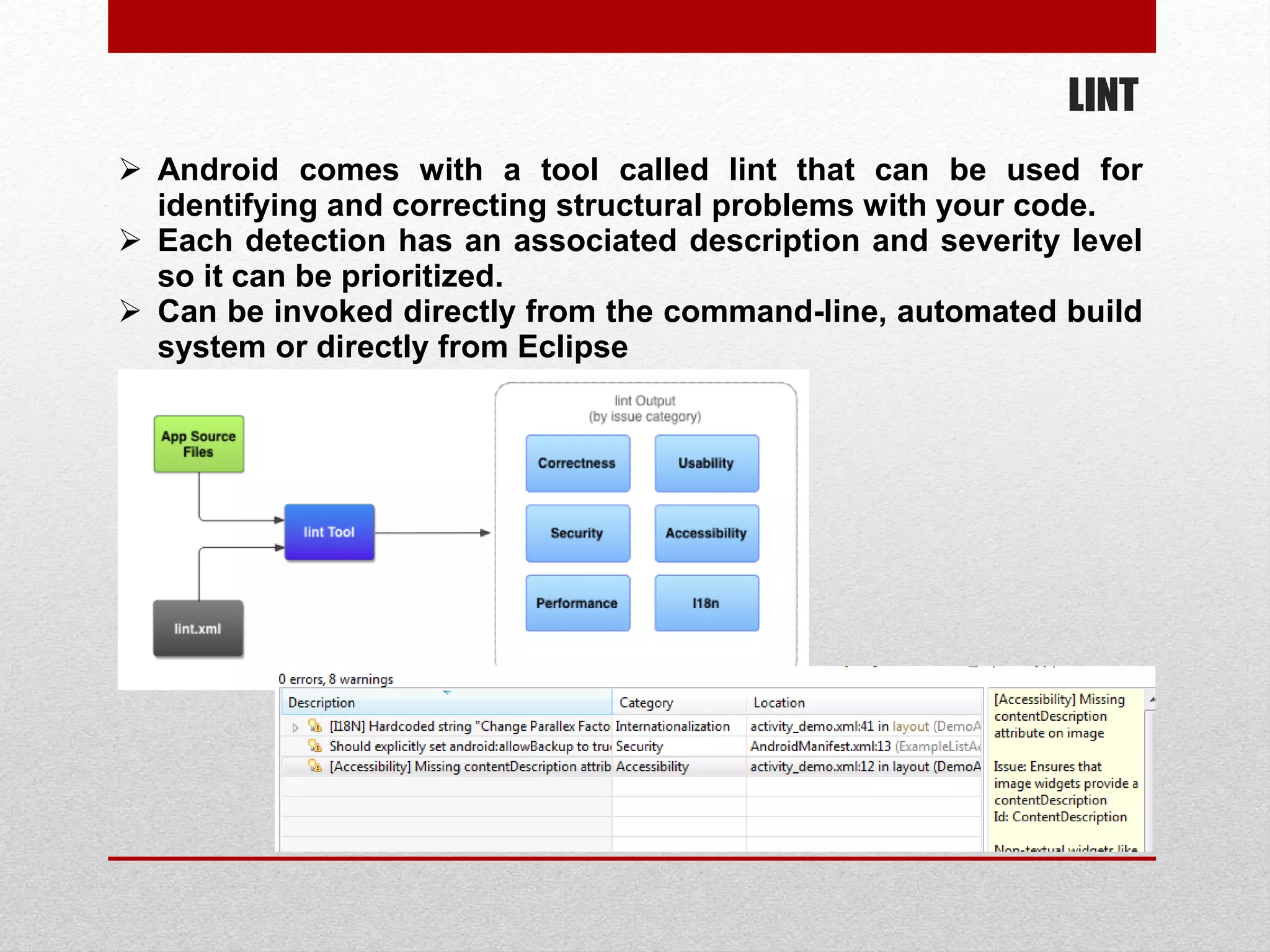
LINT
 Android comes with a tool called lint that can be used for
identifying and correcting structural problems with your code.
 Each detection has an associated description and severity level
so it can be prioritized.
 Can be invoked directly from the command-line, automated build
system or directly from Eclipse
VOLLEY
https://android.googlesource.com/platform/frameworks/volley
https://github.com/mcxiaoke/android-volley
 Unzip and import from Eclipse as a new project with code available. Export
the project as Java Volley / jar checking only the "src" folder.
 Volley is a library that facilitates and speeds up the creation of applications
that make use of networking in Android handling concurrency and network
requests.
 The advantage is that volley is responsible for managing the request threads
transparently to the developer.
 libsvolley.jar
 Objects
 RequestQueue
 Request: Contains all the necessary details of API calls to Web. For example,
the method to use (GET or POST), application data, listeners, error listeners.
VOLLEY REQUEST
import com.android.volley.*;
public static RequestQueue requestQueue;
@Override
protected void onCreate(Bundle savedInstanceState) {
requestQueue = Volley.newRequestQueue(this);
}
 JSON Request with volley.Request object
JsonObjectRequest jsObjRequest = new
JsonObjectRequest(Request.Method.GET, url, null,
successListener,null);
requestQueue.add(jsObjRequest);
 Instagram Activity
VOLLEY RESPONSE
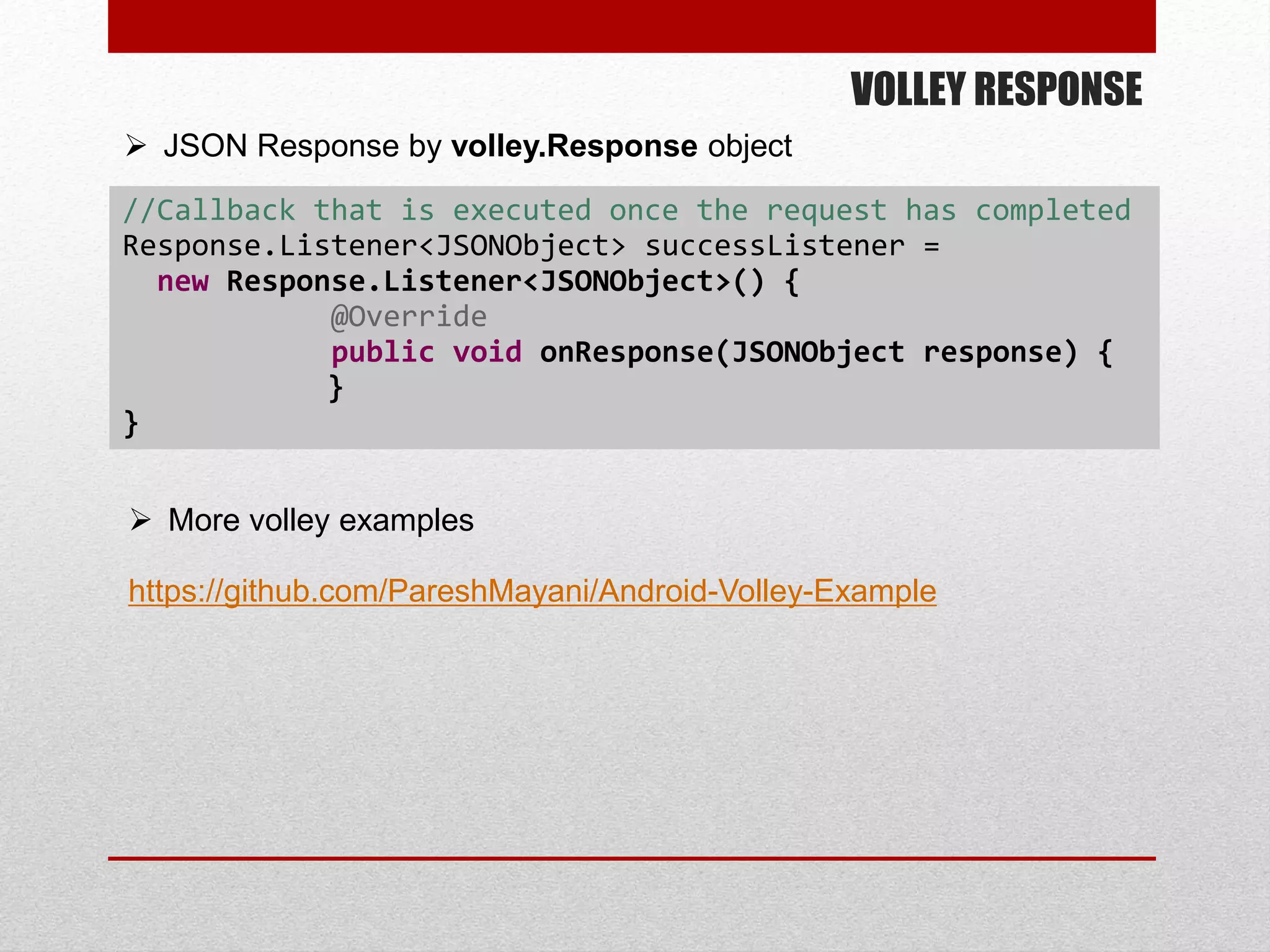
//Callback that is executed once the request has completed
Response.Listener<JSONObject> successListener =
new Response.Listener<JSONObject>() {
@Override
public void onResponse(JSONObject response) {
}
}
 JSON Response by volley.Response object
 More volley examples
https://github.com/PareshMayani/Android-Volley-Example
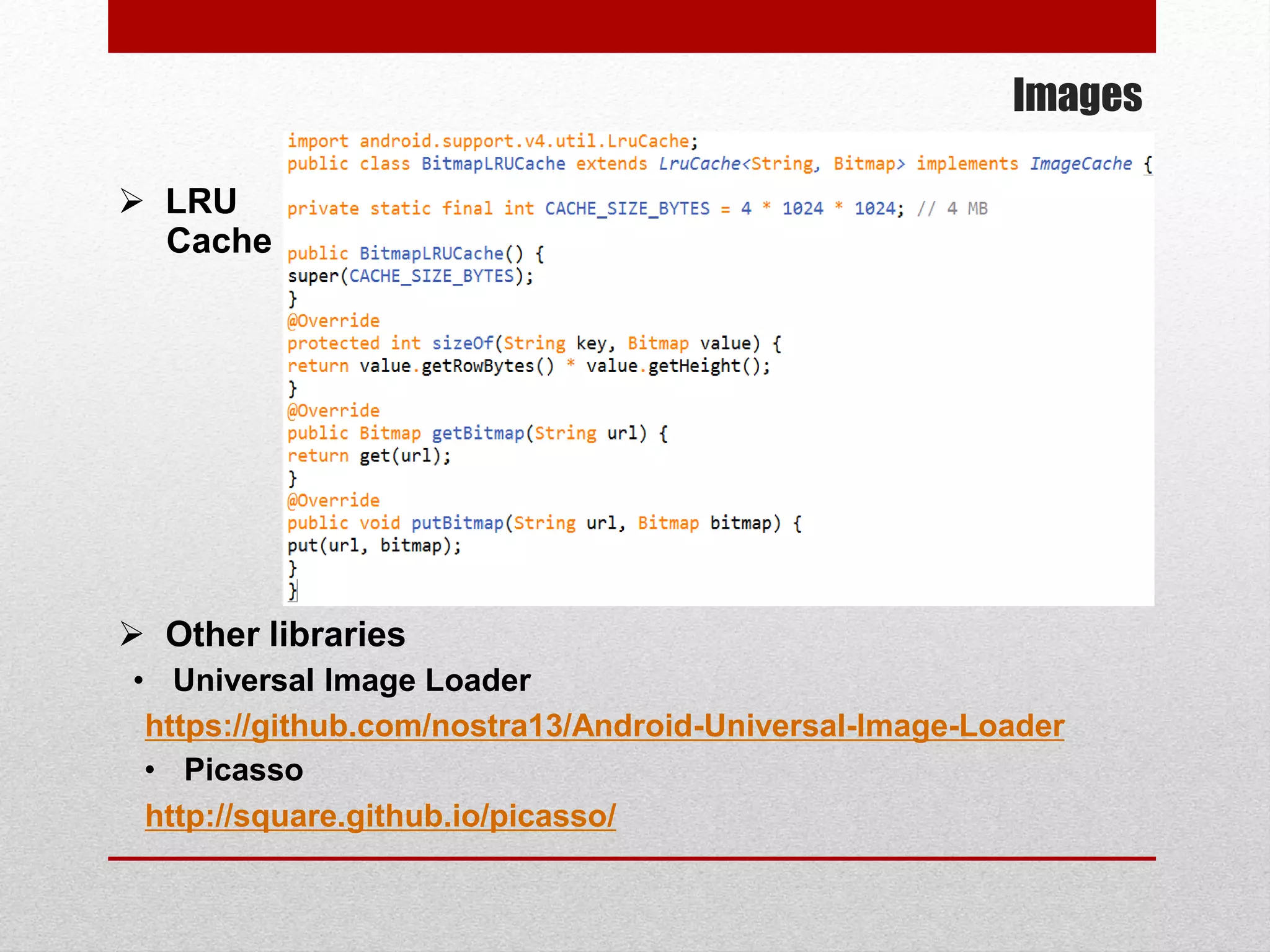
Images
 LRU
Cache
 Other libraries
https://github.com/nostra13/Android-Universal-Image-Loader
• Universal Image Loader
http://square.github.io/picasso/
• Picasso
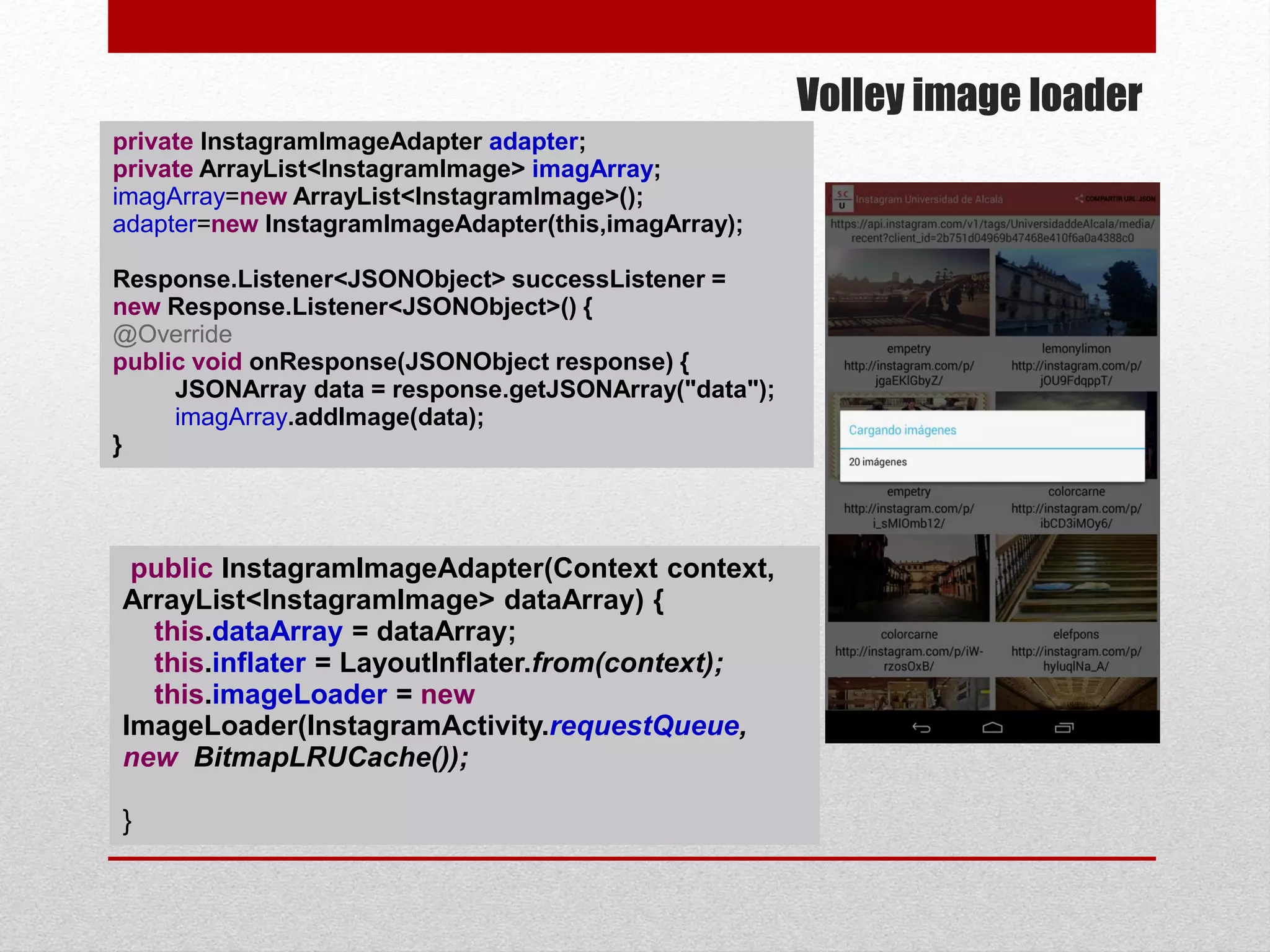
Volley image loader
public InstagramImageAdapter(Context context,
ArrayList<InstagramImage> dataArray) {
this.dataArray = dataArray;
this.inflater = LayoutInflater.from(context);
this.imageLoader = new
ImageLoader(InstagramActivity.requestQueue,
new BitmapLRUCache());
}
private InstagramImageAdapter adapter;
private ArrayList<InstagramImage> imagArray;
imagArray=new ArrayList<InstagramImage>();
adapter=new InstagramImageAdapter(this,imagArray);
Response.Listener<JSONObject> successListener =
new Response.Listener<JSONObject>() {
@Override
public void onResponse(JSONObject response) {
JSONArray data = response.getJSONArray("data");
imagArray.addImage(data);
}
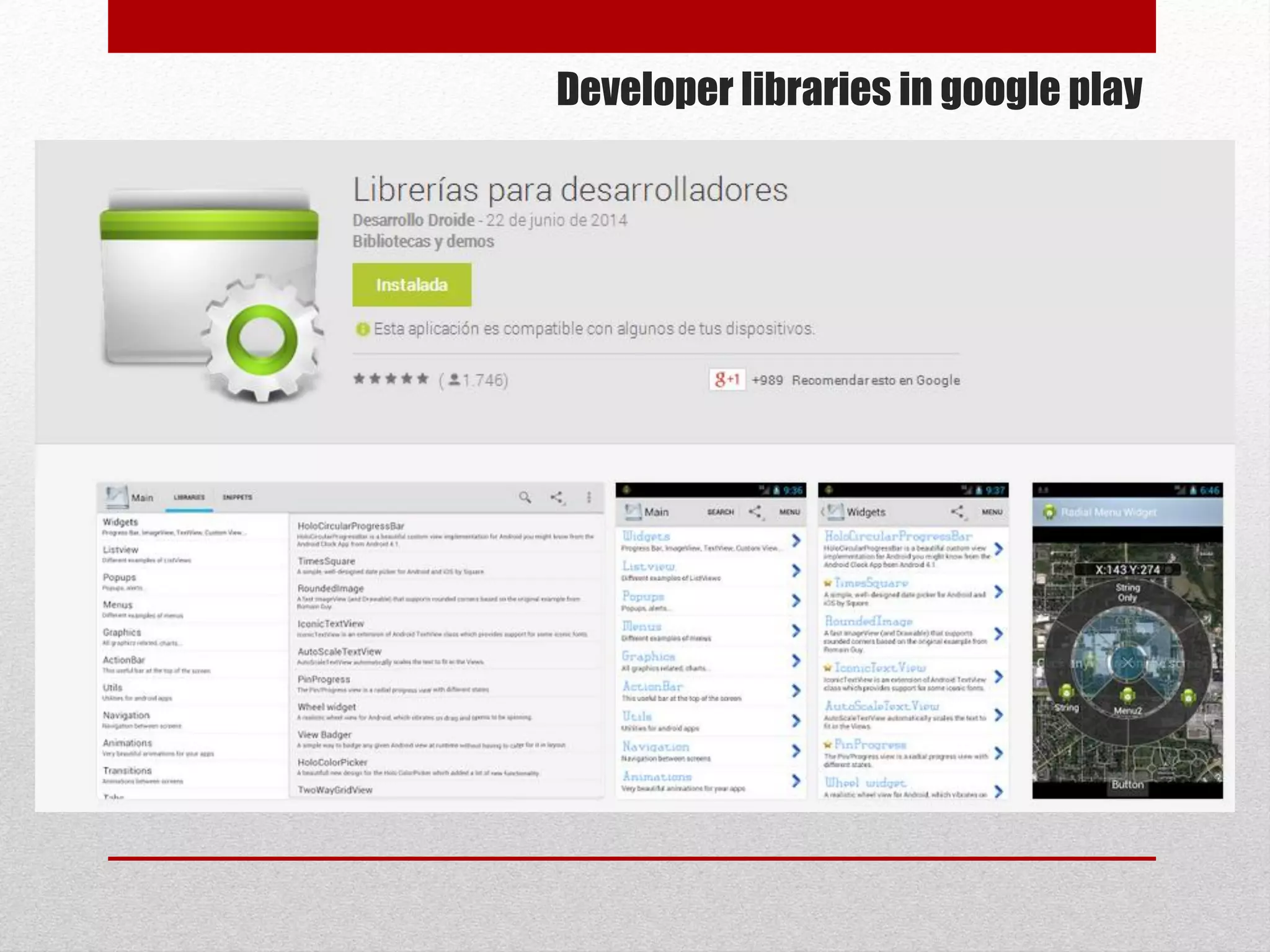
Developer libraries in google play
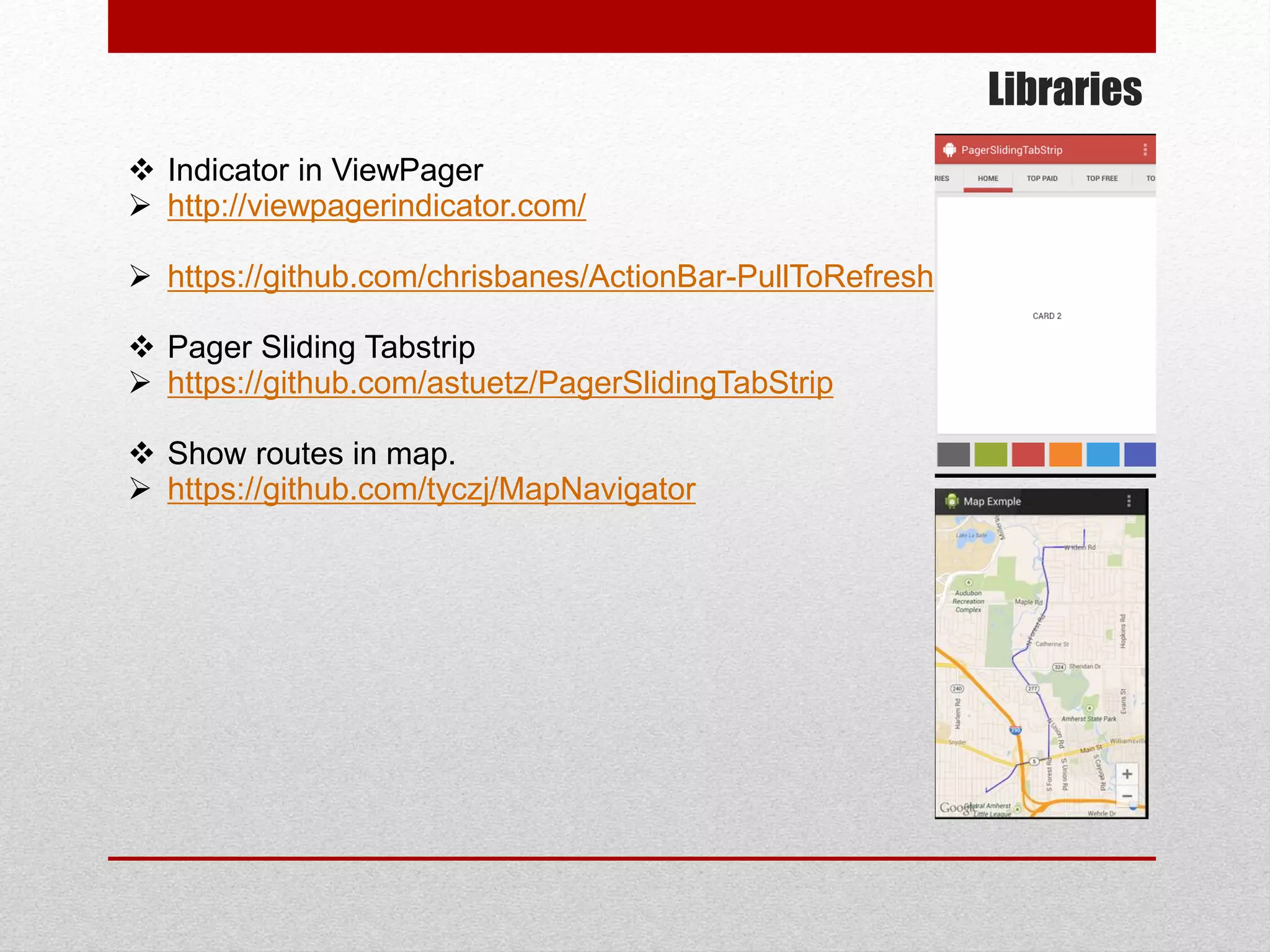
Libraries
 Indicator in ViewPager
 http://viewpagerindicator.com/
 https://github.com/chrisbanes/ActionBar-PullToRefresh
 Pager Sliding Tabstrip
 https://github.com/astuetz/PagerSlidingTabStrip
 Show routes in map.
 https://github.com/tyczj/MapNavigator
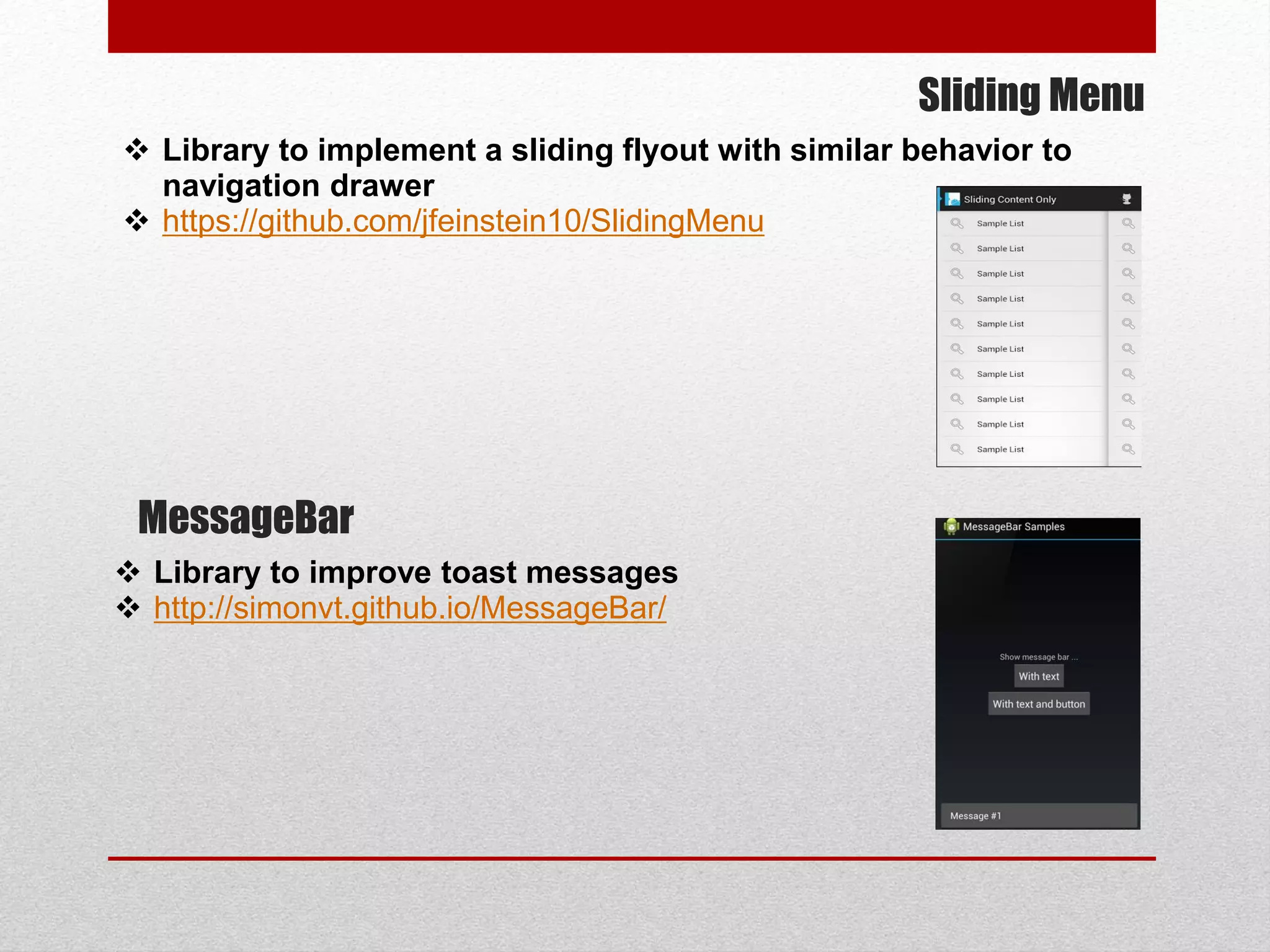
Sliding Menu
 Library to implement a sliding flyout with similar behavior to
navigation drawer
 https://github.com/jfeinstein10/SlidingMenu
MessageBar
 Library to improve toast messages
 http://simonvt.github.io/MessageBar/
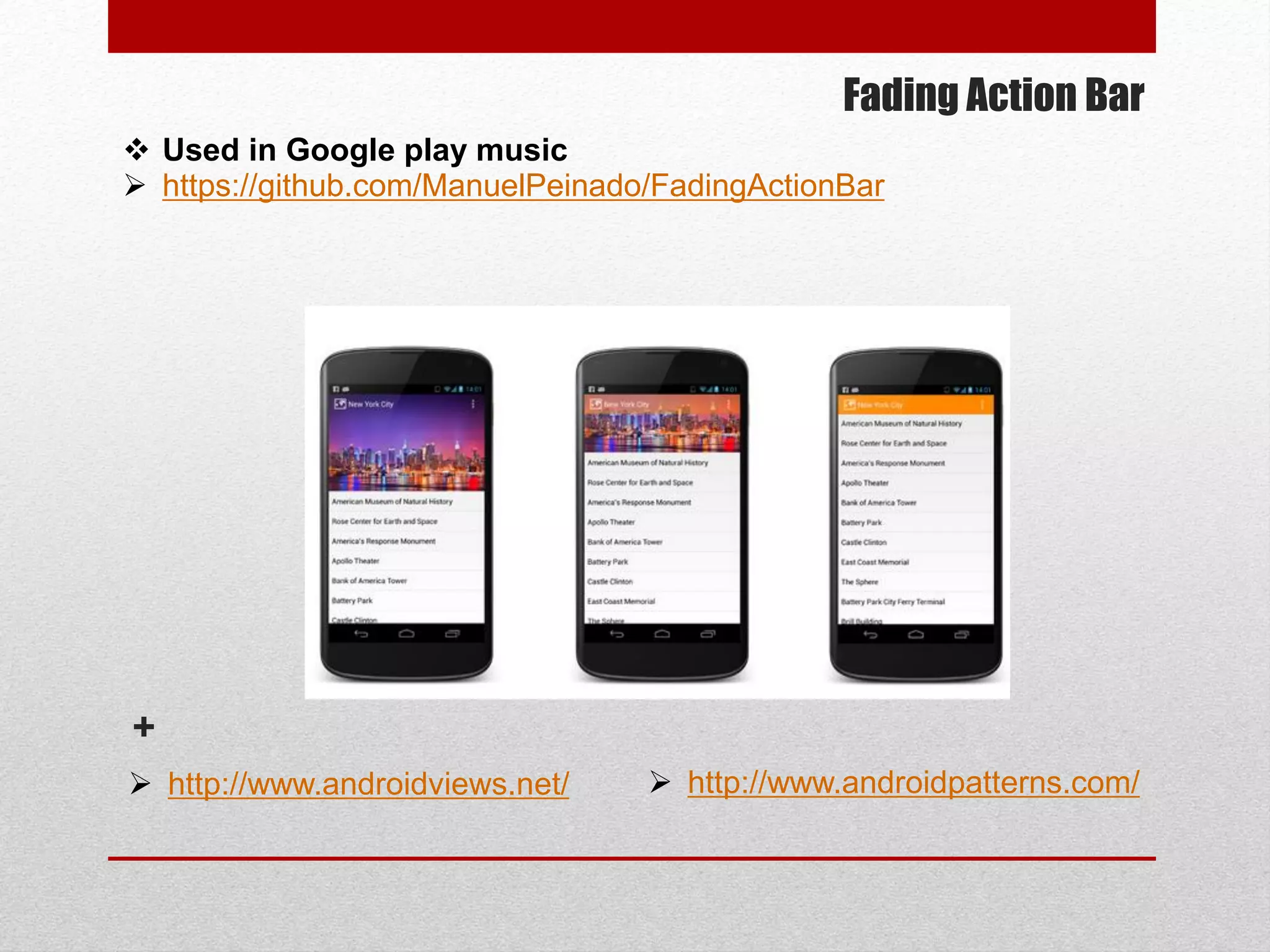
Fading Action Bar
 Used in Google play music
 https://github.com/ManuelPeinado/FadingActionBar
+
 http://www.androidviews.net/  http://www.androidpatterns.com/
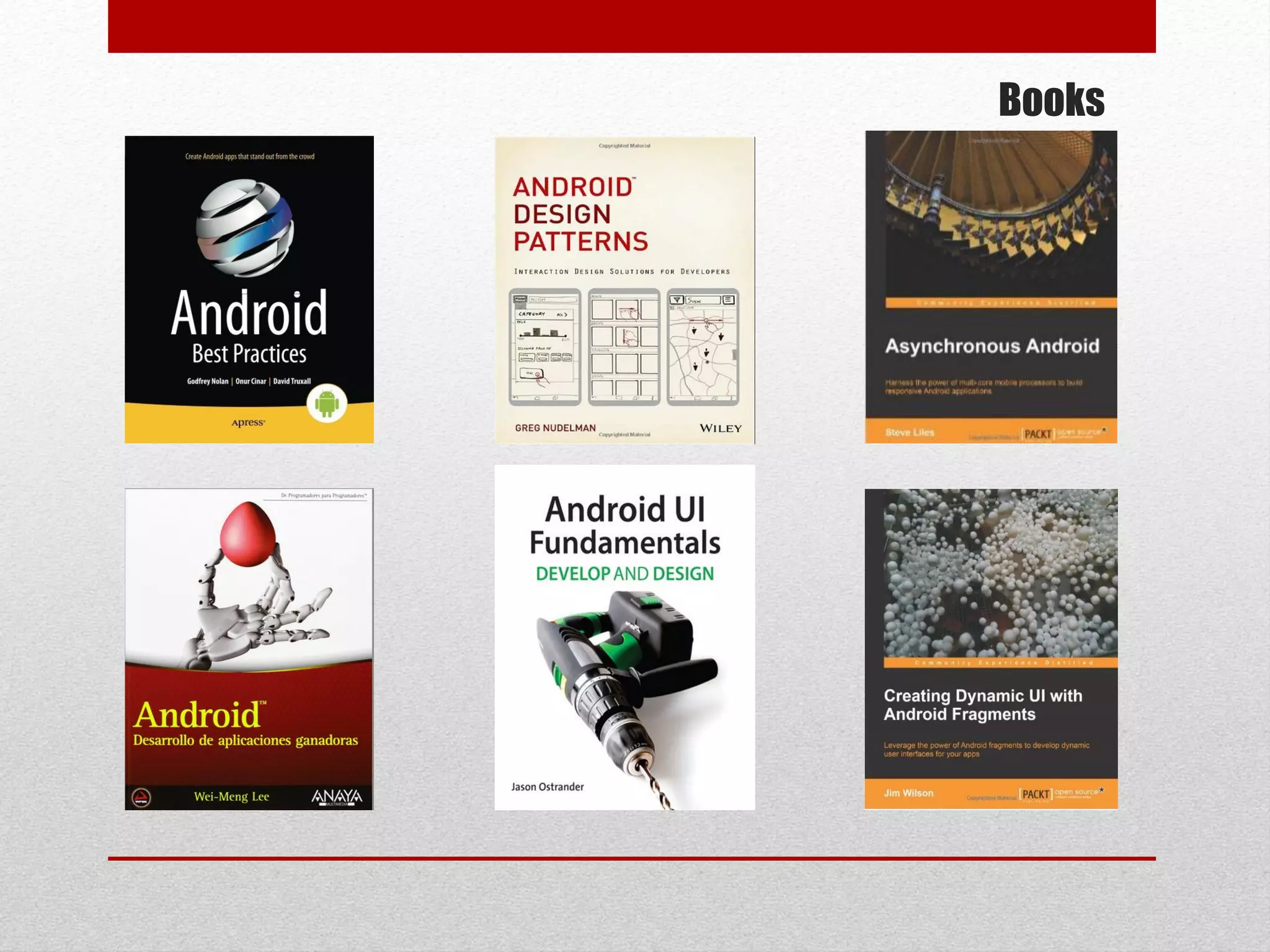
Books
About me
https://github.com/jmortega/apps
https://github.com/jmortega/android
https://www.linkedin.com/in/jmortega1
@jmortegac
https://play.google.com/store/apps/developer?id=Jos%C3%A9+Manuel+Ortega+Candel
https://speakerdeck.com/jmortega/

Android best practices

  • 1.
    Android Best Practices José ManuelOrtega DroidCon July 2014
  • 2.
  • 3.
    Index  UI DESIGN INCLUDES / REUSING LAYOUTS  STYLES  ACTION BAR SEARCH VIEW / PROGRESS BAR  ACCESSIBILITY / TALLBACK  NETWORK CONNECTION  ASYNCTASK / SERVICES  FRAGMENTS  NAVIGATION PATTERNS  GEOLOCATION / PERFORMANCE  DEPENDENCY INYECTION / ANNOTATIONS  TOOLS / VOLLEY / LIBRARIES / /BOOKS http://developer.android.com/intl/es/training/index.html
  • 4.
    UI Design  http://developer.android.com/design/index.html Waysto specify the size of an item:  dp/dip: Density independent pixel.  sp/sip: Scale independent pixel.Used in font sizes.  pt: Point.  px: Pixel. Not use  layout_width,layout_height  match_parent:takes all the space available.  wrap_content: uses the space needed  fill_parent:equivalent to match_parent
  • 5.
    Android Asset Studio Generate icons and graphic elements for each resolution  http://android-ui-utils.googlecode.com/hg/asset-studio/dist/index.html
  • 6.
    Resources /Screen support External elements you want to include and reference in the application.  Declaratively include in /res ,accesing by @<type>/<nname>  Are programmatically accessible via the R class (compiled with Android Asset Packaging Tool)  Android automatically selects the resource that adapts to the environment  Each resource type in a folder / res.  drawable: Images, Icons.  layout: Layout to organize views.  values:  string.xml: Text strings  colors.xml  dimens.xml: font sizes,margins,paddings  anim: Animations  raw: Other resources like audio or video  menu: Menus and dialogs  xml: Other xml (preferences, app widget, …) <supports-screens android:anyDensity="true" android:xlargeScreens="true" android:largeScreens="true" android:normalScreens="true" android:smallScreens="true" />
  • 7.
  • 8.
    Styles <!-- estilo paraTextView --> <style name="CodeStyleTextView" parent="@android:style/TextAppearance.Medium"> <item name="android:layout_width">match_parent</item> <item name="android:layout_height">wrap_content</item> <item name="android:paddingTop">50dp</item> <item name="android:textColor">@color/negro</item> <item name="android:background">@color/gris_claro</item> <item name="android:textSize">35sp</item> </style> <!-- estilo para Button--> <style name="CodeStyleButton" parent="android:Widget.Button"> <item name="android:layout_width">match_parent</item> <item name="android:layout_height">wrap_content</item> <item name="android:textSize">20sp</item> <item name="android:drawableTop">@drawable/logo_empresa</item> </style>
  • 9.
  • 10.
  • 11.
    Action Bar SearchView @Override public boolean onCreateOptionsMenu(Menu menu) { mSearchView = (SearchView) searchItem.getActionView(); mSearchView.setQueryHint("Search..."); mSearchView.setOnQueryTextListener(this); return true; } <item android:id="@+id/action_search" android:showAsAction="always" android:title="@string/search" android:icon="@android:drawable/ic_menu_search" android:actionViewClass= "android.support.v7.widget.SearchView" /> private SearchView mSearchView;
  • 12.
    Action Bar SearchView  Implement interface OnQueryTextListener  Override methods onQueryTextSubmit, onQueryTextChange @Override public boolean onQueryTextSubmit(String query) { UniversityListFragment fragmentList = (UniversityListFragment)getSupportFragmentManager().findFragmentBy Tag("list_fragment"); fragmentList.searchData(query); return true; } @Override public boolean onQueryTextChange(String query) { return true; }
  • 13.
    ACTION BAR PROGRESS Avoid modal Dialogues and Activities  Always update the user on progress(ProgressBar and ProgressDialog)  Render the main view and fill in data as it arrives
  • 14.
    ACTION BAR PROGRESS Progress bar in Action Bar while url loading private Activity activity = this; @Override public void onCreate(Bundle savedInstanceState) { super.onCreate(savedInstanceState); this.getWindow().requestFeature(Window. FEATURE_INDETERMINATE_PROGRESS); ActionBar ab = getSupportActionBar(); ……… } activity.setProgressBarIndeterminateVisibility(true); viewer.setWebViewClient(new WebViewClient() { public void onPageFinished(WebView view, String url) { activity.setProgressBarIndeterminateVisibility(false); }  Show the progress bar to start loading and hide when finished.
  • 15.
  • 16.
    Accessibility http://developer.android.com/training/accessibility/index.html <Button android:id="@+id/button" android:src="@drawable/button" android:contentDescription="@string/text_description"/>  Through layout Through code label.setContentDescription(getText(R.string.text_description));  Focus navigation. Next view to receive focus when user navigates <EditText android:id="@id/editText" android:layout_alignBottom="@+id/button" android:layout_toLeftOf="@id/button" android:nextFocusUp="@+id/button" android:nextFocusDown="@+id/button" android:nextFocusLeft="@+id/button" android:nextFocusRight="@+id/button" android:nextFocusForward="@+id/button"/>
  • 17.
    Network connection import android.net.ConnectivityManager; importandroid.net.NetworkInfo; ConnectivityManager connectivityManager; connectivityManager = (ConnectivityManager) context.getSystemService(Context.CONNECTIVITY_SERVICE); NetworkInfo networkInfo = connectivityManager.getActiveNetworkInfo(); Boolean connected = networkInfo != null && networkInfo.isAvailable() && networkInfo.isConnected(); <uses-permission android:name="android.permission.ACCESS_NETWORK_STATE"/>
  • 18.
    Network connection  EnableWifi / Check connection type NetworkInfo wifiInfo=connectivityManager.getNetworkInfo (ConnectivityManager.TYPE_WIFI); NetworkInfo mobileInfo = connectivityManager.getNetworkInfo (ConnectivityManager.TYPE_MOBILE); if(wifiInfo.isConnected()){ Toast.makeText(context, "Wifi is connected", Toast.LENGTH_LONG).show(); } if(mobileInfo.isConnected()){ Toast.makeText(context, "3G/4G is connected", Toast.LENGTH_LONG).show(); } WifiManager wifiManager=(WifiManager) context.getSystemService(Context.WIFI_SERVICE); wifiManager.setWifiEnabled(true); <uses-permission android:name="android.permission.CHANGE_WIFI_STATE"/>
  • 19.
    Network connection  HTTPRequest HttpGet httpGet = new HttpGet("http://www.google.com"); HttpParams httpParameters = new BasicHttpParams(); int timeoutConnection = 3000; HttpConnectionParams.setConnectionTimeout(httpParameters, timeoutConnection); int timeoutSocket = 5000; HttpConnectionParams.setSoTimeout(httpParameters, timeoutSocket); DefaultHttpClient httpClient = new DefaultHttpClient(httpParameters); try { Log.d("isNetworkAvailable", "Checking network connection..."); httpClient.execute(httpGet); Log.d("isNetworkAvailable", "Connection OK"); return true; } catch (ClientProtocolException e) {e.printStackTrace(); } catch (IOException e) {e.printStackTrace(); } return false;
  • 20.
    Responsive Avoid ANR(Application NotResponding) No response to an input event (such as key press or screen touch events) within 5 seconds. Do not block the main UI thread with heavy work Web Service call, Http Request Communication with UI Thread is made with: • Thread / Handler • ThreadPoolExecutor • AsyncTask  Goal of AsyncTask is to take care of thread management for you.
  • 21.
    Asynctask  This classwill allow us to perform background tasks without using neither directly nor Handlers Threads, trying these elements in a fully transparent way to the programmer.  When we define a AsyncTask class must define the type of three elements, the input parameters, its progress and outcome.  Override onPreExecute(),doInBackground(),onPostExecute(),onProgressUpdate() class RequestTask extends AsyncTask<String, String, String>{ @Override protected void onPreExecute() { } @Override protected void onProgressUpdate(Integer... values) { } @Override protected String doInBackground(String... uri) { } @Override protected void onPostExecute(String result) { super.onPostExecute(result); } new RequestTask().execute(url);
  • 22.
    Services  Perform theactivity in an AsyncTask.  Kill the service when the task is complete.  Leaving a service running when it’s not needed is one of the worst memory management mistakes an Android app can make.  Service problem is always execute in main thread.  The best way to limit the lifespan of your service is to use an IntentService, which finishes itself as soon as it's done handling the intent that started it.  IntentService always execute in own thread.  Allows to launch a service in a new thread, avoiding blocking the main thread.  Example:ActivityRecognitionService
  • 23.
    Fragments  A fragmentrepresents a certain behavior or a portion of a user interface activity.  Multiple fragments can be combined.  A fragment must always be part of an activity.  They emerged to provide greater flexibility to build the user interface  Override methods @Override //called when finish onCreate method in activity public void onActivityCreated(Bundle savedInstanceState) { super.onActivityCreated(savedInstanceState); } @Override public void onCreate(Bundle savedInstanceState) {//inicializar componentes super.onCreate(savedInstanceState); } @Override public View onCreateView(LayoutInflater inflater, ViewGroup container,Bundle savedInstanceState) { } http://developer.android.com/guide/components/fragments.html
  • 24.
    Fragments  Add afragment to view  by layout xml <?xml version="1.0" encoding="utf-8"?> <LinearLayout xmlns:android="http://schemas.android.com/apk/res/android" android:layout_width="fill_parent" android:layout_height="fill_parent" android:orientation="horizontal"> <fragment class="com.proyecto.spaincomputing.fragment.UniversidadesFragment" android:id="@+id/FrgListado" android:layout_width="375dp" android:layout_height="match_parent"/> <fragment class="com.proyecto.spaincomputing.fragment.FragmentDetalle" android:id="@+id/FrgDetalle" android:layout_width="match_parent" android:layout_height="match_parent"/> </LinearLayout>
  • 25.
    Fragments  Add afragment to view  By code //Fragments array Fragment[] fragments = new Fragment[]{new PortadaFragment(), new UniversityListFragment(),new UniversidadesImagesFragment()}; FragmentManager manager = getSupportFragmentManager(); manager.beginTransaction() .add(R.id.contentFrame, fragments[0]) .add(R.id.contentFrame, fragments[1]) .add(R.id.contentFrame, fragments[2]) .commit(); //show/hide manager.beginTransaction().show(fragments[0]).commit(); manager.beginTransaction().hide(fragments[1]).commit(); manager.beginTransaction().hide(fragments[2]).commit();
  • 26.
  • 27.
  • 28.
    Fragments/ Master-detail  2layout  layoutfragment_universidades_list.xml <?xml version="1.0" encoding="utf-8"?> <LinearLayout xmlns:android="http://schemas.android.com/apk/res/android" android:layout_width="match_parent" android:layout_height="match_parent" android:orientation="vertical" > <ListView android:id="@+id/listView" android:layout_width="match_parent" android:layout_height="wrap_content" > </ListView> </LinearLayout>
  • 29.
    Fragments/ Master-detail  2layout  layout-landfragment_universidades_list.xml <LinearLayout xmlns:android="http://schemas.android.com/apk/res/android" xmlns:tools="http://schemas.android.com/tools" android:layout_width="match_parent" android:layout_height="match_parent" android:baselineAligned="false" android:paddingBottom="@dimen/activity_vertical_margin" android:paddingLeft="@dimen/activity_horizontal_margin" android:paddingRight="@dimen/activity_horizontal_margin" android:paddingTop="@dimen/activity_vertical_margin" android:orientation="horizontal" tools:context=".TabsActivity" > <ListView android:id="@+id/listView" android:layout_width="0px" android:layout_height="wrap_content" android:layout_weight="1.5"> </ListView> <fragment android:id="@+id/fragmentUniversidadInfo" android:name="com.proyecto.spaincomputing.fragment.UniversidadInfoFragment" android:layout_width="0px" android:layout_height="wrap_content" android:layout_weight="4" tools:layout="@layout/fragment_universidad_info" /> </LinearLayout>
  • 30.
    Fragments/ Master-detail  Checkorientation to display the detail page UniversidadBean ub=listado.get(position); if (getResources().getConfiguration().orientation == Configuration.ORIENTATION_LANDSCAPE) { FragmentManager manager = getActivity().getSupportFragmentManager(); UniversidadInfoFragment fragment = (UniversidadInfoFragment) manager.findFragmentById(R.id.fragmentUniversidadInfo); fragment.loadWebViewContent(ub.getEnlace()); getActivity().invalidateOptionsMenu(); } else { Intent intent = new Intent(getActivity().getApplicationContext(), UniversityDetailActivity.class); intent.putExtra(UniversityDetailActivity.URL, ub.getEnlace()); url=ub.getEnlace(); intent.putExtra(UniversityDetailActivity.UNIVERSIDAD, ub.getNombre()); startActivity(intent); }
  • 31.
    Navigation patterns  Navigationdrawer  View Pager  Tabs navigation in Action Bar actionBar.setNavigationMode(ActionBar.NAVIGATION_MODE_TABS);  Drop-down Navigation in Action Bar actionBar.setNavigationMode(ActionBar.NAVIGATION_MODE_LIST);  NavUtils in library support <android.support.v4.view.ViewPager xmlns:android="http://schemas.android.com/apk/res/android" android:id="@+id/pager" android:layout_width="wrap_content" android:layout_height="wrap_content"/>
  • 32.
  • 33.
  • 34.
    Tabs navigation inAction bar http://developer.android.com/intl/es/guide/topics/ui/actionbar.html#Tabs
  • 35.
    Drop-down navigation inAction bar http://developer.android.com/intl/es/guide/topics/ui/actionbar.html#Dropdown
  • 36.
    NavUtils import android.support.v4.app.NavUtils; NavUtils.navigateUpTo(this, new Intent(this,ListadoActivity.class)); http://developer.android.com/design/patterns/navigation.html Intent intent = NavUtils.getParentActivityIntent(this); intent.setFlags(Intent.FLAG_ACTIVITY_CLEAR_TOP| Intent.FLAG_ACTIVITY_SINGLE_TOP); NavUtils.navigateUpTo(this, intent); NavUtils.navigateUpFromSameTask(this); <activity android:name=".DetalleUniversidadActivity" android:parentActivityName=".ListadoActivity" <!-- Parent activity meta-data to support 4.0 and lower --> <meta-data android:name="android.support.PARENT_ACTIVITY" android:value=".ListadoActivity" /> </activity>
  • 37.
    Singleton  Application class <application android:allowBackup="true" android:icon="@drawable/icon" android:label="@string/app_name" android:theme="@style/Theme.Styled" android:name= "com.proyecto.spaincomputing.singleton.MySingleton"> publicclass MySingleton extends Application { private static MySingleton instance; public static Context context; public static MySingleton getInstance(Context context){ if (instance == null) { // Create the instance instance = new MySingleton(context.getApplicationContext()); } return instance; } @Override public void onCreate() { super.onCreate(); context = getApplicationContext(); }}
  • 38.
    Adapter Pattern  Linkbetween the source data and the view  It works with ListView or GridView  There are many types of adapter  You can perform a custom adapter  The most used ArrayAdapter / CursorAdapter  The Adapter interacts with a collection of data objects for display in View ArrayList<UniversidadBean> listado=newArrayList<UniversidadBean>(); private ListView lstListado; lstListado=(ListView)getView().findViewById (R.id.LstListado); lstListado.setAdapter (new UniversidadAdapter(this,listado));
  • 39.
    View Holder/View ContainerPattern  ViewContainer static class ViewContainer{ public ImageView imagen; public TextView nombre; public TextView descripcion; }  Improve the performance of listview  The viewholder is used to avoid calling findViewById whenever prompted a new row to the adapter. Thus, instead of calling findViewById each time you use the references to the fields you have stored in the viewholder.  This pattern will help us to limit the number of calls to findViewById method. The idea would be to call it once, and then save the view daughter that refers to the instance of ViewHolder to be associated with the object by the method convertView View.setTag ()  Its recommend using a static class to store the items of each row in the view, functioning as a kind of cache for our view.
  • 40.
    View Holder/View ContainerPattern @Override public View getView(int position, View convertView,ViewGroup parent) { ViewContainer viewContainer; //si es la primera vez que se imprime la fila if(convertView==null){ LayoutInflater inflater = context.getLayoutInflater(); convertView = inflater.inflate(R.layout.row, null,true); //crea una vista para el objeto contenedor viewContainer=new ViewContainer() //obtiene una referencia a todas las vistas de la fila viewContainer.nombre=(TextView)convertView.findViewById(R.id.textView_superior); viewContainer.descripcion=(TextView)convertView.findViewById(R.id.textView_inferior); viewContainer.imagen=(ImageView)convertView.findViewById(R.id.imageView_imagen); //asigna el contenedor de la vista a rowView convertView.setTag(viewContainer); }else{ viewContainer=(ViewContainer) convertView.getTag(); //recicling } //personaliza el contenido de cada fila basándone en su posición viewContainer.nombre.setText(listado.get(position).getNombre()); viewContainer.descripcion.setText(listado.get(position).getDescripcion()); viewContainer.imagen.setImageResource(listado.get(position).getIdImagen()); return(convertView); }
  • 41.
    View Holder/View ContainerPattern  Debug
  • 42.
    Criteria Geolocation  LocationManager/ android.location package  ACCESS_COARSE_LOCATION/ACCESS_FINE_LOCATION //Obtain Location Manager LocationManager locationManager = (LocationManager)this.getSystemService (Context.LOCATION_SERVICE); Criteria criteria = new Criteria(); //criteria.setAccuracy(Criteria.ACCURACY_FINE); //GPS criteria.setAccuracy(Criteria.ACCURACY_COARSE); // WIFI criteria.setPowerRequirement(Criteria.POWER_LOW); criteria.setAltitudeRequired(false); criteria.setBearingRequired(false); criteria.setSpeedRequired(false); criteria.setCostAllowed(false); String provider = locationManager.getBestProvider(criteria, true); // In order to make sure the device is getting the location, request // updates [wakeup after changes of: 5 sec. or 10 meter] locationManager.requestLocationUpdates(provider, 5, 10, this); locationBridge.setNewLocation(locationManager.getLastKnownLocation(provider ));
  • 43.
    Obtain user moving LocationListener onLocationChanged()  Activity Recognition API <uses-permission android:name="com.google.android- gms.permission.ACTIVITY_RECOGNITION"/> <service android:name="ActivityRecognitionService"/> IntentFilter filter = new IntentFilter(); filter.addAction("com.example.myactivityrecognition.ACTIVITY_RECOGNITION_ DATA"); registerReceiver(receiver, filter);  Register broadcast receiver on activity
  • 44.
    Obtain user moving/ ActivityRecognitionService public class ActivityRecognitionService extends IntentService { @Override protected void onHandleIntent(Intent intent) { if(ActivityRecognitionResult.hasResult(intent)){ ActivityRecognitionResult result = ActivityRecognitionResult.extractResult(intent); Intent i = new Intent("com.example.myactivityrecognition.ACTIVITY_RECOGNITION_DATA"); i.putExtra("Activity", getType(result.getMostProbableActivity().getType()) ); i.putExtra("Confidence", result.getMostProbableActivity().getConfidence()); sendBroadcast(i); } } private String getType(int type){ if(type == DetectedActivity.UNKNOWN) return "Unknown"; else if(type == DetectedActivity.IN_VEHICLE) return "In Vehicle"; else if(type == DetectedActivity.ON_BICYCLE) return "On Bicycle"; else if(type == DetectedActivity.ON_FOOT) return "On Foot"; else return ""; } }
  • 45.
    Performance / SaveBattery life  Useful for background tracking applications  Use “PASSIVE_PROVIDER” LocationProvider (instead of “GPS_PROVIDER”)  LocationListener has three primary settings: “provider” positioning technology (e.g. GPS, NETWORK) “minTime” requested time (milliseconds) between location updates “minDistance” requested distance (m) that triggers updates if (user_moving){ -Decrease LocationListener “minTime” } else{ if(Stopped for a reasonable amount of time){ -Increase LocationListener “minTime” } }
  • 46.
    Performance /Instruction count Debug.InstructionCounticount =new Debug.InstructionCount(); icount.resetAndStart(); ………. if(icount.collect()){ Log.d("DEBUG","Total instructions executed"+icount.globalTotal()); Log.d("DEBUG","Method invocations"+icount.globalMethodInvocations()); }
  • 47.
    DEPENDENCY INYECTION  RoboGuice/ Dagger / ButterKnife  RoboGuice is a framework that brings the simplicity and ease of Dependency Injection to Android. public void onCreate(Bundle savedInstanceState) { super.onCreate(savedInstanceState); setContentView(R.layout.main); name = (TextView) findViewById(R.id.name); myName = getString(R.string.app_name); name.setText("Hello, " + myName); } @ ContentView(R.layout.main) class MyActivity extends RoboActivity{ @InjectView(R.id.name) TextView name; @InjectView(R.id.thumbnail) ImageView thumbnail; @InjectResource(R.drawable.icon) Drawable icon; public void onCreate(Bundle savedInstanceState) { super.onCreate(savedInstanceState); name.setText("Hello, " + myName); }}
  • 48.
    ButterKnife  Eliminate findViewByIdcalls by using @InjectView  Eliminate anonymous inner-classes for listeners by annotating methods with @OnClick class ExampleActivity extends Activity { @InjectView(R.id.name) EditText name; @OnClick(R.id.submit) void submit() { } @Override public void onCreate(Bundle savedInstanceState) { super.onCreate(savedInstanceState); setContentView(R.layout.simple_activity); ButterKnife.inject(this); } } https://github.com/JakeWharton/butterknife
  • 49.
    Annotations @EActivity(R.layout.translate) // Setscontent view to R.layout.translate public class TranslateActivity extends Activity { @ViewById // Injects R.id.textInput EditText textInput; @ViewById(R.id.myTextView) // Injects R.id.myTextView TextView result; @AnimationRes // Injects android.R.anim.fade_in Animation fadeIn; @Click // When R.id.doTranslate button is clicked void doTranslate() { translateInBackground(textInput.getText().toString()); } @Background // Executed in a background thread void translateInBackground(String textToTranslate) { String translatedText = callGoogleTranslate(textToTranslate); showResult(translatedText); } @UiThread // Executed in the ui thread void showResult(String translatedText) { result.setText(translatedText); result.startAnimation(fadeIn); } http://androidannotations.org/
  • 50.
    Features  Check forAPI availability before using features PackageManager pm = getPackageManager(); boolean hasCamera = pm.hasSystemFeature(PackageManager.FEATURE_CAMERA); if (hasCamera) { // do things that require the camera } boolean hasBlueTooth = pm.hasSystemFeature(PackageManager.FEATURE_BLUETOOTH); if (hasBlueTooth) { // do things that require the blueTooth } <uses-feature android:name="android.hardware.bluetooth"/> <uses-feature android:name="android.hardware.camera"/>
  • 51.
    Restore state inactivity • If you support both orientations, save the instance state while orientation changes for more responsiveness.  Before finish() an activity, onSaveInstanceState() is called to save UI state.  Restore the Activity state after being created @Override public void onSaveInstanceState(Bundle savedInstanceState) { // Always call the superclass so it can save the view hierarchy state super.onSaveInstanceState(savedInstanceState); } public void onRestoreInstanceState(Bundle savedInstanceState) { // Always call the superclass so it can restore the view hierarchy super.onRestoreInstanceState(savedInstanceState); }
  • 52.
    LINT  Android comeswith a tool called lint that can be used for identifying and correcting structural problems with your code.  Each detection has an associated description and severity level so it can be prioritized.  Can be invoked directly from the command-line, automated build system or directly from Eclipse
  • 53.
    VOLLEY https://android.googlesource.com/platform/frameworks/volley https://github.com/mcxiaoke/android-volley  Unzip andimport from Eclipse as a new project with code available. Export the project as Java Volley / jar checking only the "src" folder.  Volley is a library that facilitates and speeds up the creation of applications that make use of networking in Android handling concurrency and network requests.  The advantage is that volley is responsible for managing the request threads transparently to the developer.  libsvolley.jar  Objects  RequestQueue  Request: Contains all the necessary details of API calls to Web. For example, the method to use (GET or POST), application data, listeners, error listeners.
  • 54.
    VOLLEY REQUEST import com.android.volley.*; publicstatic RequestQueue requestQueue; @Override protected void onCreate(Bundle savedInstanceState) { requestQueue = Volley.newRequestQueue(this); }  JSON Request with volley.Request object JsonObjectRequest jsObjRequest = new JsonObjectRequest(Request.Method.GET, url, null, successListener,null); requestQueue.add(jsObjRequest);  Instagram Activity
  • 55.
    VOLLEY RESPONSE //Callback thatis executed once the request has completed Response.Listener<JSONObject> successListener = new Response.Listener<JSONObject>() { @Override public void onResponse(JSONObject response) { } }  JSON Response by volley.Response object  More volley examples https://github.com/PareshMayani/Android-Volley-Example
  • 56.
    Images  LRU Cache  Otherlibraries https://github.com/nostra13/Android-Universal-Image-Loader • Universal Image Loader http://square.github.io/picasso/ • Picasso
  • 57.
    Volley image loader publicInstagramImageAdapter(Context context, ArrayList<InstagramImage> dataArray) { this.dataArray = dataArray; this.inflater = LayoutInflater.from(context); this.imageLoader = new ImageLoader(InstagramActivity.requestQueue, new BitmapLRUCache()); } private InstagramImageAdapter adapter; private ArrayList<InstagramImage> imagArray; imagArray=new ArrayList<InstagramImage>(); adapter=new InstagramImageAdapter(this,imagArray); Response.Listener<JSONObject> successListener = new Response.Listener<JSONObject>() { @Override public void onResponse(JSONObject response) { JSONArray data = response.getJSONArray("data"); imagArray.addImage(data); }
  • 58.
  • 59.
    Libraries  Indicator inViewPager  http://viewpagerindicator.com/  https://github.com/chrisbanes/ActionBar-PullToRefresh  Pager Sliding Tabstrip  https://github.com/astuetz/PagerSlidingTabStrip  Show routes in map.  https://github.com/tyczj/MapNavigator
  • 60.
    Sliding Menu  Libraryto implement a sliding flyout with similar behavior to navigation drawer  https://github.com/jfeinstein10/SlidingMenu MessageBar  Library to improve toast messages  http://simonvt.github.io/MessageBar/
  • 61.
    Fading Action Bar Used in Google play music  https://github.com/ManuelPeinado/FadingActionBar +  http://www.androidviews.net/  http://www.androidpatterns.com/
  • 62.
  • 63.