Introduction to Fire
The Fire Triangle

Heat

Fuel

 Matches

 Wood

 Sun

 Oil

 Cigarette Butts

 Paper

 Ignition Sources

 Gases

Air, Oxygen, or Oxidizers

All three elements
must be present to
initiate a fire.
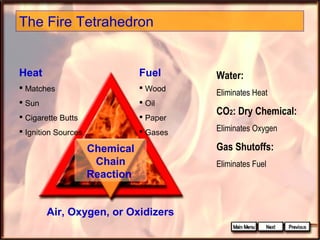
The Fire Tetrahedron

Heat

Fuel

 Matches

 Wood

 Sun

 Oil

 Cigarette Butts

 Paper

 Ignition Sources

 Gases

Chemical
Chain
Reaction
Air, Oxygen, or Oxidizers

Once a fire has
started it can only
be suppressed
when one of the
three elements is
removed, thus
stopping the
chemical chain
reaction.
The Fire Tetrahedron

Heat

Fuel

Water:

 Matches

 Wood

Eliminates Heat

 Sun

 Oil

 Cigarette Butts

 Paper

 Ignition Sources

 Gases

Chemical
Chain
Reaction
Air, Oxygen, or Oxidizers

CO2: Dry Chemical:
Eliminates Oxygen

Gas Shutoffs:
Eliminates Fuel
Fire Myths and Fire Truths: Visibility
Myth
Visibility is clear.

Kurt Russell in Backdraft
Other great Kurt Russell movies include Silkwood,
Tango & Cash, Tequila Sunrise, and Miracle.

Truth
Fires are dark.

Note that the firefighter in the
doorway cannot be seen.
Fire Myths and Fire Truths: Time
Myth
There is ample time.

Truth
There is little or no time.
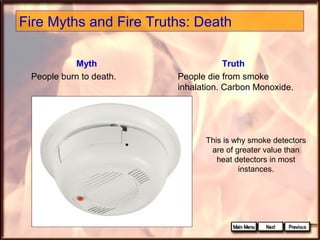
Fire Myths and Fire Truths: Death
Myth
People burn to death.

Truth
People die from smoke
inhalation. Carbon Monoxide.

This is why smoke detectors
are of greater value than
heat detectors in most
instances.
Classifications of Fire
Class A
Ordinary Combustibles
•
•
•

Paper
Wood
Plastics

Class A fires will generally leave an ash.
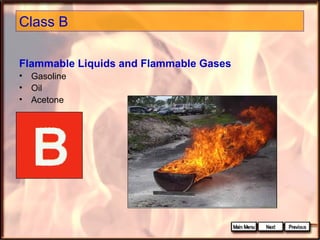
Class B
Flammable Liquids and Flammable Gases
•
•
•

Gasoline
Oil
Acetone
Class C
Class A or B Fires with an Electrical Hazard
•
•

Energized Electrical Equipment
Outlets
Class D
Combustible Metals
•
•
•

Potassium
Magnesium
Sodium
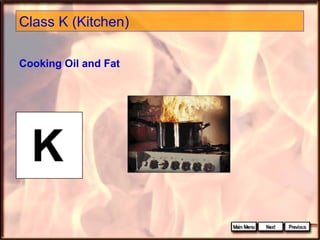
Class K (Kitchen)
Cooking Oil and Fat
Types of Fire Extinguishers
Class A
Water
•

Eliminates Heat
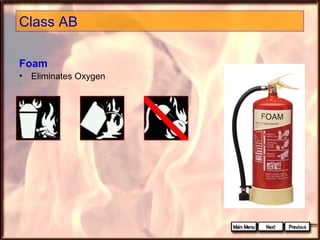
Class AB
Foam
•

Eliminates Oxygen
Class BC
CO2, Dry Chemical, or Halon
•

Eliminates Oxygen
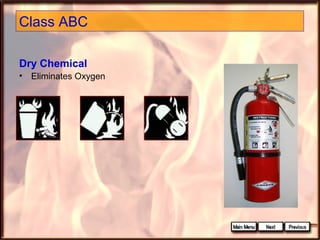
Class ABC
Dry Chemical
•

Eliminates Oxygen
Class D
Dry Powder
•

Eliminates Oxygen
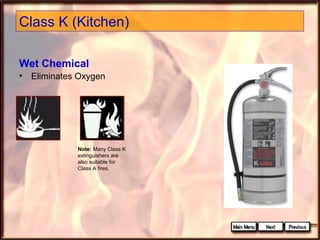
Class K (Kitchen)
Wet Chemical
•

Eliminates Oxygen

Note: Many Class K
extinguishers are
also suitable for
Class A fires.
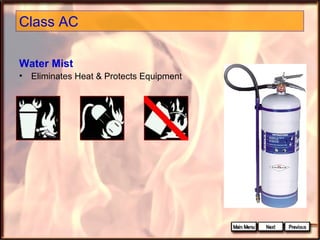
Class AC
Water Mist
•

Eliminates Heat & Protects Equipment
Using an Extinguisher
When To Use?
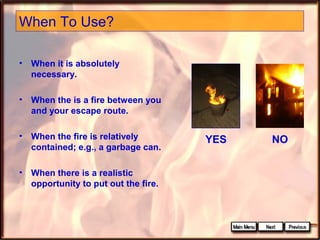
• When it is absolutely
necessary.
• When the is a fire between you
and your escape route.
• When the fire is relatively
contained; e.g., a garbage can.
• When there is a realistic
opportunity to put out the fire.

YES

NO
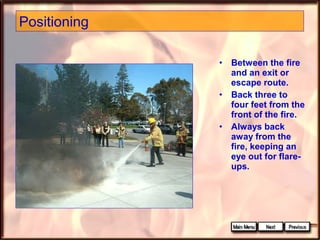
Positioning
•
•
•

Between the fire
and an exit or
escape route.
Back three to
four feet from the
front of the fire.
Always back
away from the
fire, keeping an
eye out for flareups.
P.A.S.S.

•
•
•
•

Pull the Pin
Aim (base & front of fire)
Squeeze (the handle)
Sweep (moving front to back)
Fire Alarm Systems
Alarm Activation
1.
2.
3.
4.
5.
6.

Pull Station
Heat Detector
Smoke Detector
Sprinkler
Electrician
Malfunction
Fire Suppression Systems
Hoses & Standpipes
• Hoses are a LAST resort.
• Standpipes are for fire
department use only. Do
not uncap them.
Sprinklers
• Individual sprinklers will activate when
heated to the appropriate temperature.
• Release about 75 to 150 liters/minute.
INERGEN®; Halon; CO2 Systems
• Deprive fires of oxygen.
• Dangerous for humans in such areas.
• LSC, Chemical Stores Facility, Tupper.
Fire Evacuation Procedures
Upon Hearing an Alarm
•
•
•
•
•
•
•

Exit the room.
Close the door behind you (leave unlocked).
Follow the wardens instructions.
Follow set evacuation routes.
Exit the building.
Keep back from the building (min 50m).
Wait for instructions from wardens, Dal
Security, or the HRM Fire Service.
If YOU Discover Fire
• Try and put out if it meets previous criteria.
• Close the door to the room and activate a
pull station.
• Exit the building.
• Give all information to wardens, Dal
Security, or HRM Fire Service.
Persons with Disabilities
• If you have a disability that prevents you
from leaving a building via stairwells, set
up a buddy-system.
• Stay in designated “shelter-in-place”
areas.
Re-Entering a Building
• DO NOT re-enter a building until given the
“OK” by the wardens, Dal Security, or the
HRM Fire Service.
The Law
• You MUST leave a building upon hearing
an alarm, even in the case of a fire alarm
drill.
• The Fire Service has the authority to fine
people who do not evacuate buildings.
Final Thoughts
Fires are Dangerous
• Treat fire and fire safety with respect.
• There are rarely second chances.
• Open flames are not permitted at
Dalhousie unless cleared through the
Safety Office.
Fires are Rare on Campus
• Dalhousie has had fires in the past, but
over the past decade they have been
small, with minimal damage and no
serious injuries or deaths.
• Small houses and buildings, prevalent at
Dalhousie, present the highest risk of fire.

Andrea Corrigan