AN AGILE MODELING TECHNIQUE USING THE SIXTH NORMAL FORM
     FOR STRUCTURALLY AND TEMPORALLY EVOLVING DATA
                      Lars Rönnbäck
                          [ER09]
“You can never step
     into the same river
     twice.”


2
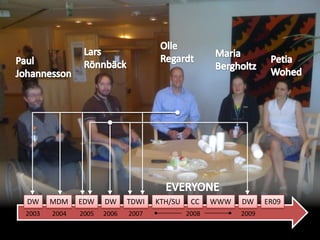
DW     MDM    EDW    DW     TDWI   KTH/SU    CC    WWW   DW     ER09
2003   2004   2005   2006   2007            2008         2009
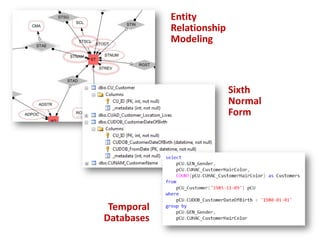
Entity
            Relationship
            Modeling


                           Sixth
                           Normal
                           Form


 Temporal
Databases
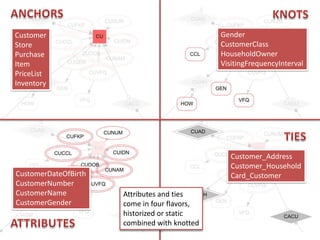
Customer                                      Gender
Store                                         CustomerClass
Purchase                                      HouseholdOwner
Item                                          VisitingFrequencyInterval
PriceList
Inventory


                                                 Customer_Address
                                                 Customer_Household
CustomerDateOfBirth                              Card_Customer
CustomerNumber
CustomerName          Attributes and ties
CustomerGender        come in four flavors,
                      historized or static
                      combined with knotted
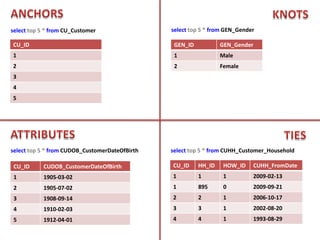
select top 5 * from CU_Customer                 select top 5 * from GEN_Gender

CU_ID                                            GEN_ID           GEN_Gender
1                                                1                Male
2                                                2                Female
3
4
5


select top 5 * from CUDOB_CustomerDateOfBirth   select top 5 * from CUHH_Customer_Household

 CU_ID     CUDOB_CustomerDateOfBirth            CU_ID     HH_ID    HOW_ID    CUHH_FromDate
 1         1905-03-02                           1         1        1         2009-02-13
 2         1905-07-02                           1         895      0         2009-09-21
 3         1908-09-14                           2         2        1         2006-10-17
 4         1910-02-03                           3         3        1         2002-08-20
 5         1912-04-01                           4         4        1         1993-08-29
1   2                                  3

4                         5


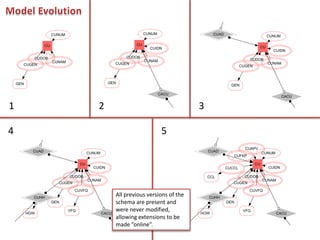
        All previous versions of the
        schema are present and
        were never modified,
        allowing extensions to be
        made ”online”.
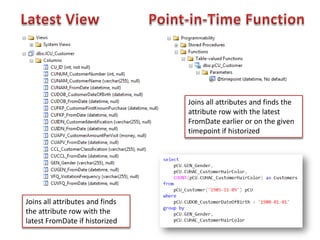
Joins all attributes and finds the
                                 attribute row with the latest
                                 FromDate earlier or on the given
                                 timepoint if historized


Joins all attributes and finds
the attribute row with the
latest FromDate if historized
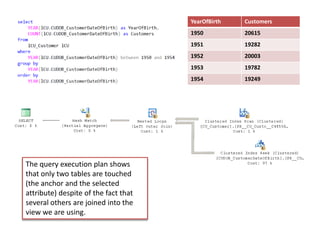
YearOfBirth   Customers
                                      1950          20615
                                      1951          19282
                                      1952          20003
                                      1953          19782
                                      1954          19249


The query execution plan shows
that only two tables are touched
(the anchor and the selected
attribute) despite of the fact that
several others are joined into the
view we are using.
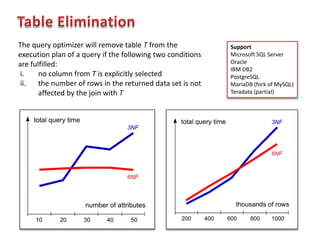
The query optimizer will remove table T from the            Support
execution plan of a query if the following two conditions   Microsoft SQL Server
are fulfilled:                                              Oracle
                                                            IBM DB2
 i.    no column from T is explicitly selected              PostgreSQL
 ii.   the number of rows in the returned data set is not   MariaDB (fork of MySQL)
       affected by the join with T                          Teradata (partial)
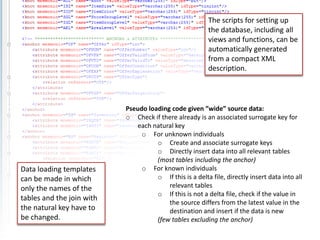
The scripts for setting up
                                                         the database, including all
                                                         views and functions, can be
                                                         automatically generated
                                                         from a compact XML
                                                         description.


                           Pseudo loading code given ”wide” source data:
                           o Check if there already is an associated surrogate key for
                              each natural key
                                o For unknown individuals
                                     o Create and associate surrogate keys
                                     o Directly insert data into all relevant tables
                                     (most tables including the anchor)
Data loading templates          o For known individuals
can be made in which                 o If this is a delta file, directly insert data into all
only the names of the                    relevant tables
                                     o If this is not a delta file, check if the value in
tables and the join with
                                         the source differs from the latest value in the
the natural key have to                  destination and insert if the data is new
be changed.                          (few tables excluding the anchor)
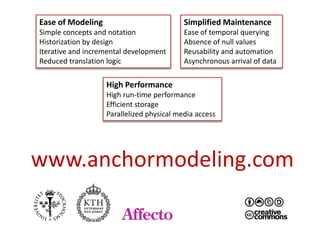
Ease of Modeling                           Simplified Maintenance
Simple concepts and notation               Ease of temporal querying
Historization by design                    Absence of null values
Iterative and incremental development      Reusability and automation
Reduced translation logic                  Asynchronous arrival of data

                   High Performance
                   High run-time performance
                   Efficient storage
                   Parallelized physical media access


www.anchormodeling.com

Anchor Modeling

  • 1.
    AN AGILE MODELINGTECHNIQUE USING THE SIXTH NORMAL FORM FOR STRUCTURALLY AND TEMPORALLY EVOLVING DATA Lars Rönnbäck [ER09]
  • 2.
    “You can neverstep into the same river twice.” 2
  • 3.
    DW MDM EDW DW TDWI KTH/SU CC WWW DW ER09 2003 2004 2005 2006 2007 2008 2009
  • 4.
    Entity Relationship Modeling Sixth Normal Form Temporal Databases
  • 5.
    Customer Gender Store CustomerClass Purchase HouseholdOwner Item VisitingFrequencyInterval PriceList Inventory Customer_Address Customer_Household CustomerDateOfBirth Card_Customer CustomerNumber CustomerName Attributes and ties CustomerGender come in four flavors, historized or static combined with knotted
  • 6.
    select top 5* from CU_Customer select top 5 * from GEN_Gender CU_ID GEN_ID GEN_Gender 1 1 Male 2 2 Female 3 4 5 select top 5 * from CUDOB_CustomerDateOfBirth select top 5 * from CUHH_Customer_Household CU_ID CUDOB_CustomerDateOfBirth CU_ID HH_ID HOW_ID CUHH_FromDate 1 1905-03-02 1 1 1 2009-02-13 2 1905-07-02 1 895 0 2009-09-21 3 1908-09-14 2 2 1 2006-10-17 4 1910-02-03 3 3 1 2002-08-20 5 1912-04-01 4 4 1 1993-08-29
  • 7.
    1 2 3 4 5 All previous versions of the schema are present and were never modified, allowing extensions to be made ”online”.
  • 8.
    Joins all attributesand finds the attribute row with the latest FromDate earlier or on the given timepoint if historized Joins all attributes and finds the attribute row with the latest FromDate if historized
  • 9.
    YearOfBirth Customers 1950 20615 1951 19282 1952 20003 1953 19782 1954 19249 The query execution plan shows that only two tables are touched (the anchor and the selected attribute) despite of the fact that several others are joined into the view we are using.
  • 10.
    The query optimizerwill remove table T from the Support execution plan of a query if the following two conditions Microsoft SQL Server are fulfilled: Oracle IBM DB2 i. no column from T is explicitly selected PostgreSQL ii. the number of rows in the returned data set is not MariaDB (fork of MySQL) affected by the join with T Teradata (partial)
  • 11.
    The scripts forsetting up the database, including all views and functions, can be automatically generated from a compact XML description. Pseudo loading code given ”wide” source data: o Check if there already is an associated surrogate key for each natural key o For unknown individuals o Create and associate surrogate keys o Directly insert data into all relevant tables (most tables including the anchor) Data loading templates o For known individuals can be made in which o If this is a delta file, directly insert data into all only the names of the relevant tables o If this is not a delta file, check if the value in tables and the join with the source differs from the latest value in the the natural key have to destination and insert if the data is new be changed. (few tables excluding the anchor)
  • 12.
    Ease of Modeling Simplified Maintenance Simple concepts and notation Ease of temporal querying Historization by design Absence of null values Iterative and incremental development Reusability and automation Reduced translation logic Asynchronous arrival of data High Performance High run-time performance Efficient storage Parallelized physical media access www.anchormodeling.com