1. What haveyou noticed with the picture
at first glance?
2. As you take a longer look, what other
details have you noticed?
3. What can you say about the boy and his
dog? What qualities do they have?
4. Do you think the picture is more
appealing if it is colored?
4.
Visual and multimediaelements are
used to catch the readers’ attention. They
also aid readers in understanding the text.
The following are examples of visual
elements:
5.
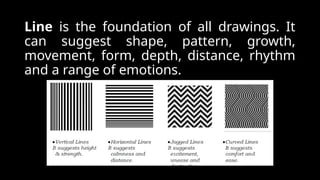
Line is thefoundation of all drawings. It
can suggest shape, pattern, growth,
movement, form, depth, distance, rhythm
and a range of emotions.
6.
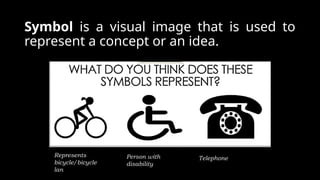
Symbol is avisual image that is used to
represent a concept or an idea.
Represents
bicycle/bicycle
lan
Person with
disability
Telephone
7.
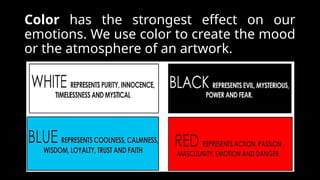
Color has thestrongest effect on our
emotions. We use color to create the mood
or the atmosphere of an artwork.
8.
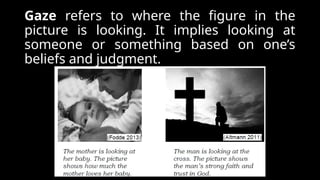
Gaze refers towhere the figure in the
picture is looking. It implies looking at
someone or something based on one’s
beliefs and judgment.
9.
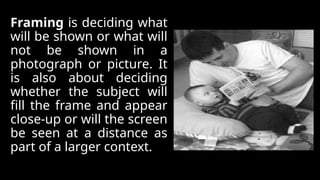
Framing is decidingwhat
will be shown or what will
not be shown in a
photograph or picture. It
is also about deciding
whether the subject will
fill the frame and appear
close-up or will the screen
be seen at a distance as
part of a larger context.
10.
The following areexamples of multimedia:
• Text is one of the basic elements of multimedia. It conveys
information to the audience, tell stories and describes things,
interpret graphics and charts, inform people about an event, or
tell something about a person.
• Graphics are part of visual presentation material. It displays
information graphically, which cannot be expressed in letters and
words.
• Animation is a collection of graphics applied with movement.
• Audio is produced by vibration as perceived by the sense of
hearing. In multimedia, audio could come in a form of speech,
sound effects and also music score.
• Video is a technology of capturing, recording, transmitting, and
reconstructing moving pictures.