Looking at Student work
to Improve Learning


  Vintage High School
   Staff Development
Why look collaboratively at
student work?
 To gain greater understanding of what
  students know and are able to do
 To embed meaningful professional
  development into the school schedule
 To foster a sense of community among
  the staff
 To develop across the curriculum a
  common language of expectations and
  standards
 To continue the metacognitive
  conversation among colleagues
 To build ways to assess student work
  and improve curriculum
 To prepare for our WASC report next
  year
 To engage in reflective practice
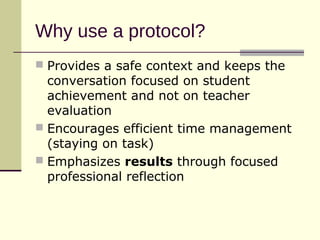
Why use a protocol?
 Provides a safe context and keeps the
  conversation focused on student
  achievement and not on teacher
  evaluation
 Encourages efficient time management
  (staying on task)
 Emphasizes results through focused
  professional reflection
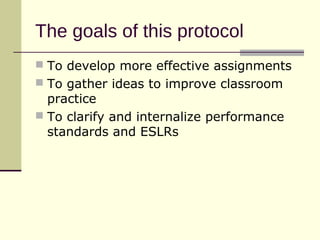
The goals of this protocol
 To develop more effective assignments
 To gather ideas to improve classroom
  practice
 To clarify and internalize performance
  standards and ESLRs
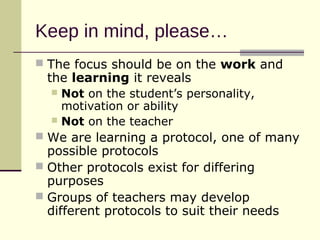
Keep in mind, please…
 The focus should be on the work and
  the learning it reveals
   Not on the student’s personality,
    motivation or ability
   Not on the teacher
 We are learning a protocol, one of many
  possible protocols
 Other protocols exist for differing
  purposes
 Groups of teachers may develop
  different protocols to suit their needs
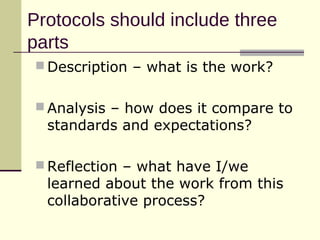
Protocols should include three
parts
 Description – what is the work?


 Analysis – how does it compare to
  standards and expectations?

 Reflection – what have I/we
  learned about the work from this
  collaborative process?
Before the meeting


Cover Sheet and Reflection
 for Student Work Samples
Description – Page 1
 Teacher, Department/Course, date
 Content Standards addressed
     List standards references and
      statements
 ESLR’s addressed
   Check off
   See reference list on back of last page
Describe the learning goal…
 Where does this lesson fit into the
  course? Is it part of a thematic unit?
  Is it an ongoing classroom routine?
  How does it connect with topics that
  precede and follow it? What was the
  sequence of learning activities?
 What should students learn and
  know how to do as a result of this
  learning opportunity?
 What materials were students given to
  work with? What were students asked
  to do with these materials?
 How were students grouped? What was
  their task? What did you do?
 How would students know the criteria
  for successful achievement of the
  lesson’s goals?
 What literacy support strategies did you
  use?
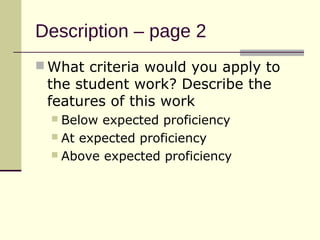
Description – page 2
 What criteria would you apply to
 the student work? Describe the
 features of this work
   Below expected proficiency
   At expected proficiency
   Above expected proficiency
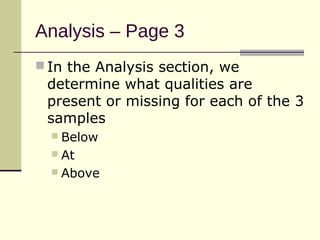
Analysis – Page 3
 In the Analysis section, we
 determine what qualities are
 present or missing for each of the 3
 samples
   Below
   At
   Above
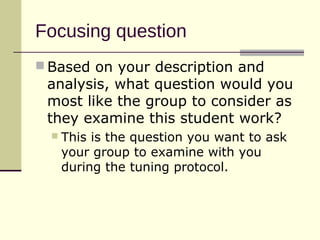
Focusing question
 Based on your description and
 analysis, what question would you
 most like the group to consider as
 they examine this student work?
     This is the question you want to ask
      your group to examine with you
      during the tuning protocol.
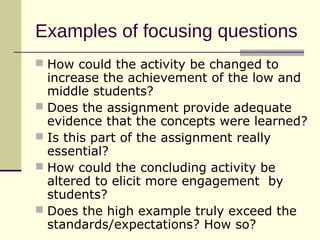
Examples of focusing questions
 How could the activity be changed to
  increase the achievement of the low and
  middle students?
 Does the assignment provide adequate
  evidence that the concepts were learned?
 Is this part of the assignment really
  essential?
 How could the concluding activity be
  altered to elicit more engagement by
  students?
 Does the high example truly exceed the
  standards/expectations? How so?
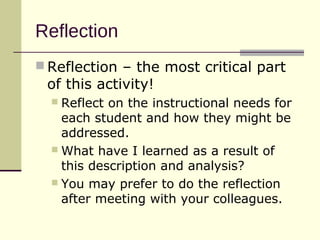
Reflection
 Reflection – the most critical part
 of this activity!
   Reflect on the instructional needs for
    each student and how they might be
    addressed.
   What have I learned as a result of
    this description and analysis?
   You may prefer to do the reflection
    after meeting with your colleagues.
Tuning Protocol


What to do in your group
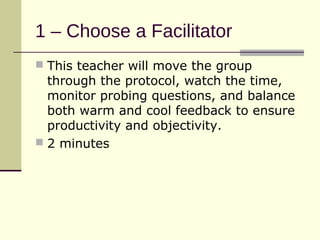
1 – Choose a Facilitator
 This teacher will move the group
  through the protocol, watch the time,
  monitor probing questions, and balance
  both warm and cool feedback to ensure
  productivity and objectivity.
 2 minutes
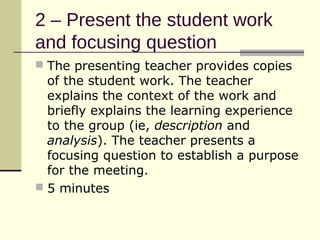
2 – Present the student work
and focusing question
 The presenting teacher provides copies
  of the student work. The teacher
  explains the context of the work and
  briefly explains the learning experience
  to the group (ie, description and
  analysis). The teacher presents a
  focusing question to establish a purpose
  for the meeting.
 5 minutes
3 – Ask clarifying questions
 The team asks clarifying questions. How
  long did students work on this
  assignment? Was a rubric involved?
  Clarifying questions should be precise
  and objective.
 3 minutes
4 – Examine the work samples
 The team quietly examines the sample
  work, making observation notes in
  silence. Participants should specifically
  focus upon the evidence of learning in
  the work.
 5 minutes
5 – Make inferences about
 learning; offer feedback
 The team uses evidence in the work to
  infer the students’ thinking,
  understanding and interpretation of the
  assignment. (The presenting teacher is
  silent throughout this step, but makes
  notes regarding comments heard). The
  team shares feedback (warm and cool).
  The team discusses the implications for
  teaching and assessment in the classroom
  in addition to identifying other kinds of
  assessments that could lead to more
  desirable qualities in the work.
 8 minutes
6 – Reflect on feedback
 The presenting teacher reflects upon
  what he or she has heard. The team is
  silent.
 2 minutes
7 – Debrief/Reflect
 The facilitator opens the discussion. Any
  speaker may contribute ideas,
  discoveries and “take-aways.” The
  group reflects orally upon the process of
  the protocol.
 5 minutes
Final Reflection
 At this point, the presenting teacher can
 go back to the work sample cover sheet
 to fill in the “Reflection” section.
   Some teachers may prefer to do the
    Reflection piece after the tuning protocol
   Others may want to do some reflection
    before and after the protocol
   Do what is most useful for you as an
    educator
Homework for March 14th
 At the next literacy training, we will
  meet in departmental groups to
  implement this protocol.
 You need to bring a work sample (the
  same one is ok), complete the cover
  sheet, and be prepared to go through
  the protocol with your department
  (some departments will subdivide into
  smaller groups).
 We will send out the cover sheet file via
  e-mail to the whole staff for future use
Thanks for your
participation today!

Analyzing student work ppt example vhs analysis of_student_work_samples

  • 1.
    Looking at Studentwork to Improve Learning Vintage High School Staff Development
  • 2.
    Why look collaborativelyat student work?  To gain greater understanding of what students know and are able to do  To embed meaningful professional development into the school schedule  To foster a sense of community among the staff  To develop across the curriculum a common language of expectations and standards
  • 3.
     To continuethe metacognitive conversation among colleagues  To build ways to assess student work and improve curriculum  To prepare for our WASC report next year  To engage in reflective practice
  • 4.
    Why use aprotocol?  Provides a safe context and keeps the conversation focused on student achievement and not on teacher evaluation  Encourages efficient time management (staying on task)  Emphasizes results through focused professional reflection
  • 5.
    The goals ofthis protocol  To develop more effective assignments  To gather ideas to improve classroom practice  To clarify and internalize performance standards and ESLRs
  • 6.
    Keep in mind,please…  The focus should be on the work and the learning it reveals  Not on the student’s personality, motivation or ability  Not on the teacher  We are learning a protocol, one of many possible protocols  Other protocols exist for differing purposes  Groups of teachers may develop different protocols to suit their needs
  • 7.
    Protocols should includethree parts  Description – what is the work?  Analysis – how does it compare to standards and expectations?  Reflection – what have I/we learned about the work from this collaborative process?
  • 8.
    Before the meeting CoverSheet and Reflection for Student Work Samples
  • 9.
    Description – Page1  Teacher, Department/Course, date  Content Standards addressed  List standards references and statements  ESLR’s addressed  Check off  See reference list on back of last page
  • 10.
    Describe the learninggoal…  Where does this lesson fit into the course? Is it part of a thematic unit? Is it an ongoing classroom routine? How does it connect with topics that precede and follow it? What was the sequence of learning activities?  What should students learn and know how to do as a result of this learning opportunity?
  • 11.
     What materialswere students given to work with? What were students asked to do with these materials?  How were students grouped? What was their task? What did you do?  How would students know the criteria for successful achievement of the lesson’s goals?  What literacy support strategies did you use?
  • 12.
    Description – page2  What criteria would you apply to the student work? Describe the features of this work  Below expected proficiency  At expected proficiency  Above expected proficiency
  • 13.
    Analysis – Page3  In the Analysis section, we determine what qualities are present or missing for each of the 3 samples  Below  At  Above
  • 14.
    Focusing question  Basedon your description and analysis, what question would you most like the group to consider as they examine this student work?  This is the question you want to ask your group to examine with you during the tuning protocol.
  • 15.
    Examples of focusingquestions  How could the activity be changed to increase the achievement of the low and middle students?  Does the assignment provide adequate evidence that the concepts were learned?  Is this part of the assignment really essential?  How could the concluding activity be altered to elicit more engagement by students?  Does the high example truly exceed the standards/expectations? How so?
  • 16.
    Reflection  Reflection –the most critical part of this activity!  Reflect on the instructional needs for each student and how they might be addressed.  What have I learned as a result of this description and analysis?  You may prefer to do the reflection after meeting with your colleagues.
  • 17.
    Tuning Protocol What todo in your group
  • 18.
    1 – Choosea Facilitator  This teacher will move the group through the protocol, watch the time, monitor probing questions, and balance both warm and cool feedback to ensure productivity and objectivity.  2 minutes
  • 19.
    2 – Presentthe student work and focusing question  The presenting teacher provides copies of the student work. The teacher explains the context of the work and briefly explains the learning experience to the group (ie, description and analysis). The teacher presents a focusing question to establish a purpose for the meeting.  5 minutes
  • 20.
    3 – Askclarifying questions  The team asks clarifying questions. How long did students work on this assignment? Was a rubric involved? Clarifying questions should be precise and objective.  3 minutes
  • 21.
    4 – Examinethe work samples  The team quietly examines the sample work, making observation notes in silence. Participants should specifically focus upon the evidence of learning in the work.  5 minutes
  • 22.
    5 – Makeinferences about learning; offer feedback  The team uses evidence in the work to infer the students’ thinking, understanding and interpretation of the assignment. (The presenting teacher is silent throughout this step, but makes notes regarding comments heard). The team shares feedback (warm and cool). The team discusses the implications for teaching and assessment in the classroom in addition to identifying other kinds of assessments that could lead to more desirable qualities in the work.  8 minutes
  • 23.
    6 – Reflecton feedback  The presenting teacher reflects upon what he or she has heard. The team is silent.  2 minutes
  • 24.
    7 – Debrief/Reflect The facilitator opens the discussion. Any speaker may contribute ideas, discoveries and “take-aways.” The group reflects orally upon the process of the protocol.  5 minutes
  • 25.
    Final Reflection  Atthis point, the presenting teacher can go back to the work sample cover sheet to fill in the “Reflection” section.  Some teachers may prefer to do the Reflection piece after the tuning protocol  Others may want to do some reflection before and after the protocol  Do what is most useful for you as an educator
  • 26.
    Homework for March14th  At the next literacy training, we will meet in departmental groups to implement this protocol.  You need to bring a work sample (the same one is ok), complete the cover sheet, and be prepared to go through the protocol with your department (some departments will subdivide into smaller groups).  We will send out the cover sheet file via e-mail to the whole staff for future use
  • 27.