ANALYTICAL PARAGRAPH
An analytical paragraph is a form descriptive
writing which is written on the basis of a given
chart, graph, data, outline, clues, table etc. When
writing an analytical paragraph, one should
remember to describe the facts in the best
possible manner and to cover the information
provided.
In short it is the art of interpreting , analysing and
writing the given data in a comparative and
reporting manner.
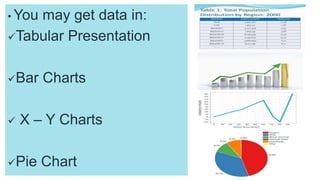
• You may get data in:
Tabular Presentation
Bar Charts
 X – Y Charts
Pie Chart
DIFFERENCE BETWEEN PARAGRAPH WRITING
& ANALYTICAL PARAGRAPH WRITING
Paragraph writing
• It can be written on
any topic.
• It has several sentences that deals
with a single subject.
Analytical Paragraph
• It studies and compiles a given set of
data and visual stimulus and frames
into a paragraph.
• Whereas it gives details of the
specified data in a precise, simple and
crisp manner.
FEATURES OF AN ANALYTICAL PARAGRAPH
1. It describes the given chart, table, data, graph, cues etc.
2. It should be brief and comprehensive (include complete information) at the same
time.
3. It should state facts that are provided by the chart.
4. It is necessary to make use of simple , comparative and accurate language.
5. It should mention figures and quantities appropriately.
6. It is appropriate to use the same tense throughout the analytical paragraph.
7. No personal observation or response should be provided.
8. It would be preferable to use the passive form of the verb.
FORMAT OF AN ANALYTICAL PARAGRAPH
• An analytical paragraph shall be divided into three parts -
1. Introduction
2. Body of the paragraph and;
3. Conclusion
INTRODUCTION
• The introduction is the first paragraph that should describe in brief what the graph
is about.
• need not go into the details.
• It is best to write the introduction in one or two lines.
• Suggestive opening lines:
 The chart given above describes
 The table suggests
 The line graph shows
 The data given provides information about
 The pie chart illustrates, etc.
THE BODY OF THE PARAGRAPH
This part of the analytical paragraph should contain details of the graph/chart given
in the question. It should contain all the important information. It is extremely
important to choose the significant details that should be included in the paragraph.
The body can be broken into two or three sub-paragraphs depending on the
information extracted from the graph.
i. Organising information
ii. Comparing information
iii. Connecting sentences
to do so:
WORDS AND PHRASES THAT HELP US
For describing trends, use phrases and words like- pattern of growth, rapidly
doubled, skyrocketed, striking increase, peaked, soaring rates, declined, plummeted,
levelled off, stagnated, fluctuate, starting to rise, starting to fall, drop down, slightly,
etc.
For describing quantities, use various styles like- 48% of, one-third of, nearly one-
fourth of, almost 80%, majority, on average, twice as much, almost equal, the
highest, the lowest, very close to 2%, roughly, approximately 5% of, just under three
per cent, etc.
For establishing relationship or contrast, use phrases and words like- relationship
between, similarly, in contrast with, in comparison to, but in the opposite case,
however, whereas, when it comes to, as opposed to, while, striking difference,
noticeable difference, etc.
For conclusion and other connecting phrases use- overall, subsequently, in all, in
a nutshell, for the chart given, in short, striking changes, including, therefore, etc.
CONCLUSION
The last paragraph should summaries the idea mentioned and the information in
general. It should be concluding in nature and act as the closing statement. One
should keep in the mind that one must not include any personal opinions,
conclusions or observations. You should simply stick to the facts.
The key is to choose wisely the important information,
organise it well, state correct facts and summaries it
properly.
SAMPLE
QUESTION

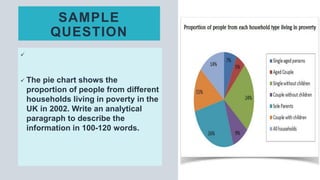
 The pie chart shows the
proportion of people from different
households living in poverty in the
UK in 2002. Write an analytical
paragraph to describe the
information in 100-120 words.
ANSWER
The given pie chart illustrates seven different categories of households living in
poverty in the UK in 2002.
It is clearly evident from the pie chart that 26% of the total poverty-stricken households
are those of sole parents. Single people without children account for the second
highest proportion with 24%. In contrast to couples without children that accounts for
just 9%, couples with children account for 15% of the poor households. Single aged
persons and aged couples proportion for 12% together for poor households.
Overall, 14% of all households in the UK were living under poverty. The younger
generation had a greater poor percentage than their aged counterparts. Couples
without children had better economic conditions than those with children.
ANALYTICAL PARAGRAPH-1.pptx

ANALYTICAL PARAGRAPH-1.pptx

  • 1.
  • 2.
    An analytical paragraphis a form descriptive writing which is written on the basis of a given chart, graph, data, outline, clues, table etc. When writing an analytical paragraph, one should remember to describe the facts in the best possible manner and to cover the information provided. In short it is the art of interpreting , analysing and writing the given data in a comparative and reporting manner.
  • 3.
    • You mayget data in: Tabular Presentation Bar Charts  X – Y Charts Pie Chart
  • 4.
    DIFFERENCE BETWEEN PARAGRAPHWRITING & ANALYTICAL PARAGRAPH WRITING Paragraph writing • It can be written on any topic. • It has several sentences that deals with a single subject. Analytical Paragraph • It studies and compiles a given set of data and visual stimulus and frames into a paragraph. • Whereas it gives details of the specified data in a precise, simple and crisp manner.
  • 5.
    FEATURES OF ANANALYTICAL PARAGRAPH 1. It describes the given chart, table, data, graph, cues etc. 2. It should be brief and comprehensive (include complete information) at the same time. 3. It should state facts that are provided by the chart. 4. It is necessary to make use of simple , comparative and accurate language. 5. It should mention figures and quantities appropriately. 6. It is appropriate to use the same tense throughout the analytical paragraph. 7. No personal observation or response should be provided. 8. It would be preferable to use the passive form of the verb.
  • 6.
    FORMAT OF ANANALYTICAL PARAGRAPH • An analytical paragraph shall be divided into three parts - 1. Introduction 2. Body of the paragraph and; 3. Conclusion
  • 7.
    INTRODUCTION • The introductionis the first paragraph that should describe in brief what the graph is about. • need not go into the details. • It is best to write the introduction in one or two lines. • Suggestive opening lines:  The chart given above describes  The table suggests  The line graph shows  The data given provides information about  The pie chart illustrates, etc.
  • 8.
    THE BODY OFTHE PARAGRAPH This part of the analytical paragraph should contain details of the graph/chart given in the question. It should contain all the important information. It is extremely important to choose the significant details that should be included in the paragraph. The body can be broken into two or three sub-paragraphs depending on the information extracted from the graph. i. Organising information ii. Comparing information iii. Connecting sentences to do so:
  • 9.
    WORDS AND PHRASESTHAT HELP US For describing trends, use phrases and words like- pattern of growth, rapidly doubled, skyrocketed, striking increase, peaked, soaring rates, declined, plummeted, levelled off, stagnated, fluctuate, starting to rise, starting to fall, drop down, slightly, etc. For describing quantities, use various styles like- 48% of, one-third of, nearly one- fourth of, almost 80%, majority, on average, twice as much, almost equal, the highest, the lowest, very close to 2%, roughly, approximately 5% of, just under three per cent, etc. For establishing relationship or contrast, use phrases and words like- relationship between, similarly, in contrast with, in comparison to, but in the opposite case, however, whereas, when it comes to, as opposed to, while, striking difference, noticeable difference, etc. For conclusion and other connecting phrases use- overall, subsequently, in all, in a nutshell, for the chart given, in short, striking changes, including, therefore, etc.
  • 10.
    CONCLUSION The last paragraphshould summaries the idea mentioned and the information in general. It should be concluding in nature and act as the closing statement. One should keep in the mind that one must not include any personal opinions, conclusions or observations. You should simply stick to the facts. The key is to choose wisely the important information, organise it well, state correct facts and summaries it properly.
  • 11.
    SAMPLE QUESTION   The piechart shows the proportion of people from different households living in poverty in the UK in 2002. Write an analytical paragraph to describe the information in 100-120 words.
  • 12.
    ANSWER The given piechart illustrates seven different categories of households living in poverty in the UK in 2002. It is clearly evident from the pie chart that 26% of the total poverty-stricken households are those of sole parents. Single people without children account for the second highest proportion with 24%. In contrast to couples without children that accounts for just 9%, couples with children account for 15% of the poor households. Single aged persons and aged couples proportion for 12% together for poor households. Overall, 14% of all households in the UK were living under poverty. The younger generation had a greater poor percentage than their aged counterparts. Couples without children had better economic conditions than those with children.