ANALYTICAL
PARAGRAPH
BY SUNITA MURGHAI
58
%
23
%
10
%
9
%
0
1
2
6
5
4
3
WHAT IS AN ANALYTICAL
PARAGRAPH?
Analytical Paragraph writing - An analytical paragraph is a form of descriptive writing
which is written on the basis of a given chart, graph, data, outline, clues, table, etc.
When writing an analytical paragraph, one should remember to describe the facts in the
best possible manner and to cover the information provided.
6
5
4
3
2
1
0
Category
1
Category
2
Category
3
Category
4
Features of an analytical paragraph writing-
 It describes the given chart, table, data, graph, cues etc.
 It should be brief and comprehensive (include complete information) at the
same time.
 It should state facts that are provided by the chart.
 It is necessary to make use of simple and accurate language.
 It should mention figures and quantities appropriately.
 It is appropriate to use the same tense throughout the analytical paragraph.
 No personal observation or response should be provided.
 It would be preferable to use the passive form of the verb.
Format of Analytical Paragraph
An analytical paragraph shall be divided into three parts-
i. Introduction
ii.Body of the paragraph and;
iii.Conclusion
THE INTRODUCTION
The introduction is the first paragraph that should describe in brief what
the graph is about. It should be like an opening paragraph that
introduces the reader to the context of the chart given. When writing the
introductory paragraph, you need not go into the details. You just need
to mention what is clearly evident from the chart or the graph given in
the question. It is best to write the introduction in one or two lines.
THE BODY OF THE
PARAGRAPH
This part of the analytical paragraph should contain details of the
graph/chart given in the question. It should contain all the important
information. It is extremely important to choose the significant details
that should be included in the paragraph.
The body can be broken into two or three sub-paragraphs depending on
the information extracted from the graph.
Breaking the body into subparagraphs makes it easy for the reader to
understand.
i. Organizing information: You should look for the large
differences that are very prominent. You can mention the
aspect which is the smallest or the largest in the data given.
Any aspects that are similar should be mentioned next. You
should further mention about the aspect that has remained
unchanged or constant throughout.
ii. Comparing information: If the chart mentions two different
parties, for example, men and women, refer to both of them
in the analytical paragraph. If there is any contrast or
comparison that could be drawn, you must present it
effectively. If the chart is about a particular time period or
highlights trends of several years, mention each year in a
concise manner. If any comparison or contrast can be done
for two or more years, you should write about it too.
iii. Mentioning quantities: When including numbers and
figures, their accuracy must be ensured. There are a number
of ways that can be used to describe quantities, for
example- percentage, fraction, ratios, etc.
iv. Connecting sentences: If different information or ideas are
there, you should use connectors or linking phrases to link
them logically. The sentences of the paragraph should be
sequential and connected rationally.
The last paragraph should summarize the idea mentioned and the
information in general. It should be concluding in nature and act as
the closing statement. One should keep in mind that one must not
include any personal opinions, conclusions, or observations. You
should simply stick to the facts.
THE CONCLUSION
i. For an introduction, you can start with the following phrases-
a) The chart given above describes
b) The table suggests
c) The line graph shows
d) The data given provides information about
e) The pie chart illustrates, etc.
USEFUL TIPS FOR WRITING AN
ANALYTICAL PARAGRAPH
ii. For describing trends, use phrases and words like- a pattern of
growth, rapidly doubled, skyrocketed, striking increase,
peaked, soaring rates, declined, plummeted, leveled off,
stagnated, fluctuate, starting to rise, starting to fall, drop down,
slightly, etc.
iii. For describing quantities, use various styles like- 48% of,
one-third of, nearly one-fourth of, almost 80%, majority, on
average, twice as much, almost equal, the highest, the lowest,
very close to 2%, roughly, approximately 5% of, just under
three percent, etc.
iv. For establishing a relationship or contrast, use phrases
and words like- relationship between, similarly, in contrast
with, in comparison to, but in the opposite case, however,
whereas, when it comes to, as opposed to, while, striking
difference, noticeable difference, etc.
v. For the conclusion and other connecting phrases use-
overall, subsequently, in all, in a nutshell, for the chart
given, in short, striking changes, including, therefore, etc.
SOLVED EXAMPLE
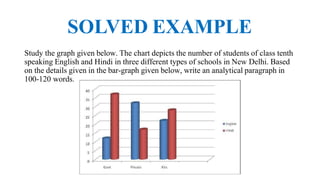
Study the graph given below. The chart depicts the number of students of class tenth
speaking English and Hindi in three different types of schools in New Delhi. Based
on the details given in the bar-graph given below, write an analytical paragraph in
100-120 words.
SOLUTION
The chart depicts the number of students of class tenth speaking English and Hindi
in three different types of schools in New Delhi.
The chart clearly illustrates that the number of students speaking Hindi in
government schools is almost 3.5 times greater than the students who speak English.
In contrast, two-third of the total students in private schools prefer to speak in
English. In KVs there is a slight difference between the choice of two languages,
with Hindi being spoken by 55% of students.
On comparing the three type of given schools, government schools have the highest
number of Hindi speakers. Private schools are at the highest position among English
speakers.
In a nutshell, Private school students prefer to speak English whereas government
school students choose Hindi over English to communicate. Students are almost
evenly distributed in kvs on the basis of the language spoken.
UNSOLVED EXAMPLES
EXAMPLE 1: The pie chart shows the proportion of people from
different households living in poverty in the UK in 2002. Write an
analytical paragraph to describe the information in 100-120 words.
EXAMPLE 2: The following table shows details about the internet
activities for six categories for different age groups. Write an analytical
paragraph for the table given in around 150-200 words.

_______________Analytical_Paragraph.pptx

  • 1.
  • 2.
    WHAT IS ANANALYTICAL PARAGRAPH? Analytical Paragraph writing - An analytical paragraph is a form of descriptive writing which is written on the basis of a given chart, graph, data, outline, clues, table, etc. When writing an analytical paragraph, one should remember to describe the facts in the best possible manner and to cover the information provided. 6 5 4 3 2 1 0 Category 1 Category 2 Category 3 Category 4
  • 3.
    Features of ananalytical paragraph writing-  It describes the given chart, table, data, graph, cues etc.  It should be brief and comprehensive (include complete information) at the same time.  It should state facts that are provided by the chart.  It is necessary to make use of simple and accurate language.  It should mention figures and quantities appropriately.  It is appropriate to use the same tense throughout the analytical paragraph.  No personal observation or response should be provided.  It would be preferable to use the passive form of the verb.
  • 4.
    Format of AnalyticalParagraph An analytical paragraph shall be divided into three parts- i. Introduction ii.Body of the paragraph and; iii.Conclusion
  • 5.
    THE INTRODUCTION The introductionis the first paragraph that should describe in brief what the graph is about. It should be like an opening paragraph that introduces the reader to the context of the chart given. When writing the introductory paragraph, you need not go into the details. You just need to mention what is clearly evident from the chart or the graph given in the question. It is best to write the introduction in one or two lines.
  • 6.
    THE BODY OFTHE PARAGRAPH This part of the analytical paragraph should contain details of the graph/chart given in the question. It should contain all the important information. It is extremely important to choose the significant details that should be included in the paragraph. The body can be broken into two or three sub-paragraphs depending on the information extracted from the graph. Breaking the body into subparagraphs makes it easy for the reader to understand.
  • 7.
    i. Organizing information:You should look for the large differences that are very prominent. You can mention the aspect which is the smallest or the largest in the data given. Any aspects that are similar should be mentioned next. You should further mention about the aspect that has remained unchanged or constant throughout. ii. Comparing information: If the chart mentions two different parties, for example, men and women, refer to both of them in the analytical paragraph. If there is any contrast or comparison that could be drawn, you must present it effectively. If the chart is about a particular time period or highlights trends of several years, mention each year in a concise manner. If any comparison or contrast can be done for two or more years, you should write about it too.
  • 8.
    iii. Mentioning quantities:When including numbers and figures, their accuracy must be ensured. There are a number of ways that can be used to describe quantities, for example- percentage, fraction, ratios, etc. iv. Connecting sentences: If different information or ideas are there, you should use connectors or linking phrases to link them logically. The sentences of the paragraph should be sequential and connected rationally.
  • 9.
    The last paragraphshould summarize the idea mentioned and the information in general. It should be concluding in nature and act as the closing statement. One should keep in mind that one must not include any personal opinions, conclusions, or observations. You should simply stick to the facts. THE CONCLUSION
  • 10.
    i. For anintroduction, you can start with the following phrases- a) The chart given above describes b) The table suggests c) The line graph shows d) The data given provides information about e) The pie chart illustrates, etc. USEFUL TIPS FOR WRITING AN ANALYTICAL PARAGRAPH
  • 11.
    ii. For describingtrends, use phrases and words like- a pattern of growth, rapidly doubled, skyrocketed, striking increase, peaked, soaring rates, declined, plummeted, leveled off, stagnated, fluctuate, starting to rise, starting to fall, drop down, slightly, etc. iii. For describing quantities, use various styles like- 48% of, one-third of, nearly one-fourth of, almost 80%, majority, on average, twice as much, almost equal, the highest, the lowest, very close to 2%, roughly, approximately 5% of, just under three percent, etc.
  • 12.
    iv. For establishinga relationship or contrast, use phrases and words like- relationship between, similarly, in contrast with, in comparison to, but in the opposite case, however, whereas, when it comes to, as opposed to, while, striking difference, noticeable difference, etc. v. For the conclusion and other connecting phrases use- overall, subsequently, in all, in a nutshell, for the chart given, in short, striking changes, including, therefore, etc.
  • 13.
    SOLVED EXAMPLE Study thegraph given below. The chart depicts the number of students of class tenth speaking English and Hindi in three different types of schools in New Delhi. Based on the details given in the bar-graph given below, write an analytical paragraph in 100-120 words.
  • 14.
    SOLUTION The chart depictsthe number of students of class tenth speaking English and Hindi in three different types of schools in New Delhi. The chart clearly illustrates that the number of students speaking Hindi in government schools is almost 3.5 times greater than the students who speak English. In contrast, two-third of the total students in private schools prefer to speak in English. In KVs there is a slight difference between the choice of two languages, with Hindi being spoken by 55% of students. On comparing the three type of given schools, government schools have the highest number of Hindi speakers. Private schools are at the highest position among English speakers. In a nutshell, Private school students prefer to speak English whereas government school students choose Hindi over English to communicate. Students are almost evenly distributed in kvs on the basis of the language spoken.
  • 15.
    UNSOLVED EXAMPLES EXAMPLE 1:The pie chart shows the proportion of people from different households living in poverty in the UK in 2002. Write an analytical paragraph to describe the information in 100-120 words.
  • 16.
    EXAMPLE 2: Thefollowing table shows details about the internet activities for six categories for different age groups. Write an analytical paragraph for the table given in around 150-200 words.