1
STEM
2
What is STEM?
STEM education grows out of the idea that
the boundaries between science, technology,
engineering, and math are permeable
permeable.
Moreover, it asserts that its four disciplines
are interdependent
interdependent.
 By endeavoring to blend
blend science,
technology, engineering, and math in its
approach, STEM education seeks to create
21st century learning opportunities
opportunities and skill
development for all
all students.
3
National STEM Crisis
U.S. behind
behind in student indicators.
Foreign nationals ahead
ahead in jobs and
degrees.
Urban
Urban students are falling behind.
Many plans exist to address this.
New national STEM Initiative addresses
programs and teachers.
4
The Future
75 %
75 % of jobs will be in STEM
Not just
just STEM careers,
it is STEM in every
every job
Technology
Technology as a “global knowledge
economy” is the future
future, and it requires
different skills.
Business and industry want
want employees
with these skills!
5
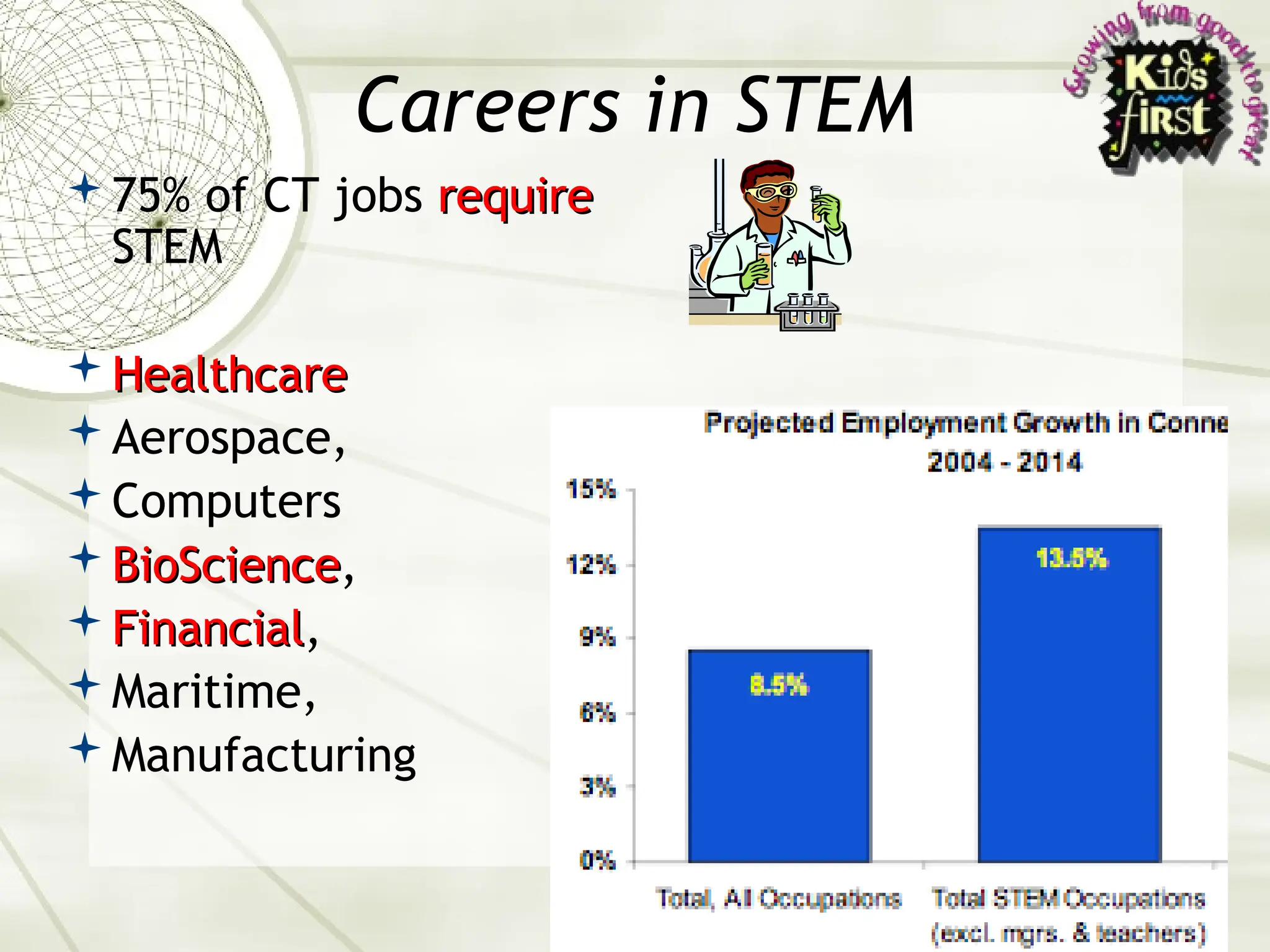
Careers in STEM
75% of CT jobs require
require
STEM
Healthcare
Healthcare
Aerospace,
Computers
BioScience
BioScience,
Financial
Financial,
Maritime,
Manufacturing
6
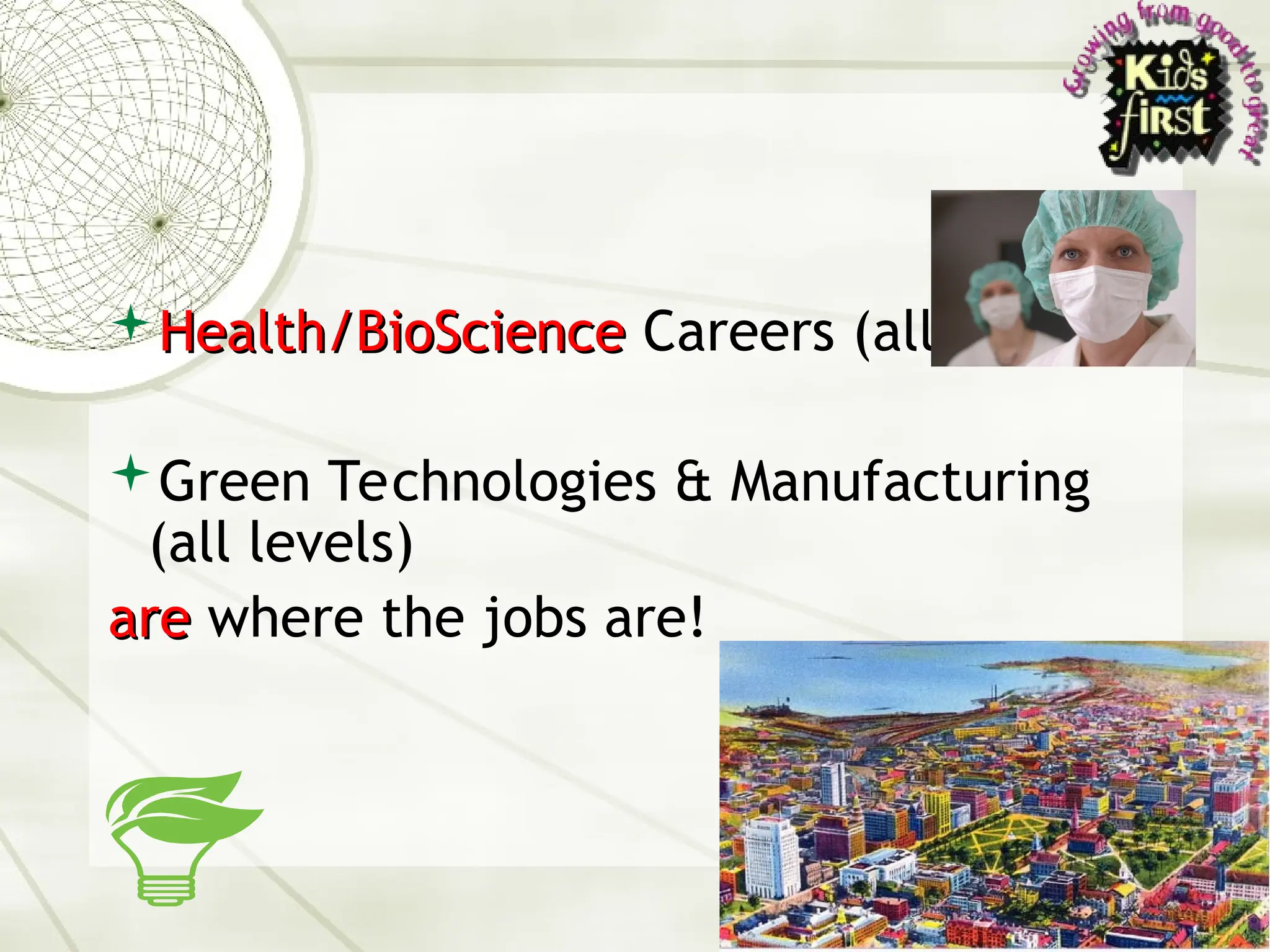
Health/BioScience
Health/BioScience Careers (all levels)
Green Technologies & Manufacturing
(all levels)
are
are where the jobs are!
Why is
STEM Education so
Important?
8
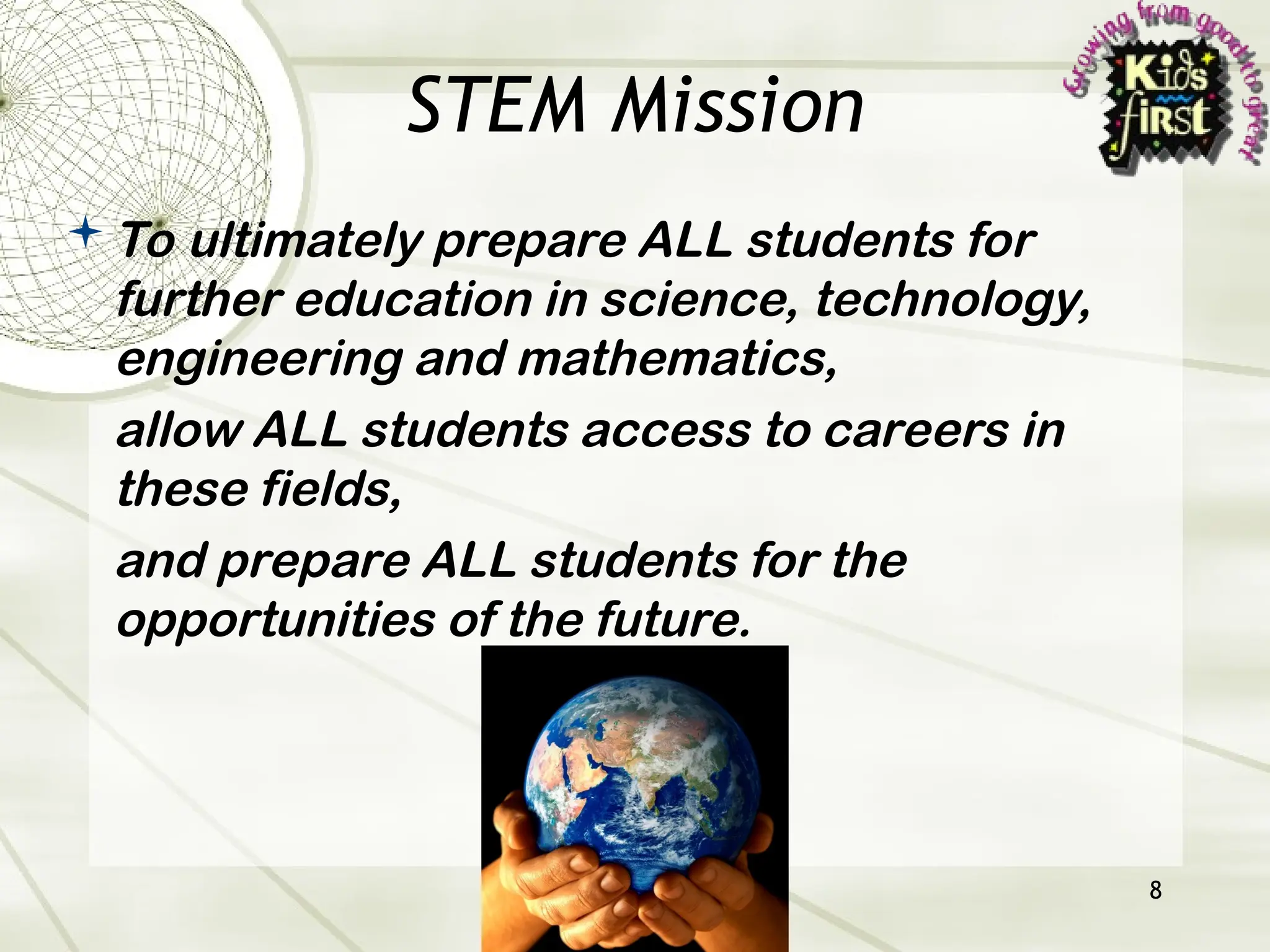
STEM Mission
To ultimately prepare ALL students for
further education in science, technology,
engineering and mathematics,
allow ALL students access to careers in
these fields,
and prepare ALL students for the
opportunities of the future.
STEM CHALLENGE
Exploring Solar Energy
Thought Questions:
1. What is Solar Energy
2. How is Solar Energy useful? (Hint: Solar Power)
3. What are some careers in solar technology?
Experimentation
Photovoltaic Cells (PV Cell Lab)
9

An overview of STEM education- Science, Technology, Engineering and Mathematics

  • 1.
  • 2.
    2 What is STEM? STEMeducation grows out of the idea that the boundaries between science, technology, engineering, and math are permeable permeable. Moreover, it asserts that its four disciplines are interdependent interdependent.  By endeavoring to blend blend science, technology, engineering, and math in its approach, STEM education seeks to create 21st century learning opportunities opportunities and skill development for all all students.
  • 3.
    3 National STEM Crisis U.S.behind behind in student indicators. Foreign nationals ahead ahead in jobs and degrees. Urban Urban students are falling behind. Many plans exist to address this. New national STEM Initiative addresses programs and teachers.
  • 4.
    4 The Future 75 % 75% of jobs will be in STEM Not just just STEM careers, it is STEM in every every job Technology Technology as a “global knowledge economy” is the future future, and it requires different skills. Business and industry want want employees with these skills!
  • 5.
    5 Careers in STEM 75%of CT jobs require require STEM Healthcare Healthcare Aerospace, Computers BioScience BioScience, Financial Financial, Maritime, Manufacturing
  • 6.
    6 Health/BioScience Health/BioScience Careers (alllevels) Green Technologies & Manufacturing (all levels) are are where the jobs are!
  • 7.
    Why is STEM Educationso Important?
  • 8.
    8 STEM Mission To ultimatelyprepare ALL students for further education in science, technology, engineering and mathematics, allow ALL students access to careers in these fields, and prepare ALL students for the opportunities of the future.
  • 9.
    STEM CHALLENGE Exploring SolarEnergy Thought Questions: 1. What is Solar Energy 2. How is Solar Energy useful? (Hint: Solar Power) 3. What are some careers in solar technology? Experimentation Photovoltaic Cells (PV Cell Lab) 9

Editor's Notes

  • #2 Richard Therrien, Science Supervisor http://teachers.discoveryeducation.com/stem/
  • #3 U.S is behind in STEM indicators of student performance :Since “A Nation at Risk”, many nationwide reports and initiatives have pointed to the STEM crisis. Our national science and math scores place us in the middle, at best.TIMMS 2007 science scores…. 8th place in grade 4, 11th place in grade 11. -Rising Above the Gathering Storm: Energizing and Employing America to a Brighter Economic Future, National Academy of Sciences, 2007, http://www.nap.edu/execsumm_pdf/11463.pdf -Rising Above the Gathering Storm, Two Years Later, http://www.nap.edu/catalog.php?record_id=12537 -A National Action Plan for Addressing the Critical Needs of the U.S. Science, Technology, Engineering, and Mathematics Education System, National Science Board, October 2007 http://www.nsf.gov/nsb/documents/2007/stem_action.pdf 75% of temporary foreign workers are in STEM fields, and over 1/3 of advanced STEM degrees go to foreign nationals. -“The Quiet Crisis”, Falling Short in Producing American Scientific and Technical Talent report. http://www.bestworkforce.org/PDFdocs/Quiet_Crisis.pdf , only 10% of STEM jobs are held by minorities. -The Science And Engineering Workforce Realizing America’s Potential, National Science Foundation, August 2003, http://www.nsf.gov/nsb/documents/2003/nsb0369/nsb0369.pdf http://www.whitehouse.gov/issues/education/educate-innovate Purpose is to: Increase STEM literacy so that all students can learn deeply and think critically in science, math, engineering, and technology.Move American students from the middle of the pack to top in the next decade.Expand STEM education and career opportunities for underrepresented groups, including women and girls. Includes many partnerships with industry and focuses on scholarships, preparation of teachers and professional development. -STEM Education Caucus, http://www.stemedcaucus.org/
  • #4 We know that the top 10 in-demand jobs in 2010 did not exist in 2004. The U.S. Department of Labor estimates that today's learner will have 10-14 jobs by the age of 38. The amount of new technical information is doubling every 2 years For students starting a 4 year technical degree this means that half of what they learn in their first year of study will be outdated by their third year of study.We are currently preparing students for jobs that dont yet exist using technologies that haven't been invented in order to solve problems WE DON'T EVEN KNOW ARE PROBLEMS YET. Kids now spend 6.5 hours a day interacting with technology The need is for accessing information, collaborating, analyzing and synthesizing, not memorizing. Recent reports show that top STEM performing high school students go into jobs that may not be classified as STEM, but use those skills, http://www.edweek.org/ew/articles/2009/10/28/10engineer.h29.html Need for Diversity Making a Case for Diversity in STEM Fields, Daryl Chubin, Shirley Malcom, November 2008, http://mentornet.net/documents/about/news/newsart.aspx?nid=37&sid=2 Tapping America’s Potential: The Education For Innovation Initiative, Gaining Momentum, Losing Ground , Business Roundatable, July 2008, http://www.tap2015.org/resource/tap_2008_progress.pdf
  • #5 Math & Science Knowledge and Skills: Catalysts for Future Economic Growth Within Connecticut, CT Department of Labor, 2006, http://www.ctdol.state.ct.us/lmi/pubs/math_science.pdf states that over 75% of the top 100 fastest growing jobs will be derived from fields that require a basic or advanced knowledge of math, science, or engineering principles. Especially key is the knowledge gap in fields that require mathematics skills. Connecticut Careers in Science, Technology, Engineering, and Mathematics (STEM), CT Department of Labor, August 2008, http://www.ctdol.state.ct.us/lmi/pubs/STEM_2008aug.pdf Computers and Engineers are among the fastest growing, and highest paying STEM occupations. More than 2/3 of STEM occupations require a bachelor’s degree. CT has a higher percentage of STEM employment than the U.S.