












An overview of blending
Submitted as final assignment for “Financing for
Development” Massive Open Online Course
(MOOC) offered by World Bank Group
Rohan Kumar Ramayad
Introduction
Introduction
Watch the video Blended Finance |
The Road to Addis and Beyond at
https://youtu.be/Bc0g7HspRw4
Definition
Definition
 Blending refers the combination of
grant with loans or equity from public
and private financiers.
Definition
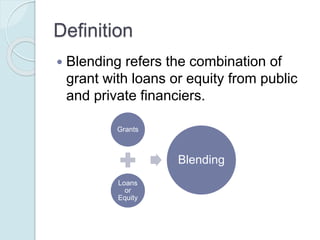
 Blending refers the combination of
grant with loans or equity from public
and private financiers.
Grants
Loans
or
Equity
Blending
Types of Blended Finance:
Mustapha et al (2014) identifies the
following forms of blended finance:
Types of Blended Finance:
Mustapha et al (2014) identifies the
following forms of blended finance:
 Direct grants
Types of Blended Finance:
Mustapha et al (2014) identifies the
following forms of blended finance:
 Direct grants
 Conditionality/performance-based grants
Types of Blended Finance:
Mustapha et al (2014) identifies the
following forms of blended finance:
 Direct grants
 Conditionality/performance-based grants
 Interest Rate Subsidy
Types of Blended Finance:
Mustapha et al (2014) identifies the
following forms of blended finance:
 Direct grants
 Conditionality/performance-based grants
 Interest Rate Subsidy
 Guarantee/risk-sharing products
Types of Blended Finance:
Mustapha et al (2014) identifies the
following forms of blended finance:
 Direct grants
 Conditionality/performance-based grants
 Interest Rate Subsidy
 Guarantee/risk-sharing products
 Structured finance − first loss financing
Types of Blended Finance:
Mustapha et al (2014) identifies the
following forms of blended finance:
 Direct grants
 Conditionality/performance-based grants
 Interest Rate Subsidy
 Guarantee/risk-sharing products
 Structured finance − first loss financing
 Technical assistance
Types of Blended Finance:
Mustapha et al (2014) identifies the
following forms of blended finance:
 Direct grants
 Conditionality/performance-based grants
 Interest Rate Subsidy
 Guarantee/risk-sharing products
 Structured finance − first loss financing
 Technical assistance
 Risk capital
Examples of blending facilities:
 Accelerated Co-financing Facility for Africa
(ACFA)
Examples of blending facilities:
 Accelerated Co-financing Facility for Africa
(ACFA)
 EU-Africa Infrastructure Trust Fund
Examples of blending facilities:
 Accelerated Co-financing Facility for Africa
(ACFA)
 EU-Africa Infrastructure Trust Fund
 Global Index Insurance Facility (GIIF)
Examples of blending facilities:
 Accelerated Co-financing Facility for Africa (ACFA)
 EU-Africa Infrastructure Trust Fund
 Global Index Insurance Facility (GIIF)
 MED 5P Initiative
Examples of blending facilities:
 Accelerated Co-financing Facility for Africa (ACFA)
 EU-Africa Infrastructure Trust Fund
 Global Index Insurance Facility (GIIF)
 MED 5P Initiative
 Neighborhood Investment Facility (NIF)
Examples of blending facilities:
 Accelerated Co-financing Facility for Africa (ACFA)
 EU-Africa Infrastructure Trust Fund
 Global Index Insurance Facility (GIIF)
 MED 5P Initiative
 Neighborhood Investment Facility (NIF)
 Public-Private Infrastructure Advisory Facility (PPIAF)
Examples of blending facilities:
 Accelerated Co-financing Facility for Africa (ACFA)
 EU-Africa Infrastructure Trust Fund
 Global Index Insurance Facility (GIIF)
 MED 5P Initiative
 Neighborhood Investment Facility (NIF)
 Public-Private Infrastructure Advisory Facility (PPIAF)
 Western Balkans Investment Framework (WBIF)
Examples of blending facilities:
 Accelerated Co-financing Facility for Africa (ACFA)
 EU-Africa Infrastructure Trust Fund
 Global Index Insurance Facility (GIIF)
 MED 5P Initiative
 Neighborhood Investment Facility (NIF)
 Public-Private Infrastructure Advisory Facility (PPIAF)
 Western Balkans Investment Framework (WBIF)
 Latin America Investment Facility (LAIF)
Examples of blending facilities:
 Accelerated Co-financing Facility for Africa (ACFA)
 EU-Africa Infrastructure Trust Fund
 Global Index Insurance Facility (GIIF)
 MED 5P Initiative
 Neighborhood Investment Facility (NIF)
 Public-Private Infrastructure Advisory Facility (PPIAF)
 Western Balkans Investment Framework (WBIF)
 Latin America Investment Facility (LAIF)
 Investment facility for Central Asia (IFCA)
Examples of blending facilities:
 Accelerated Co-financing Facility for Africa (ACFA)
 EU-Africa Infrastructure Trust Fund
 Global Index Insurance Facility (GIIF)
 MED 5P Initiative
 Neighborhood Investment Facility (NIF)
 Public-Private Infrastructure Advisory Facility (PPIAF)
 Western Balkans Investment Framework (WBIF)
 Latin America Investment Facility (LAIF)
 Investment facility for Central Asia (IFCA)
 Caribbean Investment Facility (CIF)
Discussion on blending in marign of
European Development Days in 2013
Discussion on blending in marign of
European Development Days in 2013
Watch the video below of Bruno
Wenn, the chairman of EDFI, the
Association of European Development
Finance Institutions on blending:
Discussion on blending in marign of
European Development Days in 2013
Watch the video below of Bruno
Wenn, the chairman of EDFI, the
Association of European Development
Finance Institutions on blending:
https://youtu.be/ZDOM7-fY8BI
Support for blending:
 The need to mobilise additional resources for development and
global public goods
Support for blending:
 The need to mobilise additional resources for development and
global public goods
 The prospect of closing the financial gap, for projects that could not
be wholly financed through loans only
Support for blending:
 The need to mobilise additional resources for development and global public
goods
 The prospect of closing the financial gap, for projects that could not be wholly
financed through loans only
 The possibility of improving the development impact of the investment,
through the grant element as complementary funding
Support for blending:
 The need to mobilise additional resources for development and global public
goods
 The prospect of closing the financial gap, for projects that could not be wholly
financed through loans only
 The possibility of improving the development impact of the investment,
through the grant element as complementary funding
 The objective of reducing the potential debt burden resulting from the
investment, enhancing long term public sector borrowing
capacity/sustainability
Support for blending:
 The need to mobilise additional resources for development and global public
goods
 The prospect of closing the financial gap, for projects that could not be wholly
financed through loans only
 The possibility of improving the development impact of the investment,
through the grant element as complementary funding
 The objective of reducing the potential debt burden resulting from the
investment, enhancing long term public sector borrowing
capacity/sustainability
 Economic crises and increased budget constraints on donors such that
leveraging developing financing through blending is often perceived as a
means to partly address the requirement “to do more with less”
Support for blending:
 The need to mobilise additional resources for development and global public
goods
 The prospect of closing the financial gap, for projects that could not be wholly
financed through loans only
 The possibility of improving the development impact of the investment,
through the grant element as complementary funding
 The objective of reducing the potential debt burden resulting from the
investment, enhancing long term public sector borrowing
capacity/sustainability
 Economic crises and increased budget constraints on donors such that
leveraging developing financing through blending is often perceived as a
means to partly address the requirement “to do more with less”
 The potential for enhancing the partner country governments’ ownership of
the development assistance due to the loan component
Support for blending:
 The need to mobilise additional resources for development and global public
goods
 The prospect of closing the financial gap, for projects that could not be wholly
financed through loans only
 The possibility of improving the development impact of the investment,
through the grant element as complementary funding
 The objective of reducing the potential debt burden resulting from the
investment, enhancing long term public sector borrowing
capacity/sustainability
 Economic crises and increased budget constraints on donors such that
leveraging developing financing through blending is often perceived as a
means to partly address the requirement “to do more with less”
 The potential for enhancing the partner country governments’ ownership of
the development assistance due to the loan component
 Potential economies of scale generated as a result of better pooling of
resources and coordination among development financiers
Concerns about blending:
 The risk of financial incentives outweighing
development principles
Concerns about blending:
 The risk of financial incentives outweighing development
principles
 The risk to differentiate in favour of middle-income countries
against poorer countries
Concerns about blending:
 The risk of financial incentives outweighing development
principles
 The risk to differentiate in favour of middle-income countries
against poorer countries
 The risk of crowding out private financing and distorting
markets
Concerns about blending:
 The risk of financial incentives outweighing development
principles
 The risk to differentiate in favour of middle-income countries
against poorer countries
 The risk of crowding out private financing and distorting
markets
 The risk of providing insufficient attention to transparency and
accountability
Concerns about blending:
 The risk of financial incentives outweighing development
principles
 The risk to differentiate in favour of middle-income countries
against poorer countries
 The risk of crowding out private financing and distorting
markets
 The risk of providing insufficient attention to transparency and
accountability
 The risk of unclear or ill-defined monitoring and evaluation
methods
Concerns about blending:
 The risk of financial incentives outweighing development
principles
 The risk to differentiate in favour of middle-income countries
against poorer countries
 The risk of crowding out private financing and distorting
markets
 The risk of providing insufficient attention to transparency and
accountability
 The risk of unclear or ill-defined monitoring and evaluation
methods
 The debt risks for developing countries of increasing lending.
Suggestion:
Suggestion:
ETTG report (2011) suggests that in order to guarantee
an efficient allocation and implementation of blended
finance, it is important to:
Suggestion:
ETTG report (2011) suggests that in order to guarantee
an efficient allocation and implementation of blended
finance, it is important to:
◦ reduce the complexity of blending mechanisms, for
instance by clearly assigning responsibilities
(accountability) in order to avoid transparency issues
Suggestion:
ETTG report (2011) suggests that in order to guarantee
an efficient allocation and implementation of blended
finance, it is important to:
◦ reduce the complexity of blending mechanisms, for
instance by clearly assigning responsibilities
(accountability) in order to avoid transparency issues
◦ carefully assess the impact that mixing a loan with a grant
element could have on a recipient country in order to avoid
crowding-out other potential sources of funding
Suggestion:
ETTG report (2011) suggests that in order to guarantee
an efficient allocation and implementation of blended
finance, it is important to:
◦ reduce the complexity of blending mechanisms, for
instance by clearly assigning responsibilities
(accountability) in order to avoid transparency issues
◦ carefully assess the impact that mixing a loan with a grant
element could have on a recipient country in order to avoid
crowding-out other potential sources of funding
◦ define the percentage of the grant element in such a way
as to deter recipient countries from imprudent borrowing
Suggestion:
ETTG report (2011) suggests that in order to guarantee an
efficient allocation and implementation of blended finance, it is
important to:
◦ reduce the complexity of blending mechanisms, for instance by
clearly assigning responsibilities (accountability) in order to avoid
transparency issues
◦ carefully assess the impact that mixing a loan with a grant
element could have on a recipient country in order to avoid
crowding-out other potential sources of funding
◦ define the percentage of the grant element in such a way as to
deter recipient countries from imprudent borrowing
◦ reach agreement among donors on requirements to provide funds
in a timely fashion and avoid delaying decision-making processes
Source:
 http://www.worldbank.org/mdgs/documents/MDBs-IMF-
DevFin-Solutions-11-3-15.pdf
 ETTG (2011) Aid for Trade and Blended Finance. Aid for
Trade Case Study submission to OECD/ WTO. London:
Overseas Development Institute.
 http://ecdpm.org/wp-content/uploads/2015-European-
Report-on-Development-English.pdf
 http://ecdpm.org/wp-content/uploads/2013/11/Blending-
Loans-Grants-Blend-Not-Blend.pdf
 http://www.evidenceondemand.info/topic-guide-
blended-finance-for-infrastructure-and-low-carbon-
development-full-report

An overview of blending: financing to development final assignment

  • 1.
    An overview ofblending Submitted as final assignment for “Financing for Development” Massive Open Online Course (MOOC) offered by World Bank Group Rohan Kumar Ramayad
  • 3.
  • 4.
    Introduction Watch the videoBlended Finance | The Road to Addis and Beyond at https://youtu.be/Bc0g7HspRw4
  • 5.
  • 6.
    Definition  Blending refersthe combination of grant with loans or equity from public and private financiers.
  • 7.
    Definition  Blending refersthe combination of grant with loans or equity from public and private financiers. Grants Loans or Equity Blending
  • 9.
  • 10.
    Types of BlendedFinance: Mustapha et al (2014) identifies the following forms of blended finance:
  • 11.
    Types of BlendedFinance: Mustapha et al (2014) identifies the following forms of blended finance:  Direct grants
  • 12.
    Types of BlendedFinance: Mustapha et al (2014) identifies the following forms of blended finance:  Direct grants  Conditionality/performance-based grants
  • 13.
    Types of BlendedFinance: Mustapha et al (2014) identifies the following forms of blended finance:  Direct grants  Conditionality/performance-based grants  Interest Rate Subsidy
  • 14.
    Types of BlendedFinance: Mustapha et al (2014) identifies the following forms of blended finance:  Direct grants  Conditionality/performance-based grants  Interest Rate Subsidy  Guarantee/risk-sharing products
  • 15.
    Types of BlendedFinance: Mustapha et al (2014) identifies the following forms of blended finance:  Direct grants  Conditionality/performance-based grants  Interest Rate Subsidy  Guarantee/risk-sharing products  Structured finance − first loss financing
  • 16.
    Types of BlendedFinance: Mustapha et al (2014) identifies the following forms of blended finance:  Direct grants  Conditionality/performance-based grants  Interest Rate Subsidy  Guarantee/risk-sharing products  Structured finance − first loss financing  Technical assistance
  • 17.
    Types of BlendedFinance: Mustapha et al (2014) identifies the following forms of blended finance:  Direct grants  Conditionality/performance-based grants  Interest Rate Subsidy  Guarantee/risk-sharing products  Structured finance − first loss financing  Technical assistance  Risk capital
  • 19.
  • 20.
    Examples of blendingfacilities:  Accelerated Co-financing Facility for Africa (ACFA)
  • 21.
    Examples of blendingfacilities:  Accelerated Co-financing Facility for Africa (ACFA)  EU-Africa Infrastructure Trust Fund
  • 22.
    Examples of blendingfacilities:  Accelerated Co-financing Facility for Africa (ACFA)  EU-Africa Infrastructure Trust Fund  Global Index Insurance Facility (GIIF)
  • 23.
    Examples of blendingfacilities:  Accelerated Co-financing Facility for Africa (ACFA)  EU-Africa Infrastructure Trust Fund  Global Index Insurance Facility (GIIF)  MED 5P Initiative
  • 24.
    Examples of blendingfacilities:  Accelerated Co-financing Facility for Africa (ACFA)  EU-Africa Infrastructure Trust Fund  Global Index Insurance Facility (GIIF)  MED 5P Initiative  Neighborhood Investment Facility (NIF)
  • 25.
    Examples of blendingfacilities:  Accelerated Co-financing Facility for Africa (ACFA)  EU-Africa Infrastructure Trust Fund  Global Index Insurance Facility (GIIF)  MED 5P Initiative  Neighborhood Investment Facility (NIF)  Public-Private Infrastructure Advisory Facility (PPIAF)
  • 26.
    Examples of blendingfacilities:  Accelerated Co-financing Facility for Africa (ACFA)  EU-Africa Infrastructure Trust Fund  Global Index Insurance Facility (GIIF)  MED 5P Initiative  Neighborhood Investment Facility (NIF)  Public-Private Infrastructure Advisory Facility (PPIAF)  Western Balkans Investment Framework (WBIF)
  • 27.
    Examples of blendingfacilities:  Accelerated Co-financing Facility for Africa (ACFA)  EU-Africa Infrastructure Trust Fund  Global Index Insurance Facility (GIIF)  MED 5P Initiative  Neighborhood Investment Facility (NIF)  Public-Private Infrastructure Advisory Facility (PPIAF)  Western Balkans Investment Framework (WBIF)  Latin America Investment Facility (LAIF)
  • 28.
    Examples of blendingfacilities:  Accelerated Co-financing Facility for Africa (ACFA)  EU-Africa Infrastructure Trust Fund  Global Index Insurance Facility (GIIF)  MED 5P Initiative  Neighborhood Investment Facility (NIF)  Public-Private Infrastructure Advisory Facility (PPIAF)  Western Balkans Investment Framework (WBIF)  Latin America Investment Facility (LAIF)  Investment facility for Central Asia (IFCA)
  • 29.
    Examples of blendingfacilities:  Accelerated Co-financing Facility for Africa (ACFA)  EU-Africa Infrastructure Trust Fund  Global Index Insurance Facility (GIIF)  MED 5P Initiative  Neighborhood Investment Facility (NIF)  Public-Private Infrastructure Advisory Facility (PPIAF)  Western Balkans Investment Framework (WBIF)  Latin America Investment Facility (LAIF)  Investment facility for Central Asia (IFCA)  Caribbean Investment Facility (CIF)
  • 31.
    Discussion on blendingin marign of European Development Days in 2013
  • 32.
    Discussion on blendingin marign of European Development Days in 2013 Watch the video below of Bruno Wenn, the chairman of EDFI, the Association of European Development Finance Institutions on blending:
  • 33.
    Discussion on blendingin marign of European Development Days in 2013 Watch the video below of Bruno Wenn, the chairman of EDFI, the Association of European Development Finance Institutions on blending: https://youtu.be/ZDOM7-fY8BI
  • 34.
  • 35.
    Support for blending: The need to mobilise additional resources for development and global public goods
  • 36.
    Support for blending: The need to mobilise additional resources for development and global public goods  The prospect of closing the financial gap, for projects that could not be wholly financed through loans only
  • 37.
    Support for blending: The need to mobilise additional resources for development and global public goods  The prospect of closing the financial gap, for projects that could not be wholly financed through loans only  The possibility of improving the development impact of the investment, through the grant element as complementary funding
  • 38.
    Support for blending: The need to mobilise additional resources for development and global public goods  The prospect of closing the financial gap, for projects that could not be wholly financed through loans only  The possibility of improving the development impact of the investment, through the grant element as complementary funding  The objective of reducing the potential debt burden resulting from the investment, enhancing long term public sector borrowing capacity/sustainability
  • 39.
    Support for blending: The need to mobilise additional resources for development and global public goods  The prospect of closing the financial gap, for projects that could not be wholly financed through loans only  The possibility of improving the development impact of the investment, through the grant element as complementary funding  The objective of reducing the potential debt burden resulting from the investment, enhancing long term public sector borrowing capacity/sustainability  Economic crises and increased budget constraints on donors such that leveraging developing financing through blending is often perceived as a means to partly address the requirement “to do more with less”
  • 40.
    Support for blending: The need to mobilise additional resources for development and global public goods  The prospect of closing the financial gap, for projects that could not be wholly financed through loans only  The possibility of improving the development impact of the investment, through the grant element as complementary funding  The objective of reducing the potential debt burden resulting from the investment, enhancing long term public sector borrowing capacity/sustainability  Economic crises and increased budget constraints on donors such that leveraging developing financing through blending is often perceived as a means to partly address the requirement “to do more with less”  The potential for enhancing the partner country governments’ ownership of the development assistance due to the loan component
  • 41.
    Support for blending: The need to mobilise additional resources for development and global public goods  The prospect of closing the financial gap, for projects that could not be wholly financed through loans only  The possibility of improving the development impact of the investment, through the grant element as complementary funding  The objective of reducing the potential debt burden resulting from the investment, enhancing long term public sector borrowing capacity/sustainability  Economic crises and increased budget constraints on donors such that leveraging developing financing through blending is often perceived as a means to partly address the requirement “to do more with less”  The potential for enhancing the partner country governments’ ownership of the development assistance due to the loan component  Potential economies of scale generated as a result of better pooling of resources and coordination among development financiers
  • 43.
  • 44.
    Concerns about blending: The risk of financial incentives outweighing development principles
  • 45.
    Concerns about blending: The risk of financial incentives outweighing development principles  The risk to differentiate in favour of middle-income countries against poorer countries
  • 46.
    Concerns about blending: The risk of financial incentives outweighing development principles  The risk to differentiate in favour of middle-income countries against poorer countries  The risk of crowding out private financing and distorting markets
  • 47.
    Concerns about blending: The risk of financial incentives outweighing development principles  The risk to differentiate in favour of middle-income countries against poorer countries  The risk of crowding out private financing and distorting markets  The risk of providing insufficient attention to transparency and accountability
  • 48.
    Concerns about blending: The risk of financial incentives outweighing development principles  The risk to differentiate in favour of middle-income countries against poorer countries  The risk of crowding out private financing and distorting markets  The risk of providing insufficient attention to transparency and accountability  The risk of unclear or ill-defined monitoring and evaluation methods
  • 49.
    Concerns about blending: The risk of financial incentives outweighing development principles  The risk to differentiate in favour of middle-income countries against poorer countries  The risk of crowding out private financing and distorting markets  The risk of providing insufficient attention to transparency and accountability  The risk of unclear or ill-defined monitoring and evaluation methods  The debt risks for developing countries of increasing lending.
  • 51.
  • 52.
    Suggestion: ETTG report (2011)suggests that in order to guarantee an efficient allocation and implementation of blended finance, it is important to:
  • 53.
    Suggestion: ETTG report (2011)suggests that in order to guarantee an efficient allocation and implementation of blended finance, it is important to: ◦ reduce the complexity of blending mechanisms, for instance by clearly assigning responsibilities (accountability) in order to avoid transparency issues
  • 54.
    Suggestion: ETTG report (2011)suggests that in order to guarantee an efficient allocation and implementation of blended finance, it is important to: ◦ reduce the complexity of blending mechanisms, for instance by clearly assigning responsibilities (accountability) in order to avoid transparency issues ◦ carefully assess the impact that mixing a loan with a grant element could have on a recipient country in order to avoid crowding-out other potential sources of funding
  • 55.
    Suggestion: ETTG report (2011)suggests that in order to guarantee an efficient allocation and implementation of blended finance, it is important to: ◦ reduce the complexity of blending mechanisms, for instance by clearly assigning responsibilities (accountability) in order to avoid transparency issues ◦ carefully assess the impact that mixing a loan with a grant element could have on a recipient country in order to avoid crowding-out other potential sources of funding ◦ define the percentage of the grant element in such a way as to deter recipient countries from imprudent borrowing
  • 56.
    Suggestion: ETTG report (2011)suggests that in order to guarantee an efficient allocation and implementation of blended finance, it is important to: ◦ reduce the complexity of blending mechanisms, for instance by clearly assigning responsibilities (accountability) in order to avoid transparency issues ◦ carefully assess the impact that mixing a loan with a grant element could have on a recipient country in order to avoid crowding-out other potential sources of funding ◦ define the percentage of the grant element in such a way as to deter recipient countries from imprudent borrowing ◦ reach agreement among donors on requirements to provide funds in a timely fashion and avoid delaying decision-making processes
  • 57.
    Source:  http://www.worldbank.org/mdgs/documents/MDBs-IMF- DevFin-Solutions-11-3-15.pdf  ETTG(2011) Aid for Trade and Blended Finance. Aid for Trade Case Study submission to OECD/ WTO. London: Overseas Development Institute.  http://ecdpm.org/wp-content/uploads/2015-European- Report-on-Development-English.pdf  http://ecdpm.org/wp-content/uploads/2013/11/Blending- Loans-Grants-Blend-Not-Blend.pdf  http://www.evidenceondemand.info/topic-guide- blended-finance-for-infrastructure-and-low-carbon- development-full-report