CLEA:
    An Interactive Teaching and
    Learning on Earth and Space
             Education


Hakim L. Malasan; Bosscha Observatory, ITB
  J. Aria Utama; Earth & Space Lab., UPI
HANDS-ON EXCERCISES IN
      ASTRONOMY?
• Hands-on activities, usually in a
laboratory setting, help students learn
through several processes (Hake, 1998).
•The problems: Astronomy is observati-
onal rather than experimental .
•Real observation = (at most cases) time
consuming.
HANDS-ON EXCERCISES IN
    ASTRONOMY? (Cont.)
• Computer revolution  Fast growing
of simulation in the astronomy lab.
• Simulations are used widely 
Effectively reduce the risk or expense of
a real-world exercise.
WHY HAVE A LAB COMPONENT
TO AN ASTRONOMY COURSE?
• “Interactive Engagement” with real
astronomy
•Deeper understanding of the distinction
between observation and interpretation,
data and theory.
•Appreciation of what astronomers do—
the phenomenology of the science.
PROJECT CLEA
  Contemporary Laboratory Experiences in
               Astronomy

• Laboratory exercises illustrating modern astronomical
techniques (since 1992).
•Designed for non-science majors, but adaptable.
•Simulation of measurement process.
•Modern digital data and analysis techniques, using,
wherever possible, real data.
•Modular: each module includes           software,   student
workbook(s), technical guide.
•Funded by Gettysburg College and the NSF.
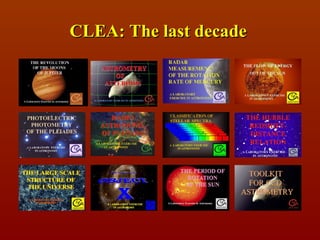
CLEA: The last decade
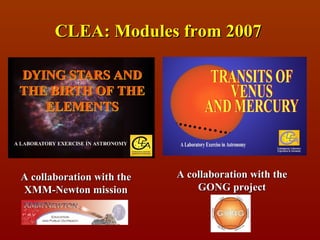
CLEA: Modules from 2007


A collaboration with the   A collaboration with the
XMM-Newton mission             GONG project
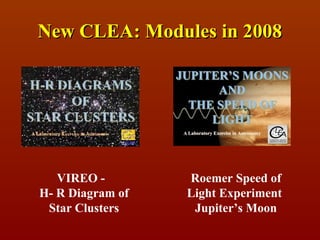
New CLEA: Modules in 2008


   VIREO -        Roemer Speed of
H- R Diagram of   Light Experiment
 Star Clusters     Jupiter’s Moon
EXAMPLES OF FUNDAMENTAL
 ASTRONOMICAL DATA SETS
•The Hubble Guide Star Catalog (coords and mags of
~20 million objects); USNO A2 (5 x10⁸ objects), …
•The CfA Redshift Survey (mags, coordinates,
redshifts of ~5 x 10⁴ galaxies
•Pulsar catalogs (coordinates, P, I(υ) for ~103 objects)
•Asteroid elements (coords, mags vs time for ~2 x10⁵
objects)
•Large surveys: 2Mass (IR), SDSS (optical &NIR),
2dF (galaxies), etc.
Instrumentation of VIREO
•3 Optical/IR Telescopes: various apertures
    •CCD Camera
    •IR Camera
    •Aperture Photometer
    •Photon-Counting Spectrometer
    •Multi-Aperture Spectrometer
•Radio Telescope: configurable aperture, etc.
    •3 separately tunable receivers
•Analysis tools for
    •Spectroscopy
    •Imaging
    •Astrometry
An interactive teaching and learning on earth and space education

An interactive teaching and learning on earth and space education

  • 1.
    CLEA: An Interactive Teaching and Learning on Earth and Space Education Hakim L. Malasan; Bosscha Observatory, ITB J. Aria Utama; Earth & Space Lab., UPI
  • 2.
    HANDS-ON EXCERCISES IN ASTRONOMY? • Hands-on activities, usually in a laboratory setting, help students learn through several processes (Hake, 1998). •The problems: Astronomy is observati- onal rather than experimental . •Real observation = (at most cases) time consuming.
  • 3.
    HANDS-ON EXCERCISES IN ASTRONOMY? (Cont.) • Computer revolution  Fast growing of simulation in the astronomy lab. • Simulations are used widely  Effectively reduce the risk or expense of a real-world exercise.
  • 4.
    WHY HAVE ALAB COMPONENT TO AN ASTRONOMY COURSE? • “Interactive Engagement” with real astronomy •Deeper understanding of the distinction between observation and interpretation, data and theory. •Appreciation of what astronomers do— the phenomenology of the science.
  • 5.
    PROJECT CLEA Contemporary Laboratory Experiences in Astronomy • Laboratory exercises illustrating modern astronomical techniques (since 1992). •Designed for non-science majors, but adaptable. •Simulation of measurement process. •Modern digital data and analysis techniques, using, wherever possible, real data. •Modular: each module includes software, student workbook(s), technical guide. •Funded by Gettysburg College and the NSF.
  • 6.
  • 7.
    CLEA: Modules from2007 A collaboration with the A collaboration with the XMM-Newton mission GONG project
  • 8.
    New CLEA: Modulesin 2008 VIREO - Roemer Speed of H- R Diagram of Light Experiment Star Clusters Jupiter’s Moon
  • 9.
    EXAMPLES OF FUNDAMENTAL ASTRONOMICAL DATA SETS •The Hubble Guide Star Catalog (coords and mags of ~20 million objects); USNO A2 (5 x10⁸ objects), … •The CfA Redshift Survey (mags, coordinates, redshifts of ~5 x 10⁴ galaxies •Pulsar catalogs (coordinates, P, I(υ) for ~103 objects) •Asteroid elements (coords, mags vs time for ~2 x10⁵ objects) •Large surveys: 2Mass (IR), SDSS (optical &NIR), 2dF (galaxies), etc.
  • 10.
    Instrumentation of VIREO •3Optical/IR Telescopes: various apertures •CCD Camera •IR Camera •Aperture Photometer •Photon-Counting Spectrometer •Multi-Aperture Spectrometer •Radio Telescope: configurable aperture, etc. •3 separately tunable receivers •Analysis tools for •Spectroscopy •Imaging •Astrometry

Editor's Notes