Opening Government
for Immigrants
Presenter: Homa Naficy
Chief Adult Learning Officer
Phone: 860.695.6334
Email: naficy@hplct.org
www.hplct.org
Opening Government for Immigrants
• Facilitating access to government
services
• Brokering civic engagement
opportunities
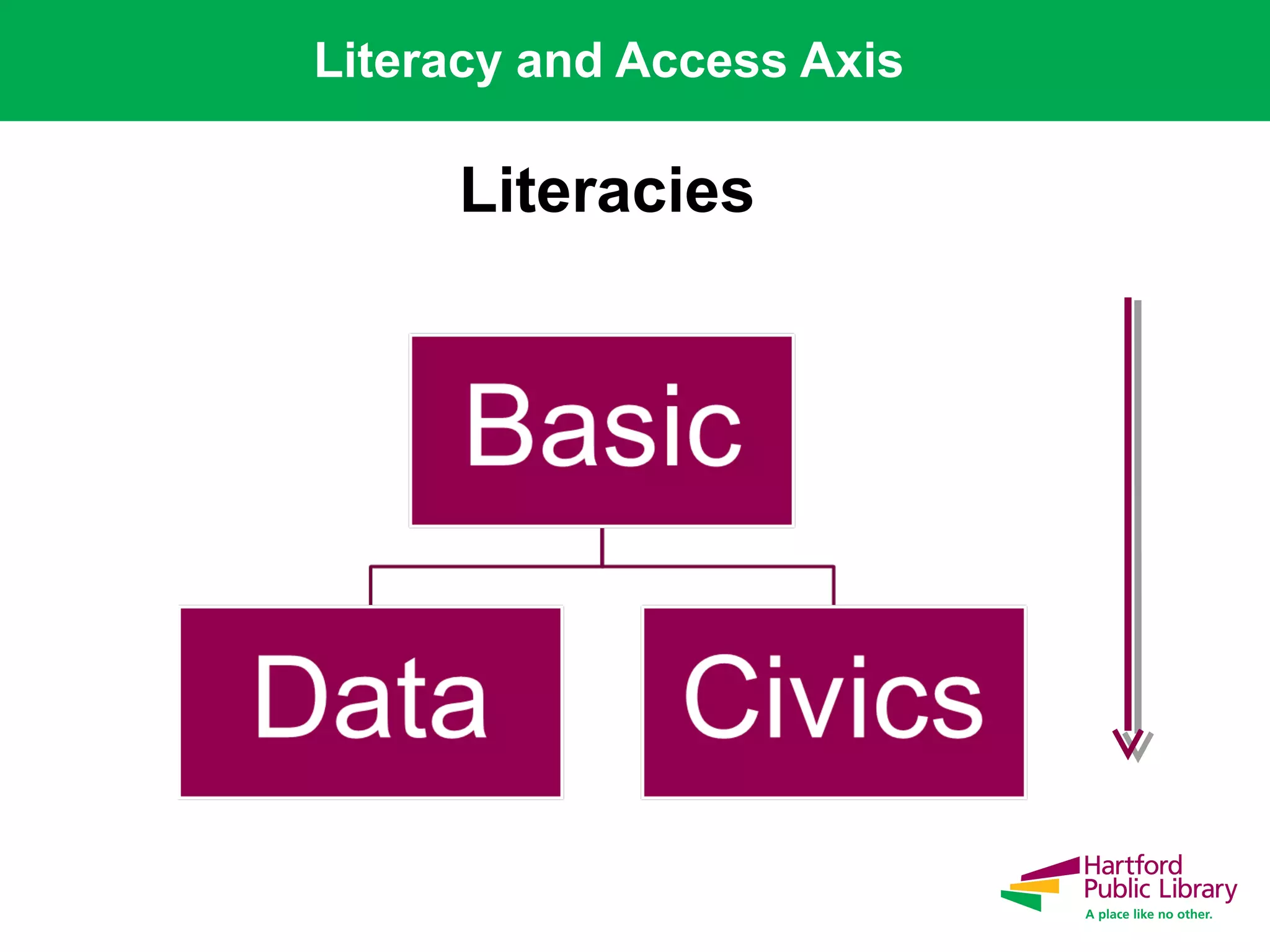
Literacy and Access Axis
Literacies
Literacy and Access Axis
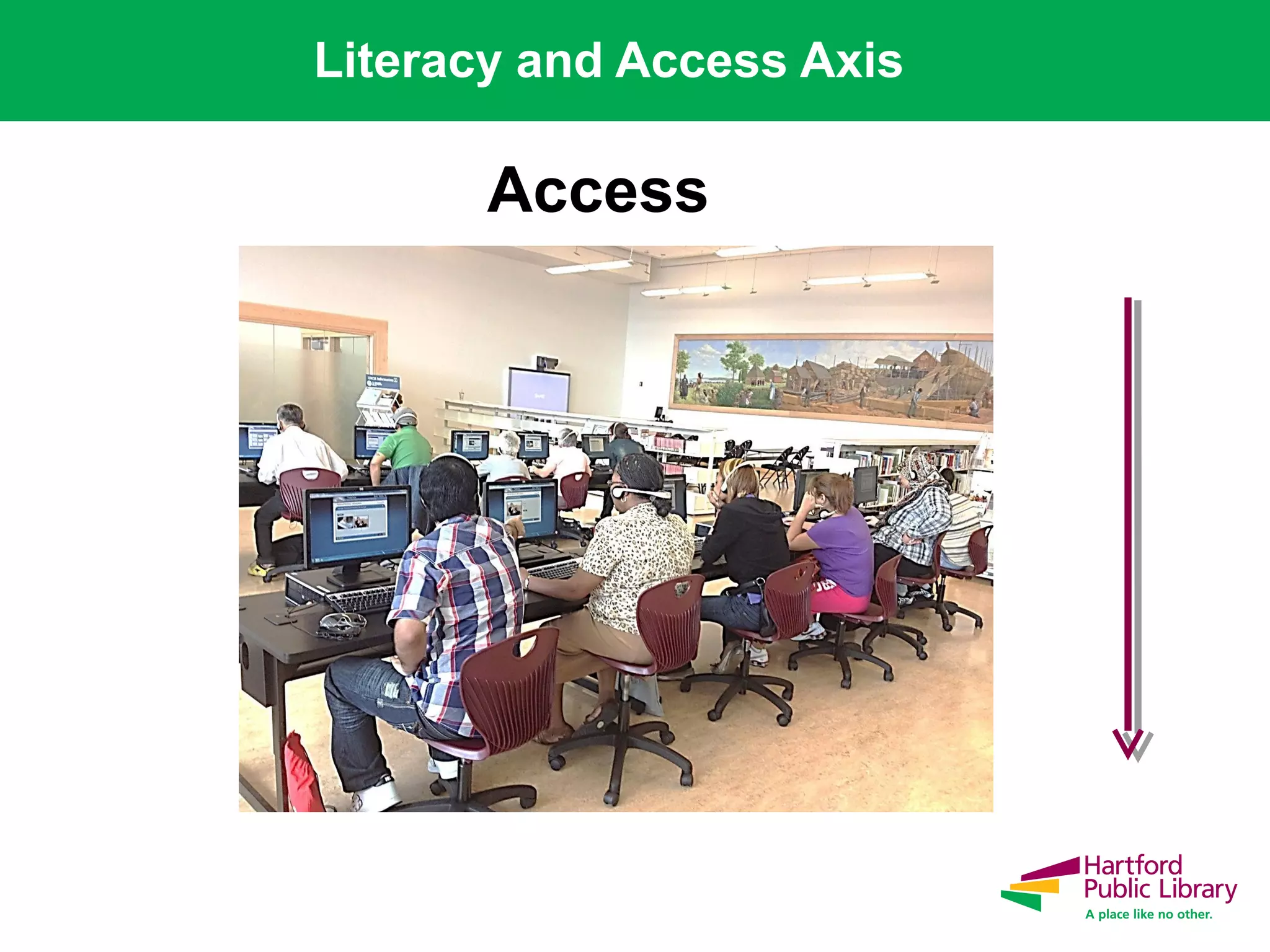
Access
Literacy and Access Axis
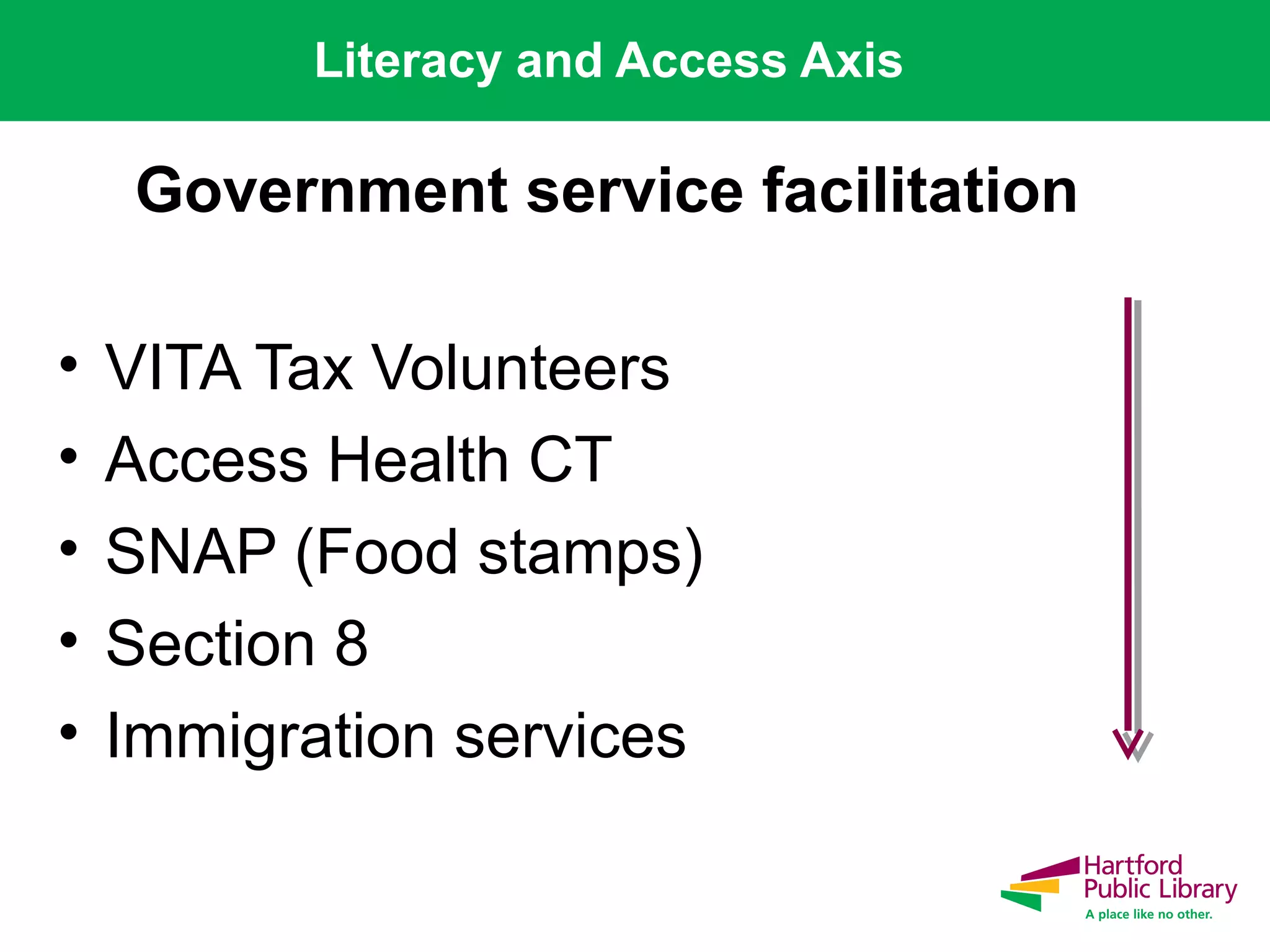
• VITA Tax Volunteers
• Access Health CT
• SNAP (Food stamps)
• Section 8
• Immigration services
Government service facilitation
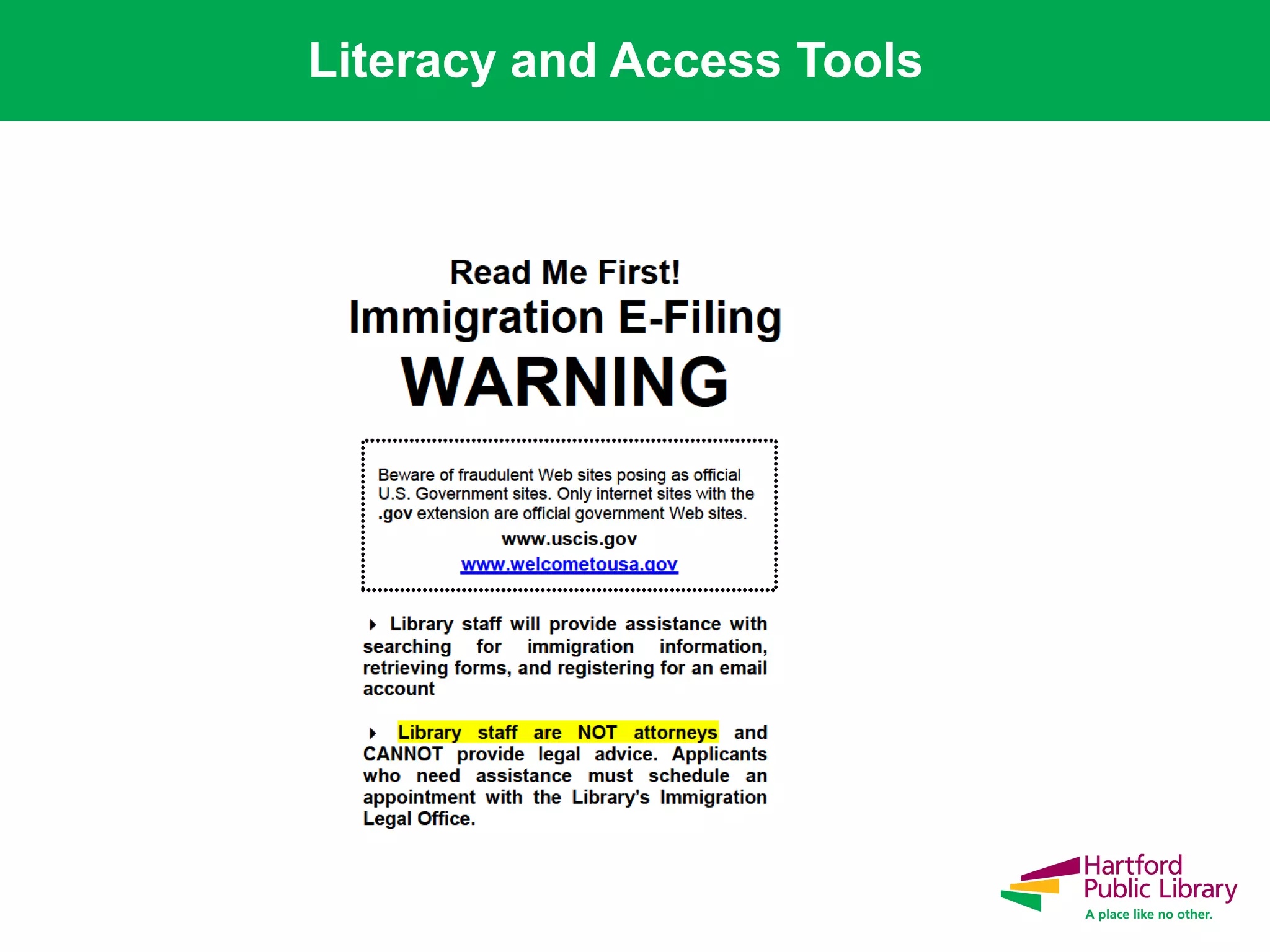
Literacy and Access Tools
Literacy and Access Axis
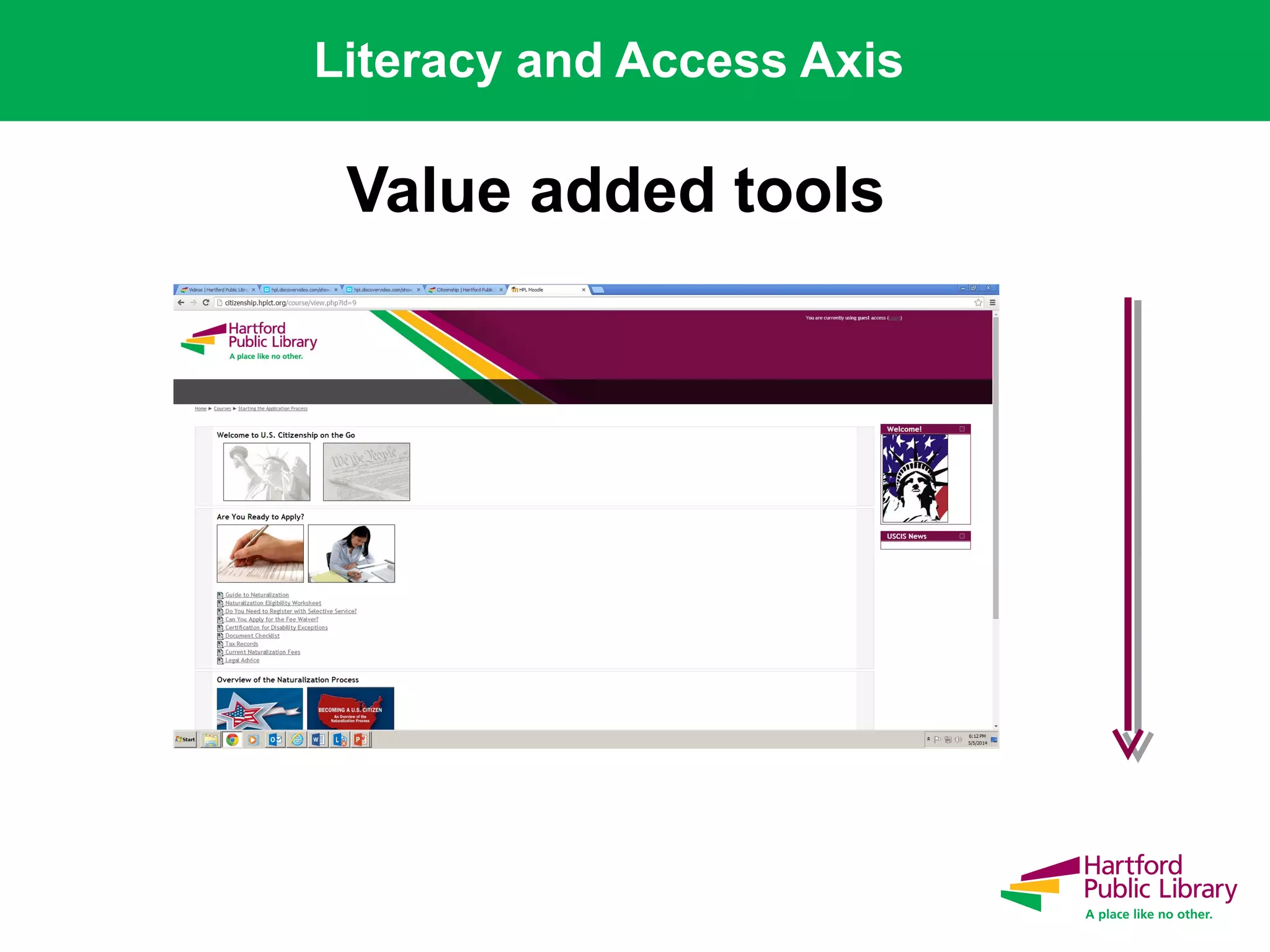
Value added tools
Civic Engagement Axis
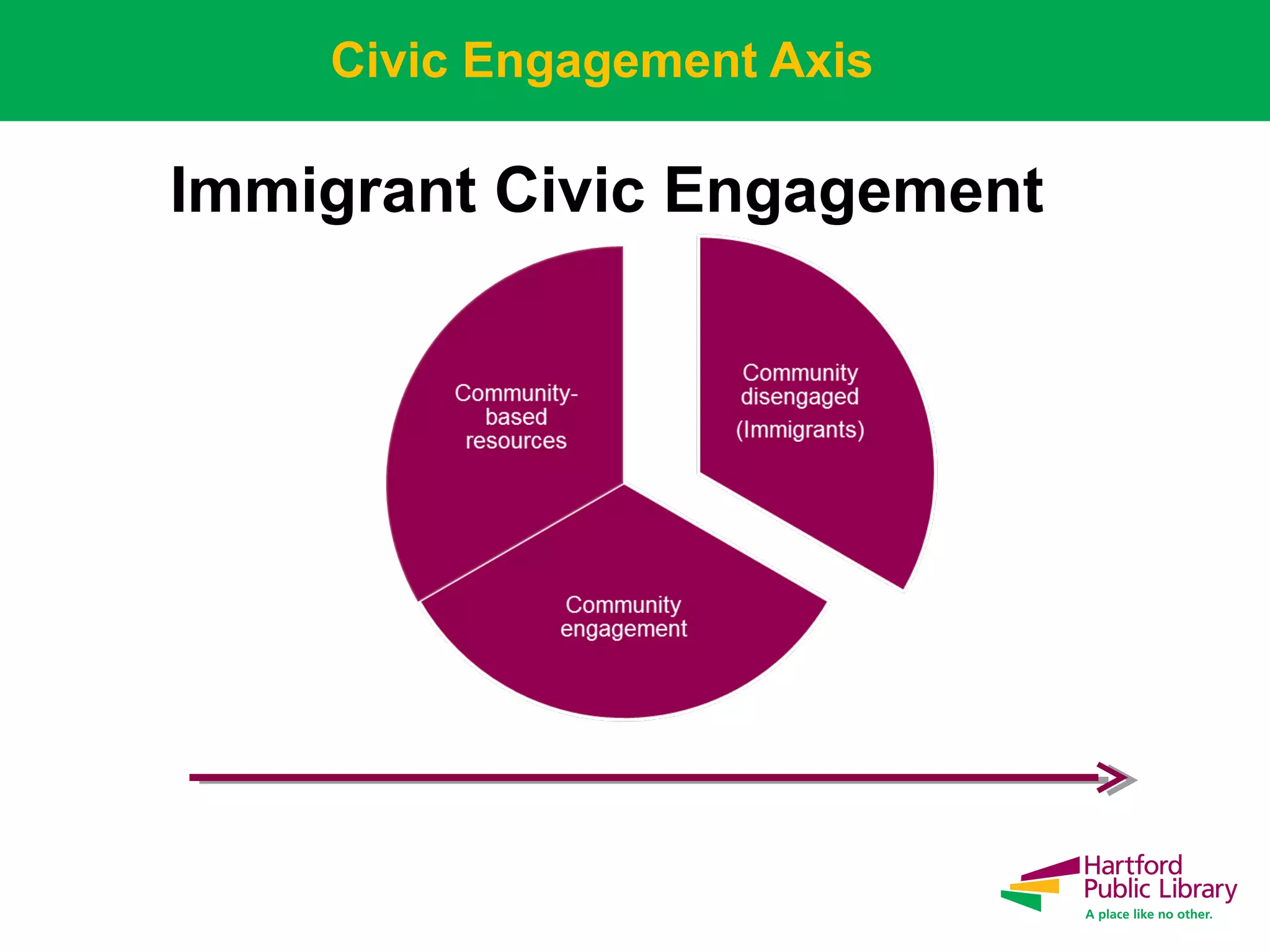
Immigrant Civic Engagement
Immigration Trends
• Arriving from lesser known locations
• Settling in newer destinations
• Increase in the proportional share of
immigrants in the general population.
Civic Engagement Axis
Building Social Relationships & Bridging Social capital
An Inclusive approach to Immigrant Civic Engagement
within Libraries: A Demonstration Project
Building Meaningful Connections
• Networks of trusting relationships, both with people
from like and unlike backgrounds, create one of civic
participations most powerful contributions to immigrant
integration
• People who know each other through shared work are
far less capable of stereotyping, and characterizing
people as ‘other’.
Civic Engagement Axis
Strategies
• Build coalitions among key stakeholders.
• Recruit and train volunteers to serve as Cultural
Navigators.
• Community Conversations
• Communications Campaign
Civic Engagement Axis
Community Engaged
• Commission on Immigrant and Refugee Affairs
• Neighborhood Welcoming Committee
Feasibility study for a We Belong Here Center
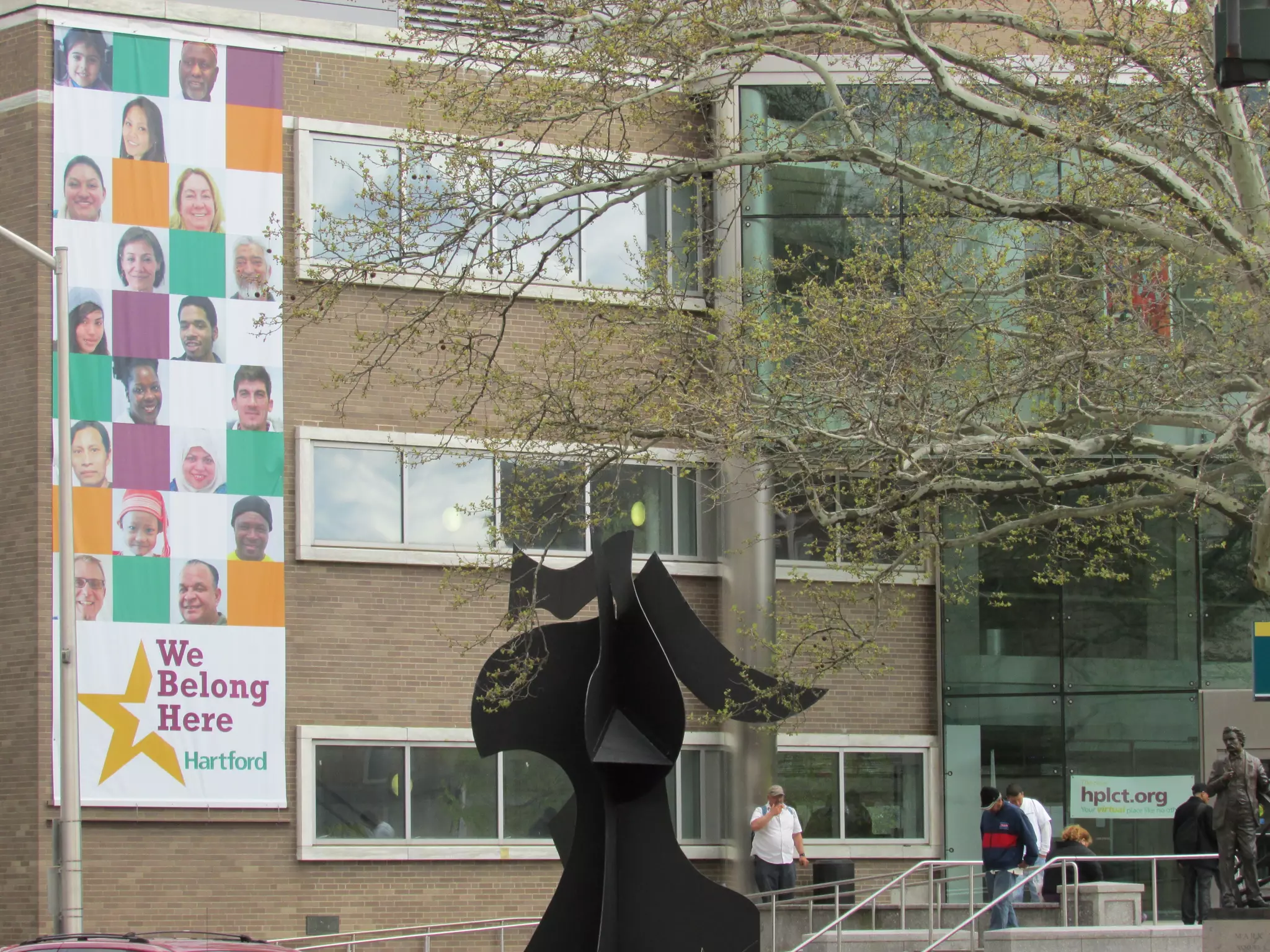
• We Belong Here Hartford
Civic Engagement Axis
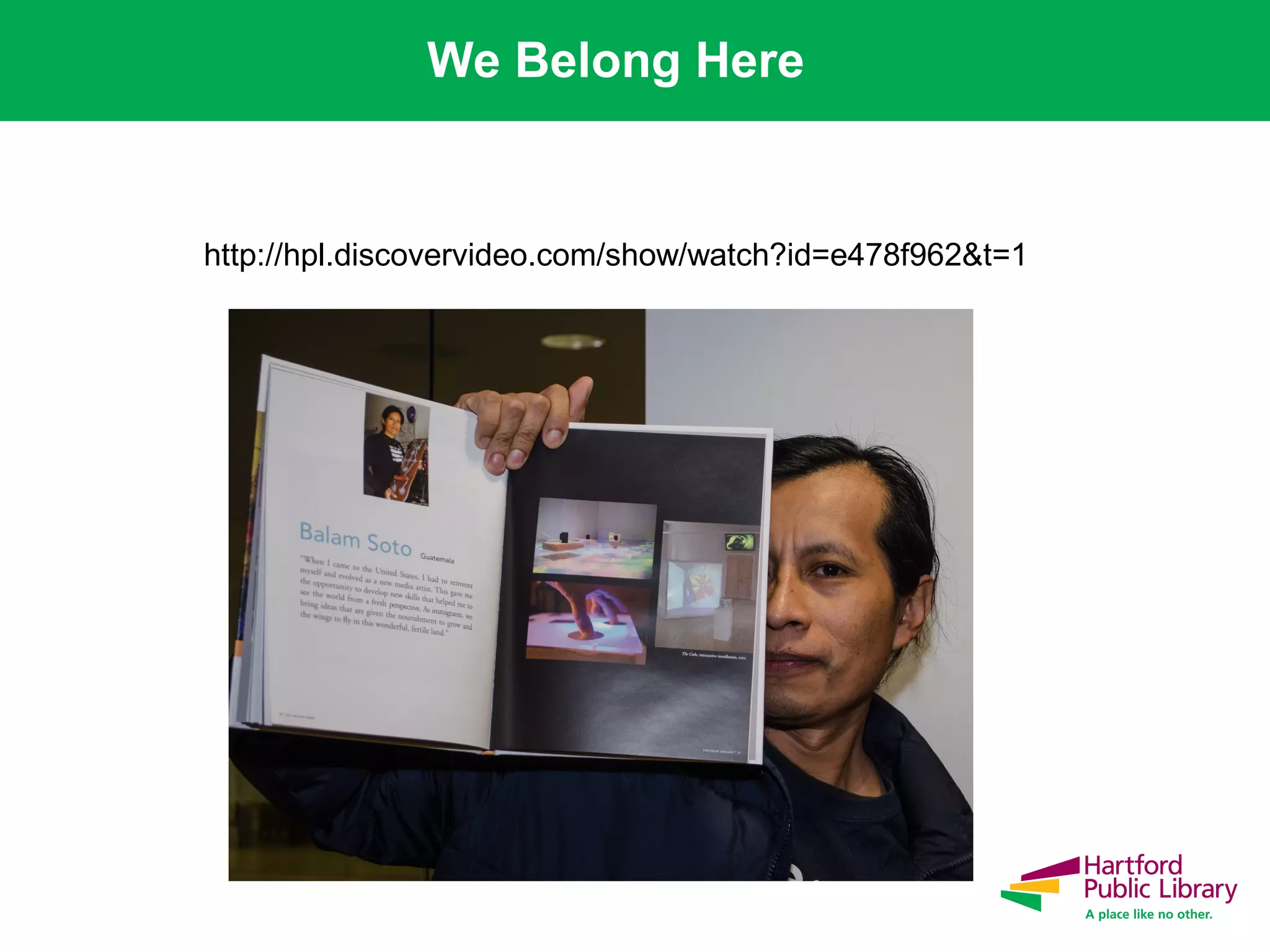
We Belong Here
http://hpl.discovervideo.com/show/watch?id=e478f962&t=1
These initiatives have been possible
through funding from IMLS and USCIS.

An Inclusive approach to Immigrant Civic Engagement within Libraries: A Demonstration Project

Editor's Notes

  • #3 Two areas of focus for us at the Library have been facilitating access and brokering civic engagement opportunities. Person/organization who serves as a trusted agent or intermediary between two groups – in this case two cultures
  • #4 Limited English proficiency is clearly the biggest barrier for immigrants needing to access government which for some may take years. So what we’ve been doing is incorporate technology and experiential learning into our instruction. Mandated by some federal grants. How we incorporate technology is determined by the level of the class. Basic levels - Language tutorial and virtual tours. Citizenship classes we provide a full orientation to the USCIS Website; so even if they are not tech savvy they at least have a point of reference. The civic literacies is introduced through experiential learning. The most effective tool for non-readers. Take away: we’ve been more successful incorporating data and civics into the ESL instruction than independently.
  • #5 Providing access to public technologies is really only part of the equation. For many immigrants and marginalized populations the human touch is critical. Without that support we are depriving them of critical information and services that they are entitled to.
  • #6 Designed to assist very low income families These services also often come with deadlines that if not met may lead to cancelation of services. Volunteer Income Tax Assistance Working with confidential material
  • #7 Located next door to USCIS Sought BIA Recognition and staff accreditation. This is the Department of Justice’s certification of not-for-profit immigration agencies and staff to be able to practice immigration law before the U.S. Citizenship and Immigration Services (USCIS) and the immigration courts.  
  • #8 Citizenship on the Go is an online course that the Library developed to facilitate preparation for Citizenship. It simplifies access to several of the online elements from the USCIS website to one centralized source. There certainly is a lot more work that needs to be done in this arena but I feel that it is more in the concrete realm, but as we move into the civic engagement topic it becomes more abstract.
  • #9 How do we get a population that is disengaged in the broader community engaged. First we need to understand why they are disengaged . An overview of current immigration trends will help us understand that.
  • #10 Arriving from lesser known locations: Uzbekistan, Liberia, the Karen from Burma, the Bantu from Somalia, the Meskitian Turks. According to a recent report Africans are arriving in the U.S. at a higher rate than immigrants from any other world. Settling in newer destinations : Immigrants are also settling in newer destination and quite often are skipping the cities – Danbury, Vernon, Ellington Increase in the proportional share For example in the 70s fewer than 1 in 20 were foreign born, today 1 in 8 is an immigrant. Children of immigrants account for one-quarter of all children under 18 The census predicts that within the next decade we will not have a dominant ethnic group which deepens the risk of marginalization and fragmentation of communities, as everyone tends to group in their own enclaves.
  • #11 This meant that we needed to come up with strategies that unify community regardless of whether they are an immigrant or not. This also meant we needed to redirect out focus to the receiving community, long term residents.
  • #12 In 2010 the Library was awarded an IMLS grant to promote immigrant civic integration. What the IMLS Project attempts to do is go beyond providing services directly to immigrants. It also involves the receiving community in support of immigrants at a level where we they feel more connected to the broader community.
  • #13 Community Conversations – can be as simple as a book group or a more structured and intentional conversation with the objective of moving towards action, these are usually multilayered they can fizzle or flourish. The broker needs to be with the project until its launched on its own and nurturing to the process and the participants.
  • #14 By showcasing local immigrant talent to the receiving community it raised the visibility of immigrant contributions to our area. The reception provided a unique opportunity for relationship building.