Introduction               Proposed System                     Use case                Conclusions       Acknowledgements


                An Aspect Based Resource Recommendation
                         System for Smart Hotels

               Aitor Almeida1 , Eduardo Castillejo 1 , Diego L´pez-de-Ipi˜a1 ,
                                                              o          n
                          Marcos Sacrist´n
                                         a 2 and Javier Diego3

               1 DeustoTech - Deusto Institute of Technology, University of Deusto http://www.morelab.deusto.es

                                             2
                                                 Treelogic http://www.treelogic.com
                                                 3
                                                     Logica http://www.logica.com/es


                                                     September 24, 2012
Introduction              Proposed System   Use case   Conclusions   Acknowledgements


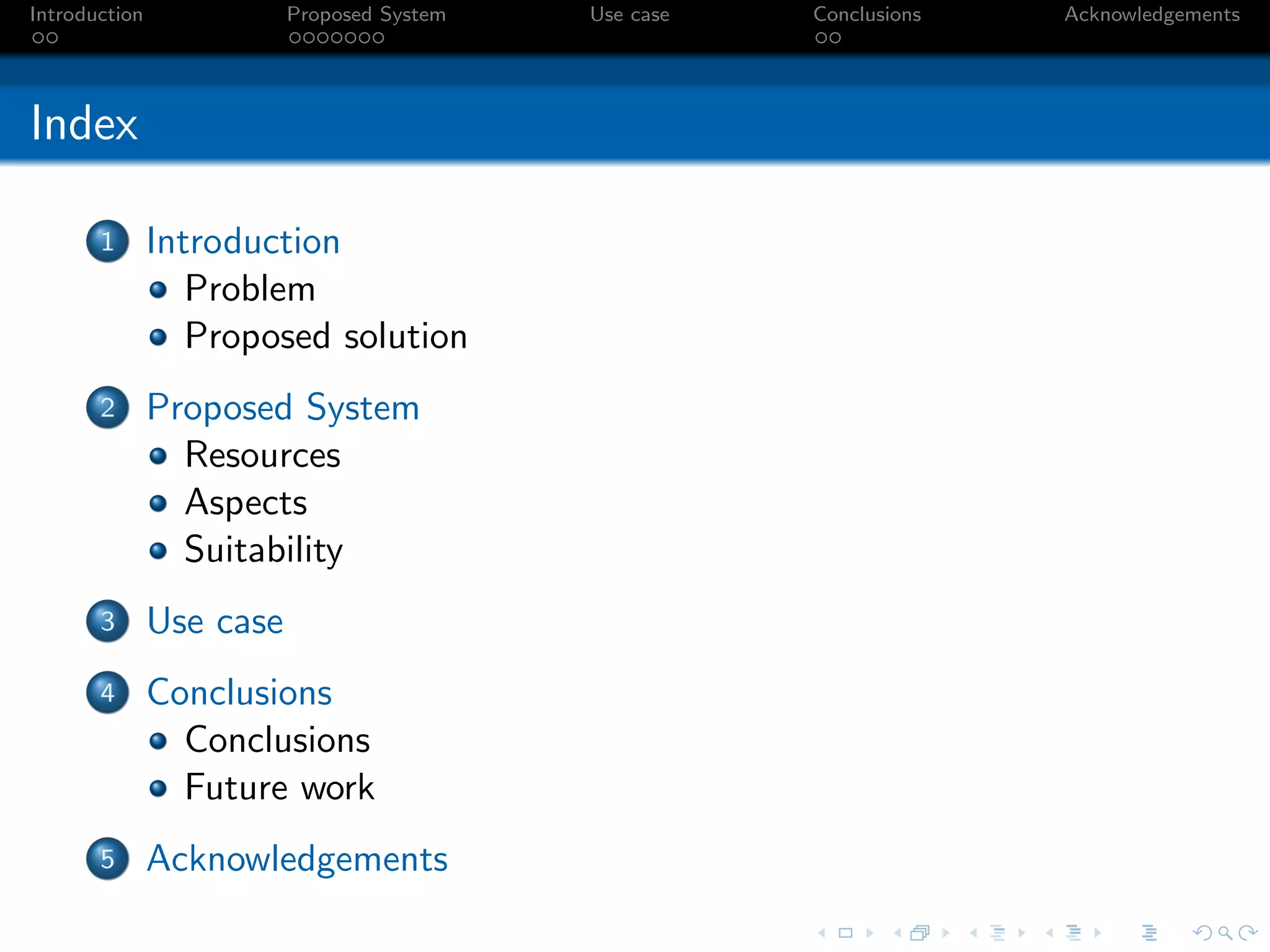
Index

       1       Introduction
                  Problem
                  Proposed solution
       2       Proposed System
                 Resources
                 Aspects
                 Suitability
       3       Use case
       4       Conclusions
                 Conclusions
                 Future work
       5       Acknowledgements
Introduction         Proposed System     Use case       Conclusions      Acknowledgements

Problem


Introduction


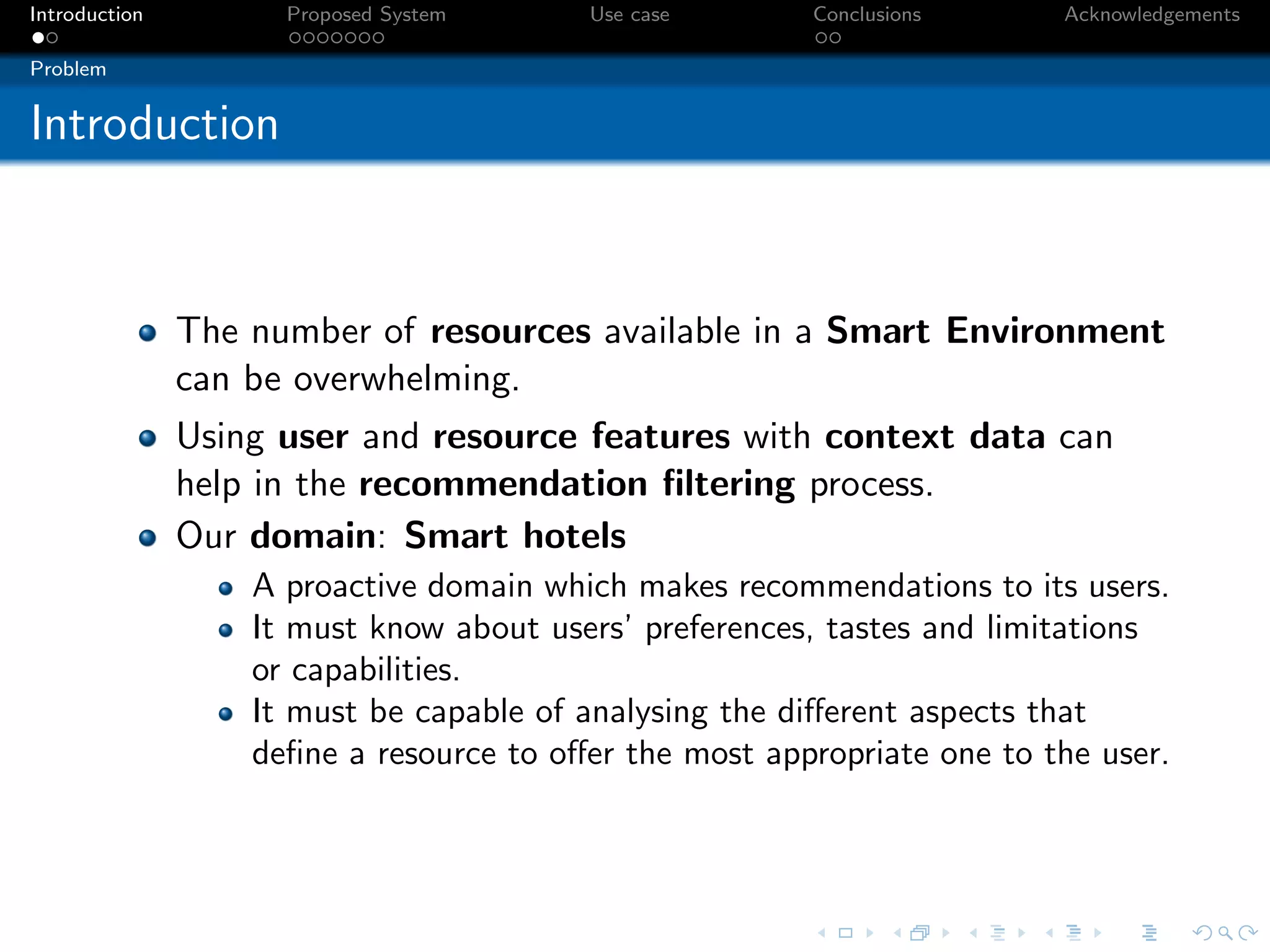
               The number of resources available in a Smart Environment
               can be overwhelming.
               Using user and resource features with context data can
               help in the recommendation filtering process.
               Our domain: Smart hotels
                   A proactive domain which makes recommendations to its users.
                   It must know about users’ preferences, tastes and limitations
                   or capabilities.
                   It must be capable of analysing the different aspects that
                   define a resource to offer the most appropriate one to the user.
Introduction         Proposed System    Use case     Conclusions    Acknowledgements

Proposed solution


Introduction


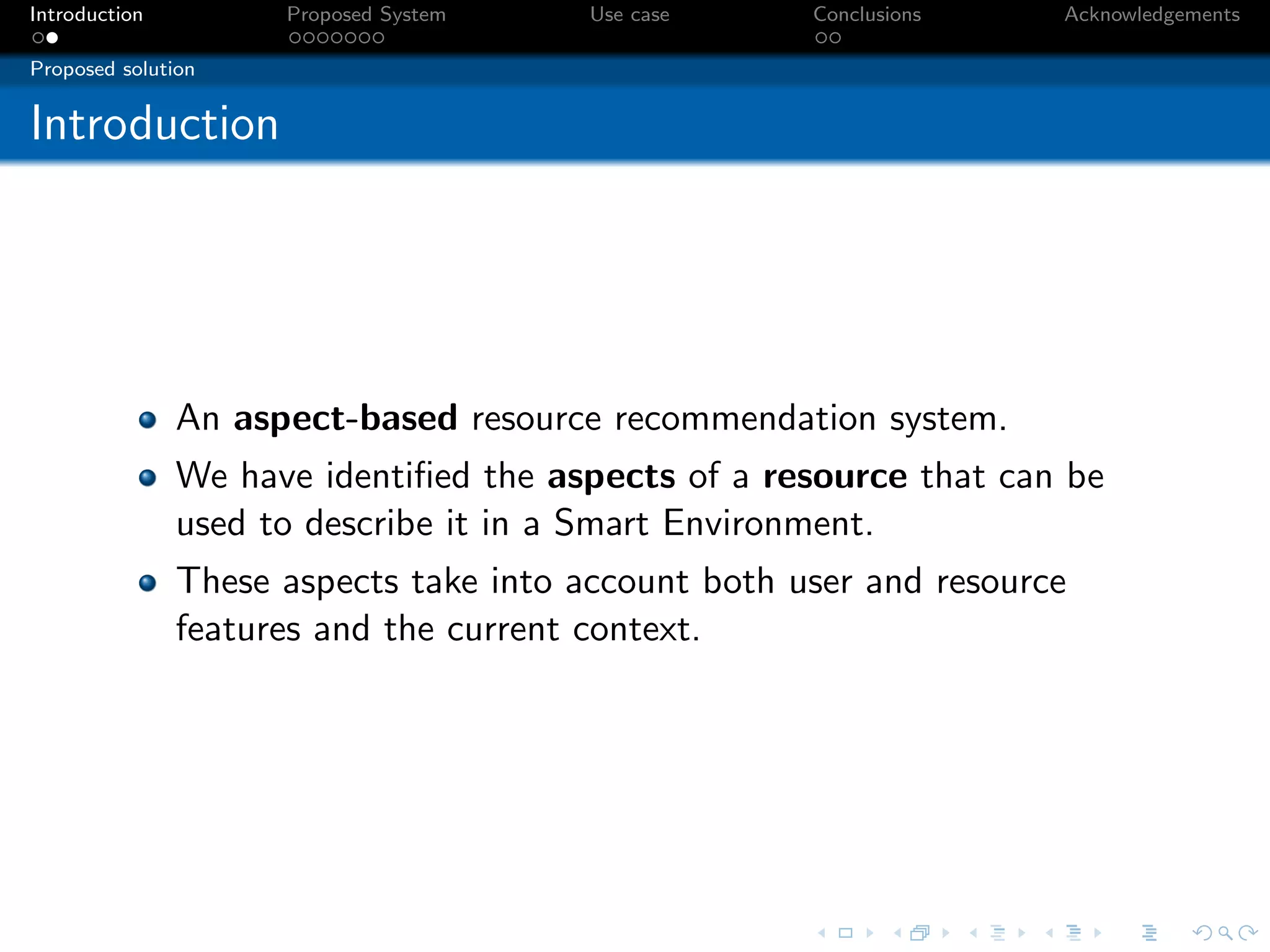
               An aspect-based resource recommendation system.
               We have identified the aspects of a resource that can be
               used to describe it in a Smart Environment.
               These aspects take into account both user and resource
               features and the current context.
Introduction   Proposed System   Use case   Conclusions   Acknowledgements

Resources


Proposed System
Introduction         Proposed System     Use case     Conclusions   Acknowledgements

Resources


Proposed System


               Resource type (in our domain):
                   Pyshical service
                   Virtual service
                   Multimedia content
                   Othe information (maps, news...)
Introduction            Proposed System   Use case    Conclusions   Acknowledgements

Resources


Proposed System


               Resource type (in our domain):
                   Pyshical service
                   Virtual service
                   Multimedia content
                   Othe information (maps, news...)

               Defined aspects must be generic enough to be used to
               describe all the available resources. In the current
               implementation we have considered:
                   1.   Predictability
                   2.   Accessibility
                   3.   Relevancy
                   4.   Offensiveness
Introduction         Proposed System     Use case               Conclusions                 Acknowledgements

Aspects


Proposed System

               1. Predictability
                   It reflects how likely a resource is to be used based on the
                   resources previously consumed.
                   The likeliness is expressed as a probability value 0..1
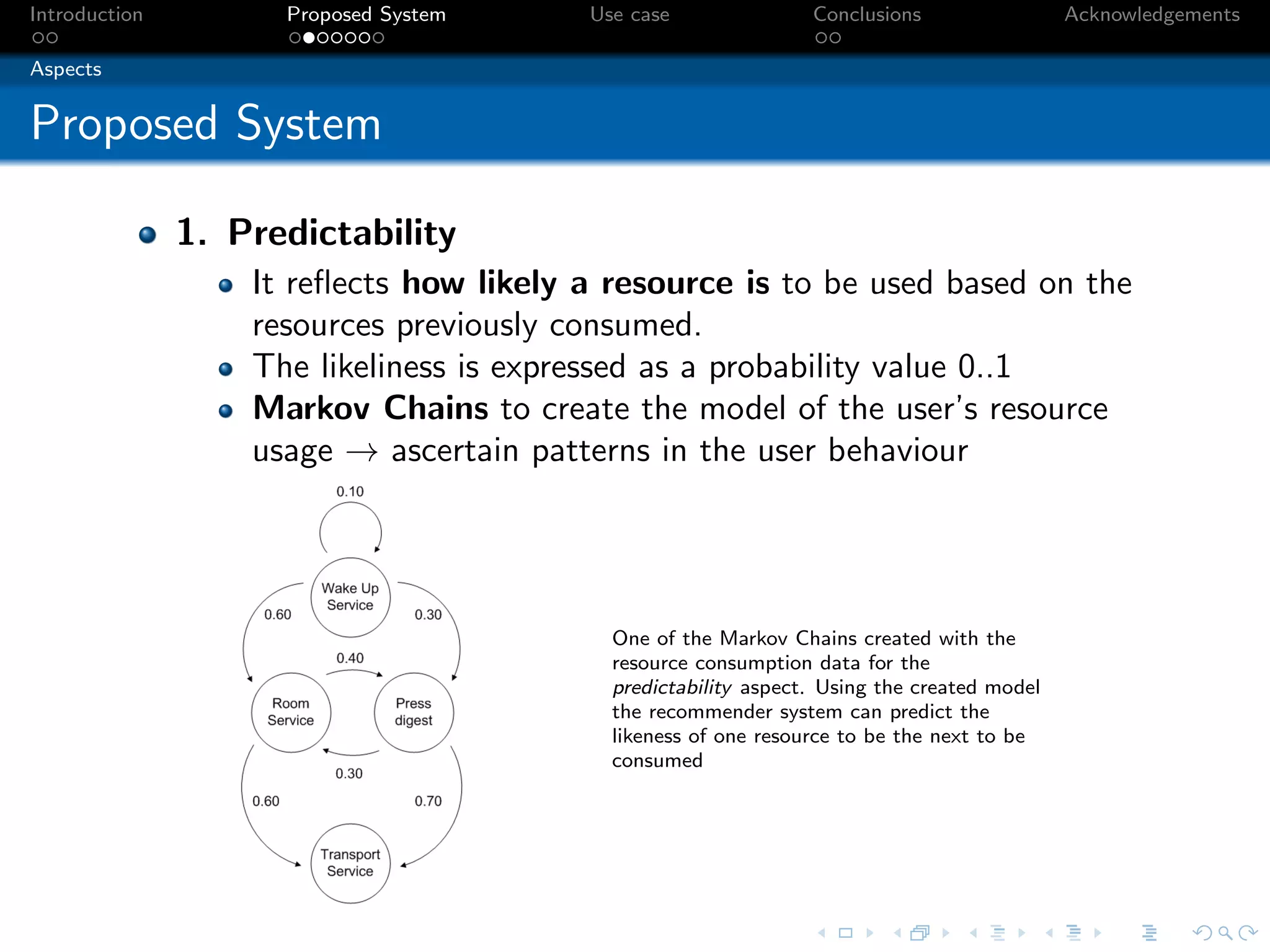
                   Markov Chains to create the model of the user’s resource
                   usage → ascertain patterns in the user behaviour


                                           One of the Markov Chains created with the
                                           resource consumption data for the
                                           predictability aspect. Using the created model
                                           the recommender system can predict the
                                           likeness of one resource to be the next to be
                                           consumed
Introduction         Proposed System                  Use case                 Conclusions                 Acknowledgements

Aspects


Proposed System


               2. Accessibility
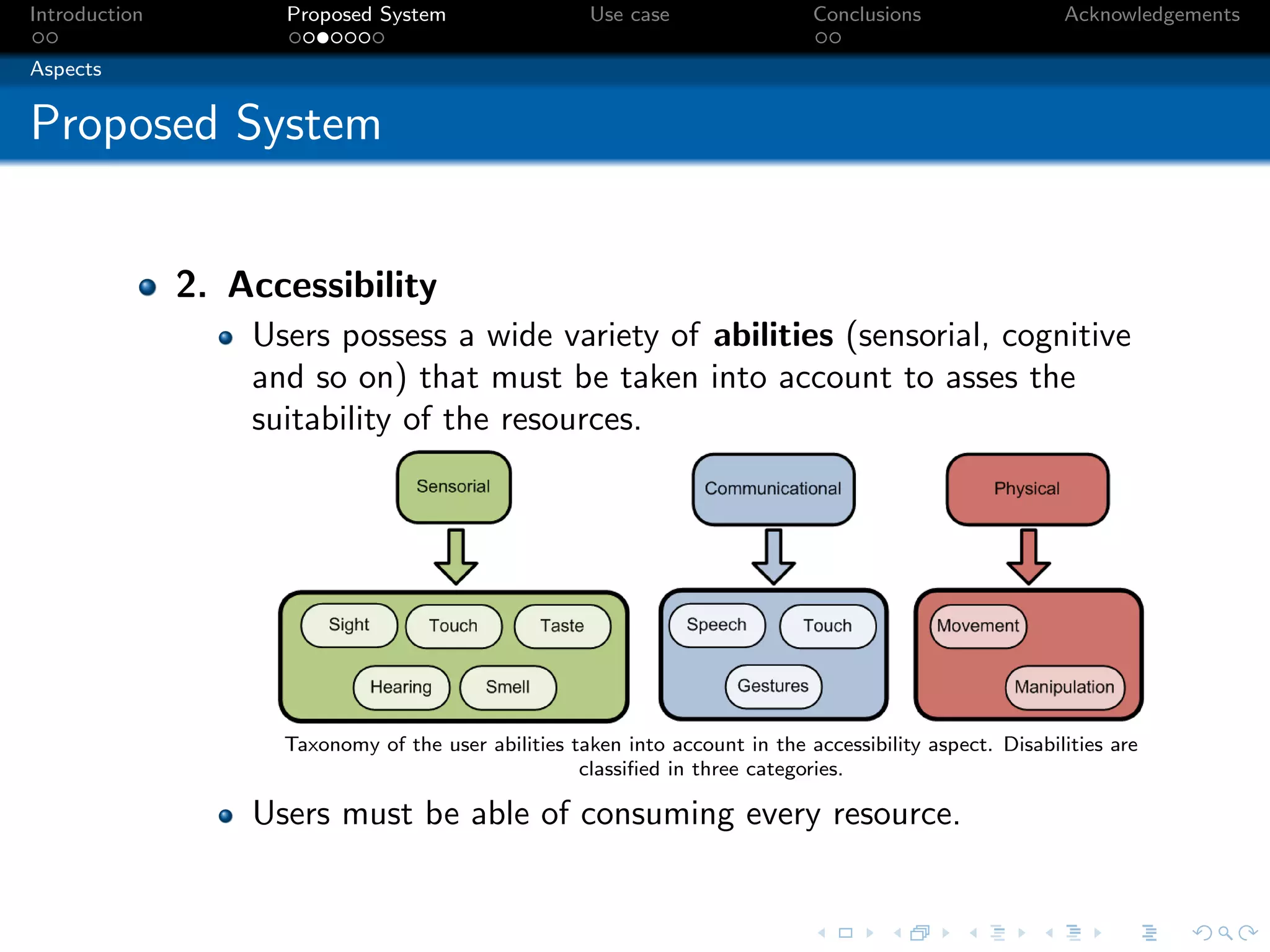
                   Users possess a wide variety of abilities (sensorial, cognitive
                   and so on) that must be taken into account to asses the
                   suitability of the resources.


                     Taxonomy of the user abilities taken into account in the accessibility aspect. Disabilities are
                                                     classified in three categories.

                   Users must be able of consuming every resource.
Introduction         Proposed System        Use case     Conclusions     Acknowledgements

Aspects


Proposed System


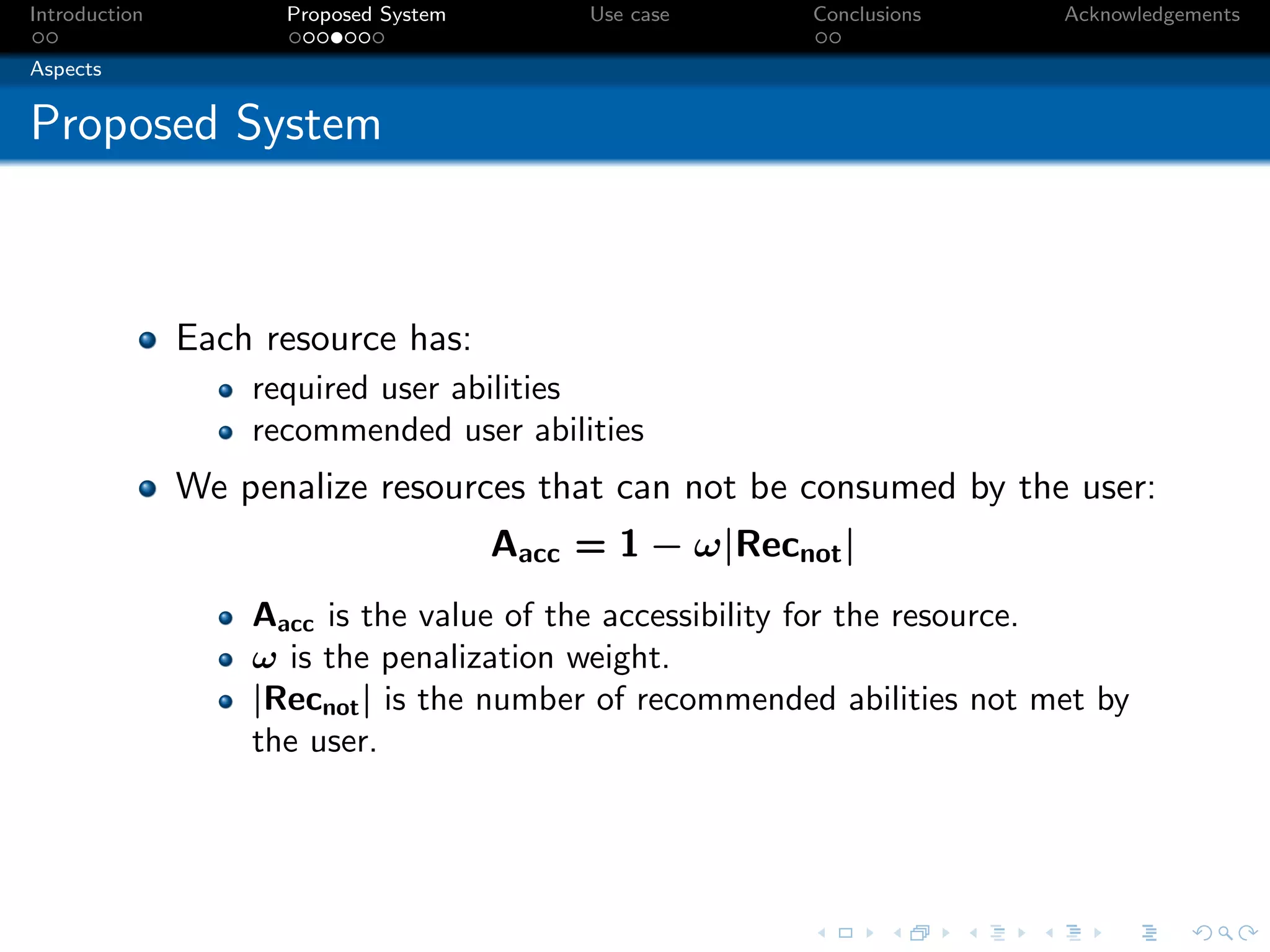
               Each resource has:
                   required user abilities
                   recommended user abilities
               We penalize resources that can not be consumed by the user:
                                       Aacc = 1 − ω|Recnot |
                   Aacc is the value of the accessibility for the resource.
                   ω is the penalization weight.
                   |Recnot | is the number of recommended abilities not met by
                   the user.
Introduction         Proposed System        Use case         Conclusions         Acknowledgements

Aspects


Proposed System


               3. Relevancy
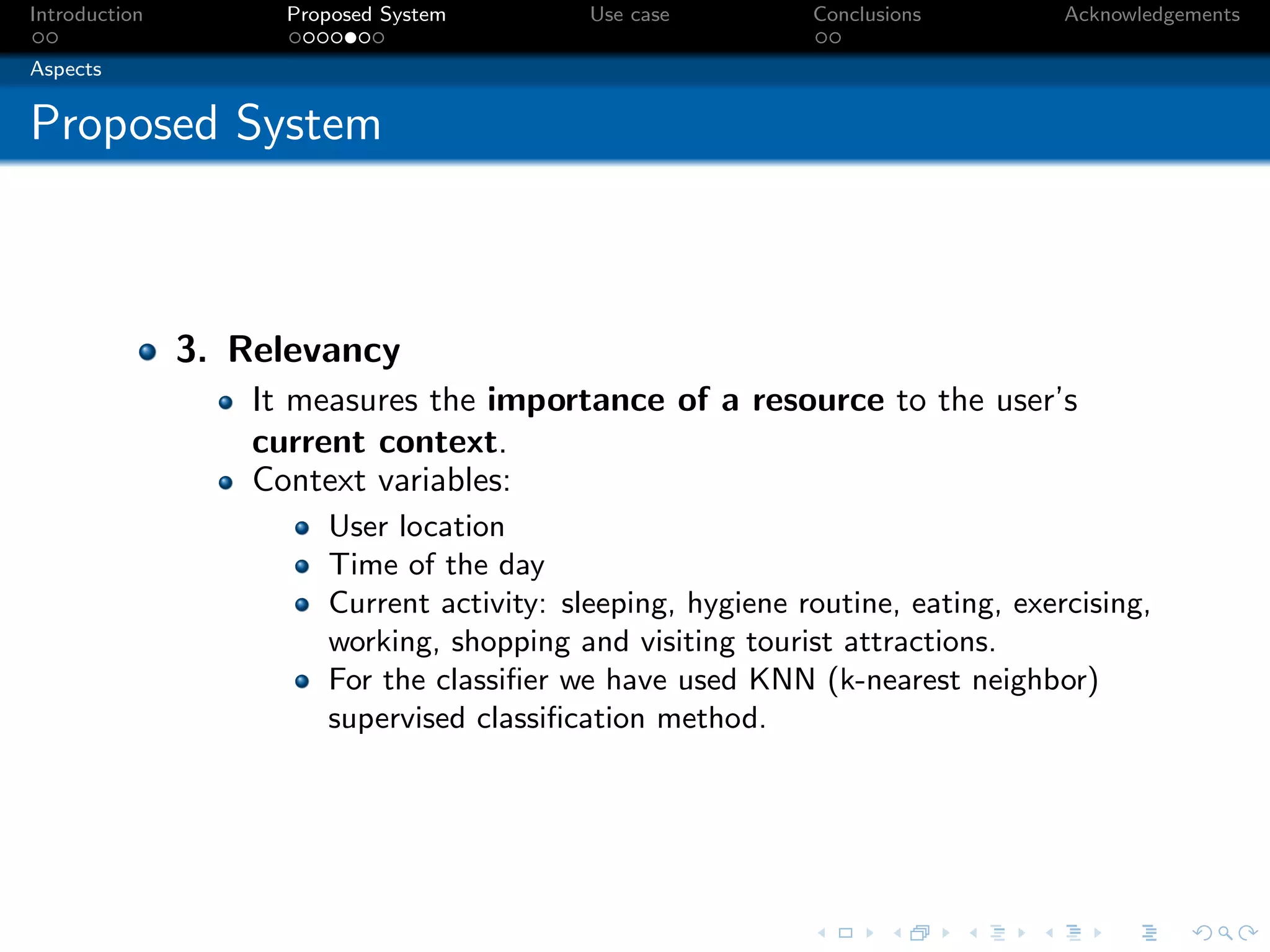
                   It measures the importance of a resource to the user’s
                   current context.
                   Context variables:
                        User location
                        Time of the day
                        Current activity: sleeping, hygiene routine, eating, exercising,
                        working, shopping and visiting tourist attractions.
                        For the classifier we have used KNN (k-nearest neighbor)
                        supervised classification method.
Introduction         Proposed System      Use case       Conclusions      Acknowledgements

Aspects


Proposed System


               4. Offensiveness
                   It measures the suitability of a resource based on a rating
                   system.
                   We use the age categories and content descriptions by PEGI
                   (Pan European Game Information) rating system.
                   To evaluate it, we use the same Accessibility formula, taking
                   the age categories as required constraints and the content
                   descriptions as the recommended ones.
Introduction          Proposed System     Use case        Conclusions       Acknowledgements

Suitability


Proposed System


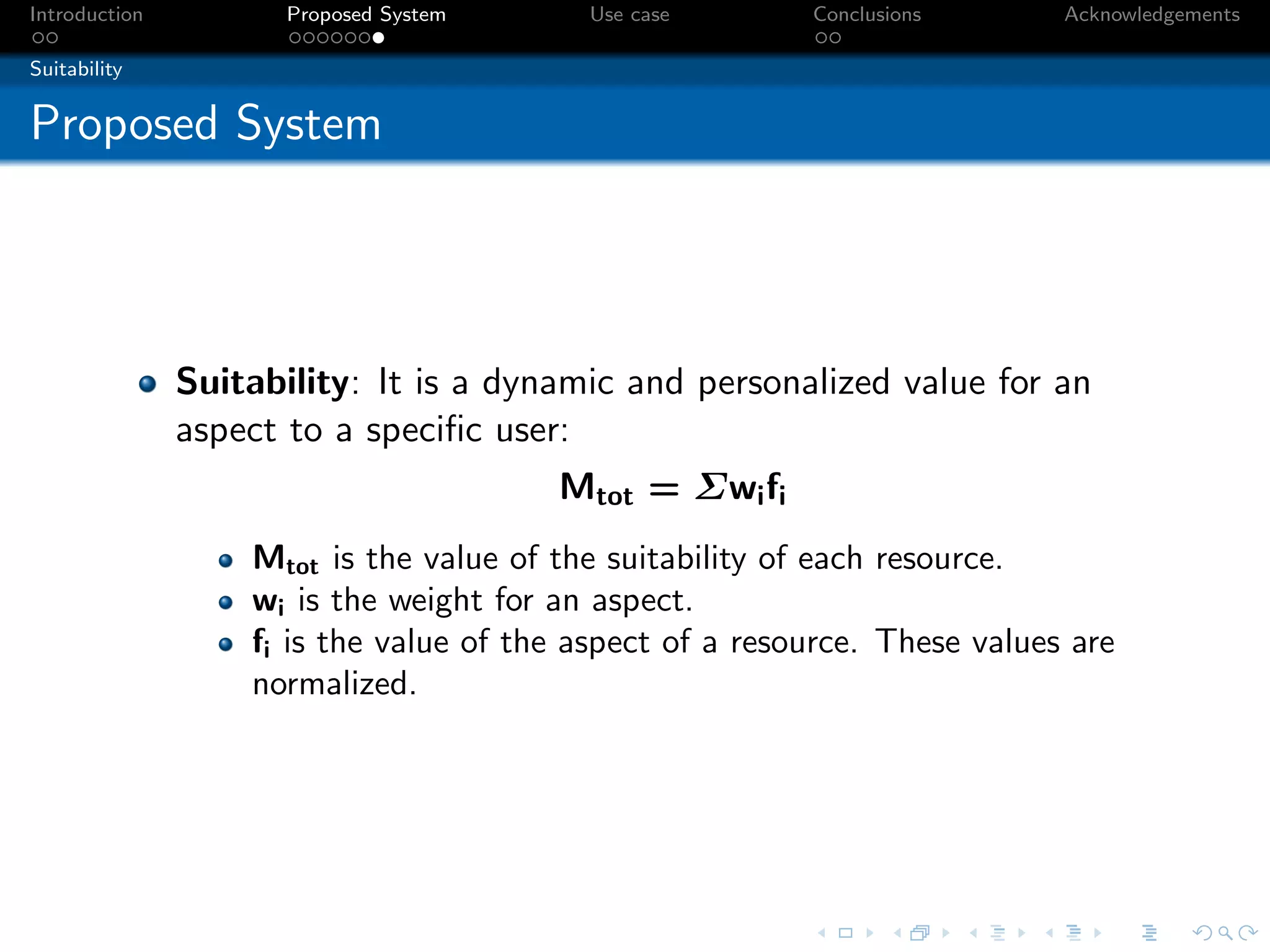
               Suitability: It is a dynamic and personalized value for an
               aspect to a specific user:
                                        Mtot = Σwi fi
                   Mtot is the value of the suitability of each resource.
                   wi is the weight for an aspect.
                   fi is the value of the aspect of a resource. These values are
                   normalized.
Introduction          Proposed System      Use case       Conclusions   Acknowledgements


Use case


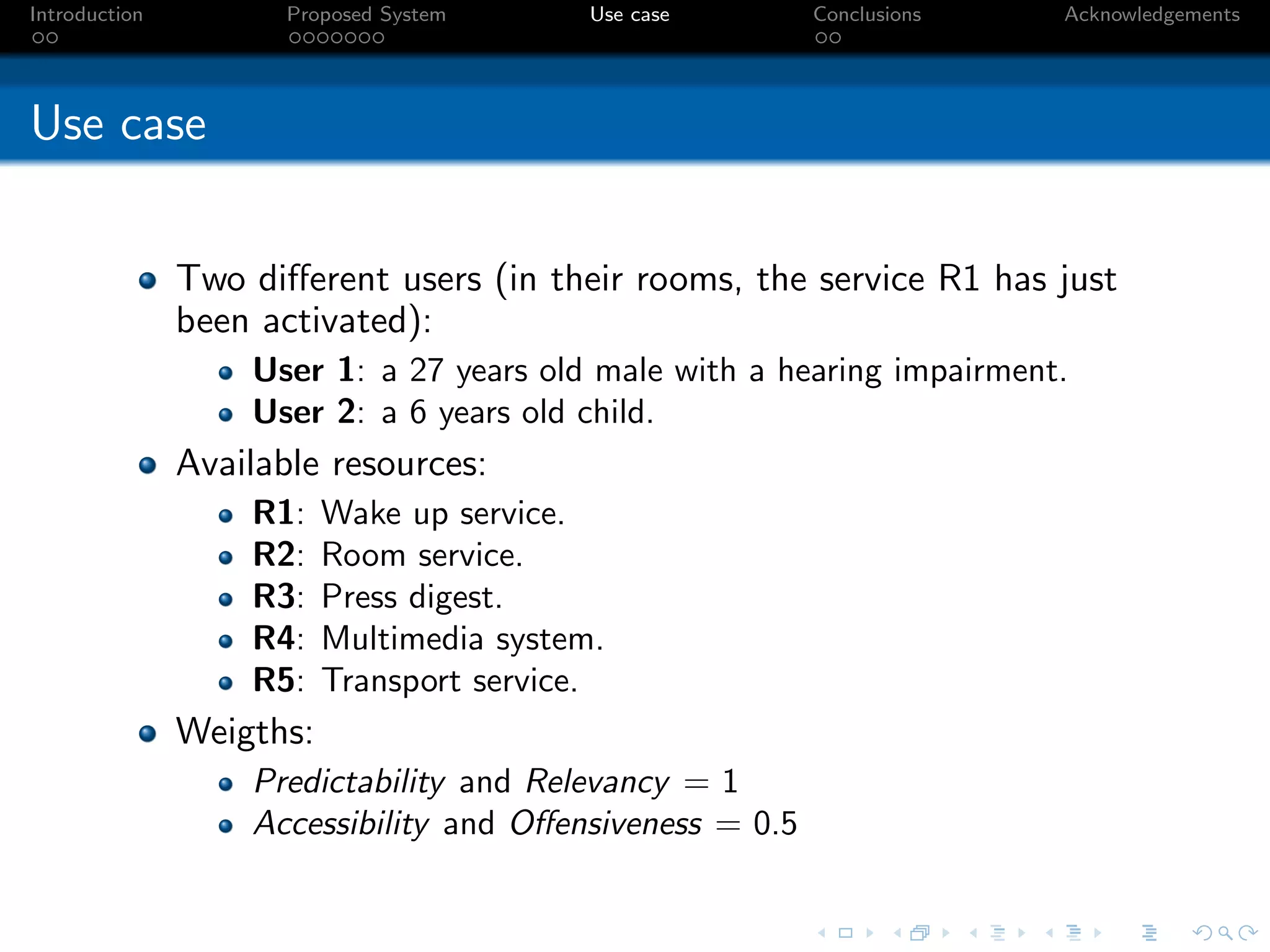
               Two different users (in their rooms, the service R1 has just
               been activated):
                   User 1: a 27 years old male with a hearing impairment.
                   User 2: a 6 years old child.
               Available resources:
                   R1:    Wake up service.
                   R2:    Room service.
                   R3:    Press digest.
                   R4:    Multimedia system.
                   R5:    Transport service.
               Weigths:
                   Predictability and Relevancy = 1
                   Accessibility and Offensiveness = 0.5
Introduction          Proposed System       Use case      Conclusions    Acknowledgements


User 1

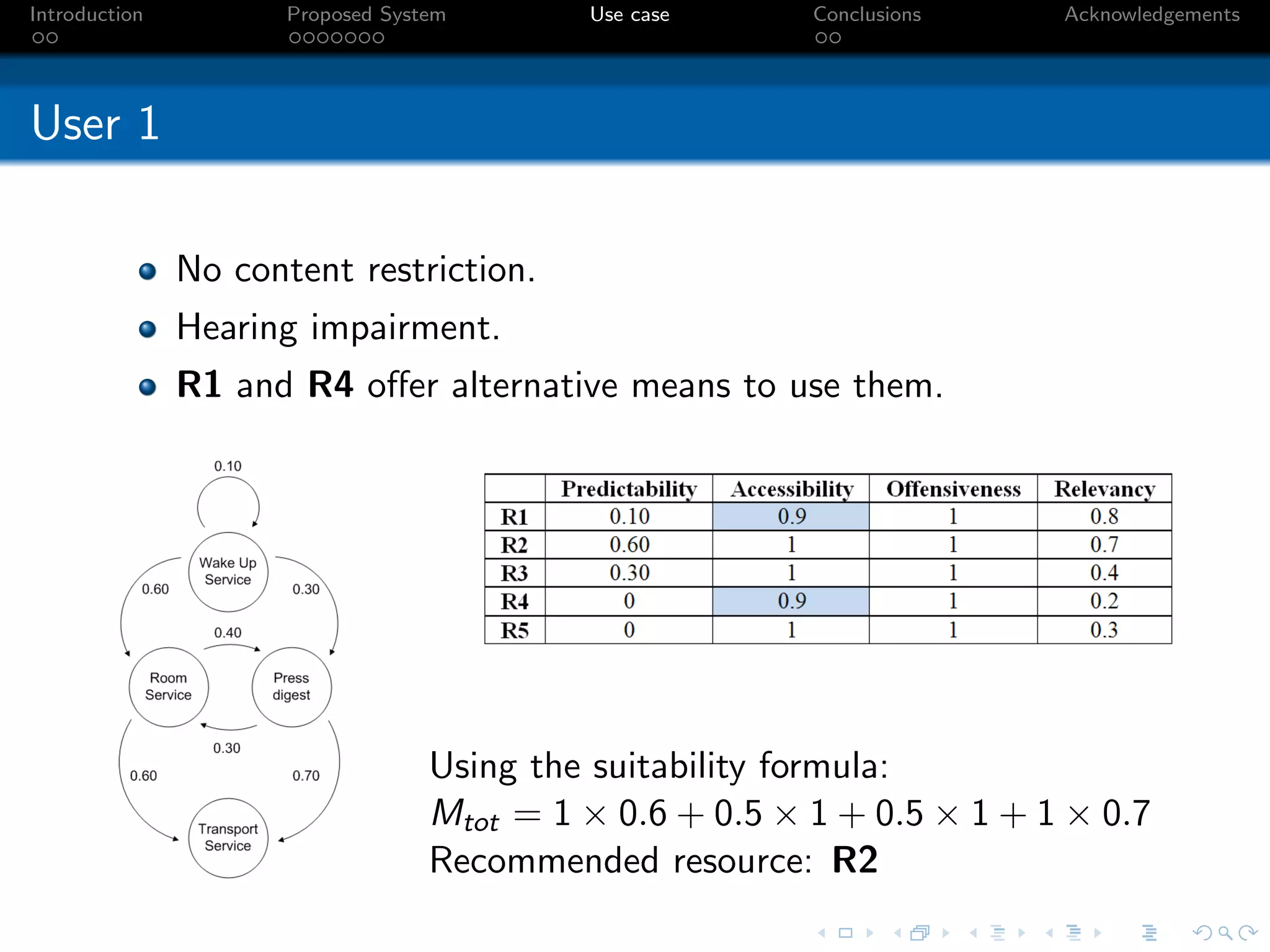
               No content restriction.
               Hearing impairment.
               R1 and R4 offer alternative means to use them.


                                   Using the suitability formula:
                                   Mtot = 1 × 0.6 + 0.5 × 1 + 0.5 × 1 + 1 × 0.7
                                   Recommended resource: R2
Introduction          Proposed System       Use case      Conclusions    Acknowledgements


User 2


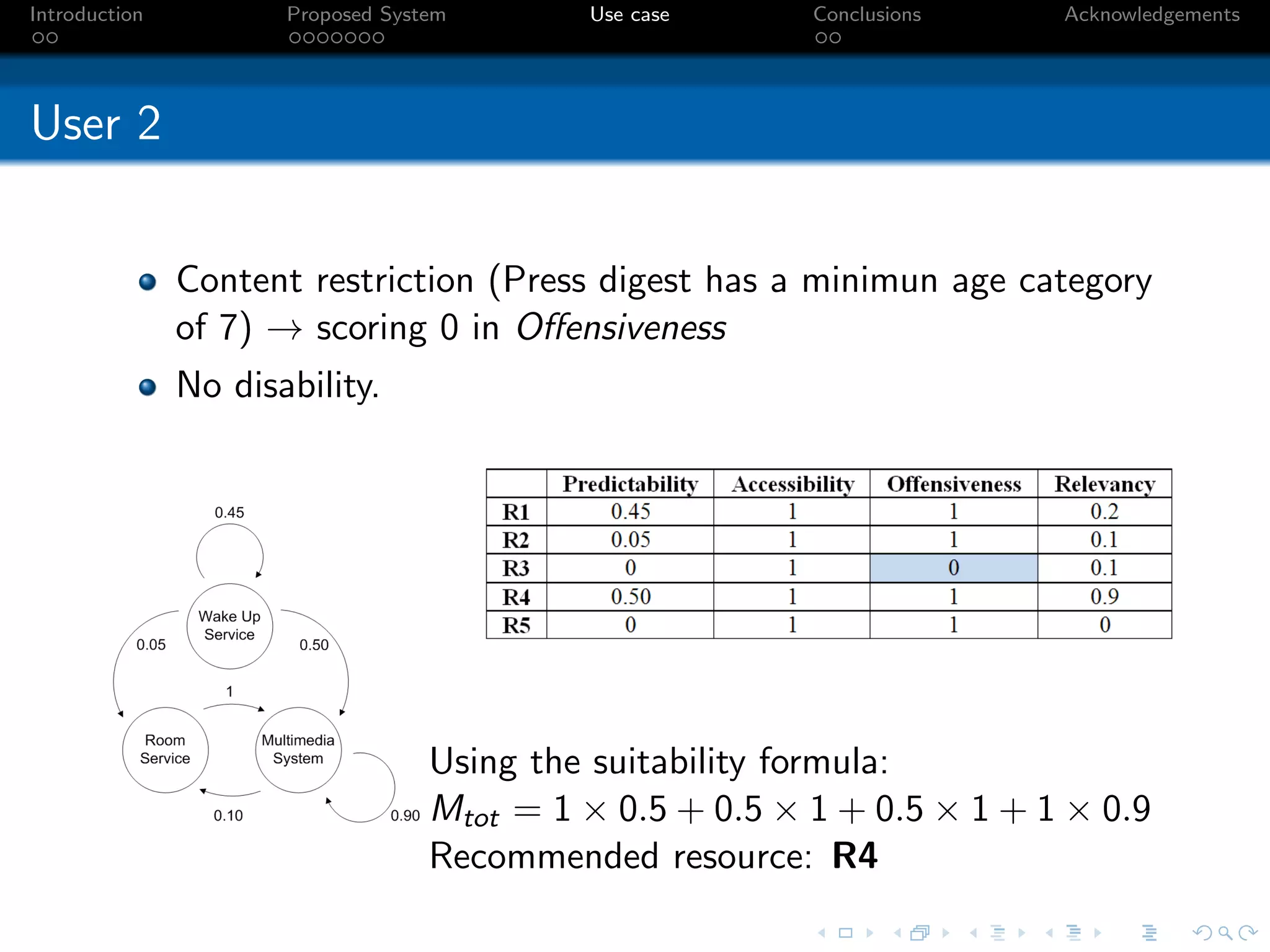
               Content restriction (Press digest has a minimun age category
               of 7) → scoring 0 in Offensiveness
               No disability.


                                   Using the suitability formula:
                                   Mtot = 1 × 0.5 + 0.5 × 1 + 0.5 × 1 + 1 × 0.9
                                   Recommended resource: R4
Introduction         Proposed System      Use case        Conclusions      Acknowledgements

Conclusions


Conclusions


               Advantages
                   Applicable to all the resource types identified in an intelligent
                   hotel domain: digital and physical services, multimedia content
                   and data.
                   Configurable process (weights).
                   Creation of a comprehensive picture of the current situation to
                   recommend the most suitable resource.
                   Anticipation of future user needs.
               Limitations
                   With Markov Chains we evaluate Predictability, but we don’t
                   evaluate the previous events that preceded the current one...
                   (Time Series?)
                   More aspects are needed.
Introduction         Proposed System     Use case       Conclusions     Acknowledgements

Future work


Conclusions


               Aspect we are working on:
                   Timeliness: it evaluates how up to date is the information
                   about a resource.
                   Satisfaction: measures the opinion of the users about a
                   resource.
                   Attention: The average number of interactions per time unit
                   with a consumed resource.
                   Closeness: Evaluates what resources are consumed by similar
                   users.
               We aim to include vagueness and uncertainty in the context
               data information by ambiguity assessing techniques.
Introduction     Proposed System   Use case     Conclusions    Acknowledgements


Acknowledgements


       This work has been supported by project grant CEN-20101019
       (THOFU), funded by the Spanish Centro para el Desarrollo
       Tecnol´gico Industrial (CDTI) and supported by the Spanish
             o
       Ministerio de Ciencia e Innovaci´n.
                                       o

An Aspect Based Resource Recommendation System for Smart Hotels

  • 1.
    Introduction Proposed System Use case Conclusions Acknowledgements An Aspect Based Resource Recommendation System for Smart Hotels Aitor Almeida1 , Eduardo Castillejo 1 , Diego L´pez-de-Ipi˜a1 , o n Marcos Sacrist´n a 2 and Javier Diego3 1 DeustoTech - Deusto Institute of Technology, University of Deusto http://www.morelab.deusto.es 2 Treelogic http://www.treelogic.com 3 Logica http://www.logica.com/es September 24, 2012
  • 2.
    Introduction Proposed System Use case Conclusions Acknowledgements Index 1 Introduction Problem Proposed solution 2 Proposed System Resources Aspects Suitability 3 Use case 4 Conclusions Conclusions Future work 5 Acknowledgements
  • 3.
    Introduction Proposed System Use case Conclusions Acknowledgements Problem Introduction The number of resources available in a Smart Environment can be overwhelming. Using user and resource features with context data can help in the recommendation filtering process. Our domain: Smart hotels A proactive domain which makes recommendations to its users. It must know about users’ preferences, tastes and limitations or capabilities. It must be capable of analysing the different aspects that define a resource to offer the most appropriate one to the user.
  • 4.
    Introduction Proposed System Use case Conclusions Acknowledgements Proposed solution Introduction An aspect-based resource recommendation system. We have identified the aspects of a resource that can be used to describe it in a Smart Environment. These aspects take into account both user and resource features and the current context.
  • 5.
    Introduction Proposed System Use case Conclusions Acknowledgements Resources Proposed System
  • 6.
    Introduction Proposed System Use case Conclusions Acknowledgements Resources Proposed System Resource type (in our domain): Pyshical service Virtual service Multimedia content Othe information (maps, news...)
  • 7.
    Introduction Proposed System Use case Conclusions Acknowledgements Resources Proposed System Resource type (in our domain): Pyshical service Virtual service Multimedia content Othe information (maps, news...) Defined aspects must be generic enough to be used to describe all the available resources. In the current implementation we have considered: 1. Predictability 2. Accessibility 3. Relevancy 4. Offensiveness
  • 8.
    Introduction Proposed System Use case Conclusions Acknowledgements Aspects Proposed System 1. Predictability It reflects how likely a resource is to be used based on the resources previously consumed. The likeliness is expressed as a probability value 0..1 Markov Chains to create the model of the user’s resource usage → ascertain patterns in the user behaviour One of the Markov Chains created with the resource consumption data for the predictability aspect. Using the created model the recommender system can predict the likeness of one resource to be the next to be consumed
  • 9.
    Introduction Proposed System Use case Conclusions Acknowledgements Aspects Proposed System 2. Accessibility Users possess a wide variety of abilities (sensorial, cognitive and so on) that must be taken into account to asses the suitability of the resources. Taxonomy of the user abilities taken into account in the accessibility aspect. Disabilities are classified in three categories. Users must be able of consuming every resource.
  • 10.
    Introduction Proposed System Use case Conclusions Acknowledgements Aspects Proposed System Each resource has: required user abilities recommended user abilities We penalize resources that can not be consumed by the user: Aacc = 1 − ω|Recnot | Aacc is the value of the accessibility for the resource. ω is the penalization weight. |Recnot | is the number of recommended abilities not met by the user.
  • 11.
    Introduction Proposed System Use case Conclusions Acknowledgements Aspects Proposed System 3. Relevancy It measures the importance of a resource to the user’s current context. Context variables: User location Time of the day Current activity: sleeping, hygiene routine, eating, exercising, working, shopping and visiting tourist attractions. For the classifier we have used KNN (k-nearest neighbor) supervised classification method.
  • 12.
    Introduction Proposed System Use case Conclusions Acknowledgements Aspects Proposed System 4. Offensiveness It measures the suitability of a resource based on a rating system. We use the age categories and content descriptions by PEGI (Pan European Game Information) rating system. To evaluate it, we use the same Accessibility formula, taking the age categories as required constraints and the content descriptions as the recommended ones.
  • 13.
    Introduction Proposed System Use case Conclusions Acknowledgements Suitability Proposed System Suitability: It is a dynamic and personalized value for an aspect to a specific user: Mtot = Σwi fi Mtot is the value of the suitability of each resource. wi is the weight for an aspect. fi is the value of the aspect of a resource. These values are normalized.
  • 14.
    Introduction Proposed System Use case Conclusions Acknowledgements Use case Two different users (in their rooms, the service R1 has just been activated): User 1: a 27 years old male with a hearing impairment. User 2: a 6 years old child. Available resources: R1: Wake up service. R2: Room service. R3: Press digest. R4: Multimedia system. R5: Transport service. Weigths: Predictability and Relevancy = 1 Accessibility and Offensiveness = 0.5
  • 15.
    Introduction Proposed System Use case Conclusions Acknowledgements User 1 No content restriction. Hearing impairment. R1 and R4 offer alternative means to use them. Using the suitability formula: Mtot = 1 × 0.6 + 0.5 × 1 + 0.5 × 1 + 1 × 0.7 Recommended resource: R2
  • 16.
    Introduction Proposed System Use case Conclusions Acknowledgements User 2 Content restriction (Press digest has a minimun age category of 7) → scoring 0 in Offensiveness No disability. Using the suitability formula: Mtot = 1 × 0.5 + 0.5 × 1 + 0.5 × 1 + 1 × 0.9 Recommended resource: R4
  • 17.
    Introduction Proposed System Use case Conclusions Acknowledgements Conclusions Conclusions Advantages Applicable to all the resource types identified in an intelligent hotel domain: digital and physical services, multimedia content and data. Configurable process (weights). Creation of a comprehensive picture of the current situation to recommend the most suitable resource. Anticipation of future user needs. Limitations With Markov Chains we evaluate Predictability, but we don’t evaluate the previous events that preceded the current one... (Time Series?) More aspects are needed.
  • 18.
    Introduction Proposed System Use case Conclusions Acknowledgements Future work Conclusions Aspect we are working on: Timeliness: it evaluates how up to date is the information about a resource. Satisfaction: measures the opinion of the users about a resource. Attention: The average number of interactions per time unit with a consumed resource. Closeness: Evaluates what resources are consumed by similar users. We aim to include vagueness and uncertainty in the context data information by ambiguity assessing techniques.
  • 19.
    Introduction Proposed System Use case Conclusions Acknowledgements Acknowledgements This work has been supported by project grant CEN-20101019 (THOFU), funded by the Spanish Centro para el Desarrollo Tecnol´gico Industrial (CDTI) and supported by the Spanish o Ministerio de Ciencia e Innovaci´n. o