The views expressed in this presentation are the views of the author/s and do not necessarily reflect the views or policies of the Asian
Development Bank, or its Board of Governors, or the governments they represent. ADB does not guarantee the accuracy of the data included
in this presentation and accepts no responsibility for any consequence of their use. The countries listed in this presentation do not imply any
view on ADB's part as to sovereignty or independent status or necessarily conform to ADB's terminology.
An Appreciative Inquiry
Cameo
Olivier Serrat
2011
Appreciative Inquiry
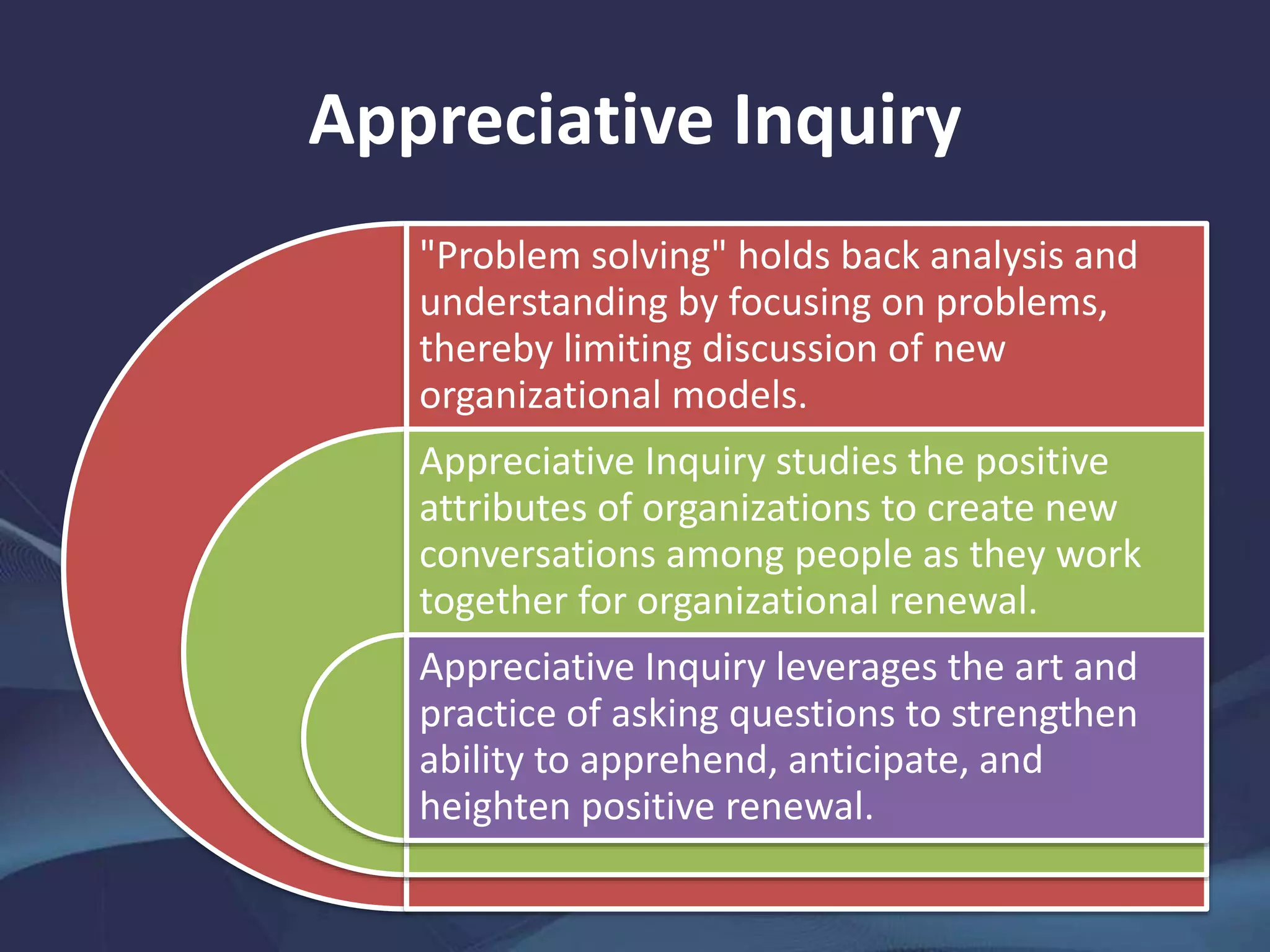
"Problem solving" holds back analysis and
understanding by focusing on problems,
thereby limiting discussion of new
organizational models.
Appreciative Inquiry studies the positive
attributes of organizations to create new
conversations among people as they work
together for organizational renewal.
Appreciative Inquiry leverages the art and
practice of asking questions to strengthen
ability to apprehend, anticipate, and
heighten positive renewal.
Appreciative Inquiry
Appreciative
Inquiry is
based on two
assumptions:
• Organizations always move in the
direction of the questions their members
ask and the things they talk about.
• Energy for positive change is created
when organizations engage continually in
remembering and analyzing
circumstances when they were at their
best rather than focusing on problems
and how they can be solved.
Appreciative Inquiry
• Discovery: People converse to (re)discover the
times when their organization was at its best.
• Dream: At a group conference facilitated by
experts, personnel envisions that the peak
moments identified in the Discovery phase have
become the norm rather than the exception.
• Design: A team is empowered to design ways to
create the organization dreamed in the group
conference.
• Delivery: Teams are formed to deliver the dream
and new designs, follow up on design elements,
and continue the appreciative process.
Appreciative
Inquiry uses
the 4-D
Cycle:
The 4D Cycle of Appreciative
Inquiry
Affirmative
Topic
Choice
Discovery—
Appreciate
the Best of
What Is
Dream—
Imagine
What Could
Be
Design—
Determine
What
Should BeDelivery—
Create What
Will Be
Sustainable Livelihoods
• People-centered
• Responsive and
participatory
• Multilevel
• Partner-friendly
• Dynamic
• Sustainable
The Sustainable
Livelihoods approach is a
way of thinking about
the objectives, scope,
and priorities for
development activities.
The approach helps
formulate development
activities that are:
Sustainable Livelihoods
The Sustainable Livelihoods approach:
• Makes the connection between people and the overall
enabling environment that influences the outcomes of
livelihood strategies.
• Brings attention to the inherent potential of people's skills,
social networks, access to physical and financial resources,
and ability to influence core institutions.
Human
Social
Physical Financial
Natural
Vulnerability
Context
• Shocks
• Trends
• Seasonalities
Livelihood
Strategies
Policies &
Institutions
• Structures
- Public Sector
- Private Sector
- Third Sector
• Processes
- Institutions
- Laws
- Policies
- Culture
Livelihood
Outcomes
•Sustainable use of
natural resources
•Income
•Well-being
•Resilience
•Food security
Capital Assets
The Livelihoods Framework
Appreciative Inquiry for
Sustainable Livelihoods
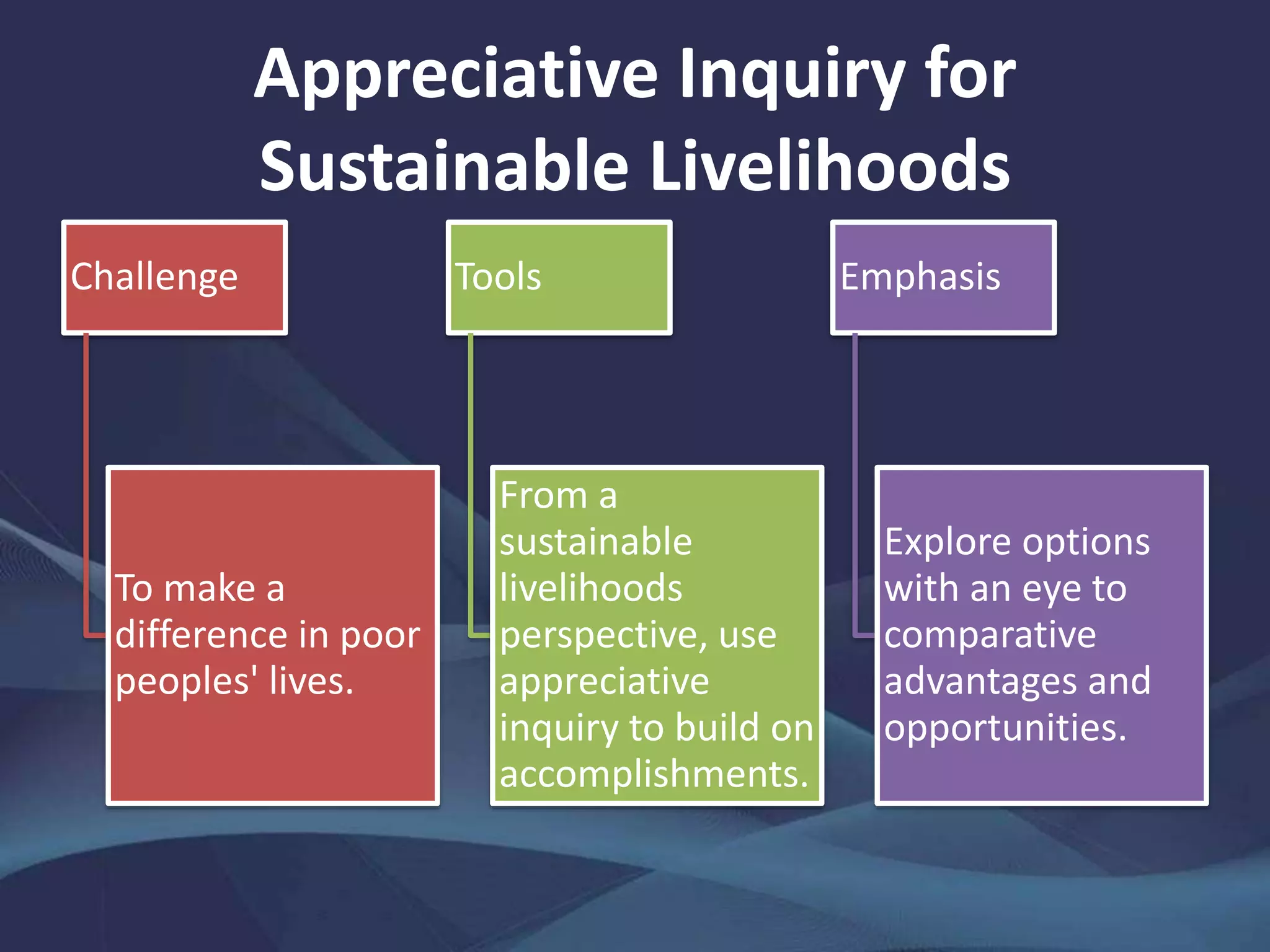
Challenge
To make a
difference in poor
peoples' lives.
Tools
From a
sustainable
livelihoods
perspective, use
appreciative
inquiry to build on
accomplishments.
Emphasis
Explore options
with an eye to
comparative
advantages and
opportunities.
Livelihoods Framework Attributes
The Sustainable Livelihoods approach encourages thinking out of
the box; it frees development practitioners from conventional
approaches that are often restricted to identifying problems and
finding solutions.
The approach invites development practitioners to look at
contexts and relationships so that development initiatives can
become more process-oriented.
The approach represents an important shift away from the
conventional focus on project inputs and outputs and the
assumed mechanical links between them.
Livelihoods Framework Attributes
The Sustainable Livelihoods approach compels development
practitioners to look for multiple entry points and to move
beyond a homogenous "community" view and a narrow sectoral
perspective.
The approach stresses the importance of understanding
institutions by mapping the institutional framework and linking
the micro to the macro and the formal to the informal.
The approach calls for a new style of appraisal that moves from
universal prescriptions to context-specific approaches that allow
alternative, local perspectives to reveal themselves.
Livelihoods Framework
Assessment
Strength Weakness
The Sustainable Livelihoods
approach seeks to understand
changing combinations of
modes of livelihood in a
dynamic and historical context.
The Sustainable Livelihoods
approach underplays elements
of the vulnerability context such
as macroeconomic trends and
conflict.
The Sustainable Livelihoods
approach explicitly advocates a
creative tension between
different levels of analysis and
emphasizes the importance of
macro and micro linkages.
The Sustainable Livelihoods
approach assumes that capital
assets can be expanded in
generalized and incremental
fashion.
Livelihoods Framework
Assessment
Strength Weakness
The Sustainable Livelihoods
approach acknowledges the
need to move beyond narrow
sectoral perspectives and places
emphasis on seeing the linkages
between sectors.
The Sustainable Livelihoods
approach does not pay enough
attention to inequalities of
power.
The Sustainable Livelihoods
approach calls for investigation
of the relationships between
different activities that
constitute livelihoods and draws
attention to social relations.
The Sustainable Livelihoods
approach underplays the fact
that enhancing the livelihoods of
one group can undermine those
of another.
The Tonle Sap at a Glance
Item Characteristic
Area •250,000–300,000 hectares (ha) in the dry season and 1.0–1.6 million ha in the wet season.
•The flooded forest extended over more than 1 million ha originally, 614,000 ha in the 1960s,
362,000 ha in 1991, and about 20,000 ha in 1997.
Hydrology •1–2 meters above mean sea level in the dry season and 8–12 meters above mean sea level in
the wet season.
•20% of the Mekong River's floodwaters are absorbed by the Tonle Sap.
•62% of the Tonle Sap's water originates from the Mekong River and 38% of the Tonle Sap's
water originates from the Tonle Sap basin.
•The Tonle Sap is connected to the Mekong River by the 100-kilometer-long Tonle Sap River,
which reverses its flow seasonally.
Biology •The flooded forest contains about 200 plant species.
•The Tonle Sap contains at least 200 species of fish, 42 species of reptiles, 225 species of
birds, and 46 species of mammals.
•Of the 500 fish species once found in Cambodia's wetlands, as many as 300 are now thought
to have disappeared.
Socio-
economy
•1.2 million people live in the area bordered by Highways No. 5 and No. 6.
•The Tonle Sap yields about 230,000 tons of fish each year (about 50% of Cambodia's total
freshwater capture fisheries production).
•Rice production in the Tonle Sap's floodplains makes up about 12% of Cambodia's total.
Threats to the Tonle Sap
Climate
Change
Cumulative Impact
of Built Structures
on the Hydrology of
the Mekong Basin
Deforestation in
the Watersheds
Agricultural
Expansion
Industrial and
Urban
Pollution
Conversion of the
Flooded Forest to
Agriculture
Overexploitation
of Fisheries and
Wildlife
Resources
Agricultural
Runoff
Mining
Habitat
Fragmentation
Collection of
Fuel Wood from
the Flooded
Forest
Introduction of
Non-Native
Species
Entry Points for Sustainable
Livelihoods
Entry Point Purpose Potential Outcomes
Establishing Village
Development Funds
• To provide a sustainable mechanism
for communities to self-fund
development activities, and
provision of safety nets to the poor
and vulnerable.
• To set in motion innovative
livelihoods improvement initiatives
with a bias toward disadvantaged
groups.
• Enhanced human and social capital
and reduced dependency on
external agencies.
• Enhanced human capital by directly
developing the knowledge and skills
of all groups to contribute to
planning at the village level.
• Improved physical capital in terms of
local infrastructure.
• Enhanced social capital through
improvement in the internal
functioning of groups.
Strengthening
Community-Based
Management of
Natural Resources
• To generate transparency and equity
into issues surrounding access t land
and other natural resources that
create conflict and dispute in
villages.
• To improve sound management of
natural resources.
• Direct impact on the stock of natural
capital by enhancing sustainable
measures to improve natural
resource management.
• Social capital can provide
community-accepted leadership and
management.
Entry Points for Sustainable
Livelihoods
Entry Point Purpose Potential Outcomes
Improving
Agronomic Practices
and Small-Scale
Irrigation
• To achieve optimum production from
local crop varieties, especially rice,
particularly during favorable
seasons.
• To make agricultural output more
reliable with the rehabilitation of
existing or construction of new
small-scale irrigation systems.
• Improved natural and physical capital
through the provision of inputs that
ensure greater household food
security.
• Enhanced social capital through
fostering Water User Groups and
Pump User Groups.
• Strengthened structures through
involvement of the Ministry of Rural
Development in cultural change
leading to social capital wealth.
• Increased coordination of activities
that allows gaps in support of efforts
to be closed.
Entry Points for Sustainable
Livelihoods
Entry Point Purpose Potential Outcomes
Developing Post-
School Literacy for
Women
• To provide women the opportunity
to acquire greater literacy in the
Khmer language and thereby
increase capacity to seek
information, lobby, and set up new
groups for gender empowerment.
• Enhanced social and human capital,
especially for poor and vulnerable
women from all three ethnic groups
in the Tonle Sap region.
• Enhanced social capital since women
would become less economically
dependent on men, leading to
greater gender empowerment.
• Lessening of social exclusion for
many women groups, including
ethnic minority women.
Entry Points for Sustainable
Livelihoods
Entry Point Purpose Potential Outcomes
Supporting Self-Help
Groups
• To enable small groups (up to 20
members) to work with one another
to pool savings toward a revolving
credit fund or to access microfinance
provider services.
• Increased financial capital, especially
for the poor and vulnerable.
• Increased financial capital induced by
the possibility of financial savings.
• Enhanced social capital through
improvement in group formation and
structure.
• Increased financial capital through
income generation and scope to
participate in external activities.
Linking Villagers to
the Private Sector
• To enable the private sector to drive
poverty reduction, for instance, in
the livestock sector but also in other
land and water-based enterprise
sectors, through open and
transparent linkages that are
protected by appropriate legislation
and practices of engagement.
• Increased financial capital through
enhanced market opportunities and
subsector activities leading to the
possibility of financial savings.
• Enhanced natural capital, which will
need sound management to prevent
overexploitation.
Entry Points for Sustainable
Livelihoods
Entry Point Purpose Potential Outcomes
Providing Post-
Schooling Vocational
Education
• To compensate for the limited
schooling of many in the Tonle Sap
region
• To equip a new labor force with basic
know-how and experience to add
value to local industry and other
economic activities
• To develop a "Living Skills" program
related to labor and migrant workers'
rights, economic development, and
HIV/AIDS
• Direct enhancement of human
capital, from which economic growth
potential can be realized
• Reduced vulnerability of those in the
workplace and workers' enhanced
knowledge of rights and obligations
to employers
• A skilled labor force at the
community level and from whom the
community can also elicit advice
Adding Value to Fish
and Non-Timber
Forest Products
• To add value to fish by introducing
appropriate training in post harvest
practices, for instance, in the areas
of fermenting and drying
• To generate higher economic returns
from non-timber forest products
harvested which could have a
significant economic value
• Enhanced human capital through a
reduction of vulnerability at times of
low fish catch or flooding
• Maximized returns to communities
from natural capital
Tonle Sap Sustainable Livelihoods
Output 1
• Community-Driven Development is Supported (to
absorb 90% of baseline costs). This entails: (i)
establishing a community-livelihood fund; and (ii)
designing and implementing livelihood investment
packages.
Output 2
• Core areas are Safeguarded (to absorb about 4% of
baseline costs). This entails: (i) establishing an
information base on core areas; (ii) instituting a
management system for core areas; and (iii)
instituting an improved network of fish sanctuaries.
Output 3
• Skills and Awareness for Sustainable Livelihoods are
Built (to absorb about 6% of baseline costs). This
entails: (i) improving coordination for community-
driven development; (ii) enhancing the skills base for
community-driven development; and (iii) educating
for protection of natural resources.
Tonle Sap Sustainable LivelihoodsOutputs
Community-
Driven
Development is
Supported
Core Areas are
Safeguarded
Skills and
Awareness for
Sustainable
Livelihoods are
Built
Outcome
Increased
access to assets
in the five
provinces that
adjoin the Tonle
Sap
Impact
Improved
livelihoods
Life on the Tonle Sap
Further Reading
• ADB. 2005. The Tonle sap Basin Strategy. Manila.
www.adb.org/documents/tonle-sap-basin-strategy
• ——. 2005. Tonle Sap Sustainable Livelihoods Project. Manila.
www.adb.org/projects/documents/tonle-sap-sustainable-
livelihoods-project-rrp
• ——. 2005. Sustaining Livelihoods on Cambodia's Tonle Sap.
Manila. www.adb.org/news/sustaining-livelihoods-
cambodias-tonle-sap
• ——. 2008. The Sustainable Livelihoods Approach. Manila.
www.adb.org/publications/sustainable-livelihoods-approach
• ——. 2008. Appreciative Inquiry. Manila.
www.adb.org/publications/appreciative-inquiry
Quick Response Codes
@ADB
@ADB Sustainable
Development Timeline
@Academia.edu
@LinkedIn
@ResearchGate
@Scholar
@SlideShare
@Twitter

An Appreciative Inquiry Cameo

  • 1.
    The views expressedin this presentation are the views of the author/s and do not necessarily reflect the views or policies of the Asian Development Bank, or its Board of Governors, or the governments they represent. ADB does not guarantee the accuracy of the data included in this presentation and accepts no responsibility for any consequence of their use. The countries listed in this presentation do not imply any view on ADB's part as to sovereignty or independent status or necessarily conform to ADB's terminology. An Appreciative Inquiry Cameo Olivier Serrat 2011
  • 2.
    Appreciative Inquiry "Problem solving"holds back analysis and understanding by focusing on problems, thereby limiting discussion of new organizational models. Appreciative Inquiry studies the positive attributes of organizations to create new conversations among people as they work together for organizational renewal. Appreciative Inquiry leverages the art and practice of asking questions to strengthen ability to apprehend, anticipate, and heighten positive renewal.
  • 3.
    Appreciative Inquiry Appreciative Inquiry is basedon two assumptions: • Organizations always move in the direction of the questions their members ask and the things they talk about. • Energy for positive change is created when organizations engage continually in remembering and analyzing circumstances when they were at their best rather than focusing on problems and how they can be solved.
  • 4.
    Appreciative Inquiry • Discovery:People converse to (re)discover the times when their organization was at its best. • Dream: At a group conference facilitated by experts, personnel envisions that the peak moments identified in the Discovery phase have become the norm rather than the exception. • Design: A team is empowered to design ways to create the organization dreamed in the group conference. • Delivery: Teams are formed to deliver the dream and new designs, follow up on design elements, and continue the appreciative process. Appreciative Inquiry uses the 4-D Cycle:
  • 5.
    The 4D Cycleof Appreciative Inquiry Affirmative Topic Choice Discovery— Appreciate the Best of What Is Dream— Imagine What Could Be Design— Determine What Should BeDelivery— Create What Will Be
  • 6.
    Sustainable Livelihoods • People-centered •Responsive and participatory • Multilevel • Partner-friendly • Dynamic • Sustainable The Sustainable Livelihoods approach is a way of thinking about the objectives, scope, and priorities for development activities. The approach helps formulate development activities that are:
  • 7.
    Sustainable Livelihoods The SustainableLivelihoods approach: • Makes the connection between people and the overall enabling environment that influences the outcomes of livelihood strategies. • Brings attention to the inherent potential of people's skills, social networks, access to physical and financial resources, and ability to influence core institutions.
  • 8.
    Human Social Physical Financial Natural Vulnerability Context • Shocks •Trends • Seasonalities Livelihood Strategies Policies & Institutions • Structures - Public Sector - Private Sector - Third Sector • Processes - Institutions - Laws - Policies - Culture Livelihood Outcomes •Sustainable use of natural resources •Income •Well-being •Resilience •Food security Capital Assets The Livelihoods Framework
  • 9.
    Appreciative Inquiry for SustainableLivelihoods Challenge To make a difference in poor peoples' lives. Tools From a sustainable livelihoods perspective, use appreciative inquiry to build on accomplishments. Emphasis Explore options with an eye to comparative advantages and opportunities.
  • 10.
    Livelihoods Framework Attributes TheSustainable Livelihoods approach encourages thinking out of the box; it frees development practitioners from conventional approaches that are often restricted to identifying problems and finding solutions. The approach invites development practitioners to look at contexts and relationships so that development initiatives can become more process-oriented. The approach represents an important shift away from the conventional focus on project inputs and outputs and the assumed mechanical links between them.
  • 11.
    Livelihoods Framework Attributes TheSustainable Livelihoods approach compels development practitioners to look for multiple entry points and to move beyond a homogenous "community" view and a narrow sectoral perspective. The approach stresses the importance of understanding institutions by mapping the institutional framework and linking the micro to the macro and the formal to the informal. The approach calls for a new style of appraisal that moves from universal prescriptions to context-specific approaches that allow alternative, local perspectives to reveal themselves.
  • 12.
    Livelihoods Framework Assessment Strength Weakness TheSustainable Livelihoods approach seeks to understand changing combinations of modes of livelihood in a dynamic and historical context. The Sustainable Livelihoods approach underplays elements of the vulnerability context such as macroeconomic trends and conflict. The Sustainable Livelihoods approach explicitly advocates a creative tension between different levels of analysis and emphasizes the importance of macro and micro linkages. The Sustainable Livelihoods approach assumes that capital assets can be expanded in generalized and incremental fashion.
  • 13.
    Livelihoods Framework Assessment Strength Weakness TheSustainable Livelihoods approach acknowledges the need to move beyond narrow sectoral perspectives and places emphasis on seeing the linkages between sectors. The Sustainable Livelihoods approach does not pay enough attention to inequalities of power. The Sustainable Livelihoods approach calls for investigation of the relationships between different activities that constitute livelihoods and draws attention to social relations. The Sustainable Livelihoods approach underplays the fact that enhancing the livelihoods of one group can undermine those of another.
  • 14.
    The Tonle Sapat a Glance Item Characteristic Area •250,000–300,000 hectares (ha) in the dry season and 1.0–1.6 million ha in the wet season. •The flooded forest extended over more than 1 million ha originally, 614,000 ha in the 1960s, 362,000 ha in 1991, and about 20,000 ha in 1997. Hydrology •1–2 meters above mean sea level in the dry season and 8–12 meters above mean sea level in the wet season. •20% of the Mekong River's floodwaters are absorbed by the Tonle Sap. •62% of the Tonle Sap's water originates from the Mekong River and 38% of the Tonle Sap's water originates from the Tonle Sap basin. •The Tonle Sap is connected to the Mekong River by the 100-kilometer-long Tonle Sap River, which reverses its flow seasonally. Biology •The flooded forest contains about 200 plant species. •The Tonle Sap contains at least 200 species of fish, 42 species of reptiles, 225 species of birds, and 46 species of mammals. •Of the 500 fish species once found in Cambodia's wetlands, as many as 300 are now thought to have disappeared. Socio- economy •1.2 million people live in the area bordered by Highways No. 5 and No. 6. •The Tonle Sap yields about 230,000 tons of fish each year (about 50% of Cambodia's total freshwater capture fisheries production). •Rice production in the Tonle Sap's floodplains makes up about 12% of Cambodia's total.
  • 15.
    Threats to theTonle Sap Climate Change Cumulative Impact of Built Structures on the Hydrology of the Mekong Basin Deforestation in the Watersheds Agricultural Expansion Industrial and Urban Pollution Conversion of the Flooded Forest to Agriculture Overexploitation of Fisheries and Wildlife Resources Agricultural Runoff Mining Habitat Fragmentation Collection of Fuel Wood from the Flooded Forest Introduction of Non-Native Species
  • 16.
    Entry Points forSustainable Livelihoods Entry Point Purpose Potential Outcomes Establishing Village Development Funds • To provide a sustainable mechanism for communities to self-fund development activities, and provision of safety nets to the poor and vulnerable. • To set in motion innovative livelihoods improvement initiatives with a bias toward disadvantaged groups. • Enhanced human and social capital and reduced dependency on external agencies. • Enhanced human capital by directly developing the knowledge and skills of all groups to contribute to planning at the village level. • Improved physical capital in terms of local infrastructure. • Enhanced social capital through improvement in the internal functioning of groups. Strengthening Community-Based Management of Natural Resources • To generate transparency and equity into issues surrounding access t land and other natural resources that create conflict and dispute in villages. • To improve sound management of natural resources. • Direct impact on the stock of natural capital by enhancing sustainable measures to improve natural resource management. • Social capital can provide community-accepted leadership and management.
  • 17.
    Entry Points forSustainable Livelihoods Entry Point Purpose Potential Outcomes Improving Agronomic Practices and Small-Scale Irrigation • To achieve optimum production from local crop varieties, especially rice, particularly during favorable seasons. • To make agricultural output more reliable with the rehabilitation of existing or construction of new small-scale irrigation systems. • Improved natural and physical capital through the provision of inputs that ensure greater household food security. • Enhanced social capital through fostering Water User Groups and Pump User Groups. • Strengthened structures through involvement of the Ministry of Rural Development in cultural change leading to social capital wealth. • Increased coordination of activities that allows gaps in support of efforts to be closed.
  • 18.
    Entry Points forSustainable Livelihoods Entry Point Purpose Potential Outcomes Developing Post- School Literacy for Women • To provide women the opportunity to acquire greater literacy in the Khmer language and thereby increase capacity to seek information, lobby, and set up new groups for gender empowerment. • Enhanced social and human capital, especially for poor and vulnerable women from all three ethnic groups in the Tonle Sap region. • Enhanced social capital since women would become less economically dependent on men, leading to greater gender empowerment. • Lessening of social exclusion for many women groups, including ethnic minority women.
  • 19.
    Entry Points forSustainable Livelihoods Entry Point Purpose Potential Outcomes Supporting Self-Help Groups • To enable small groups (up to 20 members) to work with one another to pool savings toward a revolving credit fund or to access microfinance provider services. • Increased financial capital, especially for the poor and vulnerable. • Increased financial capital induced by the possibility of financial savings. • Enhanced social capital through improvement in group formation and structure. • Increased financial capital through income generation and scope to participate in external activities. Linking Villagers to the Private Sector • To enable the private sector to drive poverty reduction, for instance, in the livestock sector but also in other land and water-based enterprise sectors, through open and transparent linkages that are protected by appropriate legislation and practices of engagement. • Increased financial capital through enhanced market opportunities and subsector activities leading to the possibility of financial savings. • Enhanced natural capital, which will need sound management to prevent overexploitation.
  • 20.
    Entry Points forSustainable Livelihoods Entry Point Purpose Potential Outcomes Providing Post- Schooling Vocational Education • To compensate for the limited schooling of many in the Tonle Sap region • To equip a new labor force with basic know-how and experience to add value to local industry and other economic activities • To develop a "Living Skills" program related to labor and migrant workers' rights, economic development, and HIV/AIDS • Direct enhancement of human capital, from which economic growth potential can be realized • Reduced vulnerability of those in the workplace and workers' enhanced knowledge of rights and obligations to employers • A skilled labor force at the community level and from whom the community can also elicit advice Adding Value to Fish and Non-Timber Forest Products • To add value to fish by introducing appropriate training in post harvest practices, for instance, in the areas of fermenting and drying • To generate higher economic returns from non-timber forest products harvested which could have a significant economic value • Enhanced human capital through a reduction of vulnerability at times of low fish catch or flooding • Maximized returns to communities from natural capital
  • 21.
    Tonle Sap SustainableLivelihoods Output 1 • Community-Driven Development is Supported (to absorb 90% of baseline costs). This entails: (i) establishing a community-livelihood fund; and (ii) designing and implementing livelihood investment packages. Output 2 • Core areas are Safeguarded (to absorb about 4% of baseline costs). This entails: (i) establishing an information base on core areas; (ii) instituting a management system for core areas; and (iii) instituting an improved network of fish sanctuaries. Output 3 • Skills and Awareness for Sustainable Livelihoods are Built (to absorb about 6% of baseline costs). This entails: (i) improving coordination for community- driven development; (ii) enhancing the skills base for community-driven development; and (iii) educating for protection of natural resources.
  • 22.
    Tonle Sap SustainableLivelihoodsOutputs Community- Driven Development is Supported Core Areas are Safeguarded Skills and Awareness for Sustainable Livelihoods are Built Outcome Increased access to assets in the five provinces that adjoin the Tonle Sap Impact Improved livelihoods
  • 23.
    Life on theTonle Sap
  • 24.
    Further Reading • ADB.2005. The Tonle sap Basin Strategy. Manila. www.adb.org/documents/tonle-sap-basin-strategy • ——. 2005. Tonle Sap Sustainable Livelihoods Project. Manila. www.adb.org/projects/documents/tonle-sap-sustainable- livelihoods-project-rrp • ——. 2005. Sustaining Livelihoods on Cambodia's Tonle Sap. Manila. www.adb.org/news/sustaining-livelihoods- cambodias-tonle-sap • ——. 2008. The Sustainable Livelihoods Approach. Manila. www.adb.org/publications/sustainable-livelihoods-approach • ——. 2008. Appreciative Inquiry. Manila. www.adb.org/publications/appreciative-inquiry
  • 25.
    Quick Response Codes @ADB @ADBSustainable Development Timeline @Academia.edu @LinkedIn @ResearchGate @Scholar @SlideShare @Twitter