AM
AMPLITUDE
MODULATION
By: Mourice C. Villalon
AMPLITUDE:
•the maximum extent of a
vibration or oscillation,
measured from the
position of equilibrium
MODULATION:
•The process by which data/information is
converted into electrical/digital signals for
transferring that signal over a medium is
called modulation. It increases strength for
maximum reach of the signals. The process of
extracting information/data from the
transmitted signal is called demodulation.
HISTORY OF AM
• Amplitude modulation (AM) is one of the earliest
modulation methods used in transmitting information over
the radio. It was developed during the first quarter of the
20th century, beginning with Roberto Landell de Moura
and Reginald Fessenden's radiotelephone experiments in
1900. Fessenden discovered the principle of AM and
successfully transmitted his voice over a distance of 1.6
km for the first time using AM on December 23, 1900.
However, widespread AM broadcasting was not
established until the 1920s, following the development of
vacuum tube receivers and transmitters.
SEND AND RECEIVE:
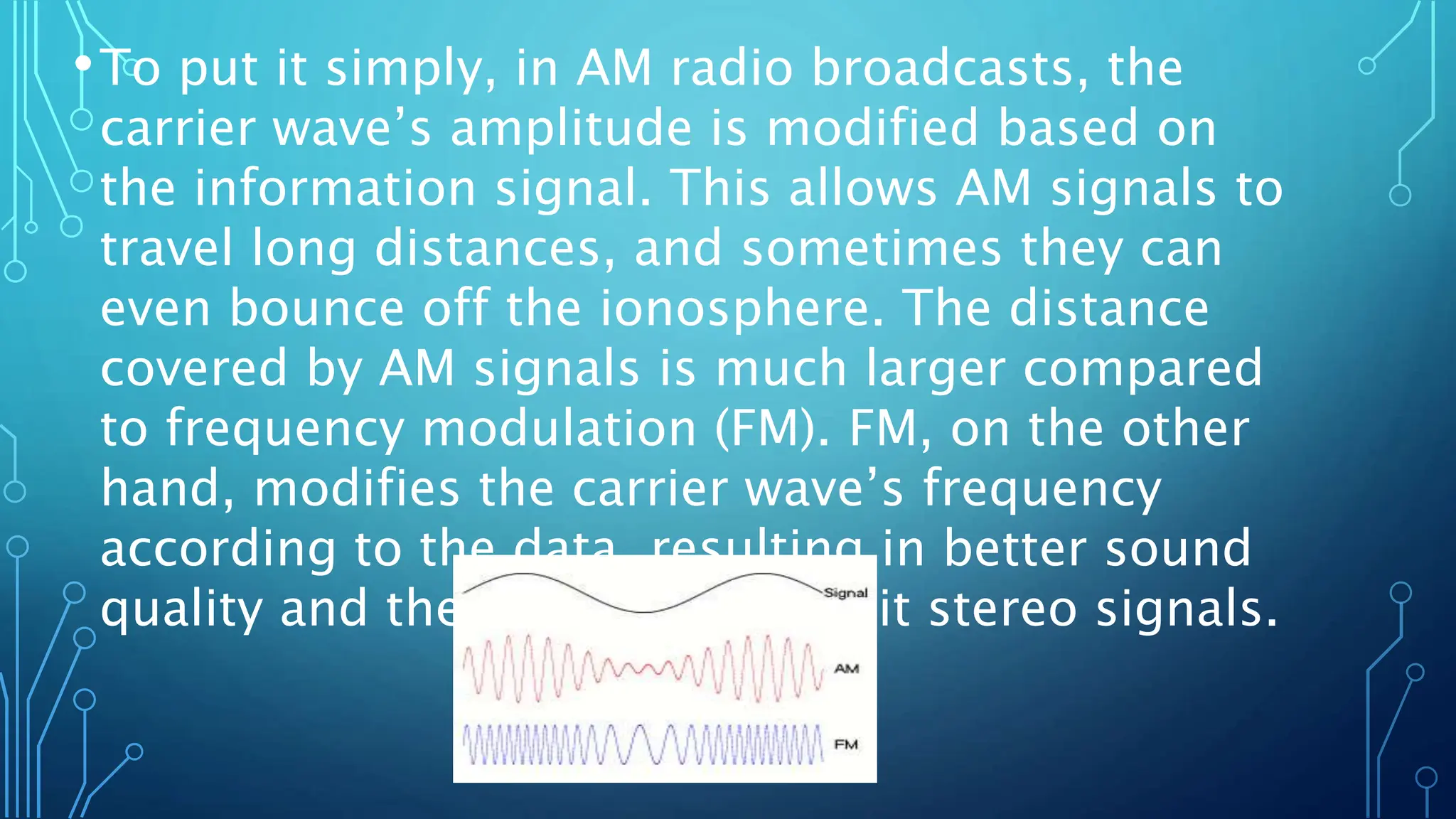
•To put it simply, in AM radio broadcasts, the
carrier wave’s amplitude is modified based on
the information signal. This allows AM signals to
travel long distances, and sometimes they can
even bounce off the ionosphere. The distance
covered by AM signals is much larger compared
to frequency modulation (FM). FM, on the other
hand, modifies the carrier wave’s frequency
according to the data, resulting in better sound
quality and the ability to transmit stereo signals.
ADVANTAGE OF AM
• The cost of amplitude modulation is low.
• Amplitude modulated signals are reflected by the earth from
the ionosphere layer.
• They travel a long distance and cover a wider area.
• Required frequency is low.
• It requires a simple transmitter and receiver.
HOW DOES IT LOOKS LIKE TO FIGURE THE
WAVE OF THE AM
BANDWIDTH REQUIREMENTS
•Bandwidth Requirements Twice the
highest modulating frequency. In AM
radio broadcasting, the modulating signal
has bandwidth of 15kHz, and hence the
bandwidth of an amplitude-modulated
signal is 30kHz.
WHAT TYPE OF SIGNAL AM IS?
END OF THE SLIDE

AMPLITUDEMODULATION " for grade 11".pptx

  • 1.
  • 2.
    AMPLITUDE: •the maximum extentof a vibration or oscillation, measured from the position of equilibrium
  • 3.
    MODULATION: •The process bywhich data/information is converted into electrical/digital signals for transferring that signal over a medium is called modulation. It increases strength for maximum reach of the signals. The process of extracting information/data from the transmitted signal is called demodulation.
  • 4.
    HISTORY OF AM •Amplitude modulation (AM) is one of the earliest modulation methods used in transmitting information over the radio. It was developed during the first quarter of the 20th century, beginning with Roberto Landell de Moura and Reginald Fessenden's radiotelephone experiments in 1900. Fessenden discovered the principle of AM and successfully transmitted his voice over a distance of 1.6 km for the first time using AM on December 23, 1900. However, widespread AM broadcasting was not established until the 1920s, following the development of vacuum tube receivers and transmitters.
  • 5.
  • 6.
    •To put itsimply, in AM radio broadcasts, the carrier wave’s amplitude is modified based on the information signal. This allows AM signals to travel long distances, and sometimes they can even bounce off the ionosphere. The distance covered by AM signals is much larger compared to frequency modulation (FM). FM, on the other hand, modifies the carrier wave’s frequency according to the data, resulting in better sound quality and the ability to transmit stereo signals.
  • 7.
    ADVANTAGE OF AM •The cost of amplitude modulation is low. • Amplitude modulated signals are reflected by the earth from the ionosphere layer. • They travel a long distance and cover a wider area. • Required frequency is low. • It requires a simple transmitter and receiver.
  • 8.
    HOW DOES ITLOOKS LIKE TO FIGURE THE WAVE OF THE AM
  • 9.
    BANDWIDTH REQUIREMENTS •Bandwidth RequirementsTwice the highest modulating frequency. In AM radio broadcasting, the modulating signal has bandwidth of 15kHz, and hence the bandwidth of an amplitude-modulated signal is 30kHz.
  • 10.
    WHAT TYPE OFSIGNAL AM IS?
  • 11.