Amorphous Computing
http://www.swiss.ai.mit.edu/projects/amorphous
Characteristics
•
•
•
•
•
•
•

Large number of computing units.
Limited computational power.
Fail with non-negligible probability.
No predetermined arrangement in space.
No global synchronization.
Limited distance communication.
Goal: Coherent robust global behavior.
Topics Covered
• Wave Propagation / Gradients
• Pattern Formation
– Growing Point / Rules and Markers
– Cell Shape Change

• Information Conservation
• Cellular Computing
• Nanoscale Computing
Wave Propagation / Gradients
• Common in biological systems (e.g., Hydra)
• Gives sense of position / distance.
Pattern Formation
• Use generative programs / not blueprints.
• Same in nature (e.g., cells).
• This is not programming of global
behavior!
Growing Point Language
• High-level actions:
– Pheromone secretion
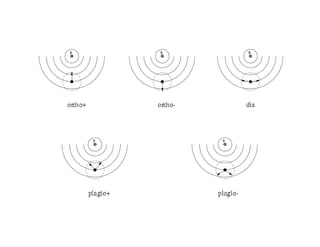
– Propagation according to tropism
– Termination

• Tropism to pheromone concentration
– towards / away / keep constant

• Translated to a low-level particle language.
Growing Point Language
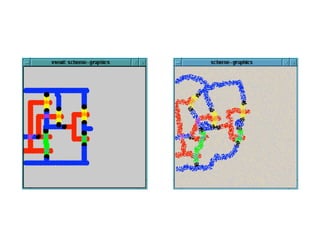
• Thesis: any planar graph can be constructed.
–
–
–
–
–

Is that important?
What is the quality of the end result?
What is the size of the program?
How is the graph described?
What share of the drawing is actually done by
the computing particles and what by the GPL
programmer?
Rules and Markers
• Event-driven computation with local state.
• Events:
– “message” received & “#” more hops to go
– “marker” is set & expires in “#” time units

• Conditions:
– “marker” is set / cleared

• Actions:
– Set / clear “marker”
– Send “message” for “#” hops
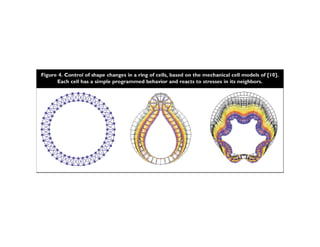
Cell Shape Change
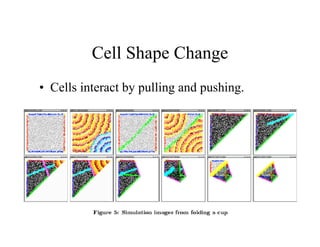
• Cells interact by pulling and pushing.
Biologically-Inspired Primitives
• We’ve seen gradients, but what else is
there?
• For local behavior…
–
–
–
–

Chemotaxis (following a gradient)
Local inhibition/competition
Counting/Quorum sensing
Random exploration/stabilization
Chemotaxis
• Move in response to a gradient, rather than only
using local concentration as an indicator
• Query neighbors if differential across cell is below
detection threshold
Local inhibition/competition
• Fast-growing cells cause slow-growing cells
to die (programmed cell death)
• Leader election
• Base morphogen level on fitness
Counting/Quorum Sensing
• Send signal, use signals from others as
feedback based on threshold
• Can be used to implement checkpoints
Random Exploration/Stabilization
• Explore randomly and in parallel, stabilize
“good” path
• Think ants!
How to Combine Local Primitives?
•
•
•
•
•

Role assignment
Asynchronous timing
Spatial modularity (subroutines)
Scale-independence
Regeneration
Conservative Systems
• Physics also provides metaphors for
amorphous computing
– Heat diffusion/chemical diffusion
– Wave equations
– Springs
Why is Mimicking Conservative
Systems a Challenge?
• Sensitive to bugs and/or failure
• Could implement using explicit tokens, but
how to keep track of tokens?
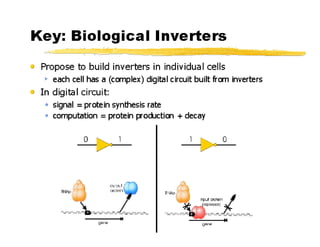
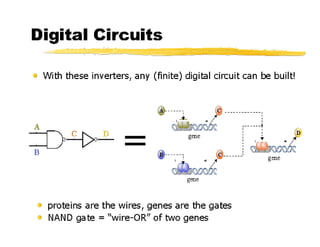
Cellular Computing
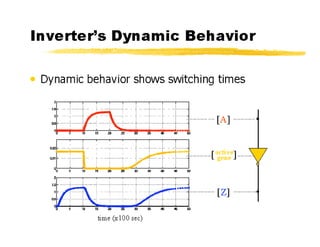
• Cool idea! But:
• Proteins are produced very slowly.
– Computation takes a long time.

• Unwanted interactions with other genes.
– Need different proteins for each gate.
– Limits the size of circuits.

• Cells have limited capacity for proteins.
– Only small circuits can fit into a cell.
slides from
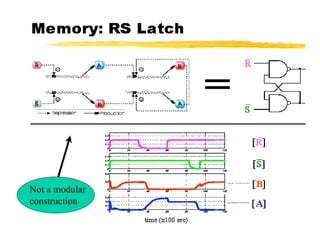
Not a modular
construction
Applications to the nano scale
• Spray walls with smart particles that detect
and fill in the cracks.
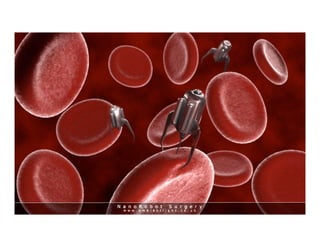
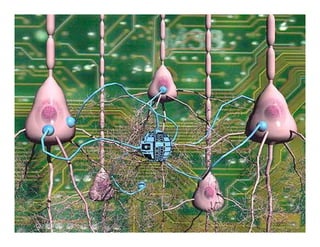
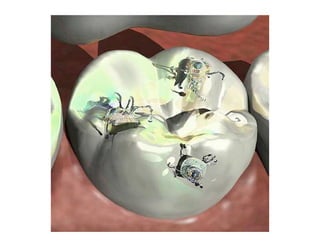
• Inject nanorobots in body to fix:
– Clogged valve problems
– Failing neurons.

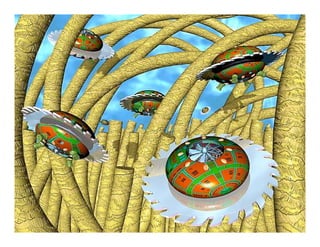
• Have personal nanorobots barbers / dentists.
Amorphous Computing (Computación Amorfa)

Amorphous Computing (Computación Amorfa)

  • 1.
  • 2.
    Characteristics • • • • • • • Large number ofcomputing units. Limited computational power. Fail with non-negligible probability. No predetermined arrangement in space. No global synchronization. Limited distance communication. Goal: Coherent robust global behavior.
  • 3.
    Topics Covered • WavePropagation / Gradients • Pattern Formation – Growing Point / Rules and Markers – Cell Shape Change • Information Conservation • Cellular Computing • Nanoscale Computing
  • 4.
    Wave Propagation /Gradients • Common in biological systems (e.g., Hydra) • Gives sense of position / distance.
  • 5.
    Pattern Formation • Usegenerative programs / not blueprints. • Same in nature (e.g., cells). • This is not programming of global behavior!
  • 6.
    Growing Point Language •High-level actions: – Pheromone secretion – Propagation according to tropism – Termination • Tropism to pheromone concentration – towards / away / keep constant • Translated to a low-level particle language.
  • 8.
    Growing Point Language •Thesis: any planar graph can be constructed. – – – – – Is that important? What is the quality of the end result? What is the size of the program? How is the graph described? What share of the drawing is actually done by the computing particles and what by the GPL programmer?
  • 10.
    Rules and Markers •Event-driven computation with local state. • Events: – “message” received & “#” more hops to go – “marker” is set & expires in “#” time units • Conditions: – “marker” is set / cleared • Actions: – Set / clear “marker” – Send “message” for “#” hops
  • 11.
    Cell Shape Change •Cells interact by pulling and pushing.
  • 13.
    Biologically-Inspired Primitives • We’veseen gradients, but what else is there? • For local behavior… – – – – Chemotaxis (following a gradient) Local inhibition/competition Counting/Quorum sensing Random exploration/stabilization
  • 14.
    Chemotaxis • Move inresponse to a gradient, rather than only using local concentration as an indicator • Query neighbors if differential across cell is below detection threshold
  • 15.
    Local inhibition/competition • Fast-growingcells cause slow-growing cells to die (programmed cell death) • Leader election • Base morphogen level on fitness
  • 16.
    Counting/Quorum Sensing • Sendsignal, use signals from others as feedback based on threshold • Can be used to implement checkpoints
  • 17.
    Random Exploration/Stabilization • Explorerandomly and in parallel, stabilize “good” path • Think ants!
  • 18.
    How to CombineLocal Primitives? • • • • • Role assignment Asynchronous timing Spatial modularity (subroutines) Scale-independence Regeneration
  • 19.
    Conservative Systems • Physicsalso provides metaphors for amorphous computing – Heat diffusion/chemical diffusion – Wave equations – Springs
  • 20.
    Why is MimickingConservative Systems a Challenge? • Sensitive to bugs and/or failure • Could implement using explicit tokens, but how to keep track of tokens?
  • 21.
    Cellular Computing • Coolidea! But: • Proteins are produced very slowly. – Computation takes a long time. • Unwanted interactions with other genes. – Need different proteins for each gate. – Limits the size of circuits. • Cells have limited capacity for proteins. – Only small circuits can fit into a cell.
  • 22.
  • 27.
  • 28.
    Applications to thenano scale • Spray walls with smart particles that detect and fill in the cracks. • Inject nanorobots in body to fix: – Clogged valve problems – Failing neurons. • Have personal nanorobots barbers / dentists.