AMBULANCE OFFLOAD DELAY
Nicole M’Carthy
Bachelor of Health Sciences, University of Calgary
Dr. David Swann, MLA
LITERATURE REVIEW
• Alberta spends the 2nd most on healthcare expenditure per capita, with a
total of $7, 329 per person (not including the territories). (1)
• Length of stay for people admitted in the hospital has increased by 11%
since 2016. (2)
• Admittance by the senior population has increased by 16% since 2016.
(2)
• In 2016, EMS crews spent 650,000 hours waiting in the emergency room
in Alberta
• Working over 135,000 hours in overtime resulting in $12 million dollars
in extra wages.
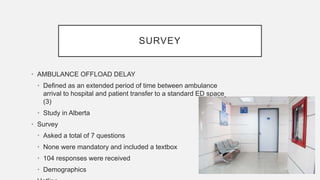
SURVEY
• AMBULANCE OFFLOAD DELAY
• Defined as an extended period of time between ambulance
arrival to hospital and patient transfer to a standard ED space
(3)
• Study in Alberta
• Survey
• Asked a total of 7 questions
• None were mandatory and included a textbox
• 104 responses were received
• Demographics
SURVEY QUESTIONS
1. How long have you been working as an EMS provider?
2. In your opinion, have Paramedic Hallway waits increased, decreased or remained
unchanged since you began working?
3. Can you provide an example of when Paramedic Hallway wait delayed RESPONSE
TIME in the community and NEGATIVELY AFFECTED PATIEENT OUTCOME
4. Has overtime increased in your experience in the past 5 years? If so, how has it
affected your health and your family?
5. 5. How have Paramedic ER hallway waits affected your relationships with nursing and
medical staff in ER?
6. What are the causes of Paramedic Hallway waits longer than 15 minutes?
7. What do you see as the solution(s) to Paramedic Hallway Waits?
HAS OVERTIME INCREASED IN THE
LAST 5 YEARS?
HOW DOES IT AFFECT YOUR HEALTH
AND YOUR FAMILY?
• "I used to be able to see my family when i got off shift. Now my children
are in bed before I get home. Average of 1-2 hours of forced overtime
reduces the time between shifts, means earlier to bed in order to get to
work on time the next day. On several occasions we've worked in excess
of 16 hours with no down time and haven't eaten. This made us
profoundly fatigued and I'm too tired to even spend time with my family
when we are done. This is becoming common place."
EFFECT OF OVERTIME
• Burn out
• Implications for families and
marriages.
• Are not allowed breaks or
time to eat.
• Sleep disorder
• “With the increase of
overtime I find myself
always tired and
exhausted, I have
insomnia and more
recently was diagnosed
with depression and
anxiety”
AN EXAMPLE OF HOW DELAYED
RESPONSE TIME
NEGATIVELY AFFECTED PATIENT
OUTCOME.
• “A paramedics father had a
sudden cardiac arrest where
they waited 31 mins for an
ambulance to come from the red
alert The instance of an Airdrie
woman waiting nearly 90 min for
an ambulance to come from the
south of Calgary with a fractured
leg.”
AN EXAMPLE OF HOW DELAYED
RESPONSE TIME
NEGATIVELY AFFECTED PATIENT
OUTCOME
• "In red alerts (no ambulances available) there are often multiple units
tied up waiting in the hallway. I have completed patient handover and
responded to numerous calls from the Hospital that are often 30+
minutes away even with a lights and siren response. Examples of
such have been status seizures, a cardiac arrest in which the patient
did not recover, cardiac chest pains, syncopal episodes. And while I
would like to say this is rare, it happens at least daily."
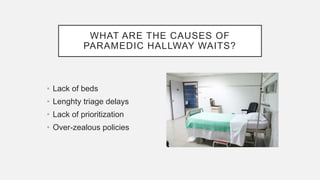
WHAT ARE THE CAUSES OF
PARAMEDIC HALLWAY WAITS?
• Lack of beds
• Lenghty triage delays
• Lack of prioritization
• Over-zealous policies
WHAT ARE THE CAUSES OF
PARAMEDIC HALLWAY WAITS?
• Primarily it's caused by Poor Process. It's also about the lack
of respect for Patients who are waiting for care from EMS in
the community. It appears that if you fall down the stairs at
home you are less valuable to the Hospital system than if you
are already at the hospital waiting to see a doctor."
SOLUTIONS
• 1) Money 2) Building for the aged,
LTC. 3) Staff for those buildings. Or,
have RN staff the hallway to take
patients thereby freeing up EMS.
• “Clear waiting room guidelines, firm
policies on hospitals to ensure EMS
crews are not delayed waiting with
patients and more ambulances
resources. “
• . Utilize community care paramedics
and home care nurses to help people
at their residence especially nursing
homes where they have 24 hour care.
• “Educating the public what needs to
go to the hospital and what requires
ambulances.
RECOMMENDATIONS
• International Examples
• UK provides a maximum of 15 minutes
for ambulance offload delay; as such
EMS providers are allowed to leave
afterwards. (3)
• Offload Programs
• Ambulance Diversion
• Redirecting patients to alternative care
locations
• Each failed to address CORE issues
• Systematic Issues
• EMS overcrowding
• Radiology and lab delays
• Usage of community clinics
• Lack of beds
KEY MESSAGES
• More research concerning the experiences of EMS
• Wasting an extensive amount of resources
• Systematic issues
• Negative outcomes
• Both patients and EMS providers
• Root causes are outside the EMS system and must be
addressed!
WHAT DO YOU SEE AS THE
SOLUTION TO PARAMEDIC HALLWAY
WAITS?
• "Stop asking Paramedics to wait with Patients. Assume care of
every patient that comes across the Hospital threshold immediately.
These are Hospital patients now, they are no longer EMS patients.
Let the EMS crews go back and do their jobs, while the Hospital
does theirs. These are first world tertiary care facilities, how on earth
is it possible that they can't manage their core business of caring for
sick and injured patients in their emergency rooms?"
REFERENCES
• 1. Canadian Institute for Health Information. Emergency Department
data tables. 2016-2017. Access from:
https://www.cihi.ca/en/emergency-department-wait-times-in-canada-
continuing-to-rise.
• 2. Stewart D, Wang D, Lang E, Innes G. LO32: Are EMS offload delay
patients at increased risk of adverse outcomes? CJEM. Cambridge
University Press; 2017;19(S1):S38–S38.
• 3. Li, M., Vanberkel, P. & Carter, A.J.E. Health Care Manag Sci. A review
on ambulance offload delay literature. (2018).
https://doi.org/10.1007/s10729-018-9450-x

Ambulance offload delay

  • 1.
    AMBULANCE OFFLOAD DELAY NicoleM’Carthy Bachelor of Health Sciences, University of Calgary Dr. David Swann, MLA
  • 2.
    LITERATURE REVIEW • Albertaspends the 2nd most on healthcare expenditure per capita, with a total of $7, 329 per person (not including the territories). (1) • Length of stay for people admitted in the hospital has increased by 11% since 2016. (2) • Admittance by the senior population has increased by 16% since 2016. (2) • In 2016, EMS crews spent 650,000 hours waiting in the emergency room in Alberta • Working over 135,000 hours in overtime resulting in $12 million dollars in extra wages.
  • 3.
    SURVEY • AMBULANCE OFFLOADDELAY • Defined as an extended period of time between ambulance arrival to hospital and patient transfer to a standard ED space (3) • Study in Alberta • Survey • Asked a total of 7 questions • None were mandatory and included a textbox • 104 responses were received • Demographics
  • 4.
    SURVEY QUESTIONS 1. Howlong have you been working as an EMS provider? 2. In your opinion, have Paramedic Hallway waits increased, decreased or remained unchanged since you began working? 3. Can you provide an example of when Paramedic Hallway wait delayed RESPONSE TIME in the community and NEGATIVELY AFFECTED PATIEENT OUTCOME 4. Has overtime increased in your experience in the past 5 years? If so, how has it affected your health and your family? 5. 5. How have Paramedic ER hallway waits affected your relationships with nursing and medical staff in ER? 6. What are the causes of Paramedic Hallway waits longer than 15 minutes? 7. What do you see as the solution(s) to Paramedic Hallway Waits?
  • 5.
    HAS OVERTIME INCREASEDIN THE LAST 5 YEARS? HOW DOES IT AFFECT YOUR HEALTH AND YOUR FAMILY? • "I used to be able to see my family when i got off shift. Now my children are in bed before I get home. Average of 1-2 hours of forced overtime reduces the time between shifts, means earlier to bed in order to get to work on time the next day. On several occasions we've worked in excess of 16 hours with no down time and haven't eaten. This made us profoundly fatigued and I'm too tired to even spend time with my family when we are done. This is becoming common place."
  • 6.
    EFFECT OF OVERTIME •Burn out • Implications for families and marriages. • Are not allowed breaks or time to eat. • Sleep disorder • “With the increase of overtime I find myself always tired and exhausted, I have insomnia and more recently was diagnosed with depression and anxiety”
  • 7.
    AN EXAMPLE OFHOW DELAYED RESPONSE TIME NEGATIVELY AFFECTED PATIENT OUTCOME. • “A paramedics father had a sudden cardiac arrest where they waited 31 mins for an ambulance to come from the red alert The instance of an Airdrie woman waiting nearly 90 min for an ambulance to come from the south of Calgary with a fractured leg.”
  • 8.
    AN EXAMPLE OFHOW DELAYED RESPONSE TIME NEGATIVELY AFFECTED PATIENT OUTCOME • "In red alerts (no ambulances available) there are often multiple units tied up waiting in the hallway. I have completed patient handover and responded to numerous calls from the Hospital that are often 30+ minutes away even with a lights and siren response. Examples of such have been status seizures, a cardiac arrest in which the patient did not recover, cardiac chest pains, syncopal episodes. And while I would like to say this is rare, it happens at least daily."
  • 9.
    WHAT ARE THECAUSES OF PARAMEDIC HALLWAY WAITS? • Lack of beds • Lenghty triage delays • Lack of prioritization • Over-zealous policies
  • 10.
    WHAT ARE THECAUSES OF PARAMEDIC HALLWAY WAITS? • Primarily it's caused by Poor Process. It's also about the lack of respect for Patients who are waiting for care from EMS in the community. It appears that if you fall down the stairs at home you are less valuable to the Hospital system than if you are already at the hospital waiting to see a doctor."
  • 11.
    SOLUTIONS • 1) Money2) Building for the aged, LTC. 3) Staff for those buildings. Or, have RN staff the hallway to take patients thereby freeing up EMS. • “Clear waiting room guidelines, firm policies on hospitals to ensure EMS crews are not delayed waiting with patients and more ambulances resources. “ • . Utilize community care paramedics and home care nurses to help people at their residence especially nursing homes where they have 24 hour care. • “Educating the public what needs to go to the hospital and what requires ambulances.
  • 12.
    RECOMMENDATIONS • International Examples •UK provides a maximum of 15 minutes for ambulance offload delay; as such EMS providers are allowed to leave afterwards. (3) • Offload Programs • Ambulance Diversion • Redirecting patients to alternative care locations • Each failed to address CORE issues • Systematic Issues • EMS overcrowding • Radiology and lab delays • Usage of community clinics • Lack of beds
  • 13.
    KEY MESSAGES • Moreresearch concerning the experiences of EMS • Wasting an extensive amount of resources • Systematic issues • Negative outcomes • Both patients and EMS providers • Root causes are outside the EMS system and must be addressed!
  • 14.
    WHAT DO YOUSEE AS THE SOLUTION TO PARAMEDIC HALLWAY WAITS? • "Stop asking Paramedics to wait with Patients. Assume care of every patient that comes across the Hospital threshold immediately. These are Hospital patients now, they are no longer EMS patients. Let the EMS crews go back and do their jobs, while the Hospital does theirs. These are first world tertiary care facilities, how on earth is it possible that they can't manage their core business of caring for sick and injured patients in their emergency rooms?"
  • 15.
    REFERENCES • 1. CanadianInstitute for Health Information. Emergency Department data tables. 2016-2017. Access from: https://www.cihi.ca/en/emergency-department-wait-times-in-canada- continuing-to-rise. • 2. Stewart D, Wang D, Lang E, Innes G. LO32: Are EMS offload delay patients at increased risk of adverse outcomes? CJEM. Cambridge University Press; 2017;19(S1):S38–S38. • 3. Li, M., Vanberkel, P. & Carter, A.J.E. Health Care Manag Sci. A review on ambulance offload delay literature. (2018). https://doi.org/10.1007/s10729-018-9450-x