The Psychology of Waiting
ACEP Scientific Assembly
Seattle,2013
EmCare Slideshare version 9-20-13
Ā© Kirk Jensen
KIRK JENSEN
MD, MBA, FACEP

Chief Medical Officer - BestPractices, Inc.
Executive Vice-President – EmCare, Inc.
IHI Faculty Member
Medical Director - The Studer Group
Ā© Kirk Jensen

2
Introduction…
The Psychology of Waiting
Federal Express noted that ―Waiting is frustrating,
demoralizing, agonizing, aggravating, annoying, time
consuming, and incredibly expensive.‖ We intuitively
know this from our own and our patients’ experiences.
Much has been written in business and service literature
about managing the waiting experience. This
presentation will familiarize emergency practitioners with
current literature and practical tips to improve the ED
experience for your patients and for you, and offer eight
specific principles for managing ED wait times.
Ā© Kirk Jensen

3
Goals
• An understanding of the psychology
involved in waiting
• What’s useful for us in our practices
• How can we apply the observations on
the psychology of waiting and benefit
from them

• Let’s have some fun with this…
Ā© Kirk Jensen

4
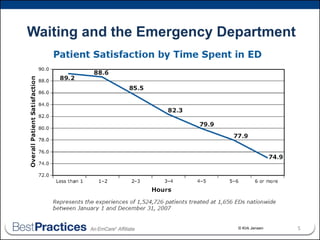
Waiting and the Emergency Department

Ā© Kirk Jensen

5
Timeliness of care has a strong
correlation to patient
satisfaction (1,2) with wait time
to be treated by a physician
having the most powerful
association with satisfaction. (3)
1.Bursch B, Beezy J, Shaw R. Emergency department
satisfaction:what matters most?
Ann Emerg Med. 1993;22:586-591.

2. Thompson DA, Yarnold PR, Williams DR, et al. Effects of
actual waiting time, perceived waiting time, information
delivery, and expressive quality on patient satisfaction in
the emergency
department .
Ann Emerg Med. 1996;28:657-665.
3. Boudreaux ED, D’Autremont S, Wood K, et al. Predictors
of emergency department patient satisfaction: stability over
17months.
Acad Emerg Med. 2004;11:51-58.
Ā© Kirk Jensen

6
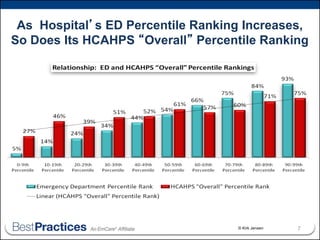
As Hospital’s ED Percentile Ranking Increases,
So Does Its HCAHPS ā€œOverallā€ Percentile Ranking

Ā© Kirk Jensen

7
Managing Waits
• Some organizations ―manage the waits‖ at
their facilities quite deftly
Best-in-Class:
 Disney (the entertainment experience/economy)
 Ritz-Carlton (Hotels)
 Casinos (think Las Vegas)
 Starbucks (retail and the service experience/economy)…

Ā© Kirk Jensen

8
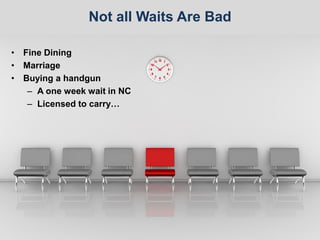
Not all Waits Are Bad
• Fine Dining
• Marriage
• Buying a handgun
– A one week wait in NC
– Licensed to carry…

Ā© Kirk Jensen

9
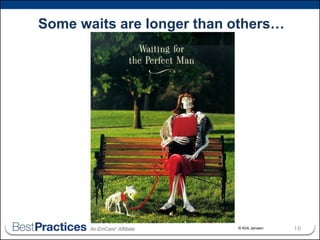
Some waits are longer than others…

Ā© Kirk Jensen

10
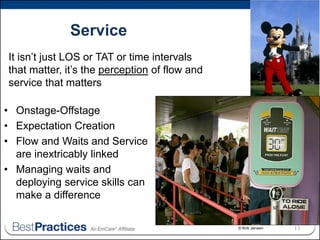
Service
It isn’t just LOS or TAT or time intervals
that matter, it’s the perception of flow and
service that matters
• Onstage-Offstage
• Expectation Creation
• Flow and Waits and Service
are inextricably linked
• Managing waits and
deploying service skills can
make a difference
Ā© Kirk Jensen

11
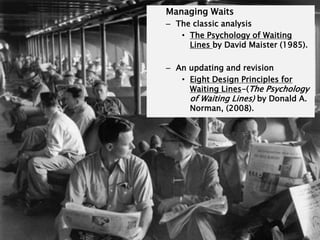
Managing Waits
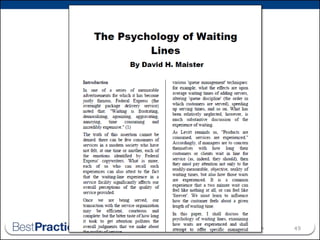
– The classic analysis
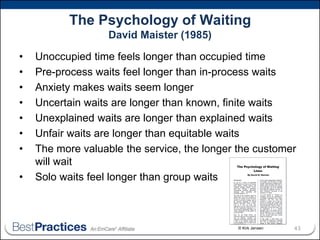
• The Psychology of Waiting
Lines by David Maister (1985).
– An updating and revision
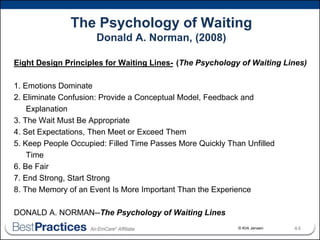
• Eight Design Principles for
Waiting Lines-(The Psychology
of Waiting Lines) by Donald A.
Norman, (2008).

Ā© Kirk Jensen

12
Managing Waits
and
the Psychology
of Waiting…

Ā© Kirk Jensen

13
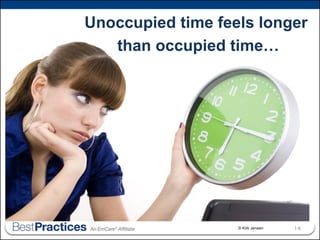
Unoccupied time feels longer
than occupied time…

Ā© Kirk Jensen

14
Unoccupied time feels longer than
occupied time
Disney is a master of this principle:
• Disney entertains you while you
are in line with tactics like
strategically-placed videos or
characters in costume.

⁻ Disney has ―pre-show‖
entertainment.

Ā© Kirk Jensen

15
Unoccupied time feels longer than
occupied time
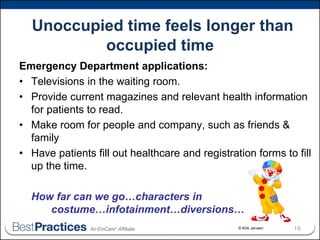
Emergency Department applications:
• Televisions in the waiting room.
• Provide current magazines and relevant health information
for patients to read.
• Make room for people and company, such as friends &
family
• Have patients fill out healthcare and registration forms to fill
up the time.
How far can we go…characters in
costume…infotainment…diversions…
Ā© Kirk Jensen

16
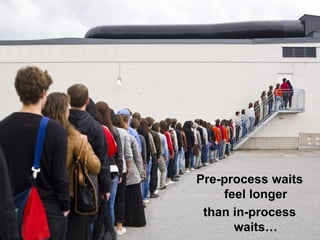
Pre-process waits
feel longer
than in-process
waits… 17
Ā© Kirk Jensen
Pre-process waits feel longer than
in-process waits
People want to get started…
Initiating any method of service-related activity or deploying
time fillers gives the impression that the process has
already begun.
Restaurants train their wait staff to acknowledge customers
as soon as they are seated with a greeting such as ―I’ll
be right with you‖. They provide menus and offer drinks
right away. They often visit the table again to mention
the ―specials‖. All of these small interactions move the
process along.
Ā© Kirk Jensen

18
Pre-process waits feel longer than
in-process waits
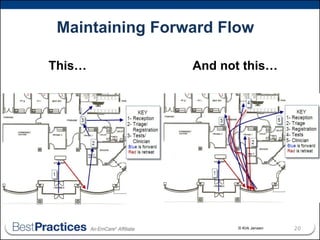
A well-run doctor’s office or Emergency Department will
move patients along sequentially; there is no need to
keep the patient waiting until everything is ready.
Have a triage nurse meet the patient, gather information
and move them into a room. If patients feel they are
moving through the system, the wait seems more
tolerable.

Ā© Kirk Jensen

19
Maintaining Forward Flow
This…

And not this…

Ā© Kirk Jensen

20
Anxiety makes waits seem
longer…

Ā© Kirk Jensen

21
Anxiety makes waits seem longer
Patients are often anxious. By definition they are
probably having a bad day already…

Simply letting patents and their significant others know what the waits
are, why they are having to wait, and what to expect can alleviate
family and patient anxiety.
• Surveys of ED patients suggest that patients would like to be
contacted while they wait in the ED every 20 to 30 minutes.
• Surveys of the ED staff will suggest that ED healthcare workers
think that contacting or ―touching‖ patients once an hour is plenty.

Establish a deliberate policy of regular contact, and your patient
satisfaction will climb…
Ā© Kirk Jensen

22
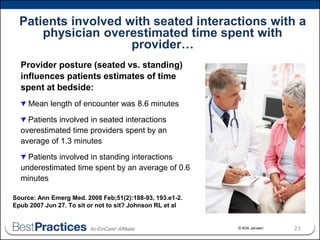
Patients involved with seated interactions with a
physician overestimated time spent with
provider…
Provider posture (seated vs. standing)
influences patients estimates of time
spent at bedside:
Mean length of encounter was 8.6 minutes
Patients involved in seated interactions
overestimated time providers spent by an
average of 1.3 minutes
Patients involved in standing interactions
underestimated time spent by an average of 0.6
minutes
Source: Ann Emerg Med. 2008 Feb;51(2):188-93, 193.e1-2.
Epub 2007 Jun 27. To sit or not to sit? Johnson RL et al

Ā© Kirk Jensen

23
Uncertain waits
are longer
than known,
finite waits…

Ā© Kirk Jensen

24
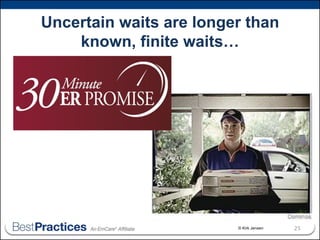
Uncertain waits are longer than
known, finite waits…

Ā© Kirk Jensen

25
Uncertain waits are longer than
known, finite waits
When a patient or family member asks a ―How
long?‖ question, it’s not just about time…
…If a patient asks how long it will take to get the results of a CT scan,
give a finite amount of time. ..
Saying ―soon‖ or ―it’s a busy day‖ creates the impression of a
longer and uncertain wait. Even better, give a finite amount of time
that is actually a bit longer than the scan will likely take. This will
lead to a more satisfied patient because you will be exceeding the
expectations that you have just set.

Disney is a master at this-Disney tells you the wait is going to be
45 minutes when they know it will be 30 minutes.
Ā© Kirk Jensen

26
Unexplained
waits are
longer than
explained
waits…

Ā© Kirk Jensen

27
Unexplained
waits are
longer than
explained
waits
Keep your patients informed:
• If they know that a ―code‖ or a major trauma has come
in, they often (though not always…) understand why they
have to wait.
• The practice (or habit…) of rounding…
Ā© Kirk Jensen

28
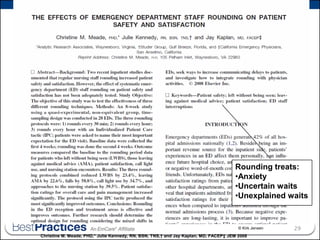
Rounding treats:
•Anxiety
•Uncertain waits
•Unexplained waits

Ā© Kirk Jensen

Christine M. Meade, PHD,* Julie Kennedy, RN, BSN, TNS,† and Jay Kaplan, MD, FACEP— JEM 2008

29
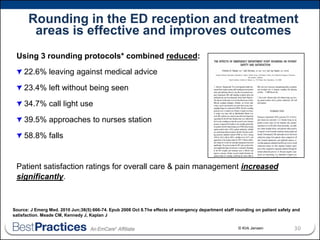
Rounding in the ED reception and treatment
areas is effective and improves outcomes
Using 3 rounding protocols* combined reduced:
22.6% leaving against medical advice
23.4% left without being seen
34.7% call light use
39.5% approaches to nurses station

58.8% falls

Patient satisfaction ratings for overall care & pain management increased
significantly.

Source: J Emerg Med. 2010 Jun;38(5):666-74. Epub 2008 Oct 8.The effects of emergency department staff rounding on patient safety and
satisfaction. Meade CM, Kennedy J, Kaplan J
Ā© Kirk Jensen

30
Providing Information to ED Patients every 15 minutes
improves patients’ perceived length of stay, efficiency and
clinical skills of the Emergency Physician
Providing personal interaction and clinical information in 15-minute
intervals to ED patients produced the following results:
Perceived length of stay was
shorter (92.6 minutes vs. 105.5
minutes in control group)

Proportion of ED patients rating
Emergency Staff Physician as
―excellent‖ or ―very good‖ was
significantly higher in the
intervention group
Source: Am J Emerg Med. 2002 Oct;20(6):506-9. Provision of clinically based information improves patients' perceived length of stay
and satisfaction with EP. Tran TP et al
Ā© Kirk Jensen

31
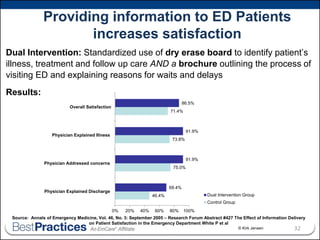
Providing information to ED Patients
increases satisfaction
Dual Intervention: Standardized use of dry erase board to identify patient’s
illness, treatment and follow up care AND a brochure outlining the process of
visiting ED and explaining reasons for waits and delays
Results:
86.5%

Overall Satisfaction

71.4%

91.9%

Physician Explained Illness
73.8%

91.9%

Physician Addressed concerns

75.0%

69.4%

Physician Explained Discharge

Dual Intervention Group

46.4%

Control Group
0%

20%

40%

60%

80%

100%

Source: Annals of Emergency Medicine, Vol. 46, No. 3: September 2005 – Research Forum Abstract #427 The Effect of Information Delivery
on Patient Satisfaction in the Emergency Department White P et al
Ā© Kirk Jensen

32
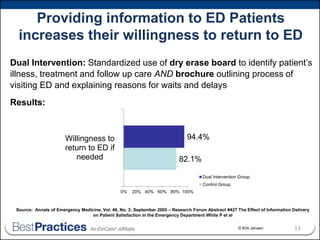
Providing information to ED Patients
increases their willingness to return to ED
Dual Intervention: Standardized use of dry erase board to identify patient’s
illness, treatment and follow up care AND brochure outlining process of
visiting ED and explaining reasons for waits and delays

Results:

94.4%

Willingness to
return to ED if
needed

82.1%
Dual Intervention Group

Control Group
0%

20% 40% 60% 80% 100%

Source: Annals of Emergency Medicine, Vol. 46, No. 3: September 2005 – Research Forum Abstract #427 The Effect of Information Delivery
on Patient Satisfaction in the Emergency Department White P et al
Ā© Kirk Jensen

33
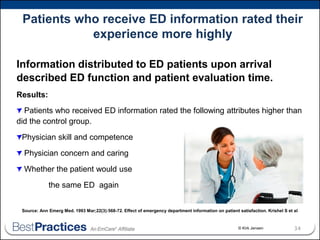
Patients who receive ED information rated their
experience more highly
Information distributed to ED patients upon arrival
described ED function and patient evaluation time.
Results:

Patients who received ED information rated the following attributes higher than
did the control group.
Physician skill and competence

Physician concern and caring
Whether the patient would use
the same ED again
Source: Ann Emerg Med. 1993 Mar;22(3):568-72. Effect of emergency department information on patient satisfaction. Krishel S et al

Ā© Kirk Jensen

34
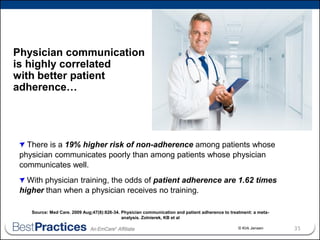
Physician communication
is highly correlated
with better patient
adherence…

There is a 19% higher risk of non-adherence among patients whose
physician communicates poorly than among patients whose physician
communicates well.
With physician training, the odds of patient adherence are 1.62 times
higher than when a physician receives no training.
Source: Med Care. 2009 Aug;47(8):826-34. Physician communication and patient adherence to treatment: a metaanalysis. Zolnierek, KB et al
Ā© Kirk Jensen

35
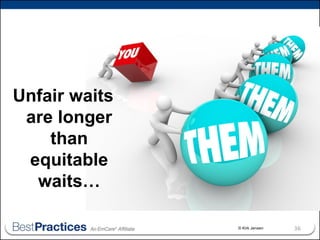
Unfair waits
are longer
than
equitable
waits…
Ā© Kirk Jensen

36
Unfair waits are longer than equitable waits
It can be easy for patients in the ED to feel like
they are being given a ―lesser‖ priority…
If you have a Fast Track waiting room in the ED designed to handle
the more acute and straightforward cases, and it is located in the
same area as the main waiting room, patients who are not as acute
and straightforward are likely to feel dissatisfied. They will notice
they aren’t moving through as fast as the other patients and they
don’t know why.

It is important to set up your rules (your operational
guidelines) to match your patient’s sense of equity.
Ā© Kirk Jensen

37
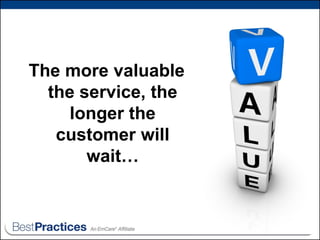
The more valuable
the service, the
longer the
customer will
wait…

Ā© Kirk Jensen

38
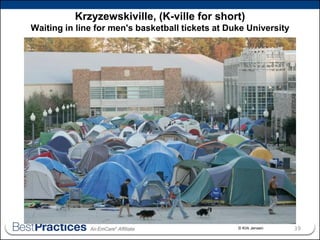
Krzyzewskiville, (K-ville for short)
Waiting in line for men's basketball tickets at Duke University

Ā© Kirk Jensen

39
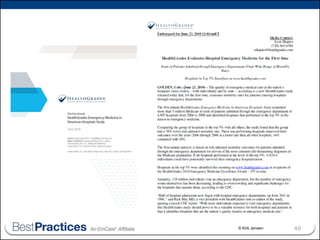
Ā© Kirk Jensen

40
The more valuable the service, the
longer the customer will wait
The more valuable the perception of service, the
longer patients will be willing to wait…
If your facility is considered a top-notch Emergency Department, surgical center or
hospital, patients will tolerate longer periods of waiting.
If you are perceived as the ―band-aid station‖ people will not be as tolerant of
waiting.

One way of managing waits is to build your brand and your
reputation.
-Make your facility the place where people and patients want to go.
-Your patients will be much more accepting of waits and delays.

Ā© Kirk Jensen

41
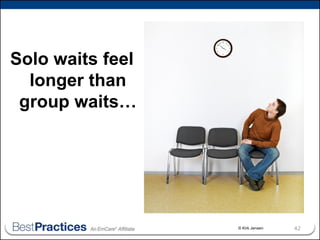
Solo waits feel
longer than
group waits…

Ā© Kirk Jensen

42
The Psychology of Waiting
David Maister (1985)
•
•
•
•
•
•
•
•

Unoccupied time feels longer than occupied time
Pre-process waits feel longer than in-process waits
Anxiety makes waits seem longer
Uncertain waits are longer than known, finite waits
Unexplained waits are longer than explained waits
Unfair waits are longer than equitable waits
The more valuable the service, the longer the customer
will wait
Solo waits feel longer than group waits

Ā© Kirk Jensen

43
The Psychology of Waiting
Donald A. Norman, (2008)
Eight Design Principles for Waiting Lines- (The Psychology of Waiting Lines)
1. Emotions Dominate
2. Eliminate Confusion: Provide a Conceptual Model, Feedback and
Explanation
3. The Wait Must Be Appropriate
4. Set Expectations, Then Meet or Exceed Them
5. Keep People Occupied: Filled Time Passes More Quickly Than Unfilled
Time
6. Be Fair
7. End Strong, Start Strong
8. The Memory of an Event Is More Important Than the Experience
DONALD A. NORMAN--The Psychology of Waiting Lines
Ā© Kirk Jensen

44
The Psychology of Waiting:
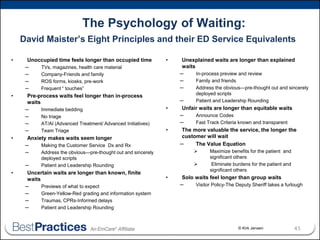
David Maister’s Eight Principles and their ED Service Equivalents
•

Unoccupied time feels longer than occupied time
─
─
─
─

•

•

Immediate bedding
No triage
AT/AI (Advanced Treatment/ Advanced Initiatives)
Team Triage

─

─

•

•

─
─
─
─

Previews of what to expect
Green-Yellow-Red grading and information system
Traumas, CPRs-Informed delays
Patient and Leadership Rounding

In-process preview and review
Family and friends
Address the obvious—pre-thought out and sincerely
deployed scripts
Patient and Leadership Rounding

Unfair waits are longer than equitable waits
─
─

Making the Customer Service Dx and Rx
Address the obvious—pre-thought out and sincerely
deployed scripts
Patient and Leadership Rounding

Uncertain waits are longer than known, finite
waits

Unexplained waits are longer than explained
waits
─
─
─

Anxiety makes waits seem longer
─
─

•

TVs, magazines, health care material
Company-Friends and family
ROS forms, kiosks, pre-work
Frequent ― touches‖

Pre-process waits feel longer than in-process
waits
─
─
─
─

•

Announce Codes
Fast Track Criteria known and transparent

The more valuable the service, the longer the
customer will wait
─
The Value Equation



•

Maximize benefits for the patient and
significant others
Eliminate burdens for the patient and
significant others

Solo waits feel longer than group waits
─

Visitor Policy-The Deputy Sheriff takes a furlough

Ā© Kirk Jensen

45
Ā© Kirk Jensen

46
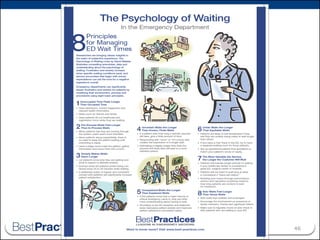
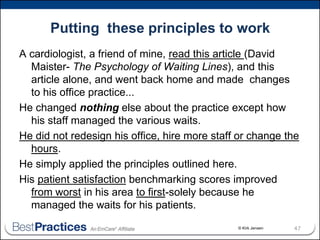
Putting these principles to work
A cardiologist, a friend of mine, read this article (David
Maister- The Psychology of Waiting Lines), and this
article alone, and went back home and made changes
to his office practice...
He changed nothing else about the practice except how
his staff managed the various waits.
He did not redesign his office, hire more staff or change the
hours.
He simply applied the principles outlined here.
His patient satisfaction benchmarking scores improved
from worst in his area to first-solely because he
managed the waits for his patients.
Ā© Kirk Jensen

47
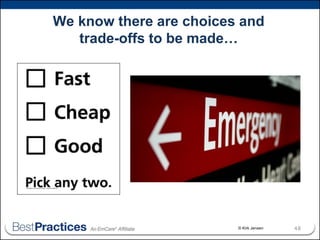
We know there are choices and
trade-offs to be made…

Ā© Kirk Jensen

48
Ā© Kirk Jensen

49
Pain is inevitable,
suffering is
optional…
Dalai Lama

Ā© Kirk Jensen

50
Resources and References

Ā© Kirk Jensen

51
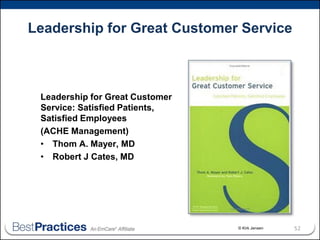
Leadership for Great Customer Service

Leadership for Great Customer
Service: Satisfied Patients,
Satisfied Employees
(ACHE Management)
• Thom A. Mayer, MD
• Robert J Cates, MD

Ā© Kirk Jensen

52
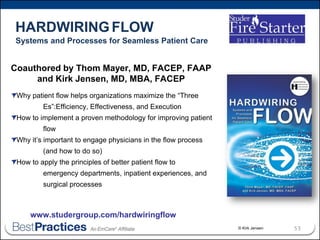
HARDWIRING FLOW
Systems and Processes for Seamless Patient Care

Coauthored by Thom Mayer, MD, FACEP, FAAP
and Kirk Jensen, MD, MBA, FACEP
Why patient flow helps organizations maximize the ―Three
Es‖:Efficiency, Effectiveness, and Execution

How to implement a proven methodology for improving patient
flow
Why it’s important to engage physicians in the flow process
(and how to do so)

How to apply the principles of better patient flow to
emergency departments, inpatient experiences, and
surgical processes

www.studergroup.com/hardwiringflow
Ā© Kirk Jensen

53
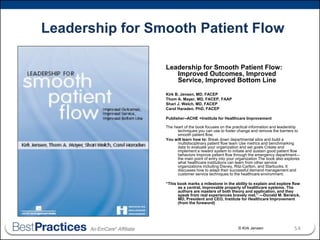
Leadership for Smooth Patient Flow
Leadership for Smooth Patient Flow:
Improved Outcomes, Improved
Service, Improved Bottom Line
Kirk B. Jensen, MD, FACEP
Thom A. Mayer, MD, FACEP, FAAP
Shari J. Welch, MD, FACEP
Carol Haraden, PhD, FACEP
Publisher--ACHE +Institute for Healthcare Improvement
The heart of the book focuses on the practical information and leadership
techniques you can use to foster change and remove the barriers to
smooth patient flow.
You will learn how to: Break down departmental silos and build a
multidisciplinary patient flow team Use metrics and benchmarking
data to evaluate your organization and set goals Create and
implement a reward system to initiate and sustain good patient flow
behaviors Improve patient flow through the emergency department—
the main point of entry into your organization The book also explores
what healthcare institutions can learn from other service
organizations including Disney, Ritz-Carlton, and Starbucks. It
discusses how to adapt their successful demand management and
customer service techniques to the healthcare environment.
―This book marks a milestone in the ability to explain and explore flow
as a central, improvable property of healthcare systems. The
authors are masters of both theory and application, and they
speak from real experiences bravely met.‖ —Donald M. Berwick,
MD, President and CEO, Institute for Healthcare Improvement
(from the foreword)

Ā© Kirk Jensen

54
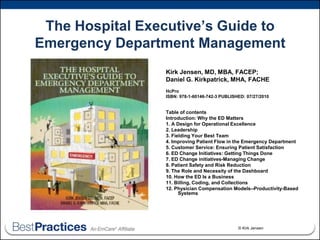
The Hospital Executive’s Guide to
Emergency Department Management
Kirk Jensen, MD, MBA, FACEP;
Daniel G. Kirkpatrick, MHA, FACHE
HcPro
ISBN: 978-1-60146-742-3 PUBLISHED: 07/27/2010

Table of contents
Introduction: Why the ED Matters
1. A Design for Operational Excellence
2. Leadership
3. Fielding Your Best Team
4. Improving Patient Flow in the Emergency Department
5. Customer Service: Ensuring Patient Satisfaction
6. ED Change Initiatives: Getting Things Done
7. ED Change initiatives-Managing Change
8. Patient Safety and Risk Reduction
9. The Role and Necessity of the Dashboard
10. How the ED Is a Business
11. Billing, Coding, and Collections
12. Physician Compensation Models--Productivity-Based
Systems

Ā© Kirk Jensen
References

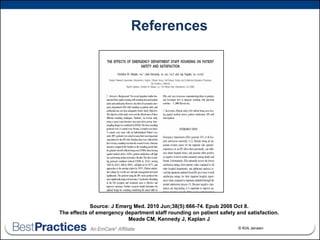
Source: J Emerg Med. 2010 Jun;38(5):666-74. Epub 2008 Oct 8.
The effects of emergency department staff rounding on patient safety and satisfaction.
Meade CM, Kennedy J, Kaplan J
Ā© Kirk Jensen
References
•

Fitzsimmons J., and M. Fitzsimmons. Service Management: Operations,
Strategy, Information Technology. 5th ed. Boston: McGraw-Hill. 2006.

•

Maister, D. The Psychology of Waiting Lines. In J. A. Czepiel, M. R.
Solomon & C. F. Surprenant (Eds.), The Service Encounter: managing
employee/customer interaction in service businesses. Lexington, MA: D. C.
Heath and Co, Lexington Books. 1985.

•

Norman, D. A. ―Designing waits that work.‖ MIT Sloan Management Review
2009; 50.4:23-28.

•

Norman, D. A. The Psychology of Waiting Lines. PDF version is an excerpt
from a draft chapter entitled "Sociable Design" for a new bookwww.jnd.org/dn.mss/the_psychology_of_waiting_lines. 2008.

•

Meade, Christine, Julie Kennedy, and Jay Kaplan. "The Effects of
Emergency Department Staff Rounding on Patient Safety and Satisfaction."
JEM 2010; 38.5: 666-674.

Ā© Kirk Jensen