AMAZON RELATIONAL
DATABASES
Amazon RDS
PREREQUISITES
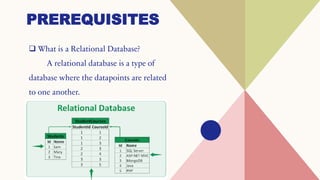
❑ What is a Relational Database?
A relational database is a type of
database where the datapoints are related
to one another.
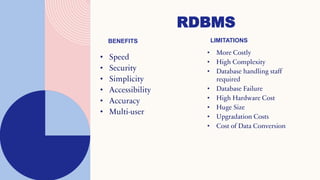
RDBMS
BENEFITS
• Speed
• Security
• Simplicity
• Accessibility
• Accuracy
• Multi-user
LIMITATIONS
• More Costly
• High Complexity
• Database handling staff
required
• Database Failure
• High Hardware Cost
• Huge Size
• Upgradation Costs
• Cost of Data Conversion
AGENDA
What is Amazon RDS?
How does Amazon RDS work?
Features
Benefits
Drawbacks
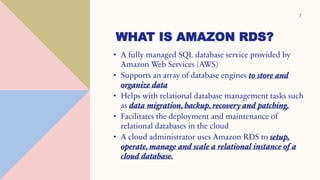
WHAT IS AMAZON RDS?
• A fully managed SQL database service provided by
Amazon Web Services (AWS)
• Supports an array of database engines to store and
organize data
• Helps with relational database management tasks such
as data migration, backup, recovery and patching.
• Facilitates the deployment and maintenance of
relational databases in the cloud
• A cloud administrator uses Amazon RDS to setup,
operate, manage and scale a relational instance of a
cloud database.
7
“
”
8
AMAZON RDS IS NOT ITSELF A
DATABASE; IT IS A SERVICE
USED TO MANAGE RELATIONAL
DATABASES.
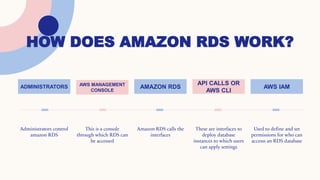
HOW DOES AMAZON RDS WORK?
ADMINISTRATORS AWS MANAGEMENT
CONSOLE
AMAZON RDS
API CALLS OR
AWS CLI
AWS IAM
Administrators control
amazon RDS
This is a console
through which RDS can
be accessed
Amazon RDS calls the
interfaces
These are interfaces to
deploy database
instances to which users
can apply settings
Used to define and set
permissions for who can
accesss an RDS database
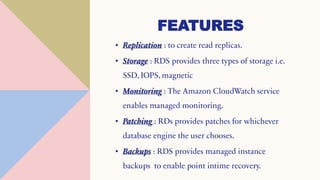
FEATURES
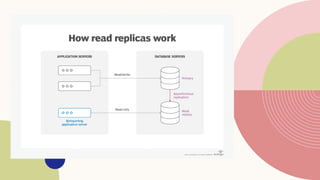
• Replication : to create read replicas.
• Storage : RDS provides three types of storage i.e.
SSD, IOPS, magnetic
• Monitoring : The Amazon CloudWatch service
enables managed monitoring.
• Patching : RDs provides patches for whichever
database engine the user chooses.
• Backups : RDS provides managed instance
backups to enable point intime recovery.
BACKUP
BENEFITS AND DRAWBACKS
BENEFITS
• Easy to use
• Cost effectiveness
• Reduce workload on a particular
instance
• Independent scaling
DRAWBACKS
• Lack of root access
• Downtime
AMAZON RDS
DATABASE INSTANCES
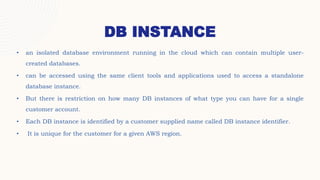
DB INSTANCE
• an isolated database environment running in the cloud which can contain multiple user-
created databases.
• can be accessed using the same client tools and applications used to access a standalone
database instance.
• But there is restriction on how many DB instances of what type you can have for a single
customer account.
• Each DB instance is identified by a customer supplied name called DB instance identifier.
• It is unique for the customer for a given AWS region.
DIFFERENT COMBINATIONS OF DB INSTANCE
BASED ON LICENSE
•
DB INSTANCE CLASSES
Instance Class Number of Vcpu Memory Range in GB Bandwidth Range in
Mbps
Standard 1 to 64 1.7 to 256 450 to 10000
Memory Optimized 2 to 128 17.1 to 3904 500 to 14000
Burstable Performance 1 to 8 1 to 32 Low to Moderate
Depending on the need of the processing power and memory requirement, there is a variety of
instance classes offered by AWS for the RDS service.
DB INSTANCE STATUS
DB Instance Status Meaning Is the Instance Billed?
Creating The instance is being created. The
instance is inaccessible while it is
being created.
No
Deleting The instance is being deleted. No
Failed The instance has failed and
Amazon RDS can't recover it.
No
Available The instance is healthy and
available.
Yes
Backing-up The instance is currently being
backed up.
Yes
The DB Instance status indicates the health of the DB. It’s value can be seen from the AWS console
or using AWS CLI command describe-db-instances. The important status values of DB instances
and their meaning is described below.
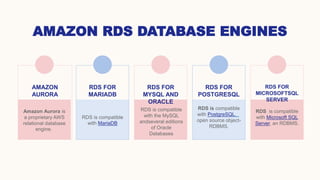
AMAZON RDS DATABASE ENGINES
AMAZON
AURORA
Amazon Aurora is
a proprietary AWS
relational database
engine.
RDS FOR
MARIADB
RDS is compatible
with MariaDB
RDS FOR
MYSQL AND
ORACLE
RDS is compatible
with the MySQL
andseveral editions
of Oracle
Databases
RDS FOR
POSTGRESQL
RDS is compatible
with PostgreSQL,
open source object-
RDBMS.
RDS FOR
MICROSOFTSQL
SERVER
RDS is compatible
with Microsoft SQL
Server, an RDBMS.
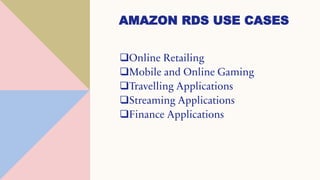
AMAZON RDS USE CASES
❑Online Retailing
❑Mobile and Online Gaming
❑Travelling Applications
❑Streaming Applications
❑Finance Applications
TAKEAWAY
❑ Amazon RDS helps organizations handle relational database
management tasks such as migration, backup, recovery and patching.
Some of the main features of Amazon RDS are replication, high
performance storage and failure detection.
❑ One of the biggest advantages of Amazon RDS is its ease of use. It lets
administrators manage multiple database instances without having to
learn other database management tools.
❑ These features enable RDS to help organizations cut costs that come
from time-consuming database administration tasks and manage the
hidden costs that come with using high-performance storage in AWS.
Learn more about ways to manage AWS costs.
THANK YOU
- Bhavitha S.B.

AMAZON RELATIONAL DATABASES.pdf

  • 1.
  • 2.
    PREREQUISITES ❑ What isa Relational Database? A relational database is a type of database where the datapoints are related to one another.
  • 4.
    RDBMS BENEFITS • Speed • Security •Simplicity • Accessibility • Accuracy • Multi-user LIMITATIONS • More Costly • High Complexity • Database handling staff required • Database Failure • High Hardware Cost • Huge Size • Upgradation Costs • Cost of Data Conversion
  • 6.
    AGENDA What is AmazonRDS? How does Amazon RDS work? Features Benefits Drawbacks
  • 7.
    WHAT IS AMAZONRDS? • A fully managed SQL database service provided by Amazon Web Services (AWS) • Supports an array of database engines to store and organize data • Helps with relational database management tasks such as data migration, backup, recovery and patching. • Facilitates the deployment and maintenance of relational databases in the cloud • A cloud administrator uses Amazon RDS to setup, operate, manage and scale a relational instance of a cloud database. 7
  • 8.
    “ ” 8 AMAZON RDS ISNOT ITSELF A DATABASE; IT IS A SERVICE USED TO MANAGE RELATIONAL DATABASES.
  • 9.
    HOW DOES AMAZONRDS WORK? ADMINISTRATORS AWS MANAGEMENT CONSOLE AMAZON RDS API CALLS OR AWS CLI AWS IAM Administrators control amazon RDS This is a console through which RDS can be accessed Amazon RDS calls the interfaces These are interfaces to deploy database instances to which users can apply settings Used to define and set permissions for who can accesss an RDS database
  • 10.
    FEATURES • Replication :to create read replicas. • Storage : RDS provides three types of storage i.e. SSD, IOPS, magnetic • Monitoring : The Amazon CloudWatch service enables managed monitoring. • Patching : RDs provides patches for whichever database engine the user chooses. • Backups : RDS provides managed instance backups to enable point intime recovery.
  • 12.
  • 13.
    BENEFITS AND DRAWBACKS BENEFITS •Easy to use • Cost effectiveness • Reduce workload on a particular instance • Independent scaling DRAWBACKS • Lack of root access • Downtime
  • 14.
  • 15.
    DB INSTANCE • anisolated database environment running in the cloud which can contain multiple user- created databases. • can be accessed using the same client tools and applications used to access a standalone database instance. • But there is restriction on how many DB instances of what type you can have for a single customer account. • Each DB instance is identified by a customer supplied name called DB instance identifier. • It is unique for the customer for a given AWS region.
  • 16.
    DIFFERENT COMBINATIONS OFDB INSTANCE BASED ON LICENSE •
  • 17.
    DB INSTANCE CLASSES InstanceClass Number of Vcpu Memory Range in GB Bandwidth Range in Mbps Standard 1 to 64 1.7 to 256 450 to 10000 Memory Optimized 2 to 128 17.1 to 3904 500 to 14000 Burstable Performance 1 to 8 1 to 32 Low to Moderate Depending on the need of the processing power and memory requirement, there is a variety of instance classes offered by AWS for the RDS service.
  • 18.
    DB INSTANCE STATUS DBInstance Status Meaning Is the Instance Billed? Creating The instance is being created. The instance is inaccessible while it is being created. No Deleting The instance is being deleted. No Failed The instance has failed and Amazon RDS can't recover it. No Available The instance is healthy and available. Yes Backing-up The instance is currently being backed up. Yes The DB Instance status indicates the health of the DB. It’s value can be seen from the AWS console or using AWS CLI command describe-db-instances. The important status values of DB instances and their meaning is described below.
  • 19.
    AMAZON RDS DATABASEENGINES AMAZON AURORA Amazon Aurora is a proprietary AWS relational database engine. RDS FOR MARIADB RDS is compatible with MariaDB RDS FOR MYSQL AND ORACLE RDS is compatible with the MySQL andseveral editions of Oracle Databases RDS FOR POSTGRESQL RDS is compatible with PostgreSQL, open source object- RDBMS. RDS FOR MICROSOFTSQL SERVER RDS is compatible with Microsoft SQL Server, an RDBMS.
  • 20.
    AMAZON RDS USECASES ❑Online Retailing ❑Mobile and Online Gaming ❑Travelling Applications ❑Streaming Applications ❑Finance Applications
  • 21.
    TAKEAWAY ❑ Amazon RDShelps organizations handle relational database management tasks such as migration, backup, recovery and patching. Some of the main features of Amazon RDS are replication, high performance storage and failure detection. ❑ One of the biggest advantages of Amazon RDS is its ease of use. It lets administrators manage multiple database instances without having to learn other database management tools. ❑ These features enable RDS to help organizations cut costs that come from time-consuming database administration tasks and manage the hidden costs that come with using high-performance storage in AWS. Learn more about ways to manage AWS costs.
  • 22.