REWA ENGINEERING COLLEGE
PRESENTION
ON
MACHINE LEARNING
SUBMITTED TO:-
SUBMITTED BY :- Proff.AK Dohre
AMAN GOYAL Assistant Proff.Nidhi Shukla
ECE DEPARMENT
ACKNOWLEDGEMENT
We are never alone any work and indebted to many people for their reviews,suggestions and technical
discussions.The generation is true for the project as well as,therefore I would like to acknowledge them
here.
First and foremost,I thanks to PROF.A.K. DOHARE(H.O.D. of ECE) for his great supervisions to
develop the text in the shape.
My special thanks to ASST.PROF.NIDHI SHUKLA(Dept of ECE)for their guidance in making the
project work successful.
Also,my gratitude is towards Dr.B.K,AGARWAL(Honourable Principal REC REWA)for giving his advice
and providing us the equipments which was needed.
I appereciate all my colleagues,faculties and my parents for their cooperation in making my work
presentation.
I own a special word of thanks to everyone for their support and encouragement.
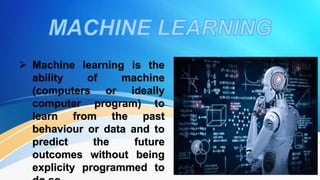
 Machine learning is the
ability of machine
(computers or ideally
computer program) to
learn from the past
behaviour or data and to
predict the future
outcomes without being
explicity programmed to
Types of machine learning
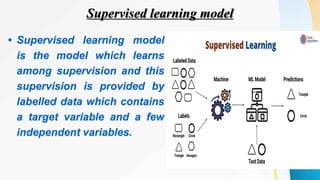
Supervised learning model
• Supervised learning model
is the model which learns
among supervision and this
supervision is provided by
labelled data which contains
a target variable and a few
independent variables.
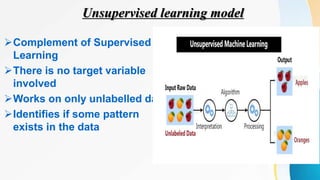
Unsupervised learning model
Complement of Supervised
Learning
There is no target variable
involved
Works on only unlabelled data
Identifies if some pattern
exists in the data
Semi-supervised learning
As the name suggests,semi-supervised learning is a bit of
both-supervised and unsupervised learning and uses both
labelled and unlabelled data.
This type of learning can be used with methods such as
classification,regression and prediction.
Semi-supervised learning is useful when the cost
associated with labelling is too high to allow for a fully
labelled training process.
Reinforcement learning
This model is used in making a sequence of
decisions.It is an learning by interacting with the
environment.
It is based on the observation that intelligent
agents tend to repeat the action that are rewarded
for and retrain from action that are punished for
It can be said that it is an trail and error method in
finding the best outcome based on experience.
DATA:-
• Data is any information about something.
• this can be in the form of numbers,text,image,videos and
so on
VARIABLE:-
• A variable represents one specific characteristics of the
data or tells one specific information about the data under
consideration.
• Types of variable:- 1.numeric or quantitive
2.categorical or qualitive
Python
Python is a vertsatile language which can be used in web
application,face recognition,object detection etc.
Object oriented programming language which allows to
create and use objects and classes easily.
Compatible with different platforms like windows,mac,etc.
Simple syntax
open source and huge community support
Python constructs
1.Conditional statements:-
Syntax:
If condition:
do something
else:
do something else
2. Iterative statements:-
Syntax:
for i in iterable[start:stop:step]:
do something
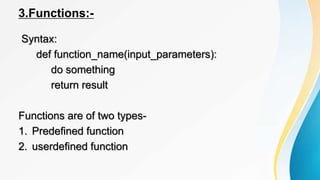
3.Functions:-
Syntax:
def function_name(input_parameters):
do something
return result
Functions are of two types-
1. Predefined function
2. userdefined function
Regression
• Regression is a statistical procedure that determines the
equation for the straight line that best fits a specific set of
data.
• Regression are of two types-
1.Simple linear regression-
 with one dependent and one independent variable.
2.Multiple linear regression-
 with more than one independent and dependent variable.
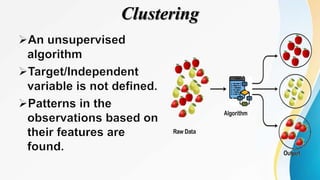
Clustering
.
T H A N K Y O U

aman goyal machine learning ppt.pptx

  • 1.
    REWA ENGINEERING COLLEGE PRESENTION ON MACHINELEARNING SUBMITTED TO:- SUBMITTED BY :- Proff.AK Dohre AMAN GOYAL Assistant Proff.Nidhi Shukla ECE DEPARMENT
  • 2.
    ACKNOWLEDGEMENT We are neveralone any work and indebted to many people for their reviews,suggestions and technical discussions.The generation is true for the project as well as,therefore I would like to acknowledge them here. First and foremost,I thanks to PROF.A.K. DOHARE(H.O.D. of ECE) for his great supervisions to develop the text in the shape. My special thanks to ASST.PROF.NIDHI SHUKLA(Dept of ECE)for their guidance in making the project work successful. Also,my gratitude is towards Dr.B.K,AGARWAL(Honourable Principal REC REWA)for giving his advice and providing us the equipments which was needed. I appereciate all my colleagues,faculties and my parents for their cooperation in making my work presentation. I own a special word of thanks to everyone for their support and encouragement.
  • 4.
     Machine learningis the ability of machine (computers or ideally computer program) to learn from the past behaviour or data and to predict the future outcomes without being explicity programmed to
  • 6.
  • 7.
    Supervised learning model •Supervised learning model is the model which learns among supervision and this supervision is provided by labelled data which contains a target variable and a few independent variables.
  • 8.
    Unsupervised learning model Complementof Supervised Learning There is no target variable involved Works on only unlabelled data Identifies if some pattern exists in the data
  • 9.
    Semi-supervised learning As thename suggests,semi-supervised learning is a bit of both-supervised and unsupervised learning and uses both labelled and unlabelled data. This type of learning can be used with methods such as classification,regression and prediction. Semi-supervised learning is useful when the cost associated with labelling is too high to allow for a fully labelled training process.
  • 10.
    Reinforcement learning This modelis used in making a sequence of decisions.It is an learning by interacting with the environment. It is based on the observation that intelligent agents tend to repeat the action that are rewarded for and retrain from action that are punished for It can be said that it is an trail and error method in finding the best outcome based on experience.
  • 11.
    DATA:- • Data isany information about something. • this can be in the form of numbers,text,image,videos and so on VARIABLE:- • A variable represents one specific characteristics of the data or tells one specific information about the data under consideration. • Types of variable:- 1.numeric or quantitive 2.categorical or qualitive
  • 12.
    Python Python is avertsatile language which can be used in web application,face recognition,object detection etc. Object oriented programming language which allows to create and use objects and classes easily. Compatible with different platforms like windows,mac,etc. Simple syntax open source and huge community support
  • 13.
    Python constructs 1.Conditional statements:- Syntax: Ifcondition: do something else: do something else 2. Iterative statements:- Syntax: for i in iterable[start:stop:step]: do something
  • 14.
    3.Functions:- Syntax: def function_name(input_parameters): do something returnresult Functions are of two types- 1. Predefined function 2. userdefined function
  • 15.
    Regression • Regression isa statistical procedure that determines the equation for the straight line that best fits a specific set of data. • Regression are of two types- 1.Simple linear regression-  with one dependent and one independent variable. 2.Multiple linear regression-  with more than one independent and dependent variable.
  • 16.
  • 17.
    . T H AN K Y O U