TotalEnergies 552 006 454 RCS Nanterre - France. Photos: 123RF - Design:
ms.industry@totalenergies.com
lubricants.totalenergies.com TotalEnergies Industry Solutions
Aluminum
processing fluids
Hot&coldrollingmills
Expertise and technical support
for all applications
Aluminium World Journal
GLAMA Maschinenbau GmbH
Headquarters:
Hornstraße 19
D-45964 Gladbeck / Germany
Fon: +49 (0) 2043 9738 0
Fax: +49 (0) 2043 9738 50
email: info@glama.de
glama.de
Cost effective heavy duty
mobile equipment
for aluminium industries . . .
always
the durable
solution
GLAMA USA Inc.
60 Helwig St., Berea, Ohio 44017
Fon: +1 877 452 6266
Email: sales@glama-us.com
METEC 2023
Halle 1 / A69
Welcome to another edition
of Aluminium World Journal.
This edition of Aluminium
World Journal contains editorial
covering some of the most recent
advancements in current production
methods, management strategies
and advanced technology developed
for the aluminium industry.
Aluminium World Journal content
is produced and sponsored by
companies, independant experts
and associations operating within
the aluminium industry.
I would like to take this opportunity
to thank everyone who has taken
time to develop the content included
within this edition.
If you are interested in discussing
contributing material, or have any
questions about this edition or future
editions of Aluminium World Journal
feel free to get in touch using
the email:
aluminiumworldjournal@gmx.com
Hope you enjoy the read.
Christopher F Harris
Managing Director
Global Media Communications Ltd
Aluminium World Journal
2023 - 1
Global Media
Communication Ltd
Managing Director
Christopher Fitcher Harris
Project Manager
Peter Jones
Finance Director
Ted Garner
Published by
Global Media Communication Ltd
85 Great Portland Street
First Floor
London
W1W 7LT
United Kingdom
Email
gmcproduction@gmx.com
Design
AcuteNorth.com
INDEX
ROLLING MILL
Total Energies 6
INNOVAL 10
Quaker Houghton 12
CAST HOUSE
STAS Inc 14
Casthouse Safe Environments 17
EPIQ Machinery 22
ALUMINIUM WORLD JOURNAL 5
6 ROLLING MILL
Rolling Lubricants
- TotalEnergies Aluminum Rolling
Competence Center
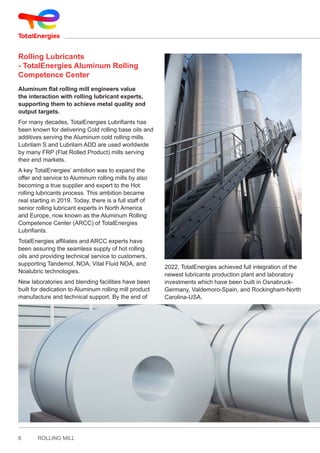
Aluminum flat rolling mill engineers value
the interaction with rolling lubricant experts,
supporting them to achieve metal quality and
output targets.
For many decades, TotalEnergies Lubrifiants has
been known for delivering Cold rolling base oils and
additives serving the Aluminum cold rolling mills.
Lubrilam S and Lubrilam ADD are used worldwide
by many FRP (Flat Rolled Product) mills serving
their end markets.
A key TotalEnergies’ ambition was to expand the
offer and service to Aluminum rolling mills by also
becoming a true supplier and expert to the Hot
rolling lubricants process. This ambition became
real starting in 2019. Today, there is a full staff of
senior rolling lubricant experts in North America
and Europe, now known as the Aluminum Rolling
Competence Center (ARCC) of TotalEnergies
Lubrifiants.
TotalEnergies affiliates and ARCC experts have
been assuring the seamless supply of hot rolling
oils and providing technical service to customers,
supporting Tandemol, NOA, Vital Fluid NOA, and
Noalubric technologies.
New laboratories and blending facilities have been
built for dedication to Aluminum rolling mill product
manufacture and technical support. By the end of
2022, TotalEnergies achieved full integration of the
newest lubricants production plant and laboratory
investments which have been built in Osnabruck-
Germany, Valdemoro-Spain, and Rockingham-North
Carolina-USA.
ALUMINIUM WORLD JOURNAL 7
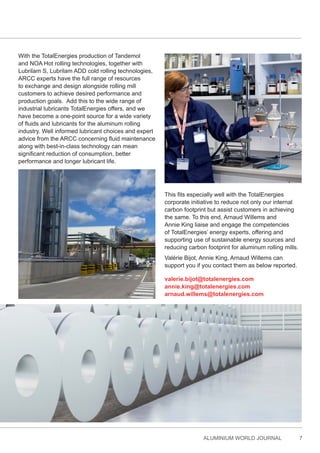
With the TotalEnergies production of Tandemol
and NOA Hot rolling technologies, together with
Lubrilam S, Lubrilam ADD cold rolling technologies,
ARCC experts have the full range of resources
to exchange and design alongside rolling mill
customers to achieve desired performance and
production goals. Add this to the wide range of
industrial lubricants TotalEnergies offers, and we
have become a one-point source for a wide variety
of fluids and lubricants for the aluminum rolling
industry. Well informed lubricant choices and expert
advice from the ARCC concerning fluid maintenance
along with best-in-class technology can mean
significant reduction of consumption, better
performance and longer lubricant life.
This fits especially well with the TotalEnergies
corporate initiative to reduce not only our internal
carbon footprint but assist customers in achieving
the same. To this end, Arnaud Willems and
Annie King liaise and engage the competencies
of TotalEnergies’ energy experts, offering and
supporting use of sustainable energy sources and
reducing carbon footprint for aluminum rolling mills.
Valérie Bijot, Annie King, Arnaud Willems can
support you if you contact them as below reported.
valerie.bijot@totalenergies.com
annie.king@totalenergies.com
arnaud.willems@totalenergies.com
8 ROLLING MILL
Aluminium Rolling Lubrication:
Chris Pargeter INNOVAL
In the industrialised world, approximately 50% of
all aluminium alloys used is in the form of flat rolled
products. Over the last 35 years major changes
have taken place in aluminium rolling lubrication
development and understanding. It is now accepted
that the rolling lubricant strongly influences both
mill productivity and metal quality. In this article,
we will give you an introduction to aluminium
rolling lubrication.
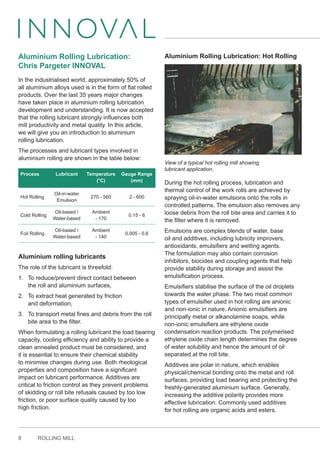
The processes and lubricant types involved in
aluminium rolling are shown in the table below:
Process Lubricant Temperature
(°C)
Gauge Range
(mm)
Hot Rolling
Oil-in-water
Emulsion
270 - 560 2 - 600
Cold Rolling
Oil-based /
Water-based
Ambient
- 170
0.15 - 6
Foil Rolling
Oil-based /
Water-based
Ambient
- 140
0.005 - 0.6
Aluminium rolling lubricants
The role of the lubricant is threefold:
1. To reduce/prevent direct contact between
the roll and aluminium surfaces,
2. To extract heat generated by friction
and deformation,
3. To transport metal fines and debris from the roll
bite area to the filter.
When formulating a rolling lubricant the load bearing
capacity, cooling efficiency and ability to provide a
clean annealed product must be considered, and
it is essential to ensure their chemical stability
to minimise changes during use. Both rheological
properties and composition have a significant
impact on lubricant performance. Additives are
critical to friction control as they prevent problems
of skidding or roll bite refusals caused by too low
friction, or poor surface quality caused by too
high friction.
Aluminium Rolling Lubrication: Hot Rolling
View of a typical hot rolling mill showing
lubricant application.
During the hot rolling process, lubrication and
thermal control of the work rolls are achieved by
spraying oil-in-water emulsions onto the rolls in
controlled patterns. The emulsion also removes any
loose debris from the roll bite area and carries it to
the filter where it is removed.
Emulsions are complex blends of water, base
oil and additives, including lubricity improvers,
antioxidants, emulsifiers and wetting agents.
The formulation may also contain corrosion
inhibitors, biocides and coupling agents that help
provide stability during storage and assist the
emulsification process.
Emulsifiers stabilise the surface of the oil droplets
towards the water phase. The two most common
types of emulsifier used in hot rolling are anionic
and non-ionic in nature. Anionic emulsifiers are
principally metal or alkanolamine soaps, while
non-ionic emulsifiers are ethylene oxide
condensation reaction products. The polymerised
ethylene oxide chain length determines the degree
of water solubility and hence the amount of oil
separated at the roll bite.
Additives are polar in nature, which enables
physical/chemical bonding onto the metal and roll
surfaces, providing load bearing and protecting the
freshly-generated aluminium surface. Generally,
increasing the additive polarity provides more
effective lubrication. Commonly used additives
for hot rolling are organic acids and esters.
ALUMINIUM WORLD JOURNAL 9
Modest amounts of organic acids in formulations
significantly affect the surface quality of the rolled
sheet, although during use they generate metal
soaps that can reduce emulsion stability. Esters
are less reactive, but relatively stable and are
extensively used in commercial formulations.
Formulations also contain extreme pressure (EP)
additives, particularly phosphate esters that help
minimise surface defects caused by localised
welding of the aluminium to the roll under high
friction conditions.
Consistent aluminium rolling lubrication performance
must be established and maintained to ensure
effective cooling and protection of the freshly-
generated surface, whilst minimising roll wear
and avoiding slippage and refusals.
Cold & Foil Rolling
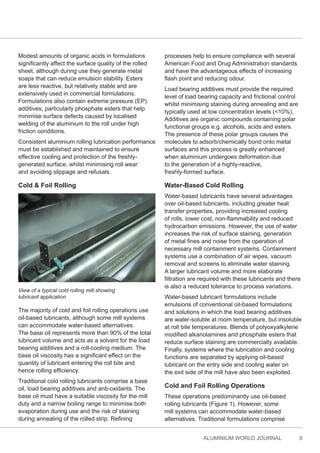
View of a typical cold rolling mill showing
lubricant application.
The majority of cold and foil rolling operations use
oil-based lubricants, although some mill systems
can accommodate water-based alternatives.
The base oil represents more than 90% of the total
lubricant volume and acts as a solvent for the load
bearing additives and a roll-cooling medium. The
base oil viscosity has a significant effect on the
quantity of lubricant entering the roll bite and
hence rolling efficiency.
Traditional cold rolling lubricants comprise a base
oil, load bearing additives and anti-oxidants. The
base oil must have a suitable viscosity for the mill
duty and a narrow boiling range to minimise both
evaporation during use and the risk of staining
during annealing of the rolled strip. Refining
processes help to ensure compliance with several
American Food and Drug Administration standards
and have the advantageous effects of increasing
flash point and reducing odour.
Load bearing additives must provide the required
level of load bearing capacity and frictional control
whilst minimising staining during annealing and are
typically used at low concentration levels (<10%).
Additives are organic compounds containing polar
functional groups e.g. alcohols, acids and esters.
The presence of these polar groups causes the
molecules to adsorb/chemically bond onto metal
surfaces and this process is greatly enhanced
when aluminium undergoes deformation due
to the generation of a highly-reactive,
freshly-formed surface.
Water-Based Cold Rolling
Water-based lubricants have several advantages
over oil-based lubricants, including greater heat
transfer properties, providing increased cooling
of rolls, lower cost, non-flammability and reduced
hydrocarbon emissions. However, the use of water
increases the risk of surface staining, generation
of metal fines and noise from the operation of
necessary mill containment systems. Containment
systems use a combination of air wipes, vacuum
removal and screens to eliminate water staining.
A larger lubricant volume and more elaborate
filtration are required with these lubricants and there
is also a reduced tolerance to process variations.
Water-based lubricant formulations include
emulsions of conventional oil-based formulations
and solutions in which the load bearing additives
are water-soluble at room temperature, but insoluble
at roll bite temperatures. Blends of polyoxyalkylene
modified alkanolamines and phosphate esters that
reduce surface staining are commercially available.
Finally, systems where the lubrication and cooling
functions are separated by applying oil-based
lubricant on the entry side and cooling water on
the exit side of the mill have also been exploited.
Cold and Foil Rolling Operations
These operations predominantly use oil-based
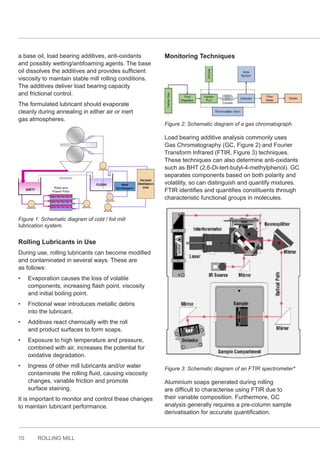
rolling lubricants (Figure 1). However, some
mill systems can accommodate water-based
alternatives. Traditional formulations comprise
10 ROLLING MILL
a base oil, load bearing additives, anti-oxidants
and possibly wetting/antifoaming agents. The base
oil dissolves the additives and provides sufficient
viscosity to maintain stable mill rolling conditions.
The additives deliver load bearing capacity
and frictional control.
The formulated lubricant should evaporate
cleanly during annealing in either air or inert
gas atmospheres.
Figure 1: Schematic diagram of cold / foil mill
lubrication system.
Rolling Lubricants in Use
During use, rolling lubricants can become modified
and contaminated in several ways. These are
as follows:
• Evaporation causes the loss of volatile
components, increasing flash point, viscosity
and initial boiling point.
• Frictional wear introduces metallic debris
into the lubricant.
• Additives react chemically with the roll
and product surfaces to form soaps.
• Exposure to high temperature and pressure,
combined with air, increases the potential for
oxidative degradation.
• Ingress of other mill lubricants and/or water
contaminate the rolling fluid, causing viscosity
changes, variable friction and promote
surface staining.
It is important to monitor and control these changes
to maintain lubricant performance.
Monitoring Techniques
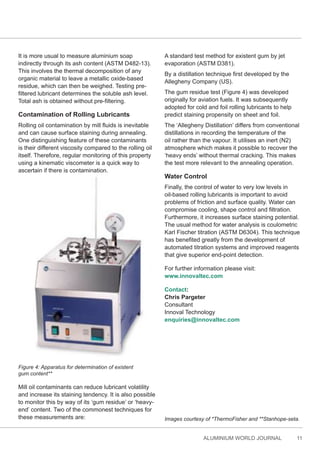
Figure 2: Schematic diagram of a gas chromatograph.
Load bearing additive analysis commonly uses
Gas Chromatography (GC, Figure 2) and Fourier
Transform Infrared (FTIR, Figure 3) techniques.
These techniques can also determine anti-oxidants
such as BHT (2,6-Di-tert-butyl-4-methylphenol). GC
separates components based on both polarity and
volatility, so can distinguish and quantify mixtures.
FTIR identifies and quantifies constituents through
characteristic functional groups in molecules.
Figure 3: Schematic diagram of an FTIR spectrometer*
Aluminium soaps generated during rolling
are difficult to characterise using FTIR due to
their variable composition. Furthermore, GC
analysis generally requires a pre-column sample
derivatisation for accurate quantification.
ALUMINIUM WORLD JOURNAL 11
It is more usual to measure aluminium soap
indirectly through its ash content (ASTM D482-13).
This involves the thermal decomposition of any
organic material to leave a metallic oxide-based
residue, which can then be weighed. Testing pre-
filtered lubricant determines the soluble ash level.
Total ash is obtained without pre-filtering.
Contamination of Rolling Lubricants
Rolling oil contamination by mill fluids is inevitable
and can cause surface staining during annealing.
One distinguishing feature of these contaminants
is their different viscosity compared to the rolling oil
itself. Therefore, regular monitoring of this property
using a kinematic viscometer is a quick way to
ascertain if there is contamination.
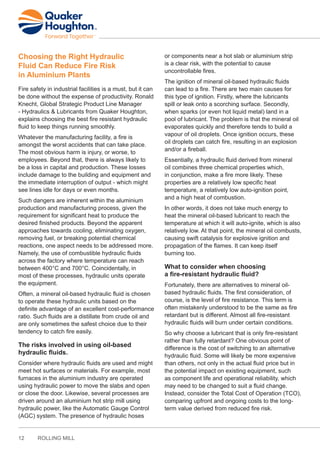
Figure 4: Apparatus for determination of existent
gum content**
Mill oil contaminants can reduce lubricant volatility
and increase its staining tendency. It is also possible
to monitor this by way of its ‘gum residue’ or ‘heavy-
end’ content. Two of the commonest techniques for
these measurements are:
A standard test method for existent gum by jet
evaporation (ASTM D381).
By a distillation technique first developed by the
Allegheny Company (US).
The gum residue test (Figure 4) was developed
originally for aviation fuels. It was subsequently
adopted for cold and foil rolling lubricants to help
predict staining propensity on sheet and foil.
The ‘Allegheny Distillation’ differs from conventional
distillations in recording the temperature of the
oil rather than the vapour. It utilises an inert (N2)
atmosphere which makes it possible to recover the
‘heavy ends’ without thermal cracking. This makes
the test more relevant to the annealing operation.
Water Control
Finally, the control of water to very low levels in
oil-based rolling lubricants is important to avoid
problems of friction and surface quality. Water can
compromise cooling, shape control and filtration.
Furthermore, it increases surface staining potential.
The usual method for water analysis is coulometric
Karl Fischer titration (ASTM D6304). This technique
has benefited greatly from the development of
automated titration systems and improved reagents
that give superior end-point detection.
For further information please visit:
www.innovaltec.com
Contact:
Chris Pargeter
Consultant
Innoval Technology
enquiries@innovaltec.com
Images courtesy of *ThermoFisher and **Stanhope-seta.
12 ROLLING MILL
Choosing the Right Hydraulic
Fluid Can Reduce Fire Risk
in Aluminium Plants
Fire safety in industrial facilities is a must, but it can
be done without the expense of productivity. Ronald
Knecht, Global Strategic Product Line Manager
- Hydraulics & Lubricants from Quaker Houghton,
explains choosing the best fire resistant hydraulic
fluid to keep things running smoothly.
Whatever the manufacturing facility, a fire is
amongst the worst accidents that can take place.
The most obvious harm is injury, or worse, to
employees. Beyond that, there is always likely to
be a loss in capital and production. These losses
include damage to the building and equipment and
the immediate interruption of output - which might
see lines idle for days or even months.
Such dangers are inherent within the aluminium
production and manufacturing process, given the
requirement for significant heat to produce the
desired finished products. Beyond the apparent
approaches towards cooling, eliminating oxygen,
removing fuel, or breaking potential chemical
reactions, one aspect needs to be addressed more.
Namely, the use of combustible hydraulic fluids
across the factory where temperature can reach
between 400°C and 700°C. Coincidentally, in
most of these processes, hydraulic units operate
the equipment.
Often, a mineral oil-based hydraulic fluid is chosen
to operate these hydraulic units based on the
definite advantage of an excellent cost-performance
ratio. Such fluids are a distillate from crude oil and
are only sometimes the safest choice due to their
tendency to catch fire easily.
The risks involved in using oil-based
hydraulic fluids.
Consider where hydraulic fluids are used and might
meet hot surfaces or materials. For example, most
furnaces in the aluminium industry are operated
using hydraulic power to move the slabs and open
or close the door. Likewise, several processes are
driven around an aluminium hot strip mill using
hydraulic power, like the Automatic Gauge Control
(AGC) system. The presence of hydraulic hoses
or components near a hot slab or aluminium strip
is a clear risk, with the potential to cause
uncontrollable fires.
The ignition of mineral oil-based hydraulic fluids
can lead to a fire. There are two main causes for
this type of ignition. Firstly, where the lubricants
spill or leak onto a scorching surface. Secondly,
when sparks (or even hot liquid metal) land in a
pool of lubricant. The problem is that the mineral oil
evaporates quickly and therefore tends to build a
vapour of oil droplets. Once ignition occurs, these
oil droplets can catch fire, resulting in an explosion
and/or a fireball.
Essentially, a hydraulic fluid derived from mineral
oil combines three chemical properties which,
in conjunction, make a fire more likely. These
properties are a relatively low specific heat
temperature, a relatively low auto-ignition point,
and a high heat of combustion.
In other words, it does not take much energy to
heat the mineral oil-based lubricant to reach the
temperature at which it will auto-ignite, which is also
relatively low. At that point, the mineral oil combusts,
causing swift catalysis for explosive ignition and
propagation of the flames. It can keep itself
burning too.
What to consider when choosing
a fire-resistant hydraulic fluid?
Fortunately, there are alternatives to mineral oil-
based hydraulic fluids. The first consideration, of
course, is the level of fire resistance. This term is
often mistakenly understood to be the same as fire
retardant but is different. Almost all fire-resistant
hydraulic fluids will burn under certain conditions.
So why choose a lubricant that is only fire-resistant
rather than fully retardant? One obvious point of
difference is the cost of switching to an alternative
hydraulic fluid. Some will likely be more expensive
than others, not only in the actual fluid price but in
the potential impact on existing equipment, such
as component life and operational reliability, which
may need to be changed to suit a fluid change.
Instead, consider the Total Cost of Operation (TCO),
comparing upfront and ongoing costs to the long-
term value derived from reduced fire risk.
ALUMINIUM WORLD JOURNAL 13
By triangulating these often-conflicting demands, it
is possible to strike the optimum balance to protect
productivity and profitability while managing an
appropriate level of risk. It’s worth investigating the
most common and generally accepted tests for
fire resistance. Such tests are devised by Factory
Mutual (FM Global). Using an FM Global-approved
hydraulic fluid can reduce the insurance premium a
company needs to pay.
Understanding the different types
of hydraulic fluid
The fundamental distinction in choosing a hydraulic
fluid is whether it is water-based or water-free. There
are pros and cons for each fluid type, meaning that
procurement specialists and maintenance managers
should consider the merits of all five types. The
different types are either water-based:
• HFA-E (mineral oil containing emulsion)
• HFA-S (a synthetic aqueous solution)
• HFC (a water glycol solution)
… or water-free:
• HFD-R (a phosphate ester-based)
• HFD-U (mainly synthetic polyol esters
and natural esters).
The fluids marked HFA-E and HFA-S require unique
hydraulic systems and are generally not found in the
Aluminium industry.
How do the other fluid types stack up in
comparison? Phosphate ester (HFD-R) based
lubricants have a negative reputation. Phosphate
ester (HFD-R) fluids are fire resistant by chemistry
but have a reputation to be CMR (Carcinogenic,
Mutagenic, Reprotoxic) materials. Also, the
combustion fumes they produce may be neurotoxic.
HFD-R fluids can be 10 to 15 times more expensive
than mineral oil and must be carefully maintained
as these products generate aggressive acids
as they age.
Of the remaining fluid types, both have good fire-
resistant properties, meaning other criteria must
also be considered. HFC fluids, also known as water
glycols, are widely used in aluminium processing
plants and other industries and represent about
50% of the total fire resistant hydraulic fluids market.
Their high-water content makes them very good for
fire resistance, and while they have a comparable
price to mineral oil, they do not measure up in
performance attributes. Additionally, hydraulic
units for HFC are more expensive to purchase,
the service components have a shorter lifetime,
more fluid management is needed, and the energy
consumption can be 10 to 20% higher compared
to mineral oil or polyol ester-based fire-resistant
hydraulic fluids.
That leaves polyol ester-based fluids (HFD-U) the
best solution and alternative to mineral oil. Typically,
no changes need to be made to the hydraulic unit
when converting from a mineral oil or water glycol
hydraulic fluid to a polyol ester fluid. Compared
to mineral oil-based fluids, nothing is sacrificed
regarding the fluid’s performance, and polyol
ester-based (HFD-U) fluids have reduced
environmental impact.
Making the Aluminium Plant Safer.
Considering how to reduce the fire risk from
hydraulic fluids is vital. Mineral oil getting in touch
with a hot surface can be limited by changing the
design of the hydraulic unit, but it can never be
avoided, and the risk is not reduced much.
Others might prefer the installation of a fire
extinguisher system to avoid having to change the
type of oil used, but not only is this expensive, but
it can also be ‘too little, too late’ as the main danger
caused by oil-based lubricants is the initial explosive
ignition and resulting fireball, which pass the
extinguisher before it can react. In short, swapping
a mineral oil-based hydraulic fluid for an HFD-U
type such as QUINTOLUBRIC® is one of the
surest ways to improve safety.
Contact: Jeremy Salisbury
Marketing Director, Quaker Houghton
jeremy.salisbury@quakerhoughton.com
www.home.quakerhoughton.com/product-lines/
hydraulic-fluids
14 CAST HOUSE
Proven Molten Aluminium Treatments
By STAS Inc
Introduction
STAS Inc. is a world leader in providing
high-tech equipment for the aluminium
industry. Specializing in the development,
fabrication, and commercialization of process
equipment in various areas of the aluminium
production chain, including electrolysis,
rodding shop, casthouse, crucible shop, and
surface inspection. Additionally, STAS offers
engineering solutions aimed at improving
productivity and safety for aluminium
producers from primary smelting plants
to secondary remelters.
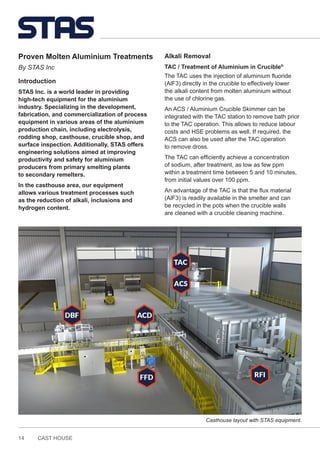
In the casthouse area, our equipment
allows various treatment processes such
as the reduction of alkali, inclusions and
hydrogen content.
Alkali Removal
TAC / Treatment of Aluminium in Crucible®
The TAC uses the injection of aluminium fluoride
(AlF3) directly in the crucible to effectively lower
the alkali content from molten aluminium without
the use of chlorine gas.
An ACS / Aluminium Crucible Skimmer can be
integrated with the TAC station to remove bath prior
to the TAC operation. This allows to reduce labour
costs and HSE problems as well. If required, the
ACS can also be used after the TAC operation
to remove dross.
The TAC can efficiently achieve a concentration
of sodium, after treatment, as low as few ppm
within a treatment time between 5 and 10 minutes,
from initial values over 100 ppm.
An advantage of the TAC is that the flux material
(AlF3) is readily available in the smelter and can
be recycled in the pots when the crucible walls
are cleaned with a crucible cleaning machine.
Casthouse layout with STAS equipment.
ALUMINIUM WORLD JOURNAL 15
RFI / Rotary Flux Injector®
It has long been accepted as an efficient alternative
to replace lancing and porous plugs. Its main
purpose is the reduction of alkali in the melt.
The RFI involves injecting a fixed quantity of
granular flux below the metal surface using a carrier
gas. The flux and gas mixture are injected through
a hollow rotating shaft at which end an impeller is
installed. The impeller has been selected to provide
vigorous shearing and dispersion of the gas and flux
mixture. It was designed to achieve ample metal
circulation in the furnace. This metal circulation
allows the alkali to reach the reaction zone and
homogenises the temperature and the alloy.
The RFI must be placed at a very specific location
into molten metal. Since each plant and even each
furnace is different, several models have been
developed to meet clients requirements. Some
equipment can be used to treat one furnace only,
while others can treat two furnaces in sequence.
Self-propelled mobile RFI can be moved across the
casthouse to process multiple furnaces. All those
RFI models are available in RGI and RFGI versions.
Degassing (Hydrogen Reduction)
ACD / Aluminium Compact Degasser®
The ACD is a multi-stage, in-line degassing
equipment that treats the molten aluminium as it
passes in the casting trough between the furnace
and the casting pit. The spinning rotors injects gas
below the aluminium surface.
Being a modular system, with 2 rotors per module,
the ACD is able to treat flow rates up to 1500 kg/
min. The ACD is designed to use up to 10 rotors
but two ACDs can be installed in series if required.
The number of rotors is in function of the metal
flow rate, alloy type, as well as the desired
reduction of hydrogen, inclusions and alkali.
Depending on the metallurgical requirements,
the ACD can be configured in argon only,
argon/flux or argon/chlorine.
The ACD achieves a high degassing performance
with a minimal footprint. There is also no metal hold-
up at the end of the drop and during alloy changes.
FFD / Flux Feeder for Degasser®
The FFD is a flux feeder designed to inject very
small quantities of solid flux underneath the metal
surface. The solid flux is added to assist alkali and
inclusion removal. The strong shearing forces of
our degasser rotor properly disperses the liquid
salt droplets. The main advantage of the FFD
is the elimination of chlorine gas from the
degassing process.
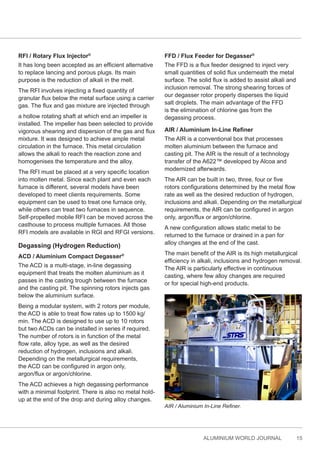
AIR / Aluminium In-Line Refiner
The AIR is a conventional box that processes
molten aluminium between the furnace and
casting pit. The AIR is the result of a technology
transfer of the A622™ developed by Alcoa and
modernized afterwards.
The AIR can be built in two, three, four or five
rotors configurations determined by the metal flow
rate as well as the desired reduction of hydrogen,
inclusions and alkali. Depending on the metallurgical
requirements, the AIR can be configured in argon
only, argon/flux or argon/chlorine.
A new configuration allows static metal to be
returned to the furnace or drained in a pan for
alloy changes at the end of the cast.
The main benefit of the AIR is its high metallurgical
efficiency in alkali, inclusions and hydrogen removal.
The AIR is particularly effective in continuous
casting, where few alloy changes are required
or for special high-end products.
AIR / Aluminium In-Line Refiner.
16 CAST HOUSE
Inclusion Removal
DBF / Deep Bed Filter®
The DBF is a mechanical filtration device
specially designed to remove inclusions
efficiently and economically in large quantities
of molten aluminium.
The DBF consists of a refractory lined steel box
containing a bed of tabular alumina through which
the metal flows. At the casting station, the DBF box
is fitted with an electrically heated holding lid used
to maintain the metal temperature between casts.
To maintain the excellent filtration efficiency of the
DBF, the filtering bed needs to be replaced after
some casting time. The operation requires to dump
the filtering media, to clean the inside of the box,
to rebuild the new filtering bed and finally to
preheat the box to the required temperature.
The main advantage of a DBF is the high and
consistent filtering efficiency with low operating
costs. The DBF is best used with continuous
or batch castings with little to no alloy changes.
ACF / Advanced Compact Filter
The ACF is a filtration system that can use
filtering cartridges as high as 60 or 70 ppi, thanks
to its priming vacuum system. This new filtration
technology is adapted to frequent alloy changes
and can provide inclusion removal higher than 90%.
The ACF can filter up to 100 tonnes per cast, with
a flow rate up to 1100 kg/min.
The ACF is under license from Rio Tinto and
is commercialized and manufactured by STAS.
The ACF is the optimal filtration solution for high
inclusion removal efficiency for casthouse producing
multiple alloy families.
Conclusion
In summary, STAS offers the equipment needed
to process molten aluminium whether in the
crucible, in the furnace or along the trough
line to ensure compliance with specifications
of aluminium producers.
Want more details?
Contact us
info@stas.com
1 418 696-0074
www.stas.com
STAS Inc. 622 Rue des Actionnaires, Chicoutimi
(Québec) Canada G7J 5A9.
ALUMINIUM WORLD JOURNAL 17
Casthouse Safe Environments
Alex Lowery, Consulting Editor
Light Metals Age: Improving Safety Strategies
in Aluminium Casthouse Environments
A casthouse is unlike any other workplace.
It is an environment with a variety of unique
hazards that injure and kill workers annually.
Companies mitigate these hazards differently
across the industry. There are some common
characteristics for casthouses that have
developed a safe environment for their workers.
As with any department, safety begins and
ends with the department manager. The first
characteristic safety conscious casthouses have
is a good manager. Casthouse managers play
an important role in the overall safety culture
of a department. Understanding how to develop
and facilitate an environment where safety
flourishes takes hard work. Consistent training
and development for managers in leadership
and safety topics is one common attribute that
the safest companies in our industry adhere to.
One mistake casthouses make is to either discount
or downplay the seriousness of a hazard when they
have not experienced an incident with that specific
hazard. They realize their error when an incident
occurs with that hazard injuring or killing a worker.
All hazards in a casthouse should be identified
and mitigated by training and install the appropriate
engineering controls. The hazards that commonly
injure and kill casthouse workers are molten
metal, moveable equipment, and falls.
Safety Clothing
Molten metal hazards include radiant heat,
splashes, and explosions. Workers are exposed
to radiant heat when performing tasks with
molten metal during a cast, during transferring, or
performing tasks with a furnace or drain pan. The
short- and long-term health effects of working in
a high heat workplace are unknown by many in
the aluminium industry. The Canadian Centre for
Occupational Health and Safety lists long-term heat
exposure as a contribution to workers’ heart, kidney,
and liver damage. Temporary infertility in both
women and men who are exposed to high heat work
environments is also common. Workers should be
dressed in primary (aluminized) clothing to minimize
the amount of radiant heat exposure. This type of
clothing reflects more than 90% of radiant heat.
Without primary clothing, secondary clothing and the
worker’s body absorbs all the radiant heat. Some
workplaces are hesitant to use primary clothing
because they are concerned it is hot to wear. There
are various methods and techniques of keeping
workers cool while wearing primary clothing. One
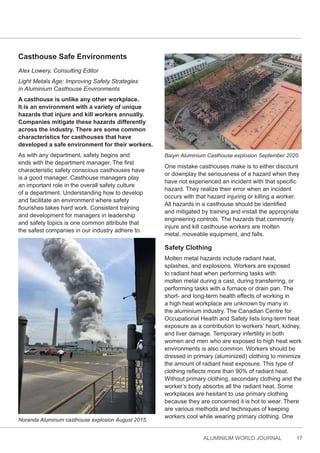
Noranda Aluminum casthouse explosion August 2015.
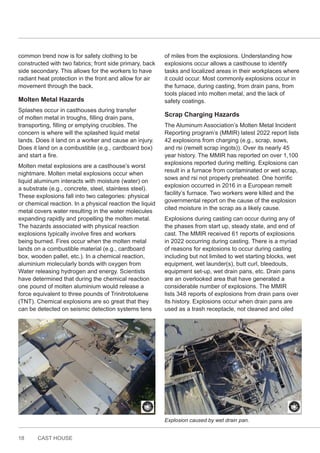
Baiyin Aluminium Casthouse explosion September 2020.
18 CAST HOUSE
common trend now is for safety clothing to be
constructed with two fabrics; front side primary, back
side secondary. This allows for the workers to have
radiant heat protection in the front and allow for air
movement through the back.
Molten Metal Hazards
Splashes occur in casthouses during transfer
of molten metal in troughs, filling drain pans,
transporting, filling or emptying crucibles. The
concern is where will the splashed liquid metal
lands. Does it land on a worker and cause an injury.
Does it land on a combustible (e.g., cardboard box)
and start a fire.
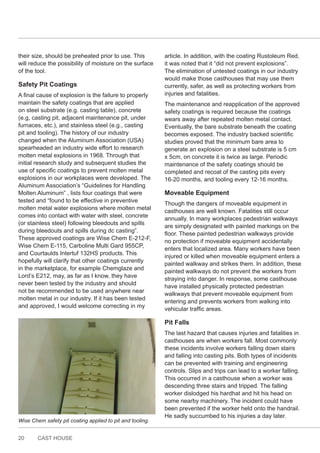
Molten metal explosions are a casthouse’s worst
nightmare. Molten metal explosions occur when
liquid aluminum interacts with moisture (water) on
a substrate (e.g., concrete, steel, stainless steel).
These explosions fall into two categories: physical
or chemical reaction. In a physical reaction the liquid
metal covers water resulting in the water molecules
expanding rapidly and propelling the molten metal.
The hazards associated with physical reaction
explosions typically involve fires and workers
being burned. Fires occur when the molten metal
lands on a combustible material (e.g., cardboard
box, wooden pallet, etc.). In a chemical reaction,
aluminium molecularly bonds with oxygen from
Water releasing hydrogen and energy. Scientists
have determined that during the chemical reaction
one pound of molten aluminium would release a
force equivalent to three pounds of Trinitrotoluene
(TNT). Chemical explosions are so great that they
can be detected on seismic detection systems tens
of miles from the explosions. Understanding how
explosions occur allows a casthouse to identify
tasks and localized areas in their workplaces where
it could occur. Most commonly explosions occur in
the furnace, during casting, from drain pans, from
tools placed into molten metal, and the lack of
safety coatings.
Scrap Charging Hazards
The Aluminum Association’s Molten Metal Incident
Reporting program’s (MMIR) latest 2022 report lists
42 explosions from charging (e.g., scrap, sows,
and rsi (remelt scrap ingots)). Over its nearly 45
year history. The MMIR has reported on over 1,100
explosions reported during melting. Explosions can
result in a furnace from contaminated or wet scrap,
sows and rsi not properly preheated. One horrific
explosion occurred in 2016 in a European remelt
facility’s furnace. Two workers were killed and the
governmental report on the cause of the explosion
cited moisture in the scrap as a likely cause.
Explosions during casting can occur during any of
the phases from start up, steady state, and end of
cast. The MMIR received 61 reports of explosions
in 2022 occurring during casting. There is a myriad
of reasons for explosions to occur during casting
including but not limited to wet starting blocks, wet
equipment, wet launder(s), butt curl, bleedouts,
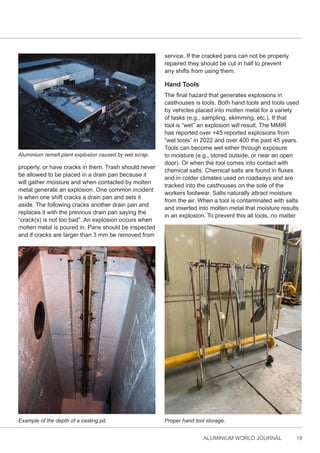
equipment set-up, wet drain pans, etc. Drain pans
are an overlooked area that have generated a
considerable number of explosions. The MMIR
lists 348 reports of explosions from drain pans over
its history. Explosions occur when drain pans are
used as a trash receptacle, not cleaned and oiled
Explosion caused by wet drain pan.
ALUMINIUM WORLD JOURNAL 19
properly, or have cracks in them. Trash should never
be allowed to be placed in a drain pan because it
will gather moisture and when contacted by molten
metal generate an explosion. One common incident
is when one shift cracks a drain pan and sets it
aside. The following cracks another drain pan and
replaces it with the previous drain pan saying the
“crack(s) is not too bad”. An explosion occurs when
molten metal is poured in. Pans should be inspected
and if cracks are larger than 3 mm be removed from
service. If the cracked pans can not be properly
repaired they should be cut in half to prevent
any shifts from using them.
Hand Tools
The final hazard that generates explosions in
casthouses is tools. Both hand tools and tools used
by vehicles placed into molten metal for a variety
of tasks (e.g., sampling, skimming, etc.). If that
tool is “wet” an explosion will result. The MMIR
has reported over +45 reported explosions from
“wet tools” in 2022 and over 400 the past 45 years.
Tools can become wet either through exposure
to moisture (e.g., stored outside, or near an open
door). Or when the tool comes into contact with
chemical salts. Chemical salts are found in fluxes
and in colder climates used on roadways and are
tracked into the casthouses on the sole of the
workers footwear. Salts naturally attract moisture
from the air. When a tool is contaminated with salts
and inserted into molten metal that moisture results
in an explosion. To prevent this all tools, no matter
Aluminium remelt plant explosion caused by wet scrap.
Proper hand tool storage.
Example of the depth of a casting pit.
20 CAST HOUSE
their size, should be preheated prior to use. This
will reduce the possibility of moisture on the surface
of the tool.
Safety Pit Coatings
A final cause of explosion is the failure to properly
maintain the safety coatings that are applied
on steel substrate (e.g. casting table), concrete
(e.g, casting pit, adjacent maintenance pit, under
furnaces, etc.), and stainless steel (e.g., casting
pit and tooling). The history of our industry
changed when the Aluminum Association (USA)
spearheaded an industry wide effort to research
molten metal explosions in 1968. Through that
initial research study and subsequent studies the
use of specific coatings to prevent molten metal
explosions in our workplaces were developed. The
Aluminum Association’s “Guidelines for Handling
Molten Aluminum” , lists four coatings that were
tested and “found to be effective in preventive
molten metal water explosions where molten metal
comes into contact with water with steel, concrete
(or stainless steel) following bleedouts and spills
during bleedouts and spills during dc casting”.
These approved coatings are Wise Chem E-212-F,
Wise Chem E-115, Carboline Multi Gard 955CP,
and Courtaulds Intertuf 132HS products. This
hopefully will clarify that other coatings currently
in the marketplace, for example Chemglaze and
Lord’s E212, may, as far as I know, they have
never been tested by the industry and should
not be recommended to be used anywhere near
molten metal in our industry. If it has been tested
and approved, I would welcome correcting in my
article. In addition, with the coating Rustoleum Red,
it was noted that it “did not prevent explosions”.
The elimination of untested coatings in our industry
would make those casthouses that may use them
currently, safer, as well as protecting workers from
injuries and fatalities.
The maintenance and reapplication of the approved
safety coatings is required because the coatings
wears away after repeated molten metal contact.
Eventually, the bare substrate beneath the coating
becomes exposed. The industry backed scientific
studies proved that the minimum bare area to
generate an explosion on a steel substrate is 5 cm
x 5cm, on concrete it is twice as large. Periodic
maintenance of the safety coatings should be
completed and recoat of the casting pits every
16-20 months, and tooling every 12-16 months.
Moveable Equipment
Though the dangers of moveable equipment in
casthouses are well known. Fatalities still occur
annually. In many workplaces pedestrian walkways
are simply designated with painted markings on the
floor. These painted pedestrian walkways provide
no protection if moveable equipment accidentally
enters that localized area. Many workers have been
injured or killed when moveable equipment enters a
painted walkway and strikes them. In addition, these
painted walkways do not prevent the workers from
straying into danger. In response, some casthouse
have installed physically protected pedestrian
walkways that prevent moveable equipment from
entering and prevents workers from walking into
vehicular traffic areas.
Pit Falls
The last hazard that causes injuries and fatalities in
casthouses are when workers fall. Most commonly
these incidents involve workers falling down stairs
and falling into casting pits. Both types of incidents
can be prevented with training and engineering
controls. Slips and trips can lead to a worker falling.
This occurred in a casthouse when a worker was
descending three stairs and tripped. The falling
worker dislodged his hardhat and hit his head on
some nearby machinery. The incident could have
been prevented if the worker held onto the handrail.
He sadly succumbed to his injuries a day later.
Wise Chem safety pit coating applied to pit and tooling.
ALUMINIUM WORLD JOURNAL 21
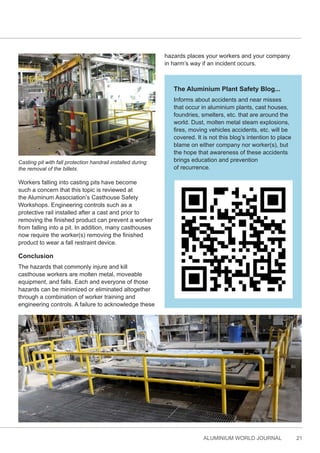
Workers falling into casting pits have become
such a concern that this topic is reviewed at
the Aluminum Association’s Casthouse Safety
Workshops. Engineering controls such as a
protective rail installed after a cast and prior to
removing the finished product can prevent a worker
from falling into a pit. In addition, many casthouses
now require the worker(s) removing the finished
product to wear a fall restraint device.
Conclusion
The hazards that commonly injure and kill
casthouse workers are molten metal, moveable
equipment, and falls. Each and everyone of those
hazards can be minimized or eliminated altogether
through a combination of worker training and
engineering controls. A failure to acknowledge these
hazards places your workers and your company
in harm’s way if an incident occurs.
The Aluminium Plant Safety Blog...
Informs about accidents and near misses
that occur in aluminium plants, cast houses,
foundries, smelters, etc. that are around the
world. Dust, molten metal steam explosions,
fires, moving vehicles accidents, etc. will be
covered. It is not this blog’s intention to place
blame on either company nor worker(s), but
the hope that awareness of these accidents
brings education and prevention
of recurrence.
Casting pit with fall protection handrail installed during
the removal of the billets.
22 CAST HOUSE
Automation of Furnace Tending:
Meet ARFT (Patent Pending)
Patrice Côté - President
Cédrik Ménard - Designer, Project Manager
Dynamic Concept, Saguenay, Québec, Canada
Éloïse Harvey - Chief Executive Officer
EPIQ Machinery, St-Bruno, Québec, Canada
Abstract
With increasing aluminium production worldwide,
both primary and secondary aluminium producers
deal with repetitive and demanding furnace tending
tasks. That added to the manpower shortage the
industry is facing. Two equipment designers pooled
their expertise to create a new state-of-the art
equipment, Automated Robotic Furnace Tending
(ARFT). It is not the first time that Dynamic Concept
and EPIQ Machinery co-operate, but ARFT is their
first co-creation meant to relieve aluminium
producers from furnace tending operations
still executed by operators.
Furnace tending is one of the activities in the
casthouse which most depends on operators.
Due to the large dimensions of melting and holding
furnaces, the tending equipment is also large,
either mobile and operated by people or mounted
on rails. Robotics integration is limited, because
standard robots are designed for high speeds
with small payloads while here slow speeds at
large payloads are required. To overcome these
limitations, a custom robot has been designed,
integrating innovative features such as portability
(onboard energy supply) and high payload capacity.
The key elements of the complete system (i.e., user
interface, robot control system and integrated vision
system) for which the technology is patent pending
were developed and manufactured by Dynamic
Concept. EPIQ MECFOR contributed to the
engineering and manufacturing of the components
providing the mobility required for the equipment
and the tools for working in molten aluminium.
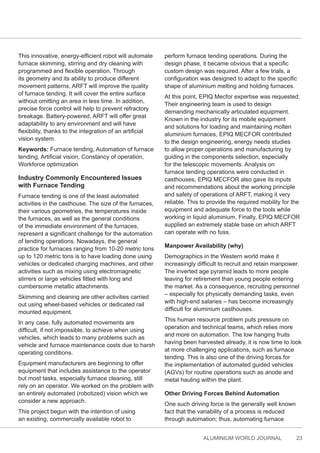
Patrice Côté, President of Dynamic Concept and Eloise Harvey, CEO of EPIQ Machinery.
ALUMINIUM WORLD JOURNAL 23
This innovative, energy-efficient robot will automate
furnace skimming, stirring and dry cleaning with
programmed and flexible operation. Through
its geometry and its ability to produce different
movement patterns, ARFT will improve the quality
of furnace tending. It will cover the entire surface
without omitting an area in less time. In addition,
precise force control will help to prevent refractory
breakage. Battery-powered, ARFT will offer great
adaptability to any environment and will have
flexibility, thanks to the integration of an artificial
vision system.
Keywords: Furnace tending, Automation of furnace
tending, Artificial vision, Constancy of operation,
Workforce optimization
Industry Commonly Encountered Issues
with Furnace Tending
Furnace tending is one of the least automated
activities in the casthouse. The size of the furnaces,
their various geometries, the temperatures inside
the furnaces, as well as the general conditions
of the immediate environment of the furnaces,
represent a significant challenge for the automation
of tending operations. Nowadays, the general
practice for furnaces ranging from 10-20 metric tons
up to 120 metric tons is to have loading done using
vehicles or dedicated charging machines, and other
activities such as mixing using electromagnetic
stirrers or large vehicles fitted with long and
cumbersome metallic attachments.
Skimming and cleaning are other activities carried
out using wheel-based vehicles or dedicated rail
mounted equipment.
In any case, fully automated movements are
difficult, if not impossible, to achieve when using
vehicles, which leads to many problems such as
vehicle and furnace maintenance costs due to harsh
operating conditions.
Equipment manufacturers are beginning to offer
equipment that includes assistance to the operator
but most tasks, especially furnace cleaning, still
rely on an operator. We worked on the problem with
an entirely automated (robotized) vision which we
consider a new approach.
This project begun with the intention of using
an existing, commercially available robot to
perform furnace tending operations. During the
design phase, it became obvious that a specific
custom design was required. After a few trials, a
configuration was designed to adapt to the specific
shape of aluminium melting and holding furnaces.
At this point, EPIQ Mecfor expertise was requested.
Their engineering team is used to design
demanding mechanically articulated equipment.
Known in the industry for its mobile equipment
and solutions for loading and maintaining molten
aluminium furnaces, EPIQ MECFOR contributed
to the design engineering, energy needs studies
to allow proper operations and manufacturing by
guiding in the components selection, especially
for the telescopic movements. Analysis on
furnace tending operations were conducted in
casthouses, EPIQ MECFOR also gave its inputs
and recommendations about the working principle
and safety of operations of ARFT, making it very
reliable. This to provide the required mobility for the
equipment and adequate force to the tools while
working in liquid aluminium. Finally, EPIQ MECFOR
supplied an extremely stable base on which ARFT
can operate with no fuss.
Manpower Availability (why)
Demographics in the Western world make it
increasingly difficult to recruit and retain manpower.
The inverted age pyramid leads to more people
leaving for retirement than young people entering
the market. As a consequence, recruiting personnel
– especially for physically demanding tasks, even
with high-end salaries – has become increasingly
difficult for aluminium casthouses.
This human resource problem puts pressure on
operation and technical teams, which relies more
and more on automation. The low hanging fruits
having been harvested already, it is now time to look
at more challenging applications, such as furnace
tending. This is also one of the driving forces for
the implementation of automated guided vehicles
(AGVs) for routine operations such as anode and
metal hauling within the plant.
Other Driving Forces Behind Automation
One such driving force is the generally well known
fact that the variability of a process is reduced
through automation; thus, automating furnace
24 CAST HOUSE
operations can help better control residual dross.
There is also increased pressure, in North American
and European plants, to reduce costs in order to
compete with plants in BRIC countries. Robotization
helps reducing production costs by improving
productivity and consistency of operations as well
as maintenance costs for furnace tending equipment
and furnace refractories.
Another important driving force is safety. The use
of a diesel-powered vehicle with hydraulics in front
of a furnace exposes the worker to molten metal
splashes if the tooling or charging alloys are not
properly preheated. Although modern furnace
tending equipment integrates excellent worker
protection, there is always a risk of fire in the event
of metal projections or spillage.
The interaction between vehicles and pedestrians
is also one important risk factor in the casthouse.
Many efforts are made to prevent pedestrians
and vehicles from passing each other, but certain
interactions are sometimes difficult to avoid.
Existing Technologies for Furnace Tending,
and their Limitations
Vehicles
The simplest equipment for furnace tending is a
specialized and extremely flexible vehicle used to
perform many tasks such as charging, alloying,
mixing, skimming and cleaning the furnace.
However, the downside in using vehicles is that in all
cases, they require skilled operators, therefore with
the limitations that this implies – such as schedules,
breaks, meals, intershift delays – which reduce
the operating window. In addition, skill variability
between operators, including skill reduction due to
fatigue, reduces the efficiency of operations and
increases maintenance costs. Tending operations
are hard on trucks and increase fleet upkeep costs.
When using a vehicle, it is very difficult for an
operator to accurately control the depth of the
skimming tool, or the force to be applied against the
lining during cleaning. The long tool attachments
that are used with these vehicles can easily hit and
damage the furnace refractory lining and the roof.
Diesel powered vehicles also pose a health risk
due to the possible build up of carbon monoxide
and exhaust gases if the area is not properly
ventilated. Efforts are being made to electrify these
vehicles, but they are still in the early phases of
implementation.
Specialized Machines
Specialized machines, such as those used for
charging and skimming, for example, are very
efficient due to their specific technology. Most of the
time, however, such specialization is limited where
furnaces are aligned so that rails can be used
to displace the machines. Moreover, the furnaces,
to be serviceable with the same tending equipment,
must be identical or very similar. More specialized
operations such as furnace cleaning still requires
human intervention with more specialized tooling
(and still needs for a vehicle).
The Common Limitation: The Human Factor
The common limitation regarding existing
technologies is the human factor. Since furnace
operations are in the critical path for delivering metal
to the casting equipment, casthouse managers
wish to avoid anything that can disrupt the flow of
metal, including delays in furnace operations. When
operators perform operations that are in the critical
path, this adds pressure to all casthouse operations.
In summary, manpower availability is becoming an
issue in most of the Western world, while furnace
tending operations still largely depend on the
skills of the operators. This is an important factor
motivating the implementation of automated furnace
tending operations. However, the various challenges
posed by the furnace geometry and the casthouse
configuration make it an opportunity for robotization
compared to conventional automation.
Summary of current issues
• Furnace structure and refractory breaking
• Cleaning operation not on regular schedule
• Efficiency of cleaning
• Efficiency of stirring
• Personal Turnover
• Safety
ALUMINIUM WORLD JOURNAL 25
Technical Description of ARFT
The solution is a flexible, fully programmable
automated Robot for Multi-Operation.
A commercially available robot, even the biggest
one, cannot reach all furnace area. These robots
are designed for high speeds with small payloads
while here slow speeds at large payloads are
required. To overcome these limitations, a custom
robot has been designed, integrating innovative
features such as portability (onboard energy supply)
and high payload capacity.
This robot has been tested in real condition
in operation many times and is now ready for
implementation.
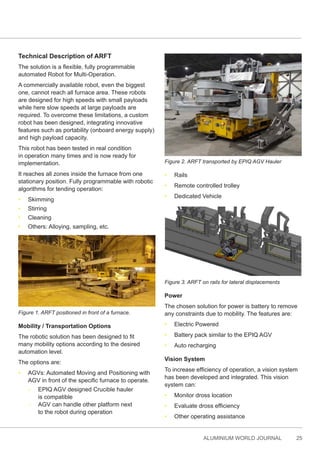
It reaches all zones inside the furnace from one
stationary position. Fully programmable with robotic
algorithms for tending operation:
• Skimming
• Stirring
• Cleaning
• Others: Alloying, sampling, etc.
Figure 1. ARFT positioned in front of a furnace.
Mobility / Transportation Options
The robotic solution has been designed to fit
many mobility options according to the desired
automation level.
The options are:
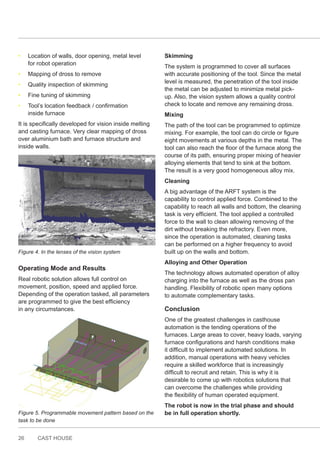
• AGVs: Automated Moving and Positioning with
AGV in front of the specific furnace to operate.
- EPIQ AGV designed Crucible hauler
is compatible
- AGV can handle other platform next
to the robot during operation
Figure 2. ARFT transported by EPIQ AGV Hauler
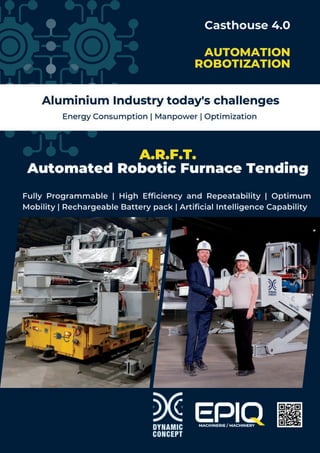
• Rails
• Remote controlled trolley
• Dedicated Vehicle
Figure 3. ARFT on rails for lateral displacements
Power
The chosen solution for power is battery to remove
any constraints due to mobility. The features are:
• Electric Powered
• Battery pack similar to the EPIQ AGV
• Auto recharging
Vision System
To increase efficiency of operation, a vision system
has been developed and integrated. This vision
system can:
• Monitor dross location
• Evaluate dross efficiency
• Other operating assistance
26 CAST HOUSE
• Location of walls, door opening, metal level
for robot operation
• Mapping of dross to remove
• Quality inspection of skimming
• Fine tuning of skimming
• Tool’s location feedback / confirmation
inside furnace
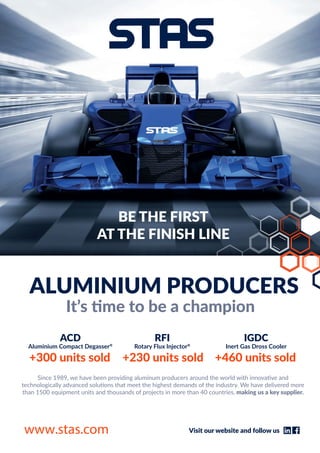
It is specifically developed for vision inside melting
and casting furnace. Very clear mapping of dross
over aluminium bath and furnace structure and
inside walls.
Figure 4. In the lenses of the vision system
Operating Mode and Results
Real robotic solution allows full control on
movement, position, speed and applied force.
Depending of the operation tasked, all parameters
are programmed to give the best efficiency
in any circumstances.
Figure 5. Programmable movement pattern based on the
task to be done
Skimming
The system is programmed to cover all surfaces
with accurate positioning of the tool. Since the metal
level is measured, the penetration of the tool inside
the metal can be adjusted to minimize metal pick-
up. Also, the vision system allows a quality control
check to locate and remove any remaining dross.
Mixing
The path of the tool can be programmed to optimize
mixing. For example, the tool can do circle or figure
eight movements at various depths in the metal. The
tool can also reach the floor of the furnace along the
course of its path, ensuring proper mixing of heavier
alloying elements that tend to sink at the bottom.
The result is a very good homogeneous alloy mix.
Cleaning
A big advantage of the ARFT system is the
capability to control applied force. Combined to the
capability to reach all walls and bottom, the cleaning
task is very efficient. The tool applied a controlled
force to the wall to clean allowing removing of the
dirt without breaking the refractory. Even more,
since the operation is automated, cleaning tasks
can be performed on a higher frequency to avoid
built up on the walls and bottom.
Alloying and Other Operation
The technology allows automated operation of alloy
charging into the furnace as well as the dross pan
handling. Flexibility of robotic open many options
to automate complementary tasks.
Conclusion
One of the greatest challenges in casthouse
automation is the tending operations of the
furnaces. Large areas to cover, heavy loads, varying
furnace configurations and harsh conditions make
it difficult to implement automated solutions. In
addition, manual operations with heavy vehicles
require a skilled workforce that is increasingly
difficult to recruit and retain. This is why it is
desirable to come up with robotics solutions that
can overcome the challenges while providing
the flexibility of human operated equipment.
The robot is now in the trial phase and should
be in full operation shortly.
Aluminium World Journal 2023-1_mobile version.pdf

Aluminium World Journal 2023-1_mobile version.pdf

  • 1.
    TotalEnergies 552 006454 RCS Nanterre - France. Photos: 123RF - Design: ms.industry@totalenergies.com lubricants.totalenergies.com TotalEnergies Industry Solutions Aluminum processing fluids Hot&coldrollingmills Expertise and technical support for all applications Aluminium World Journal
  • 2.
    GLAMA Maschinenbau GmbH Headquarters: Hornstraße19 D-45964 Gladbeck / Germany Fon: +49 (0) 2043 9738 0 Fax: +49 (0) 2043 9738 50 email: info@glama.de glama.de Cost effective heavy duty mobile equipment for aluminium industries . . . always the durable solution GLAMA USA Inc. 60 Helwig St., Berea, Ohio 44017 Fon: +1 877 452 6266 Email: sales@glama-us.com METEC 2023 Halle 1 / A69
  • 3.
    Welcome to anotheredition of Aluminium World Journal. This edition of Aluminium World Journal contains editorial covering some of the most recent advancements in current production methods, management strategies and advanced technology developed for the aluminium industry. Aluminium World Journal content is produced and sponsored by companies, independant experts and associations operating within the aluminium industry. I would like to take this opportunity to thank everyone who has taken time to develop the content included within this edition. If you are interested in discussing contributing material, or have any questions about this edition or future editions of Aluminium World Journal feel free to get in touch using the email: aluminiumworldjournal@gmx.com Hope you enjoy the read. Christopher F Harris Managing Director Global Media Communications Ltd Aluminium World Journal 2023 - 1
  • 4.
    Global Media Communication Ltd ManagingDirector Christopher Fitcher Harris Project Manager Peter Jones Finance Director Ted Garner Published by Global Media Communication Ltd 85 Great Portland Street First Floor London W1W 7LT United Kingdom Email gmcproduction@gmx.com Design AcuteNorth.com
  • 5.
    INDEX ROLLING MILL Total Energies6 INNOVAL 10 Quaker Houghton 12 CAST HOUSE STAS Inc 14 Casthouse Safe Environments 17 EPIQ Machinery 22 ALUMINIUM WORLD JOURNAL 5
  • 6.
    6 ROLLING MILL RollingLubricants - TotalEnergies Aluminum Rolling Competence Center Aluminum flat rolling mill engineers value the interaction with rolling lubricant experts, supporting them to achieve metal quality and output targets. For many decades, TotalEnergies Lubrifiants has been known for delivering Cold rolling base oils and additives serving the Aluminum cold rolling mills. Lubrilam S and Lubrilam ADD are used worldwide by many FRP (Flat Rolled Product) mills serving their end markets. A key TotalEnergies’ ambition was to expand the offer and service to Aluminum rolling mills by also becoming a true supplier and expert to the Hot rolling lubricants process. This ambition became real starting in 2019. Today, there is a full staff of senior rolling lubricant experts in North America and Europe, now known as the Aluminum Rolling Competence Center (ARCC) of TotalEnergies Lubrifiants. TotalEnergies affiliates and ARCC experts have been assuring the seamless supply of hot rolling oils and providing technical service to customers, supporting Tandemol, NOA, Vital Fluid NOA, and Noalubric technologies. New laboratories and blending facilities have been built for dedication to Aluminum rolling mill product manufacture and technical support. By the end of 2022, TotalEnergies achieved full integration of the newest lubricants production plant and laboratory investments which have been built in Osnabruck- Germany, Valdemoro-Spain, and Rockingham-North Carolina-USA.
  • 7.
    ALUMINIUM WORLD JOURNAL7 With the TotalEnergies production of Tandemol and NOA Hot rolling technologies, together with Lubrilam S, Lubrilam ADD cold rolling technologies, ARCC experts have the full range of resources to exchange and design alongside rolling mill customers to achieve desired performance and production goals. Add this to the wide range of industrial lubricants TotalEnergies offers, and we have become a one-point source for a wide variety of fluids and lubricants for the aluminum rolling industry. Well informed lubricant choices and expert advice from the ARCC concerning fluid maintenance along with best-in-class technology can mean significant reduction of consumption, better performance and longer lubricant life. This fits especially well with the TotalEnergies corporate initiative to reduce not only our internal carbon footprint but assist customers in achieving the same. To this end, Arnaud Willems and Annie King liaise and engage the competencies of TotalEnergies’ energy experts, offering and supporting use of sustainable energy sources and reducing carbon footprint for aluminum rolling mills. Valérie Bijot, Annie King, Arnaud Willems can support you if you contact them as below reported. valerie.bijot@totalenergies.com annie.king@totalenergies.com arnaud.willems@totalenergies.com
  • 8.
    8 ROLLING MILL AluminiumRolling Lubrication: Chris Pargeter INNOVAL In the industrialised world, approximately 50% of all aluminium alloys used is in the form of flat rolled products. Over the last 35 years major changes have taken place in aluminium rolling lubrication development and understanding. It is now accepted that the rolling lubricant strongly influences both mill productivity and metal quality. In this article, we will give you an introduction to aluminium rolling lubrication. The processes and lubricant types involved in aluminium rolling are shown in the table below: Process Lubricant Temperature (°C) Gauge Range (mm) Hot Rolling Oil-in-water Emulsion 270 - 560 2 - 600 Cold Rolling Oil-based / Water-based Ambient - 170 0.15 - 6 Foil Rolling Oil-based / Water-based Ambient - 140 0.005 - 0.6 Aluminium rolling lubricants The role of the lubricant is threefold: 1. To reduce/prevent direct contact between the roll and aluminium surfaces, 2. To extract heat generated by friction and deformation, 3. To transport metal fines and debris from the roll bite area to the filter. When formulating a rolling lubricant the load bearing capacity, cooling efficiency and ability to provide a clean annealed product must be considered, and it is essential to ensure their chemical stability to minimise changes during use. Both rheological properties and composition have a significant impact on lubricant performance. Additives are critical to friction control as they prevent problems of skidding or roll bite refusals caused by too low friction, or poor surface quality caused by too high friction. Aluminium Rolling Lubrication: Hot Rolling View of a typical hot rolling mill showing lubricant application. During the hot rolling process, lubrication and thermal control of the work rolls are achieved by spraying oil-in-water emulsions onto the rolls in controlled patterns. The emulsion also removes any loose debris from the roll bite area and carries it to the filter where it is removed. Emulsions are complex blends of water, base oil and additives, including lubricity improvers, antioxidants, emulsifiers and wetting agents. The formulation may also contain corrosion inhibitors, biocides and coupling agents that help provide stability during storage and assist the emulsification process. Emulsifiers stabilise the surface of the oil droplets towards the water phase. The two most common types of emulsifier used in hot rolling are anionic and non-ionic in nature. Anionic emulsifiers are principally metal or alkanolamine soaps, while non-ionic emulsifiers are ethylene oxide condensation reaction products. The polymerised ethylene oxide chain length determines the degree of water solubility and hence the amount of oil separated at the roll bite. Additives are polar in nature, which enables physical/chemical bonding onto the metal and roll surfaces, providing load bearing and protecting the freshly-generated aluminium surface. Generally, increasing the additive polarity provides more effective lubrication. Commonly used additives for hot rolling are organic acids and esters.
  • 9.
    ALUMINIUM WORLD JOURNAL9 Modest amounts of organic acids in formulations significantly affect the surface quality of the rolled sheet, although during use they generate metal soaps that can reduce emulsion stability. Esters are less reactive, but relatively stable and are extensively used in commercial formulations. Formulations also contain extreme pressure (EP) additives, particularly phosphate esters that help minimise surface defects caused by localised welding of the aluminium to the roll under high friction conditions. Consistent aluminium rolling lubrication performance must be established and maintained to ensure effective cooling and protection of the freshly- generated surface, whilst minimising roll wear and avoiding slippage and refusals. Cold & Foil Rolling View of a typical cold rolling mill showing lubricant application. The majority of cold and foil rolling operations use oil-based lubricants, although some mill systems can accommodate water-based alternatives. The base oil represents more than 90% of the total lubricant volume and acts as a solvent for the load bearing additives and a roll-cooling medium. The base oil viscosity has a significant effect on the quantity of lubricant entering the roll bite and hence rolling efficiency. Traditional cold rolling lubricants comprise a base oil, load bearing additives and anti-oxidants. The base oil must have a suitable viscosity for the mill duty and a narrow boiling range to minimise both evaporation during use and the risk of staining during annealing of the rolled strip. Refining processes help to ensure compliance with several American Food and Drug Administration standards and have the advantageous effects of increasing flash point and reducing odour. Load bearing additives must provide the required level of load bearing capacity and frictional control whilst minimising staining during annealing and are typically used at low concentration levels (<10%). Additives are organic compounds containing polar functional groups e.g. alcohols, acids and esters. The presence of these polar groups causes the molecules to adsorb/chemically bond onto metal surfaces and this process is greatly enhanced when aluminium undergoes deformation due to the generation of a highly-reactive, freshly-formed surface. Water-Based Cold Rolling Water-based lubricants have several advantages over oil-based lubricants, including greater heat transfer properties, providing increased cooling of rolls, lower cost, non-flammability and reduced hydrocarbon emissions. However, the use of water increases the risk of surface staining, generation of metal fines and noise from the operation of necessary mill containment systems. Containment systems use a combination of air wipes, vacuum removal and screens to eliminate water staining. A larger lubricant volume and more elaborate filtration are required with these lubricants and there is also a reduced tolerance to process variations. Water-based lubricant formulations include emulsions of conventional oil-based formulations and solutions in which the load bearing additives are water-soluble at room temperature, but insoluble at roll bite temperatures. Blends of polyoxyalkylene modified alkanolamines and phosphate esters that reduce surface staining are commercially available. Finally, systems where the lubrication and cooling functions are separated by applying oil-based lubricant on the entry side and cooling water on the exit side of the mill have also been exploited. Cold and Foil Rolling Operations These operations predominantly use oil-based rolling lubricants (Figure 1). However, some mill systems can accommodate water-based alternatives. Traditional formulations comprise
  • 10.
    10 ROLLING MILL abase oil, load bearing additives, anti-oxidants and possibly wetting/antifoaming agents. The base oil dissolves the additives and provides sufficient viscosity to maintain stable mill rolling conditions. The additives deliver load bearing capacity and frictional control. The formulated lubricant should evaporate cleanly during annealing in either air or inert gas atmospheres. Figure 1: Schematic diagram of cold / foil mill lubrication system. Rolling Lubricants in Use During use, rolling lubricants can become modified and contaminated in several ways. These are as follows: • Evaporation causes the loss of volatile components, increasing flash point, viscosity and initial boiling point. • Frictional wear introduces metallic debris into the lubricant. • Additives react chemically with the roll and product surfaces to form soaps. • Exposure to high temperature and pressure, combined with air, increases the potential for oxidative degradation. • Ingress of other mill lubricants and/or water contaminate the rolling fluid, causing viscosity changes, variable friction and promote surface staining. It is important to monitor and control these changes to maintain lubricant performance. Monitoring Techniques Figure 2: Schematic diagram of a gas chromatograph. Load bearing additive analysis commonly uses Gas Chromatography (GC, Figure 2) and Fourier Transform Infrared (FTIR, Figure 3) techniques. These techniques can also determine anti-oxidants such as BHT (2,6-Di-tert-butyl-4-methylphenol). GC separates components based on both polarity and volatility, so can distinguish and quantify mixtures. FTIR identifies and quantifies constituents through characteristic functional groups in molecules. Figure 3: Schematic diagram of an FTIR spectrometer* Aluminium soaps generated during rolling are difficult to characterise using FTIR due to their variable composition. Furthermore, GC analysis generally requires a pre-column sample derivatisation for accurate quantification.
  • 11.
    ALUMINIUM WORLD JOURNAL11 It is more usual to measure aluminium soap indirectly through its ash content (ASTM D482-13). This involves the thermal decomposition of any organic material to leave a metallic oxide-based residue, which can then be weighed. Testing pre- filtered lubricant determines the soluble ash level. Total ash is obtained without pre-filtering. Contamination of Rolling Lubricants Rolling oil contamination by mill fluids is inevitable and can cause surface staining during annealing. One distinguishing feature of these contaminants is their different viscosity compared to the rolling oil itself. Therefore, regular monitoring of this property using a kinematic viscometer is a quick way to ascertain if there is contamination. Figure 4: Apparatus for determination of existent gum content** Mill oil contaminants can reduce lubricant volatility and increase its staining tendency. It is also possible to monitor this by way of its ‘gum residue’ or ‘heavy- end’ content. Two of the commonest techniques for these measurements are: A standard test method for existent gum by jet evaporation (ASTM D381). By a distillation technique first developed by the Allegheny Company (US). The gum residue test (Figure 4) was developed originally for aviation fuels. It was subsequently adopted for cold and foil rolling lubricants to help predict staining propensity on sheet and foil. The ‘Allegheny Distillation’ differs from conventional distillations in recording the temperature of the oil rather than the vapour. It utilises an inert (N2) atmosphere which makes it possible to recover the ‘heavy ends’ without thermal cracking. This makes the test more relevant to the annealing operation. Water Control Finally, the control of water to very low levels in oil-based rolling lubricants is important to avoid problems of friction and surface quality. Water can compromise cooling, shape control and filtration. Furthermore, it increases surface staining potential. The usual method for water analysis is coulometric Karl Fischer titration (ASTM D6304). This technique has benefited greatly from the development of automated titration systems and improved reagents that give superior end-point detection. For further information please visit: www.innovaltec.com Contact: Chris Pargeter Consultant Innoval Technology enquiries@innovaltec.com Images courtesy of *ThermoFisher and **Stanhope-seta.
  • 12.
    12 ROLLING MILL Choosingthe Right Hydraulic Fluid Can Reduce Fire Risk in Aluminium Plants Fire safety in industrial facilities is a must, but it can be done without the expense of productivity. Ronald Knecht, Global Strategic Product Line Manager - Hydraulics & Lubricants from Quaker Houghton, explains choosing the best fire resistant hydraulic fluid to keep things running smoothly. Whatever the manufacturing facility, a fire is amongst the worst accidents that can take place. The most obvious harm is injury, or worse, to employees. Beyond that, there is always likely to be a loss in capital and production. These losses include damage to the building and equipment and the immediate interruption of output - which might see lines idle for days or even months. Such dangers are inherent within the aluminium production and manufacturing process, given the requirement for significant heat to produce the desired finished products. Beyond the apparent approaches towards cooling, eliminating oxygen, removing fuel, or breaking potential chemical reactions, one aspect needs to be addressed more. Namely, the use of combustible hydraulic fluids across the factory where temperature can reach between 400°C and 700°C. Coincidentally, in most of these processes, hydraulic units operate the equipment. Often, a mineral oil-based hydraulic fluid is chosen to operate these hydraulic units based on the definite advantage of an excellent cost-performance ratio. Such fluids are a distillate from crude oil and are only sometimes the safest choice due to their tendency to catch fire easily. The risks involved in using oil-based hydraulic fluids. Consider where hydraulic fluids are used and might meet hot surfaces or materials. For example, most furnaces in the aluminium industry are operated using hydraulic power to move the slabs and open or close the door. Likewise, several processes are driven around an aluminium hot strip mill using hydraulic power, like the Automatic Gauge Control (AGC) system. The presence of hydraulic hoses or components near a hot slab or aluminium strip is a clear risk, with the potential to cause uncontrollable fires. The ignition of mineral oil-based hydraulic fluids can lead to a fire. There are two main causes for this type of ignition. Firstly, where the lubricants spill or leak onto a scorching surface. Secondly, when sparks (or even hot liquid metal) land in a pool of lubricant. The problem is that the mineral oil evaporates quickly and therefore tends to build a vapour of oil droplets. Once ignition occurs, these oil droplets can catch fire, resulting in an explosion and/or a fireball. Essentially, a hydraulic fluid derived from mineral oil combines three chemical properties which, in conjunction, make a fire more likely. These properties are a relatively low specific heat temperature, a relatively low auto-ignition point, and a high heat of combustion. In other words, it does not take much energy to heat the mineral oil-based lubricant to reach the temperature at which it will auto-ignite, which is also relatively low. At that point, the mineral oil combusts, causing swift catalysis for explosive ignition and propagation of the flames. It can keep itself burning too. What to consider when choosing a fire-resistant hydraulic fluid? Fortunately, there are alternatives to mineral oil- based hydraulic fluids. The first consideration, of course, is the level of fire resistance. This term is often mistakenly understood to be the same as fire retardant but is different. Almost all fire-resistant hydraulic fluids will burn under certain conditions. So why choose a lubricant that is only fire-resistant rather than fully retardant? One obvious point of difference is the cost of switching to an alternative hydraulic fluid. Some will likely be more expensive than others, not only in the actual fluid price but in the potential impact on existing equipment, such as component life and operational reliability, which may need to be changed to suit a fluid change. Instead, consider the Total Cost of Operation (TCO), comparing upfront and ongoing costs to the long- term value derived from reduced fire risk.
  • 13.
    ALUMINIUM WORLD JOURNAL13 By triangulating these often-conflicting demands, it is possible to strike the optimum balance to protect productivity and profitability while managing an appropriate level of risk. It’s worth investigating the most common and generally accepted tests for fire resistance. Such tests are devised by Factory Mutual (FM Global). Using an FM Global-approved hydraulic fluid can reduce the insurance premium a company needs to pay. Understanding the different types of hydraulic fluid The fundamental distinction in choosing a hydraulic fluid is whether it is water-based or water-free. There are pros and cons for each fluid type, meaning that procurement specialists and maintenance managers should consider the merits of all five types. The different types are either water-based: • HFA-E (mineral oil containing emulsion) • HFA-S (a synthetic aqueous solution) • HFC (a water glycol solution) … or water-free: • HFD-R (a phosphate ester-based) • HFD-U (mainly synthetic polyol esters and natural esters). The fluids marked HFA-E and HFA-S require unique hydraulic systems and are generally not found in the Aluminium industry. How do the other fluid types stack up in comparison? Phosphate ester (HFD-R) based lubricants have a negative reputation. Phosphate ester (HFD-R) fluids are fire resistant by chemistry but have a reputation to be CMR (Carcinogenic, Mutagenic, Reprotoxic) materials. Also, the combustion fumes they produce may be neurotoxic. HFD-R fluids can be 10 to 15 times more expensive than mineral oil and must be carefully maintained as these products generate aggressive acids as they age. Of the remaining fluid types, both have good fire- resistant properties, meaning other criteria must also be considered. HFC fluids, also known as water glycols, are widely used in aluminium processing plants and other industries and represent about 50% of the total fire resistant hydraulic fluids market. Their high-water content makes them very good for fire resistance, and while they have a comparable price to mineral oil, they do not measure up in performance attributes. Additionally, hydraulic units for HFC are more expensive to purchase, the service components have a shorter lifetime, more fluid management is needed, and the energy consumption can be 10 to 20% higher compared to mineral oil or polyol ester-based fire-resistant hydraulic fluids. That leaves polyol ester-based fluids (HFD-U) the best solution and alternative to mineral oil. Typically, no changes need to be made to the hydraulic unit when converting from a mineral oil or water glycol hydraulic fluid to a polyol ester fluid. Compared to mineral oil-based fluids, nothing is sacrificed regarding the fluid’s performance, and polyol ester-based (HFD-U) fluids have reduced environmental impact. Making the Aluminium Plant Safer. Considering how to reduce the fire risk from hydraulic fluids is vital. Mineral oil getting in touch with a hot surface can be limited by changing the design of the hydraulic unit, but it can never be avoided, and the risk is not reduced much. Others might prefer the installation of a fire extinguisher system to avoid having to change the type of oil used, but not only is this expensive, but it can also be ‘too little, too late’ as the main danger caused by oil-based lubricants is the initial explosive ignition and resulting fireball, which pass the extinguisher before it can react. In short, swapping a mineral oil-based hydraulic fluid for an HFD-U type such as QUINTOLUBRIC® is one of the surest ways to improve safety. Contact: Jeremy Salisbury Marketing Director, Quaker Houghton jeremy.salisbury@quakerhoughton.com www.home.quakerhoughton.com/product-lines/ hydraulic-fluids
  • 14.
    14 CAST HOUSE ProvenMolten Aluminium Treatments By STAS Inc Introduction STAS Inc. is a world leader in providing high-tech equipment for the aluminium industry. Specializing in the development, fabrication, and commercialization of process equipment in various areas of the aluminium production chain, including electrolysis, rodding shop, casthouse, crucible shop, and surface inspection. Additionally, STAS offers engineering solutions aimed at improving productivity and safety for aluminium producers from primary smelting plants to secondary remelters. In the casthouse area, our equipment allows various treatment processes such as the reduction of alkali, inclusions and hydrogen content. Alkali Removal TAC / Treatment of Aluminium in Crucible® The TAC uses the injection of aluminium fluoride (AlF3) directly in the crucible to effectively lower the alkali content from molten aluminium without the use of chlorine gas. An ACS / Aluminium Crucible Skimmer can be integrated with the TAC station to remove bath prior to the TAC operation. This allows to reduce labour costs and HSE problems as well. If required, the ACS can also be used after the TAC operation to remove dross. The TAC can efficiently achieve a concentration of sodium, after treatment, as low as few ppm within a treatment time between 5 and 10 minutes, from initial values over 100 ppm. An advantage of the TAC is that the flux material (AlF3) is readily available in the smelter and can be recycled in the pots when the crucible walls are cleaned with a crucible cleaning machine. Casthouse layout with STAS equipment.
  • 15.
    ALUMINIUM WORLD JOURNAL15 RFI / Rotary Flux Injector® It has long been accepted as an efficient alternative to replace lancing and porous plugs. Its main purpose is the reduction of alkali in the melt. The RFI involves injecting a fixed quantity of granular flux below the metal surface using a carrier gas. The flux and gas mixture are injected through a hollow rotating shaft at which end an impeller is installed. The impeller has been selected to provide vigorous shearing and dispersion of the gas and flux mixture. It was designed to achieve ample metal circulation in the furnace. This metal circulation allows the alkali to reach the reaction zone and homogenises the temperature and the alloy. The RFI must be placed at a very specific location into molten metal. Since each plant and even each furnace is different, several models have been developed to meet clients requirements. Some equipment can be used to treat one furnace only, while others can treat two furnaces in sequence. Self-propelled mobile RFI can be moved across the casthouse to process multiple furnaces. All those RFI models are available in RGI and RFGI versions. Degassing (Hydrogen Reduction) ACD / Aluminium Compact Degasser® The ACD is a multi-stage, in-line degassing equipment that treats the molten aluminium as it passes in the casting trough between the furnace and the casting pit. The spinning rotors injects gas below the aluminium surface. Being a modular system, with 2 rotors per module, the ACD is able to treat flow rates up to 1500 kg/ min. The ACD is designed to use up to 10 rotors but two ACDs can be installed in series if required. The number of rotors is in function of the metal flow rate, alloy type, as well as the desired reduction of hydrogen, inclusions and alkali. Depending on the metallurgical requirements, the ACD can be configured in argon only, argon/flux or argon/chlorine. The ACD achieves a high degassing performance with a minimal footprint. There is also no metal hold- up at the end of the drop and during alloy changes. FFD / Flux Feeder for Degasser® The FFD is a flux feeder designed to inject very small quantities of solid flux underneath the metal surface. The solid flux is added to assist alkali and inclusion removal. The strong shearing forces of our degasser rotor properly disperses the liquid salt droplets. The main advantage of the FFD is the elimination of chlorine gas from the degassing process. AIR / Aluminium In-Line Refiner The AIR is a conventional box that processes molten aluminium between the furnace and casting pit. The AIR is the result of a technology transfer of the A622™ developed by Alcoa and modernized afterwards. The AIR can be built in two, three, four or five rotors configurations determined by the metal flow rate as well as the desired reduction of hydrogen, inclusions and alkali. Depending on the metallurgical requirements, the AIR can be configured in argon only, argon/flux or argon/chlorine. A new configuration allows static metal to be returned to the furnace or drained in a pan for alloy changes at the end of the cast. The main benefit of the AIR is its high metallurgical efficiency in alkali, inclusions and hydrogen removal. The AIR is particularly effective in continuous casting, where few alloy changes are required or for special high-end products. AIR / Aluminium In-Line Refiner.
  • 16.
    16 CAST HOUSE InclusionRemoval DBF / Deep Bed Filter® The DBF is a mechanical filtration device specially designed to remove inclusions efficiently and economically in large quantities of molten aluminium. The DBF consists of a refractory lined steel box containing a bed of tabular alumina through which the metal flows. At the casting station, the DBF box is fitted with an electrically heated holding lid used to maintain the metal temperature between casts. To maintain the excellent filtration efficiency of the DBF, the filtering bed needs to be replaced after some casting time. The operation requires to dump the filtering media, to clean the inside of the box, to rebuild the new filtering bed and finally to preheat the box to the required temperature. The main advantage of a DBF is the high and consistent filtering efficiency with low operating costs. The DBF is best used with continuous or batch castings with little to no alloy changes. ACF / Advanced Compact Filter The ACF is a filtration system that can use filtering cartridges as high as 60 or 70 ppi, thanks to its priming vacuum system. This new filtration technology is adapted to frequent alloy changes and can provide inclusion removal higher than 90%. The ACF can filter up to 100 tonnes per cast, with a flow rate up to 1100 kg/min. The ACF is under license from Rio Tinto and is commercialized and manufactured by STAS. The ACF is the optimal filtration solution for high inclusion removal efficiency for casthouse producing multiple alloy families. Conclusion In summary, STAS offers the equipment needed to process molten aluminium whether in the crucible, in the furnace or along the trough line to ensure compliance with specifications of aluminium producers. Want more details? Contact us info@stas.com 1 418 696-0074 www.stas.com STAS Inc. 622 Rue des Actionnaires, Chicoutimi (Québec) Canada G7J 5A9.
  • 17.
    ALUMINIUM WORLD JOURNAL17 Casthouse Safe Environments Alex Lowery, Consulting Editor Light Metals Age: Improving Safety Strategies in Aluminium Casthouse Environments A casthouse is unlike any other workplace. It is an environment with a variety of unique hazards that injure and kill workers annually. Companies mitigate these hazards differently across the industry. There are some common characteristics for casthouses that have developed a safe environment for their workers. As with any department, safety begins and ends with the department manager. The first characteristic safety conscious casthouses have is a good manager. Casthouse managers play an important role in the overall safety culture of a department. Understanding how to develop and facilitate an environment where safety flourishes takes hard work. Consistent training and development for managers in leadership and safety topics is one common attribute that the safest companies in our industry adhere to. One mistake casthouses make is to either discount or downplay the seriousness of a hazard when they have not experienced an incident with that specific hazard. They realize their error when an incident occurs with that hazard injuring or killing a worker. All hazards in a casthouse should be identified and mitigated by training and install the appropriate engineering controls. The hazards that commonly injure and kill casthouse workers are molten metal, moveable equipment, and falls. Safety Clothing Molten metal hazards include radiant heat, splashes, and explosions. Workers are exposed to radiant heat when performing tasks with molten metal during a cast, during transferring, or performing tasks with a furnace or drain pan. The short- and long-term health effects of working in a high heat workplace are unknown by many in the aluminium industry. The Canadian Centre for Occupational Health and Safety lists long-term heat exposure as a contribution to workers’ heart, kidney, and liver damage. Temporary infertility in both women and men who are exposed to high heat work environments is also common. Workers should be dressed in primary (aluminized) clothing to minimize the amount of radiant heat exposure. This type of clothing reflects more than 90% of radiant heat. Without primary clothing, secondary clothing and the worker’s body absorbs all the radiant heat. Some workplaces are hesitant to use primary clothing because they are concerned it is hot to wear. There are various methods and techniques of keeping workers cool while wearing primary clothing. One Noranda Aluminum casthouse explosion August 2015. Baiyin Aluminium Casthouse explosion September 2020.
  • 18.
    18 CAST HOUSE commontrend now is for safety clothing to be constructed with two fabrics; front side primary, back side secondary. This allows for the workers to have radiant heat protection in the front and allow for air movement through the back. Molten Metal Hazards Splashes occur in casthouses during transfer of molten metal in troughs, filling drain pans, transporting, filling or emptying crucibles. The concern is where will the splashed liquid metal lands. Does it land on a worker and cause an injury. Does it land on a combustible (e.g., cardboard box) and start a fire. Molten metal explosions are a casthouse’s worst nightmare. Molten metal explosions occur when liquid aluminum interacts with moisture (water) on a substrate (e.g., concrete, steel, stainless steel). These explosions fall into two categories: physical or chemical reaction. In a physical reaction the liquid metal covers water resulting in the water molecules expanding rapidly and propelling the molten metal. The hazards associated with physical reaction explosions typically involve fires and workers being burned. Fires occur when the molten metal lands on a combustible material (e.g., cardboard box, wooden pallet, etc.). In a chemical reaction, aluminium molecularly bonds with oxygen from Water releasing hydrogen and energy. Scientists have determined that during the chemical reaction one pound of molten aluminium would release a force equivalent to three pounds of Trinitrotoluene (TNT). Chemical explosions are so great that they can be detected on seismic detection systems tens of miles from the explosions. Understanding how explosions occur allows a casthouse to identify tasks and localized areas in their workplaces where it could occur. Most commonly explosions occur in the furnace, during casting, from drain pans, from tools placed into molten metal, and the lack of safety coatings. Scrap Charging Hazards The Aluminum Association’s Molten Metal Incident Reporting program’s (MMIR) latest 2022 report lists 42 explosions from charging (e.g., scrap, sows, and rsi (remelt scrap ingots)). Over its nearly 45 year history. The MMIR has reported on over 1,100 explosions reported during melting. Explosions can result in a furnace from contaminated or wet scrap, sows and rsi not properly preheated. One horrific explosion occurred in 2016 in a European remelt facility’s furnace. Two workers were killed and the governmental report on the cause of the explosion cited moisture in the scrap as a likely cause. Explosions during casting can occur during any of the phases from start up, steady state, and end of cast. The MMIR received 61 reports of explosions in 2022 occurring during casting. There is a myriad of reasons for explosions to occur during casting including but not limited to wet starting blocks, wet equipment, wet launder(s), butt curl, bleedouts, equipment set-up, wet drain pans, etc. Drain pans are an overlooked area that have generated a considerable number of explosions. The MMIR lists 348 reports of explosions from drain pans over its history. Explosions occur when drain pans are used as a trash receptacle, not cleaned and oiled Explosion caused by wet drain pan.
  • 19.
    ALUMINIUM WORLD JOURNAL19 properly, or have cracks in them. Trash should never be allowed to be placed in a drain pan because it will gather moisture and when contacted by molten metal generate an explosion. One common incident is when one shift cracks a drain pan and sets it aside. The following cracks another drain pan and replaces it with the previous drain pan saying the “crack(s) is not too bad”. An explosion occurs when molten metal is poured in. Pans should be inspected and if cracks are larger than 3 mm be removed from service. If the cracked pans can not be properly repaired they should be cut in half to prevent any shifts from using them. Hand Tools The final hazard that generates explosions in casthouses is tools. Both hand tools and tools used by vehicles placed into molten metal for a variety of tasks (e.g., sampling, skimming, etc.). If that tool is “wet” an explosion will result. The MMIR has reported over +45 reported explosions from “wet tools” in 2022 and over 400 the past 45 years. Tools can become wet either through exposure to moisture (e.g., stored outside, or near an open door). Or when the tool comes into contact with chemical salts. Chemical salts are found in fluxes and in colder climates used on roadways and are tracked into the casthouses on the sole of the workers footwear. Salts naturally attract moisture from the air. When a tool is contaminated with salts and inserted into molten metal that moisture results in an explosion. To prevent this all tools, no matter Aluminium remelt plant explosion caused by wet scrap. Proper hand tool storage. Example of the depth of a casting pit.
  • 20.
    20 CAST HOUSE theirsize, should be preheated prior to use. This will reduce the possibility of moisture on the surface of the tool. Safety Pit Coatings A final cause of explosion is the failure to properly maintain the safety coatings that are applied on steel substrate (e.g. casting table), concrete (e.g, casting pit, adjacent maintenance pit, under furnaces, etc.), and stainless steel (e.g., casting pit and tooling). The history of our industry changed when the Aluminum Association (USA) spearheaded an industry wide effort to research molten metal explosions in 1968. Through that initial research study and subsequent studies the use of specific coatings to prevent molten metal explosions in our workplaces were developed. The Aluminum Association’s “Guidelines for Handling Molten Aluminum” , lists four coatings that were tested and “found to be effective in preventive molten metal water explosions where molten metal comes into contact with water with steel, concrete (or stainless steel) following bleedouts and spills during bleedouts and spills during dc casting”. These approved coatings are Wise Chem E-212-F, Wise Chem E-115, Carboline Multi Gard 955CP, and Courtaulds Intertuf 132HS products. This hopefully will clarify that other coatings currently in the marketplace, for example Chemglaze and Lord’s E212, may, as far as I know, they have never been tested by the industry and should not be recommended to be used anywhere near molten metal in our industry. If it has been tested and approved, I would welcome correcting in my article. In addition, with the coating Rustoleum Red, it was noted that it “did not prevent explosions”. The elimination of untested coatings in our industry would make those casthouses that may use them currently, safer, as well as protecting workers from injuries and fatalities. The maintenance and reapplication of the approved safety coatings is required because the coatings wears away after repeated molten metal contact. Eventually, the bare substrate beneath the coating becomes exposed. The industry backed scientific studies proved that the minimum bare area to generate an explosion on a steel substrate is 5 cm x 5cm, on concrete it is twice as large. Periodic maintenance of the safety coatings should be completed and recoat of the casting pits every 16-20 months, and tooling every 12-16 months. Moveable Equipment Though the dangers of moveable equipment in casthouses are well known. Fatalities still occur annually. In many workplaces pedestrian walkways are simply designated with painted markings on the floor. These painted pedestrian walkways provide no protection if moveable equipment accidentally enters that localized area. Many workers have been injured or killed when moveable equipment enters a painted walkway and strikes them. In addition, these painted walkways do not prevent the workers from straying into danger. In response, some casthouse have installed physically protected pedestrian walkways that prevent moveable equipment from entering and prevents workers from walking into vehicular traffic areas. Pit Falls The last hazard that causes injuries and fatalities in casthouses are when workers fall. Most commonly these incidents involve workers falling down stairs and falling into casting pits. Both types of incidents can be prevented with training and engineering controls. Slips and trips can lead to a worker falling. This occurred in a casthouse when a worker was descending three stairs and tripped. The falling worker dislodged his hardhat and hit his head on some nearby machinery. The incident could have been prevented if the worker held onto the handrail. He sadly succumbed to his injuries a day later. Wise Chem safety pit coating applied to pit and tooling.
  • 21.
    ALUMINIUM WORLD JOURNAL21 Workers falling into casting pits have become such a concern that this topic is reviewed at the Aluminum Association’s Casthouse Safety Workshops. Engineering controls such as a protective rail installed after a cast and prior to removing the finished product can prevent a worker from falling into a pit. In addition, many casthouses now require the worker(s) removing the finished product to wear a fall restraint device. Conclusion The hazards that commonly injure and kill casthouse workers are molten metal, moveable equipment, and falls. Each and everyone of those hazards can be minimized or eliminated altogether through a combination of worker training and engineering controls. A failure to acknowledge these hazards places your workers and your company in harm’s way if an incident occurs. The Aluminium Plant Safety Blog... Informs about accidents and near misses that occur in aluminium plants, cast houses, foundries, smelters, etc. that are around the world. Dust, molten metal steam explosions, fires, moving vehicles accidents, etc. will be covered. It is not this blog’s intention to place blame on either company nor worker(s), but the hope that awareness of these accidents brings education and prevention of recurrence. Casting pit with fall protection handrail installed during the removal of the billets.
  • 22.
    22 CAST HOUSE Automationof Furnace Tending: Meet ARFT (Patent Pending) Patrice Côté - President Cédrik Ménard - Designer, Project Manager Dynamic Concept, Saguenay, Québec, Canada Éloïse Harvey - Chief Executive Officer EPIQ Machinery, St-Bruno, Québec, Canada Abstract With increasing aluminium production worldwide, both primary and secondary aluminium producers deal with repetitive and demanding furnace tending tasks. That added to the manpower shortage the industry is facing. Two equipment designers pooled their expertise to create a new state-of-the art equipment, Automated Robotic Furnace Tending (ARFT). It is not the first time that Dynamic Concept and EPIQ Machinery co-operate, but ARFT is their first co-creation meant to relieve aluminium producers from furnace tending operations still executed by operators. Furnace tending is one of the activities in the casthouse which most depends on operators. Due to the large dimensions of melting and holding furnaces, the tending equipment is also large, either mobile and operated by people or mounted on rails. Robotics integration is limited, because standard robots are designed for high speeds with small payloads while here slow speeds at large payloads are required. To overcome these limitations, a custom robot has been designed, integrating innovative features such as portability (onboard energy supply) and high payload capacity. The key elements of the complete system (i.e., user interface, robot control system and integrated vision system) for which the technology is patent pending were developed and manufactured by Dynamic Concept. EPIQ MECFOR contributed to the engineering and manufacturing of the components providing the mobility required for the equipment and the tools for working in molten aluminium. Patrice Côté, President of Dynamic Concept and Eloise Harvey, CEO of EPIQ Machinery.
  • 23.
    ALUMINIUM WORLD JOURNAL23 This innovative, energy-efficient robot will automate furnace skimming, stirring and dry cleaning with programmed and flexible operation. Through its geometry and its ability to produce different movement patterns, ARFT will improve the quality of furnace tending. It will cover the entire surface without omitting an area in less time. In addition, precise force control will help to prevent refractory breakage. Battery-powered, ARFT will offer great adaptability to any environment and will have flexibility, thanks to the integration of an artificial vision system. Keywords: Furnace tending, Automation of furnace tending, Artificial vision, Constancy of operation, Workforce optimization Industry Commonly Encountered Issues with Furnace Tending Furnace tending is one of the least automated activities in the casthouse. The size of the furnaces, their various geometries, the temperatures inside the furnaces, as well as the general conditions of the immediate environment of the furnaces, represent a significant challenge for the automation of tending operations. Nowadays, the general practice for furnaces ranging from 10-20 metric tons up to 120 metric tons is to have loading done using vehicles or dedicated charging machines, and other activities such as mixing using electromagnetic stirrers or large vehicles fitted with long and cumbersome metallic attachments. Skimming and cleaning are other activities carried out using wheel-based vehicles or dedicated rail mounted equipment. In any case, fully automated movements are difficult, if not impossible, to achieve when using vehicles, which leads to many problems such as vehicle and furnace maintenance costs due to harsh operating conditions. Equipment manufacturers are beginning to offer equipment that includes assistance to the operator but most tasks, especially furnace cleaning, still rely on an operator. We worked on the problem with an entirely automated (robotized) vision which we consider a new approach. This project begun with the intention of using an existing, commercially available robot to perform furnace tending operations. During the design phase, it became obvious that a specific custom design was required. After a few trials, a configuration was designed to adapt to the specific shape of aluminium melting and holding furnaces. At this point, EPIQ Mecfor expertise was requested. Their engineering team is used to design demanding mechanically articulated equipment. Known in the industry for its mobile equipment and solutions for loading and maintaining molten aluminium furnaces, EPIQ MECFOR contributed to the design engineering, energy needs studies to allow proper operations and manufacturing by guiding in the components selection, especially for the telescopic movements. Analysis on furnace tending operations were conducted in casthouses, EPIQ MECFOR also gave its inputs and recommendations about the working principle and safety of operations of ARFT, making it very reliable. This to provide the required mobility for the equipment and adequate force to the tools while working in liquid aluminium. Finally, EPIQ MECFOR supplied an extremely stable base on which ARFT can operate with no fuss. Manpower Availability (why) Demographics in the Western world make it increasingly difficult to recruit and retain manpower. The inverted age pyramid leads to more people leaving for retirement than young people entering the market. As a consequence, recruiting personnel – especially for physically demanding tasks, even with high-end salaries – has become increasingly difficult for aluminium casthouses. This human resource problem puts pressure on operation and technical teams, which relies more and more on automation. The low hanging fruits having been harvested already, it is now time to look at more challenging applications, such as furnace tending. This is also one of the driving forces for the implementation of automated guided vehicles (AGVs) for routine operations such as anode and metal hauling within the plant. Other Driving Forces Behind Automation One such driving force is the generally well known fact that the variability of a process is reduced through automation; thus, automating furnace
  • 24.
    24 CAST HOUSE operationscan help better control residual dross. There is also increased pressure, in North American and European plants, to reduce costs in order to compete with plants in BRIC countries. Robotization helps reducing production costs by improving productivity and consistency of operations as well as maintenance costs for furnace tending equipment and furnace refractories. Another important driving force is safety. The use of a diesel-powered vehicle with hydraulics in front of a furnace exposes the worker to molten metal splashes if the tooling or charging alloys are not properly preheated. Although modern furnace tending equipment integrates excellent worker protection, there is always a risk of fire in the event of metal projections or spillage. The interaction between vehicles and pedestrians is also one important risk factor in the casthouse. Many efforts are made to prevent pedestrians and vehicles from passing each other, but certain interactions are sometimes difficult to avoid. Existing Technologies for Furnace Tending, and their Limitations Vehicles The simplest equipment for furnace tending is a specialized and extremely flexible vehicle used to perform many tasks such as charging, alloying, mixing, skimming and cleaning the furnace. However, the downside in using vehicles is that in all cases, they require skilled operators, therefore with the limitations that this implies – such as schedules, breaks, meals, intershift delays – which reduce the operating window. In addition, skill variability between operators, including skill reduction due to fatigue, reduces the efficiency of operations and increases maintenance costs. Tending operations are hard on trucks and increase fleet upkeep costs. When using a vehicle, it is very difficult for an operator to accurately control the depth of the skimming tool, or the force to be applied against the lining during cleaning. The long tool attachments that are used with these vehicles can easily hit and damage the furnace refractory lining and the roof. Diesel powered vehicles also pose a health risk due to the possible build up of carbon monoxide and exhaust gases if the area is not properly ventilated. Efforts are being made to electrify these vehicles, but they are still in the early phases of implementation. Specialized Machines Specialized machines, such as those used for charging and skimming, for example, are very efficient due to their specific technology. Most of the time, however, such specialization is limited where furnaces are aligned so that rails can be used to displace the machines. Moreover, the furnaces, to be serviceable with the same tending equipment, must be identical or very similar. More specialized operations such as furnace cleaning still requires human intervention with more specialized tooling (and still needs for a vehicle). The Common Limitation: The Human Factor The common limitation regarding existing technologies is the human factor. Since furnace operations are in the critical path for delivering metal to the casting equipment, casthouse managers wish to avoid anything that can disrupt the flow of metal, including delays in furnace operations. When operators perform operations that are in the critical path, this adds pressure to all casthouse operations. In summary, manpower availability is becoming an issue in most of the Western world, while furnace tending operations still largely depend on the skills of the operators. This is an important factor motivating the implementation of automated furnace tending operations. However, the various challenges posed by the furnace geometry and the casthouse configuration make it an opportunity for robotization compared to conventional automation. Summary of current issues • Furnace structure and refractory breaking • Cleaning operation not on regular schedule • Efficiency of cleaning • Efficiency of stirring • Personal Turnover • Safety
  • 25.
    ALUMINIUM WORLD JOURNAL25 Technical Description of ARFT The solution is a flexible, fully programmable automated Robot for Multi-Operation. A commercially available robot, even the biggest one, cannot reach all furnace area. These robots are designed for high speeds with small payloads while here slow speeds at large payloads are required. To overcome these limitations, a custom robot has been designed, integrating innovative features such as portability (onboard energy supply) and high payload capacity. This robot has been tested in real condition in operation many times and is now ready for implementation. It reaches all zones inside the furnace from one stationary position. Fully programmable with robotic algorithms for tending operation: • Skimming • Stirring • Cleaning • Others: Alloying, sampling, etc. Figure 1. ARFT positioned in front of a furnace. Mobility / Transportation Options The robotic solution has been designed to fit many mobility options according to the desired automation level. The options are: • AGVs: Automated Moving and Positioning with AGV in front of the specific furnace to operate. - EPIQ AGV designed Crucible hauler is compatible - AGV can handle other platform next to the robot during operation Figure 2. ARFT transported by EPIQ AGV Hauler • Rails • Remote controlled trolley • Dedicated Vehicle Figure 3. ARFT on rails for lateral displacements Power The chosen solution for power is battery to remove any constraints due to mobility. The features are: • Electric Powered • Battery pack similar to the EPIQ AGV • Auto recharging Vision System To increase efficiency of operation, a vision system has been developed and integrated. This vision system can: • Monitor dross location • Evaluate dross efficiency • Other operating assistance
  • 26.
    26 CAST HOUSE •Location of walls, door opening, metal level for robot operation • Mapping of dross to remove • Quality inspection of skimming • Fine tuning of skimming • Tool’s location feedback / confirmation inside furnace It is specifically developed for vision inside melting and casting furnace. Very clear mapping of dross over aluminium bath and furnace structure and inside walls. Figure 4. In the lenses of the vision system Operating Mode and Results Real robotic solution allows full control on movement, position, speed and applied force. Depending of the operation tasked, all parameters are programmed to give the best efficiency in any circumstances. Figure 5. Programmable movement pattern based on the task to be done Skimming The system is programmed to cover all surfaces with accurate positioning of the tool. Since the metal level is measured, the penetration of the tool inside the metal can be adjusted to minimize metal pick- up. Also, the vision system allows a quality control check to locate and remove any remaining dross. Mixing The path of the tool can be programmed to optimize mixing. For example, the tool can do circle or figure eight movements at various depths in the metal. The tool can also reach the floor of the furnace along the course of its path, ensuring proper mixing of heavier alloying elements that tend to sink at the bottom. The result is a very good homogeneous alloy mix. Cleaning A big advantage of the ARFT system is the capability to control applied force. Combined to the capability to reach all walls and bottom, the cleaning task is very efficient. The tool applied a controlled force to the wall to clean allowing removing of the dirt without breaking the refractory. Even more, since the operation is automated, cleaning tasks can be performed on a higher frequency to avoid built up on the walls and bottom. Alloying and Other Operation The technology allows automated operation of alloy charging into the furnace as well as the dross pan handling. Flexibility of robotic open many options to automate complementary tasks. Conclusion One of the greatest challenges in casthouse automation is the tending operations of the furnaces. Large areas to cover, heavy loads, varying furnace configurations and harsh conditions make it difficult to implement automated solutions. In addition, manual operations with heavy vehicles require a skilled workforce that is increasingly difficult to recruit and retain. This is why it is desirable to come up with robotics solutions that can overcome the challenges while providing the flexibility of human operated equipment. The robot is now in the trial phase and should be in full operation shortly.