AM Lubrication Training Rig
Training Manual
Lubrication Safety
Environmental Considerations
Why Lubricate
How Lubrication Works
Incorrect Lubrication
Automatic Greasing
Manual Greasing
Mine Lubrication Standards and one Point
Lessons.
Verification
Contents
Lubrication Training
Safety
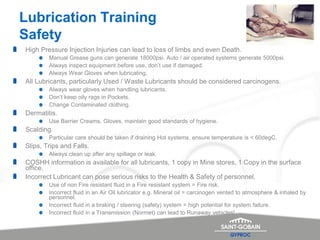
High Pressure Injection Injuries can lead to loss of limbs and even Death.
Manual Grease guns can generate 18000psi. Auto / air operated systems generate 5000psi.
Always inspect equipment before use, don’t use if damaged.
Always Wear Gloves when lubricating.
All Lubricants, particularly Used / Waste Lubricants should be considered carcinogens.
Always wear gloves when handling lubricants.
Don’t keep oily rags in Pockets.
Change Contaminated clothing.
Dermatitis.
Use Barrier Creams, Gloves, maintain good standards of hygiene.
Scalding.
Particular care should be taken if draining Hot systems, ensure temperature is < 60degC.
Slips, Trips and Falls.
Always clean up after any spillage or leak.
COSHH information is available for all lubricants, 1 copy in Mine stores, 1 Copy in the surface
office.
Incorrect Lubricant can pose serious risks to the Health & Safety of personnel.
Use of non Fire resistant fluid in a Fire resistant system = Fire risk.
Incorrect fluid in an Air Oil lubricator e.g. Mineral oil = carcinogen vented to atmosphere & inhaled by
personnel.
Incorrect fluid in a braking / steering (safety) system = high potential for system failure.
Incorrect fluid in a Transmission (Normet) can lead to Runaway vehicles!
Safety
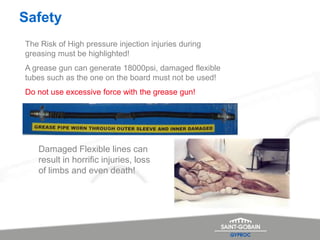
The Risk of High pressure injection injuries during
greasing must be highlighted!
A grease gun can generate 18000psi, damaged flexible
tubes such as the one on the board must not be used!
Do not use excessive force with the grease gun!
Damaged Flexible lines can
result in horrific injuries, loss
of limbs and even death!
Safety
PPE
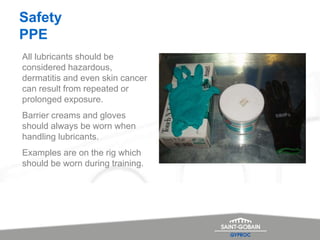
All lubricants should be
considered hazardous,
dermatitis and even skin cancer
can result from repeated or
prolonged exposure.
Barrier creams and gloves
should always be worn when
handling lubricants.
Examples are on the rig which
should be worn during training.
Safety
Incorrect Lubricant
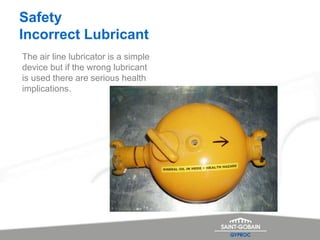
The air line lubricator is a simple
device but if the wrong lubricant
is used there are serious health
implications.
Lubrication Training
Environmental Issues
Correct Disposal of Oil Contaminated Waste
and Used Lubricants.
Train out OPL 13/ENVI/001
Spill Response.
Train out ENVI-WATER-01
Reporting of Environmental Incidents &
Concerns.
Report all Incidents and Concerns to Mine
Management (even if you have already dealt with
it).
Lubrication Training
Environmental Issues
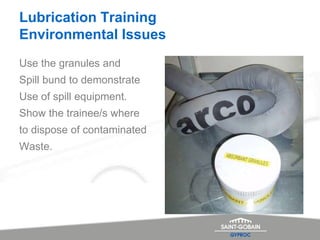
Use the granules and
Spill bund to demonstrate
Use of spill equipment.
Show the trainee/s where
to dispose of contaminated
Waste.
Lubrication Training
Why Lubricate
Correct Lubrication is essential in order to
maintain machinery at its optimal working
condition.
Increased productivity through correct
equipment performance.
Minimises downtime through lubrication related
failures.
Reduced maintenance costs.
Lubrication training.
Problems with Under / Irregular
Lubrication
Metal to metal contact allowed = high wear out
rate.
Heat is not dissipated.
Contamination is not flushed out.
Grease seals are not maintained allowing
contaminants to enter.
Shock loads are not absorbed.
Parts are not protected from Corrosion
Increased Power / Energy Use.
Why Lubricate
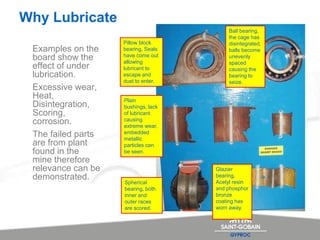
Examples on the
board show the
effect of under
lubrication.
Excessive wear,
Heat,
Disintegration,
Scoring,
corrosion.
The failed parts
are from plant
found in the
mine therefore
relevance can be
demonstrated.
Glazier
bearing,
Acetyl resin
and phosphor
bronze
coating has
worn away.
Spherical
bearing, both
inner and
outer races
are scored.
Ball bearing,
the cage has
disintegrated,
balls become
unevenly
spaced
causing the
bearing to
seize.
Pillow block
bearing, Seals
have come out
allowing
lubricant to
escape and
dust to enter.
Plain
bushings, lack
of lubricant
causing
extreme wear,
embedded
metallic
particles can
be seen.
Why Lubricate
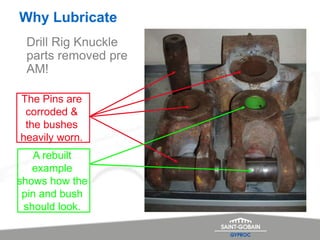
Drill Rig Knuckle
parts removed pre
AM!
The Pins are
corroded &
the bushes
heavily worn.
A rebuilt
example
shows how the
pin and bush
should look.
How Lubrication works.
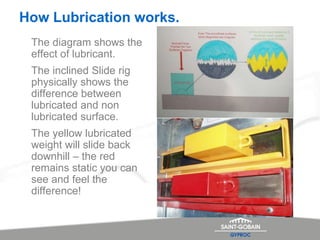
The diagram shows the
effect of lubricant.
The inclined Slide rig
physically shows the
difference between
lubricated and non
lubricated surface.
The yellow lubricated
weight will slide back
downhill – the red
remains static you can
see and feel the
difference!
How Lubrication works.
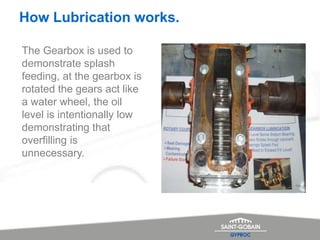
The Gearbox is used to
demonstrate splash
feeding, at the gearbox is
rotated the gears act like
a water wheel, the oil
level is intentionally low
demonstrating that
overfilling is
unnecessary.
How Lubrication works.
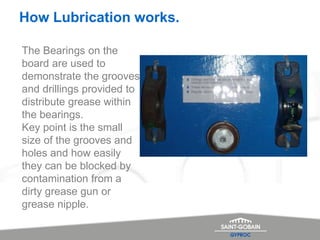
The Bearings on the
board are used to
demonstrate the grooves
and drillings provided to
distribute grease within
the bearings.
Key point is the small
size of the grooves and
holes and how easily
they can be blocked by
contamination from a
dirty grease gun or
grease nipple.
How Lubrication works.
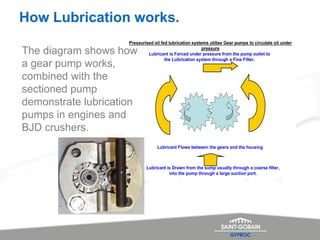
Lubricant is Drawn from the sump usually through a coarse filter,
into the pump through a large suction port.
Lubricant is Forced under pressure from the pump outlet to
the Lubrication system through a Fine Filter.
Pressurised oil fed lubrication systems utilise Gear pumps to circulate oil under
pressure
Lubricant Flows between the gears and the housing
The diagram shows how
a gear pump works,
combined with the
sectioned pump
demonstrate lubrication
pumps in engines and
BJD crushers.
Lubrication Training
Viscosity
Viscosity is the measure of the internal friction in a liquid or
the resistance to a flow:
Low viscosity fluids flow easily (water, alcohol);
High viscosity fluids pour slowly (molasses, cold honey, etc).
Viscosity properties change due to temperature and pressure
Viscosity Decreases as temperature Increases.
Viscosity Increases as Pressure Increases.
Generally within gear system applications:
High speed, low loads - low viscosity oils ISO VG10 - 150,
SAE 5W
Low speed, high loads high viscosity oils ISOVG320 and
above, SAE 60W
Lubrication Training
Viscosity
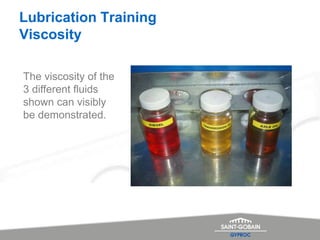
The viscosity of the
3 different fluids
shown can visibly
be demonstrated.
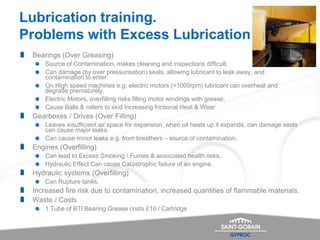
Lubrication training.
Problems with Excess Lubrication
Bearings (Over Greasing)
Source of Contamination, makes cleaning and inspections difficult.
Can damage (by over pressurisation) seals, allowing lubricant to leak away, and
contamination to enter.
On High speed machines e.g. electric motors (>1000rpm) lubricant can overheat and
degrade prematurely.
Electric Motors, overfilling risks filling motor windings with grease.
Cause Balls & rollers to skid Increasing frictional Heat & Wear
Gearboxes / Drives (Over Filling)
Leaves insufficient air space for expansion, when oil heats up it expands, can damage seals
can cause major leaks.
Can cause minor leaks e.g. from breathers – source of contamination.
Engines (Overfilling)
Can lead to Excess Smoking / Fumes & associated health risks.
Hydraulic Effect Can cause Catastrophic failure of an engine.
Hydraulic systems (Overfilling)
Can Rupture tanks.
Increased fire risk due to contamination, increased quantities of flammable materials.
Waste / Costs
1 Tube of BTI Bearing Grease costs £10 / Cartridge
Lubrication Training
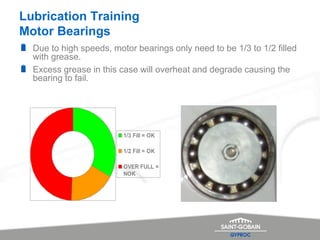
Motor Bearings
Due to high speeds, motor bearings only need to be 1/3 to 1/2 filled
with grease.
Excess grease in this case will overheat and degrade causing the
bearing to fail.
1/3 Fill = OK
1/2 Fill = OK
OVER FULL =
NOK
Lubrication Training
Problems with Excess Lubrication
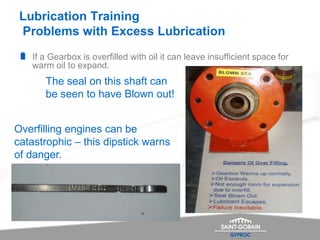
If a Gearbox is overfilled with oil it can leave insufficient space for
warm oil to expand.
The seal on this shaft can
be seen to have Blown out!
Overfilling engines can be
catastrophic – this dipstick warns
of danger.
Lubrication Training
Contamination
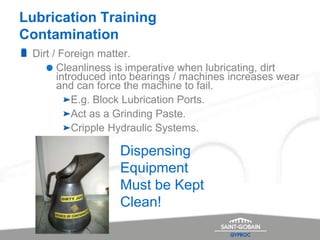
Dirt / Foreign matter.
Cleanliness is imperative when lubricating, dirt
introduced into bearings / machines increases wear
and can force the machine to fail.
E.g. Block Lubrication Ports.
Act as a Grinding Paste.
Cripple Hydraulic Systems.
Dispensing
Equipment
Must be Kept
Clean!
Lubrication Training
Contamination
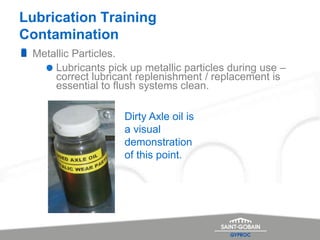
Metallic Particles.
Lubricants pick up metallic particles during use –
correct lubricant replenishment / replacement is
essential to flush systems clean.
Dirty Axle oil is
a visual
demonstration
of this point.
Lubrication Training
Contamination
Incorrect Lubricant.
All lubricants have different properties, the incorrect lubricant added to a
machine can lead to an unsafe machine and a costly repair.
Aquacent
Fire Resistant Fluid.
40:60 Oil : Water Mix.
Max Operating Temperature 60deg C.
Must be protected from Low temperatures.
Hydratherm
Fire Resistant Fluid
20:80 Oil : Water Mix.
Better Lubricating properties than Aquacent.
WILL NOT MIX WITH ANY OTHER OIL!
Must be protected from Low temperatures.
BP Terrac Super Transmission
Not FIRE RESISTANT FLUID!
High Grade Hydraulic Transmission oil.
Max Operating temperature >100deg C
Lubrication Training
Contamination
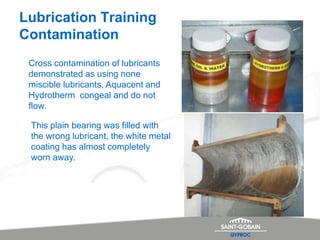
Cross contamination of lubricants
demonstrated as using none
miscible lubricants, Aquacent and
Hydrotherm congeal and do not
flow.
This plain bearing was filled with
the wrong lubricant, the white metal
coating has almost completely
worn away.
Lubrication Training
Automatic Lubricators
Why Auto-lube
Auto-lubes are used where a in high load / high speed
applications where a constant feed of fresh lubricant is
required during operation.
Adjustment of auto lubes.
This is pre set during machine commissioning.
Do not adjust at will, careful monitoring is required after any
adjustments.
Careful Inspections of Automated systems are required.
Check that pumps and injectors are correctly functioning.
Check Pipe-work and connectors for damage & leaks.
Check that fresh grease is present at the point of use.
Lubrication Training
Automatic Lubricators
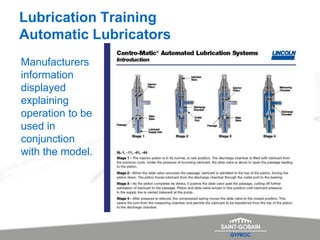
Manufacturers
information
displayed
explaining
operation to be
used in
conjunction
with the model.
Lubrication Training
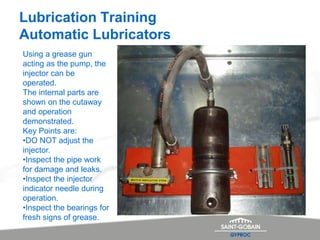
Automatic Lubricators
Using a grease gun
acting as the pump, the
injector can be
operated.
The internal parts are
shown on the cutaway
and operation
demonstrated.
Key Points are:
•DO NOT adjust the
injector.
•Inspect the pipe work
for damage and leaks.
•Inspect the injector
indicator needle during
operation.
•Inspect the bearings for
fresh signs of grease.
Lubrication Training
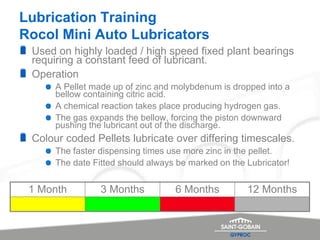
Rocol Mini Auto Lubricators
Used on highly loaded / high speed fixed plant bearings
requiring a constant feed of lubricant.
Operation
A Pellet made up of zinc and molybdenum is dropped into a
bellow containing citric acid.
A chemical reaction takes place producing hydrogen gas.
The gas expands the bellow, forcing the piston downward
pushing the lubricant out of the discharge.
Colour coded Pellets lubricate over differing timescales.
The faster dispensing times use more zinc in the pellet.
The date Fitted should always be marked on the Lubricator!
1 Month 3 Months 6 Months 12 Months
Lubrication Training
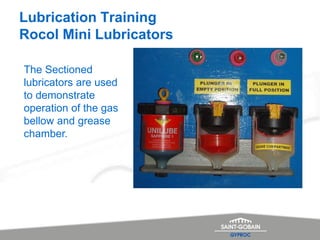
Rocol Mini Lubricators
The Sectioned
lubricators are used
to demonstrate
operation of the gas
bellow and grease
chamber.
Lubrication Training
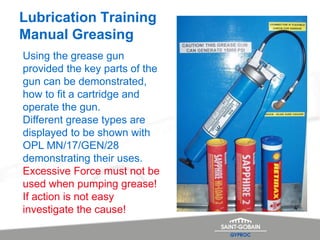
Manual Greasing
Using the grease gun
provided the key parts of the
gun can be demonstrated,
how to fit a cartridge and
operate the gun.
Different grease types are
displayed to be shown with
OPL MN/17/GEN/28
demonstrating their uses.
Excessive Force must not be
used when pumping grease!
If action is not easy
investigate the cause!
Lubrication Training
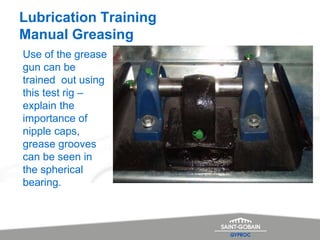
Manual Greasing
Use of the grease
gun can be
trained out using
this test rig –
explain the
importance of
nipple caps,
grease grooves
can be seen in
the spherical
bearing.
Lubrication Training
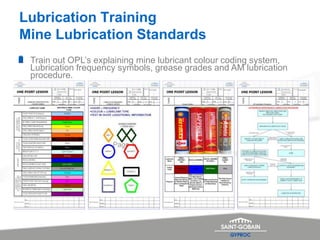
Mine Lubrication Standards
Train out OPL’s explaining mine lubricant colour coding system,
Lubrication frequency symbols, grease grades and AM lubrication
procedure.
Summary
Lubrication Training
Verification Questionnaire.
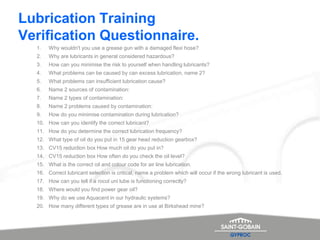
1. Why wouldn't you use a grease gun with a damaged flexi hose?
2. Why are lubricants in general considered hazardous?
3. How can you minimise the risk to yourself when handling lubricants?
4. What problems can be caused by can excess lubrication, name 2?
5. What problems can insufficient lubrication cause?
6. Name 2 sources of contamination:
7. Name 2 types of contamination:
8. Name 2 problems caused by contamination:
9. How do you minimise contamination during lubrication?
10. How can you identify the correct lubricant?
11. How do you determine the correct lubrication frequency?
12. What type of oil do you put in 15 gear head reduction gearbox?
13. CV15 reduction box How much oil do you put in?
14. CV15 reduction box How often do you check the oil level?
15. What is the correct oil and colour code for air line lubrication.
16. Correct lubricant selection is critical, name a problem which will occur if the wrong lubricant is used.
17. How can you tell if a rocol uni lube is functioning correctly?
18. Where would you find power gear oil?
19. Why do we use Aquacent in our hydraulic systems?
20. How many different types of grease are in use at Birkshead mine?

Lube training how to.ppt

  • 1.
    AM Lubrication TrainingRig Training Manual
  • 2.
    Lubrication Safety Environmental Considerations WhyLubricate How Lubrication Works Incorrect Lubrication Automatic Greasing Manual Greasing Mine Lubrication Standards and one Point Lessons. Verification Contents
  • 3.
    Lubrication Training Safety High PressureInjection Injuries can lead to loss of limbs and even Death. Manual Grease guns can generate 18000psi. Auto / air operated systems generate 5000psi. Always inspect equipment before use, don’t use if damaged. Always Wear Gloves when lubricating. All Lubricants, particularly Used / Waste Lubricants should be considered carcinogens. Always wear gloves when handling lubricants. Don’t keep oily rags in Pockets. Change Contaminated clothing. Dermatitis. Use Barrier Creams, Gloves, maintain good standards of hygiene. Scalding. Particular care should be taken if draining Hot systems, ensure temperature is < 60degC. Slips, Trips and Falls. Always clean up after any spillage or leak. COSHH information is available for all lubricants, 1 copy in Mine stores, 1 Copy in the surface office. Incorrect Lubricant can pose serious risks to the Health & Safety of personnel. Use of non Fire resistant fluid in a Fire resistant system = Fire risk. Incorrect fluid in an Air Oil lubricator e.g. Mineral oil = carcinogen vented to atmosphere & inhaled by personnel. Incorrect fluid in a braking / steering (safety) system = high potential for system failure. Incorrect fluid in a Transmission (Normet) can lead to Runaway vehicles!
  • 4.
    Safety The Risk ofHigh pressure injection injuries during greasing must be highlighted! A grease gun can generate 18000psi, damaged flexible tubes such as the one on the board must not be used! Do not use excessive force with the grease gun! Damaged Flexible lines can result in horrific injuries, loss of limbs and even death!
  • 5.
    Safety PPE All lubricants shouldbe considered hazardous, dermatitis and even skin cancer can result from repeated or prolonged exposure. Barrier creams and gloves should always be worn when handling lubricants. Examples are on the rig which should be worn during training.
  • 6.
    Safety Incorrect Lubricant The airline lubricator is a simple device but if the wrong lubricant is used there are serious health implications.
  • 7.
    Lubrication Training Environmental Issues CorrectDisposal of Oil Contaminated Waste and Used Lubricants. Train out OPL 13/ENVI/001 Spill Response. Train out ENVI-WATER-01 Reporting of Environmental Incidents & Concerns. Report all Incidents and Concerns to Mine Management (even if you have already dealt with it).
  • 8.
    Lubrication Training Environmental Issues Usethe granules and Spill bund to demonstrate Use of spill equipment. Show the trainee/s where to dispose of contaminated Waste.
  • 9.
    Lubrication Training Why Lubricate CorrectLubrication is essential in order to maintain machinery at its optimal working condition. Increased productivity through correct equipment performance. Minimises downtime through lubrication related failures. Reduced maintenance costs.
  • 10.
    Lubrication training. Problems withUnder / Irregular Lubrication Metal to metal contact allowed = high wear out rate. Heat is not dissipated. Contamination is not flushed out. Grease seals are not maintained allowing contaminants to enter. Shock loads are not absorbed. Parts are not protected from Corrosion Increased Power / Energy Use.
  • 11.
    Why Lubricate Examples onthe board show the effect of under lubrication. Excessive wear, Heat, Disintegration, Scoring, corrosion. The failed parts are from plant found in the mine therefore relevance can be demonstrated. Glazier bearing, Acetyl resin and phosphor bronze coating has worn away. Spherical bearing, both inner and outer races are scored. Ball bearing, the cage has disintegrated, balls become unevenly spaced causing the bearing to seize. Pillow block bearing, Seals have come out allowing lubricant to escape and dust to enter. Plain bushings, lack of lubricant causing extreme wear, embedded metallic particles can be seen.
  • 12.
    Why Lubricate Drill RigKnuckle parts removed pre AM! The Pins are corroded & the bushes heavily worn. A rebuilt example shows how the pin and bush should look.
  • 13.
    How Lubrication works. Thediagram shows the effect of lubricant. The inclined Slide rig physically shows the difference between lubricated and non lubricated surface. The yellow lubricated weight will slide back downhill – the red remains static you can see and feel the difference!
  • 14.
    How Lubrication works. TheGearbox is used to demonstrate splash feeding, at the gearbox is rotated the gears act like a water wheel, the oil level is intentionally low demonstrating that overfilling is unnecessary.
  • 15.
    How Lubrication works. TheBearings on the board are used to demonstrate the grooves and drillings provided to distribute grease within the bearings. Key point is the small size of the grooves and holes and how easily they can be blocked by contamination from a dirty grease gun or grease nipple.
  • 16.
    How Lubrication works. Lubricantis Drawn from the sump usually through a coarse filter, into the pump through a large suction port. Lubricant is Forced under pressure from the pump outlet to the Lubrication system through a Fine Filter. Pressurised oil fed lubrication systems utilise Gear pumps to circulate oil under pressure Lubricant Flows between the gears and the housing The diagram shows how a gear pump works, combined with the sectioned pump demonstrate lubrication pumps in engines and BJD crushers.
  • 17.
    Lubrication Training Viscosity Viscosity isthe measure of the internal friction in a liquid or the resistance to a flow: Low viscosity fluids flow easily (water, alcohol); High viscosity fluids pour slowly (molasses, cold honey, etc). Viscosity properties change due to temperature and pressure Viscosity Decreases as temperature Increases. Viscosity Increases as Pressure Increases. Generally within gear system applications: High speed, low loads - low viscosity oils ISO VG10 - 150, SAE 5W Low speed, high loads high viscosity oils ISOVG320 and above, SAE 60W
  • 18.
    Lubrication Training Viscosity The viscosityof the 3 different fluids shown can visibly be demonstrated.
  • 19.
    Lubrication training. Problems withExcess Lubrication Bearings (Over Greasing) Source of Contamination, makes cleaning and inspections difficult. Can damage (by over pressurisation) seals, allowing lubricant to leak away, and contamination to enter. On High speed machines e.g. electric motors (>1000rpm) lubricant can overheat and degrade prematurely. Electric Motors, overfilling risks filling motor windings with grease. Cause Balls & rollers to skid Increasing frictional Heat & Wear Gearboxes / Drives (Over Filling) Leaves insufficient air space for expansion, when oil heats up it expands, can damage seals can cause major leaks. Can cause minor leaks e.g. from breathers – source of contamination. Engines (Overfilling) Can lead to Excess Smoking / Fumes & associated health risks. Hydraulic Effect Can cause Catastrophic failure of an engine. Hydraulic systems (Overfilling) Can Rupture tanks. Increased fire risk due to contamination, increased quantities of flammable materials. Waste / Costs 1 Tube of BTI Bearing Grease costs £10 / Cartridge
  • 20.
    Lubrication Training Motor Bearings Dueto high speeds, motor bearings only need to be 1/3 to 1/2 filled with grease. Excess grease in this case will overheat and degrade causing the bearing to fail. 1/3 Fill = OK 1/2 Fill = OK OVER FULL = NOK
  • 21.
    Lubrication Training Problems withExcess Lubrication If a Gearbox is overfilled with oil it can leave insufficient space for warm oil to expand. The seal on this shaft can be seen to have Blown out! Overfilling engines can be catastrophic – this dipstick warns of danger.
  • 22.
    Lubrication Training Contamination Dirt /Foreign matter. Cleanliness is imperative when lubricating, dirt introduced into bearings / machines increases wear and can force the machine to fail. E.g. Block Lubrication Ports. Act as a Grinding Paste. Cripple Hydraulic Systems. Dispensing Equipment Must be Kept Clean!
  • 23.
    Lubrication Training Contamination Metallic Particles. Lubricantspick up metallic particles during use – correct lubricant replenishment / replacement is essential to flush systems clean. Dirty Axle oil is a visual demonstration of this point.
  • 24.
    Lubrication Training Contamination Incorrect Lubricant. Alllubricants have different properties, the incorrect lubricant added to a machine can lead to an unsafe machine and a costly repair. Aquacent Fire Resistant Fluid. 40:60 Oil : Water Mix. Max Operating Temperature 60deg C. Must be protected from Low temperatures. Hydratherm Fire Resistant Fluid 20:80 Oil : Water Mix. Better Lubricating properties than Aquacent. WILL NOT MIX WITH ANY OTHER OIL! Must be protected from Low temperatures. BP Terrac Super Transmission Not FIRE RESISTANT FLUID! High Grade Hydraulic Transmission oil. Max Operating temperature >100deg C
  • 25.
    Lubrication Training Contamination Cross contaminationof lubricants demonstrated as using none miscible lubricants, Aquacent and Hydrotherm congeal and do not flow. This plain bearing was filled with the wrong lubricant, the white metal coating has almost completely worn away.
  • 26.
    Lubrication Training Automatic Lubricators WhyAuto-lube Auto-lubes are used where a in high load / high speed applications where a constant feed of fresh lubricant is required during operation. Adjustment of auto lubes. This is pre set during machine commissioning. Do not adjust at will, careful monitoring is required after any adjustments. Careful Inspections of Automated systems are required. Check that pumps and injectors are correctly functioning. Check Pipe-work and connectors for damage & leaks. Check that fresh grease is present at the point of use.
  • 27.
  • 28.
    Lubrication Training Automatic Lubricators Usinga grease gun acting as the pump, the injector can be operated. The internal parts are shown on the cutaway and operation demonstrated. Key Points are: •DO NOT adjust the injector. •Inspect the pipe work for damage and leaks. •Inspect the injector indicator needle during operation. •Inspect the bearings for fresh signs of grease.
  • 29.
    Lubrication Training Rocol MiniAuto Lubricators Used on highly loaded / high speed fixed plant bearings requiring a constant feed of lubricant. Operation A Pellet made up of zinc and molybdenum is dropped into a bellow containing citric acid. A chemical reaction takes place producing hydrogen gas. The gas expands the bellow, forcing the piston downward pushing the lubricant out of the discharge. Colour coded Pellets lubricate over differing timescales. The faster dispensing times use more zinc in the pellet. The date Fitted should always be marked on the Lubricator! 1 Month 3 Months 6 Months 12 Months
  • 30.
    Lubrication Training Rocol MiniLubricators The Sectioned lubricators are used to demonstrate operation of the gas bellow and grease chamber.
  • 31.
    Lubrication Training Manual Greasing Usingthe grease gun provided the key parts of the gun can be demonstrated, how to fit a cartridge and operate the gun. Different grease types are displayed to be shown with OPL MN/17/GEN/28 demonstrating their uses. Excessive Force must not be used when pumping grease! If action is not easy investigate the cause!
  • 32.
    Lubrication Training Manual Greasing Useof the grease gun can be trained out using this test rig – explain the importance of nipple caps, grease grooves can be seen in the spherical bearing.
  • 33.
    Lubrication Training Mine LubricationStandards Train out OPL’s explaining mine lubricant colour coding system, Lubrication frequency symbols, grease grades and AM lubrication procedure.
  • 34.
    Summary Lubrication Training Verification Questionnaire. 1.Why wouldn't you use a grease gun with a damaged flexi hose? 2. Why are lubricants in general considered hazardous? 3. How can you minimise the risk to yourself when handling lubricants? 4. What problems can be caused by can excess lubrication, name 2? 5. What problems can insufficient lubrication cause? 6. Name 2 sources of contamination: 7. Name 2 types of contamination: 8. Name 2 problems caused by contamination: 9. How do you minimise contamination during lubrication? 10. How can you identify the correct lubricant? 11. How do you determine the correct lubrication frequency? 12. What type of oil do you put in 15 gear head reduction gearbox? 13. CV15 reduction box How much oil do you put in? 14. CV15 reduction box How often do you check the oil level? 15. What is the correct oil and colour code for air line lubrication. 16. Correct lubricant selection is critical, name a problem which will occur if the wrong lubricant is used. 17. How can you tell if a rocol uni lube is functioning correctly? 18. Where would you find power gear oil? 19. Why do we use Aquacent in our hydraulic systems? 20. How many different types of grease are in use at Birkshead mine?