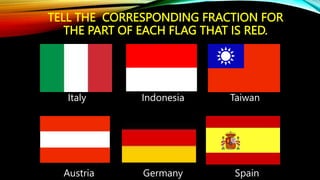
TELL THE CORRESPONDING FRACTION FOR
THE PART OF EACH FLAG THAT IS RED.
Italy Indonesia Taiwan
Austria Germany Spain
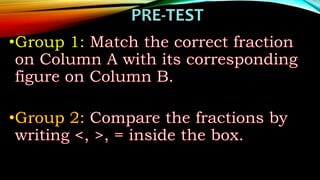
•Group 1:
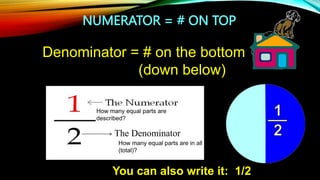
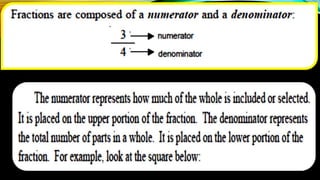
NUMERATOR = # ON TOP
Denominator = # on the bottom
(down below)
The Denominator
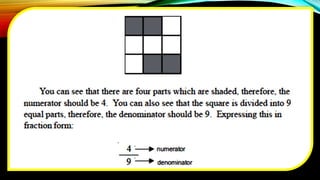
How many equal parts are
described?
How many equal parts are in all
(total)?
You can also write it: 1/2
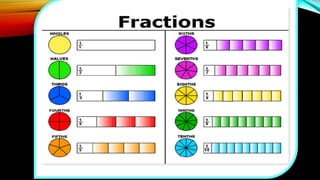
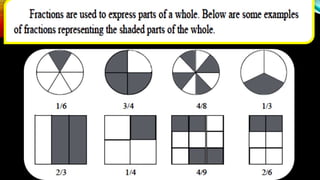
PARTS OF A WHOLE
• Whole = 1 complete
thing
• Different from a hole in
the ground
COMPARING FRACTIONS
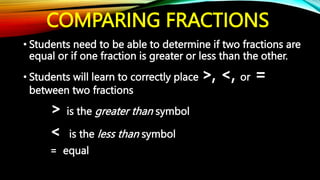
• Students need to be able to determine if two fractions are
equal or if one fraction is greater or less than the other.
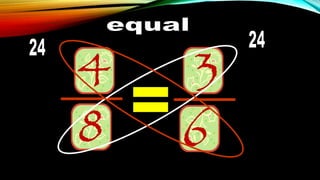
• Students will learn to correctly place >, <, or =
between two fractions
> is the greater than symbol
< is the less than symbol
= equal
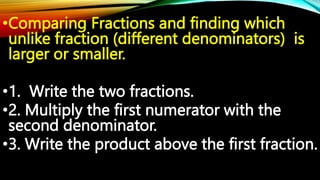
•Comparing Fractions and finding which
unlike fraction (different denominators) is
larger or smaller.
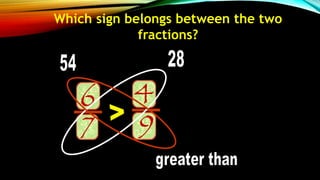
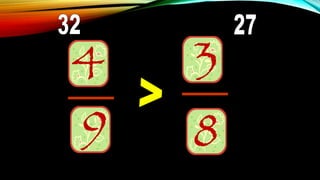
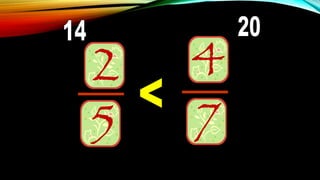
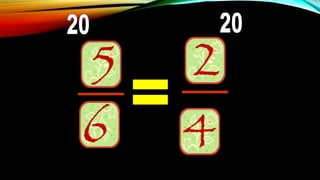
•1. Write the two fractions.
•2. Multiply the first numerator with the
second denominator.
•3. Write the product above the first fraction.
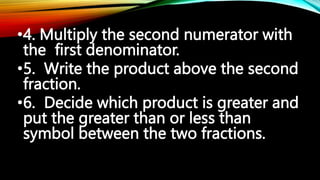
•4. Multiply the second numerator with
the first denominator.
•5. Write the product above the second
fraction.
•6. Decide which product is greater and
put the greater than or less than
symbol between the two fractions.
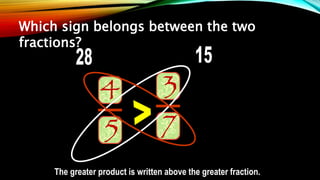
Which sign belongs between the two
fractions?
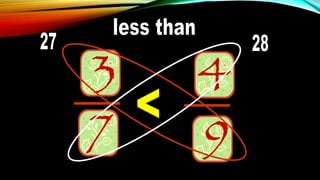
The greater product is written above the greater fraction.
Which sign belongs between the two
fractions?
Comparing Fractions
Ask:
 How important is fraction in our life?
 Why do you think fraction is very useful in market or
buying an item in a department store?
 What do you mean by fractions?
 Who will you use fraction in balancing quality and
affordability when buying and selling products?
Group Work
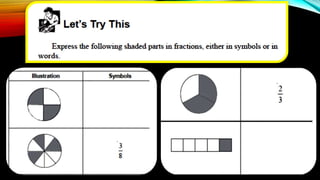
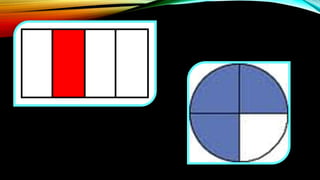
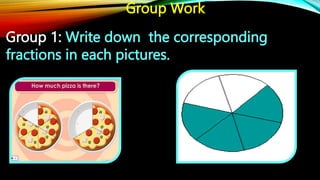
Group 1: Write down the corresponding
fractions in each pictures.
Group Work
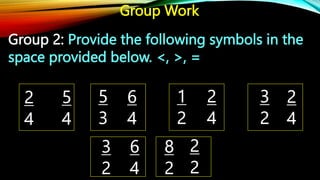
Group 2: Provide the following symbols in the
space provided below. <, >, =
In what way
fractions is very
useful in the
community?
•Learners will answer
the post-test using
the worksheets.
•Simple Investigation:
• Interview people in your family or
community about the importance of
fraction in their daily life.
ALS Learning Strand 3-Learning About Fraction for Advance Elementary .pptx

ALS Learning Strand 3-Learning About Fraction for Advance Elementary .pptx

  • 2.
    TELL THE CORRESPONDINGFRACTION FOR THE PART OF EACH FLAG THAT IS RED. Italy Indonesia Taiwan Austria Germany Spain
  • 3.
  • 4.
    NUMERATOR = #ON TOP Denominator = # on the bottom (down below) The Denominator How many equal parts are described? How many equal parts are in all (total)? You can also write it: 1/2
  • 5.
    PARTS OF AWHOLE • Whole = 1 complete thing • Different from a hole in the ground
  • 26.
    COMPARING FRACTIONS • Studentsneed to be able to determine if two fractions are equal or if one fraction is greater or less than the other. • Students will learn to correctly place >, <, or = between two fractions > is the greater than symbol < is the less than symbol = equal
  • 27.
    •Comparing Fractions andfinding which unlike fraction (different denominators) is larger or smaller. •1. Write the two fractions. •2. Multiply the first numerator with the second denominator. •3. Write the product above the first fraction.
  • 28.
    •4. Multiply thesecond numerator with the first denominator. •5. Write the product above the second fraction. •6. Decide which product is greater and put the greater than or less than symbol between the two fractions.
  • 29.
    Which sign belongsbetween the two fractions? The greater product is written above the greater fraction.
  • 30.
    Which sign belongsbetween the two fractions?
  • 33.
  • 37.
    Ask:  How importantis fraction in our life?  Why do you think fraction is very useful in market or buying an item in a department store?  What do you mean by fractions?  Who will you use fraction in balancing quality and affordability when buying and selling products?
  • 38.
    Group Work Group 1:Write down the corresponding fractions in each pictures.
  • 40.
    Group Work Group 2:Provide the following symbols in the space provided below. <, >, =
  • 41.
    In what way fractionsis very useful in the community?
  • 42.
    •Learners will answer thepost-test using the worksheets.
  • 43.
    •Simple Investigation: • Interviewpeople in your family or community about the importance of fraction in their daily life.