





Date written: between 1602-1603



Date Printed:the script was first printed in
1623 in the First Folio.



Date First Performed: the drama was first
performed between 1602 and 1603.



Total Number of Words: 24,505


Settings: The settings for the drama are in
Rousillon, Paris, Marseilles in France and
Florence, Italy.
Famous Line:
"Our remedies oft in ourselves do lie,
which we ascribe to Heaven.“
 Theme: it is comedy and love.

Characters


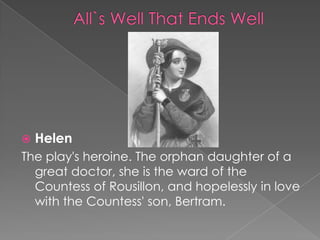
Helen

The play's heroine. The orphan daughter of a
great doctor, she is the ward of the
Countess of Rousillon, and hopelessly in love
with the Countess' son, Bertram.
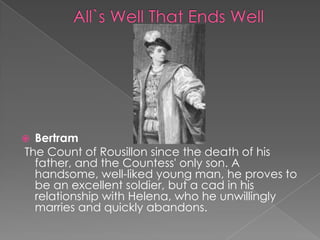
Bertram
The Count of Rousillon since the death of his
father, and the Countess' only son. A
handsome, well-liked young man, he proves to
be an excellent soldier, but a cad in his
relationship with Helena, who he unwillingly
marries and quickly abandons.


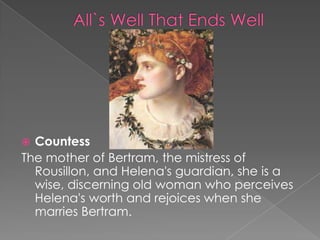
Countess
The mother of Bertram, the mistress of
Rousillon, and Helena's guardian, she is a
wise, discerning old woman who perceives
Helena's worth and rejoices when she
marries Bertram.

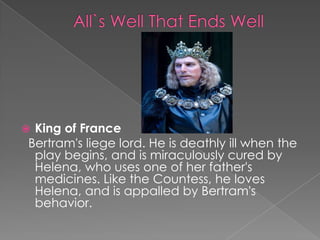
King of France
Bertram's liege lord. He is deathly ill when the
play begins, and is miraculously cured by
Helena, who uses one of her father's
medicines. Like the Countess, he loves
Helena, and is appalled by Bertram's
behavior.


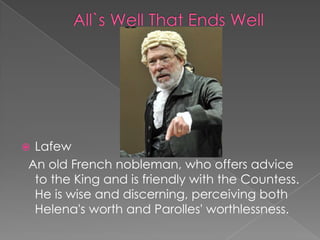
Lafew
An old French nobleman, who offers advice
to the King and is friendly with the Countess.
He is wise and discerning, perceiving both
Helena's worth and Parolles' worthlessness.


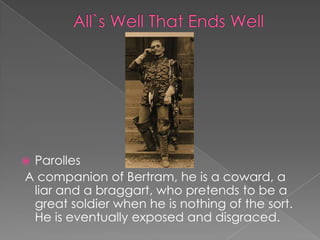
Parolles
A companion of Bertram, he is a coward, a
liar and a braggart, who pretends to be a
great soldier when he is nothing of the sort.
He is eventually exposed and disgraced.


Other characters:
 First Lord A genial French nobleman
named Dumaine, he serves in the
Florentine army and becomes friends
with Bertram.
 Second Lord - The First Lord Dumaine's
brother, similar in character and also a
friend to Bertram.
 Diana - A young virgin in Florence, who
Bertram attempts to seduce. She assists
Helena in tricking him into sleeping with
his lawful wife.
Widow - Diana's mother.
 Mariana - A woman of Florence.
 Duke of Florence - The ruler of Florence,
many French lords (including Bertram,
Parolles, and Dumaine) volunteer to fight
for him.
 Clown - An old servant of the Countess,
who serves as a messenger and enjoys
coarse, sexual humor.
 Steward - Another servant of the
Countess.





Bertram, the son of a widowed countess sets off from
Roussilon with his friend, Parolles, and the Lord Lafeu, to the
French court. He is the ward of the French king. He is unaware
that Helena, orphan daughter of the countess’ physician,
raised in the household of the countess, is in love with him.
The countess gives her permission to try and cure the king’s
illness. No-one has been able to cure him but Helena
succeeds and, as a reward, the king invites her to choose a
husband from among his wards. She chooses Bertram.
Bertram’s ambitions for a wife go beyond her, however, and
although he marries her on the king’s orders, he runs away
with Parolles to fight in the wars in Italy.He writes a letter
to Helena, telling her that he will not recognise the marriage
until she can demonstrate that she is wearing his heirloom ring
and carrying his child.
Helena goes home and prepares to seek Bertram out. She
disguises herself as a pilgrim and goes to Florence where she
is befriended by a widow and her daughter, Diana. In the
meantime Bertram has fallen in love with Diana.
Helena fakes her death and Bertram returns to the
French court. His mother and Lafeu, also believing
Helena to be dead, arrange for Bertram to marry
Lafeu’s daughter. Bertram gives Lafeu a ring that
Helena, as Diana, had given him at the late night
meeting in Florence and it becomes apparent that it
is the ring that the king had given Helena on her
marriage to Bertram.
 In the midst of the confusion Diana arrives with
Bertram’s ring and accuses him of seducing and
abandoning her. Bertram denies it but Lafeu withdraws
his daughter from the marriage. The king orders that
Diana be taken to prison but then Helena appears as a
witness to the truth of Diana’s story. She is pregnant and
her story soon comes out. Bertram accepts her as his
wife. The king offers Diana a choice of husbands from
among his courtiers, with a rich dowry. The play ends
with everyone being more or less satisfied.


All`s well that ends well

  • 2.
     Date written: between1602-1603  Date Printed:the script was first printed in 1623 in the First Folio.  Date First Performed: the drama was first performed between 1602 and 1603.  Total Number of Words: 24,505
  • 3.
     Settings: The settingsfor the drama are in Rousillon, Paris, Marseilles in France and Florence, Italy.
  • 4.
    Famous Line: "Our remediesoft in ourselves do lie, which we ascribe to Heaven.“  Theme: it is comedy and love. 
  • 5.
  • 6.
     Helen The play's heroine.The orphan daughter of a great doctor, she is the ward of the Countess of Rousillon, and hopelessly in love with the Countess' son, Bertram.
  • 7.
    Bertram The Count ofRousillon since the death of his father, and the Countess' only son. A handsome, well-liked young man, he proves to be an excellent soldier, but a cad in his relationship with Helena, who he unwillingly marries and quickly abandons. 
  • 8.
    Countess The mother ofBertram, the mistress of Rousillon, and Helena's guardian, she is a wise, discerning old woman who perceives Helena's worth and rejoices when she marries Bertram. 
  • 9.
    King of France Bertram'sliege lord. He is deathly ill when the play begins, and is miraculously cured by Helena, who uses one of her father's medicines. Like the Countess, he loves Helena, and is appalled by Bertram's behavior. 
  • 10.
    Lafew An old Frenchnobleman, who offers advice to the King and is friendly with the Countess. He is wise and discerning, perceiving both Helena's worth and Parolles' worthlessness. 
  • 11.
    Parolles A companion ofBertram, he is a coward, a liar and a braggart, who pretends to be a great soldier when he is nothing of the sort. He is eventually exposed and disgraced. 
  • 12.
    Other characters:  FirstLord A genial French nobleman named Dumaine, he serves in the Florentine army and becomes friends with Bertram.  Second Lord - The First Lord Dumaine's brother, similar in character and also a friend to Bertram.  Diana - A young virgin in Florence, who Bertram attempts to seduce. She assists Helena in tricking him into sleeping with his lawful wife.
  • 13.
    Widow - Diana'smother.  Mariana - A woman of Florence.  Duke of Florence - The ruler of Florence, many French lords (including Bertram, Parolles, and Dumaine) volunteer to fight for him.  Clown - An old servant of the Countess, who serves as a messenger and enjoys coarse, sexual humor.  Steward - Another servant of the Countess. 
  • 14.
      Bertram, the sonof a widowed countess sets off from Roussilon with his friend, Parolles, and the Lord Lafeu, to the French court. He is the ward of the French king. He is unaware that Helena, orphan daughter of the countess’ physician, raised in the household of the countess, is in love with him. The countess gives her permission to try and cure the king’s illness. No-one has been able to cure him but Helena succeeds and, as a reward, the king invites her to choose a husband from among his wards. She chooses Bertram. Bertram’s ambitions for a wife go beyond her, however, and although he marries her on the king’s orders, he runs away with Parolles to fight in the wars in Italy.He writes a letter to Helena, telling her that he will not recognise the marriage until she can demonstrate that she is wearing his heirloom ring and carrying his child. Helena goes home and prepares to seek Bertram out. She disguises herself as a pilgrim and goes to Florence where she is befriended by a widow and her daughter, Diana. In the meantime Bertram has fallen in love with Diana.
  • 15.
    Helena fakes herdeath and Bertram returns to the French court. His mother and Lafeu, also believing Helena to be dead, arrange for Bertram to marry Lafeu’s daughter. Bertram gives Lafeu a ring that Helena, as Diana, had given him at the late night meeting in Florence and it becomes apparent that it is the ring that the king had given Helena on her marriage to Bertram.  In the midst of the confusion Diana arrives with Bertram’s ring and accuses him of seducing and abandoning her. Bertram denies it but Lafeu withdraws his daughter from the marriage. The king orders that Diana be taken to prison but then Helena appears as a witness to the truth of Diana’s story. She is pregnant and her story soon comes out. Bertram accepts her as his wife. The king offers Diana a choice of husbands from among his courtiers, with a rich dowry. The play ends with everyone being more or less satisfied. 