Dr. Blaine Robin MSc, PhD
[ Occupational Therapist & Sociologist ]
Undergraduate seminar
All Saints University, Roseau, Dominica
11th
June 2015
“ The importance for Medical Professionals in
appreciating the cultural background of
patients (including race and ethnicity) when
assessing the needs of patients ”.
Why is this important to medical
professionals?
- Reduce prejudicial and stereo typical ideas and therefore
build a better form of mutual respect between people.
- Build a better understanding of cultural values of a
particular group of people (e.g. Lupus Sufferers; HIV Aids
sufferers; E Bola sufferers).
- Move towards a new professional paradigm of doctor to
patient interactions
Professor Paul Farmer
Dr. Paul Farmer, physician and anthropologist, is chief strategist and
co-founder of Partners In Health, Kolokotrones University Professor
and chair of the Department of Global Health and Social Medicine
at Harvard Medical School, and chief of the Division of Global
Health Equity at Brigham and Women’s Hospital in Boston. He also
serves as U.N. Special Adviser to the Secretary-General on
community-based medicine and lessons from Haiti. Farmer has
written extensively on health, human rights, and the consequences
of social inequality. His most recent books are In the Company of
the Poor: Conversations with Dr. Paul Farmer and Fr. Gustavo
Gutiérrez, Reimagining Global Health: An Introduction, and To
Repair the World: Paul Farmer Speaks to the Next Generation.
Professor Arthur Kleinman
Medical anthropology, social suffering, mental health, stigma,
subjectivity, moral experience, and caregiving, Reimagining Global
Health, a book on subjectivity in China with his former students
(Deep China. 2012, UC Press), and a book on moral life in China
(Governance of Life in Chinese Moral Experience. 2011,
Routledge),What Really Matters: Living a Moral Life Amidst
Uncertainty and Danger (OUP, 2006), Writing at the Margin:
Discourse between Anthropology and Medicine (UC Press, 1995),
and The Illness Narratives: Suffering and on culture, bereavement
and psychiatry. He has co-authored articles on stigma and mental
illness; on the appropriate uses of culture in clinical practice; and on
medical anthropology.
Aims of the presentation
1. To take today’s audience through the journey I
made as a researcher to understand the lives of
people with a common medical diagnosis.
2. To go through an abridged version of chapter 4:
Research Methods from my publication – The
Politics of Lupus.
3. To describe some of the challenges I experienced
– both subtle and demanding – and how I
overcame this.
4. To summarise the issues
Commence Presentation
Defining Ethnography
Ethnography: scientific description of the culture of a society by
someone who has lived in it, or a book containing this: One of the aims
of ethnography is to contribute to an understanding of the human
race. Malinowski wrote several ethnographies of the Trobriand
Islands.
(http://dictionary.cambridge.org/dictionary/british/ethnography?
q=Ethnography. Date accessed: September 2014).
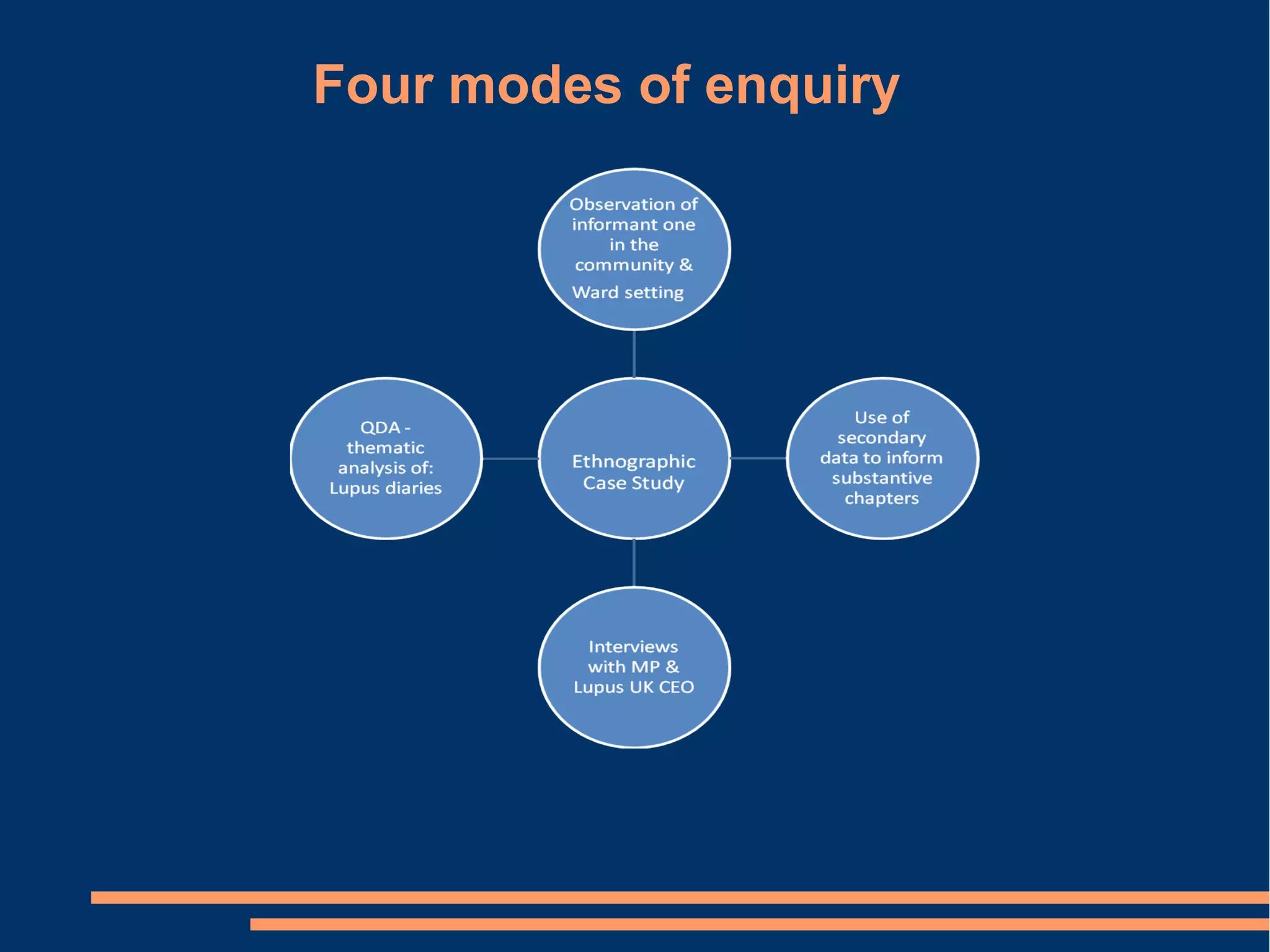
Four modes of enquiry
Qualitative Data Analysis techniques used?
QDA techniques included:
• Line - by - line coding
• Thematic analysis
• Constant comparison and
• Framework tables
(cf. Miles and Huberman 1994, Braun and Clarke 2006, Glaser 1978).
The author as ethnographer
As an ethnographer I became the instrument of data collection.
‘[T]he self must not only be offered, it must be accepted’ (Goffman
1979 p 41).
[Implications: Practical examples – professionals that use
immersion/infiltration; the need for reflection, debriefing &
supervision]
Uncovering the issues
Line by Line coding
Framework Tables
Thematic Analysis
What is going on in their lives?
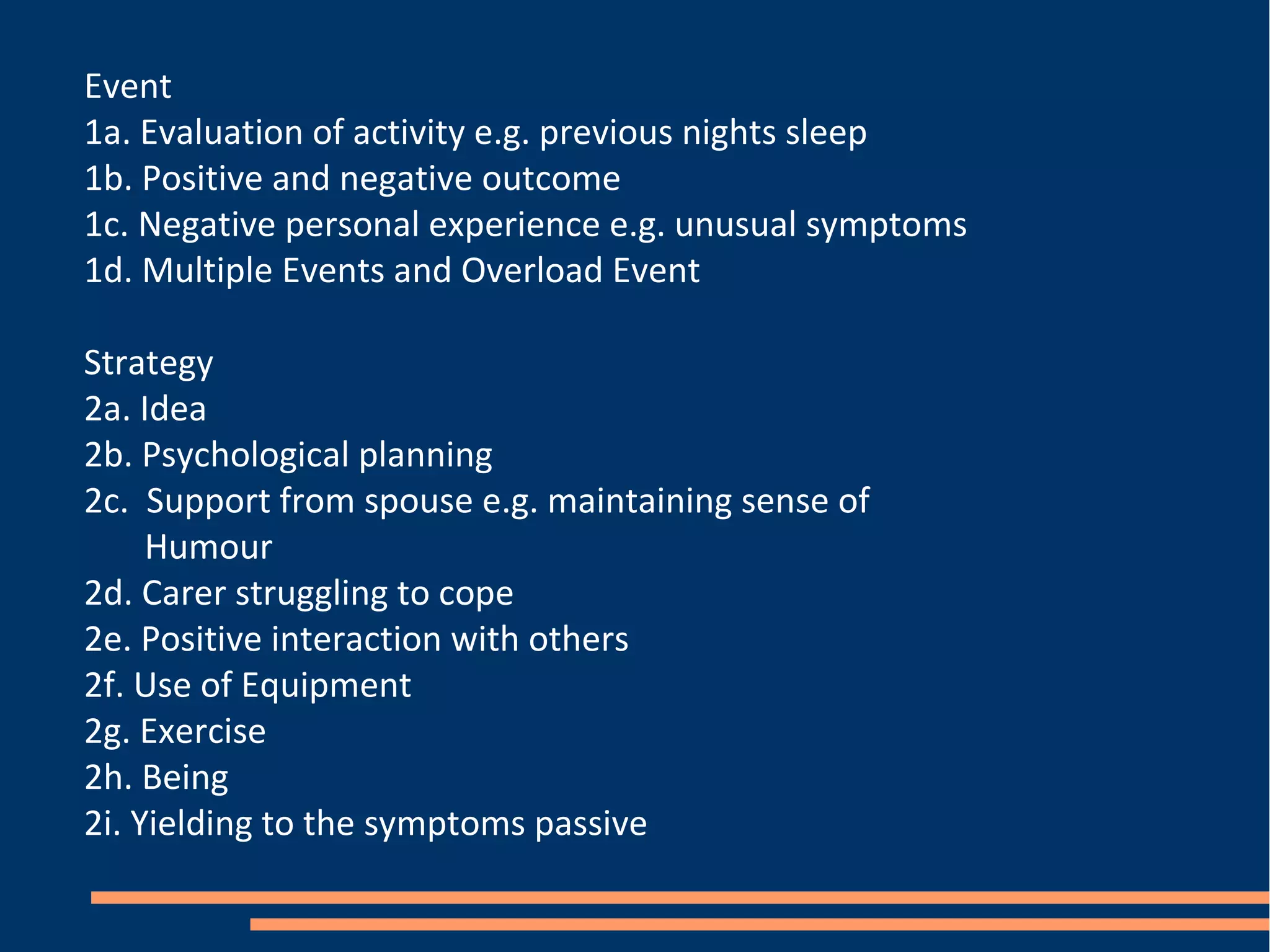
Event
1a. Evaluation of activity e.g. previous nights sleep
1b. Positive and negative outcome
1c. Negative personal experience e.g. unusual symptoms
1d. Multiple Events and Overload Event
Strategy
2a. Idea
2b. Psychological planning
2c. Support from spouse e.g. maintaining sense of
Humour
2d. Carer struggling to cope
2e. Positive interaction with others
2f. Use of Equipment
2g. Exercise
2h. Being
2i. Yielding to the symptoms passive
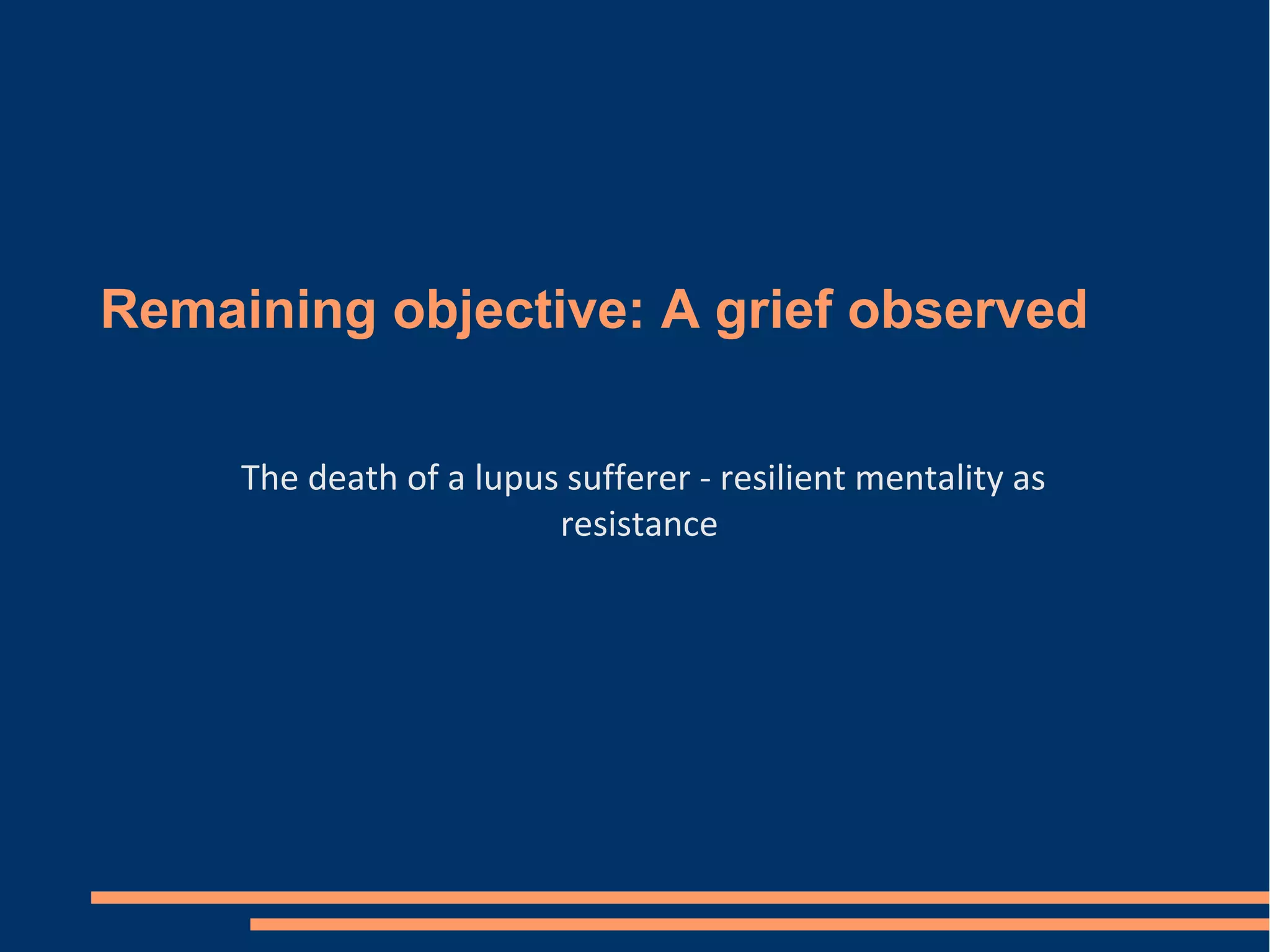
Remaining objective: A grief observed
The death of a lupus sufferer - resilient mentality as
resistance
Mixed narratives
Death and dying
What can we learn from bad practice and how
can we go forward?
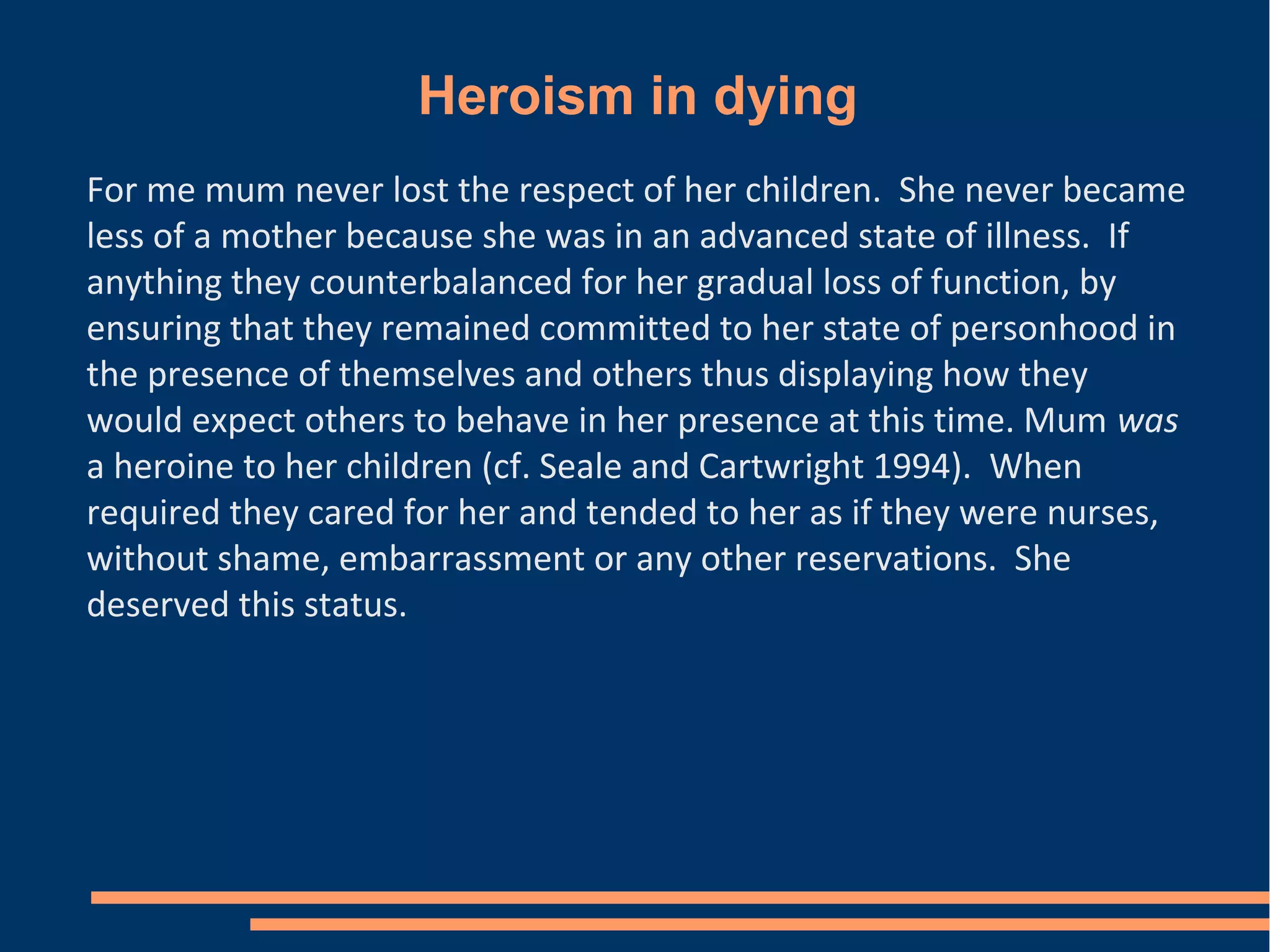
Social context of dying
On reflection the process of dying had commenced weeks before the my
mother finally died. For me it comprised increasing moments of
dependency on other people to perform routine dignity tasks of feeding,
washing and toileting. She was unable to self-toilet to pass faeces or
urine. She lay on her back with large pressure sores on her buttock, which
often came into contact with urine and faeces.
She relied on a “male” catheter to pass her urine and her body had to be
turned in order for her pads to be removed and changed without
damaging the injured skin surrounding the site of the pressure sores. In
addition she became unable to press the call alarm for help and assistance.
The encroaching social death in mum’s situation was a precursor to actual
physical/biological death (cf. Mulkay 1993). This process of social death
began to appear to me as a series of power plays between others and
mum. This began as others began to take control of mum’s body.
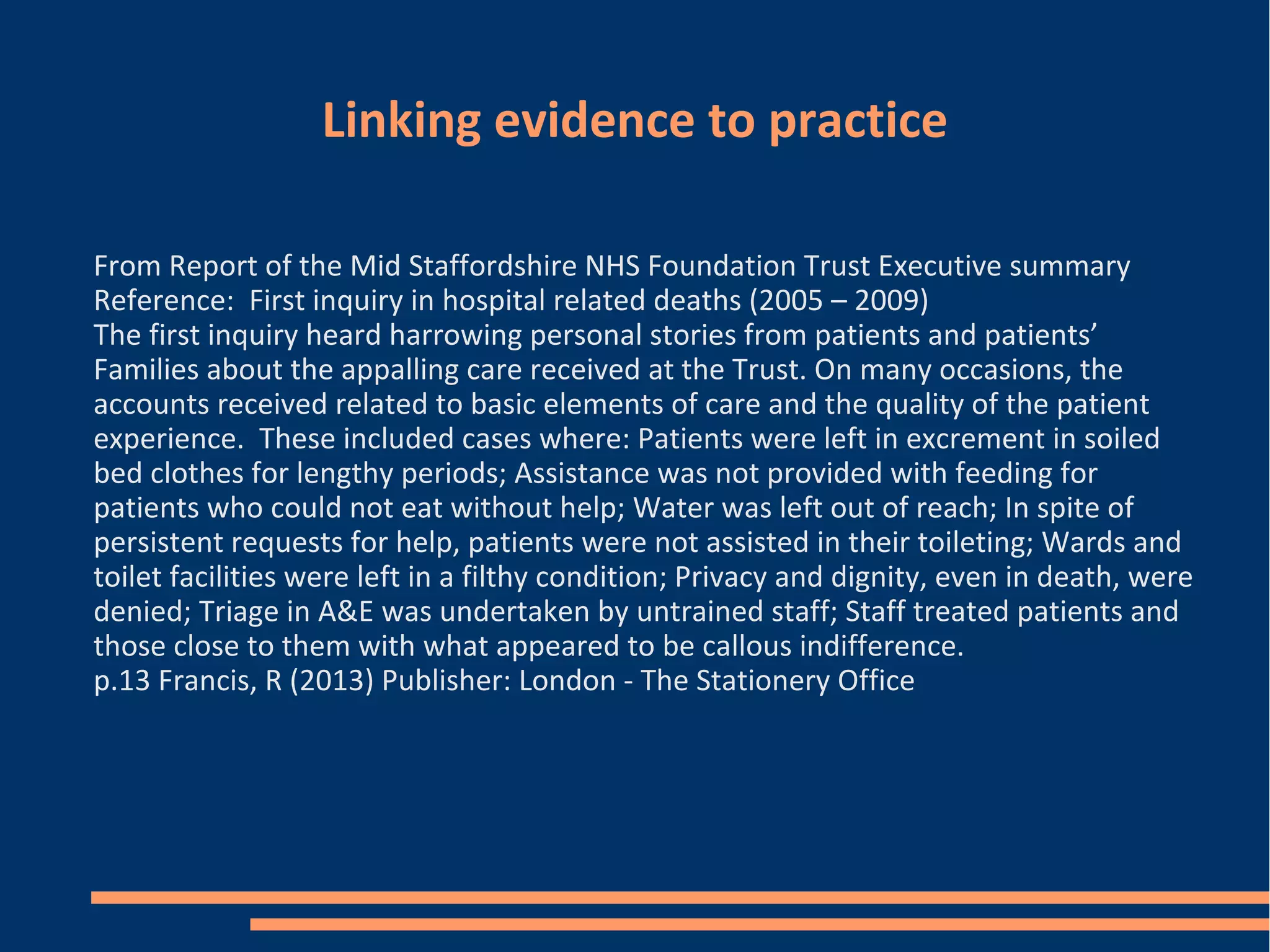
Heroism in dying
For me mum never lost the respect of her children. She never became
less of a mother because she was in an advanced state of illness. If
anything they counterbalanced for her gradual loss of function, by
ensuring that they remained committed to her state of personhood in
the presence of themselves and others thus displaying how they
would expect others to behave in her presence at this time. Mum was
a heroine to her children (cf. Seale and Cartwright 1994). When
required they cared for her and tended to her as if they were nurses,
without shame, embarrassment or any other reservations. She
deserved this status.
Linking evidence to practice
From Report of the Mid Staffordshire NHS Foundation Trust Executive summary
Reference: First inquiry in hospital related deaths (2005 – 2009)
The first inquiry heard harrowing personal stories from patients and patients’
Families about the appalling care received at the Trust. On many occasions, the
accounts received related to basic elements of care and the quality of the patient
experience. These included cases where: Patients were left in excrement in soiled
bed clothes for lengthy periods; Assistance was not provided with feeding for
patients who could not eat without help; Water was left out of reach; In spite of
persistent requests for help, patients were not assisted in their toileting; Wards and
toilet facilities were left in a filthy condition; Privacy and dignity, even in death, were
denied; Triage in A&E was undertaken by untrained staff; Staff treated patients and
those close to them with what appeared to be callous indifference.
p.13 Francis, R (2013) Publisher: London - The Stationery Office
Thank you
Bibliography
Anderson, J.M. (1991) Immigrant women speak of chronic illness: the social construction of the devalued self. Journal of
Advanced Nursing. Vol. 16 p710 – 717.
Anderson, J.M., Dyck, I. and Lynam, J. (1997) Health care professionals and women speaking: constraints in everyday life
and management of chronic illness. Health Vol. 1, p57 – 80.
Atkinson, Paul., Delamont, Sara., Coffey, Amanda., Lofland, John.,& Loftland, Lyn.H. (eds.) 2001. Handbook of
Ethnography.California: Sage.
Braun, A, and Clarke, V. (2006) Using thematic analysis in psychology. Qualitative Research in Psychology. Vol. 3. P77 –
101.
Chriss, J. (2002) ‘Gouldner’s tragic vision’. Sociological Quaterly. Vol. 43. P81-96.
Davies, C, Finlay, L. and Bullman, A. (eds). (2000) Changing Practice in Health and Social Care. London. Open University
Press & Sage.
Denzin, N. (1992) Symbolic interactionism and cultural studies: the politics of interpretation. Oxford: Blackwell.
Elias, N. (1985) The Loneliness of Dying. Oxford. Basil Blackwell.
Ellis, C. and Bochner, A. (2002) Ethnographically Speaking. New York. Altamira
Goffman, E. (1979) Stigma. Notes on the management of spoiled identity. London. Penguin.
Glaser, B. G. (1978) Theoretical Sensitivity: Advances in the methodology of grounded theory. New York. Sociology Press.
Good, B.J. (1994) Medicine, rationality and experience. An anthropological perspective. London. Cambridge University
Press.
Gomm, R., Hammersley, M. and Foster, P. (2008) Case Study Method. London. Sage.
Gouldner, A. (1970) The coming crisis of western sociology. New York. Avon.
Hertz, R. (eds). (1997) Reflexivity and Voice. London. Sage.
Holland, R. (1999) ‘Reflexivity’. Human Relations.Vol.52. p 463 – 484.
Miklaucich, M. (1998) Limitations on life: Women’s lived experiences of angina. Journal of Advanced Nursing Research
Vol. 15. P478 -486.
Miles, B. M., and Huberman, A.M. (1994) Qualitative Data Analysis. London. Sage.
Mulkay, M. (1993) Social Death in Britain, in D. Clark (eds). The Sociology of Death.
Oxford: Blackwell/Sociological Review.
Potter, J and Wetherell, M. (1987) Discourse and Social Psychology: Beyond Attitudes and Behaviour. London. Sage.
Reeves, G.E.M. (2004) ‘Updates on immunology, diagnosis and management of systemic lupus erythematosus’. Internal
Medicine Journal. Vol. 34. P 338 – 347.
Sandywell, B. (1996) The beginnings of European theorizing: reflexivity in the archaic age. London. Sage.
Scarry, E. (1985) The Body in Pain. London. Oxford University Press.
Seale, C. (2007) The Quality of Qualitative Research. London. Sage.
Seale, C and Cartwright, A. (1994) The year before death. Aldershot.

All Saints University -

  • 1.
    Dr. Blaine RobinMSc, PhD [ Occupational Therapist & Sociologist ] Undergraduate seminar All Saints University, Roseau, Dominica 11th June 2015
  • 2.
    “ The importancefor Medical Professionals in appreciating the cultural background of patients (including race and ethnicity) when assessing the needs of patients ”.
  • 3.
    Why is thisimportant to medical professionals? - Reduce prejudicial and stereo typical ideas and therefore build a better form of mutual respect between people. - Build a better understanding of cultural values of a particular group of people (e.g. Lupus Sufferers; HIV Aids sufferers; E Bola sufferers). - Move towards a new professional paradigm of doctor to patient interactions
  • 4.
    Professor Paul Farmer Dr.Paul Farmer, physician and anthropologist, is chief strategist and co-founder of Partners In Health, Kolokotrones University Professor and chair of the Department of Global Health and Social Medicine at Harvard Medical School, and chief of the Division of Global Health Equity at Brigham and Women’s Hospital in Boston. He also serves as U.N. Special Adviser to the Secretary-General on community-based medicine and lessons from Haiti. Farmer has written extensively on health, human rights, and the consequences of social inequality. His most recent books are In the Company of the Poor: Conversations with Dr. Paul Farmer and Fr. Gustavo Gutiérrez, Reimagining Global Health: An Introduction, and To Repair the World: Paul Farmer Speaks to the Next Generation.
  • 5.
    Professor Arthur Kleinman Medicalanthropology, social suffering, mental health, stigma, subjectivity, moral experience, and caregiving, Reimagining Global Health, a book on subjectivity in China with his former students (Deep China. 2012, UC Press), and a book on moral life in China (Governance of Life in Chinese Moral Experience. 2011, Routledge),What Really Matters: Living a Moral Life Amidst Uncertainty and Danger (OUP, 2006), Writing at the Margin: Discourse between Anthropology and Medicine (UC Press, 1995), and The Illness Narratives: Suffering and on culture, bereavement and psychiatry. He has co-authored articles on stigma and mental illness; on the appropriate uses of culture in clinical practice; and on medical anthropology.
  • 6.
    Aims of thepresentation 1. To take today’s audience through the journey I made as a researcher to understand the lives of people with a common medical diagnosis. 2. To go through an abridged version of chapter 4: Research Methods from my publication – The Politics of Lupus. 3. To describe some of the challenges I experienced – both subtle and demanding – and how I overcame this. 4. To summarise the issues
  • 7.
  • 8.
    Defining Ethnography Ethnography: scientificdescription of the culture of a society by someone who has lived in it, or a book containing this: One of the aims of ethnography is to contribute to an understanding of the human race. Malinowski wrote several ethnographies of the Trobriand Islands. (http://dictionary.cambridge.org/dictionary/british/ethnography? q=Ethnography. Date accessed: September 2014).
  • 9.
  • 10.
    Qualitative Data Analysistechniques used? QDA techniques included: • Line - by - line coding • Thematic analysis • Constant comparison and • Framework tables (cf. Miles and Huberman 1994, Braun and Clarke 2006, Glaser 1978).
  • 11.
    The author asethnographer As an ethnographer I became the instrument of data collection. ‘[T]he self must not only be offered, it must be accepted’ (Goffman 1979 p 41). [Implications: Practical examples – professionals that use immersion/infiltration; the need for reflection, debriefing & supervision]
  • 12.
  • 13.
  • 15.
  • 17.
  • 18.
    What is goingon in their lives?
  • 19.
    Event 1a. Evaluation ofactivity e.g. previous nights sleep 1b. Positive and negative outcome 1c. Negative personal experience e.g. unusual symptoms 1d. Multiple Events and Overload Event Strategy 2a. Idea 2b. Psychological planning 2c. Support from spouse e.g. maintaining sense of Humour 2d. Carer struggling to cope 2e. Positive interaction with others 2f. Use of Equipment 2g. Exercise 2h. Being 2i. Yielding to the symptoms passive
  • 20.
    Remaining objective: Agrief observed The death of a lupus sufferer - resilient mentality as resistance
  • 21.
  • 22.
  • 23.
    What can welearn from bad practice and how can we go forward?
  • 24.
    Social context ofdying On reflection the process of dying had commenced weeks before the my mother finally died. For me it comprised increasing moments of dependency on other people to perform routine dignity tasks of feeding, washing and toileting. She was unable to self-toilet to pass faeces or urine. She lay on her back with large pressure sores on her buttock, which often came into contact with urine and faeces. She relied on a “male” catheter to pass her urine and her body had to be turned in order for her pads to be removed and changed without damaging the injured skin surrounding the site of the pressure sores. In addition she became unable to press the call alarm for help and assistance. The encroaching social death in mum’s situation was a precursor to actual physical/biological death (cf. Mulkay 1993). This process of social death began to appear to me as a series of power plays between others and mum. This began as others began to take control of mum’s body.
  • 25.
    Heroism in dying Forme mum never lost the respect of her children. She never became less of a mother because she was in an advanced state of illness. If anything they counterbalanced for her gradual loss of function, by ensuring that they remained committed to her state of personhood in the presence of themselves and others thus displaying how they would expect others to behave in her presence at this time. Mum was a heroine to her children (cf. Seale and Cartwright 1994). When required they cared for her and tended to her as if they were nurses, without shame, embarrassment or any other reservations. She deserved this status.
  • 26.
    Linking evidence topractice From Report of the Mid Staffordshire NHS Foundation Trust Executive summary Reference: First inquiry in hospital related deaths (2005 – 2009) The first inquiry heard harrowing personal stories from patients and patients’ Families about the appalling care received at the Trust. On many occasions, the accounts received related to basic elements of care and the quality of the patient experience. These included cases where: Patients were left in excrement in soiled bed clothes for lengthy periods; Assistance was not provided with feeding for patients who could not eat without help; Water was left out of reach; In spite of persistent requests for help, patients were not assisted in their toileting; Wards and toilet facilities were left in a filthy condition; Privacy and dignity, even in death, were denied; Triage in A&E was undertaken by untrained staff; Staff treated patients and those close to them with what appeared to be callous indifference. p.13 Francis, R (2013) Publisher: London - The Stationery Office
  • 27.
  • 28.
    Bibliography Anderson, J.M. (1991)Immigrant women speak of chronic illness: the social construction of the devalued self. Journal of Advanced Nursing. Vol. 16 p710 – 717. Anderson, J.M., Dyck, I. and Lynam, J. (1997) Health care professionals and women speaking: constraints in everyday life and management of chronic illness. Health Vol. 1, p57 – 80. Atkinson, Paul., Delamont, Sara., Coffey, Amanda., Lofland, John.,& Loftland, Lyn.H. (eds.) 2001. Handbook of Ethnography.California: Sage. Braun, A, and Clarke, V. (2006) Using thematic analysis in psychology. Qualitative Research in Psychology. Vol. 3. P77 – 101. Chriss, J. (2002) ‘Gouldner’s tragic vision’. Sociological Quaterly. Vol. 43. P81-96. Davies, C, Finlay, L. and Bullman, A. (eds). (2000) Changing Practice in Health and Social Care. London. Open University Press & Sage. Denzin, N. (1992) Symbolic interactionism and cultural studies: the politics of interpretation. Oxford: Blackwell. Elias, N. (1985) The Loneliness of Dying. Oxford. Basil Blackwell. Ellis, C. and Bochner, A. (2002) Ethnographically Speaking. New York. Altamira Goffman, E. (1979) Stigma. Notes on the management of spoiled identity. London. Penguin. Glaser, B. G. (1978) Theoretical Sensitivity: Advances in the methodology of grounded theory. New York. Sociology Press. Good, B.J. (1994) Medicine, rationality and experience. An anthropological perspective. London. Cambridge University Press. Gomm, R., Hammersley, M. and Foster, P. (2008) Case Study Method. London. Sage.
  • 29.
    Gouldner, A. (1970)The coming crisis of western sociology. New York. Avon. Hertz, R. (eds). (1997) Reflexivity and Voice. London. Sage. Holland, R. (1999) ‘Reflexivity’. Human Relations.Vol.52. p 463 – 484. Miklaucich, M. (1998) Limitations on life: Women’s lived experiences of angina. Journal of Advanced Nursing Research Vol. 15. P478 -486. Miles, B. M., and Huberman, A.M. (1994) Qualitative Data Analysis. London. Sage. Mulkay, M. (1993) Social Death in Britain, in D. Clark (eds). The Sociology of Death. Oxford: Blackwell/Sociological Review. Potter, J and Wetherell, M. (1987) Discourse and Social Psychology: Beyond Attitudes and Behaviour. London. Sage. Reeves, G.E.M. (2004) ‘Updates on immunology, diagnosis and management of systemic lupus erythematosus’. Internal Medicine Journal. Vol. 34. P 338 – 347. Sandywell, B. (1996) The beginnings of European theorizing: reflexivity in the archaic age. London. Sage. Scarry, E. (1985) The Body in Pain. London. Oxford University Press. Seale, C. (2007) The Quality of Qualitative Research. London. Sage. Seale, C and Cartwright, A. (1994) The year before death. Aldershot.