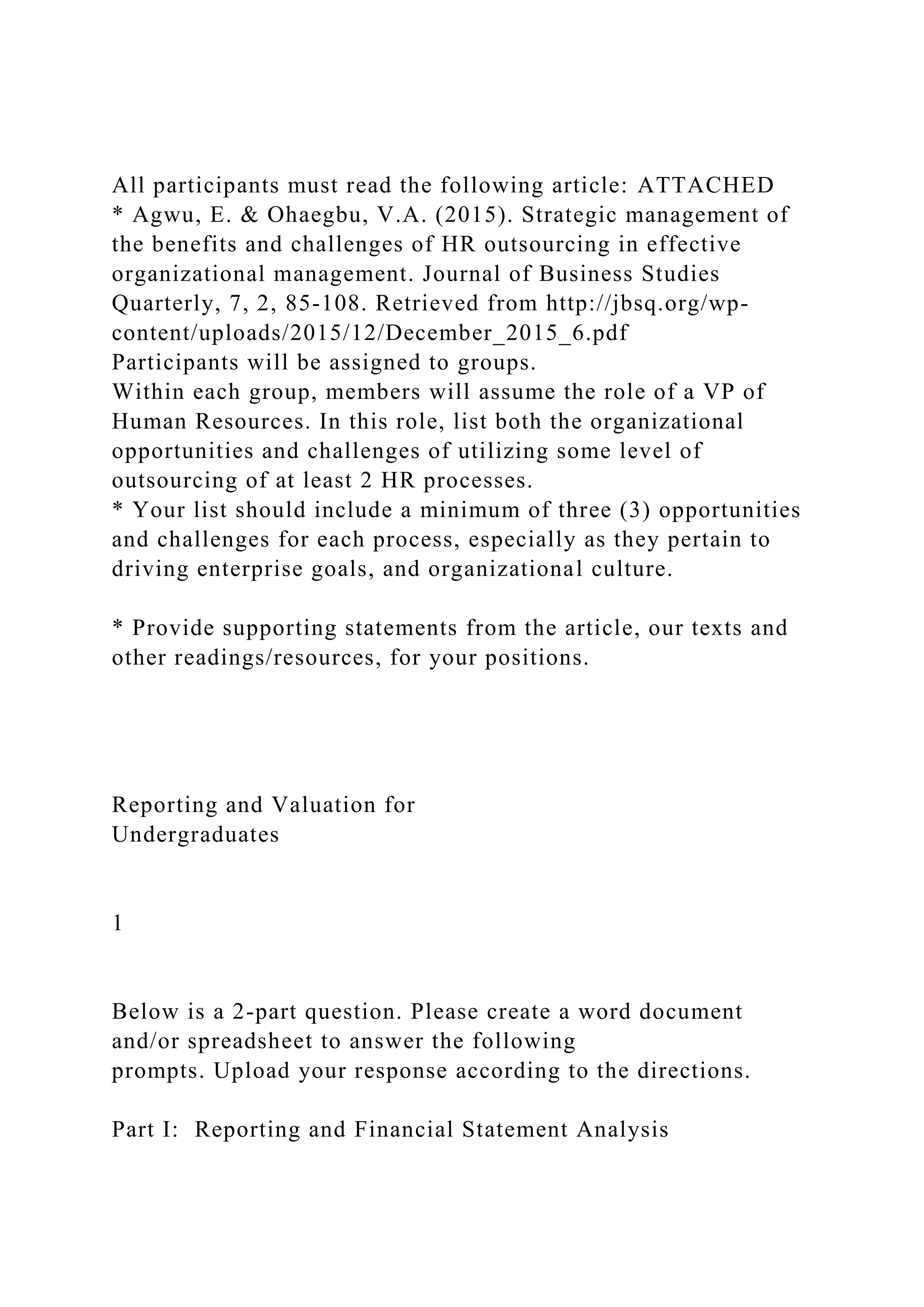
All participants must read the following article: ATTACHED
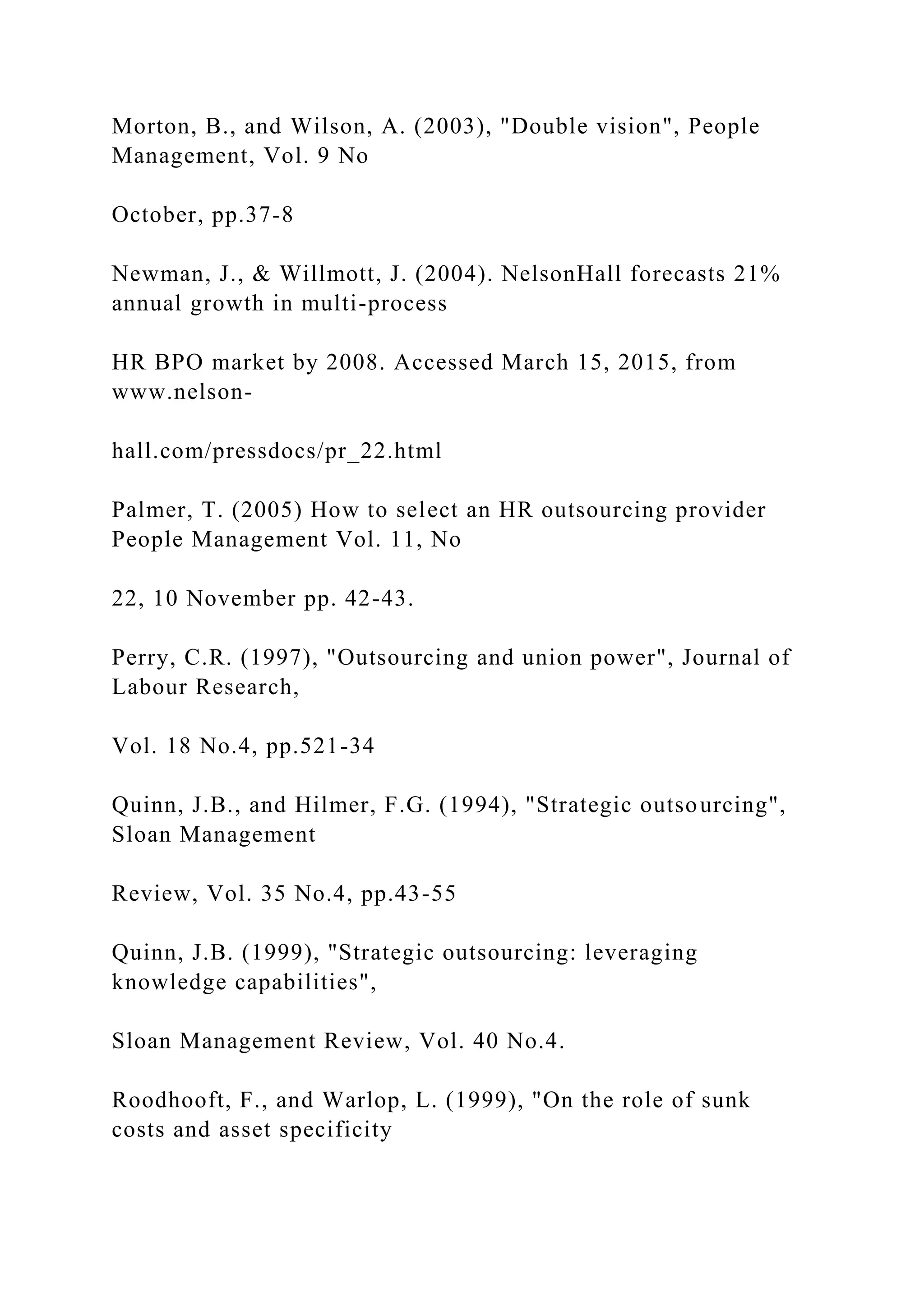
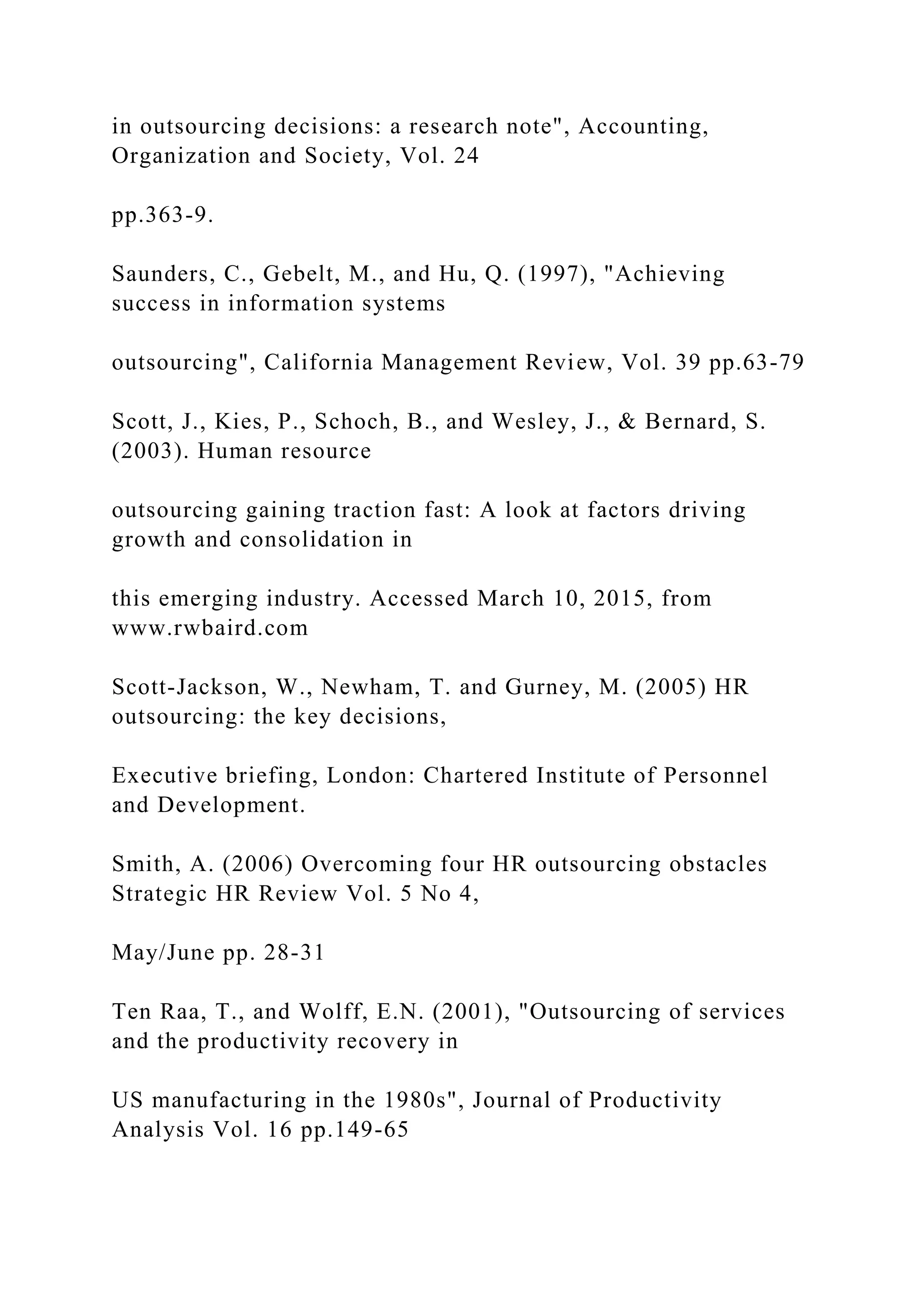
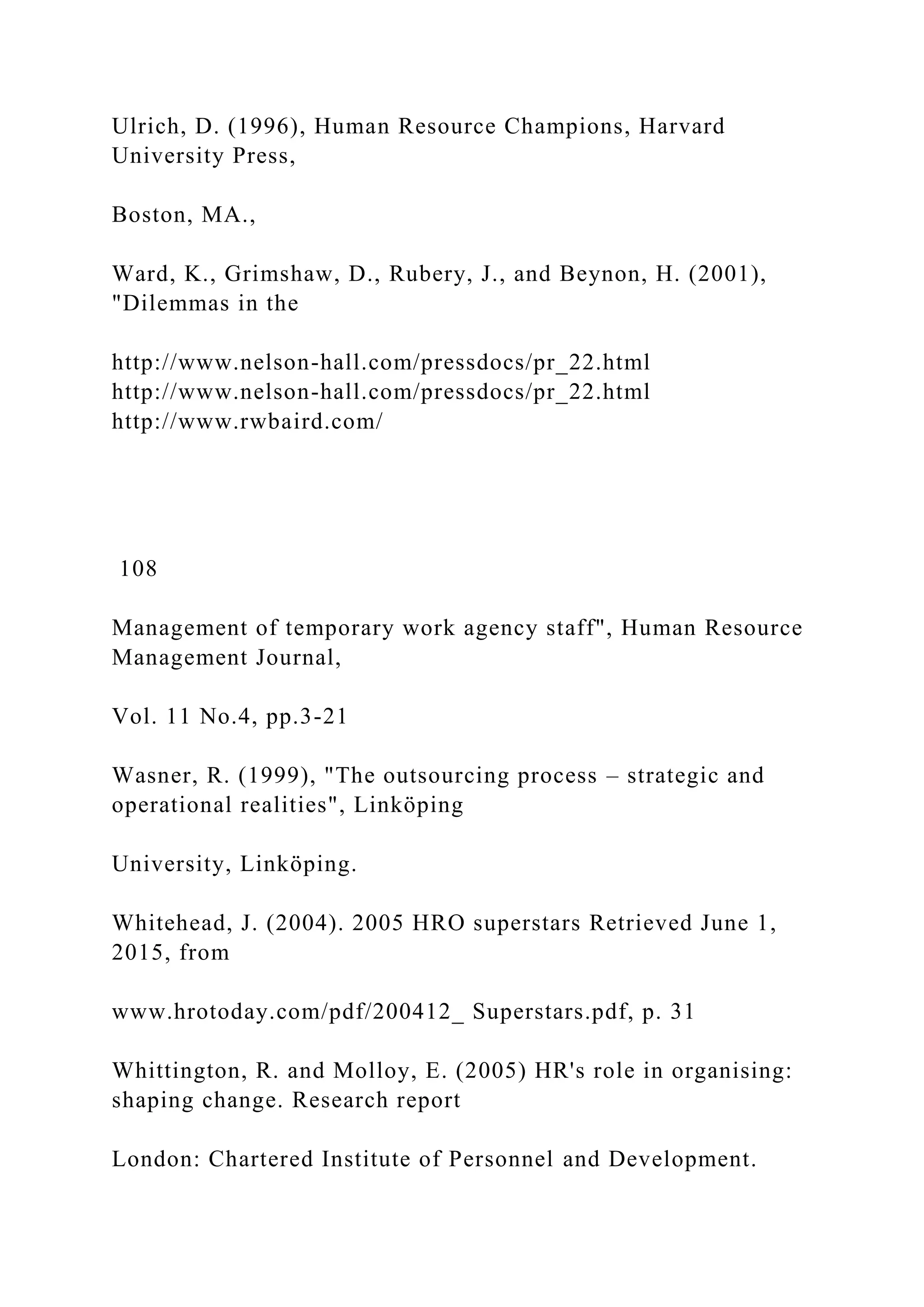
* Agwu, E. & Ohaegbu, V.A. (2015). Strategic management of
the benefits and challenges of HR outsourcing in effective
organizational management. Journal of Business Studies
Quarterly, 7, 2, 85-108. Retrieved from http://jbsq.org/wp-
content/uploads/2015/12/December_2015_6.pdf
Participants will be assigned to groups.
Within each group, members will assume the role of a VP of
Human Resources. In this role, list both the organizational
opportunities and challenges of utilizing some level of
outsourcing of at least 2 HR processes.
* Your list should include a minimum of three (3) opportunities
and challenges for each process, especially as they pertain to
driving enterprise goals, and organizational culture.
* Provide supporting statements from the article, our texts and
other readings/resources, for your positions.
Reporting and Valuation for
Undergraduates
1
Below is a 2-part question. Please create a word document
and/or spreadsheet to answer the following
prompts. Upload your response according to the directions.
Part I: Reporting and Financial Statement Analysis
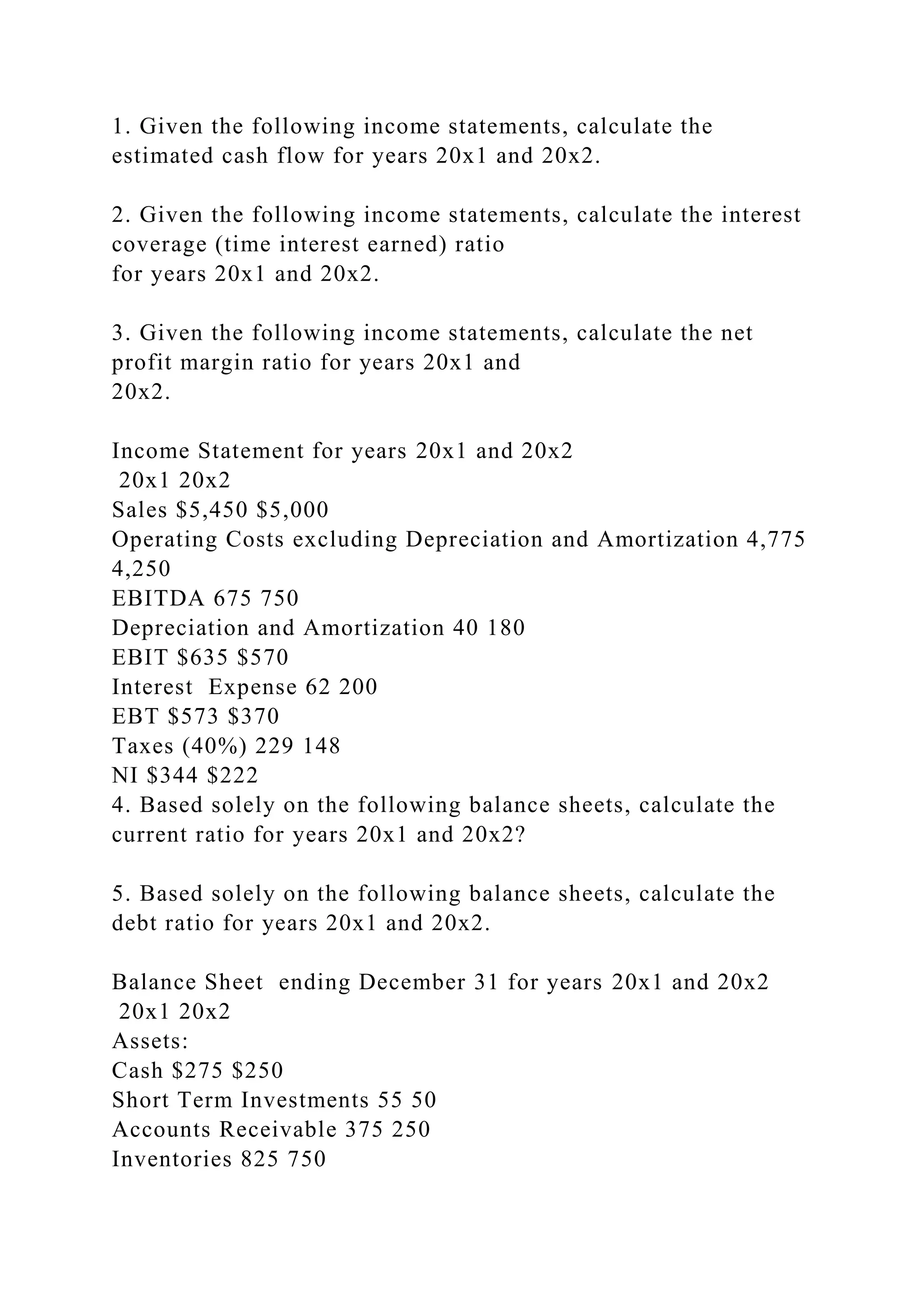
1. Given the following income statements, calculate the
estimated cash flow for years 20x1 and 20x2.
2. Given the following income statements, calculate the interest
coverage (time interest earned) ratio
for years 20x1 and 20x2.
3. Given the following income statements, calculate the net
profit margin ratio for years 20x1 and
20x2.
Income Statement for years 20x1 and 20x2
20x1 20x2
Sales $5,450 $5,000
Operating Costs excluding Depreciation and Amortization 4,775
4,250
EBITDA 675 750
Depreciation and Amortization 40 180
EBIT $635 $570
Interest Expense 62 200
EBT $573 $370
Taxes (40%) 229 148
NI $344 $222
4. Based solely on the following balance sheets, calculate the
current ratio for years 20x1 and 20x2?
5. Based solely on the following balance sheets, calculate the
debt ratio for years 20x1 and 20x2.
Balance Sheet ending December 31 for years 20x1 and 20x2
20x1 20x2
Assets:
Cash $275 $250
Short Term Investments 55 50
Accounts Receivable 375 250
Inventories 825 750
Total Current Assets $1,530 $1,300
Net Plant and Equipment 2,925 2,750
Total Assets $4,455 $4,050
Liabilities:
Notes Payable $192 $100
Accounts Payable 580 100
Miscellaneous Payables 245 250
Total Current Liabilities $1,017 $450
Long-Term Debt 550 500
Total Liabilities $1,567 $950
Reporting and Valuation for
Undergraduates
2
Common Stock 2154 2,600
Retained Earnings 734 500
Less Treasury Stock 46 0
Total Shareholder Equity $2,888 $3,100
Liabilities and Shareholder Equity $4,455 $4,050
6. Based on both the income statements and balance sheets,
calculate the return on assets (return on
investment) ratios for years 20x1 and 20x2.
7. Based on both the income statements and balance sheets,
calculate the total asset turnover ratio
for years 20x1 and 20x2.
Part II: Capital Budgeting and Financing Considerations
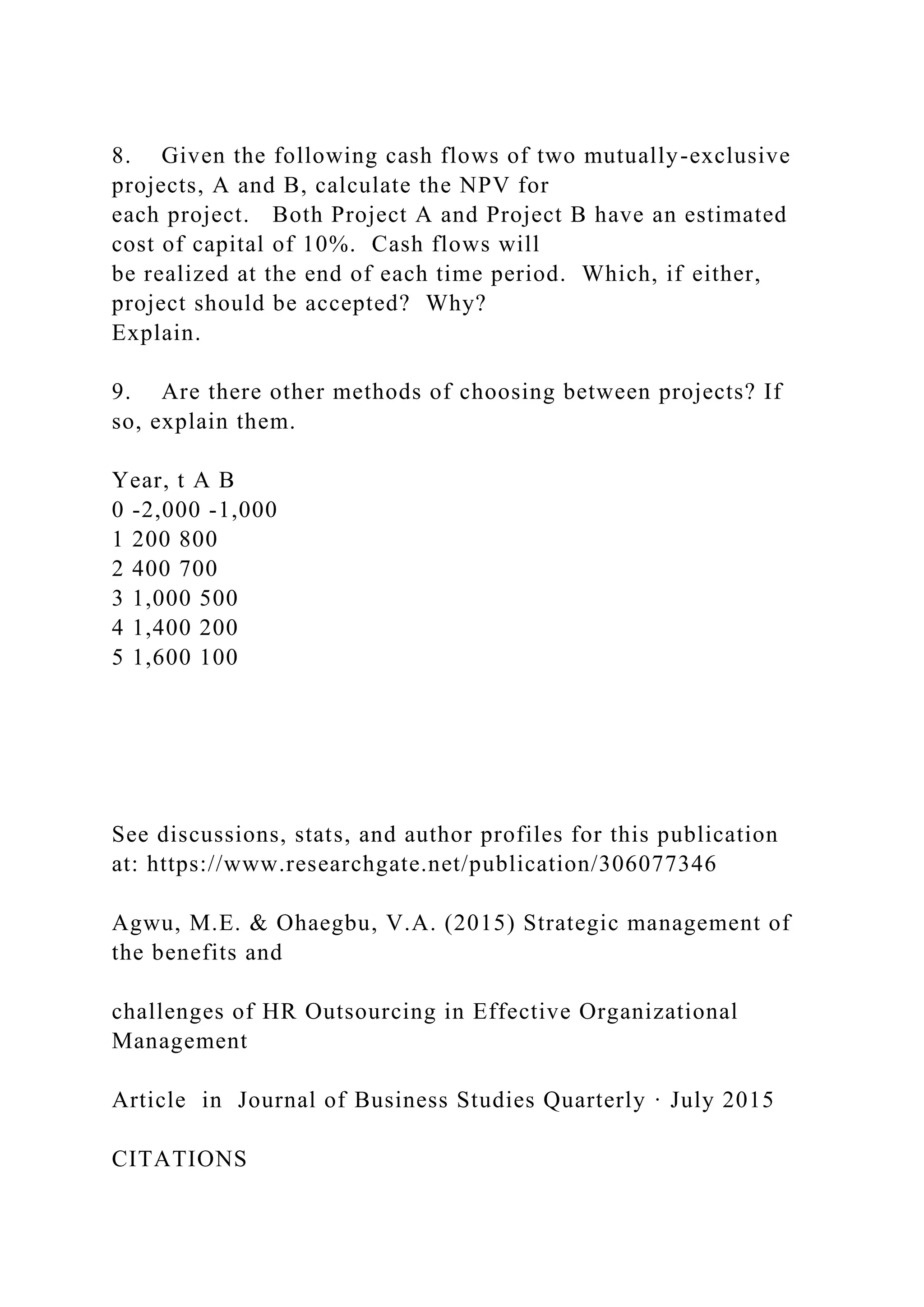
8. Given the following cash flows of two mutually-exclusive
projects, A and B, calculate the NPV for
each project. Both Project A and Project B have an estimated
cost of capital of 10%. Cash flows will
be realized at the end of each time period. Which, if either,
project should be accepted? Why?
Explain.
9. Are there other methods of choosing between projects? If
so, explain them.
Year, t A B
0 -2,000 -1,000
1 200 800
2 400 700
3 1,000 500
4 1,400 200
5 1,600 100
See discussions, stats, and author profiles for this publication
at: https://www.researchgate.net/publication/306077346
Agwu, M.E. & Ohaegbu, V.A. (2015) Strategic management of
the benefits and
challenges of HR Outsourcing in Effective Organizational
Management
Article in Journal of Business Studies Quarterly · July 2015
CITATIONS
0
READS
199
1 author:
Some of the authors of this publication are also working on
these related projects:
Journal Publication View project
journal View project
Edwin Agwu
Lagos Business School, Pan-Atlantic University, Lagos State
72 PUBLICATIONS 122 CITATIONS
SEE PROFILE
All content following this page was uploaded by Edwin Agwu
on 02 December 2016.
The user has requested enhancement of the downloaded file.
https://www.researchgate.net/publication/306077346_Agwu_ME
_Ohaegbu_VA_2015_Strategic_management_of_the_benefits_a
nd_challenges_of_HR_Outsourcing_in_Effective_Organizationa
l_Management?enrichId=rgreq-
5a256b172abc05d2a004c0bc01928841-
XXX&enrichSource=Y292ZXJQYWdlOzMwNjA3NzM0NjtBUz
o0MzQ3MzA5MTE5NjUxODRAMTQ4MDY1OTMzNDc1Ng%3
D%3D&el=1_x_2&_esc=publicationCoverPdf
https://www.researchgate.net/publication/306077346_Agwu_ME
_Ohaegbu_VA_2015_Strategic_management_of_the_benefits_a
nd_challenges_of_HR_Outsourcing_in_Effective_Organizationa
l_Management?enrichId=rgreq-
5a256b172abc05d2a004c0bc01928841-
XXX&enrichSource=Y292ZXJQYWdlOzMwNjA3NzM0NjtBUz
o0MzQ3MzA5MTE5NjUxODRAMTQ4MDY1OTMzNDc1Ng%3
D%3D&el=1_x_3&_esc=publicationCoverPdf
https://www.researchgate.net/project/Journal-
Publication?enrichId=rgreq-
5a256b172abc05d2a004c0bc01928841-
XXX&enrichSource=Y292ZXJQYWdlOzMwNjA3NzM0NjtBUz
o0MzQ3MzA5MTE5NjUxODRAMTQ4MDY1OTMzNDc1Ng%3
D%3D&el=1_x_9&_esc=publicationCoverPdf
https://www.researchgate.net/project/journal-
20?enrichId=rgreq-5a256b172abc05d2a004c0bc01928841-
XXX&enrichSource=Y292ZXJQYWdlOzMwNjA3NzM0NjtBUz
o0MzQ3MzA5MTE5NjUxODRAMTQ4MDY1OTMzNDc1Ng%3
D%3D&el=1_x_9&_esc=publicationCoverPdf
https://www.researchgate.net/?enrichId=rgreq-
5a256b172abc05d2a004c0bc01928841-
XXX&enrichSource=Y292ZXJQYWdlOzMwNjA3NzM0NjtBUz
o0MzQ3MzA5MTE5NjUxODRAMTQ4MDY1OTMzNDc1Ng%3
D%3D&el=1_x_1&_esc=publicationCoverPdf
https://www.researchgate.net/profile/Edwin_Agwu?enrichId=rgr
eq-5a256b172abc05d2a004c0bc01928841-
XXX&enrichSource=Y292ZXJQYWdlOzMwNjA3NzM0NjtBUz
o0MzQ3MzA5MTE5NjUxODRAMTQ4MDY1OTMzNDc1Ng%3
D%3D&el=1_x_4&_esc=publicationCoverPdf
https://www.researchgate.net/profile/Edwin_Agwu?enrichId=rgr
eq-5a256b172abc05d2a004c0bc01928841-
XXX&enrichSource=Y292ZXJQYWdlOzMwNjA3NzM0NjtBUz
o0MzQ3MzA5MTE5NjUxODRAMTQ4MDY1OTMzNDc1Ng%3
D%3D&el=1_x_5&_esc=publicationCoverPdf
https://www.researchgate.net/profile/Edwin_Agwu?enrichId=rgr
eq-5a256b172abc05d2a004c0bc01928841-
XXX&enrichSource=Y292ZXJQYWdlOzMwNjA3NzM0NjtBUz
o0MzQ3MzA5MTE5NjUxODRAMTQ4MDY1OTMzNDc1Ng%3
D%3D&el=1_x_7&_esc=publicationCoverPdf
https://www.researchgate.net/profile/Edwin_Agwu?enrichId=rgr
eq-5a256b172abc05d2a004c0bc01928841-
XXX&enrichSource=Y292ZXJQYWdlOzMwNjA3NzM0NjtBUz
o0MzQ3MzA5MTE5NjUxODRAMTQ4MDY1OTMzNDc1Ng%3
D%3D&el=1_x_10&_esc=publicationCoverPdf
Journal of Business Studies Quarterly
2015, Volume 7, Number 2
ISSN 2152-1034
Strategic Management of the Benefits and Challenges of HR
Outsourcing in Effective Organizational Management
Agwu Edwin – PhD, MSc, MBA, BSc (Hons), NCE
Associate Professor of Strategic Management and Marketing,
School of Business,
Covenant University, Ogun State, Nigeria & Adjunct Lecturer
and External dissertation supervisor for Global MBA students
at Manchester Business School, United Kingdom: Email:
[email protected] or
[email protected]
Ohaegbu, V. Awele, PhD (ongoing), MSc, BSc
Department of Business Management, Covenant University, Ota,
Ogun State
[email protected] or [email protected]
Abstract
The stiff competition and ever changing business environment
has brought with them a plethora
of challenges for organizational managers. Different
programmes are often designed to
overcome these challenges and enhance performance.
Outsourcing has become an increasingly
dominant preference for organizations seeking to focus on core
competences, reduce operating
costs and enhance service deliveries. Outsourcing generally is
considered an important factor in
today’s businesses and has become the fastest growing business
process outsourcing services in
many countries in recent years. The growth of outsourcing as a
management too is evidenced on
the premises where various organisations outsource within and
across borders. This study
therefore outlines the strategic management of the benefits and
challenges of this often
controversial tool in meeting organisational needs. While the
findings of this study revealed cost
and time savings, among others, as some of the key reasons for
outsourcing, the challenges
weighed heavily on the loss of expertise and inability of
business organizations to muster any
form of business secrets and often lead to low morale on the
part of organisational employees.
Keywords: Outsourcing, Human Resource, Benefits, Challenges,
Organizational management
1.0 Introduction
Outsourcing has become a growing trend in the 21st century. It
is the strategy of companies to
concentrate more and more on their core competencies and key
businesses. One definition of
outsourcing is that it is a contractual relationship between an
external vendor and an enterprise in
which the vendor assumes responsibility for one or more
business functions of the enterprise
Boxall and Steeneveld, (1999); this means that these companies
have sought different partners to
take care of their support functions. Today, every organization
aims at increasing productivity by
enhancing return on investments and achieving economies of
scale. The general consensus is that
mailto:[email protected]
86
organisations should focus only on their core competencies and
outsource non-critical business
activities. Therefore, routine administrative works, although
important, can be outsourced to
third party vendors. The idea of outsourcing according to Fill
and Visser, (2000) has its roots in
the competitive advantage theory propagated by Adam Smith in
his book 'The Wealth of Nations'
which was published in 1776. Over the years, the meaning of
the term 'outsourcing' has
undergone a sea-change. Kotabe & Murray, (2001) stressed that
what started off as the shifting
of manufacturing to countries providing cheap labour during the
industrial revolution, has taken
on a new connotation in today's scenario. Barthelemy, (2003)
observes “the idea of contracting-
out as a means for improving public administration dates back
to the 1850s”. The author also
noted that there was a clear increase in outsourcing between
1987 and 1995, since then, there has
been a boom in outsourcing. Klaas, (2003), also observed that
third party involvement in IT can
be traced back to the 1960s in the USA, the landmark event that
brought IT outsourcing to the
attention of the business world was Eastman Kodak’s decision
to outsource its IT to an IBM
subsidiary in 1989. Other companies soon followed, including
Continental, Enron, American
Standard, National Car Rental, and Copperweld. By the early
1990s, IT outsourcing cases were
being reported in journals such as the Harvard Business Review.
This study examines from
strategic management point, the benefits and challenges of
outsourcing of human resource in
effective organizational management.
2.0 Review of related literature
The history of outsourcing dates back to the industrial
development that began in the late 17th
century. For instance, the making of America's covered wagon
covers and clipper ships' sails was
a job outsourced to workers in Scotland, with raw material
imported from India. England's textile
industry became so efficient in the 1830s that eventually Indian
manufacturers couldn't compete,
and that work was outsourced to England, (Benson and
Leronimo (1996). Wasner, (1999), states
that the ancient Chinese and the Japanese empires were also
adept at outsourcing to their
conquered nations. But looking at recent times, in the USA
many computer companies used to
outsource their payroll processing in the 1970s and 1980s.
Learning that outsourcing existed
since the early days of our civilization, one may wonder why no
one talked about it, twenty years
back and the reason for the hues and cries about it now?
Alexander and Young, (1996) stressed
that the reason outsourcing stayed out of the news was because
it used to happen on a small scale
and was concentrated in some specific regions, like the USA
and Europe. But now outsourcing is
billions of pounds a year industry and the world cannot afford
to ignore it. Globalization,
explosive growth of internet, and the development of
information society in every region of the
world has made outsourcing an integral part of the world
economy. Bajpai, Sachs, Arora, and
Khurana, (2004), stated that the origin of outsourcing could be
related to exporting of the
valuable goods from developing countries to US and European
countries. China, India and most
Asiatic countries, for instance, are becoming hubs for most
outsourcing businesses. Particularly,
China and India have proven records for their innovations in
almost all sectors, whether it is
painting, craft or other technological domains. The last few
years have witnessed a lot of
activities in patent filing and patent lawsuits. These results in
huge need for the various patents
related services. This leads to the generation on Knowledge
Outsourcing concept. Most of them
acquire their patent works from top industries in US, Europe
and Japan. And most of the firms
have gained reputation, from their unique service qualities.
Thus, the core to this business is
innovation, new tools and techniques for the delivery of quality
work at competitive costs.
Bajpai, et al., (2004), further stressed that the evolution of these
capsules of energy, in corporate
terms “The Outsource centres” has broken a very stupendous
ritual of Chinese and Indian work
http://www.emeraldinsight.com/Insight/ViewContentServlet?Fil
ename=Published/EmeraldFullTextArticle/Articles/0240250901.
html#b34
87
cultures which was the ancient day light shift system. Men and
women of these vast lands were
fed on the principles of “Work Only When the Sun is up and
shining, because the nights are not
meant for working”. However, as a rule of demography, the
West wakes up when the East goes
to sleep. So, the Indian Mard (Man in Hindi) and the Bharatiya
Nari (the typical Indian woman)
have now been exposed to working round the solar clock; in
other terms, catapulting the Indian
work group to the norms of world business.
Lawler, Ulrich, Fitz-enz, and Madden, (2005), in support of this
assertion, states that, it was not
long ago that the concept of Business - Across - the - Seas was
a distant dream, in fact an
impossible feat to imagine. But the technical advancements of
the West and the remarkable ideas
of technology have rendered these realistic yet astonishing
business transactions feasible. In
furtherance of this, the authors stated, ‘’How else would you
like to describe “A zappy New
York corporate head, seated at 309, Lake St., Penn Yan, NY -
14527 in the busiest of corporate
blocks in ‘’The Big Apple’’, calling in to order for a Pizza for
lunch, to be answered by an ardent
order taker situated at a call centre in New Delhi, India, who
ensures that the Pizza is delivered in
a remarkable service time, with extreme accuracy to the point
that the number of Jalapeños in the
Pizza ordered are accurate to ensure the customer’s delight”.
That is the advent of technology
that has scaled remarkable heights. This seems quite simple, but
as the experts would tell you “It
Is Not as Simple as It Seems”. They authors further stated that,
‘’if you would ever want to know
how effective the origin of outsourcing fundamentals has been
in the Indian Market, you do not
have to hold a conference of the top heads of the leading
organizations in the market. Rather,
walk up to an entry level representative in a call centre, and he
or she would explain to you how
happy they are talking to the Smith’s and the Spencer’s of
Virginia and Florida. The smile on the
faces of these mighty warriors would explain the success of
Outsourcing on the Indian soil’’.
Cook, (1999), in his submission observed that the origin of
outsourcing in America dates back to
the 1970’s when IBM developed the IT industry in India. Later,
the Internet and
telecommunications boom encouraged outsourcing as a means of
promoting capitalism.
2.1 Overview of the meanings of outsourcing
Organisations are constantly in search of new solutions and
strategies to develop and increase
their competitive advantage; outsourcing is one of these
strategies that can lead to greater
competitiveness, (Kotabe, and Murray, (2001). Hindle (2005),
defined outsourcing as a
management strategy by which an organization delegates major,
non-core functions to
specialized and efficient service providers. Koch, (2004), states
that it can also be described as
the contractual agreement between the customer and one or
more suppliers to provide services or
processes that the customer is currently providing internally.
Morton and Wilson, (2003), viewed
outsourcing as having works that was formerly done inside the
organization performed by an
external organization. The vendor (hereafter the outsourcer and
outsourcee are, respectively,
referred to as vendor and client) may be an independent entity
or a wholly owned subsidiary.
Klaas, (2003), in his submission, defined outsourcing as
“reliance on external sources for
manufacturing components and other value-adding activities”.
Gray, (2002) focused on
employment, defining outsourcing as, “another firm's employees
carrying out tasks previously
performed by one's own employees”. Dyer, Kale, & Singh,
(2001), also, viewed outsourcing as
turning over to a supplier those activities outside the
organization's chosen core competencies.
Campbell, (1995), briefly described outsourcing as a “managed
process of transferring activities
to be performed by others” and its main advantage is
conceptually based on two strategic pillars
88
the core
competencies of the company; and
considered strategic
necessities and/or whenever the company does not possesses the
adequate competencies
and skills.
Alexander and Young, (1996), observed that the single biggest
cause in the increase of
outsourcing has been the concept of the core organisations
which focuses its in-house expertise
on its primary functions and purchases any necessary support
from a range of sources in its
periphery. But Fill and Visser, (2000), warned that it can be
dangerous to focus too narrowly on
a single, isolated process when making an outsourcing decision.
In supporting this assertion,
Barthelemy and Adsit (2003), suggested that such choices
should be made only after four
questions have been answered:
-
effectiveness of using
outsourcing?
using outsourcing?
ill be the net effect on the strength, versatility and
resourcefulness of the treasury
department if the duties in question are outsourced?
outsourcing, and how vulnerable
would the organization be if that third party somehow became
unable to perform as
expected?
Harper, (2001), pointed out that outsourcing can free up assets
and reduce costs in the immediate
financial period. While Newman and Willmott (2004) stressed
that organisations outsourcing
parts of their in-house operations report significant savings on
operational and capital costs.
Hindle (2005) in his study found a correlation between
outsourcing best practice and high
performing companies. This is explained by Transaction Cost
Economics (TCE) – the
underpinning for make-or-buy decisions, (Perry, 1997).
Figure 1: Outsourcing decision framework
Source: Wasner, R. (1999), "The outsourcing process – strategic
and operational realities", Linköping
University, Linköping
89
Perry, (1997) further states that in Transaction Cost Economics,
the boundaries of the firm (i.e.
whether products and services are bought or provided in-house)
are determined by the most cost-
effective option. This includes “the uncertainty associated with
executing the transaction and the
uniqueness or specificity of the assets associated with the goods
or services transacted”. Hindle
(2005) also observed that outsourcing might seem to be a simple
cost reduction option, but there
are challenges to getting it right. Knowing what benefits to
expect in the first instance and setting
measurable performance indicators for both the client and the
outsourcer are important starting
points. Incorporating the critical success factors described
above:
-in,
All these will help increase the odds of having a successful HR
outsourcing relationship. Ward,
Grimshaw, Rubery, Beynon, (2001) asserts that one way of
evaluating whether the outsourcing
contract can create or protect firm value is to assess the capital
market's reaction to the
outsourcing decision. Kotabe and Murray (2001) argue that
many UK work organisations are
losing the ability to plan coherent human resources policies in
the face of external and internal
problems, particularly competitive pressures and rapid
technological change. The EU Directive
on fixed-term contracts, requiring equality between contract
staff and permanent workers may
have led employers to substitute temporary agency workers for
directly hired temporary staff,
(Gray, 2002). Furthermore, Gilley and Rasheed (2000) provide
clarification for the definitional
confusion; positioning outsourcing as procuring something that
was either originally sourced
internally (i.e. vertical disintegration) or could have been
sourced internally notwithstanding the
decision to go outside (i.e. make or buy). This includes
arrangements and concepts which have
been termed: – internal versus external sourcing, or as stated by
Axelsson and Wynstra, (2002);
strategic make-or-outsource decisions; contracting out, sub-
contracting, purchasing,
privatisation, Balogun, (2004) coined it as: compulsory
competitive tendering, market testing and
liberalisation. Adler, (2003), stressed that the decision-making
process that management must
undergo when considering outsourcing, hinges on a “make or
buy” philosophy. More variables
are brought into play when management considers outsourcing a
product or service that is
currently being produced internally. Many more options exist
currently than there was even a
decade ago.
2.2 Human Resource Management in Organizations
Charles Darwin once said: ‘’It is not the strongest of the species
that survive, nor the most
intelligent, but the one most responsive to change’’. Therefore,
human resource must also evolve
and transform and outsourcing can be the tool towards
accomplishing just that. There has been a
paradigm shift in the past few decades regarding the perception
of human resource within
various organizations. It is no longer only a backend or an
administrative activity and human
resource managers are no longer confined to being mere paper-
pushers for hiring and paying
people. Klaas, (2003), states that human resource is shifting
focus away from what it’s routinely
traditionally handled-transactional and administrative activities
and now taking on a more
consultative and strategic role within organizations. In today’s
business world, human resource is
aligning itself with the larger business goals and strategies of
organizations where they exist.
http://www.emeraldinsight.com/Insight/ViewContentServlet?Fil
ename=Published/EmeraldFullTextArticle/Articles/0240250901.
html#b89
90
Many administrative and operations jobs in human resource are
being outsourced in attempts to
cut costs and increase efficiency. Klaas, (2003), further stated
that apart from the cost benefits of
outsourcing of human resource, another reason is also to reduce
the administrative
responsibilities of human resource so that it can focus on the
strategic aspects. The primary role
of the HR department is to ensure that the organization’s human
resources are utilized effectively
and managed in compliance with company policies and
procedures, government legislation, and,
in unionized settings, collective agreement(s), Barthelemy
(2003). To effectively utilize the HR
department’s assistance and services, all managers as a matter
of policy, must be familiar with its
roles. Human resource department staff members are involved
in five distinct types of activities:
formulating policies and procedures, offering advice, providing
services, monitoring to ensure
compliance, and serving as consultant and change agent, Hayes,
(2000). According to Gilley and
Rasheed (2000), managers at all levels must concern themselves
with HRM functions since they
all meet their goals through the efforts of others, which require
the effective management of
people. Every supervisor and manager has responsibilities
related to a wide range of HRM
activities. These include analyzing jobs, planning labour needs,
selecting employees, orienting
and training employees, managing compensation,
communicating (which includes counselling
and disciplining), and maintaining employee commitment.
Furthermore, Hindle (2005 ), stressed
that part of the managers responsibilities also includes ensuring
fair treatment; appraising
performance; ensuring employee health and safety; building and
maintaining good
employee/labour relations; handling complaints and grievances;
and ensuring compliance with
human rights, occupational health and safety, labour relations,
and other legislation affecting the
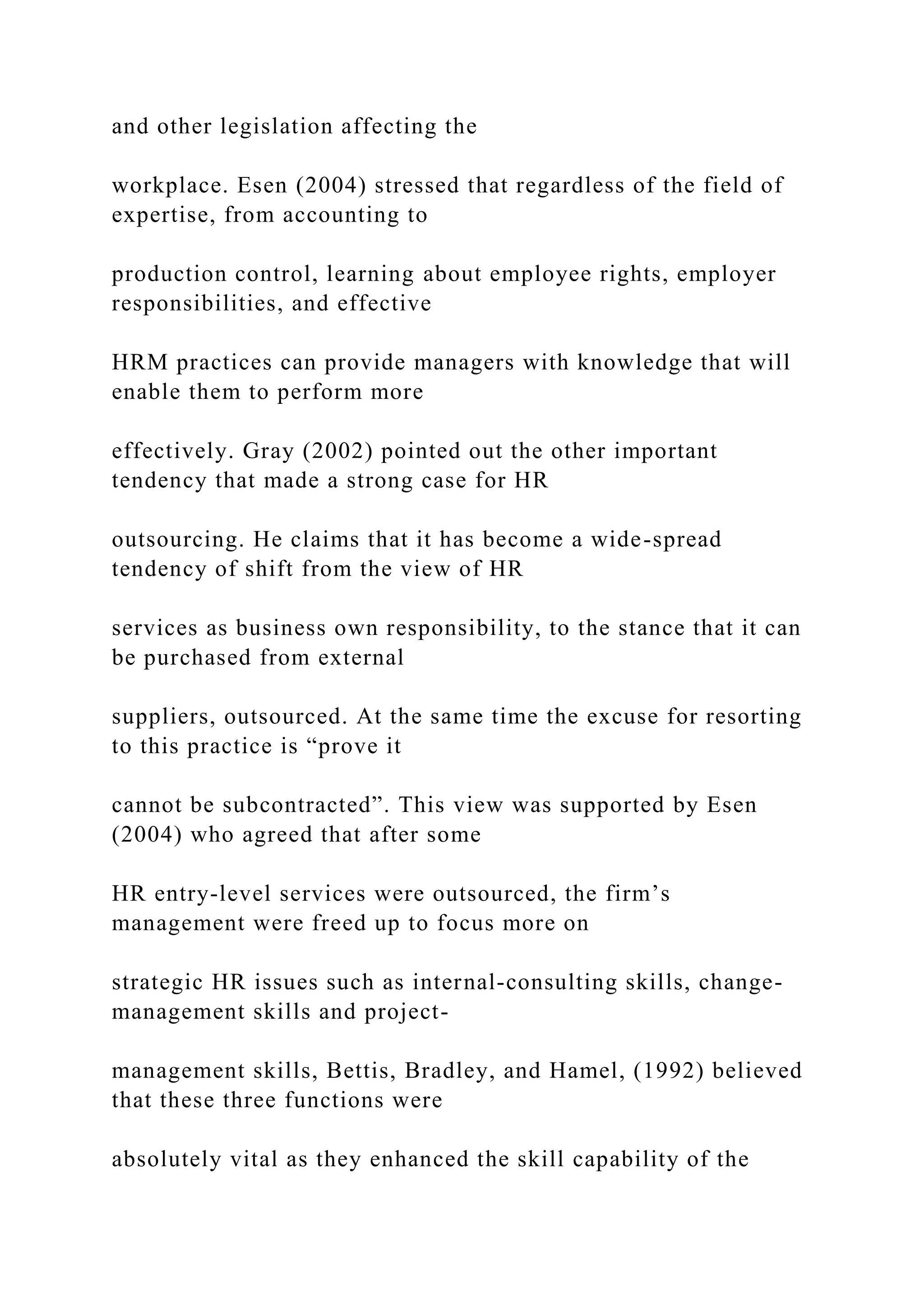
workplace. Esen (2004) stressed that regardless of the field of
expertise, from accounting to
production control, learning about employee rights, employer
responsibilities, and effective
HRM practices can provide managers with knowledge that will
enable them to perform more
effectively. Gray (2002) pointed out the other important
tendency that made a strong case for HR
outsourcing. He claims that it has become a wide-spread
tendency of shift from the view of HR
services as business own responsibility, to the stance that it can
be purchased from external
suppliers, outsourced. At the same time the excuse for resorting
to this practice is “prove it
cannot be subcontracted”. This view was supported by Esen
(2004) who agreed that after some
HR entry-level services were outsourced, the firm’s
management were freed up to focus more on
strategic HR issues such as internal-consulting skills, change-
management skills and project-
management skills, Bettis, Bradley, and Hamel, (1992) believed
that these three functions were
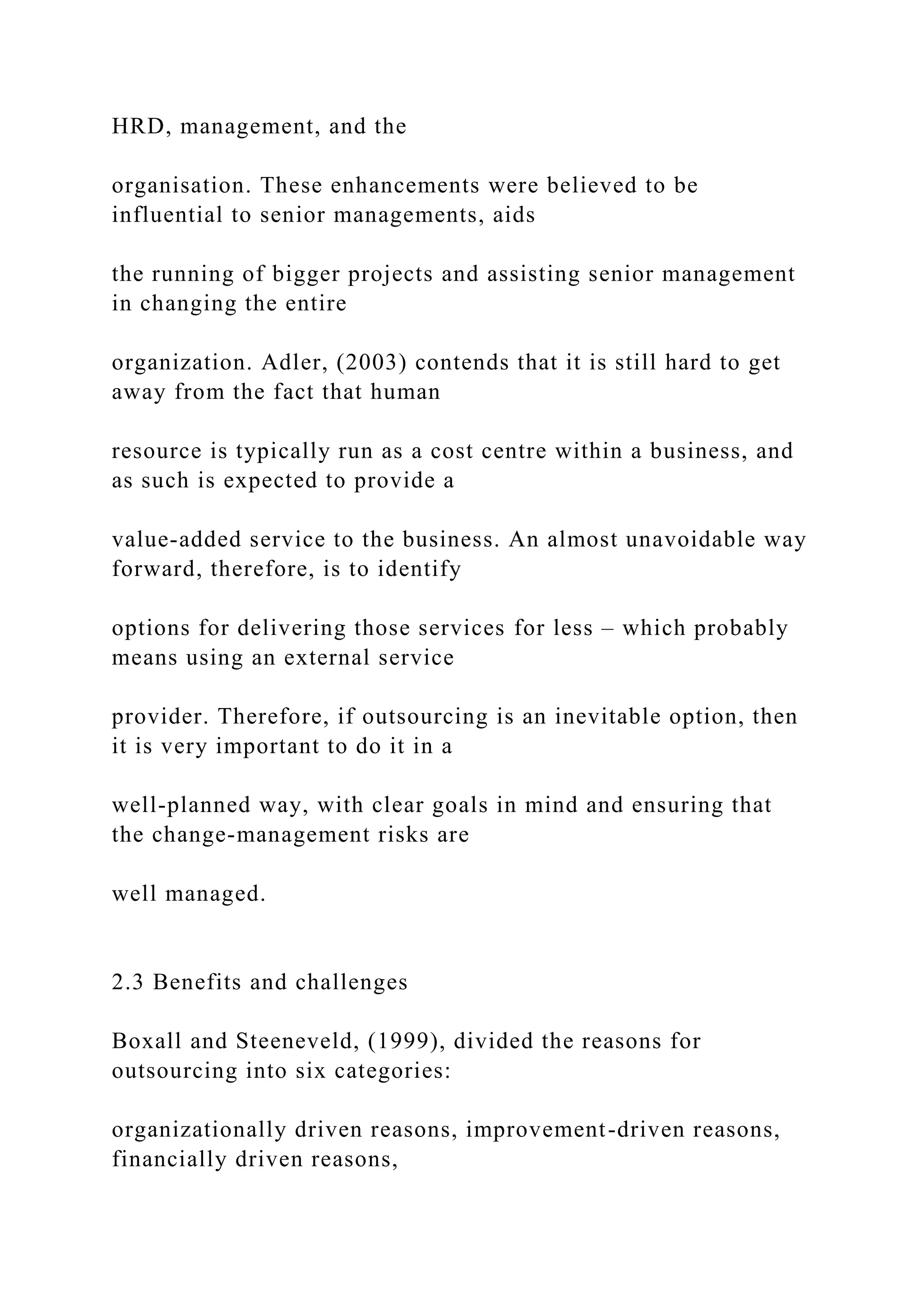
absolutely vital as they enhanced the skill capability of the
HRD, management, and the
organisation. These enhancements were believed to be
influential to senior managements, aids
the running of bigger projects and assisting senior management
in changing the entire
organization. Adler, (2003) contends that it is still hard to get
away from the fact that human
resource is typically run as a cost centre within a business, and
as such is expected to provide a
value-added service to the business. An almost unavoidable way
forward, therefore, is to identify
options for delivering those services for less – which probably
means using an external service
provider. Therefore, if outsourcing is an inevitable option, then
it is very important to do it in a
well-planned way, with clear goals in mind and ensuring that
the change-management risks are
well managed.
2.3 Benefits and challenges
Boxall and Steeneveld, (1999), divided the reasons for
outsourcing into six categories:
organizationally driven reasons, improvement-driven reasons,
financially driven reasons,
revenue-driven reasons, cost-driven reasons and employee-
driven reasons. The benefits created
91
from outsourcing can be divided into the same categories as the
reasons for outsourcing. Lawler,
Ulrich, Fitz-enz & Madden, (2005), pointed out that the reasons
and benefits of outsourcing are
organisationally driven when a company needs to enhance its
performance through
organizational changes. The transformation process can be
difficult, but outsourcing can be used
as a tool to make it easier, (Boxall and Steeneveld, 1999).
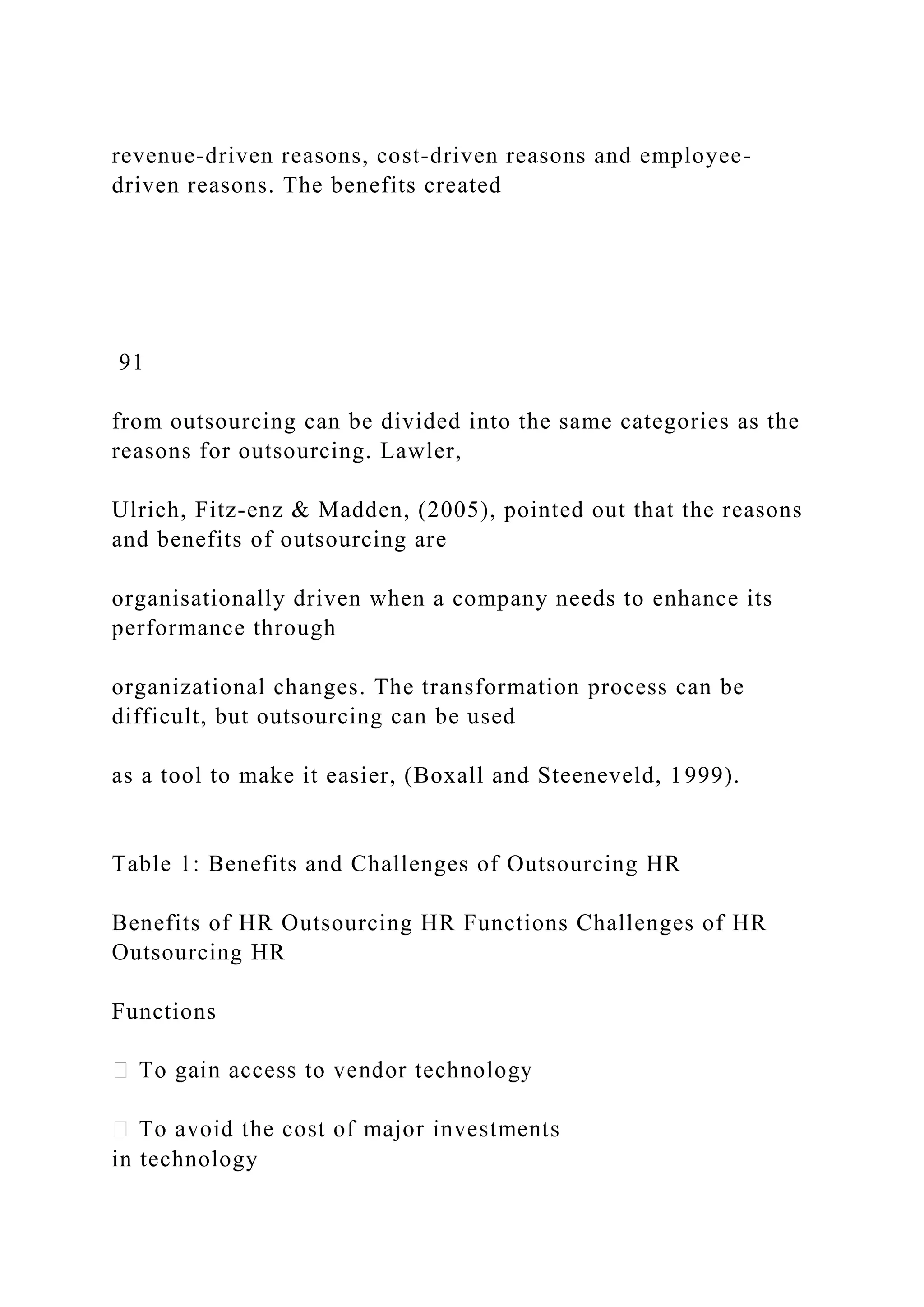
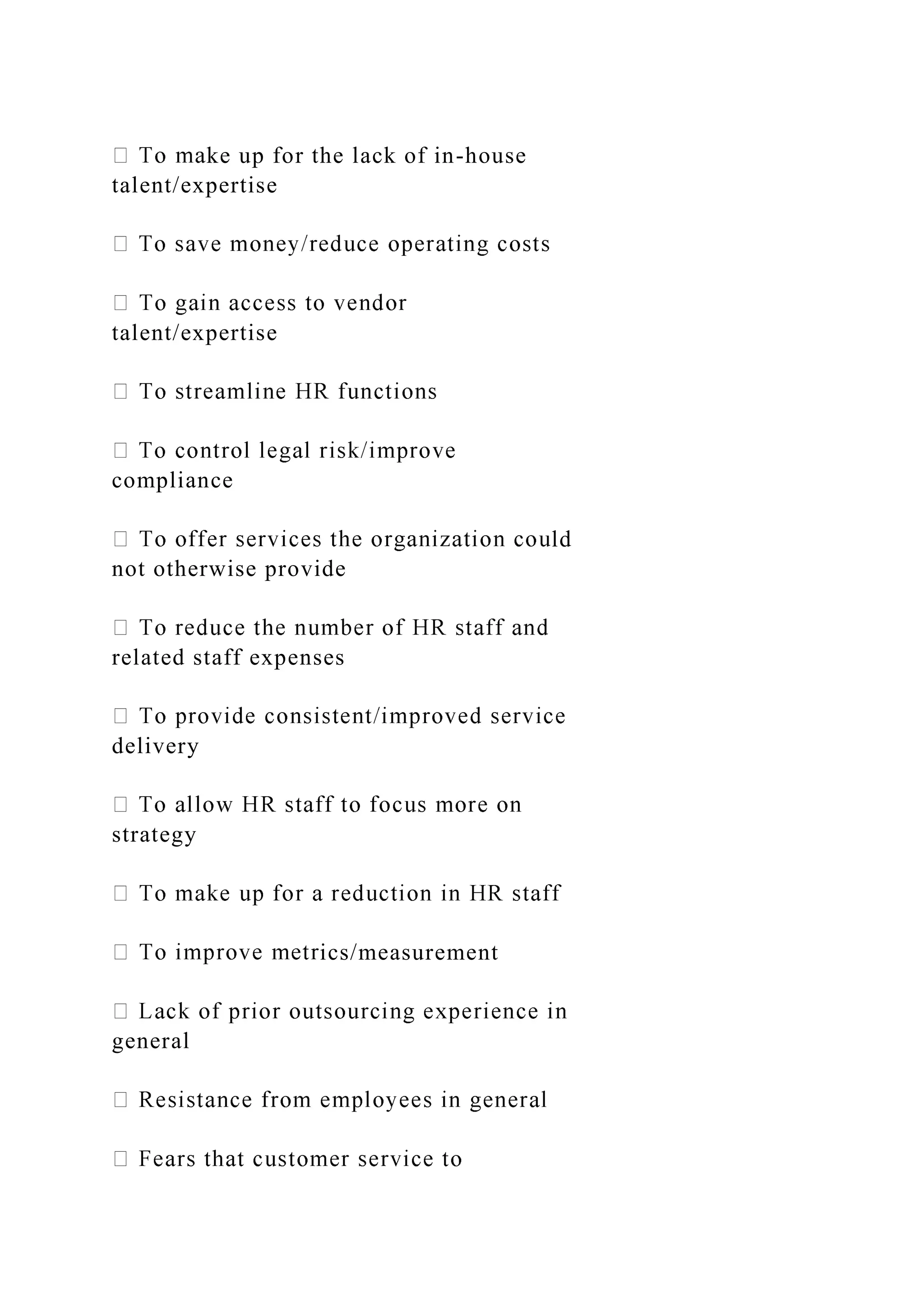
Table 1: Benefits and Challenges of Outsourcing HR
Benefits of HR Outsourcing HR Functions Challenges of HR
Outsourcing HR
Functions
in technology
ke up for the lack of in-house
talent/expertise
talent/expertise
compliance
ld
not otherwise provide
related staff expenses
delivery
strategy
ics/measurement
general
employees might be affected
company culture
ontrol
in vendors
vendors
ified
Source: Scott-Jackson, W., Newham, T. and Gurney, M. (2005)
HR outsourcing: the key decisions,
Executive briefing, London: Chartered Institute of Personnel
and Development
Organizational performance development can be carried out for
example by focusing on a
company’s own core competence. When outsourcing non-core
support functions, the
management and the rest of the personnel can concentrate better
on the core competence areas,
(Ten Raa and Wolff, 2001). Also, if there is a need to increase
the flexibility of a function to
meet changing business conditions, a company does not have to
worry about the capacity and
resources for the function, while the outsourcing company takes
care of the acquiring and
downsizing the needed resources, (Roodhooft and Warlop,
(1999). A company also has freedom
of choice when taking on new or changing old outsourcing
partners. However, the main
objective of outsourcing is to develop the total performance of a
company, to increase product
and service value, customer satisfaction and shareholder value
are qualities that create long-term
success for a company, (Quinn, 1999). In many organizations
the resources allocated for support
functions are often limited. The changes carried out in a
company are improvement-driven when
92
the acquiring and obtaining of a high level of operating
performance in support functions is done
through outsourcing. Also, a service provider usually has better
knowledge and a better skills
base for a certain function than a company’s own personnel has.
A company can benefit by
improving the level of performance of its support functions by
using an outside service
provider’s high-level resources dedicated only to one function,
(Perry, 1997). Outsourcing
directs some of the risk involved in operating a function to the
service provider, (Jones and
Pollitt, 2004). The service provider can also give fresh and
innovative ideas to a company which
might be blind to its own weaknesses and opportunities, (Klaas,
2003). Buying outsourcing from
superior and world-known service providers can also improve
the credibility and image of a
company, (McIvor and McHugh, 2000).If a company is in need
of instant cash, outsourcing
allows it to sell assets for cash as part of a long-term service
agreement, (Harper, 2001). When
outsourcing is done in the hope of gaining new business
opportunities, of accelerating expansion
in operations, sales and production or just to exploit existing
skills, it can be categorised as
revenue-driven.
Outsourcing provides the opportunity for a company to become
part of the service provider’s
network of other customers, suppliers and affiliated companies,
(Bryce and Useem, 1998). When
a company runs out of resources to deliver the required amount
of products or services, building
and acquiring the needed resources might take too much time or
there might not be resources
enough to make the necessary investments. Outsourcing also
makes it possible for a company to
share the service provider’s capacity, advanced processes and
systems when the company needs
them, without waiting for a new production facility to be built,
or makes possible an increase in
production and sales without big investments, (Anderson and
Weitz, 1986). If a function has
broader market applications with unique technologies than the
company is ready to invest in, a
joint venture with an outsource provider could be considered.
The partner benefits from and
utilizes the industry knowledge, special skills and technologies
related to the function, and by
exploiting the partner’s marketing and distributing channels,
these can be turned into revenue,
(Balogun and Hailey, 2004). Outsourcing is also used to reduce
current costs and to turn fixed
costs into variable costs. These are cost-driven reasons. A
service provider often has a better cost
structure in carrying out a task than a company’s internal
function could have. A service provider
divides overhead costs over more activity units, and therefore a
service provider often has lower
overhead costs per unit than a company’s internal units,
(Dennis, 2003). Through outsourcing,
normally fixed costs can be converted to variable costs.
Providers handle varying demand more
efficiently because of their economies of scale. The service
provider has bigger capacity and
volume than a company’s internal units. Thus, changes in
demand have a smaller effect for the
service provider. It is also possible for a company to gain a cost
advantage over competition
through lower operating costs, (Gray, 2002). Outsourcing can
offer employees a stronger career
path. This employee-driven reason for outsourcing means that
the people working in a support
function of a company do not have such strong career
possibilities as the employees working in
the core competence area of a company. If the support function
is outsourced, the service
provider often employs people with previous experience in the
outsourced area, (Gilley, Greer
and Rasheed, 2004)
This view was supported by Balogun and Hailey, (2004), who
argues that HR outsourcing
represents a strategic tool for achieving competitive advantage.
He states that outsourcing of the
transaction-based HR activities frees HR managers and other
managers to deal with strategic
business issues. According to Alexander and Young, (1996), the
other major rationales for HR
93
outsourcing is to cut administrative and high transaction cost
activities, minimize the workload
of regular workers, reduce cost, reap economies of scale,
improve quality and efficiency, and
gain expertise from outside vendors. Summing up all the points,
the following list of pull factors
of outsourcing can be made:
– HR costs are reduced because the services are
cheaper and the size of the
function can be cut back;
– members of the function are not
diverted from the key tasks
which add value;
– know-how and experience that is
unavailable in the organisation ca
n be purchased
But Momme and Hvolby, (2002) believe that HR outsourcing is
a faddish trend, and will not take
off to the extent that has been predicted. They urge firms to
question whether an external source
can ever know the business as well as business owner does, and
though there may be a place for
outsourcing routine tasks like payroll, it is unwise to let a
vendor make important decisions for
the firm. Gunsauley (2002) stressed that when managers decide
whether to outsource, the need to
retain sufficient skills in-house to fulfil the role of vendor-
manager and intelligent customer is
often overlooked, as is the need to ensure there is a cost-
effective exit if the outsourcing
arrangement does not work.
On the basis of the Information systems outsourcing, (Balogun
and Hailey, 2004), draws the
following picture:
on employee morale.
Stating that outsourcing is driven by a desire to reduce costs
while improving the quality of IS
and user services, they casts serious doubts whether these
objectives are feasible. Other
important issue raised by Dennis, (2003), points out those
different strategies differ in their
requirements for HR practices may imply varying needs for HR
outsourcing.
From these issues two major points arise:
functions?
at shall be the criteria for measuring the adequacy of the
expertise of HR service
supplier?
Gray, (2002), suggests that it is difficult to control the quality
since the process of production is
external. During internal process a company can apply quality
improvement tools. Receiving off-
shelf product or solution a company may face the problems of
hidden flaws in quality (so called
“floating” flaw or error). With outsourcing a company may be
dependent on its suppliers, what
reduces its flexibility capacity. Another vital point was raised
by Gray, (2002) who speaks about
commitment and survival syndrome. Delayering may lead to
“survival syndrome”. It may cause
the loss of trust and commitment. As a result, the staff turnover
may increase and the
productivity might decrease significantly. Unless the
outsourcing process is carefully carried out,
94
internal resistance may arise based on reluctance by the internal
employees to outsource service
activities that are perceived to be central to the way the
company competes and the brand of the
firm, (Bryce and Useem, 1998). Overt and covert resistance by
managers and employees can be a
significant obstacle to the change process. It can sabotage both
the outsourcing process (Harper,
2001) and the adoption of service logic which consists of the
delivery of more customer-oriented
services such as solutions (Hayes, Hunton and Reck, 2000).
Although this resistance cannot be
avoided altogether, the change approach, or the way in which
the outsourcing project is carried
out (e.g. top-down or bottom-up, revolution or evolution,
participative or directive) should be
adjusted to the content and context of the change, (Balogun,
(2002).
By doing this, the negative effects of internal resistance can be
reduced to a more constructive
level. In other cases, especially at prosperous firms and during
boom periods, outsourcing may
be taken too lightly by employees and managers who are
searching for interesting new areas,
neglecting the firm's core business (Bettis et al., 1992). Zhu et
al., (2001), opined that ‘’even
though the ideal outsourcing process is often described as a
being linear, well planned, having
clear goals, etc. in reality this rational approach may not be
feasible. Many industries are so
volatile that it is nearly impossible to forecast, with any degree
of accuracy, more than a few
months into the future. Under such conditions, responsiveness
to changes in the market and
technology are more important than formal planning procedures
(Bettis and Hitt, 1995; Bettis et
al., 1992). This is even more important in many service
businesses, where knowledge of the
customers' needs and strategies is often decentralised to service
employees in the field.
Management may have a broad overview of the business, but in
rapidly changing environments
and complex organisations, it must gather information from
those who are better informed about
the market, i.e. its service employees and purchasers.
Management must also ensure that the
employees have an overview of the strategic intent of the firm
so that interactions with customers
and suppliers are consistent with the overall ambition of the
firm, (Quinn and Hilmer, 1994).
Furthermore, Zhu et al., (2001), stressed that in turbulent
contexts such as during the adoption of
a service-centred logic, learning and flexibility may be more
important than planning and
rationality, (Momme and Hvolby, 2002; Wasner, 1999). Fill and
Visser, (2000), claimed that
such a rational outsourcing approach is often unfeasible due to
the difficulty of predicting
environmental changes and foreseeing events that will impact
the outsourcing process. Instead of
planning, they emphasise the need to be flexible during the
outsourcing process. Wasner (1999,
p. 32), for instance, suggests that outsourcing should be seen as
an iterative process which cycles
between:
It is likely that both approaches, i.e. the rational approach and
the more flexible and iterative one,
are applicable, but only under certain conditions. The latter
perspective seems particularly
feasible in turbulent contexts, for instance at firms which are
also transforming their business
into a more service-centred logic, (Gilley and Rasheed 2000).
Hitherto, however, little empirical
evidence exists which supports such a supposition and hence
this in-depth longitudinal case
study may be justified. Besides, other problems appear quite
often. According to Harper, (2001)
these problems are:
95
executives; and
eople the feeling that they
are the winners or the losers.
Consequently, from this perspective, there is nothing more
important for the success of an
outsourcing than the attitudes of the executives that have to do
with it. In fact, the author found
that the cornerstone for the implementation of an effective
outsourcing is an appropriate
management that tries to obtain the personnel's wholehearted
collaboration. However, the
process might turn out to be naturally dangerous, since
organisations, like individuals, are
reluctant to change. Despite the shortcomings, Equa Terra
(2005), states that the potential of
outsourcing is enormous, if implemented correctly, (Scott, Kies,
Schoch, Wesley, and Bernard,
2003), claimed that it can dramatically improve an
organization’s effectiveness, they further
stated that, on average, companies are realizing a 9 per cent cost
saving and a 15 per cent
increase in capacity and quality through outsourcing. There is
enormous pressure on major
corporations to establish competitive positions in a global
marketplace. The global imperative for
outsourcing accelerates as firms evolve from sellers of products
and services abroad to setting up
operations in foreign countries and staffing those operations
with host country or their party
nationals, (Fill and Visser, 2000). Most corporations believe
that in order to compete globally,
they have to look at efficiency and cost containment rather than
relying strictly on revenue
increases. In agreement, Mclvor and Humphreys, (2000),
pointed that as companies seek to
enhance their competitive positions in an increasingly global
marketplace, they are discovering
that they can cut costs and maintain quality by relying more on
outside service providers for
activities viewed as supplementary to their core businesses.
Lawler, et al., (2005), offers a handy
analogy in which he compares outsourcing to marriages by
saying that both relationships are
easy to consummate but much harder to terminate. Thus, if a
company decides to outsource a
function without a solid reason, any risks caused by the
outsourcing can be very difficult to
reverse. Uncertainty and risk of failure exist every time a
company is considering outsourcing a
function. If the company decides to hand out part of its
operations to an outside service provider,
it will be very difficult to bring it back inside the company in
the case of failure Anderson and
Weitz, (1986). Axelsson and Wynstra, (2002), however states
that after shifting the responsibility
for a function to the service provider and not dealing with the
function for a while, the company
may experience a dependency on the service provider.
Alexander and Young, (1996) stressed
that outsourcing might create a loss of control over the
outsourced function, furthermore, If the
outsourcing is done for the wrong function, one which in fact is
critical for a company’s
operations, the loss of control can be fatal. Also, controlling
and communicating with service
providers can create hidden costs. The responsibilities of both
parties must be clearly defined or
the service provider’s priorities might not match client needs,
(Bryce and Useem, 1998).
Together with the outsourced function the competence inside
the function will drift away from
the company. Gray, (2002), opined that the loss of core
competencies and critical skills is a big
risk that management must keep in mind when selecting a
function which will be outsourced
(Dennis, 2003). Outsourcing also affects the amount of cross-
functional intercourse, which will
create a loss in the company’s cross-functional skills
According to Whitehead, (2004), outsourcing creates many
negative emotions among
employees. This can appear as employee unhappiness and
lowered working morale, (Gunsauley,
2002). If the remaining employees have to work in fear of being
the next to go, it will show in
the overall efficiency and atmosphere of the company. Also, if
the outsourced personnel are
hired by the service provider to perform the same task for the
old employer, the level of
96
motivation might not be so high as before. It can take a long
time for the benefits of outsourcing
to become visible. This means that outsourcing contracts often
cover a few years. In some
studies, over half of companies in which the primary object
through outsourcing is cost reduction
are at the end dissatisfied with their outsourcing relationships,
(Klaas, 2003). If a company is
only looking for fast cost reductions and does not consider
outsourcing as a long-term
development strategy, the probability of failure is greater than
if outsourcing is done with a
longer time scope.
2.4 Need for HR Outsourcing
Outsourcing is the performance by outside parties on a recurring
basis of activities that would
otherwise be performed in-house. Functions that are commonly
outsourced are: - Information
Technology, Human Resource, Sales Marketing, Finance,
Administrative and various others,
(Zhu, Hsu, and Lillie, (2001). Human resource outsourcing
involves outsourcing particular
functions to a third party. Usually non-critical, routine
administrative transactional functions are
outsourced. Increasingly, however, critical functions are being
outsourced as well but the third
party service providers chosen are specialists in their respective
fields, (EquaTerra, 2005)
2.4.1 Outsourcing stages
An organization can adopt any or all of following three stages
of outsourcing:
- usually training, resume or
curriculum vitae (CV) processing
or vetting, search and selection, are outsourced. Thus an
organization retains all major
processes and functions with it and is not really risking much.
-level Outsourcing: - here one or more processes relating
to human resource are
outsourced. It involves some measure of risk by an organization
which requires sensitive
employee database to be shared with the service provider.
However the organization still
retains the strategic aspects and core-competencies and final
decision making. The human
resource processes that are commonly outsourced are payroll
administration, recruitment
administration, pension, benefit administration, search and
selection, training,
benchmarking surveys/research, etc.
- under this stage, the entire HR
function is outsourced to a
third party including the policy formulation and strategic
aspects.
2.4.2 In-house outsourcing
This is a new trend in outsourcing that has emerged in recent
years. As opposed to outsourcing to
a third party several organizations are setting up back-end
offices in Labour Cost efficient
countries. The motivation is to cut cost, avail the benefits of
cheaper labour in the host country
and draw from a pool of talent crunch in the parent country. It
allows them to retain ownership of
their processes and data without involving a third party. As a
result, they get to partake in most
of the benefits without the associated risks. But as opposed to
‘out-house’ outsourcing it requires
long-term investments in setting up offices, staff and
infrastructure, (Newman and Willmott,
2004). Anderson and Weitz, (1986), state that the issue of build
versus buy is also a strong driver
for outsourcing. In this case, companies choose to "leapfrog"
their efforts by hiring an
outsourced service provider to get things up and running
quickly. Harper, (2001), observed that
97
some human resource departments within various organizations
are going for one-stop solutions
human resource outsourcing shops where activities such as
payroll, compensation, benefits, and
BPO are handled by the service provider. Ten Raa, and Wolff,
(2001), observed that human
resource related issues, particularly in US-based firms, are
starting to outsource even some of
their core tasks, like parts of training or recruitment. These
firms are learning how to take core
functions apart and outsource some of their elements, further
reducing the burden on the HR
department of the organization. In yet other cases, HR
organizations are not thinking in terms of
core or non-core activities and they are simply categorizing
transactional activities and looking
for a different way to perform them.
3.0 Cases associated with HR outsourcing
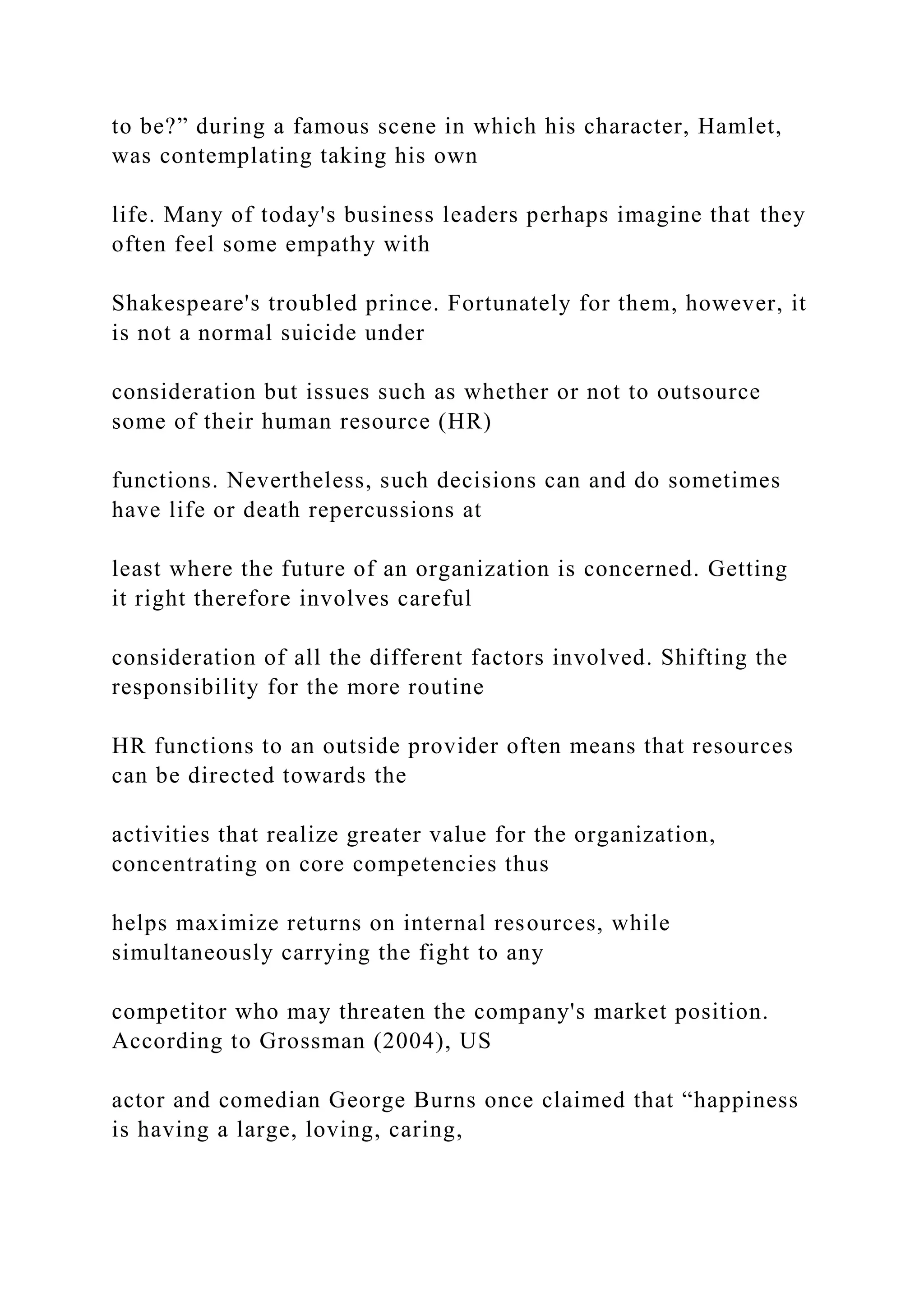
Back in the early 1600s, dramatist William Shakespeare coined
the immortal phrase “to be or not
to be?” during a famous scene in which his character, Hamlet,
was contemplating taking his own
life. Many of today's business leaders perhaps imagine that they
often feel some empathy with
Shakespeare's troubled prince. Fortunately for them, however, it
is not a normal suicide under
consideration but issues such as whether or not to outsource
some of their human resource (HR)
functions. Nevertheless, such decisions can and do sometimes
have life or death repercussions at
least where the future of an organization is concerned. Getting
it right therefore involves careful
consideration of all the different factors involved. Shifting the
responsibility for the more routine
HR functions to an outside provider often means that resources
can be directed towards the
activities that realize greater value for the organization,
concentrating on core competencies thus
helps maximize returns on internal resources, while
simultaneously carrying the fight to any
competitor who may threaten the company's market position.
According to Grossman (2004), US
actor and comedian George Burns once claimed that “happiness
is having a large, loving, caring,
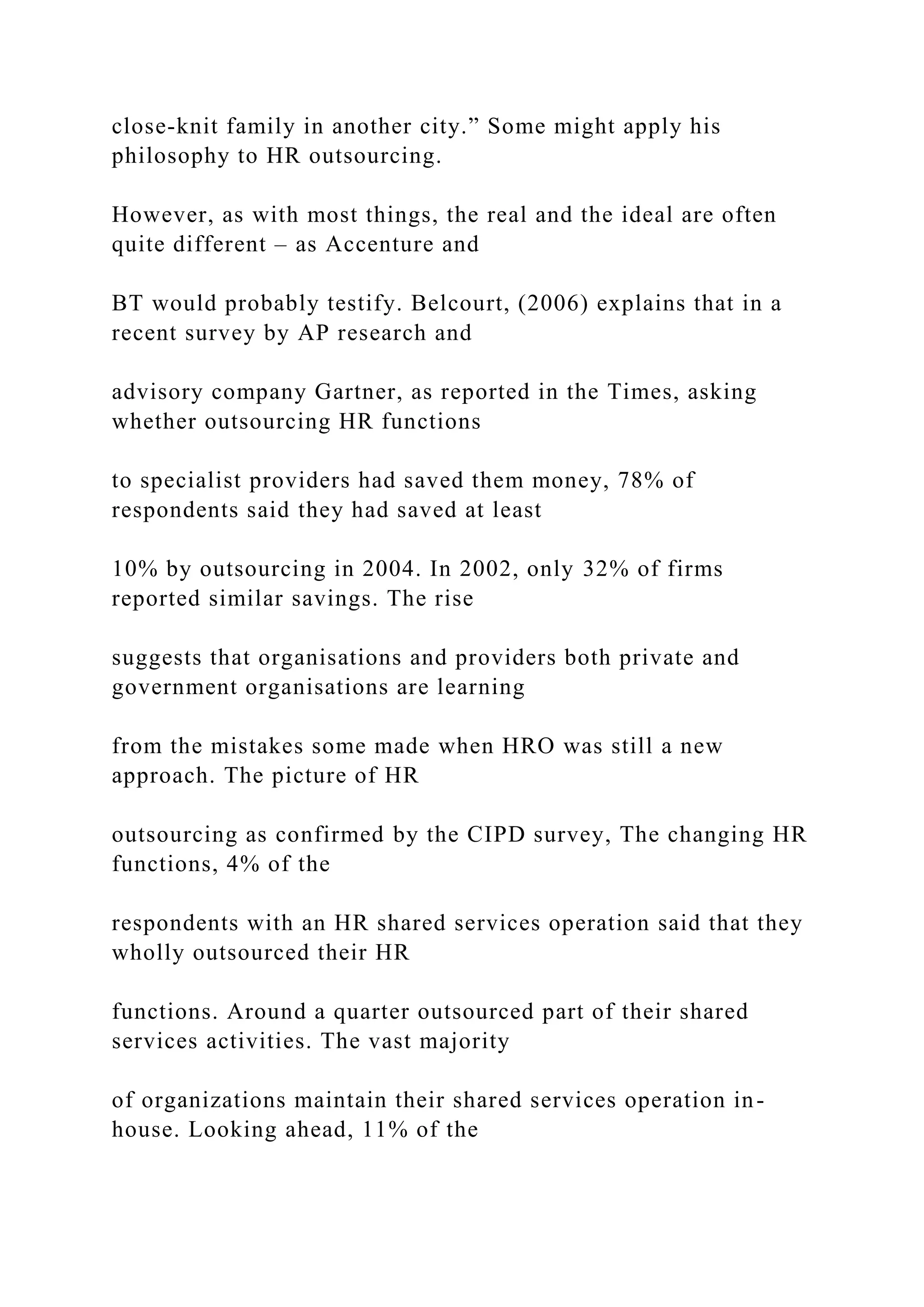
close-knit family in another city.” Some might apply his
philosophy to HR outsourcing.
However, as with most things, the real and the ideal are often
quite different – as Accenture and
BT would probably testify. Belcourt, (2006) explains that in a
recent survey by AP research and
advisory company Gartner, as reported in the Times, asking
whether outsourcing HR functions
to specialist providers had saved them money, 78% of
respondents said they had saved at least
10% by outsourcing in 2004. In 2002, only 32% of firms
reported similar savings. The rise
suggests that organisations and providers both private and
government organisations are learning
from the mistakes some made when HRO was still a new
approach. The picture of HR
outsourcing as confirmed by the CIPD survey, The changing HR
functions, 4% of the
respondents with an HR shared services operation said that they
wholly outsourced their HR
functions. Around a quarter outsourced part of their shared
services activities. The vast majority
of organizations maintain their shared services operation in-
house. Looking ahead, 11% of the
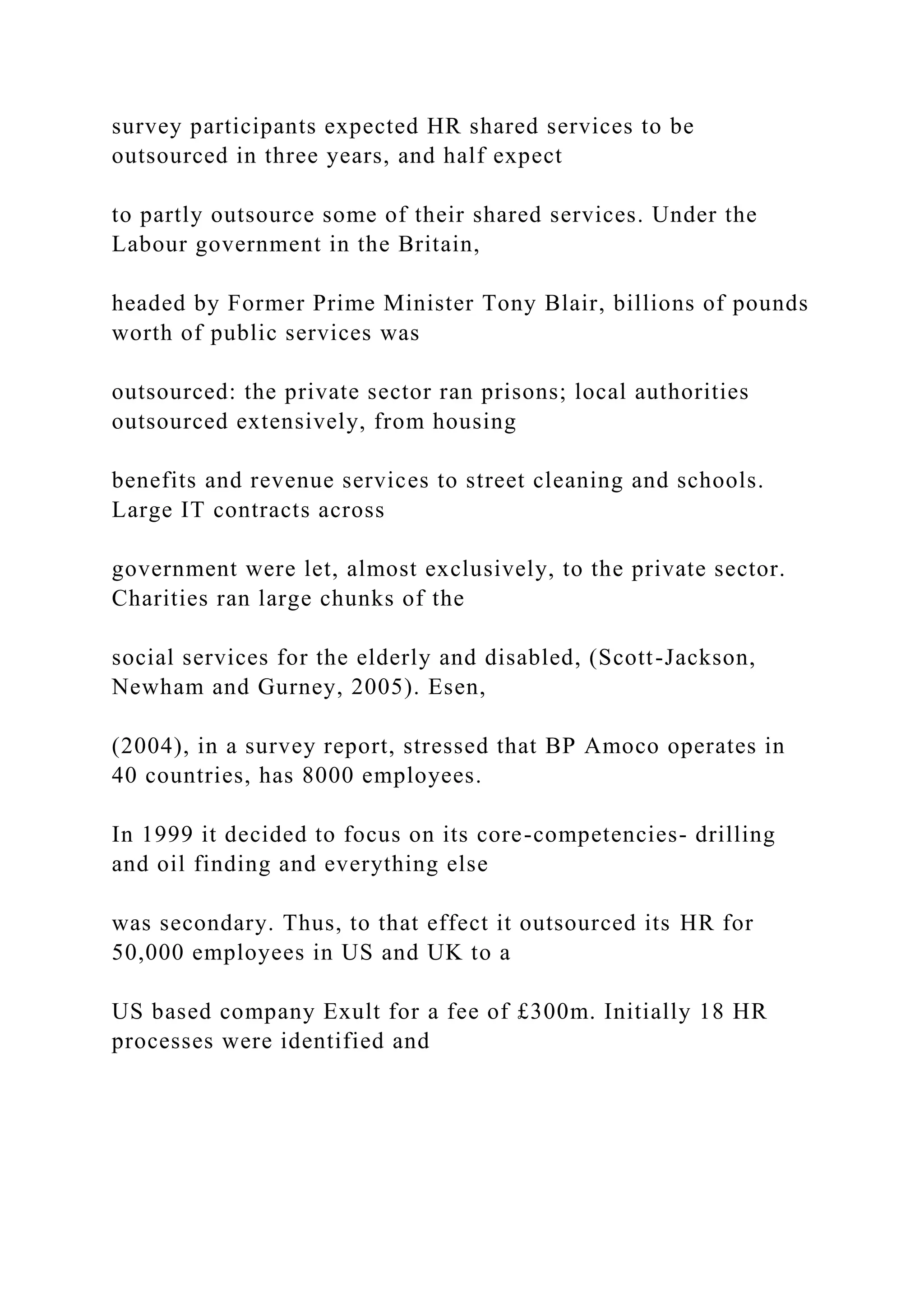
survey participants expected HR shared services to be
outsourced in three years, and half expect
to partly outsource some of their shared services. Under the
Labour government in the Britain,
headed by Former Prime Minister Tony Blair, billions of pounds
worth of public services was
outsourced: the private sector ran prisons; local authorities
outsourced extensively, from housing
benefits and revenue services to street cleaning and schools.
Large IT contracts across
government were let, almost exclusively, to the private sector.
Charities ran large chunks of the
social services for the elderly and disabled, (Scott-Jackson,
Newham and Gurney, 2005). Esen,
(2004), in a survey report, stressed that BP Amoco operates in
40 countries, has 8000 employees.
In 1999 it decided to focus on its core-competencies- drilling
and oil finding and everything else
was secondary. Thus, to that effect it outsourced its HR for
50,000 employees in US and UK to a
US based company Exult for a fee of £300m. Initially 18 HR
processes were identified and
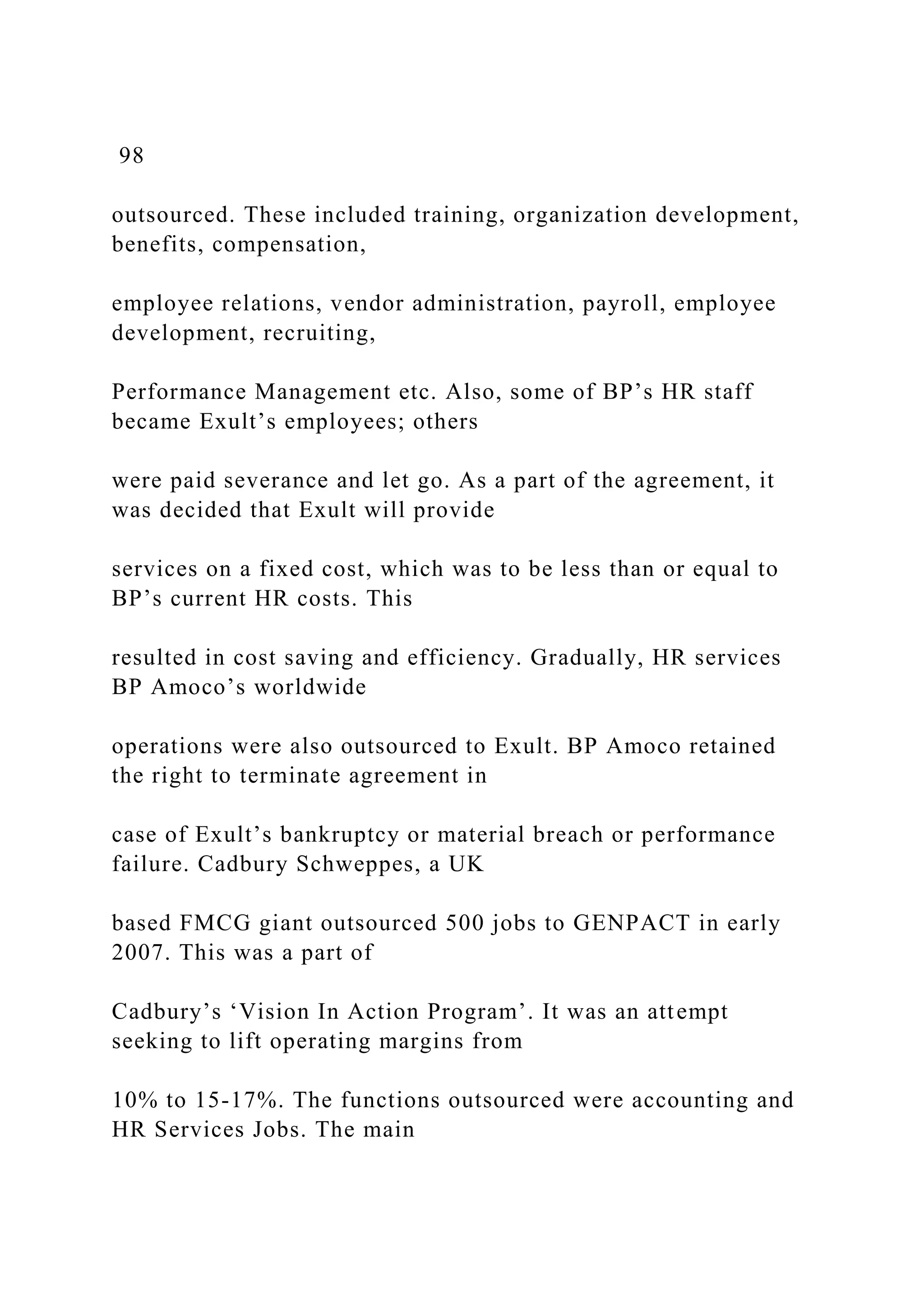
98
outsourced. These included training, organization development,
benefits, compensation,
employee relations, vendor administration, payroll, employee
development, recruiting,
Performance Management etc. Also, some of BP’s HR staff
became Exult’s employees; others
were paid severance and let go. As a part of the agreement, it
was decided that Exult will provide
services on a fixed cost, which was to be less than or equal to
BP’s current HR costs. This
resulted in cost saving and efficiency. Gradually, HR services
BP Amoco’s worldwide
operations were also outsourced to Exult. BP Amoco retained
the right to terminate agreement in
case of Exult’s bankruptcy or material breach or performance
failure. Cadbury Schweppes, a UK
based FMCG giant outsourced 500 jobs to GENPACT in early
2007. This was a part of
Cadbury’s ‘Vision In Action Program’. It was an attempt
seeking to lift operating margins from
10% to 15-17%. The functions outsourced were accounting and
HR Services Jobs. The main
reason was raising costs of labour. HR Jobs were to be handled
by GENPACT’s shared business
services division. Job locations would be based in India, China
and Romania, (Chartered Institute
of Personnel and Development, 2007)
In December 1999, BP gave away £300 million and
responsibility for its global human resources
administration and management. The seven-year contract, with
then start-up firm Exult, is the
biggest HR outsourcing deal on record, and some would say it is
a sign of the times, (Grossman,
2004). BP decided HR outsourcing may be right for them after a
fast succession of takeovers,
which brought them 100,000 new employees spread all over the
world and a number of
conflicting HR strategies. The organization was interested in
saving money and increasing
efficiency, and soon realized that an HR vendor may be able to
cut their in-house HR costs and
coordinate the systems in place.
Exult, based in California, looks at companies that spread over
at least five countries and have
over 25,000 bringing in revenue of over $10 billion a year. They
say they can cut costs between
10% and 20% per year. After some debate, it was decided that
the firms were mutually attractive.
The subsequent deal made Exult in charge of running most of
BP’s HR processes, leaving BP
with “only the things that would require judgment and policy”.
Hindle (2005) in his submission
stated that since BT outsourced some of its HR functions in the
spring of 2002 it has reaped
many benefits. Accenture HR Services committed to saving BT
five per cent per year over the
duration of the initial contract. A UK contract for HR services,
covering 87,000 employees and
180,000 pensioners, has resulted in £18 million in savings to
date, with a total projected saving
of £30 million by end of the contract in third quarter (Q3) of
2005. So successful has the original
partnership been that earlier this year the two companies signed
a new ten-year contract to
extend the relationship to another 10,000 BT employees in 37
additional countries. While cost
savings for this project are estimated to exceed those already
achieved, the benefits of
outsourcing have been more far-reaching than just direct cost
savings. By outsourcing, BT has
rationalized its training catalogue by 50%, reduced training
waiting lists by 26% and saved £2.2
million in time and money lost due to sickness. It has also
increased employee satisfaction
ratings across training and counselling – with 93% of employees
reporting that counselling made
them better equipped to manage their challenges, (Accenture,
2004). As a result of outsourcing,
BT reduced its HR function from 14,500 to 600 HR people. This
transformation was delivered
entirely through restructuring, process improvement,
elimination of duplication and focus on
productivity (Accenture, 2004).
99
t it succeeded in:
Greater efficiency achieved throughout HR (reduced transaction
times for basic HR
administrative tasks);
(from 3.81% to 3.10%.
95% of attendees
expressed satisfaction
following a stress workshop; 95% of employees using the
counselling service said they
would be pleased to use it again; and 93% of employees
reported that counselling made
them feel better equipped to manage their challenges.
Furthermore, in a recent Yankee Group report on human
resources (HR) business process
outsourcing, only 48%t of key decision makers agreed that HR
outsourcing had delivered the
promised return on investment they expected. With the market
for HR outsourcing set to grow
from £13 billion in 2003 to £29 billion in 2008. According to a
HR Consulting giant, Hewitt
Associates, a June 2002 on-line survey by the firm on
"Outsourcing in the Asia Pacific" survey,
threw up some interesting highlights. The survey, responded to
by over 424 company
representatives around the Asia-Pacific region, pointed to the
following:
concentration on core competencies
aid they had considered
outsourcing of HR as a means by
which to control costs
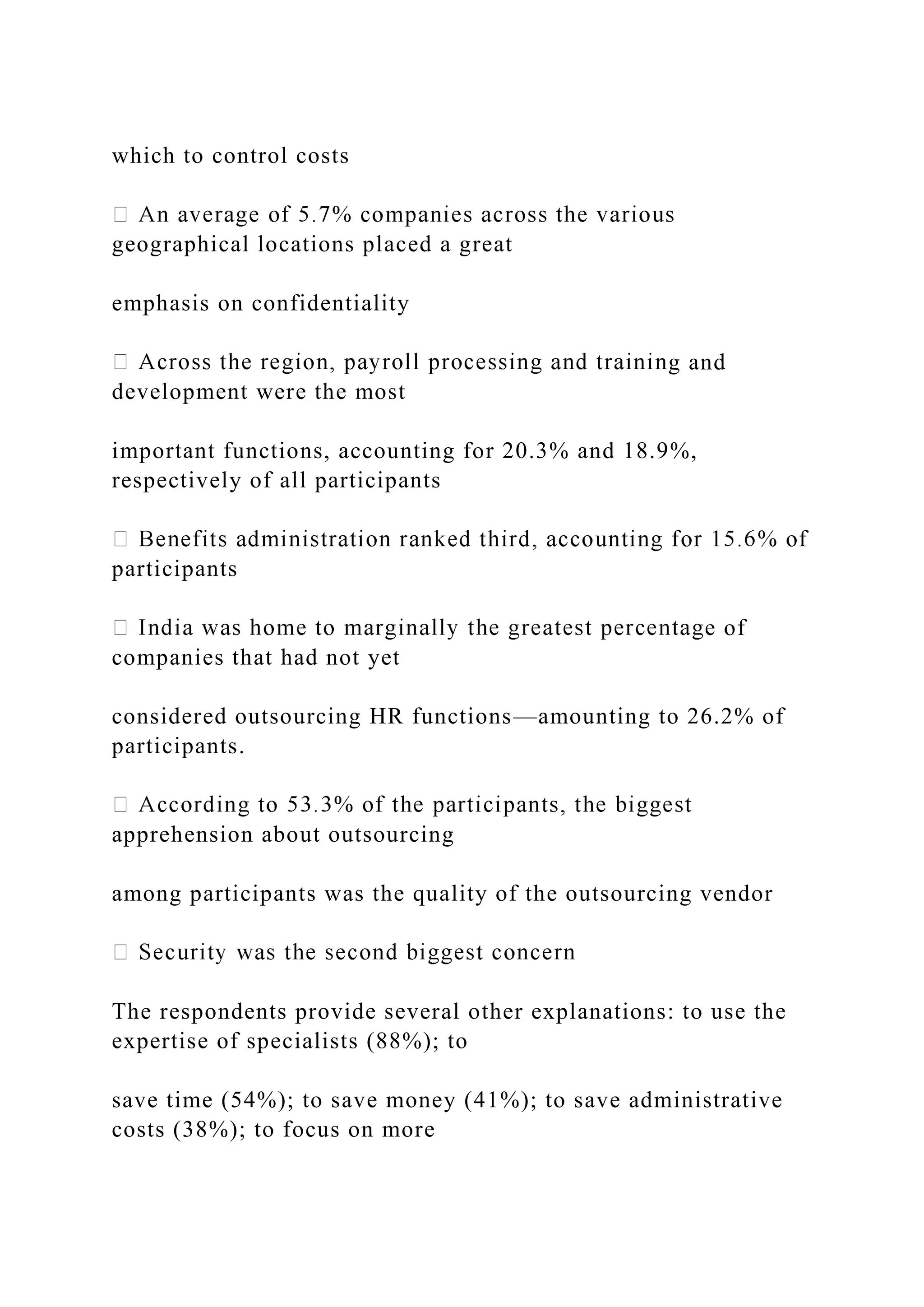
geographical locations placed a great
emphasis on confidentiality
g and
development were the most
important functions, accounting for 20.3% and 18.9%,
respectively of all participants
participants
e of
companies that had not yet
considered outsourcing HR functions—amounting to 26.2% of
participants.
apprehension about outsourcing
among participants was the quality of the outsourcing vendor
The respondents provide several other explanations: to use the
expertise of specialists (88%); to
save time (54%); to save money (41%); to save administrative
costs (38%); to focus on more
strategic initiatives (30 percent); the function is not part of the
core business (26%);
responsibilities have increased (21%): and to reduce liability
(7%), (Esen, 2004).
They also stated that outsourcing can save company money
provided that it enters the right
relationship with the right vendor. Because human resources
professionals state that the main
reasons they outsource are to use the expertise of specialists and
to save time, the responses
reveal that quality and flexibility are the key factors. This view
is also supported by Balogun,
Hope Hailey, (2004), who argues that HR outsourcing
represents a strategic tool for achieving
competitive advantage. They further stated that outsourcing of
the transaction-based HR
activities frees HR managers and other managers to deal with
strategic business issues. A
General Insurance company of British and Irish origin has 3,500
employees in 77 offices in 28
countries. In 2005, they decided to set up an offshore division
in Gurgaon, China. This division
was primarily for financial research/ Accounting and HR
operations. And in the Gurgaon office
it has a dedicated 14-member HR Operations team for global
business for compensation and
100
benefits, payroll, Retirement benefit processes. This team
reports to HR Operations Head in the
UK, who in turn reports to HR Head. This captive KPO division
as they like to bracket
themselves has proven to be an extremely successful venture.
Since its inception two and half
years ago it has been instrumental in reducing costs by 25% and
increasing profits by 33%,
(Main, 2006). Morton and Wilson, (2003), asserts that
technologies have altered the economics
of HR outsourcing services as it makes it easy, quick, and cheap
to transfer internal data (e.g.
payroll data or delivery instructions) to a vendor. The vendor
can analyze the data and instantly
copy results to the client, employees' banks, and the tax office.
Problems of time delays are
eliminated. Palmer, (2005) stressed that for informational tasks,
physical locations of the vendor
and client are irrelevant; the outsourced task can be performed
in a low wage country and/or a
centralized facility that provides economies of scale or a
different cost structure. This is
exemplified by the Indian call center whose volume justifies a
high fixed, low variable cost
technology. Morton and Wilson, (2003), further stated that
instead of shuffling paper work and
fielding phone calls, HR managers use the Internet to obtain
information and communicate with
others, affecting virtually every HR function. HR database
management systems maintain
organizationally relevant information about employees.
Developments in computer hardware and
software have not only made possible user-friendly access to
employee information, but also the
ability to analyze this information for purposes of
organizational planning. Main, (2006),
observed that in a recent survey conducted by the API Institute
on the importance of technology
to human resources outsourcing, 72% of the respondents stated
that technological advances are
revolutionizing the way organizations manage HR information.
They further stated that
technological advancements are helping to re-define the role of
HR in various organizations.
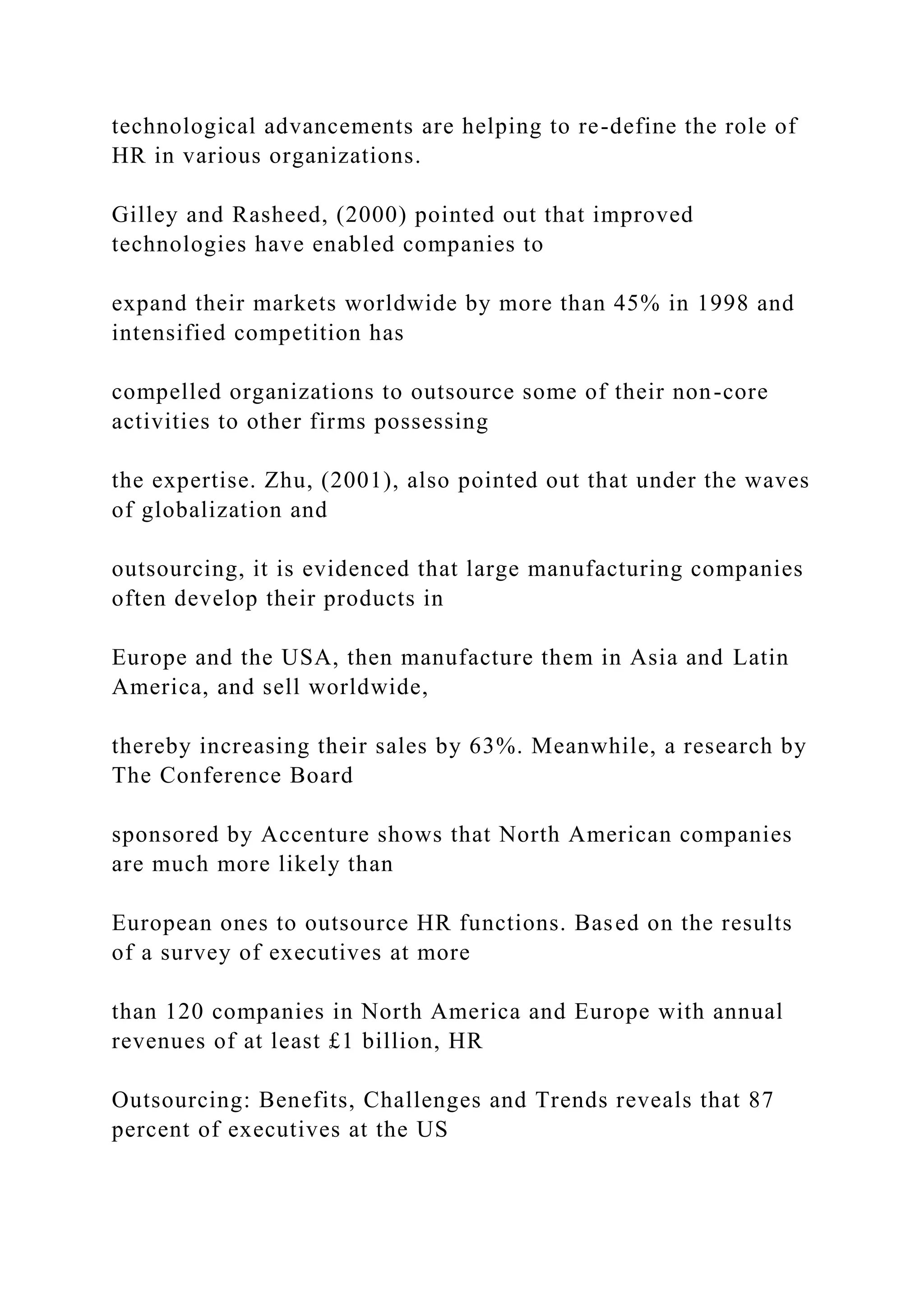
Gilley and Rasheed, (2000) pointed out that improved
technologies have enabled companies to
expand their markets worldwide by more than 45% in 1998 and
intensified competition has
compelled organizations to outsource some of their non-core
activities to other firms possessing
the expertise. Zhu, (2001), also pointed out that under the waves
of globalization and
outsourcing, it is evidenced that large manufacturing companies
often develop their products in
Europe and the USA, then manufacture them in Asia and Latin
America, and sell worldwide,
thereby increasing their sales by 63%. Meanwhile, a research by
The Conference Board
sponsored by Accenture shows that North American companies
are much more likely than
European ones to outsource HR functions. Based on the results
of a survey of executives at more
than 120 companies in North America and Europe with annual
revenues of at least £1 billion, HR
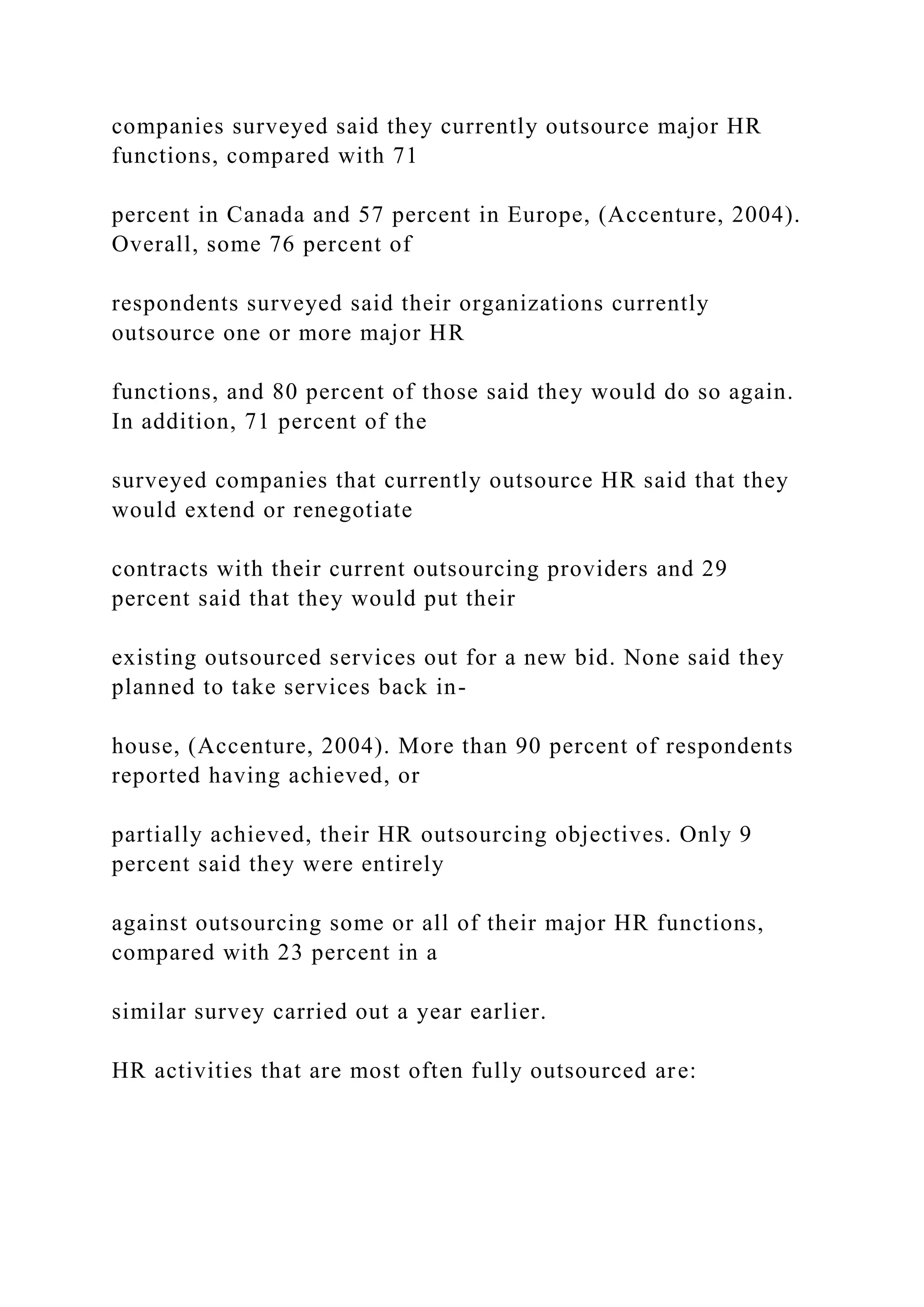
Outsourcing: Benefits, Challenges and Trends reveals that 87
percent of executives at the US
companies surveyed said they currently outsource major HR
functions, compared with 71
percent in Canada and 57 percent in Europe, (Accenture, 2004).
Overall, some 76 percent of
respondents surveyed said their organizations currently
outsource one or more major HR
functions, and 80 percent of those said they would do so again.
In addition, 71 percent of the
surveyed companies that currently outsource HR said that they
would extend or renegotiate
contracts with their current outsourcing providers and 29
percent said that they would put their
existing outsourced services out for a new bid. None said they
planned to take services back in-
house, (Accenture, 2004). More than 90 percent of respondents
reported having achieved, or
partially achieved, their HR outsourcing objectives. Only 9
percent said they were entirely
against outsourcing some or all of their major HR functions,
compared with 23 percent in a
similar survey carried out a year earlier.
HR activities that are most often fully outsourced are:
101
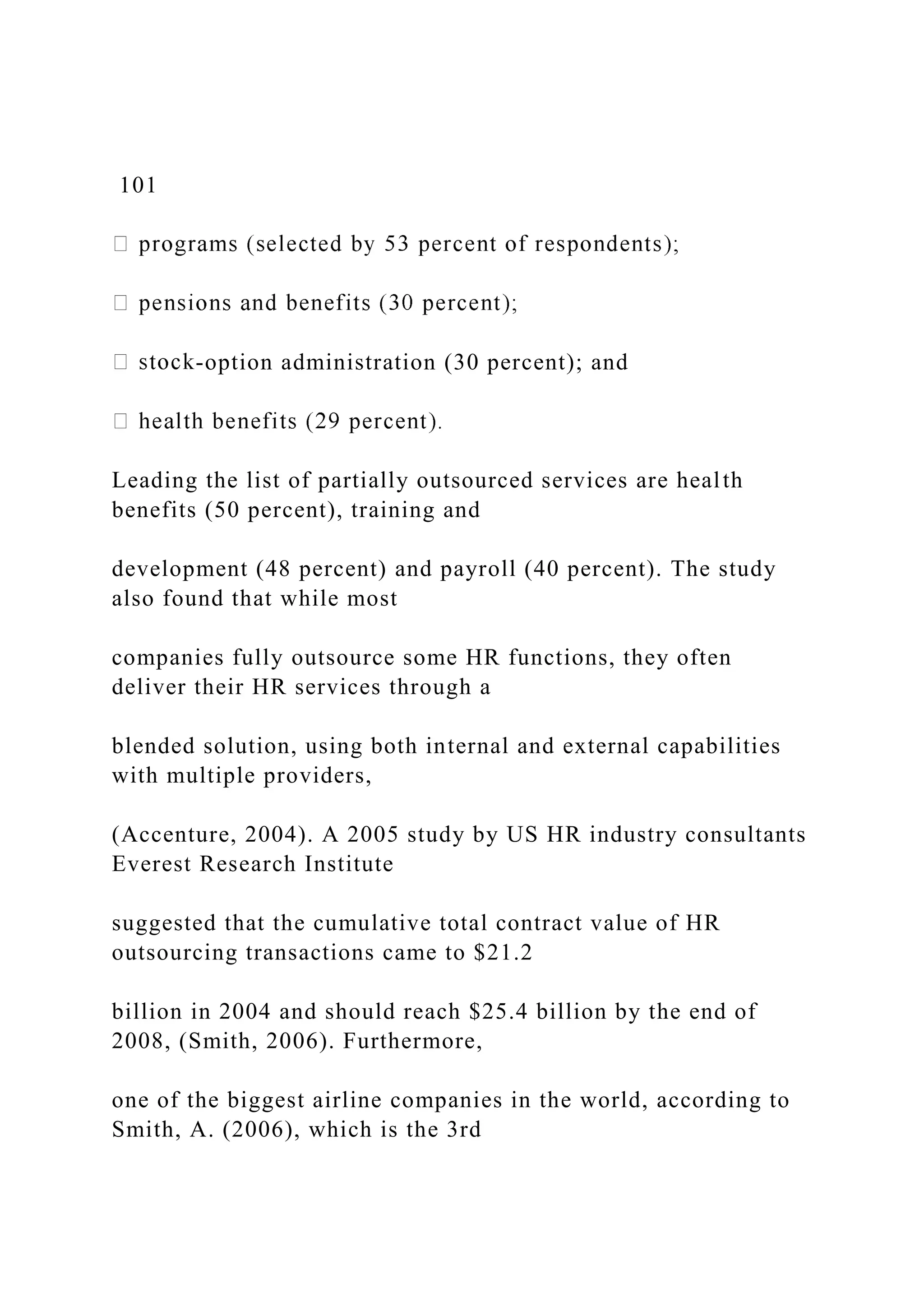
-option administration (30 percent); and
Leading the list of partially outsourced services are health
benefits (50 percent), training and
development (48 percent) and payroll (40 percent). The study
also found that while most
companies fully outsource some HR functions, they often
deliver their HR services through a
blended solution, using both internal and external capabilities
with multiple providers,
(Accenture, 2004). A 2005 study by US HR industry consultants
Everest Research Institute
suggested that the cumulative total contract value of HR
outsourcing transactions came to $21.2
billion in 2004 and should reach $25.4 billion by the end of
2008, (Smith, 2006). Furthermore,
one of the biggest airline companies in the world, according to
Smith, A. (2006), which is the 3rd
largest airlines in terms of U.S traffic, has signed a deal with a
company to outsource its human
resource operations. The deal between the companies is valued
at one hundred and twenty
million dollars and the airline company is very confident of
saving nearly 25% on its cost.
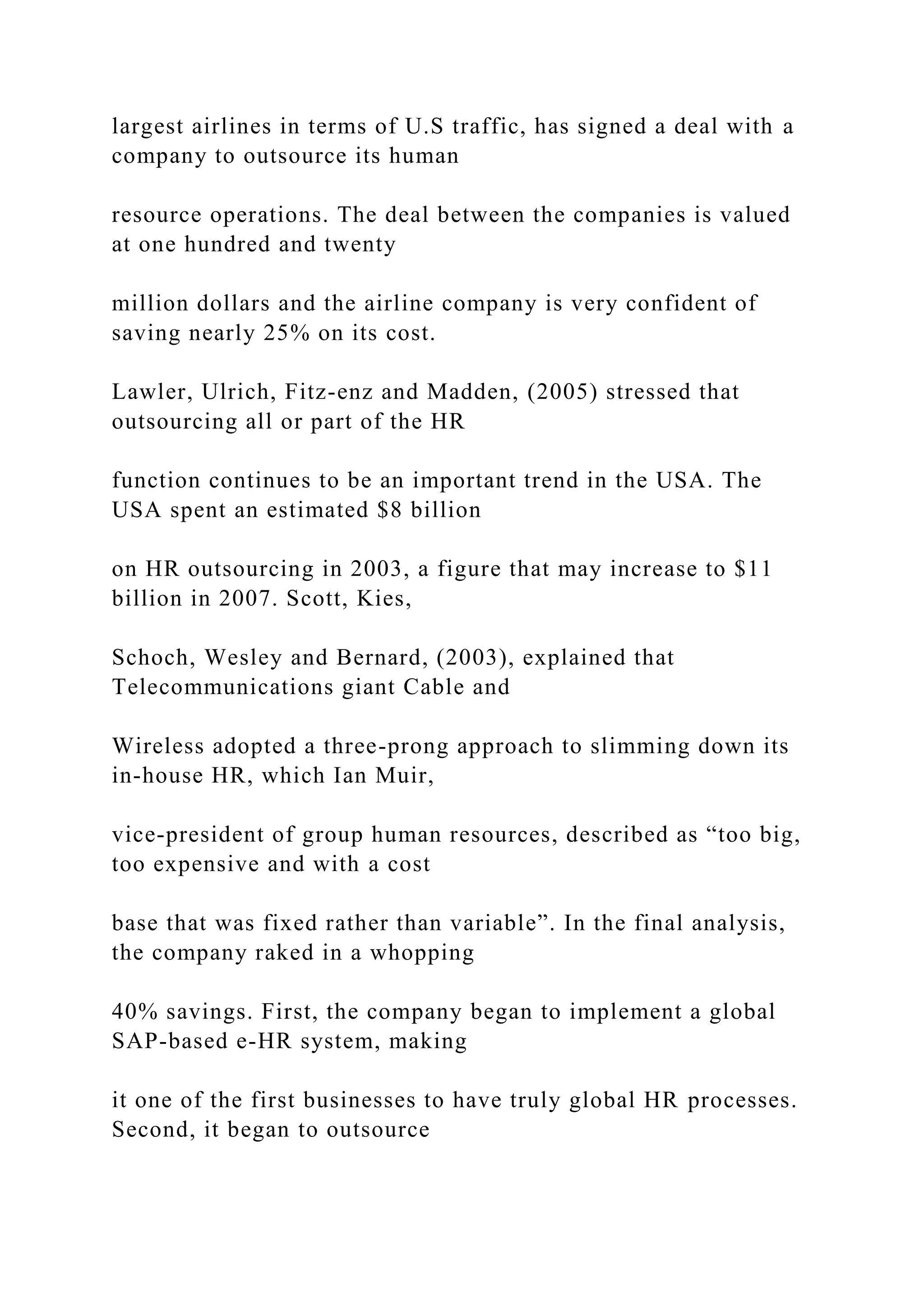
Lawler, Ulrich, Fitz-enz and Madden, (2005) stressed that
outsourcing all or part of the HR
function continues to be an important trend in the USA. The
USA spent an estimated $8 billion
on HR outsourcing in 2003, a figure that may increase to $11
billion in 2007. Scott, Kies,
Schoch, Wesley and Bernard, (2003), explained that
Telecommunications giant Cable and
Wireless adopted a three-prong approach to slimming down its
in-house HR, which Ian Muir,
vice-president of group human resources, described as “too big,
too expensive and with a cost
base that was fixed rather than variable”. In the final analysis,
the company raked in a whopping
40% savings. First, the company began to implement a global
SAP-based e-HR system, making
it one of the first businesses to have truly global HR processes.
Second, it began to outsource
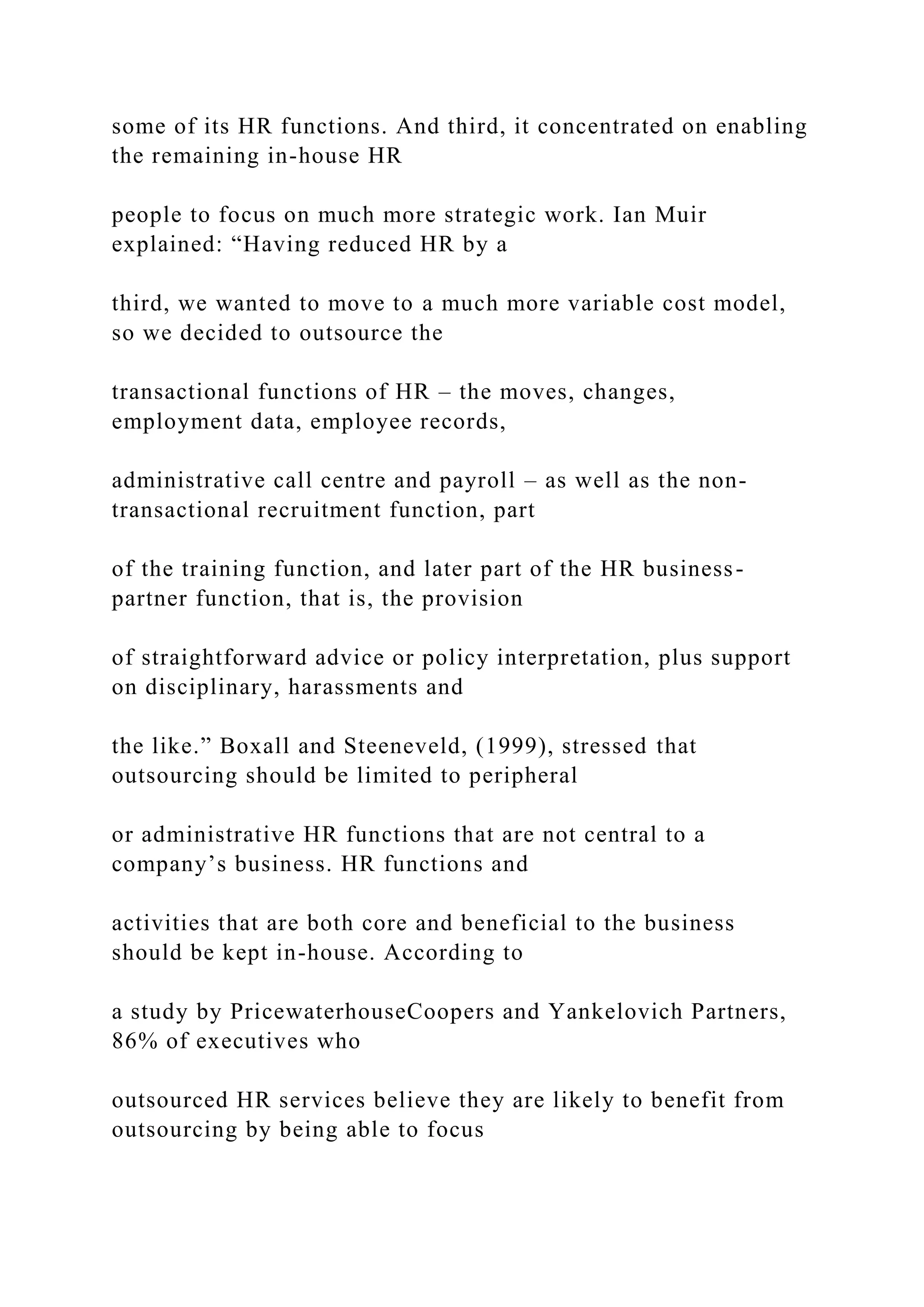
some of its HR functions. And third, it concentrated on enabling
the remaining in-house HR
people to focus on much more strategic work. Ian Muir
explained: “Having reduced HR by a
third, we wanted to move to a much more variable cost model,
so we decided to outsource the
transactional functions of HR – the moves, changes,
employment data, employee records,
administrative call centre and payroll – as well as the non-
transactional recruitment function, part
of the training function, and later part of the HR business-
partner function, that is, the provision
of straightforward advice or policy interpretation, plus support
on disciplinary, harassments and
the like.” Boxall and Steeneveld, (1999), stressed that
outsourcing should be limited to peripheral
or administrative HR functions that are not central to a
company’s business. HR functions and
activities that are both core and beneficial to the business
should be kept in-house. According to
a study by PricewaterhouseCoopers and Yankelovich Partners,
86% of executives who
outsourced HR services believe they are likely to benefit from
outsourcing by being able to focus
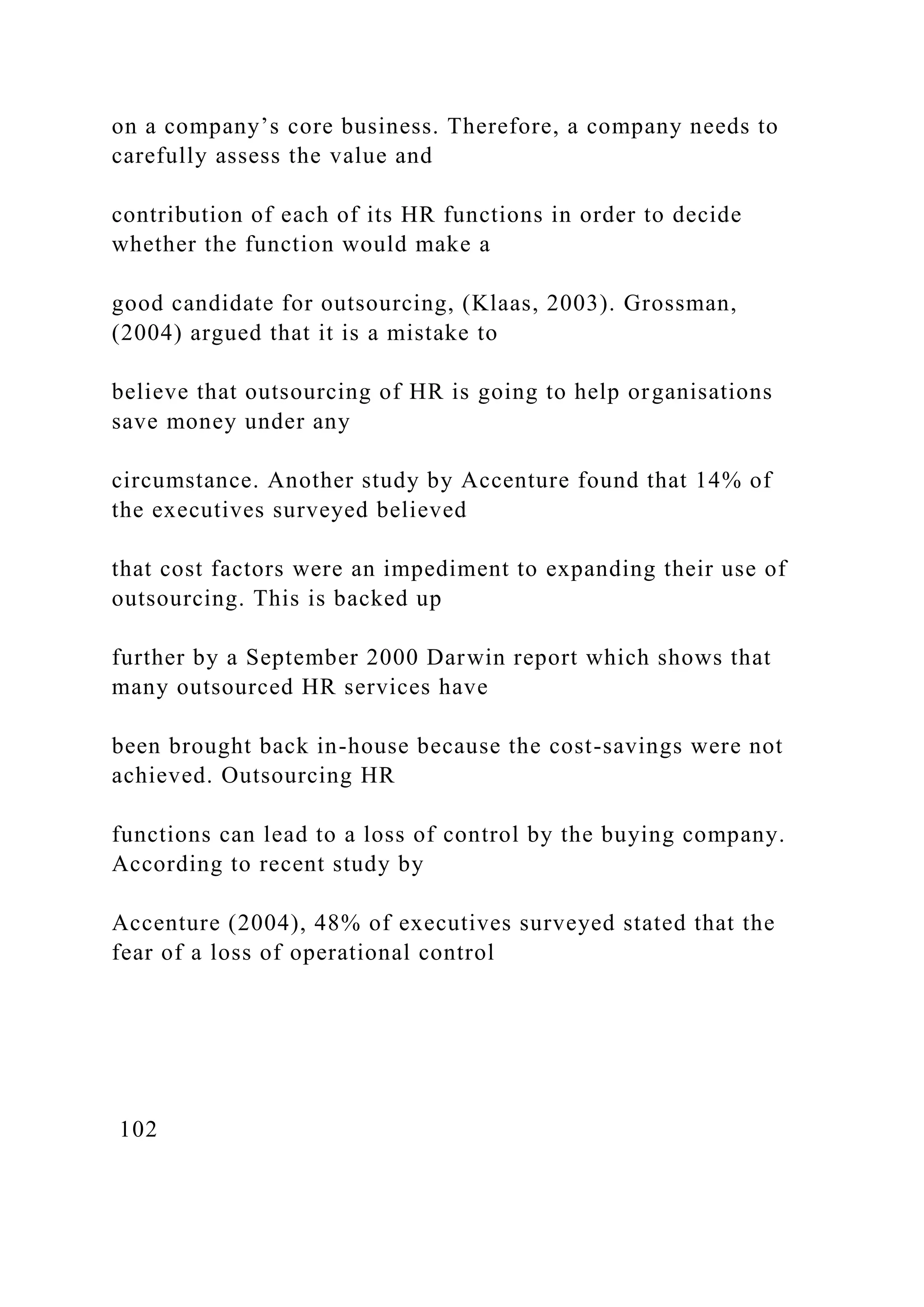
on a company’s core business. Therefore, a company needs to
carefully assess the value and
contribution of each of its HR functions in order to decide
whether the function would make a
good candidate for outsourcing, (Klaas, 2003). Grossman,
(2004) argued that it is a mistake to
believe that outsourcing of HR is going to help organisations
save money under any
circumstance. Another study by Accenture found that 14% of
the executives surveyed believed
that cost factors were an impediment to expanding their use of
outsourcing. This is backed up
further by a September 2000 Darwin report which shows that
many outsourced HR services have
been brought back in-house because the cost-savings were not
achieved. Outsourcing HR
functions can lead to a loss of control by the buying company.
According to recent study by
Accenture (2004), 48% of executives surveyed stated that the
fear of a loss of operational control
102
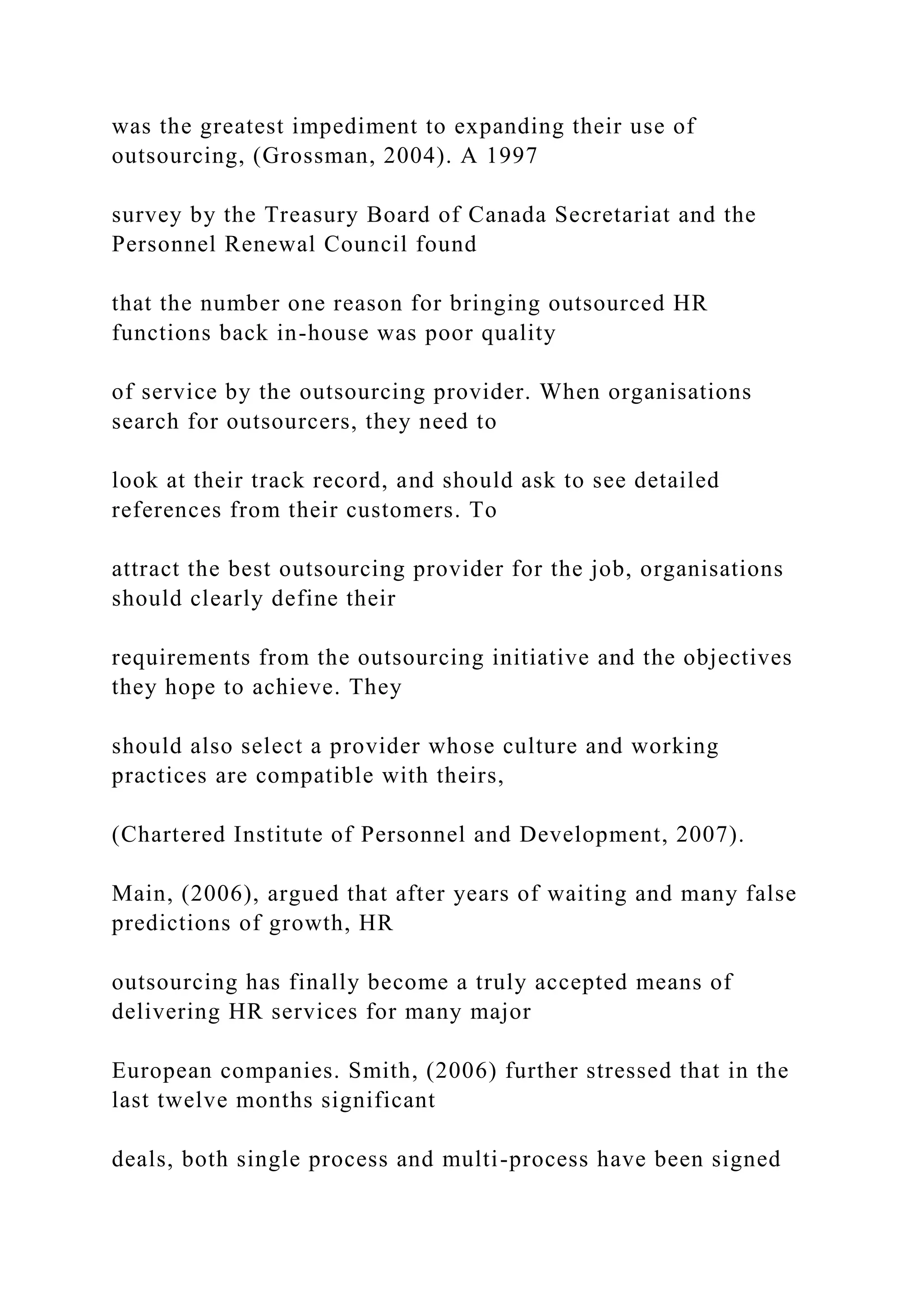
was the greatest impediment to expanding their use of
outsourcing, (Grossman, 2004). A 1997
survey by the Treasury Board of Canada Secretariat and the
Personnel Renewal Council found
that the number one reason for bringing outsourced HR
functions back in-house was poor quality
of service by the outsourcing provider. When organisations
search for outsourcers, they need to
look at their track record, and should ask to see detailed
references from their customers. To
attract the best outsourcing provider for the job, organisations
should clearly define their
requirements from the outsourcing initiative and the objectives
they hope to achieve. They
should also select a provider whose culture and working
practices are compatible with theirs,
(Chartered Institute of Personnel and Development, 2007).
Main, (2006), argued that after years of waiting and many false
predictions of growth, HR
outsourcing has finally become a truly accepted means of
delivering HR services for many major
European companies. Smith, (2006) further stressed that in the
last twelve months significant
deals, both single process and multi-process have been signed
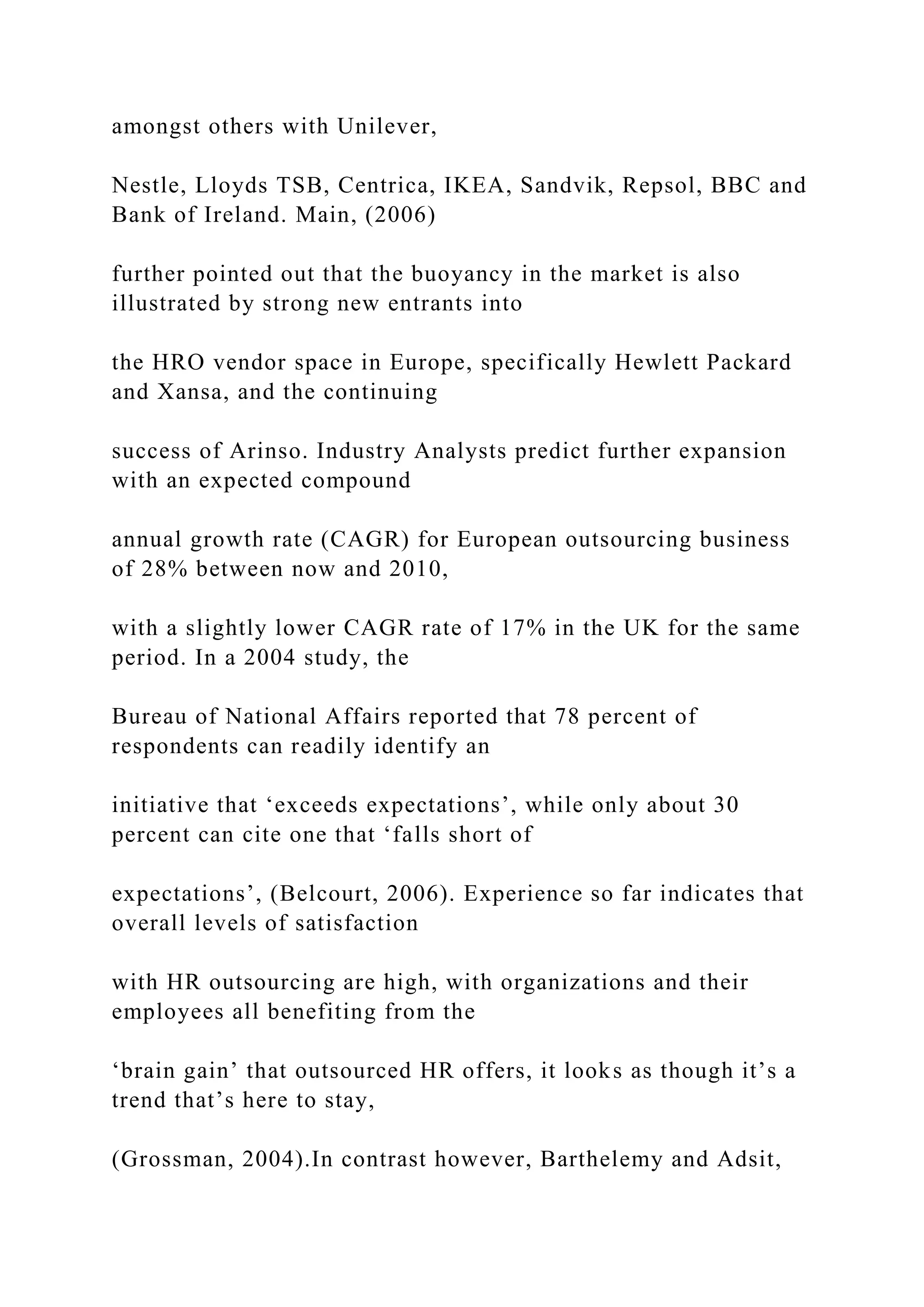
amongst others with Unilever,
Nestle, Lloyds TSB, Centrica, IKEA, Sandvik, Repsol, BBC and
Bank of Ireland. Main, (2006)
further pointed out that the buoyancy in the market is also
illustrated by strong new entrants into
the HRO vendor space in Europe, specifically Hewlett Packard
and Xansa, and the continuing
success of Arinso. Industry Analysts predict further expansion
with an expected compound
annual growth rate (CAGR) for European outsourcing business
of 28% between now and 2010,
with a slightly lower CAGR rate of 17% in the UK for the same
period. In a 2004 study, the
Bureau of National Affairs reported that 78 percent of
respondents can readily identify an
initiative that ‘exceeds expectations’, while only about 30
percent can cite one that ‘falls short of
expectations’, (Belcourt, 2006). Experience so far indicates that
overall levels of satisfaction
with HR outsourcing are high, with organizations and their
employees all benefiting from the
‘brain gain’ that outsourced HR offers, it looks as though it’s a
trend that’s here to stay,
(Grossman, 2004).In contrast however, Barthelemy and Adsit,
(2003), argued that by
outsourcing a HR function, organisations tend to lose the
managerial control. This happens
because it is harder to manage the outsourcing service provider
as compared to managing one's
own employees. Also because organisations generally tend to
skip (or miss to calculate) the
potential hidden costs of HR outsourcing, This hidden and
missed out costs of outsourcing is
hard to predict causing overall costs to be underestimated. In a
separate 2004 SHRM human
resource outsourcing survey found that in some cases HR
outsourcing led to a decrease in
customer service (25% of respondents), a less personal
relationship with employees (37% of
respondents), and a decrease in employee morale (6% of
respondents), (Grossman, 2004).
According to Adler, (2003), it is still hard to get away from the
fact that HR is typically run as a
cost centre within a business, and as such is expected to provide
a value-added service to the
business. An almost unavoidable way forward, therefore, is to
identify options for delivering
those services for less, which probably means using an external
service provider. The challenge,
therefore, if outsourcing is an inevitable trend, is to do it in a
well-planned way, with clear goals
in mind and ensuring that the change-management risks are well
managed. The framework
suggests that organizations should consider all the mentioned
factors and their implications when
making outsourcing decisions.
Whenever organisations decide to transfer ownership and
responsibility for activities
traditionally carried out internally to external providers, they
simultaneously redraw
organisational boundaries and change organisational structures
and shape. These changes often
involve reductions in personnel in order to improve the
efficiency of the firm in terms of cost
103
disciplines and to maintain competitiveness in the market,
(Dyer, Kale and Singh, 2001).
Outsourcing of human resources creates change problems. If an
in-house function is outsourced
to a vendor, there is danger of disruption caused by
misunderstanding or failure to transfer data
properly. Outsourcing a function may entail dismissal or
redeployment of employees, changes in
the work they do or their transfer to the vendor's employment
and its different condition,
(Barthelemy and Adsit, 2003). Smith, (2006), observed that
outsourcing of human resources
obviously has an effect on employee morale. “Indeed, among
531 companies surveyed by the
Wyatt Company in 1993, more than half reported decreased
morale and commitment among
downsizing survivors”. These statements show the importance
of employee morale to the success
of an organization. According to the Yankee Group (1996), 80
per cent of employees will
initially view HR outsourcing extremely negatively. Their
acceptance level will improve,
however, if management communicates its rationale constantly
about the deal, and possible
career paths. By the time the deal is finalized, 50 per cent
should be accepting of the situation
with a further 30 per cent acclimatizing to the deal within six
months after it is signed,
(Barthelemy and Adsit, 2003). These statistics describe a “best
case” scenario that can only be
achieved when communication channels remain open.
Developing a policy on how to
communicate an outsourcing move is very important to a
successful transition” (Perry, 1997).
The heart of an organisation is its engagement with staff;
something an external supplier cannot
provide, (Adler, 2003). Furthermore, managers must ensure all
those affected are made aware of
milestones that are reached and the options available. Providing
counselling and out-placement
services, therefore, is an essential component of the successful
HR outsourcing process. All
employees must believe that management is being fair.
Seeing fellow employees lose their jobs always leads to an
emotional response from surviving
employees. According to one Public Service Commission of
Canada publication, survivors
exhibit many of the following symptoms:
As well: “it doesn’t take long for some of the survivors to
channel that emotion into two
counterproductive streams: retaliation and self-defence”. These
actions can be very damaging to
an organization, as some employees may break company. In
order not to deal with the
unpleasantness of redundancies, negative publicity and the
legality of employee rights,
organisations are increasingly undertaking outsourcing deals
which include the transfer of staff
to service providers. In certain cases, service providers take
over the entire workforce of
outsourced activity as a condition of contract, (Harris,
Giumipero and Hult, 1998). Wasner,
(1999) in support of the above, stated that outsourcing of human
resources functions often have
immediate and continuing effects on employment in absolute
and relative terms. Usually a
significant number of employees are transferred to the service
supplier, who then enters into a
service contract to provide the service that the employees
previously delivered directly. The
following are examples of such transfers: 1,250 employees of
British Aerospace (BA) were
transferred into Computer Science Corporation (CSC) (see
Business Wire, 1993; Regulatory
News Service, 1993). British Petroleum outsourcing agreements
involved transferring 1,400 of its
IT staff (see Computer Weekly, 1992) and around 1,100 of the
chemical giant’s, ICI, staff have
104
been transferred to Origin as a result of an outsourcing deal
(Computer Weekly, 1996). Other
announcements relate to a smaller number of employees; for
example, General Accident
(Glasgow Herald, 1997) and Rolls Royce (Birmingham Post,
1997) who transferred 250 and 160
respectively. Belcourt, (2006), states that the correct application
of the European Acquired
Rights Directive and TUPE (in the UK) has ensured that
affected employees normally don’t lose
out if they transfer across to the vendor organization.
4.0 Discussion and conclusion
Organizations the world over are today faced with two very
important roles. The first involves
being a business partner which focuses on core functions that
impact on the bottom-line
objectives of the organization. And the second is that top
managements are now critical iin
ensuring that the day to day needs of employees are addressed
in order for them to function
efficiently. Top managements have since the dawn of the new
millennium and the aftermath of
the global meltdown of 2008 realized that these two roles
affords them great foresights to
manage the organization’s strategic approaches while at the
same time ensuring that its
immediate and relevant concerns are not in any way affected.
The forces of globalization are
sweeping across the world and national borders are
disappearing. One major outcome of this
change is that competition has intensified greatly. In the past,
low performing organizations
could survive because they were protected by national
boundaries and governments. These may
not be possible any more. In this global era, organizations have
to be able to take on other
companies located in any part of the world in terms of product
quality and ability to successfully
deliver these products to the end-users with a well refined
logistics and properly trained and
motivated work-force. They need to be supple and adaptable to
meet the competitive challenges,
(Banham, 2003). To face the onslaught of hyper-competition,
organizations are becoming
responsive and flexible. The human factor, if managed
effectively, is perhaps the most important
in imparting organizational flexibility. Managing the human
factor as a competitive tool falls in
the domain of strategic human resource management, (Lawler,
Ulrich, Fitz-enz, and Madden,
2005).
5.0 References
Accenture (2004) “Accenture HR Services: Client success story:
BT”, Accenture,
available at URL:http:// www.accentureHRservices.com
(accessed February 28, 2015)
Adler, P.S. (2003), "Making the HR outsourcing decision", MIT
Sloan Management Review,
Vol. 45 No. Autumn, pp. 53-60.
Agwu, M. Edwin; Carter, A.L. and Murray, P.J. (2014)
Downsizing as a strategic tool for
effective organizational management, International Journal of
Research in Management,
Science & Technology (E-ISSN: 2321-3264) Vol. 2, No. 1,
pp.1-9. April 2014 Available
at www.ijrmst.org
Agwu, E. M. and Taylor, A. R. (2014) CSR as a strategic
management tool: expectations and
realities of two MNCs in Nigeria. International Journal of Civic
Engagement and Social
Change (IJCESC); January-March 2014, Vol. 1, No. 1, pp.27-
43. Available at:
http://www.igi-global.com/journal/international-journal-civic-
engagement-social
[email protected]
Agwu, M.E, and Kadiri, I. (2014) Analysis of critical strategic
factors for the successful
implementation of poverty alleviation programmes in Nigeria.
International Journal of
http://www.accenturehrservices.com/
http://www.ijrmst.org/
http://www.igi-global.com/journal/international-journal-civic-
engagement-social
mailto:[email protected]
105
Computational Engineering & Management, Vol. 17(1) 1–9,
January 2014. Available at:
http//www.basicresearchjournals.org
Alexander, M., Young, D. (1996), "Outsourcing: where's the
value?" Long Range
Planning, Vol., Vol. 29 pp.728-30.
Anderson, J., Weitz, B. (1986), "Make-or-buy decisions:
vertical integration and
marketing productivity", Sloan Management Review, No.
Spring, pp.3-19
Axelsson, B., Wynstra, F. (2002), Buying Business Services,
Wiley, Chichester, United Kingdom
Bajpai, N., Sachs, J., Arora, R., & Khurana, H. (2004, June).
Global services sourcing: Issues of
cost and quality [CGSD Working Paper No.16]
Balogun, J., Hope Hailey, V. (2004), Exploring Strategic
Change, Prentice-Hall, Harlow
Banham, R. (2003), HR Outsourcing Leads the Way.
Outsourcing Essentials.
Vol. 1, The Outsourcing Institute,
Barnes, P. (2004), "Good going", Financial Management, ISSN
1471-9185,
No. October, pp.31-2.
Barthelemy, J., and Adsit, D. (2003), "The seven deadly sins of
outsourcing",
Academy of Management Executive, Vol. 17 No.2, pp.87-100
Belcourt, M. (2006) Outsourcing: the benefits and the risks.
Human Resource
Management Review. Vol 16, No 2, June. pp269-279
Benson, J., and Leronimo, N. (1996), "Outsourcing decisions:
evidence from
Australia-based enterprises", International Labour Review, Vol.
135 No.1, pp.59-73.
Bettis, R.A., and Hitt, M.A. (1995), "The new competitive
landscape", Strategic
Management Journal, Vol. 16 pp.7-19.
Bettis, R.A., and Bradley, S.P., Hamel, G. (1992), "Outsourcing
and industrial
decline", Academy of Management Executive, Vol. 6 No.1,
pp.7-22.
Berg, B.L. (1998), Qualitative Research Methods for the Social
Sciences, 3rd ed.,
Allyn & Bacon, Boston, MA.,
Bolumole, Y.A. (2001), "The supply chain role of third-party
logistics providers",
International Journal of Logistics Management, Vol. 12 No.2,
pp.87-102
Boxall, P., and Steeneveld, M. (1999), "Human resource
strategy and competitive
advantage: a longitudinal study of engineering consultancies",
Journal of Management
Studies, Vol. 36 No.4, pp.443-63.
Bryce, D.J., and Useem, M.U. (1998), "The impact of corporate
outsourcing on
company value", European Management Journal, Vol. 16 No.6,
pp.635-43
Chartered Institute Of Personnel and Development (2007), The
changing HR
function. Survey report, London: CIPD. Available at:
http://www.cipd.co.uk/surveys
(accessed March 10, 2015)
Cook, M. (1999), Outsourcing Human Resources Functions.
Strategies for
Providing Enhanced HR Services at Lower Cost, AMACOM,
New York, NY
Das, T.K., and Teng, B-S (1999), "Managing risk in strategic
alliances", Academy of
Management Executive, Vol. 13 No.4, pp.50-62
Deloitte. (2005). Calling a change in the outsourcing market:
The realities for the
world's largest organizations. From www.deloitte.com (accessed
January 18, 2008)
Dennis, M.J. (2003), "Service management: building profits
after the sale",
Supply Chain Management Review, Vol. 7 No.1, pp.42-8.
Dyer, J.H., and Kale, P., Singh, H. (2001), "How to make
strategic alliances work",
MIT Sloan Management Review, Vol. 42 No.4, pp.37-43
http://www.cipd.co.uk/surveys
http://www.deloitte.com/
106
Eisenhardt, K. M. (1989), "Building theories from case study",
Academy of
Management Review, Vol. 14 No.4, pp.532-50
EquaTerra, T. (2005). Transforming HR: Realities, futures and
the role of BPO.
Retrieved June 2, 2005, from www.equaterra.com
Esen, E. (2004). SHRM human resource outsourcing survey
report Alexandria,
VA: Society for Human Resource Management.
Fill, C., Visser, E. (2000), "The outsourcing dilemma: a
composite approach to
the make or buy decision", Management Decision, Vol. 38 No.1,
pp.43-50.
Gilley, K.M., Greer, C.R., and Rasheed, A.A. (2004), "Human
resource outsourcing and
organizational performance in manufacturing firms", Journal of
Business Research, Vol.
57 No.3, pp.232-40.
Gilley, K.M., and Rasheed, A. (2000), "Making more by doing
less: an analysis of
outsourcing and its effects on firm performance", Journal of
Management, Vol. 26 No.4,
pp.763-90.
Gray, A. (2002), "Jobseekers and Gatekeepers: the role of the
private
employment agency in the placement of the unemployed",
Work, Employment and
Society, Vol. 16 No.4, pp.655-74.
Grossman, R.J. (2004), "Sticker shock", HR Magazine, ISSN
1047-3149, Vol. 49 No.7, pp.79-
86.
Gunsauley, C. (2002), "Workers report family tensions, rising
job stress",
Employee Benefit News, Vol. 16 No.13, pp.81-2.
Harper, P. (2001), "How to keep your organizational reality
from sabotaging your
outsourcing strategy", The Professional Journal, Vol. 25 No.12,
pp.17-20
Harris, A., Giumipero, L., and Hult, T. (1998), "Impact of
organisational and contract
flexibility on outsourcing contracts", Industrial Marketing
Management, Vol. 27 pp.373-
84.
Hayes, D.C., Hunton, J.E., and Reck, J.L. (2000), "Information
systems outsourcing
announcements: investigating the impact on the market value of
contract-granting firms",
Journal of Information Systems, Vol. 14 No.2, pp.109-25.
Hewitt HR Outsourcing: Trends & Insights Survey 2005 - IDC
Worldwide and
U.S. HR Management Services 2005-2009. Author Lisa Rowan
http://was4.hewitt.com/hewitt/resource/newsroom/subnewsroom
/pdf/industry_facts1005.
pdf (accessed May 21, 2015)
Hindle, J. (2005), HR outsourcing in operation: critical success
factors. Journal:
Human Resource Management International Digest, ISSN: 0967-
0734 Year: May 2005
Volume: 13 Issue: 3 Page: 39 - 42 DOI: Publisher: Emerald
Group Publishing Limited
(accessed May 18, 2015)
Jones, I.W. and Pollitt, M.G. (2004) 'Understanding How Issues
in Corporate
Governance Develop: Cadbury Report to Higgs Review',
Corporate Governance, April
2004, vol 12, no. 2, p162.
Klaas, B., McClendon, J.A., and Gainey, T. (1999), "HR
outsourcing and its impact:
the role of transaction costs", Personnel Psychology, Vol. 52
pp.113-36.
Klaas, B.S. (2003), "Professional employer organizations and
their role in small
and medium enterprises: the impact of HR outsourcing",
Entrepreneurship Theory and
Practice, Vol. 28 No. Autumn, pp.43-59
Koch, J. (2004). HR outsourcing in government organizations:
Emerging trends, early lessons.
New York: The Conference Board.
http://www.equaterra.com/
http://dx.doi.org/10.1016/S0148-2963(02)00304-1
http://was4.hewitt.com/hewitt/resource/newsroom/subnewsroom
/pdf/industry_facts1005.pdf
http://was4.hewitt.com/hewitt/resource/newsroom/subnewsroom
/pdf/industry_facts1005.pdf
107
Kotabe, M., and Murray, J.Y. (2001), "Outsourcing service
activities", Marketing
Management, Vol. 10 No.1, pp.40-5
Lawler, E., Ulrich, D., Fitz-enz, J., & Madden, J. (2005).
Human resources business process
outsourcing: Transforming how HR gets its work done. San
Francisco: Josey-Bass.
Leonard, B. (1999), "Employers to spend $7 billion on HR
outsourcing", HR
Magazine, Vol. 44 No.13, pp.27
Main, C. (2006) How to manage an HR outsourcing contract.
People Management. Vol 12, No
13. 29 June. pp44-45.
McIvor, R., and McHugh, M. (2000), "Partnership sourcing: an
organization change
management perspective", Journal of Supply Chain
Management, Vol. 36 No.3, pp.12-
20.
Mclvor, R.T., and Humphreys, P.K. (2000), "A case-based
reasoning approach to the
make or buy decision", Integrated Manufacturing Systems, Vol.
11 No.5, pp.295-310
Momme, J., and Hvolby, H-H. (2002), "An outsourcing
framework: action research in
the heavy industry sector", European Journal of Purchasing &
Supply Management, Vol.
8 No.4, pp.185-96.
Morton, B., and Wilson, A. (2003), "Double vision", People
Management, Vol. 9 No
October, pp.37-8
Newman, J., & Willmott, J. (2004). NelsonHall forecasts 21%
annual growth in multi-process
HR BPO market by 2008. Accessed March 15, 2015, from
www.nelson-
hall.com/pressdocs/pr_22.html
Palmer, T. (2005) How to select an HR outsourcing provider
People Management Vol. 11, No
22, 10 November pp. 42-43.
Perry, C.R. (1997), "Outsourcing and union power", Journal of
Labour Research,
Vol. 18 No.4, pp.521-34
Quinn, J.B., and Hilmer, F.G. (1994), "Strategic outsourcing",
Sloan Management
Review, Vol. 35 No.4, pp.43-55
Quinn, J.B. (1999), "Strategic outsourcing: leveraging
knowledge capabilities",
Sloan Management Review, Vol. 40 No.4.
Roodhooft, F., and Warlop, L. (1999), "On the role of sunk
costs and asset specificity
in outsourcing decisions: a research note", Accounting,
Organization and Society, Vol. 24
pp.363-9.
Saunders, C., Gebelt, M., and Hu, Q. (1997), "Achieving
success in information systems
outsourcing", California Management Review, Vol. 39 pp.63-79
Scott, J., Kies, P., Schoch, B., and Wesley, J., & Bernard, S.
(2003). Human resource
outsourcing gaining traction fast: A look at factors driving
growth and consolidation in
this emerging industry. Accessed March 10, 2015, from
www.rwbaird.com
Scott-Jackson, W., Newham, T. and Gurney, M. (2005) HR
outsourcing: the key decisions,
Executive briefing, London: Chartered Institute of Personnel
and Development.
Smith, A. (2006) Overcoming four HR outsourcing obstacles
Strategic HR Review Vol. 5 No 4,
May/June pp. 28-31
Ten Raa, T., and Wolff, E.N. (2001), "Outsourcing of services
and the productivity recovery in
US manufacturing in the 1980s", Journal of Productivity
Analysis Vol. 16 pp.149-65
Ulrich, D. (1996), Human Resource Champions, Harvard
University Press,
Boston, MA.,
Ward, K., Grimshaw, D., Rubery, J., and Beynon, H. (2001),
"Dilemmas in the
http://www.nelson-hall.com/pressdocs/pr_22.html
http://www.rwbaird.com/
108
Management of temporary work agency staff", Human Resource
Management Journal,
Vol. 11 No.4, pp.3-21
Wasner, R. (1999), "The outsourcing process – strategic and
operational realities", Linköping
University, Linköping.
Whitehead, J. (2004). 2005 HRO superstars Retrieved June 1,
2015, from
www.hrotoday.com/pdf/200412_ Superstars.pdf, p. 31
Whittington, R. and Molloy, E. (2005) HR's role in organising:
shaping change. Research report
London: Chartered Institute of Personnel and Development.
Yamamoto, M. (2008) “Outsourcing: U.S. needs reforms, not
rhetoric.” CNET News
http://www.cnetnews.com> (accessed March 01, 2015)
Zhu, Z., Hsu, K., and Lillie, J. (2001), "Outsourcing – a
strategic move: the process
and the ingredients for success", Management Decision, Vol. 39
No.5, pp.373-8.
Websites:
CIOL Site –Dataquest - The Outsourcing Rush
http://www.dqindia.com/content/special/103031303.asp online
(accessed March 15, 2015)
http://society.guardian.co.uk/microsite/outsourcing_/story/0,132
30,933818,00.html (accessed
March 15, 2015.
View publication statsView publication stats
http://www.hrotoday.com/pdf/200412_%20Superstars.pdf
http://www.cnetnews.com/
http://www.dqindia.com/content/special/103031303.asp%20onli
ne%20(accessed%20March
http://society.guardian.co.uk/microsite/outsourcing_/story/0,132
30,933818,00.html
https://www.researchgate.net/publication/306077346
All participants must read the following article ATTACHED Agwu.docx

All participants must read the following article ATTACHED Agwu.docx

  • 1.
    All participants mustread the following article: ATTACHED * Agwu, E. & Ohaegbu, V.A. (2015). Strategic management of the benefits and challenges of HR outsourcing in effective organizational management. Journal of Business Studies Quarterly, 7, 2, 85-108. Retrieved from http://jbsq.org/wp- content/uploads/2015/12/December_2015_6.pdf Participants will be assigned to groups. Within each group, members will assume the role of a VP of Human Resources. In this role, list both the organizational opportunities and challenges of utilizing some level of outsourcing of at least 2 HR processes. * Your list should include a minimum of three (3) opportunities and challenges for each process, especially as they pertain to driving enterprise goals, and organizational culture. * Provide supporting statements from the article, our texts and other readings/resources, for your positions. Reporting and Valuation for Undergraduates 1 Below is a 2-part question. Please create a word document and/or spreadsheet to answer the following prompts. Upload your response according to the directions. Part I: Reporting and Financial Statement Analysis
  • 2.
    1. Given thefollowing income statements, calculate the estimated cash flow for years 20x1 and 20x2. 2. Given the following income statements, calculate the interest coverage (time interest earned) ratio for years 20x1 and 20x2. 3. Given the following income statements, calculate the net profit margin ratio for years 20x1 and 20x2. Income Statement for years 20x1 and 20x2 20x1 20x2 Sales $5,450 $5,000 Operating Costs excluding Depreciation and Amortization 4,775 4,250 EBITDA 675 750 Depreciation and Amortization 40 180 EBIT $635 $570 Interest Expense 62 200 EBT $573 $370 Taxes (40%) 229 148 NI $344 $222 4. Based solely on the following balance sheets, calculate the current ratio for years 20x1 and 20x2? 5. Based solely on the following balance sheets, calculate the debt ratio for years 20x1 and 20x2. Balance Sheet ending December 31 for years 20x1 and 20x2 20x1 20x2 Assets: Cash $275 $250 Short Term Investments 55 50 Accounts Receivable 375 250 Inventories 825 750
  • 3.
    Total Current Assets$1,530 $1,300 Net Plant and Equipment 2,925 2,750 Total Assets $4,455 $4,050 Liabilities: Notes Payable $192 $100 Accounts Payable 580 100 Miscellaneous Payables 245 250 Total Current Liabilities $1,017 $450 Long-Term Debt 550 500 Total Liabilities $1,567 $950 Reporting and Valuation for Undergraduates 2 Common Stock 2154 2,600 Retained Earnings 734 500 Less Treasury Stock 46 0 Total Shareholder Equity $2,888 $3,100 Liabilities and Shareholder Equity $4,455 $4,050 6. Based on both the income statements and balance sheets, calculate the return on assets (return on investment) ratios for years 20x1 and 20x2. 7. Based on both the income statements and balance sheets, calculate the total asset turnover ratio for years 20x1 and 20x2. Part II: Capital Budgeting and Financing Considerations
  • 4.
    8. Given thefollowing cash flows of two mutually-exclusive projects, A and B, calculate the NPV for each project. Both Project A and Project B have an estimated cost of capital of 10%. Cash flows will be realized at the end of each time period. Which, if either, project should be accepted? Why? Explain. 9. Are there other methods of choosing between projects? If so, explain them. Year, t A B 0 -2,000 -1,000 1 200 800 2 400 700 3 1,000 500 4 1,400 200 5 1,600 100 See discussions, stats, and author profiles for this publication at: https://www.researchgate.net/publication/306077346 Agwu, M.E. & Ohaegbu, V.A. (2015) Strategic management of the benefits and challenges of HR Outsourcing in Effective Organizational Management Article in Journal of Business Studies Quarterly · July 2015 CITATIONS
  • 5.
    0 READS 199 1 author: Some ofthe authors of this publication are also working on these related projects: Journal Publication View project journal View project Edwin Agwu Lagos Business School, Pan-Atlantic University, Lagos State 72 PUBLICATIONS 122 CITATIONS SEE PROFILE All content following this page was uploaded by Edwin Agwu on 02 December 2016. The user has requested enhancement of the downloaded file. https://www.researchgate.net/publication/306077346_Agwu_ME _Ohaegbu_VA_2015_Strategic_management_of_the_benefits_a nd_challenges_of_HR_Outsourcing_in_Effective_Organizationa l_Management?enrichId=rgreq- 5a256b172abc05d2a004c0bc01928841- XXX&enrichSource=Y292ZXJQYWdlOzMwNjA3NzM0NjtBUz o0MzQ3MzA5MTE5NjUxODRAMTQ4MDY1OTMzNDc1Ng%3 D%3D&el=1_x_2&_esc=publicationCoverPdf
  • 6.
    https://www.researchgate.net/publication/306077346_Agwu_ME _Ohaegbu_VA_2015_Strategic_management_of_the_benefits_a nd_challenges_of_HR_Outsourcing_in_Effective_Organizationa l_Management?enrichId=rgreq- 5a256b172abc05d2a004c0bc01928841- XXX&enrichSource=Y292ZXJQYWdlOzMwNjA3NzM0NjtBUz o0MzQ3MzA5MTE5NjUxODRAMTQ4MDY1OTMzNDc1Ng%3 D%3D&el=1_x_3&_esc=publicationCoverPdf https://www.researchgate.net/project/Journal- Publication?enrichId=rgreq- 5a256b172abc05d2a004c0bc01928841- XXX&enrichSource=Y292ZXJQYWdlOzMwNjA3NzM0NjtBUz o0MzQ3MzA5MTE5NjUxODRAMTQ4MDY1OTMzNDc1Ng%3 D%3D&el=1_x_9&_esc=publicationCoverPdf https://www.researchgate.net/project/journal- 20?enrichId=rgreq-5a256b172abc05d2a004c0bc01928841- XXX&enrichSource=Y292ZXJQYWdlOzMwNjA3NzM0NjtBUz o0MzQ3MzA5MTE5NjUxODRAMTQ4MDY1OTMzNDc1Ng%3 D%3D&el=1_x_9&_esc=publicationCoverPdf https://www.researchgate.net/?enrichId=rgreq- 5a256b172abc05d2a004c0bc01928841- XXX&enrichSource=Y292ZXJQYWdlOzMwNjA3NzM0NjtBUz o0MzQ3MzA5MTE5NjUxODRAMTQ4MDY1OTMzNDc1Ng%3 D%3D&el=1_x_1&_esc=publicationCoverPdf https://www.researchgate.net/profile/Edwin_Agwu?enrichId=rgr eq-5a256b172abc05d2a004c0bc01928841- XXX&enrichSource=Y292ZXJQYWdlOzMwNjA3NzM0NjtBUz o0MzQ3MzA5MTE5NjUxODRAMTQ4MDY1OTMzNDc1Ng%3 D%3D&el=1_x_4&_esc=publicationCoverPdf https://www.researchgate.net/profile/Edwin_Agwu?enrichId=rgr eq-5a256b172abc05d2a004c0bc01928841- XXX&enrichSource=Y292ZXJQYWdlOzMwNjA3NzM0NjtBUz o0MzQ3MzA5MTE5NjUxODRAMTQ4MDY1OTMzNDc1Ng%3 D%3D&el=1_x_5&_esc=publicationCoverPdf https://www.researchgate.net/profile/Edwin_Agwu?enrichId=rgr eq-5a256b172abc05d2a004c0bc01928841-
  • 7.
    XXX&enrichSource=Y292ZXJQYWdlOzMwNjA3NzM0NjtBUz o0MzQ3MzA5MTE5NjUxODRAMTQ4MDY1OTMzNDc1Ng%3 D%3D&el=1_x_7&_esc=publicationCoverPdf https://www.researchgate.net/profile/Edwin_Agwu?enrichId=rgr eq-5a256b172abc05d2a004c0bc01928841- XXX&enrichSource=Y292ZXJQYWdlOzMwNjA3NzM0NjtBUz o0MzQ3MzA5MTE5NjUxODRAMTQ4MDY1OTMzNDc1Ng%3 D%3D&el=1_x_10&_esc=publicationCoverPdf Journal of BusinessStudies Quarterly 2015, Volume 7, Number 2 ISSN 2152-1034 Strategic Management of the Benefits and Challenges of HR Outsourcing in Effective Organizational Management Agwu Edwin – PhD, MSc, MBA, BSc (Hons), NCE Associate Professor of Strategic Management and Marketing, School of Business, Covenant University, Ogun State, Nigeria & Adjunct Lecturer and External dissertation supervisor for Global MBA students at Manchester Business School, United Kingdom: Email: [email protected] or [email protected]
  • 8.
    Ohaegbu, V. Awele,PhD (ongoing), MSc, BSc Department of Business Management, Covenant University, Ota, Ogun State [email protected] or [email protected] Abstract The stiff competition and ever changing business environment has brought with them a plethora of challenges for organizational managers. Different programmes are often designed to overcome these challenges and enhance performance. Outsourcing has become an increasingly dominant preference for organizations seeking to focus on core competences, reduce operating costs and enhance service deliveries. Outsourcing generally is considered an important factor in today’s businesses and has become the fastest growing business process outsourcing services in many countries in recent years. The growth of outsourcing as a management too is evidenced on the premises where various organisations outsource within and across borders. This study therefore outlines the strategic management of the benefits and challenges of this often controversial tool in meeting organisational needs. While the
  • 9.
    findings of thisstudy revealed cost and time savings, among others, as some of the key reasons for outsourcing, the challenges weighed heavily on the loss of expertise and inability of business organizations to muster any form of business secrets and often lead to low morale on the part of organisational employees. Keywords: Outsourcing, Human Resource, Benefits, Challenges, Organizational management 1.0 Introduction Outsourcing has become a growing trend in the 21st century. It is the strategy of companies to concentrate more and more on their core competencies and key businesses. One definition of outsourcing is that it is a contractual relationship between an external vendor and an enterprise in which the vendor assumes responsibility for one or more business functions of the enterprise Boxall and Steeneveld, (1999); this means that these companies have sought different partners to take care of their support functions. Today, every organization aims at increasing productivity by
  • 10.
    enhancing return oninvestments and achieving economies of scale. The general consensus is that mailto:[email protected] mailto:[email protected] mailto:[email protected] mailto:[email protected] 86 organisations should focus only on their core competencies and outsource non-critical business activities. Therefore, routine administrative works, although important, can be outsourced to third party vendors. The idea of outsourcing according to Fill and Visser, (2000) has its roots in the competitive advantage theory propagated by Adam Smith in his book 'The Wealth of Nations' which was published in 1776. Over the years, the meaning of the term 'outsourcing' has undergone a sea-change. Kotabe & Murray, (2001) stressed that what started off as the shifting of manufacturing to countries providing cheap labour during the industrial revolution, has taken
  • 11.
    on a newconnotation in today's scenario. Barthelemy, (2003) observes “the idea of contracting- out as a means for improving public administration dates back to the 1850s”. The author also noted that there was a clear increase in outsourcing between 1987 and 1995, since then, there has been a boom in outsourcing. Klaas, (2003), also observed that third party involvement in IT can be traced back to the 1960s in the USA, the landmark event that brought IT outsourcing to the attention of the business world was Eastman Kodak’s decision to outsource its IT to an IBM subsidiary in 1989. Other companies soon followed, including Continental, Enron, American Standard, National Car Rental, and Copperweld. By the early 1990s, IT outsourcing cases were being reported in journals such as the Harvard Business Review. This study examines from strategic management point, the benefits and challenges of outsourcing of human resource in effective organizational management. 2.0 Review of related literature The history of outsourcing dates back to the industrial
  • 12.
    development that beganin the late 17th century. For instance, the making of America's covered wagon covers and clipper ships' sails was a job outsourced to workers in Scotland, with raw material imported from India. England's textile industry became so efficient in the 1830s that eventually Indian manufacturers couldn't compete, and that work was outsourced to England, (Benson and Leronimo (1996). Wasner, (1999), states that the ancient Chinese and the Japanese empires were also adept at outsourcing to their conquered nations. But looking at recent times, in the USA many computer companies used to outsource their payroll processing in the 1970s and 1980s. Learning that outsourcing existed since the early days of our civilization, one may wonder why no one talked about it, twenty years back and the reason for the hues and cries about it now? Alexander and Young, (1996) stressed that the reason outsourcing stayed out of the news was because it used to happen on a small scale and was concentrated in some specific regions, like the USA and Europe. But now outsourcing is billions of pounds a year industry and the world cannot afford
  • 13.
    to ignore it.Globalization, explosive growth of internet, and the development of information society in every region of the world has made outsourcing an integral part of the world economy. Bajpai, Sachs, Arora, and Khurana, (2004), stated that the origin of outsourcing could be related to exporting of the valuable goods from developing countries to US and European countries. China, India and most Asiatic countries, for instance, are becoming hubs for most outsourcing businesses. Particularly, China and India have proven records for their innovations in almost all sectors, whether it is painting, craft or other technological domains. The last few years have witnessed a lot of activities in patent filing and patent lawsuits. These results in huge need for the various patents related services. This leads to the generation on Knowledge Outsourcing concept. Most of them acquire their patent works from top industries in US, Europe and Japan. And most of the firms have gained reputation, from their unique service qualities. Thus, the core to this business is innovation, new tools and techniques for the delivery of quality
  • 14.
    work at competitivecosts. Bajpai, et al., (2004), further stressed that the evolution of these capsules of energy, in corporate terms “The Outsource centres” has broken a very stupendous ritual of Chinese and Indian work http://www.emeraldinsight.com/Insight/ViewContentServlet?Fil ename=Published/EmeraldFullTextArticle/Articles/0240250901. html#b34 87 cultures which was the ancient day light shift system. Men and women of these vast lands were fed on the principles of “Work Only When the Sun is up and shining, because the nights are not meant for working”. However, as a rule of demography, the West wakes up when the East goes to sleep. So, the Indian Mard (Man in Hindi) and the Bharatiya Nari (the typical Indian woman) have now been exposed to working round the solar clock; in other terms, catapulting the Indian work group to the norms of world business. Lawler, Ulrich, Fitz-enz, and Madden, (2005), in support of this assertion, states that, it was not
  • 15.
    long ago thatthe concept of Business - Across - the - Seas was a distant dream, in fact an impossible feat to imagine. But the technical advancements of the West and the remarkable ideas of technology have rendered these realistic yet astonishing business transactions feasible. In furtherance of this, the authors stated, ‘’How else would you like to describe “A zappy New York corporate head, seated at 309, Lake St., Penn Yan, NY - 14527 in the busiest of corporate blocks in ‘’The Big Apple’’, calling in to order for a Pizza for lunch, to be answered by an ardent order taker situated at a call centre in New Delhi, India, who ensures that the Pizza is delivered in a remarkable service time, with extreme accuracy to the point that the number of Jalapeños in the Pizza ordered are accurate to ensure the customer’s delight”. That is the advent of technology that has scaled remarkable heights. This seems quite simple, but as the experts would tell you “It Is Not as Simple as It Seems”. They authors further stated that, ‘’if you would ever want to know how effective the origin of outsourcing fundamentals has been in the Indian Market, you do not
  • 16.
    have to holda conference of the top heads of the leading organizations in the market. Rather, walk up to an entry level representative in a call centre, and he or she would explain to you how happy they are talking to the Smith’s and the Spencer’s of Virginia and Florida. The smile on the faces of these mighty warriors would explain the success of Outsourcing on the Indian soil’’. Cook, (1999), in his submission observed that the origin of outsourcing in America dates back to the 1970’s when IBM developed the IT industry in India. Later, the Internet and telecommunications boom encouraged outsourcing as a means of promoting capitalism. 2.1 Overview of the meanings of outsourcing Organisations are constantly in search of new solutions and strategies to develop and increase their competitive advantage; outsourcing is one of these strategies that can lead to greater competitiveness, (Kotabe, and Murray, (2001). Hindle (2005), defined outsourcing as a management strategy by which an organization delegates major, non-core functions to
  • 17.
    specialized and efficientservice providers. Koch, (2004), states that it can also be described as the contractual agreement between the customer and one or more suppliers to provide services or processes that the customer is currently providing internally. Morton and Wilson, (2003), viewed outsourcing as having works that was formerly done inside the organization performed by an external organization. The vendor (hereafter the outsourcer and outsourcee are, respectively, referred to as vendor and client) may be an independent entity or a wholly owned subsidiary. Klaas, (2003), in his submission, defined outsourcing as “reliance on external sources for manufacturing components and other value-adding activities”. Gray, (2002) focused on employment, defining outsourcing as, “another firm's employees carrying out tasks previously performed by one's own employees”. Dyer, Kale, & Singh, (2001), also, viewed outsourcing as turning over to a supplier those activities outside the organization's chosen core competencies. Campbell, (1995), briefly described outsourcing as a “managed process of transferring activities
  • 18.
    to be performedby others” and its main advantage is conceptually based on two strategic pillars 88 the core competencies of the company; and considered strategic necessities and/or whenever the company does not possesses the adequate competencies and skills. Alexander and Young, (1996), observed that the single biggest cause in the increase of outsourcing has been the concept of the core organisations which focuses its in-house expertise on its primary functions and purchases any necessary support from a range of sources in its periphery. But Fill and Visser, (2000), warned that it can be dangerous to focus too narrowly on a single, isolated process when making an outsourcing decision. In supporting this assertion, Barthelemy and Adsit (2003), suggested that such choices
  • 19.
    should be madeonly after four questions have been answered: - effectiveness of using outsourcing? using outsourcing? ill be the net effect on the strength, versatility and resourcefulness of the treasury department if the duties in question are outsourced? outsourcing, and how vulnerable would the organization be if that third party somehow became unable to perform as expected? Harper, (2001), pointed out that outsourcing can free up assets and reduce costs in the immediate financial period. While Newman and Willmott (2004) stressed that organisations outsourcing parts of their in-house operations report significant savings on operational and capital costs. Hindle (2005) in his study found a correlation between outsourcing best practice and high performing companies. This is explained by Transaction Cost Economics (TCE) – the
  • 20.
    underpinning for make-or-buydecisions, (Perry, 1997). Figure 1: Outsourcing decision framework Source: Wasner, R. (1999), "The outsourcing process – strategic and operational realities", Linköping University, Linköping 89 Perry, (1997) further states that in Transaction Cost Economics, the boundaries of the firm (i.e. whether products and services are bought or provided in-house) are determined by the most cost- effective option. This includes “the uncertainty associated with executing the transaction and the uniqueness or specificity of the assets associated with the goods or services transacted”. Hindle (2005) also observed that outsourcing might seem to be a simple cost reduction option, but there
  • 21.
    are challenges togetting it right. Knowing what benefits to expect in the first instance and setting measurable performance indicators for both the client and the outsourcer are important starting points. Incorporating the critical success factors described above: -in, All these will help increase the odds of having a successful HR outsourcing relationship. Ward, Grimshaw, Rubery, Beynon, (2001) asserts that one way of evaluating whether the outsourcing contract can create or protect firm value is to assess the capital market's reaction to the outsourcing decision. Kotabe and Murray (2001) argue that many UK work organisations are losing the ability to plan coherent human resources policies in the face of external and internal problems, particularly competitive pressures and rapid technological change. The EU Directive
  • 22.
    on fixed-term contracts,requiring equality between contract staff and permanent workers may have led employers to substitute temporary agency workers for directly hired temporary staff, (Gray, 2002). Furthermore, Gilley and Rasheed (2000) provide clarification for the definitional confusion; positioning outsourcing as procuring something that was either originally sourced internally (i.e. vertical disintegration) or could have been sourced internally notwithstanding the decision to go outside (i.e. make or buy). This includes arrangements and concepts which have been termed: – internal versus external sourcing, or as stated by Axelsson and Wynstra, (2002); strategic make-or-outsource decisions; contracting out, sub- contracting, purchasing, privatisation, Balogun, (2004) coined it as: compulsory competitive tendering, market testing and liberalisation. Adler, (2003), stressed that the decision-making process that management must undergo when considering outsourcing, hinges on a “make or buy” philosophy. More variables are brought into play when management considers outsourcing a product or service that is
  • 23.
    currently being producedinternally. Many more options exist currently than there was even a decade ago. 2.2 Human Resource Management in Organizations Charles Darwin once said: ‘’It is not the strongest of the species that survive, nor the most intelligent, but the one most responsive to change’’. Therefore, human resource must also evolve and transform and outsourcing can be the tool towards accomplishing just that. There has been a paradigm shift in the past few decades regarding the perception of human resource within various organizations. It is no longer only a backend or an administrative activity and human resource managers are no longer confined to being mere paper- pushers for hiring and paying people. Klaas, (2003), states that human resource is shifting focus away from what it’s routinely traditionally handled-transactional and administrative activities and now taking on a more consultative and strategic role within organizations. In today’s business world, human resource is aligning itself with the larger business goals and strategies of
  • 24.
    organizations where theyexist. http://www.emeraldinsight.com/Insight/ViewContentServlet?Fil ename=Published/EmeraldFullTextArticle/Articles/0240250901. html#b89 90 Many administrative and operations jobs in human resource are being outsourced in attempts to cut costs and increase efficiency. Klaas, (2003), further stated that apart from the cost benefits of outsourcing of human resource, another reason is also to reduce the administrative responsibilities of human resource so that it can focus on the strategic aspects. The primary role of the HR department is to ensure that the organization’s human resources are utilized effectively and managed in compliance with company policies and procedures, government legislation, and, in unionized settings, collective agreement(s), Barthelemy (2003). To effectively utilize the HR department’s assistance and services, all managers as a matter of policy, must be familiar with its roles. Human resource department staff members are involved
  • 25.
    in five distincttypes of activities: formulating policies and procedures, offering advice, providing services, monitoring to ensure compliance, and serving as consultant and change agent, Hayes, (2000). According to Gilley and Rasheed (2000), managers at all levels must concern themselves with HRM functions since they all meet their goals through the efforts of others, which require the effective management of people. Every supervisor and manager has responsibilities related to a wide range of HRM activities. These include analyzing jobs, planning labour needs, selecting employees, orienting and training employees, managing compensation, communicating (which includes counselling and disciplining), and maintaining employee commitment. Furthermore, Hindle (2005 ), stressed that part of the managers responsibilities also includes ensuring fair treatment; appraising performance; ensuring employee health and safety; building and maintaining good employee/labour relations; handling complaints and grievances; and ensuring compliance with human rights, occupational health and safety, labour relations,
  • 26.
    and other legislationaffecting the workplace. Esen (2004) stressed that regardless of the field of expertise, from accounting to production control, learning about employee rights, employer responsibilities, and effective HRM practices can provide managers with knowledge that will enable them to perform more effectively. Gray (2002) pointed out the other important tendency that made a strong case for HR outsourcing. He claims that it has become a wide-spread tendency of shift from the view of HR services as business own responsibility, to the stance that it can be purchased from external suppliers, outsourced. At the same time the excuse for resorting to this practice is “prove it cannot be subcontracted”. This view was supported by Esen (2004) who agreed that after some HR entry-level services were outsourced, the firm’s management were freed up to focus more on strategic HR issues such as internal-consulting skills, change- management skills and project- management skills, Bettis, Bradley, and Hamel, (1992) believed that these three functions were absolutely vital as they enhanced the skill capability of the
  • 27.
    HRD, management, andthe organisation. These enhancements were believed to be influential to senior managements, aids the running of bigger projects and assisting senior management in changing the entire organization. Adler, (2003) contends that it is still hard to get away from the fact that human resource is typically run as a cost centre within a business, and as such is expected to provide a value-added service to the business. An almost unavoidable way forward, therefore, is to identify options for delivering those services for less – which probably means using an external service provider. Therefore, if outsourcing is an inevitable option, then it is very important to do it in a well-planned way, with clear goals in mind and ensuring that the change-management risks are well managed. 2.3 Benefits and challenges Boxall and Steeneveld, (1999), divided the reasons for outsourcing into six categories: organizationally driven reasons, improvement-driven reasons, financially driven reasons,
  • 28.
    revenue-driven reasons, cost-drivenreasons and employee- driven reasons. The benefits created 91 from outsourcing can be divided into the same categories as the reasons for outsourcing. Lawler, Ulrich, Fitz-enz & Madden, (2005), pointed out that the reasons and benefits of outsourcing are organisationally driven when a company needs to enhance its performance through organizational changes. The transformation process can be difficult, but outsourcing can be used as a tool to make it easier, (Boxall and Steeneveld, 1999). Table 1: Benefits and Challenges of Outsourcing HR Benefits of HR Outsourcing HR Functions Challenges of HR Outsourcing HR Functions in technology
  • 29.
    ke up forthe lack of in-house talent/expertise talent/expertise compliance ld not otherwise provide related staff expenses delivery strategy ics/measurement general
  • 30.
    employees might beaffected company culture ontrol in vendors vendors ified Source: Scott-Jackson, W., Newham, T. and Gurney, M. (2005) HR outsourcing: the key decisions, Executive briefing, London: Chartered Institute of Personnel and Development Organizational performance development can be carried out for example by focusing on a company’s own core competence. When outsourcing non-core support functions, the management and the rest of the personnel can concentrate better
  • 31.
    on the corecompetence areas, (Ten Raa and Wolff, 2001). Also, if there is a need to increase the flexibility of a function to meet changing business conditions, a company does not have to worry about the capacity and resources for the function, while the outsourcing company takes care of the acquiring and downsizing the needed resources, (Roodhooft and Warlop, (1999). A company also has freedom of choice when taking on new or changing old outsourcing partners. However, the main objective of outsourcing is to develop the total performance of a company, to increase product and service value, customer satisfaction and shareholder value are qualities that create long-term success for a company, (Quinn, 1999). In many organizations the resources allocated for support functions are often limited. The changes carried out in a company are improvement-driven when 92 the acquiring and obtaining of a high level of operating
  • 32.
    performance in supportfunctions is done through outsourcing. Also, a service provider usually has better knowledge and a better skills base for a certain function than a company’s own personnel has. A company can benefit by improving the level of performance of its support functions by using an outside service provider’s high-level resources dedicated only to one function, (Perry, 1997). Outsourcing directs some of the risk involved in operating a function to the service provider, (Jones and Pollitt, 2004). The service provider can also give fresh and innovative ideas to a company which might be blind to its own weaknesses and opportunities, (Klaas, 2003). Buying outsourcing from superior and world-known service providers can also improve the credibility and image of a company, (McIvor and McHugh, 2000).If a company is in need of instant cash, outsourcing allows it to sell assets for cash as part of a long-term service agreement, (Harper, 2001). When outsourcing is done in the hope of gaining new business opportunities, of accelerating expansion in operations, sales and production or just to exploit existing
  • 33.
    skills, it canbe categorised as revenue-driven. Outsourcing provides the opportunity for a company to become part of the service provider’s network of other customers, suppliers and affiliated companies, (Bryce and Useem, 1998). When a company runs out of resources to deliver the required amount of products or services, building and acquiring the needed resources might take too much time or there might not be resources enough to make the necessary investments. Outsourcing also makes it possible for a company to share the service provider’s capacity, advanced processes and systems when the company needs them, without waiting for a new production facility to be built, or makes possible an increase in production and sales without big investments, (Anderson and Weitz, 1986). If a function has broader market applications with unique technologies than the company is ready to invest in, a joint venture with an outsource provider could be considered. The partner benefits from and utilizes the industry knowledge, special skills and technologies
  • 34.
    related to thefunction, and by exploiting the partner’s marketing and distributing channels, these can be turned into revenue, (Balogun and Hailey, 2004). Outsourcing is also used to reduce current costs and to turn fixed costs into variable costs. These are cost-driven reasons. A service provider often has a better cost structure in carrying out a task than a company’s internal function could have. A service provider divides overhead costs over more activity units, and therefore a service provider often has lower overhead costs per unit than a company’s internal units, (Dennis, 2003). Through outsourcing, normally fixed costs can be converted to variable costs. Providers handle varying demand more efficiently because of their economies of scale. The service provider has bigger capacity and volume than a company’s internal units. Thus, changes in demand have a smaller effect for the service provider. It is also possible for a company to gain a cost advantage over competition through lower operating costs, (Gray, 2002). Outsourcing can offer employees a stronger career path. This employee-driven reason for outsourcing means that
  • 35.
    the people workingin a support function of a company do not have such strong career possibilities as the employees working in the core competence area of a company. If the support function is outsourced, the service provider often employs people with previous experience in the outsourced area, (Gilley, Greer and Rasheed, 2004) This view was supported by Balogun and Hailey, (2004), who argues that HR outsourcing represents a strategic tool for achieving competitive advantage. He states that outsourcing of the transaction-based HR activities frees HR managers and other managers to deal with strategic business issues. According to Alexander and Young, (1996), the other major rationales for HR 93 outsourcing is to cut administrative and high transaction cost activities, minimize the workload of regular workers, reduce cost, reap economies of scale,
  • 36.
    improve quality andefficiency, and gain expertise from outside vendors. Summing up all the points, the following list of pull factors of outsourcing can be made: – HR costs are reduced because the services are cheaper and the size of the function can be cut back; – members of the function are not diverted from the key tasks which add value; – know-how and experience that is unavailable in the organisation ca n be purchased But Momme and Hvolby, (2002) believe that HR outsourcing is a faddish trend, and will not take off to the extent that has been predicted. They urge firms to question whether an external source can ever know the business as well as business owner does, and though there may be a place for outsourcing routine tasks like payroll, it is unwise to let a vendor make important decisions for the firm. Gunsauley (2002) stressed that when managers decide whether to outsource, the need to retain sufficient skills in-house to fulfil the role of vendor-
  • 37.
    manager and intelligentcustomer is often overlooked, as is the need to ensure there is a cost- effective exit if the outsourcing arrangement does not work. On the basis of the Information systems outsourcing, (Balogun and Hailey, 2004), draws the following picture: on employee morale. Stating that outsourcing is driven by a desire to reduce costs while improving the quality of IS and user services, they casts serious doubts whether these objectives are feasible. Other important issue raised by Dennis, (2003), points out those different strategies differ in their requirements for HR practices may imply varying needs for HR outsourcing.
  • 38.
    From these issuestwo major points arise: functions? at shall be the criteria for measuring the adequacy of the expertise of HR service supplier? Gray, (2002), suggests that it is difficult to control the quality since the process of production is external. During internal process a company can apply quality improvement tools. Receiving off- shelf product or solution a company may face the problems of hidden flaws in quality (so called “floating” flaw or error). With outsourcing a company may be dependent on its suppliers, what reduces its flexibility capacity. Another vital point was raised by Gray, (2002) who speaks about commitment and survival syndrome. Delayering may lead to “survival syndrome”. It may cause the loss of trust and commitment. As a result, the staff turnover may increase and the productivity might decrease significantly. Unless the outsourcing process is carefully carried out,
  • 39.
    94 internal resistance mayarise based on reluctance by the internal employees to outsource service activities that are perceived to be central to the way the company competes and the brand of the firm, (Bryce and Useem, 1998). Overt and covert resistance by managers and employees can be a significant obstacle to the change process. It can sabotage both the outsourcing process (Harper, 2001) and the adoption of service logic which consists of the delivery of more customer-oriented services such as solutions (Hayes, Hunton and Reck, 2000). Although this resistance cannot be avoided altogether, the change approach, or the way in which the outsourcing project is carried out (e.g. top-down or bottom-up, revolution or evolution, participative or directive) should be adjusted to the content and context of the change, (Balogun, (2002). By doing this, the negative effects of internal resistance can be reduced to a more constructive level. In other cases, especially at prosperous firms and during
  • 40.
    boom periods, outsourcingmay be taken too lightly by employees and managers who are searching for interesting new areas, neglecting the firm's core business (Bettis et al., 1992). Zhu et al., (2001), opined that ‘’even though the ideal outsourcing process is often described as a being linear, well planned, having clear goals, etc. in reality this rational approach may not be feasible. Many industries are so volatile that it is nearly impossible to forecast, with any degree of accuracy, more than a few months into the future. Under such conditions, responsiveness to changes in the market and technology are more important than formal planning procedures (Bettis and Hitt, 1995; Bettis et al., 1992). This is even more important in many service businesses, where knowledge of the customers' needs and strategies is often decentralised to service employees in the field. Management may have a broad overview of the business, but in rapidly changing environments and complex organisations, it must gather information from those who are better informed about the market, i.e. its service employees and purchasers.
  • 41.
    Management must alsoensure that the employees have an overview of the strategic intent of the firm so that interactions with customers and suppliers are consistent with the overall ambition of the firm, (Quinn and Hilmer, 1994). Furthermore, Zhu et al., (2001), stressed that in turbulent contexts such as during the adoption of a service-centred logic, learning and flexibility may be more important than planning and rationality, (Momme and Hvolby, 2002; Wasner, 1999). Fill and Visser, (2000), claimed that such a rational outsourcing approach is often unfeasible due to the difficulty of predicting environmental changes and foreseeing events that will impact the outsourcing process. Instead of planning, they emphasise the need to be flexible during the outsourcing process. Wasner (1999, p. 32), for instance, suggests that outsourcing should be seen as an iterative process which cycles between: It is likely that both approaches, i.e. the rational approach and
  • 42.
    the more flexibleand iterative one, are applicable, but only under certain conditions. The latter perspective seems particularly feasible in turbulent contexts, for instance at firms which are also transforming their business into a more service-centred logic, (Gilley and Rasheed 2000). Hitherto, however, little empirical evidence exists which supports such a supposition and hence this in-depth longitudinal case study may be justified. Besides, other problems appear quite often. According to Harper, (2001) these problems are: 95 executives; and eople the feeling that they are the winners or the losers. Consequently, from this perspective, there is nothing more important for the success of an
  • 43.
    outsourcing than theattitudes of the executives that have to do with it. In fact, the author found that the cornerstone for the implementation of an effective outsourcing is an appropriate management that tries to obtain the personnel's wholehearted collaboration. However, the process might turn out to be naturally dangerous, since organisations, like individuals, are reluctant to change. Despite the shortcomings, Equa Terra (2005), states that the potential of outsourcing is enormous, if implemented correctly, (Scott, Kies, Schoch, Wesley, and Bernard, 2003), claimed that it can dramatically improve an organization’s effectiveness, they further stated that, on average, companies are realizing a 9 per cent cost saving and a 15 per cent increase in capacity and quality through outsourcing. There is enormous pressure on major corporations to establish competitive positions in a global marketplace. The global imperative for outsourcing accelerates as firms evolve from sellers of products and services abroad to setting up operations in foreign countries and staffing those operations with host country or their party
  • 44.
    nationals, (Fill andVisser, 2000). Most corporations believe that in order to compete globally, they have to look at efficiency and cost containment rather than relying strictly on revenue increases. In agreement, Mclvor and Humphreys, (2000), pointed that as companies seek to enhance their competitive positions in an increasingly global marketplace, they are discovering that they can cut costs and maintain quality by relying more on outside service providers for activities viewed as supplementary to their core businesses. Lawler, et al., (2005), offers a handy analogy in which he compares outsourcing to marriages by saying that both relationships are easy to consummate but much harder to terminate. Thus, if a company decides to outsource a function without a solid reason, any risks caused by the outsourcing can be very difficult to reverse. Uncertainty and risk of failure exist every time a company is considering outsourcing a function. If the company decides to hand out part of its operations to an outside service provider, it will be very difficult to bring it back inside the company in the case of failure Anderson and
  • 45.
    Weitz, (1986). Axelssonand Wynstra, (2002), however states that after shifting the responsibility for a function to the service provider and not dealing with the function for a while, the company may experience a dependency on the service provider. Alexander and Young, (1996) stressed that outsourcing might create a loss of control over the outsourced function, furthermore, If the outsourcing is done for the wrong function, one which in fact is critical for a company’s operations, the loss of control can be fatal. Also, controlling and communicating with service providers can create hidden costs. The responsibilities of both parties must be clearly defined or the service provider’s priorities might not match client needs, (Bryce and Useem, 1998). Together with the outsourced function the competence inside the function will drift away from the company. Gray, (2002), opined that the loss of core competencies and critical skills is a big risk that management must keep in mind when selecting a function which will be outsourced (Dennis, 2003). Outsourcing also affects the amount of cross- functional intercourse, which will
  • 46.
    create a lossin the company’s cross-functional skills According to Whitehead, (2004), outsourcing creates many negative emotions among employees. This can appear as employee unhappiness and lowered working morale, (Gunsauley, 2002). If the remaining employees have to work in fear of being the next to go, it will show in the overall efficiency and atmosphere of the company. Also, if the outsourced personnel are hired by the service provider to perform the same task for the old employer, the level of 96 motivation might not be so high as before. It can take a long time for the benefits of outsourcing to become visible. This means that outsourcing contracts often cover a few years. In some studies, over half of companies in which the primary object through outsourcing is cost reduction are at the end dissatisfied with their outsourcing relationships, (Klaas, 2003). If a company is
  • 47.
    only looking forfast cost reductions and does not consider outsourcing as a long-term development strategy, the probability of failure is greater than if outsourcing is done with a longer time scope. 2.4 Need for HR Outsourcing Outsourcing is the performance by outside parties on a recurring basis of activities that would otherwise be performed in-house. Functions that are commonly outsourced are: - Information Technology, Human Resource, Sales Marketing, Finance, Administrative and various others, (Zhu, Hsu, and Lillie, (2001). Human resource outsourcing involves outsourcing particular functions to a third party. Usually non-critical, routine administrative transactional functions are outsourced. Increasingly, however, critical functions are being outsourced as well but the third party service providers chosen are specialists in their respective fields, (EquaTerra, 2005) 2.4.1 Outsourcing stages
  • 48.
    An organization canadopt any or all of following three stages of outsourcing: - usually training, resume or curriculum vitae (CV) processing or vetting, search and selection, are outsourced. Thus an organization retains all major processes and functions with it and is not really risking much. -level Outsourcing: - here one or more processes relating to human resource are outsourced. It involves some measure of risk by an organization which requires sensitive employee database to be shared with the service provider. However the organization still retains the strategic aspects and core-competencies and final decision making. The human resource processes that are commonly outsourced are payroll administration, recruitment administration, pension, benefit administration, search and selection, training, benchmarking surveys/research, etc. - under this stage, the entire HR function is outsourced to a third party including the policy formulation and strategic aspects.
  • 49.
    2.4.2 In-house outsourcing Thisis a new trend in outsourcing that has emerged in recent years. As opposed to outsourcing to a third party several organizations are setting up back-end offices in Labour Cost efficient countries. The motivation is to cut cost, avail the benefits of cheaper labour in the host country and draw from a pool of talent crunch in the parent country. It allows them to retain ownership of their processes and data without involving a third party. As a result, they get to partake in most of the benefits without the associated risks. But as opposed to ‘out-house’ outsourcing it requires long-term investments in setting up offices, staff and infrastructure, (Newman and Willmott, 2004). Anderson and Weitz, (1986), state that the issue of build versus buy is also a strong driver for outsourcing. In this case, companies choose to "leapfrog" their efforts by hiring an outsourced service provider to get things up and running quickly. Harper, (2001), observed that
  • 50.
    97 some human resourcedepartments within various organizations are going for one-stop solutions human resource outsourcing shops where activities such as payroll, compensation, benefits, and BPO are handled by the service provider. Ten Raa, and Wolff, (2001), observed that human resource related issues, particularly in US-based firms, are starting to outsource even some of their core tasks, like parts of training or recruitment. These firms are learning how to take core functions apart and outsource some of their elements, further reducing the burden on the HR department of the organization. In yet other cases, HR organizations are not thinking in terms of core or non-core activities and they are simply categorizing transactional activities and looking for a different way to perform them. 3.0 Cases associated with HR outsourcing Back in the early 1600s, dramatist William Shakespeare coined the immortal phrase “to be or not
  • 51.
    to be?” duringa famous scene in which his character, Hamlet, was contemplating taking his own life. Many of today's business leaders perhaps imagine that they often feel some empathy with Shakespeare's troubled prince. Fortunately for them, however, it is not a normal suicide under consideration but issues such as whether or not to outsource some of their human resource (HR) functions. Nevertheless, such decisions can and do sometimes have life or death repercussions at least where the future of an organization is concerned. Getting it right therefore involves careful consideration of all the different factors involved. Shifting the responsibility for the more routine HR functions to an outside provider often means that resources can be directed towards the activities that realize greater value for the organization, concentrating on core competencies thus helps maximize returns on internal resources, while simultaneously carrying the fight to any competitor who may threaten the company's market position. According to Grossman (2004), US actor and comedian George Burns once claimed that “happiness is having a large, loving, caring,
  • 52.
    close-knit family inanother city.” Some might apply his philosophy to HR outsourcing. However, as with most things, the real and the ideal are often quite different – as Accenture and BT would probably testify. Belcourt, (2006) explains that in a recent survey by AP research and advisory company Gartner, as reported in the Times, asking whether outsourcing HR functions to specialist providers had saved them money, 78% of respondents said they had saved at least 10% by outsourcing in 2004. In 2002, only 32% of firms reported similar savings. The rise suggests that organisations and providers both private and government organisations are learning from the mistakes some made when HRO was still a new approach. The picture of HR outsourcing as confirmed by the CIPD survey, The changing HR functions, 4% of the respondents with an HR shared services operation said that they wholly outsourced their HR functions. Around a quarter outsourced part of their shared services activities. The vast majority of organizations maintain their shared services operation in- house. Looking ahead, 11% of the
  • 53.
    survey participants expectedHR shared services to be outsourced in three years, and half expect to partly outsource some of their shared services. Under the Labour government in the Britain, headed by Former Prime Minister Tony Blair, billions of pounds worth of public services was outsourced: the private sector ran prisons; local authorities outsourced extensively, from housing benefits and revenue services to street cleaning and schools. Large IT contracts across government were let, almost exclusively, to the private sector. Charities ran large chunks of the social services for the elderly and disabled, (Scott-Jackson, Newham and Gurney, 2005). Esen, (2004), in a survey report, stressed that BP Amoco operates in 40 countries, has 8000 employees. In 1999 it decided to focus on its core-competencies- drilling and oil finding and everything else was secondary. Thus, to that effect it outsourced its HR for 50,000 employees in US and UK to a US based company Exult for a fee of £300m. Initially 18 HR processes were identified and
  • 54.
    98 outsourced. These includedtraining, organization development, benefits, compensation, employee relations, vendor administration, payroll, employee development, recruiting, Performance Management etc. Also, some of BP’s HR staff became Exult’s employees; others were paid severance and let go. As a part of the agreement, it was decided that Exult will provide services on a fixed cost, which was to be less than or equal to BP’s current HR costs. This resulted in cost saving and efficiency. Gradually, HR services BP Amoco’s worldwide operations were also outsourced to Exult. BP Amoco retained the right to terminate agreement in case of Exult’s bankruptcy or material breach or performance failure. Cadbury Schweppes, a UK based FMCG giant outsourced 500 jobs to GENPACT in early 2007. This was a part of Cadbury’s ‘Vision In Action Program’. It was an attempt seeking to lift operating margins from 10% to 15-17%. The functions outsourced were accounting and HR Services Jobs. The main
  • 55.
    reason was raisingcosts of labour. HR Jobs were to be handled by GENPACT’s shared business services division. Job locations would be based in India, China and Romania, (Chartered Institute of Personnel and Development, 2007) In December 1999, BP gave away £300 million and responsibility for its global human resources administration and management. The seven-year contract, with then start-up firm Exult, is the biggest HR outsourcing deal on record, and some would say it is a sign of the times, (Grossman, 2004). BP decided HR outsourcing may be right for them after a fast succession of takeovers, which brought them 100,000 new employees spread all over the world and a number of conflicting HR strategies. The organization was interested in saving money and increasing efficiency, and soon realized that an HR vendor may be able to cut their in-house HR costs and coordinate the systems in place. Exult, based in California, looks at companies that spread over at least five countries and have over 25,000 bringing in revenue of over $10 billion a year. They say they can cut costs between
  • 56.
    10% and 20%per year. After some debate, it was decided that the firms were mutually attractive. The subsequent deal made Exult in charge of running most of BP’s HR processes, leaving BP with “only the things that would require judgment and policy”. Hindle (2005) in his submission stated that since BT outsourced some of its HR functions in the spring of 2002 it has reaped many benefits. Accenture HR Services committed to saving BT five per cent per year over the duration of the initial contract. A UK contract for HR services, covering 87,000 employees and 180,000 pensioners, has resulted in £18 million in savings to date, with a total projected saving of £30 million by end of the contract in third quarter (Q3) of 2005. So successful has the original partnership been that earlier this year the two companies signed a new ten-year contract to extend the relationship to another 10,000 BT employees in 37 additional countries. While cost savings for this project are estimated to exceed those already achieved, the benefits of outsourcing have been more far-reaching than just direct cost savings. By outsourcing, BT has
  • 57.
    rationalized its trainingcatalogue by 50%, reduced training waiting lists by 26% and saved £2.2 million in time and money lost due to sickness. It has also increased employee satisfaction ratings across training and counselling – with 93% of employees reporting that counselling made them better equipped to manage their challenges, (Accenture, 2004). As a result of outsourcing, BT reduced its HR function from 14,500 to 600 HR people. This transformation was delivered entirely through restructuring, process improvement, elimination of duplication and focus on productivity (Accenture, 2004). 99 t it succeeded in: Greater efficiency achieved throughout HR (reduced transaction times for basic HR administrative tasks); (from 3.81% to 3.10%.
  • 58.
    95% of attendees expressedsatisfaction following a stress workshop; 95% of employees using the counselling service said they would be pleased to use it again; and 93% of employees reported that counselling made them feel better equipped to manage their challenges. Furthermore, in a recent Yankee Group report on human resources (HR) business process outsourcing, only 48%t of key decision makers agreed that HR outsourcing had delivered the promised return on investment they expected. With the market for HR outsourcing set to grow from £13 billion in 2003 to £29 billion in 2008. According to a HR Consulting giant, Hewitt Associates, a June 2002 on-line survey by the firm on "Outsourcing in the Asia Pacific" survey, threw up some interesting highlights. The survey, responded to by over 424 company representatives around the Asia-Pacific region, pointed to the following: concentration on core competencies aid they had considered outsourcing of HR as a means by
  • 59.
    which to controlcosts geographical locations placed a great emphasis on confidentiality g and development were the most important functions, accounting for 20.3% and 18.9%, respectively of all participants participants e of companies that had not yet considered outsourcing HR functions—amounting to 26.2% of participants. apprehension about outsourcing among participants was the quality of the outsourcing vendor The respondents provide several other explanations: to use the expertise of specialists (88%); to save time (54%); to save money (41%); to save administrative costs (38%); to focus on more
  • 60.
    strategic initiatives (30percent); the function is not part of the core business (26%); responsibilities have increased (21%): and to reduce liability (7%), (Esen, 2004). They also stated that outsourcing can save company money provided that it enters the right relationship with the right vendor. Because human resources professionals state that the main reasons they outsource are to use the expertise of specialists and to save time, the responses reveal that quality and flexibility are the key factors. This view is also supported by Balogun, Hope Hailey, (2004), who argues that HR outsourcing represents a strategic tool for achieving competitive advantage. They further stated that outsourcing of the transaction-based HR activities frees HR managers and other managers to deal with strategic business issues. A General Insurance company of British and Irish origin has 3,500 employees in 77 offices in 28 countries. In 2005, they decided to set up an offshore division in Gurgaon, China. This division was primarily for financial research/ Accounting and HR operations. And in the Gurgaon office
  • 61.
    it has adedicated 14-member HR Operations team for global business for compensation and 100 benefits, payroll, Retirement benefit processes. This team reports to HR Operations Head in the UK, who in turn reports to HR Head. This captive KPO division as they like to bracket themselves has proven to be an extremely successful venture. Since its inception two and half years ago it has been instrumental in reducing costs by 25% and increasing profits by 33%, (Main, 2006). Morton and Wilson, (2003), asserts that technologies have altered the economics of HR outsourcing services as it makes it easy, quick, and cheap to transfer internal data (e.g. payroll data or delivery instructions) to a vendor. The vendor can analyze the data and instantly copy results to the client, employees' banks, and the tax office. Problems of time delays are eliminated. Palmer, (2005) stressed that for informational tasks, physical locations of the vendor
  • 62.
    and client areirrelevant; the outsourced task can be performed in a low wage country and/or a centralized facility that provides economies of scale or a different cost structure. This is exemplified by the Indian call center whose volume justifies a high fixed, low variable cost technology. Morton and Wilson, (2003), further stated that instead of shuffling paper work and fielding phone calls, HR managers use the Internet to obtain information and communicate with others, affecting virtually every HR function. HR database management systems maintain organizationally relevant information about employees. Developments in computer hardware and software have not only made possible user-friendly access to employee information, but also the ability to analyze this information for purposes of organizational planning. Main, (2006), observed that in a recent survey conducted by the API Institute on the importance of technology to human resources outsourcing, 72% of the respondents stated that technological advances are revolutionizing the way organizations manage HR information. They further stated that
  • 63.
    technological advancements arehelping to re-define the role of HR in various organizations. Gilley and Rasheed, (2000) pointed out that improved technologies have enabled companies to expand their markets worldwide by more than 45% in 1998 and intensified competition has compelled organizations to outsource some of their non-core activities to other firms possessing the expertise. Zhu, (2001), also pointed out that under the waves of globalization and outsourcing, it is evidenced that large manufacturing companies often develop their products in Europe and the USA, then manufacture them in Asia and Latin America, and sell worldwide, thereby increasing their sales by 63%. Meanwhile, a research by The Conference Board sponsored by Accenture shows that North American companies are much more likely than European ones to outsource HR functions. Based on the results of a survey of executives at more than 120 companies in North America and Europe with annual revenues of at least £1 billion, HR Outsourcing: Benefits, Challenges and Trends reveals that 87 percent of executives at the US
  • 64.
    companies surveyed saidthey currently outsource major HR functions, compared with 71 percent in Canada and 57 percent in Europe, (Accenture, 2004). Overall, some 76 percent of respondents surveyed said their organizations currently outsource one or more major HR functions, and 80 percent of those said they would do so again. In addition, 71 percent of the surveyed companies that currently outsource HR said that they would extend or renegotiate contracts with their current outsourcing providers and 29 percent said that they would put their existing outsourced services out for a new bid. None said they planned to take services back in- house, (Accenture, 2004). More than 90 percent of respondents reported having achieved, or partially achieved, their HR outsourcing objectives. Only 9 percent said they were entirely against outsourcing some or all of their major HR functions, compared with 23 percent in a similar survey carried out a year earlier. HR activities that are most often fully outsourced are:
  • 65.
    101 -option administration (30percent); and Leading the list of partially outsourced services are health benefits (50 percent), training and development (48 percent) and payroll (40 percent). The study also found that while most companies fully outsource some HR functions, they often deliver their HR services through a blended solution, using both internal and external capabilities with multiple providers, (Accenture, 2004). A 2005 study by US HR industry consultants Everest Research Institute suggested that the cumulative total contract value of HR outsourcing transactions came to $21.2 billion in 2004 and should reach $25.4 billion by the end of 2008, (Smith, 2006). Furthermore, one of the biggest airline companies in the world, according to Smith, A. (2006), which is the 3rd
  • 66.
    largest airlines interms of U.S traffic, has signed a deal with a company to outsource its human resource operations. The deal between the companies is valued at one hundred and twenty million dollars and the airline company is very confident of saving nearly 25% on its cost. Lawler, Ulrich, Fitz-enz and Madden, (2005) stressed that outsourcing all or part of the HR function continues to be an important trend in the USA. The USA spent an estimated $8 billion on HR outsourcing in 2003, a figure that may increase to $11 billion in 2007. Scott, Kies, Schoch, Wesley and Bernard, (2003), explained that Telecommunications giant Cable and Wireless adopted a three-prong approach to slimming down its in-house HR, which Ian Muir, vice-president of group human resources, described as “too big, too expensive and with a cost base that was fixed rather than variable”. In the final analysis, the company raked in a whopping 40% savings. First, the company began to implement a global SAP-based e-HR system, making it one of the first businesses to have truly global HR processes. Second, it began to outsource
  • 67.
    some of itsHR functions. And third, it concentrated on enabling the remaining in-house HR people to focus on much more strategic work. Ian Muir explained: “Having reduced HR by a third, we wanted to move to a much more variable cost model, so we decided to outsource the transactional functions of HR – the moves, changes, employment data, employee records, administrative call centre and payroll – as well as the non- transactional recruitment function, part of the training function, and later part of the HR business- partner function, that is, the provision of straightforward advice or policy interpretation, plus support on disciplinary, harassments and the like.” Boxall and Steeneveld, (1999), stressed that outsourcing should be limited to peripheral or administrative HR functions that are not central to a company’s business. HR functions and activities that are both core and beneficial to the business should be kept in-house. According to a study by PricewaterhouseCoopers and Yankelovich Partners, 86% of executives who outsourced HR services believe they are likely to benefit from outsourcing by being able to focus
  • 68.
    on a company’score business. Therefore, a company needs to carefully assess the value and contribution of each of its HR functions in order to decide whether the function would make a good candidate for outsourcing, (Klaas, 2003). Grossman, (2004) argued that it is a mistake to believe that outsourcing of HR is going to help organisations save money under any circumstance. Another study by Accenture found that 14% of the executives surveyed believed that cost factors were an impediment to expanding their use of outsourcing. This is backed up further by a September 2000 Darwin report which shows that many outsourced HR services have been brought back in-house because the cost-savings were not achieved. Outsourcing HR functions can lead to a loss of control by the buying company. According to recent study by Accenture (2004), 48% of executives surveyed stated that the fear of a loss of operational control 102
  • 69.
    was the greatestimpediment to expanding their use of outsourcing, (Grossman, 2004). A 1997 survey by the Treasury Board of Canada Secretariat and the Personnel Renewal Council found that the number one reason for bringing outsourced HR functions back in-house was poor quality of service by the outsourcing provider. When organisations search for outsourcers, they need to look at their track record, and should ask to see detailed references from their customers. To attract the best outsourcing provider for the job, organisations should clearly define their requirements from the outsourcing initiative and the objectives they hope to achieve. They should also select a provider whose culture and working practices are compatible with theirs, (Chartered Institute of Personnel and Development, 2007). Main, (2006), argued that after years of waiting and many false predictions of growth, HR outsourcing has finally become a truly accepted means of delivering HR services for many major European companies. Smith, (2006) further stressed that in the last twelve months significant deals, both single process and multi-process have been signed
  • 70.
    amongst others withUnilever, Nestle, Lloyds TSB, Centrica, IKEA, Sandvik, Repsol, BBC and Bank of Ireland. Main, (2006) further pointed out that the buoyancy in the market is also illustrated by strong new entrants into the HRO vendor space in Europe, specifically Hewlett Packard and Xansa, and the continuing success of Arinso. Industry Analysts predict further expansion with an expected compound annual growth rate (CAGR) for European outsourcing business of 28% between now and 2010, with a slightly lower CAGR rate of 17% in the UK for the same period. In a 2004 study, the Bureau of National Affairs reported that 78 percent of respondents can readily identify an initiative that ‘exceeds expectations’, while only about 30 percent can cite one that ‘falls short of expectations’, (Belcourt, 2006). Experience so far indicates that overall levels of satisfaction with HR outsourcing are high, with organizations and their employees all benefiting from the ‘brain gain’ that outsourced HR offers, it looks as though it’s a trend that’s here to stay, (Grossman, 2004).In contrast however, Barthelemy and Adsit,
  • 71.
    (2003), argued thatby outsourcing a HR function, organisations tend to lose the managerial control. This happens because it is harder to manage the outsourcing service provider as compared to managing one's own employees. Also because organisations generally tend to skip (or miss to calculate) the potential hidden costs of HR outsourcing, This hidden and missed out costs of outsourcing is hard to predict causing overall costs to be underestimated. In a separate 2004 SHRM human resource outsourcing survey found that in some cases HR outsourcing led to a decrease in customer service (25% of respondents), a less personal relationship with employees (37% of respondents), and a decrease in employee morale (6% of respondents), (Grossman, 2004). According to Adler, (2003), it is still hard to get away from the fact that HR is typically run as a cost centre within a business, and as such is expected to provide a value-added service to the business. An almost unavoidable way forward, therefore, is to identify options for delivering those services for less, which probably means using an external
  • 72.
    service provider. Thechallenge, therefore, if outsourcing is an inevitable trend, is to do it in a well-planned way, with clear goals in mind and ensuring that the change-management risks are well managed. The framework suggests that organizations should consider all the mentioned factors and their implications when making outsourcing decisions. Whenever organisations decide to transfer ownership and responsibility for activities traditionally carried out internally to external providers, they simultaneously redraw organisational boundaries and change organisational structures and shape. These changes often involve reductions in personnel in order to improve the efficiency of the firm in terms of cost 103 disciplines and to maintain competitiveness in the market, (Dyer, Kale and Singh, 2001). Outsourcing of human resources creates change problems. If an in-house function is outsourced
  • 73.
    to a vendor,there is danger of disruption caused by misunderstanding or failure to transfer data properly. Outsourcing a function may entail dismissal or redeployment of employees, changes in the work they do or their transfer to the vendor's employment and its different condition, (Barthelemy and Adsit, 2003). Smith, (2006), observed that outsourcing of human resources obviously has an effect on employee morale. “Indeed, among 531 companies surveyed by the Wyatt Company in 1993, more than half reported decreased morale and commitment among downsizing survivors”. These statements show the importance of employee morale to the success of an organization. According to the Yankee Group (1996), 80 per cent of employees will initially view HR outsourcing extremely negatively. Their acceptance level will improve, however, if management communicates its rationale constantly about the deal, and possible career paths. By the time the deal is finalized, 50 per cent should be accepting of the situation with a further 30 per cent acclimatizing to the deal within six months after it is signed,
  • 74.
    (Barthelemy and Adsit,2003). These statistics describe a “best case” scenario that can only be achieved when communication channels remain open. Developing a policy on how to communicate an outsourcing move is very important to a successful transition” (Perry, 1997). The heart of an organisation is its engagement with staff; something an external supplier cannot provide, (Adler, 2003). Furthermore, managers must ensure all those affected are made aware of milestones that are reached and the options available. Providing counselling and out-placement services, therefore, is an essential component of the successful HR outsourcing process. All employees must believe that management is being fair. Seeing fellow employees lose their jobs always leads to an emotional response from surviving employees. According to one Public Service Commission of Canada publication, survivors exhibit many of the following symptoms:
  • 75.
    As well: “itdoesn’t take long for some of the survivors to channel that emotion into two counterproductive streams: retaliation and self-defence”. These actions can be very damaging to an organization, as some employees may break company. In order not to deal with the unpleasantness of redundancies, negative publicity and the legality of employee rights, organisations are increasingly undertaking outsourcing deals which include the transfer of staff to service providers. In certain cases, service providers take over the entire workforce of outsourced activity as a condition of contract, (Harris, Giumipero and Hult, 1998). Wasner, (1999) in support of the above, stated that outsourcing of human resources functions often have immediate and continuing effects on employment in absolute and relative terms. Usually a significant number of employees are transferred to the service supplier, who then enters into a service contract to provide the service that the employees previously delivered directly. The
  • 76.
    following are examplesof such transfers: 1,250 employees of British Aerospace (BA) were transferred into Computer Science Corporation (CSC) (see Business Wire, 1993; Regulatory News Service, 1993). British Petroleum outsourcing agreements involved transferring 1,400 of its IT staff (see Computer Weekly, 1992) and around 1,100 of the chemical giant’s, ICI, staff have 104 been transferred to Origin as a result of an outsourcing deal (Computer Weekly, 1996). Other announcements relate to a smaller number of employees; for example, General Accident (Glasgow Herald, 1997) and Rolls Royce (Birmingham Post, 1997) who transferred 250 and 160 respectively. Belcourt, (2006), states that the correct application of the European Acquired Rights Directive and TUPE (in the UK) has ensured that affected employees normally don’t lose out if they transfer across to the vendor organization.
  • 77.
    4.0 Discussion andconclusion Organizations the world over are today faced with two very important roles. The first involves being a business partner which focuses on core functions that impact on the bottom-line objectives of the organization. And the second is that top managements are now critical iin ensuring that the day to day needs of employees are addressed in order for them to function efficiently. Top managements have since the dawn of the new millennium and the aftermath of the global meltdown of 2008 realized that these two roles affords them great foresights to manage the organization’s strategic approaches while at the same time ensuring that its immediate and relevant concerns are not in any way affected. The forces of globalization are sweeping across the world and national borders are disappearing. One major outcome of this change is that competition has intensified greatly. In the past, low performing organizations could survive because they were protected by national boundaries and governments. These may not be possible any more. In this global era, organizations have
  • 78.
    to be ableto take on other companies located in any part of the world in terms of product quality and ability to successfully deliver these products to the end-users with a well refined logistics and properly trained and motivated work-force. They need to be supple and adaptable to meet the competitive challenges, (Banham, 2003). To face the onslaught of hyper-competition, organizations are becoming responsive and flexible. The human factor, if managed effectively, is perhaps the most important in imparting organizational flexibility. Managing the human factor as a competitive tool falls in the domain of strategic human resource management, (Lawler, Ulrich, Fitz-enz, and Madden, 2005). 5.0 References Accenture (2004) “Accenture HR Services: Client success story: BT”, Accenture, available at URL:http:// www.accentureHRservices.com (accessed February 28, 2015) Adler, P.S. (2003), "Making the HR outsourcing decision", MIT Sloan Management Review,
  • 79.
    Vol. 45 No.Autumn, pp. 53-60. Agwu, M. Edwin; Carter, A.L. and Murray, P.J. (2014) Downsizing as a strategic tool for effective organizational management, International Journal of Research in Management, Science & Technology (E-ISSN: 2321-3264) Vol. 2, No. 1, pp.1-9. April 2014 Available at www.ijrmst.org Agwu, E. M. and Taylor, A. R. (2014) CSR as a strategic management tool: expectations and realities of two MNCs in Nigeria. International Journal of Civic Engagement and Social Change (IJCESC); January-March 2014, Vol. 1, No. 1, pp.27- 43. Available at: http://www.igi-global.com/journal/international-journal-civic- engagement-social [email protected] Agwu, M.E, and Kadiri, I. (2014) Analysis of critical strategic factors for the successful implementation of poverty alleviation programmes in Nigeria. International Journal of http://www.accenturehrservices.com/ http://www.ijrmst.org/ http://www.igi-global.com/journal/international-journal-civic-
  • 80.
    engagement-social mailto:[email protected] 105 Computational Engineering& Management, Vol. 17(1) 1–9, January 2014. Available at: http//www.basicresearchjournals.org Alexander, M., Young, D. (1996), "Outsourcing: where's the value?" Long Range Planning, Vol., Vol. 29 pp.728-30. Anderson, J., Weitz, B. (1986), "Make-or-buy decisions: vertical integration and marketing productivity", Sloan Management Review, No. Spring, pp.3-19 Axelsson, B., Wynstra, F. (2002), Buying Business Services, Wiley, Chichester, United Kingdom Bajpai, N., Sachs, J., Arora, R., & Khurana, H. (2004, June). Global services sourcing: Issues of cost and quality [CGSD Working Paper No.16] Balogun, J., Hope Hailey, V. (2004), Exploring Strategic Change, Prentice-Hall, Harlow Banham, R. (2003), HR Outsourcing Leads the Way.
  • 81.
    Outsourcing Essentials. Vol. 1,The Outsourcing Institute, Barnes, P. (2004), "Good going", Financial Management, ISSN 1471-9185, No. October, pp.31-2. Barthelemy, J., and Adsit, D. (2003), "The seven deadly sins of outsourcing", Academy of Management Executive, Vol. 17 No.2, pp.87-100 Belcourt, M. (2006) Outsourcing: the benefits and the risks. Human Resource Management Review. Vol 16, No 2, June. pp269-279 Benson, J., and Leronimo, N. (1996), "Outsourcing decisions: evidence from Australia-based enterprises", International Labour Review, Vol. 135 No.1, pp.59-73. Bettis, R.A., and Hitt, M.A. (1995), "The new competitive landscape", Strategic Management Journal, Vol. 16 pp.7-19. Bettis, R.A., and Bradley, S.P., Hamel, G. (1992), "Outsourcing and industrial decline", Academy of Management Executive, Vol. 6 No.1, pp.7-22.
  • 82.
    Berg, B.L. (1998),Qualitative Research Methods for the Social Sciences, 3rd ed., Allyn & Bacon, Boston, MA., Bolumole, Y.A. (2001), "The supply chain role of third-party logistics providers", International Journal of Logistics Management, Vol. 12 No.2, pp.87-102 Boxall, P., and Steeneveld, M. (1999), "Human resource strategy and competitive advantage: a longitudinal study of engineering consultancies", Journal of Management Studies, Vol. 36 No.4, pp.443-63. Bryce, D.J., and Useem, M.U. (1998), "The impact of corporate outsourcing on company value", European Management Journal, Vol. 16 No.6, pp.635-43 Chartered Institute Of Personnel and Development (2007), The changing HR function. Survey report, London: CIPD. Available at: http://www.cipd.co.uk/surveys (accessed March 10, 2015) Cook, M. (1999), Outsourcing Human Resources Functions. Strategies for
  • 83.
    Providing Enhanced HRServices at Lower Cost, AMACOM, New York, NY Das, T.K., and Teng, B-S (1999), "Managing risk in strategic alliances", Academy of Management Executive, Vol. 13 No.4, pp.50-62 Deloitte. (2005). Calling a change in the outsourcing market: The realities for the world's largest organizations. From www.deloitte.com (accessed January 18, 2008) Dennis, M.J. (2003), "Service management: building profits after the sale", Supply Chain Management Review, Vol. 7 No.1, pp.42-8. Dyer, J.H., and Kale, P., Singh, H. (2001), "How to make strategic alliances work", MIT Sloan Management Review, Vol. 42 No.4, pp.37-43 http://www.cipd.co.uk/surveys http://www.deloitte.com/ 106 Eisenhardt, K. M. (1989), "Building theories from case study", Academy of
  • 84.
    Management Review, Vol.14 No.4, pp.532-50 EquaTerra, T. (2005). Transforming HR: Realities, futures and the role of BPO. Retrieved June 2, 2005, from www.equaterra.com Esen, E. (2004). SHRM human resource outsourcing survey report Alexandria, VA: Society for Human Resource Management. Fill, C., Visser, E. (2000), "The outsourcing dilemma: a composite approach to the make or buy decision", Management Decision, Vol. 38 No.1, pp.43-50. Gilley, K.M., Greer, C.R., and Rasheed, A.A. (2004), "Human resource outsourcing and organizational performance in manufacturing firms", Journal of Business Research, Vol. 57 No.3, pp.232-40. Gilley, K.M., and Rasheed, A. (2000), "Making more by doing less: an analysis of outsourcing and its effects on firm performance", Journal of Management, Vol. 26 No.4, pp.763-90. Gray, A. (2002), "Jobseekers and Gatekeepers: the role of the
  • 85.
    private employment agency inthe placement of the unemployed", Work, Employment and Society, Vol. 16 No.4, pp.655-74. Grossman, R.J. (2004), "Sticker shock", HR Magazine, ISSN 1047-3149, Vol. 49 No.7, pp.79- 86. Gunsauley, C. (2002), "Workers report family tensions, rising job stress", Employee Benefit News, Vol. 16 No.13, pp.81-2. Harper, P. (2001), "How to keep your organizational reality from sabotaging your outsourcing strategy", The Professional Journal, Vol. 25 No.12, pp.17-20 Harris, A., Giumipero, L., and Hult, T. (1998), "Impact of organisational and contract flexibility on outsourcing contracts", Industrial Marketing Management, Vol. 27 pp.373- 84. Hayes, D.C., Hunton, J.E., and Reck, J.L. (2000), "Information systems outsourcing announcements: investigating the impact on the market value of contract-granting firms",
  • 86.
    Journal of InformationSystems, Vol. 14 No.2, pp.109-25. Hewitt HR Outsourcing: Trends & Insights Survey 2005 - IDC Worldwide and U.S. HR Management Services 2005-2009. Author Lisa Rowan http://was4.hewitt.com/hewitt/resource/newsroom/subnewsroom /pdf/industry_facts1005. pdf (accessed May 21, 2015) Hindle, J. (2005), HR outsourcing in operation: critical success factors. Journal: Human Resource Management International Digest, ISSN: 0967- 0734 Year: May 2005 Volume: 13 Issue: 3 Page: 39 - 42 DOI: Publisher: Emerald Group Publishing Limited (accessed May 18, 2015) Jones, I.W. and Pollitt, M.G. (2004) 'Understanding How Issues in Corporate Governance Develop: Cadbury Report to Higgs Review', Corporate Governance, April 2004, vol 12, no. 2, p162. Klaas, B., McClendon, J.A., and Gainey, T. (1999), "HR outsourcing and its impact: the role of transaction costs", Personnel Psychology, Vol. 52
  • 87.
    pp.113-36. Klaas, B.S. (2003),"Professional employer organizations and their role in small and medium enterprises: the impact of HR outsourcing", Entrepreneurship Theory and Practice, Vol. 28 No. Autumn, pp.43-59 Koch, J. (2004). HR outsourcing in government organizations: Emerging trends, early lessons. New York: The Conference Board. http://www.equaterra.com/ http://dx.doi.org/10.1016/S0148-2963(02)00304-1 http://dx.doi.org/10.1016/S0148-2963(02)00304-1 http://dx.doi.org/10.1016/S0148-2963(02)00304-1 http://was4.hewitt.com/hewitt/resource/newsroom/subnewsroom /pdf/industry_facts1005.pdf http://was4.hewitt.com/hewitt/resource/newsroom/subnewsroom /pdf/industry_facts1005.pdf 107 Kotabe, M., and Murray, J.Y. (2001), "Outsourcing service activities", Marketing Management, Vol. 10 No.1, pp.40-5 Lawler, E., Ulrich, D., Fitz-enz, J., & Madden, J. (2005). Human resources business process
  • 88.
    outsourcing: Transforming howHR gets its work done. San Francisco: Josey-Bass. Leonard, B. (1999), "Employers to spend $7 billion on HR outsourcing", HR Magazine, Vol. 44 No.13, pp.27 Main, C. (2006) How to manage an HR outsourcing contract. People Management. Vol 12, No 13. 29 June. pp44-45. McIvor, R., and McHugh, M. (2000), "Partnership sourcing: an organization change management perspective", Journal of Supply Chain Management, Vol. 36 No.3, pp.12- 20. Mclvor, R.T., and Humphreys, P.K. (2000), "A case-based reasoning approach to the make or buy decision", Integrated Manufacturing Systems, Vol. 11 No.5, pp.295-310 Momme, J., and Hvolby, H-H. (2002), "An outsourcing framework: action research in the heavy industry sector", European Journal of Purchasing & Supply Management, Vol. 8 No.4, pp.185-96.
  • 89.
    Morton, B., andWilson, A. (2003), "Double vision", People Management, Vol. 9 No October, pp.37-8 Newman, J., & Willmott, J. (2004). NelsonHall forecasts 21% annual growth in multi-process HR BPO market by 2008. Accessed March 15, 2015, from www.nelson- hall.com/pressdocs/pr_22.html Palmer, T. (2005) How to select an HR outsourcing provider People Management Vol. 11, No 22, 10 November pp. 42-43. Perry, C.R. (1997), "Outsourcing and union power", Journal of Labour Research, Vol. 18 No.4, pp.521-34 Quinn, J.B., and Hilmer, F.G. (1994), "Strategic outsourcing", Sloan Management Review, Vol. 35 No.4, pp.43-55 Quinn, J.B. (1999), "Strategic outsourcing: leveraging knowledge capabilities", Sloan Management Review, Vol. 40 No.4. Roodhooft, F., and Warlop, L. (1999), "On the role of sunk costs and asset specificity
  • 90.
    in outsourcing decisions:a research note", Accounting, Organization and Society, Vol. 24 pp.363-9. Saunders, C., Gebelt, M., and Hu, Q. (1997), "Achieving success in information systems outsourcing", California Management Review, Vol. 39 pp.63-79 Scott, J., Kies, P., Schoch, B., and Wesley, J., & Bernard, S. (2003). Human resource outsourcing gaining traction fast: A look at factors driving growth and consolidation in this emerging industry. Accessed March 10, 2015, from www.rwbaird.com Scott-Jackson, W., Newham, T. and Gurney, M. (2005) HR outsourcing: the key decisions, Executive briefing, London: Chartered Institute of Personnel and Development. Smith, A. (2006) Overcoming four HR outsourcing obstacles Strategic HR Review Vol. 5 No 4, May/June pp. 28-31 Ten Raa, T., and Wolff, E.N. (2001), "Outsourcing of services and the productivity recovery in US manufacturing in the 1980s", Journal of Productivity Analysis Vol. 16 pp.149-65
  • 91.
    Ulrich, D. (1996),Human Resource Champions, Harvard University Press, Boston, MA., Ward, K., Grimshaw, D., Rubery, J., and Beynon, H. (2001), "Dilemmas in the http://www.nelson-hall.com/pressdocs/pr_22.html http://www.nelson-hall.com/pressdocs/pr_22.html http://www.rwbaird.com/ 108 Management of temporary work agency staff", Human Resource Management Journal, Vol. 11 No.4, pp.3-21 Wasner, R. (1999), "The outsourcing process – strategic and operational realities", Linköping University, Linköping. Whitehead, J. (2004). 2005 HRO superstars Retrieved June 1, 2015, from www.hrotoday.com/pdf/200412_ Superstars.pdf, p. 31 Whittington, R. and Molloy, E. (2005) HR's role in organising: shaping change. Research report London: Chartered Institute of Personnel and Development.
  • 92.
    Yamamoto, M. (2008)“Outsourcing: U.S. needs reforms, not rhetoric.” CNET News http://www.cnetnews.com> (accessed March 01, 2015) Zhu, Z., Hsu, K., and Lillie, J. (2001), "Outsourcing – a strategic move: the process and the ingredients for success", Management Decision, Vol. 39 No.5, pp.373-8. Websites: CIOL Site –Dataquest - The Outsourcing Rush http://www.dqindia.com/content/special/103031303.asp online (accessed March 15, 2015) http://society.guardian.co.uk/microsite/outsourcing_/story/0,132 30,933818,00.html (accessed March 15, 2015. View publication statsView publication stats http://www.hrotoday.com/pdf/200412_%20Superstars.pdf http://www.cnetnews.com/ http://www.cnetnews.com/ http://www.dqindia.com/content/special/103031303.asp%20onli ne%20(accessed%20March http://society.guardian.co.uk/microsite/outsourcing_/story/0,132 30,933818,00.html https://www.researchgate.net/publication/306077346