China stock plunge hits world markets, but U.S. stocks stabilize
By Joseph Inokotong with agency / August 25, 2015
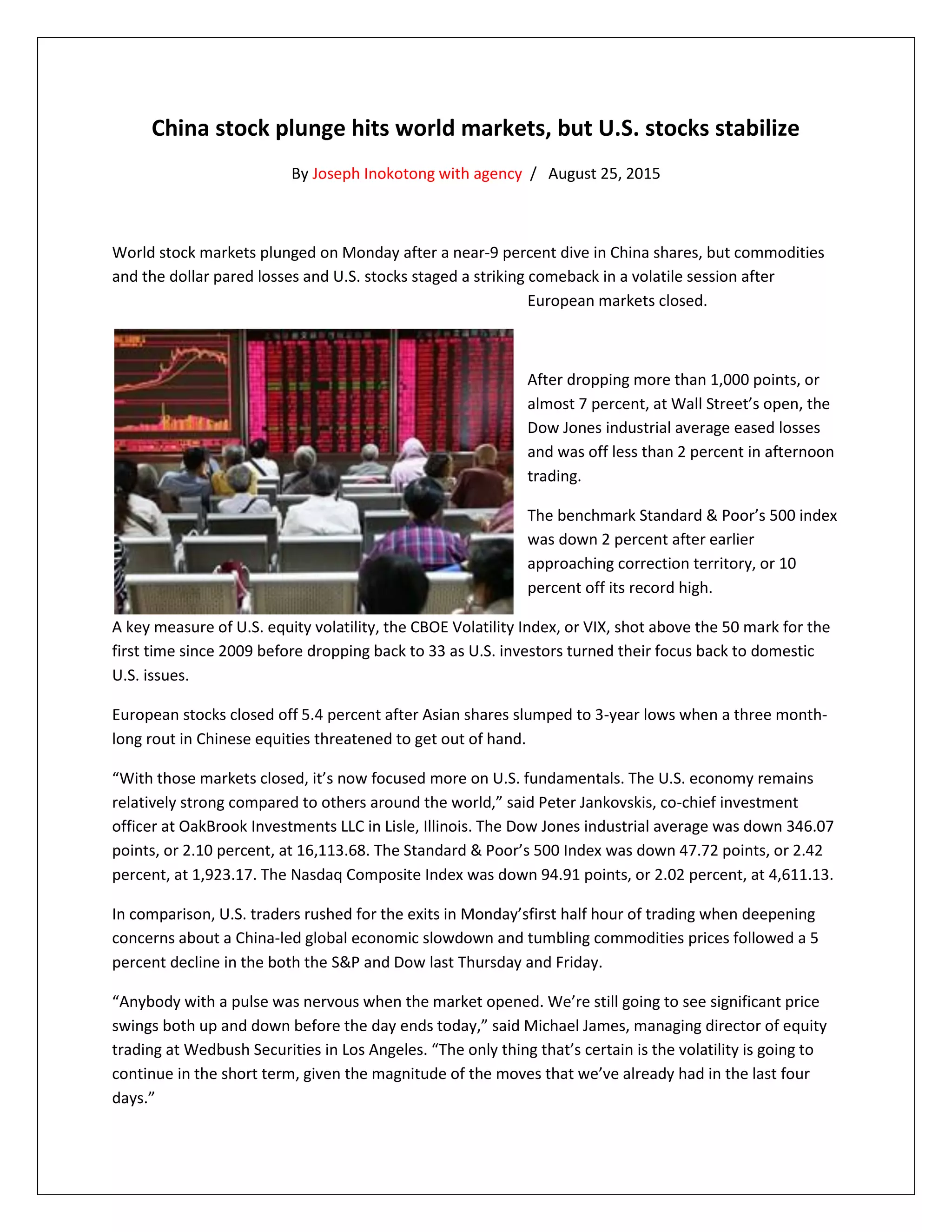
World stock markets plunged on Monday after a near-9 percent dive in China shares, but commodities
and the dollar pared losses and U.S. stocks staged a striking comeback in a volatile session after
European markets closed.
After dropping more than 1,000 points, or
almost 7 percent, at Wall Street’s open, the
Dow Jones industrial average eased losses
and was off less than 2 percent in afternoon
trading.
The benchmark Standard & Poor’s 500 index
was down 2 percent after earlier
approaching correction territory, or 10
percent off its record high.
A key measure of U.S. equity volatility, the CBOE Volatility Index, or VIX, shot above the 50 mark for the
first time since 2009 before dropping back to 33 as U.S. investors turned their focus back to domestic
U.S. issues.
European stocks closed off 5.4 percent after Asian shares slumped to 3-year lows when a three month-
long rout in Chinese equities threatened to get out of hand.
“With those markets closed, it’s now focused more on U.S. fundamentals. The U.S. economy remains
relatively strong compared to others around the world,” said Peter Jankovskis, co-chief investment
officer at OakBrook Investments LLC in Lisle, Illinois. The Dow Jones industrial average was down 346.07
points, or 2.10 percent, at 16,113.68. The Standard & Poor’s 500 Index was down 47.72 points, or 2.42
percent, at 1,923.17. The Nasdaq Composite Index was down 94.91 points, or 2.02 percent, at 4,611.13.
In comparison, U.S. traders rushed for the exits in Monday’sfirst half hour of trading when deepening
concerns about a China-led global economic slowdown and tumbling commodities prices followed a 5
percent decline in the both the S&P and Dow last Thursday and Friday.
“Anybody with a pulse was nervous when the market opened. We’re still going to see significant price
swings both up and down before the day ends today,” said Michael James, managing director of equity
trading at Wedbush Securities in Los Angeles. “The only thing that’s certain is the volatility is going to
continue in the short term, given the magnitude of the moves that we’ve already had in the last four
days.”
Oil prices also recovered somewhat after plunging to six-and-a-half year lows. Safe-haven U.S.
government and German bonds, as well as the yen and the euro, rallied as currency concerns kicked in
due to China’s recent currency devaluation.
U.S. crude was last down 3.7 percent at about $38.95 a barrel after falling as low as $37.75 earlier in the
day and Brent was off 4.2 percent at $43.57 after falling as low as $42.51 to take it under January’s lows
for the first time. Worries about weaker demand from normally resource-hungry China added to global
supply glut concerns.
The S&P’s energy index was the weakest performer with a 2.9 percent decline in afternoon trading.
Copper, seen as a barometer of global industrial demand, hit a six-year low, and Nickel fell sharply. The
slump in Chinese stocks was their worst performance since the depths of the global financial crisis in
2007 and wiped out what was left of 2015’s gains, which in June were at more than 50 percent.
Many traders had hoped Beijing would have taken support measures, such as an interest rate cut, over
the weekend after China’s main stocks markets slumped 11 percent last week. With serious doubts
emerging about the likelihood of a U.S. interest rate rise this year, the dollar was down 1.5 percent
against other major currencies after falling as much as 2.5 percent earlier in the day.
The Australian dollar fell to more than six-year lows and many emerging market currencies also plunged,
while the frantic dash to safety pushed the euro to a seven-and-a-half month high above $1.17. MSCI’s
broadest index of Asia-Pacific shares outside Japan fell 5.4 percent to a more than three-year low.
Tokyo’s Nikkei ended down 4.6 percent and Australian and Indonesian shares hit two-year troughs.
London’s FTSE 100, with its large number of global miners and oil firms, ended down 4.7 percent for its
10th straight decline – its worst run since 2003. The MSCI all world stock index was off 3 percent.
News Source : nigerianpilot.com/china-stock-plunge-hits-world-markets-but-u-s-stocks-stabilise

All nigerian newspapers

  • 1.
    China stock plungehits world markets, but U.S. stocks stabilize By Joseph Inokotong with agency / August 25, 2015 World stock markets plunged on Monday after a near-9 percent dive in China shares, but commodities and the dollar pared losses and U.S. stocks staged a striking comeback in a volatile session after European markets closed. After dropping more than 1,000 points, or almost 7 percent, at Wall Street’s open, the Dow Jones industrial average eased losses and was off less than 2 percent in afternoon trading. The benchmark Standard & Poor’s 500 index was down 2 percent after earlier approaching correction territory, or 10 percent off its record high. A key measure of U.S. equity volatility, the CBOE Volatility Index, or VIX, shot above the 50 mark for the first time since 2009 before dropping back to 33 as U.S. investors turned their focus back to domestic U.S. issues. European stocks closed off 5.4 percent after Asian shares slumped to 3-year lows when a three month- long rout in Chinese equities threatened to get out of hand. “With those markets closed, it’s now focused more on U.S. fundamentals. The U.S. economy remains relatively strong compared to others around the world,” said Peter Jankovskis, co-chief investment officer at OakBrook Investments LLC in Lisle, Illinois. The Dow Jones industrial average was down 346.07 points, or 2.10 percent, at 16,113.68. The Standard & Poor’s 500 Index was down 47.72 points, or 2.42 percent, at 1,923.17. The Nasdaq Composite Index was down 94.91 points, or 2.02 percent, at 4,611.13. In comparison, U.S. traders rushed for the exits in Monday’sfirst half hour of trading when deepening concerns about a China-led global economic slowdown and tumbling commodities prices followed a 5 percent decline in the both the S&P and Dow last Thursday and Friday. “Anybody with a pulse was nervous when the market opened. We’re still going to see significant price swings both up and down before the day ends today,” said Michael James, managing director of equity trading at Wedbush Securities in Los Angeles. “The only thing that’s certain is the volatility is going to continue in the short term, given the magnitude of the moves that we’ve already had in the last four days.”
  • 2.
    Oil prices alsorecovered somewhat after plunging to six-and-a-half year lows. Safe-haven U.S. government and German bonds, as well as the yen and the euro, rallied as currency concerns kicked in due to China’s recent currency devaluation. U.S. crude was last down 3.7 percent at about $38.95 a barrel after falling as low as $37.75 earlier in the day and Brent was off 4.2 percent at $43.57 after falling as low as $42.51 to take it under January’s lows for the first time. Worries about weaker demand from normally resource-hungry China added to global supply glut concerns. The S&P’s energy index was the weakest performer with a 2.9 percent decline in afternoon trading. Copper, seen as a barometer of global industrial demand, hit a six-year low, and Nickel fell sharply. The slump in Chinese stocks was their worst performance since the depths of the global financial crisis in 2007 and wiped out what was left of 2015’s gains, which in June were at more than 50 percent. Many traders had hoped Beijing would have taken support measures, such as an interest rate cut, over the weekend after China’s main stocks markets slumped 11 percent last week. With serious doubts emerging about the likelihood of a U.S. interest rate rise this year, the dollar was down 1.5 percent against other major currencies after falling as much as 2.5 percent earlier in the day. The Australian dollar fell to more than six-year lows and many emerging market currencies also plunged, while the frantic dash to safety pushed the euro to a seven-and-a-half month high above $1.17. MSCI’s broadest index of Asia-Pacific shares outside Japan fell 5.4 percent to a more than three-year low. Tokyo’s Nikkei ended down 4.6 percent and Australian and Indonesian shares hit two-year troughs. London’s FTSE 100, with its large number of global miners and oil firms, ended down 4.7 percent for its 10th straight decline – its worst run since 2003. The MSCI all world stock index was off 3 percent. News Source : nigerianpilot.com/china-stock-plunge-hits-world-markets-but-u-s-stocks-stabilise