WP 7 Presentation
Andreas Bley with contributions from Christian
Martin, Christian Reuther, Stefan Ulbrich,
Norbert Herda (MLAB)
Goals
Pilots and System integration
• To implement and design the ALIAS pilots and
prototype
• To integrate additional hardware
• To integrate developed software modules, like the
human-machine-interface and the dialog manager
11.06.2013 WP 7 Presentation 2
Achievements at a glance
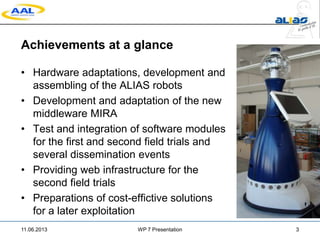
• Hardware adaptations, development and
assembling of the ALIAS robots
• Development and adaptation of the new
middleware MIRA
• Test and integration of software modules
for the first and second field trials and
several dissemination events
• Providing web infrastructure for the
second field trials
• Preparations of cost-effictive solutions
for a later exploitation
11.06.2013 WP 7 Presentation 3
Achievements
• D7.1 Definition of the proofed ALIAS software
framework
• D7.2 First ALIAS pilot for user trials
• D7.3 Second ALIAS pilot for user trials
11.06.2013 WP 7 Presentation 4
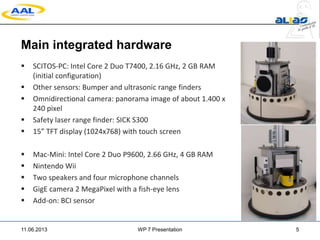
Main integrated hardware
 SCITOS-PC: Intel Core 2 Duo T7400, 2.16 GHz, 2 GB RAM
(initial configuration)
 Other sensors: Bumper and ultrasonic range finders
 Omnidirectional camera: panorama image of about 1.400 x
240 pixel
 Safety laser range finder: SICK S300
 15” TFT display (1024x768) with touch screen
 Mac-Mini: Intel Core 2 Duo P9600, 2.66 GHz, 4 GB RAM
 Nintendo Wii
 Two speakers and four microphone channels
 GigE camera 2 MegaPixel with a fish-eye lens
 Add-on: BCI sensor
11.06.2013 WP 7 Presentation 5
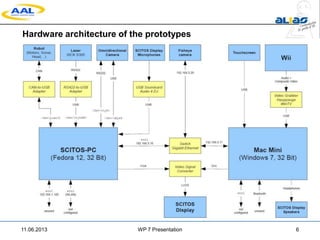
Hardware architecture of the prototypes
11.06.2013 WP 7 Presentation 6
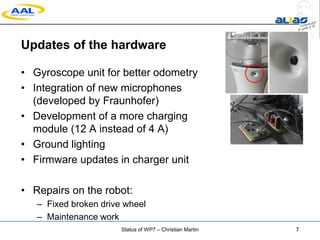
Updates of the hardware
• Gyroscope unit for better odometry
• Integration of new microphones
(developed by Fraunhofer)
• Development of a more charging
module (12 A instead of 4 A)
• Ground lighting
• Firmware updates in charger unit
• Repairs on the robot:
– Fixed broken drive wheel
– Maintenance work
Status of WP7 – Christian Martin 7
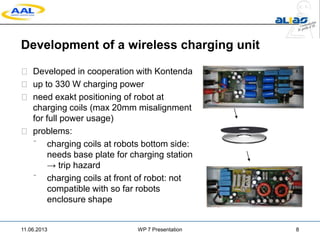
Development of a wireless charging unit
 Developed in cooperation with Kontenda
 up to 330 W charging power
 need exakt positioning of robot at
charging coils (max 20mm misalignment
for full power usage)
 problems:
 charging coils at robots bottom side:
needs base plate for charging station
→ trip hazard
 charging coils at front of robot: not
compatible with so far robots
enclosure shape
11.06.2013 WP 7 Presentation 8
Updates of ALIAS’s software
• Adaption of new Middleware MIRA to the ALIAS robot
– MIRA was developed by IUT and MLAB
– MIRA replaces the “old” MetraLabs
software (Blackboard, RobotDaemon, …)
• CogniDrive:
– Simplified mapping process
– Long-term tests with 3D collision avoidance
Status of WP7 – Christian Martin 9
3D collision avoidance needs depth data
• Different drivers for PrimeSense devices (Asus, Kinect) are
available
– OpenNI:
• different branches available (official, avin2, ROS, more?)
• very heavy and bulky and contains a lot of stuff, which is not necessary
– OpenKinect / libfreenect:
• very limited functionality
• different branches for different sensors, no common version available
• Goal: Own MIRA driver for PrimeSense devices:
– reduce overhead as much as possible
– fast and light weight, only using libusb
– Released February 2013
Status of WP7 – Christian Martin 10
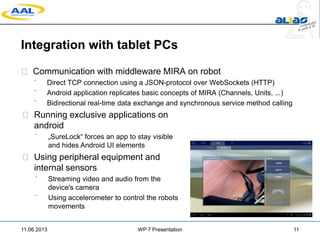
Integration with tablet PCs
 Communication with middleware MIRA on robot
 Direct TCP connection using a JSON-protocol over WebSockets (HTTP)
 Android application replicates basic concepts of MIRA (Channels, Units, ...)
 Bidirectional real-time data exchange and synchronous service method calling
11.06.2013 WP 7 Presentation 11
 Running exclusive applications on
android
 „SureLock“ forces an app to stay visible
and hides Android UI elements
 Using peripheral equipment and
internal sensors
 Streaming video and audio from the
device's camera
 Using accelerometer to control the robots
movements
Fixed problems and limitations:
 Possibility of an electrical damage of the robot head unit caused by a motor
controller of the eye lids.
 Similar problem with the pan motor unit
 Additional components need a lot of power
 DVD of Wii can only be exchanged, when the housing of the robot is removed
11.06.2013 WP 7 Presentation 12
Open problems:
 Still a lot of hard-coded operation sequences
 Some modules are very limited to the scenarios.
Problems & Lessons Learned
 Sometimes too much coding ("hacking session").
 Some deadlocks due to module dependencies.
 Single point of failure: If the dialog manager does not work, nothing else will work.
Missing fallback system?
 Focus more one functions, that are really required by the users.
 Omit functions, which are optional or too sophisticated.
 Two state machines (one in the Dialog Manager and one on the Linux side) is not a
good idea.
 Too much (unused, expensive and/or unsuitable) hardware on the current prototype
 Integration of a Tablet PC with available functionalities would be useful. This would
increase the value of the robot very much.
11.06.2013 WP 7 Presentation 13
Outlook / Future Work
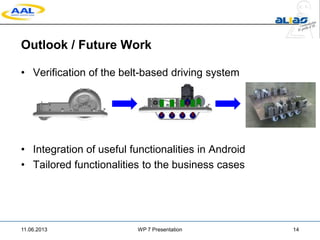
• Verification of the belt-based driving system
• Integration of useful functionalities in Android
• Tailored functionalities to the business cases
11.06.2013 WP 7 Presentation 14

ALIAS WP7 Results

  • 1.
    WP 7 Presentation AndreasBley with contributions from Christian Martin, Christian Reuther, Stefan Ulbrich, Norbert Herda (MLAB)
  • 2.
    Goals Pilots and Systemintegration • To implement and design the ALIAS pilots and prototype • To integrate additional hardware • To integrate developed software modules, like the human-machine-interface and the dialog manager 11.06.2013 WP 7 Presentation 2
  • 3.
    Achievements at aglance • Hardware adaptations, development and assembling of the ALIAS robots • Development and adaptation of the new middleware MIRA • Test and integration of software modules for the first and second field trials and several dissemination events • Providing web infrastructure for the second field trials • Preparations of cost-effictive solutions for a later exploitation 11.06.2013 WP 7 Presentation 3
  • 4.
    Achievements • D7.1 Definitionof the proofed ALIAS software framework • D7.2 First ALIAS pilot for user trials • D7.3 Second ALIAS pilot for user trials 11.06.2013 WP 7 Presentation 4
  • 5.
    Main integrated hardware SCITOS-PC: Intel Core 2 Duo T7400, 2.16 GHz, 2 GB RAM (initial configuration)  Other sensors: Bumper and ultrasonic range finders  Omnidirectional camera: panorama image of about 1.400 x 240 pixel  Safety laser range finder: SICK S300  15” TFT display (1024x768) with touch screen  Mac-Mini: Intel Core 2 Duo P9600, 2.66 GHz, 4 GB RAM  Nintendo Wii  Two speakers and four microphone channels  GigE camera 2 MegaPixel with a fish-eye lens  Add-on: BCI sensor 11.06.2013 WP 7 Presentation 5
  • 6.
    Hardware architecture ofthe prototypes 11.06.2013 WP 7 Presentation 6
  • 7.
    Updates of thehardware • Gyroscope unit for better odometry • Integration of new microphones (developed by Fraunhofer) • Development of a more charging module (12 A instead of 4 A) • Ground lighting • Firmware updates in charger unit • Repairs on the robot: – Fixed broken drive wheel – Maintenance work Status of WP7 – Christian Martin 7
  • 8.
    Development of awireless charging unit  Developed in cooperation with Kontenda  up to 330 W charging power  need exakt positioning of robot at charging coils (max 20mm misalignment for full power usage)  problems:  charging coils at robots bottom side: needs base plate for charging station → trip hazard  charging coils at front of robot: not compatible with so far robots enclosure shape 11.06.2013 WP 7 Presentation 8
  • 9.
    Updates of ALIAS’ssoftware • Adaption of new Middleware MIRA to the ALIAS robot – MIRA was developed by IUT and MLAB – MIRA replaces the “old” MetraLabs software (Blackboard, RobotDaemon, …) • CogniDrive: – Simplified mapping process – Long-term tests with 3D collision avoidance Status of WP7 – Christian Martin 9
  • 10.
    3D collision avoidanceneeds depth data • Different drivers for PrimeSense devices (Asus, Kinect) are available – OpenNI: • different branches available (official, avin2, ROS, more?) • very heavy and bulky and contains a lot of stuff, which is not necessary – OpenKinect / libfreenect: • very limited functionality • different branches for different sensors, no common version available • Goal: Own MIRA driver for PrimeSense devices: – reduce overhead as much as possible – fast and light weight, only using libusb – Released February 2013 Status of WP7 – Christian Martin 10
  • 11.
    Integration with tabletPCs  Communication with middleware MIRA on robot  Direct TCP connection using a JSON-protocol over WebSockets (HTTP)  Android application replicates basic concepts of MIRA (Channels, Units, ...)  Bidirectional real-time data exchange and synchronous service method calling 11.06.2013 WP 7 Presentation 11  Running exclusive applications on android  „SureLock“ forces an app to stay visible and hides Android UI elements  Using peripheral equipment and internal sensors  Streaming video and audio from the device's camera  Using accelerometer to control the robots movements
  • 12.
    Fixed problems andlimitations:  Possibility of an electrical damage of the robot head unit caused by a motor controller of the eye lids.  Similar problem with the pan motor unit  Additional components need a lot of power  DVD of Wii can only be exchanged, when the housing of the robot is removed 11.06.2013 WP 7 Presentation 12 Open problems:  Still a lot of hard-coded operation sequences  Some modules are very limited to the scenarios.
  • 13.
    Problems & LessonsLearned  Sometimes too much coding ("hacking session").  Some deadlocks due to module dependencies.  Single point of failure: If the dialog manager does not work, nothing else will work. Missing fallback system?  Focus more one functions, that are really required by the users.  Omit functions, which are optional or too sophisticated.  Two state machines (one in the Dialog Manager and one on the Linux side) is not a good idea.  Too much (unused, expensive and/or unsuitable) hardware on the current prototype  Integration of a Tablet PC with available functionalities would be useful. This would increase the value of the robot very much. 11.06.2013 WP 7 Presentation 13
  • 14.
    Outlook / FutureWork • Verification of the belt-based driving system • Integration of useful functionalities in Android • Tailored functionalities to the business cases 11.06.2013 WP 7 Presentation 14