Algorithm
   By Taimoor Abdullah Khan
                    BSCS - 1st
Definition
“Set of instructions used to perform a certain task.”
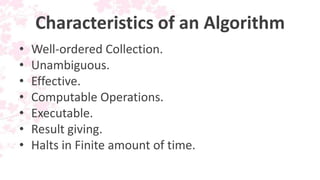
Characteristics of an Algorithm
•   Well-ordered Collection.
•   Unambiguous.
•   Effective.
•   Computable Operations.
•   Executable.
•   Result giving.
•   Halts in Finite amount of time.
Elements of Algorithm
1.   Constants.
2.   Variables.
3.   Arrays.
4.   Operators.
5.   Loops.
6.   Conditional Statements.
7.   Comments
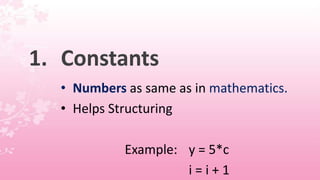
1. Constants
  • Numbers as same as in mathematics.
  • Helps Structuring

            Example: y = 5*c
                     i=i+1
Value


2. Variables
   • For Storing Values.
   • Can be given any name, but given such to
     remind of its purpose. Sum, Temp etc.
Value             Value             Value


                                                myArray
                              myArray
3. Arrays             0                 1                 2
  • Two or more Variables with same name.
  • Addressed individually by their index.
                             myArray[7]
  • Variable or constant both used to address the
    index.
  • Each location can store a different value.
  • Usually Starting at index 0.
4. Operators
  • Used to perform Operations on Variables or
    Constants.
  • Mathematical Operators: +, -, *, / and %.
  • Assignment Operator: =
  • Comparison Operator: ==
  • Increment , Decrement Operator: ++, --
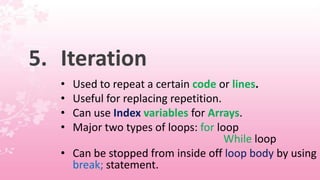
5. Iteration
   • Used to repeat a certain code or lines.
   • Useful for replacing repetition.
   • Can use Index variables for Arrays.
   • Major two types of loops: for loop
                                      While loop
   • Can be stopped from inside off loop body by using
     break; statement.
While Loop
•   Repeats if a certain Condition is true.
•   Stops when Condition becomes false.
•   Can repeat Infinite times.
•   Can be given value ‘1’ to represent Boolean value for ‘True’ so the loop
    remains true.
•   Syntax: while(Condition)
           {
                 Loop body;
           }
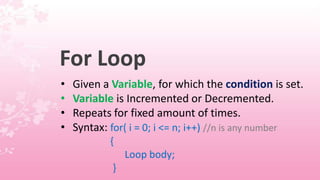
For Loop
•   Given a Variable, for which the condition is set.
•   Variable is Incremented or Decremented.
•   Repeats for fixed amount of times.
•   Syntax: for( i = 0; i <= n; i++) //n is any number
            {
                Loop body;
            }
6. Conditional Statement
   •   Used to take decision.
   •   Checks a Condition.
   •   Runs a statement body if Condition is true.
   •   Otherwise runs statment body for “Else” statement if any is given.
   •   Syntax: If(Condition)
                   {
                           Loop body;
                   }
              Else
                   {
                           Loop body;
                    }
7. Comments
  • Useful in long and complex programs.
  • Can be written where required
    explanation.
  • Mostly written after ‘//’.
The End
 What Are You Staring At?? Its Done!
Thank you.

Algorithm

  • 1.
    Algorithm By Taimoor Abdullah Khan BSCS - 1st
  • 2.
    Definition “Set of instructionsused to perform a certain task.”
  • 3.
    Characteristics of anAlgorithm • Well-ordered Collection. • Unambiguous. • Effective. • Computable Operations. • Executable. • Result giving. • Halts in Finite amount of time.
  • 4.
    Elements of Algorithm 1. Constants. 2. Variables. 3. Arrays. 4. Operators. 5. Loops. 6. Conditional Statements. 7. Comments
  • 5.
    1. Constants • Numbers as same as in mathematics. • Helps Structuring Example: y = 5*c i=i+1
  • 6.
    Value 2. Variables • For Storing Values. • Can be given any name, but given such to remind of its purpose. Sum, Temp etc.
  • 7.
    Value Value Value myArray myArray 3. Arrays 0 1 2 • Two or more Variables with same name. • Addressed individually by their index. myArray[7] • Variable or constant both used to address the index. • Each location can store a different value. • Usually Starting at index 0.
  • 8.
    4. Operators • Used to perform Operations on Variables or Constants. • Mathematical Operators: +, -, *, / and %. • Assignment Operator: = • Comparison Operator: == • Increment , Decrement Operator: ++, --
  • 9.
    5. Iteration • Used to repeat a certain code or lines. • Useful for replacing repetition. • Can use Index variables for Arrays. • Major two types of loops: for loop While loop • Can be stopped from inside off loop body by using break; statement.
  • 10.
    While Loop • Repeats if a certain Condition is true. • Stops when Condition becomes false. • Can repeat Infinite times. • Can be given value ‘1’ to represent Boolean value for ‘True’ so the loop remains true. • Syntax: while(Condition) { Loop body; }
  • 11.
    For Loop • Given a Variable, for which the condition is set. • Variable is Incremented or Decremented. • Repeats for fixed amount of times. • Syntax: for( i = 0; i <= n; i++) //n is any number { Loop body; }
  • 12.
    6. Conditional Statement • Used to take decision. • Checks a Condition. • Runs a statement body if Condition is true. • Otherwise runs statment body for “Else” statement if any is given. • Syntax: If(Condition) { Loop body; } Else { Loop body; }
  • 13.
    7. Comments • Useful in long and complex programs. • Can be written where required explanation. • Mostly written after ‘//’.
  • 14.
    The End WhatAre You Staring At?? Its Done!
  • 15.