ALGORITHM AND FLOWCHART
.
What is an Algorithm?
The word Algorithm means ” A set of finite rules
or instructions to be followed in calculations or
other problem-solving operations ” Or ” A
procedure for solving a mathematical problem
in a finite number of steps that frequently
involves recursive operations”.
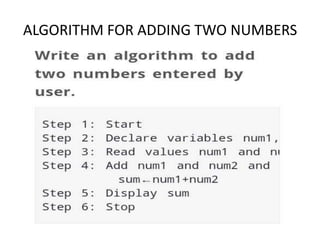
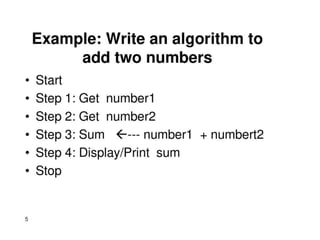
ALGORITHM FOR ADDING TWO NUMBERS
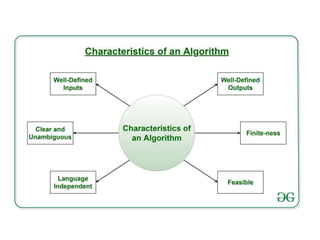
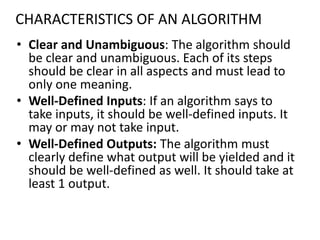
CHARACTERISTICS OF AN ALGORITHM
• Clear and Unambiguous: The algorithm should
be clear and unambiguous. Each of its steps
should be clear in all aspects and must lead to
only one meaning.
• Well-Defined Inputs: If an algorithm says to
take inputs, it should be well-defined inputs. It
may or may not take input.
• Well-Defined Outputs: The algorithm must
clearly define what output will be yielded and it
should be well-defined as well. It should take at
least 1 output.
CHARACTERISTICS OF AN ALGORITHM
Finite-ness: The algorithm must be finite, i.e. it
should terminate after a finite time.
• Feasible: The algorithm must be simple, generic,
and practical, such that it can be executed with
the available resources. It must not contain some
future technology or anything.
• Language Independent: The Algorithm designed
must be language-independent, i.e. it must be
just plain instructions that can be implemented in
any language, and yet the output will be the
same, as expected.
Properties of Algorithm:
• It should terminate after a finite time.
• It should produce at least one output.
• It should take zero or more input.
• It should be deterministic means giving the
same output for the same input case.
• Every step in the algorithm must be effective
i.e. every step should do some work.
How to Design an Algorithm?
• In order to write an algorithm, the following things are
needed as a pre-requisite:
• The problem that is to be solved by this algorithm i.e.
clear problem definition.
• The constraints of the problem must be considered
while solving the problem.
• The input to be taken to solve the problem.
• The output to be expected when the problem is
solved.
• The solution to this problem, is within the given
constraints.
Then the algorithm is written with the help of the above parameters such
that it solves the problem.
Example: Consider the example to add three numbers and print the sum.
•
• Step 1: Fulfilling the pre-requisites
As discussed above, in order to write an algorithm, its pre-requisites must
be fulfilled.
– The problem that is to be solved by this algorithm: Add 3 numbers and print
their sum.
– The constraints of the problem that must be considered while solving the
problem: The numbers must contain only digits and no other characters.
– The input to be taken to solve the problem: The three numbers to be added.
– The output to be expected when the problem is solved: The sum of the three
numbers taken as the input i.e. a single integer value.
– The solution to this problem, in the given constraints: The solution consists of
adding the 3 numbers. It can be done with the help of ‘+’ operator, or bit-wise,
or any other method.
•
Step 2: Designing the algorithm
Now let’s design the algorithm with the help
of the above pre-requisites:
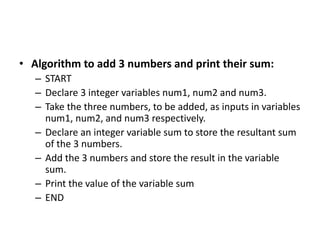
• Algorithm to add 3 numbers and print their sum:
– START
– Declare 3 integer variables num1, num2 and num3.
– Take the three numbers, to be added, as inputs in variables
num1, num2, and num3 respectively.
– Declare an integer variable sum to store the resultant sum
of the 3 numbers.
– Add the 3 numbers and store the result in the variable
sum.
– Print the value of the variable sum
– END
Step 3: Testing the algorithm by implementing
it.
In order to test the algorithm, let’s implement
it in C language.
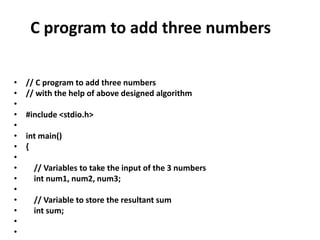
C program to add three numbers
• // C program to add three numbers
• // with the help of above designed algorithm
•
• #include <stdio.h>
•
• int main()
• {
•
• // Variables to take the input of the 3 numbers
• int num1, num2, num3;
•
• // Variable to store the resultant sum
• int sum;
•
•
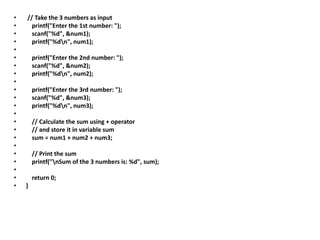
• // Take the 3 numbers as input
• printf("Enter the 1st number: ");
• scanf("%d", &num1);
• printf("%dn", num1);
•
• printf("Enter the 2nd number: ");
• scanf("%d", &num2);
• printf("%dn", num2);
•
• printf("Enter the 3rd number: ");
• scanf("%d", &num3);
• printf("%dn", num3);
•
• // Calculate the sum using + operator
• // and store it in variable sum
• sum = num1 + num2 + num3;
•
• // Print the sum
• printf("nSum of the 3 numbers is: %d", sum);
•
• return 0;
• }
Time Complexity
The time complexity of an algorithm
refers to the amount of time that is
required by the algorithm to execute and
get the result.
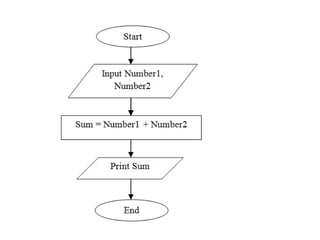
FLOWCHART
A flowchart is a diagram that shows an
overview of a program . Flowcharts normally
use standard symbols to represent the
different types of instructions . These symbols
are used to construct the flowchart and show
the step-by-step solution to the problem.
Flowcharts are sometimes known as flow
diagrams.
THANK YOU

ALGO VS FLOW.pptx

  • 1.
  • 2.
    What is anAlgorithm? The word Algorithm means ” A set of finite rules or instructions to be followed in calculations or other problem-solving operations ” Or ” A procedure for solving a mathematical problem in a finite number of steps that frequently involves recursive operations”.
  • 3.
  • 6.
    CHARACTERISTICS OF ANALGORITHM • Clear and Unambiguous: The algorithm should be clear and unambiguous. Each of its steps should be clear in all aspects and must lead to only one meaning. • Well-Defined Inputs: If an algorithm says to take inputs, it should be well-defined inputs. It may or may not take input. • Well-Defined Outputs: The algorithm must clearly define what output will be yielded and it should be well-defined as well. It should take at least 1 output.
  • 7.
    CHARACTERISTICS OF ANALGORITHM Finite-ness: The algorithm must be finite, i.e. it should terminate after a finite time. • Feasible: The algorithm must be simple, generic, and practical, such that it can be executed with the available resources. It must not contain some future technology or anything. • Language Independent: The Algorithm designed must be language-independent, i.e. it must be just plain instructions that can be implemented in any language, and yet the output will be the same, as expected.
  • 8.
    Properties of Algorithm: •It should terminate after a finite time. • It should produce at least one output. • It should take zero or more input. • It should be deterministic means giving the same output for the same input case. • Every step in the algorithm must be effective i.e. every step should do some work.
  • 9.
    How to Designan Algorithm? • In order to write an algorithm, the following things are needed as a pre-requisite: • The problem that is to be solved by this algorithm i.e. clear problem definition. • The constraints of the problem must be considered while solving the problem. • The input to be taken to solve the problem. • The output to be expected when the problem is solved. • The solution to this problem, is within the given constraints.
  • 10.
    Then the algorithmis written with the help of the above parameters such that it solves the problem. Example: Consider the example to add three numbers and print the sum. • • Step 1: Fulfilling the pre-requisites As discussed above, in order to write an algorithm, its pre-requisites must be fulfilled. – The problem that is to be solved by this algorithm: Add 3 numbers and print their sum. – The constraints of the problem that must be considered while solving the problem: The numbers must contain only digits and no other characters. – The input to be taken to solve the problem: The three numbers to be added. – The output to be expected when the problem is solved: The sum of the three numbers taken as the input i.e. a single integer value. – The solution to this problem, in the given constraints: The solution consists of adding the 3 numbers. It can be done with the help of ‘+’ operator, or bit-wise, or any other method. •
  • 11.
    Step 2: Designingthe algorithm Now let’s design the algorithm with the help of the above pre-requisites:
  • 12.
    • Algorithm toadd 3 numbers and print their sum: – START – Declare 3 integer variables num1, num2 and num3. – Take the three numbers, to be added, as inputs in variables num1, num2, and num3 respectively. – Declare an integer variable sum to store the resultant sum of the 3 numbers. – Add the 3 numbers and store the result in the variable sum. – Print the value of the variable sum – END
  • 13.
    Step 3: Testingthe algorithm by implementing it. In order to test the algorithm, let’s implement it in C language.
  • 14.
    C program toadd three numbers • // C program to add three numbers • // with the help of above designed algorithm • • #include <stdio.h> • • int main() • { • • // Variables to take the input of the 3 numbers • int num1, num2, num3; • • // Variable to store the resultant sum • int sum; • •
  • 15.
    • // Takethe 3 numbers as input • printf("Enter the 1st number: "); • scanf("%d", &num1); • printf("%dn", num1); • • printf("Enter the 2nd number: "); • scanf("%d", &num2); • printf("%dn", num2); • • printf("Enter the 3rd number: "); • scanf("%d", &num3); • printf("%dn", num3); • • // Calculate the sum using + operator • // and store it in variable sum • sum = num1 + num2 + num3; • • // Print the sum • printf("nSum of the 3 numbers is: %d", sum); • • return 0; • }
  • 16.
    Time Complexity The timecomplexity of an algorithm refers to the amount of time that is required by the algorithm to execute and get the result.
  • 17.
    FLOWCHART A flowchart isa diagram that shows an overview of a program . Flowcharts normally use standard symbols to represent the different types of instructions . These symbols are used to construct the flowchart and show the step-by-step solution to the problem. Flowcharts are sometimes known as flow diagrams.
  • 20.