Basic Aircraft Structure
Final Presentation Presented To:
Respected Sir:-
Rana Athar Munir
Group
Presentation
• Awais Hassan
• Sap: 70113186
• Abdul Moiz
• Sap: 70109260
Basic Aircraft
Structure
• Aircraft Components
• Material use in Airframe Construction
• Example of Material use in Airframe
Construction
• Fuselage Structure:
1. Truss Type
2. Pratt Truss
3. Warren Truss
4. Monocoque
5. Semi-Monocoque
• Basic Structure
• Wing Structure
• Empennage Structure
• Power Plant
• Landing Gear Structure
Aircraft
Components
• A. Fuselage
• B. Wings
• C. Empennage or Tail
• D. Power Plant
• E. Landing Gear or
Undercarriage
Fuselage
• The fuselage is the
‘body’ of an aircraft, its
primary structure; it is
the envelope that
houses the cockpit, the
space for carrying
passengers or for the
cargo hold.
• Carries accessories
and other equipment’s.
WING
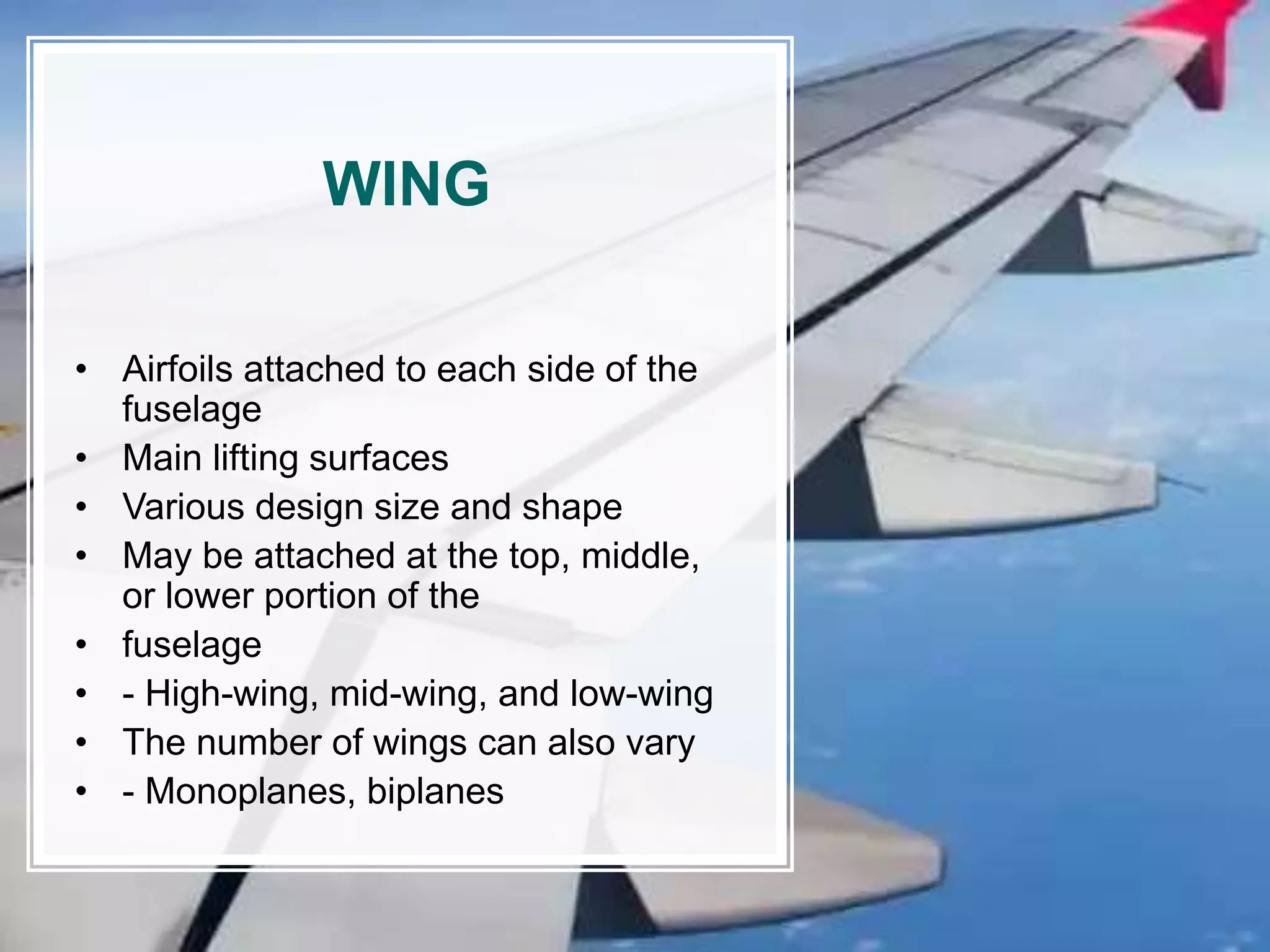
• Airfoils attached to each side of the
fuselage
• Main lifting surfaces
• Various design size and shape
• May be attached at the top, middle,
or lower portion of the
• fuselage
• - High-wing, mid-wing, and low-wing
• The number of wings can also vary
• - Monoplanes, biplanes
Empennage
Power
Plant
Landing Gear
• Located underneath of the
fuselage with shock strut
• Fixed / Retractable
• Provides means of landing
taxiing
• Tri- cycle –Conventional
type
• Floating gear for seaplane
/ski- equipped for ice
surface landing etc.
Material use in Airframe
Construction
• Airframe Materials Properties
• - High Strength to Weight ratio
• - Light weight
• - Corrosion Resistant
• - Should be non-flammable
• - High quality
Fuselage
Structure
• BASIC STRUCTURE
TYPES
• TRUSS TYPE
• - PRATT TRUSS
• - WARREN TRUSS
• MONOCOQUE
• SEMI-MONOCOQUE
TRUSS TYPE
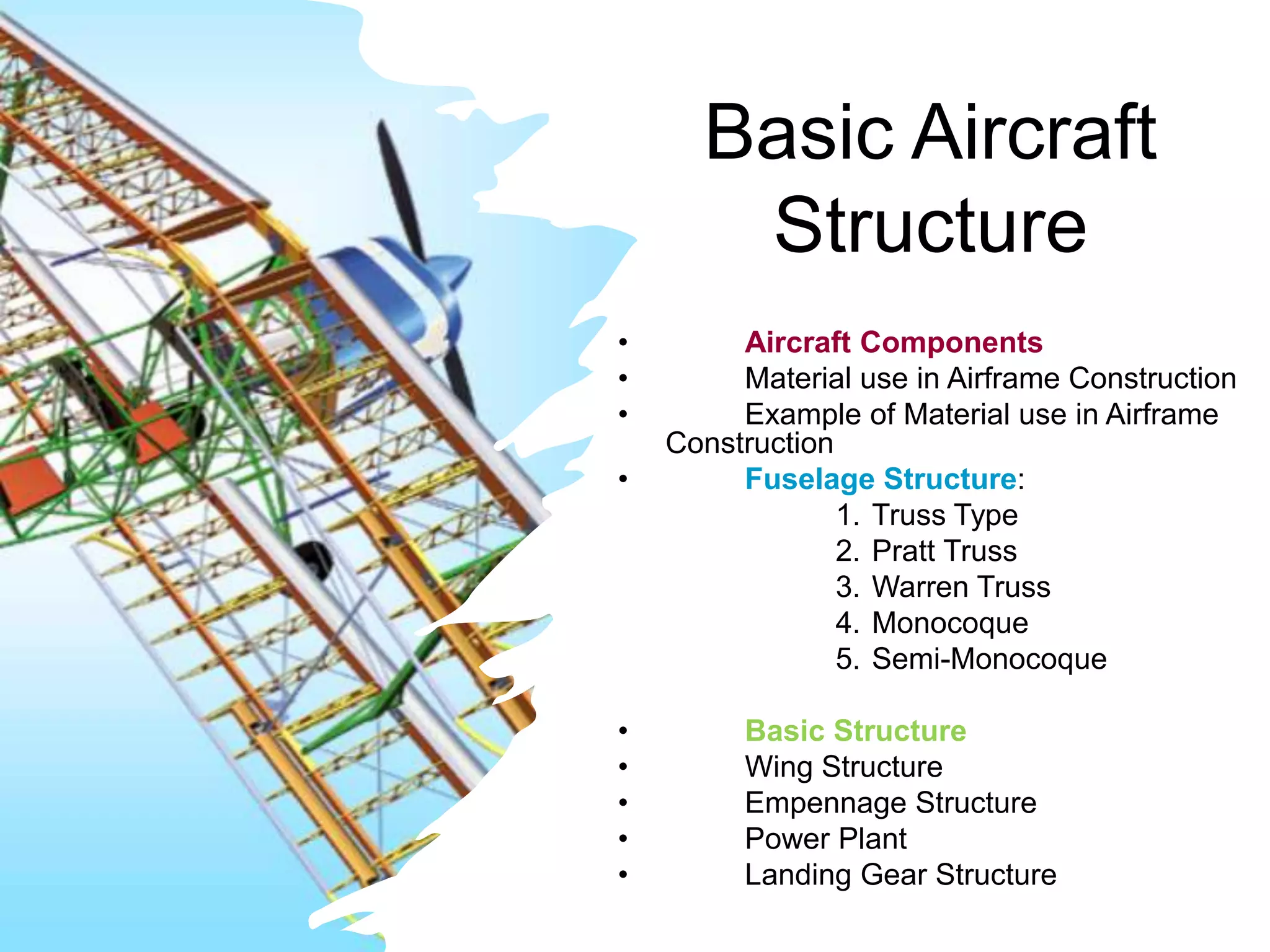
• Most early aircraft used this
technique with wood and wire
trusses and this type of structure is
still in use in many lightweight
aircraft using welded steel tube
trusses. The truss type fuselage
frame is assembled with a rigid
frame e.g. beams, bar, tube etc….
• There are two types of truss
structure.
• - PRATT TRUSS
• - WARREN TRUSS
PRATT TRUSS
• Early days Wooden or metal
structure Great weight
• Difficult to streamline
• Diagonal members of tubing or
solid rods
WARREN TRUSS
• Force transfer to every
others structure
• Capable to carry tension +
compression.
• Reduce amount of webs
work
• More space , strength ,
rigidity
• Better streamline
Warren Truss Structure of an airplane
Monocoque /SEMI-
MONOCOQUE
• This is the preferred method of constructing an all-aluminum
fuselage. First, a series of frames in the shape of the fuselage
cross sections are held in position on a rigid fixture, These
frames are then joined with lightweight longitudinal elements
called stringers. These are in turn covered with a skin of sheet
aluminum, attached by riveting or by bonding with special.
Most modern large aircraft are built using this technique.
• Monocoque is a structural technique in which stresses are reacted by a
thin membrane or a shell of material, rather than a collection of beams.
Such structures are stiff in bending, and light, and are therefore ideal for
weight-sensitive vehicles such as airplanes
AKG Presentation.pptx

AKG Presentation.pptx

  • 1.
    Basic Aircraft Structure FinalPresentation Presented To: Respected Sir:- Rana Athar Munir
  • 2.
    Group Presentation • Awais Hassan •Sap: 70113186 • Abdul Moiz • Sap: 70109260
  • 3.
    Basic Aircraft Structure • AircraftComponents • Material use in Airframe Construction • Example of Material use in Airframe Construction • Fuselage Structure: 1. Truss Type 2. Pratt Truss 3. Warren Truss 4. Monocoque 5. Semi-Monocoque • Basic Structure • Wing Structure • Empennage Structure • Power Plant • Landing Gear Structure
  • 4.
    Aircraft Components • A. Fuselage •B. Wings • C. Empennage or Tail • D. Power Plant • E. Landing Gear or Undercarriage
  • 5.
    Fuselage • The fuselageis the ‘body’ of an aircraft, its primary structure; it is the envelope that houses the cockpit, the space for carrying passengers or for the cargo hold. • Carries accessories and other equipment’s.
  • 6.
    WING • Airfoils attachedto each side of the fuselage • Main lifting surfaces • Various design size and shape • May be attached at the top, middle, or lower portion of the • fuselage • - High-wing, mid-wing, and low-wing • The number of wings can also vary • - Monoplanes, biplanes
  • 7.
  • 8.
  • 9.
    Landing Gear • Locatedunderneath of the fuselage with shock strut • Fixed / Retractable • Provides means of landing taxiing • Tri- cycle –Conventional type • Floating gear for seaplane /ski- equipped for ice surface landing etc.
  • 10.
    Material use inAirframe Construction • Airframe Materials Properties • - High Strength to Weight ratio • - Light weight • - Corrosion Resistant • - Should be non-flammable • - High quality
  • 11.
    Fuselage Structure • BASIC STRUCTURE TYPES •TRUSS TYPE • - PRATT TRUSS • - WARREN TRUSS • MONOCOQUE • SEMI-MONOCOQUE
  • 12.
    TRUSS TYPE • Mostearly aircraft used this technique with wood and wire trusses and this type of structure is still in use in many lightweight aircraft using welded steel tube trusses. The truss type fuselage frame is assembled with a rigid frame e.g. beams, bar, tube etc…. • There are two types of truss structure. • - PRATT TRUSS • - WARREN TRUSS
  • 13.
    PRATT TRUSS • Earlydays Wooden or metal structure Great weight • Difficult to streamline • Diagonal members of tubing or solid rods
  • 14.
    WARREN TRUSS • Forcetransfer to every others structure • Capable to carry tension + compression. • Reduce amount of webs work • More space , strength , rigidity • Better streamline
  • 15.
    Warren Truss Structureof an airplane
  • 16.
    Monocoque /SEMI- MONOCOQUE • Thisis the preferred method of constructing an all-aluminum fuselage. First, a series of frames in the shape of the fuselage cross sections are held in position on a rigid fixture, These frames are then joined with lightweight longitudinal elements called stringers. These are in turn covered with a skin of sheet aluminum, attached by riveting or by bonding with special. Most modern large aircraft are built using this technique. • Monocoque is a structural technique in which stresses are reacted by a thin membrane or a shell of material, rather than a collection of beams. Such structures are stiff in bending, and light, and are therefore ideal for weight-sensitive vehicles such as airplanes