Illustration by Smart-Servier Medical Art
CHANGES IN AIRWAY
MANAGEMENT IN POST
COVID 19 PANDEMIC
DR DAISY GOGOI
PRATIKSHA HOSPITAL
GUWAHATI,ASSAM
Illustration by Smart-Servier Medical Art
The SARS-CoV-2 (COVID-19) pandemic represents the
infection with the highest lethality.
Most sequelae and multi-organ consequences,
especially respiratory.
Various interventions in the field of respiratory and
intensive care medicine done to reduce mortality and
chronicity.
MULTIDISCIPLINARY -physical, emotional, organizing,
and economic aspects.
Post
INTRODUCTION
Illustration by Smart-Servier Medical Art
•Introduction to Airway Management in the Post-COVID Era
Preparing for Airway Management in the Post-COVID Era
Innovations in Airway Management Techniques
Training and Education in Post-COVID Airway Management
Challenges and Solutions in Post-COVID Airway Management
Mitigating Risks and Ensuring Patient Safe
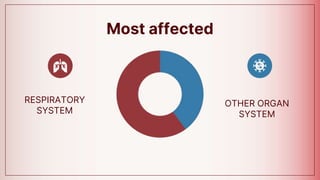
Most affected
OTHER ORGAN
SYSTEM
RESPIRATORY
SYSTEM
Illustration by Smart-Servier Medical Art
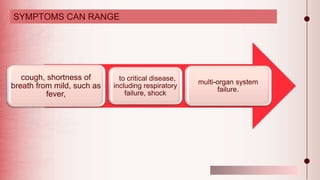
cough, shortness of
breath from mild, such as
fever,
, to critical disease,
including respiratory
failure, shock
multi-organ system
failure.
SYMPTOMS CAN RANGE
Illustration by Smart-Servier Medical Art
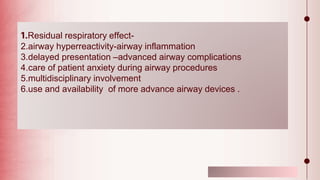
1.Residual respiratory effect-
2.airway hyperreactivity-airway inflammation
3.delayed presentation –advanced airway complications
4.care of patient anxiety during airway procedures
5.multidisciplinary involvement
6.use and availability of more advance airway devices .
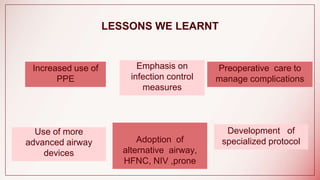
LESSONS WE LEARNT
Increased use of
PPE
Emphasis on
infection control
measures
Preoperative care to
manage complications
Use of more
advanced airway
devices
Adoption of
alternative airway,
HFNC, NIV ,prone
Development of
specialized protocol
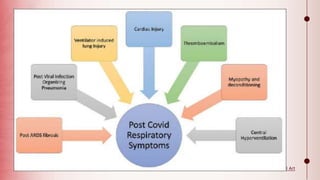
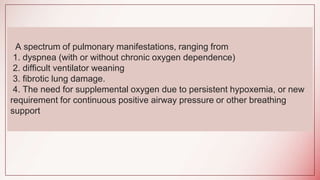
A spectrum of pulmonary manifestations, ranging from
1. dyspnea (with or without chronic oxygen dependence)
2. difficult ventilator weaning
3. fibrotic lung damage.
4. The need for supplemental oxygen due to persistent hypoxemia, or new
requirement for continuous positive airway pressure or other breathing
support
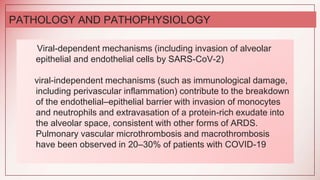
Viral-dependent mechanisms (including invasion of alveolar
epithelial and endothelial cells by SARS-CoV-2)
viral-independent mechanisms (such as immunological damage,
including perivascular inflammation) contribute to the breakdown
of the endothelial–epithelial barrier with invasion of monocytes
and neutrophils and extravasation of a protein-rich exudate into
the alveolar space, consistent with other forms of ARDS.
Pulmonary vascular microthrombosis and macrothrombosis
have been observed in 20–30% of patients with COVID-19
PATHOLOGY AND PATHOPHYSIOLOGY
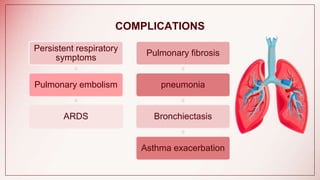
COMPLICATIONS
Persistent respiratory
symptoms
Pulmonary embolism
ARDS
Pulmonary fibrosis
pneumonia
Bronchiectasis
Asthma exacerbation
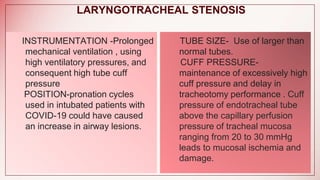
LARYNGOTRACHEAL STENOSIS
TUBE SIZE- Use of larger than
normal tubes.
CUFF PRESSURE-
maintenance of excessively high
cuff pressure and delay in
tracheotomy performance . Cuff
pressure of endotracheal tube
above the capillary perfusion
pressure of tracheal mucosa
ranging from 20 to 30 mmHg
leads to mucosal ischemia and
damage.
INSTRUMENTATION -Prolonged
mechanical ventilation , using
high ventilatory pressures, and
consequent high tube cuff
pressure
POSITION-pronation cycles
used in intubated patients with
COVID-19 could have caused
an increase in airway lesions.
Illustration by Smart-Servier Medical Art
Persistent interstitial lung changes
Most frequent sequele.
Survivors from severe covid19 that required
high-flux nasal cannula (HFNC), non-invasive
ventilation (NIV) or intubation and
mechanical ventilation are more prone.
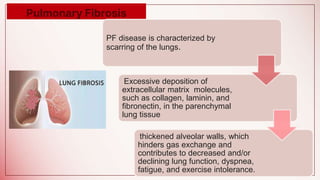
Pulmonary Fibrosis
PF disease is characterized by
scarring of the lungs.
Excessive deposition of
extracellular matrix molecules,
such as collagen, laminin, and
fibronectin, in the parenchymal
lung tissue
thickened alveolar walls, which
hinders gas exchange and
contributes to decreased and/or
declining lung function, dyspnea,
fatigue, and exercise intolerance.
● The higher mortality rate of our ECMO-treated COVID-19 patients admitted after July 1, 2020, was
unexpected.
● strong and dysregulated spontaneous respiratory efforts, associated with wide transpulmonary pressure
swings might heighten the risk of harmful “self-inflicted lung injury” on HFNO or NIV, with more
frequent fibrotic evolution of COVID-19 pneumonia
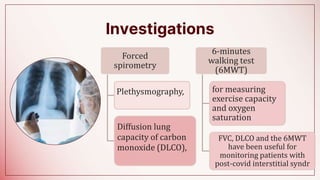
Investigations
,
Forced
spirometry
Plethysmography,
Diffusion lung
capacity of carbon
monoxide (DLCO),
6-minutes
walking test
(6MWT)
for measuring
exercise capacity
and oxygen
saturation
FVC, DLCO and the 6MWT
have been useful for
monitoring patients with
post-covid interstitial syndr
Pulmonary function tests
● Pulmonary function tests have always been valuable in assessing
pulmonary diseases and respiratory function.
● MERS and SARS has shown that pulmonary function testing is a
valuable tool to assess for lung damage after recovery.
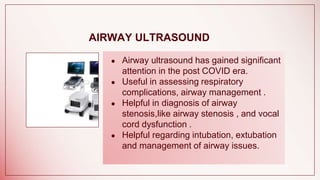
AIRWAY ULTRASOUND
● Airway ultrasound has gained significant
attention in the post COVID era.
● Useful in assessing respiratory
complications, airway management .
● Helpful in diagnosis of airway
stenosis,like airway stenosis , and vocal
cord dysfunction .
● Helpful regarding intubation, extubation
and management of airway issues.
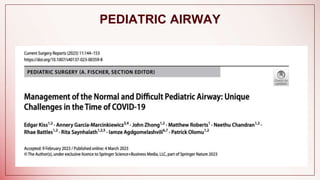
PEDIATRIC AIRWAY
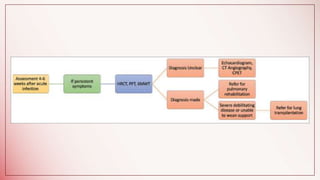
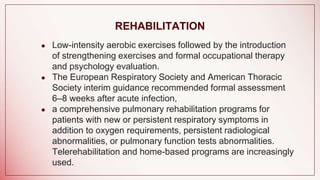
REHABILITATION
● Low-intensity aerobic exercises followed by the introduction
of strengthening exercises and formal occupational therapy
and psychology evaluation.
● The European Respiratory Society and American Thoracic
Society interim guidance recommended formal assessment
6–8 weeks after acute infection,
● a comprehensive pulmonary rehabilitation programs for
patients with new or persistent respiratory symptoms in
addition to oxygen requirements, persistent radiological
abnormalities, or pulmonary function tests abnormalities.
Telerehabilitation and home-based programs are increasingly
used.

Illustration by Smart-Servier Medical Art
Labarca et al. conducted a case–control study among patients with acute
respiratory distress syndrome (ARDS) secondary to COVID-19 and mild or
moderate disease, showing that, in surviving patients, the prevalence of
undiagnosed OSA was statistically significant compared to patients with mild
or moderate disease. After adjusting for other confounders, OSA was
independently associated with ARDS. Moreover, undiagnosed OSA
presented more pulmonary sequelae in the medium term, in addition to being
associated with variables such as male gender, ARDS, and total days on
invasive mechanical ventilation
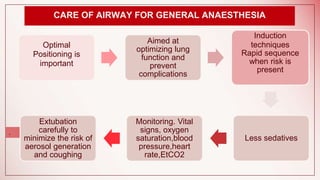
CARE OF AIRWAY FOR GENERAL ANAESTHESIA
.
Optimal
Positioning is
important
Aimed at
optimizing lung
function and
prevent
complications
Induction
techniques
Rapid sequence
when risk is
present
Less sedatives
Monitoring. Vital
signs, oxygen
saturation,blood
pressure,heart
rate,EtCO2
Extubation
carefully to
minimize the risk of
aerosol generation
and coughing
Illustration by Smart-Servier Medical Art
AIRWAY
INSTRUMENTATION
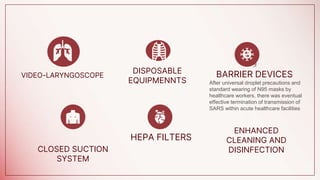
VIDEO-LARYNGOSCOPE
DISPOSABLE
EQUIPMENNTS
.9
BARRIER DEVICES
CLOSED SUCTION
SYSTEM
HEPA FILTERS
ENHANCED
CLEANING AND
DISINFECTION
After universal droplet precautions and
standard wearing of N95 masks by
healthcare workers, there was eventual
effective termination of transmission of
SARS within acute healthcare facilities
Illustration by Smart-Servier Medical Art
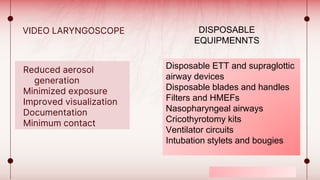
VIDEO LARYNGOSCOPE
Reduced aerosol
generation
Minimized exposure
Improved visualization
Documentation
Minimum contact
DISPOSABLE
EQUIPMENNTS
Disposable ETT and supraglottic
airway devices
Disposable blades and handles
Filters and HMEFs
Nasopharyngeal airways
Cricothyrotomy kits
Ventilator circuits
Intubation stylets and bougies
Illustration by Smart-Servier Medical Art
ETT-. It completely seal the trachea and provides better
protection against aerosol liberation and lowers infection risk for
healthcare providers .
MUSCLE RELAXANT- Use of more rapid inducing agents like
succinylcholine and rocuronium .
Illustration by Smart-Servier Medical Art
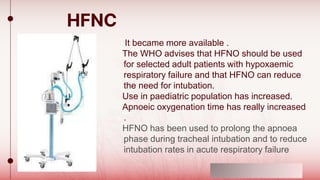
HFNC
It became more available .
The WHO advises that HFNO should be used
for selected adult patients with hypoxaemic
respiratory failure and that HFNO can reduce
the need for intubation.
Use in paediatric population has increased.
Apnoeic oxygenation time has really increased
.
HFNO has been used to prolong the apnoea
phase during tracheal intubation and to reduce
intubation rates in acute respiratory failure
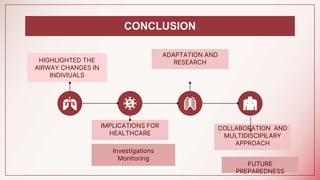
CONCLUSION
HIGHLIGHTED THE
AIRWAY CHANGES IN
INDIVIUALS
IMPLICATIONS FOR
HEALTHCARE
Investigations
Monitoring
ADAPTATION AND
RESEARCH
COLLABORATION AND
MULTIDISCIPILARY
APPROACH
FUTURE
PREPAREDNESS
THANK YOU

AIRWAY POST COVID pptx

  • 1.
    Illustration by Smart-ServierMedical Art CHANGES IN AIRWAY MANAGEMENT IN POST COVID 19 PANDEMIC DR DAISY GOGOI PRATIKSHA HOSPITAL GUWAHATI,ASSAM
  • 3.
    Illustration by Smart-ServierMedical Art The SARS-CoV-2 (COVID-19) pandemic represents the infection with the highest lethality. Most sequelae and multi-organ consequences, especially respiratory. Various interventions in the field of respiratory and intensive care medicine done to reduce mortality and chronicity. MULTIDISCIPLINARY -physical, emotional, organizing, and economic aspects. Post INTRODUCTION
  • 4.
    Illustration by Smart-ServierMedical Art •Introduction to Airway Management in the Post-COVID Era Preparing for Airway Management in the Post-COVID Era Innovations in Airway Management Techniques Training and Education in Post-COVID Airway Management Challenges and Solutions in Post-COVID Airway Management Mitigating Risks and Ensuring Patient Safe
  • 5.
  • 6.
    Illustration by Smart-ServierMedical Art cough, shortness of breath from mild, such as fever, , to critical disease, including respiratory failure, shock multi-organ system failure. SYMPTOMS CAN RANGE
  • 7.
  • 8.
    Illustration by Smart-ServierMedical Art 1.Residual respiratory effect- 2.airway hyperreactivity-airway inflammation 3.delayed presentation –advanced airway complications 4.care of patient anxiety during airway procedures 5.multidisciplinary involvement 6.use and availability of more advance airway devices .
  • 9.
    LESSONS WE LEARNT Increaseduse of PPE Emphasis on infection control measures Preoperative care to manage complications Use of more advanced airway devices Adoption of alternative airway, HFNC, NIV ,prone Development of specialized protocol
  • 11.
    A spectrum ofpulmonary manifestations, ranging from 1. dyspnea (with or without chronic oxygen dependence) 2. difficult ventilator weaning 3. fibrotic lung damage. 4. The need for supplemental oxygen due to persistent hypoxemia, or new requirement for continuous positive airway pressure or other breathing support
  • 12.
    Viral-dependent mechanisms (includinginvasion of alveolar epithelial and endothelial cells by SARS-CoV-2) viral-independent mechanisms (such as immunological damage, including perivascular inflammation) contribute to the breakdown of the endothelial–epithelial barrier with invasion of monocytes and neutrophils and extravasation of a protein-rich exudate into the alveolar space, consistent with other forms of ARDS. Pulmonary vascular microthrombosis and macrothrombosis have been observed in 20–30% of patients with COVID-19 PATHOLOGY AND PATHOPHYSIOLOGY
  • 13.
    COMPLICATIONS Persistent respiratory symptoms Pulmonary embolism ARDS Pulmonaryfibrosis pneumonia Bronchiectasis Asthma exacerbation
  • 15.
    LARYNGOTRACHEAL STENOSIS TUBE SIZE-Use of larger than normal tubes. CUFF PRESSURE- maintenance of excessively high cuff pressure and delay in tracheotomy performance . Cuff pressure of endotracheal tube above the capillary perfusion pressure of tracheal mucosa ranging from 20 to 30 mmHg leads to mucosal ischemia and damage. INSTRUMENTATION -Prolonged mechanical ventilation , using high ventilatory pressures, and consequent high tube cuff pressure POSITION-pronation cycles used in intubated patients with COVID-19 could have caused an increase in airway lesions.
  • 16.
    Illustration by Smart-ServierMedical Art Persistent interstitial lung changes Most frequent sequele. Survivors from severe covid19 that required high-flux nasal cannula (HFNC), non-invasive ventilation (NIV) or intubation and mechanical ventilation are more prone.
  • 17.
    Pulmonary Fibrosis PF diseaseis characterized by scarring of the lungs. Excessive deposition of extracellular matrix molecules, such as collagen, laminin, and fibronectin, in the parenchymal lung tissue thickened alveolar walls, which hinders gas exchange and contributes to decreased and/or declining lung function, dyspnea, fatigue, and exercise intolerance.
  • 18.
    ● The highermortality rate of our ECMO-treated COVID-19 patients admitted after July 1, 2020, was unexpected. ● strong and dysregulated spontaneous respiratory efforts, associated with wide transpulmonary pressure swings might heighten the risk of harmful “self-inflicted lung injury” on HFNO or NIV, with more frequent fibrotic evolution of COVID-19 pneumonia
  • 19.
    Investigations , Forced spirometry Plethysmography, Diffusion lung capacity ofcarbon monoxide (DLCO), 6-minutes walking test (6MWT) for measuring exercise capacity and oxygen saturation FVC, DLCO and the 6MWT have been useful for monitoring patients with post-covid interstitial syndr
  • 20.
    Pulmonary function tests ●Pulmonary function tests have always been valuable in assessing pulmonary diseases and respiratory function. ● MERS and SARS has shown that pulmonary function testing is a valuable tool to assess for lung damage after recovery.
  • 21.
    AIRWAY ULTRASOUND ● Airwayultrasound has gained significant attention in the post COVID era. ● Useful in assessing respiratory complications, airway management . ● Helpful in diagnosis of airway stenosis,like airway stenosis , and vocal cord dysfunction . ● Helpful regarding intubation, extubation and management of airway issues.
  • 23.
  • 25.
    REHABILITATION ● Low-intensity aerobicexercises followed by the introduction of strengthening exercises and formal occupational therapy and psychology evaluation. ● The European Respiratory Society and American Thoracic Society interim guidance recommended formal assessment 6–8 weeks after acute infection, ● a comprehensive pulmonary rehabilitation programs for patients with new or persistent respiratory symptoms in addition to oxygen requirements, persistent radiological abnormalities, or pulmonary function tests abnormalities. Telerehabilitation and home-based programs are increasingly used.
  • 26.
    Illustration by Smart-ServierMedical Art Labarca et al. conducted a case–control study among patients with acute respiratory distress syndrome (ARDS) secondary to COVID-19 and mild or moderate disease, showing that, in surviving patients, the prevalence of undiagnosed OSA was statistically significant compared to patients with mild or moderate disease. After adjusting for other confounders, OSA was independently associated with ARDS. Moreover, undiagnosed OSA presented more pulmonary sequelae in the medium term, in addition to being associated with variables such as male gender, ARDS, and total days on invasive mechanical ventilation
  • 27.
    CARE OF AIRWAYFOR GENERAL ANAESTHESIA . Optimal Positioning is important Aimed at optimizing lung function and prevent complications Induction techniques Rapid sequence when risk is present Less sedatives Monitoring. Vital signs, oxygen saturation,blood pressure,heart rate,EtCO2 Extubation carefully to minimize the risk of aerosol generation and coughing
  • 28.
    Illustration by Smart-ServierMedical Art AIRWAY INSTRUMENTATION
  • 29.
    VIDEO-LARYNGOSCOPE DISPOSABLE EQUIPMENNTS .9 BARRIER DEVICES CLOSED SUCTION SYSTEM HEPAFILTERS ENHANCED CLEANING AND DISINFECTION After universal droplet precautions and standard wearing of N95 masks by healthcare workers, there was eventual effective termination of transmission of SARS within acute healthcare facilities
  • 30.
    Illustration by Smart-ServierMedical Art VIDEO LARYNGOSCOPE Reduced aerosol generation Minimized exposure Improved visualization Documentation Minimum contact DISPOSABLE EQUIPMENNTS Disposable ETT and supraglottic airway devices Disposable blades and handles Filters and HMEFs Nasopharyngeal airways Cricothyrotomy kits Ventilator circuits Intubation stylets and bougies
  • 31.
    Illustration by Smart-ServierMedical Art ETT-. It completely seal the trachea and provides better protection against aerosol liberation and lowers infection risk for healthcare providers . MUSCLE RELAXANT- Use of more rapid inducing agents like succinylcholine and rocuronium .
  • 32.
    Illustration by Smart-ServierMedical Art HFNC It became more available . The WHO advises that HFNO should be used for selected adult patients with hypoxaemic respiratory failure and that HFNO can reduce the need for intubation. Use in paediatric population has increased. Apnoeic oxygenation time has really increased . HFNO has been used to prolong the apnoea phase during tracheal intubation and to reduce intubation rates in acute respiratory failure
  • 33.
    CONCLUSION HIGHLIGHTED THE AIRWAY CHANGESIN INDIVIUALS IMPLICATIONS FOR HEALTHCARE Investigations Monitoring ADAPTATION AND RESEARCH COLLABORATION AND MULTIDISCIPILARY APPROACH FUTURE PREPAREDNESS
  • 35.

Editor's Notes

  • #16 SIZE-The fear of contamination of health care workers during invasive and aerosol generating manoeuvres such as tracheostomy often
  • #31 Availabity and cost effectiveness of disposable equipments should be balanced with the environmental consideration
  • #32 ETT-Over the past years, prehospital airway management for paramedics has moved away from endotracheal intubation (ETI) towards supraglottic airway devices (SAD), skill acquisition and skill retention for ETI have proven difficult and there is evidence that SAD are non-inferior to ETI in OHCA. In the context of COVID-19, however, ETI has made a comeback