Linear & Nonlinear Analysis of an
Aircraft Engine Bearing Bracket
June 2022
Jousef Murad
Problem Setup
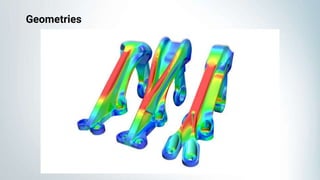
Geometries
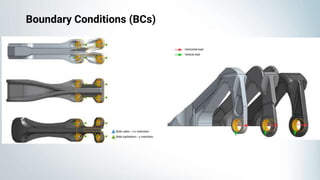
Boundary Conditions (BCs)
Material Properties
Young’s Modulus 200 GPa
Poisson’s Ratio 0.27
Density 7833 kg/m³
Yield Stress 1.0 GPa
Material
● High levels of deformation?
○ Might model nonlinear material properties
● Do you need to model a simulation over a period of time?
○ The linear solver is unable to model time, so the nonlinear solver is required
○ Even if you don’t need to see the effects of time, we can use the nonlinear solver with an end time of 1
second to get results that may be impossible with the linear solver
● What are your boundary conditions?
○ A simple simulation that consists of only applied forces and fixed supports should be modeled with the
linear solver
○ A complicated simulation consists of applied velocities should be modeled with the non-linear solver
● Are you working with complicated geometry?
○ The linear solver utilizes “contacts”. Any adjacent faces will be automatically detected, and held coincident
through the simulation regardless of the boundary conditions
○ The non-linear solver utilizes “physical contacts”. We can define two faces within a physical contact and
they will not be allowed to penetrate each other, but they are not held coincident except through boundary
conditions
Nonlinear Analysis Tips
● Three types of nonlinearity!
○ Material nonlinearity :
■ Allows us to define materials that go into the “plastic region”
● Material does not follow Hooke’s law
■ Stress-strain curves are required
○ Geometric nonlinearity :
■ Body undergoes large deformations → strain-displacement relations become nonlinear!
○ Boundary nonlinearity :
■ Contact problems
Nonlinear systems are not equal to the sum of its parts → Systems do not satisfy superposition principle!
What is Non-Linear Static FEA?
- What can you say about the performance of Model 1 although it has a great strength/mass ratio?
- How does the deformation of Model 1 look like compared to the other models?
- Which model would you choose and why? Which geometric properties do you think contribute to the overall
performance of each component?
Post-Processing Questions (Voluntary)
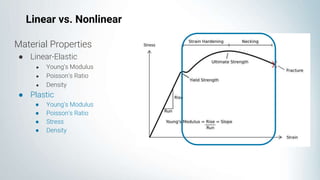
Material Properties
● Linear-Elastic
● Young’s Modulus
● Poisson’s Ratio
● Density
● Plastic
● Young’s Modulus
● Poisson’s Ratio
● Stress
● Density
Linear vs. Nonlinear
Material Properties
● Linear-Elastic
● Young’s Modulus
● Poisson’s Ratio
● Density
● Plastic
● Young’s Modulus
● Poisson’s Ratio
● Stress
● Density
Linear vs. Nonlinear

Aircraft Engine Bearing Bracket Analysis.pptx

  • 1.
    Linear & NonlinearAnalysis of an Aircraft Engine Bearing Bracket June 2022 Jousef Murad
  • 2.
  • 3.
  • 4.
  • 5.
    Material Properties Young’s Modulus200 GPa Poisson’s Ratio 0.27 Density 7833 kg/m³ Yield Stress 1.0 GPa Material
  • 6.
    ● High levelsof deformation? ○ Might model nonlinear material properties ● Do you need to model a simulation over a period of time? ○ The linear solver is unable to model time, so the nonlinear solver is required ○ Even if you don’t need to see the effects of time, we can use the nonlinear solver with an end time of 1 second to get results that may be impossible with the linear solver ● What are your boundary conditions? ○ A simple simulation that consists of only applied forces and fixed supports should be modeled with the linear solver ○ A complicated simulation consists of applied velocities should be modeled with the non-linear solver ● Are you working with complicated geometry? ○ The linear solver utilizes “contacts”. Any adjacent faces will be automatically detected, and held coincident through the simulation regardless of the boundary conditions ○ The non-linear solver utilizes “physical contacts”. We can define two faces within a physical contact and they will not be allowed to penetrate each other, but they are not held coincident except through boundary conditions Nonlinear Analysis Tips
  • 7.
    ● Three typesof nonlinearity! ○ Material nonlinearity : ■ Allows us to define materials that go into the “plastic region” ● Material does not follow Hooke’s law ■ Stress-strain curves are required ○ Geometric nonlinearity : ■ Body undergoes large deformations → strain-displacement relations become nonlinear! ○ Boundary nonlinearity : ■ Contact problems Nonlinear systems are not equal to the sum of its parts → Systems do not satisfy superposition principle! What is Non-Linear Static FEA?
  • 8.
    - What canyou say about the performance of Model 1 although it has a great strength/mass ratio? - How does the deformation of Model 1 look like compared to the other models? - Which model would you choose and why? Which geometric properties do you think contribute to the overall performance of each component? Post-Processing Questions (Voluntary)
  • 9.
    Material Properties ● Linear-Elastic ●Young’s Modulus ● Poisson’s Ratio ● Density ● Plastic ● Young’s Modulus ● Poisson’s Ratio ● Stress ● Density Linear vs. Nonlinear
  • 10.
    Material Properties ● Linear-Elastic ●Young’s Modulus ● Poisson’s Ratio ● Density ● Plastic ● Young’s Modulus ● Poisson’s Ratio ● Stress ● Density Linear vs. Nonlinear