What We Do

     Monitor air pollution
Regulate industrial air emissions
 Teach people about air quality

           We cover
Butler, Clermont, Hamilton and
        Warren counties.
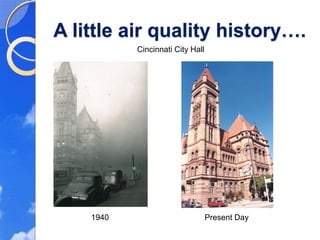
A little air quality history….
           Cincinnati City Hall


    1940                          Present Day
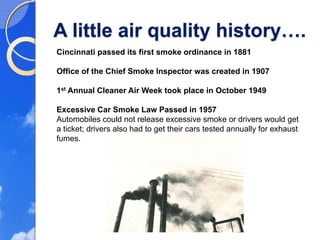
A little air quality history….
Cincinnati passed its first smoke ordinance in 1881

Office of the Chief Smoke Inspector was created in 1907

1st Annual Cleaner Air Week took place in October 1949

Excessive Car Smoke Law Passed in 1957
Automobiles could not release excessive smoke or drivers would get
a ticket; drivers also had to get their cars tested annually for exhaust
fumes.
Question & Answer
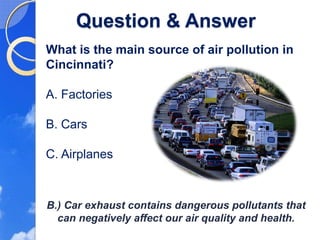
What is the main source of air pollution in
Cincinnati?

A. Factories

B. Cars

C. Airplanes


B.) Car exhaust contains dangerous pollutants that
  can negatively affect our air quality and health.
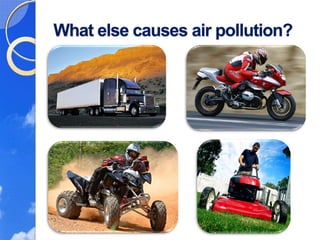
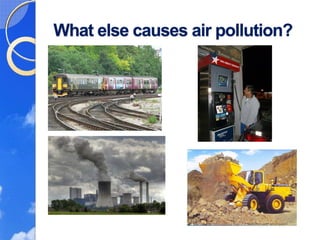
What else causes air pollution?
Air Pollution:
The Dirty Half Dozen
1. Ground Level Ozone: main source of smog:
    car exhaust, gas vapors, industrial emissions.

2. Particulate Matter (PM): soot, dust and dirt in the air.

3. Nitrogen Dioxides (NOx): car exhaust and power plants;
    another main source of smog

4. Carbon Dioxide (CO2): car exhaust.

5. Sulfur Dioxide (SO2): burning coal at power plants.

6. Lead: emissions from motor vehicles and industrial sources.
Question & Answer
What happens in the summer when there is a
lot of air pollution and it get really hot & humid?
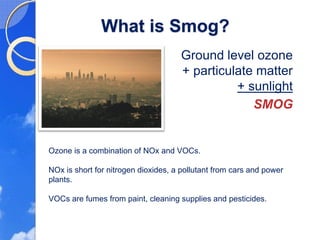
What is Smog?
                                     Ground level ozone
                                     + particulate matter
                                               + sunlight
                                                  SMOG


Ozone is a combination of NOx and VOCs.

NOx is short for nitrogen dioxides, a pollutant from cars and power
plants.

VOCs are fumes from paint, cleaning supplies and pesticides.
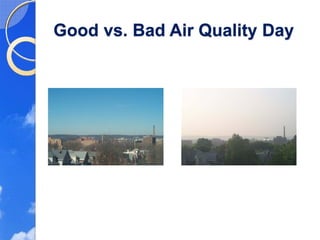
Good vs. Bad Air Quality Day
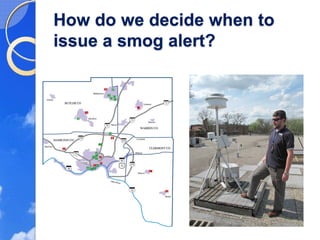
How do we decide when to
issue a smog alert?
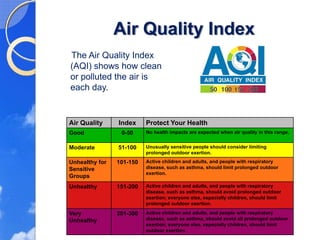
Air Quality Index
The Air Quality Index
(AQI) shows how clean
or polluted the air is
each day.


Air Quality     Index     Protect Your Health
Good             0-50     No health impacts are expected when air quality in this range.


Moderate        51-100    Unusually sensitive people should consider limiting
                          prolonged outdoor exertion.
Unhealthy for   101-150   Active children and adults, and people with respiratory
Sensitive                 disease, such as asthma, should limit prolonged outdoor
                          exertion.
Groups
Unhealthy       151-200   Active children and adults, and people with respiratory
                          disease, such as asthma, should avoid prolonged outdoor
                          exertion; everyone else, especially children, should limit
                          prolonged outdoor exertion.

Very            201-300   Active children and adults, and people with respiratory
Unhealthy                 disease, such as asthma, should avoid all prolonged outdoor
                          exertion; everyone else, especially children, should limit
                          outdoor exertion.
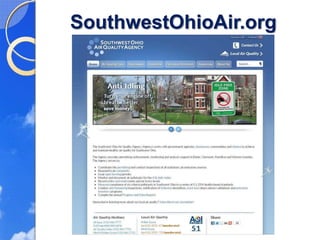
SouthwestOhioAir.org
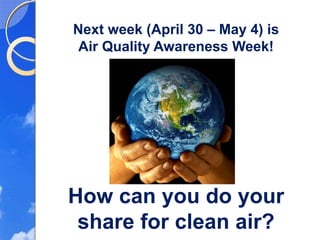
Next week (April 30 – May 4) is
 Air Quality Awareness Week!


How can you do your
 share for clean air?
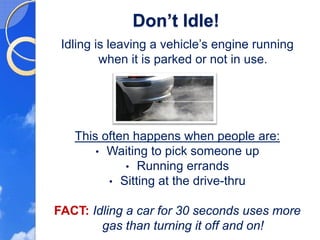
Don’t Idle!
 Idling is leaving a vehicle’s engine running
         when it is parked or not in use.


   This often happens when people are:
       • Waiting to pick someone up
            • Running errands
         • Sitting at the drive-thru


FACT: Idling a car for 30 seconds uses more
        gas than turning it off and on!
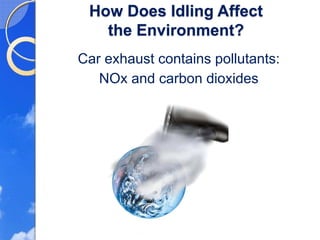
How Does Idling Affect
   the Environment?
Car exhaust contains pollutants:
   NOx and carbon dioxides
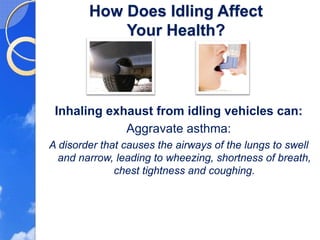
How Does Idling Affect
            Your Health?


 Inhaling exhaust from idling vehicles can:
             Aggravate asthma:
A disorder that causes the airways of the lungs to swell
  and narrow, leading to wheezing, shortness of breath,
              chest tightness and coughing.
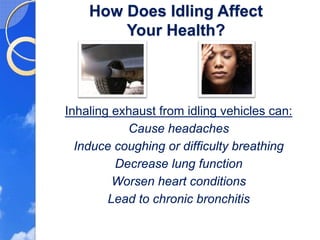
How Does Idling Affect
        Your Health?


Inhaling exhaust from idling vehicles can:
           Cause headaches
  Induce coughing or difficulty breathing
         Decrease lung function
         Worsen heart conditions
        Lead to chronic bronchitis
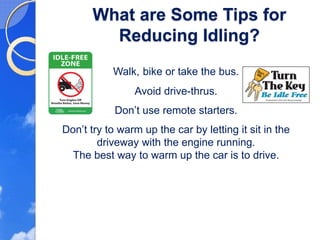
What are Some Tips for
         Reducing Idling?
           Walk, bike or take the bus.
                Avoid drive-thrus.
            Don’t use remote starters.
Don’t try to warm up the car by letting it sit in the
        driveway with the engine running.
  The best way to warm up the car is to drive.
Do Your Share for Clean Air!
 Recycle!


 Compost!
Do Your Share for Clean Air!
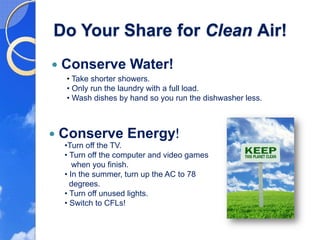
Conserve Water!
 • Take shorter showers.
 • Only run the laundry with a full load.
 • Wash dishes by hand so you run the dishwasher less.


Conserve Energy!
 •Turn off the TV.
 • Turn off the computer and video games
    when you finish.
 • In the summer, turn up the AC to 78
   degrees.
 • Turn off unused lights.
 • Switch to CFLs!
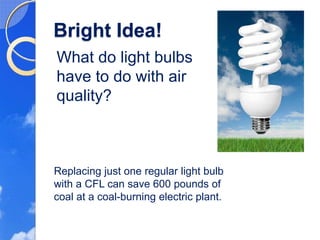
Bright Idea!
What do light bulbs
have to do with air
quality?


Replacing just one regular light bulb
with a CFL can save 600 pounds of
coal at a coal-burning electric plant.
Pop Quiz
High ozone pollution levels are most likely to occur during
a. cold, rainy days
b. cool, windy nights
c. hot, sunny days

Ground level ozone is
a. one of the main parts of smog
b. formed on hot, sunny days when (NOx) and (VOCs) combine
with sunlight
c. makes it difficult to breathe
d. all of the above

Which of the following would reduce ozone pollution?
a. Carpool or use public transportation
b. Limit your speed to 55 m.p.h. on highways
c. Have your car tuned and inspected regularly
d. All of the above
Pop Quiz
During ozone season, people can help reduce ozone by
a. mowing the lawn after 8 p.m.
b. carpooling or by reducing use of cars/vehicles on days when
high ozone levels are predicted
c. limiting the use of oil-based paints and other VOCs
d. all of the above
Which statements are true about car idling?
a. Idling is bad for our health.
b. Idling causes unnecessary pollution.
c. Idling uses less gas than turning the car off and back on.
d. all of the above
e. A and B
f. B and C

The Air Quality Index measures
a. whether or not the sun will shine today.
b. the weather forecast
c. how much air pollution there is today.
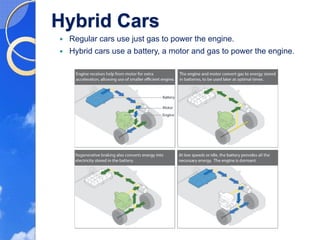
Hybrid Cars
 Regular cars use just gas to power the engine.
 Hybrid cars use a battery, a motor and gas to power the engine.

Air Quality Presentation for 5th Grade

  • 2.
    What We Do Monitor air pollution Regulate industrial air emissions Teach people about air quality We cover Butler, Clermont, Hamilton and Warren counties.
  • 3.
    A little airquality history…. Cincinnati City Hall 1940 Present Day
  • 4.
    A little airquality history…. Cincinnati passed its first smoke ordinance in 1881 Office of the Chief Smoke Inspector was created in 1907 1st Annual Cleaner Air Week took place in October 1949 Excessive Car Smoke Law Passed in 1957 Automobiles could not release excessive smoke or drivers would get a ticket; drivers also had to get their cars tested annually for exhaust fumes.
  • 5.
    Question & Answer Whatis the main source of air pollution in Cincinnati? A. Factories B. Cars C. Airplanes B.) Car exhaust contains dangerous pollutants that can negatively affect our air quality and health.
  • 6.
    What else causesair pollution?
  • 7.
    What else causesair pollution?
  • 8.
    Air Pollution: The DirtyHalf Dozen 1. Ground Level Ozone: main source of smog: car exhaust, gas vapors, industrial emissions. 2. Particulate Matter (PM): soot, dust and dirt in the air. 3. Nitrogen Dioxides (NOx): car exhaust and power plants; another main source of smog 4. Carbon Dioxide (CO2): car exhaust. 5. Sulfur Dioxide (SO2): burning coal at power plants. 6. Lead: emissions from motor vehicles and industrial sources.
  • 9.
    Question & Answer Whathappens in the summer when there is a lot of air pollution and it get really hot & humid?
  • 10.
    What is Smog? Ground level ozone + particulate matter + sunlight SMOG Ozone is a combination of NOx and VOCs. NOx is short for nitrogen dioxides, a pollutant from cars and power plants. VOCs are fumes from paint, cleaning supplies and pesticides.
  • 11.
    Good vs. BadAir Quality Day
  • 12.
    How do wedecide when to issue a smog alert?
  • 13.
    Air Quality Index TheAir Quality Index (AQI) shows how clean or polluted the air is each day. Air Quality Index Protect Your Health Good 0-50 No health impacts are expected when air quality in this range. Moderate 51-100 Unusually sensitive people should consider limiting prolonged outdoor exertion. Unhealthy for 101-150 Active children and adults, and people with respiratory Sensitive disease, such as asthma, should limit prolonged outdoor exertion. Groups Unhealthy 151-200 Active children and adults, and people with respiratory disease, such as asthma, should avoid prolonged outdoor exertion; everyone else, especially children, should limit prolonged outdoor exertion. Very 201-300 Active children and adults, and people with respiratory Unhealthy disease, such as asthma, should avoid all prolonged outdoor exertion; everyone else, especially children, should limit outdoor exertion.
  • 14.
  • 15.
    Next week (April30 – May 4) is Air Quality Awareness Week! How can you do your share for clean air?
  • 16.
    Don’t Idle! Idlingis leaving a vehicle’s engine running when it is parked or not in use. This often happens when people are: • Waiting to pick someone up • Running errands • Sitting at the drive-thru FACT: Idling a car for 30 seconds uses more gas than turning it off and on!
  • 17.
    How Does IdlingAffect the Environment? Car exhaust contains pollutants: NOx and carbon dioxides
  • 18.
    How Does IdlingAffect Your Health? Inhaling exhaust from idling vehicles can: Aggravate asthma: A disorder that causes the airways of the lungs to swell and narrow, leading to wheezing, shortness of breath, chest tightness and coughing.
  • 19.
    How Does IdlingAffect Your Health? Inhaling exhaust from idling vehicles can: Cause headaches Induce coughing or difficulty breathing Decrease lung function Worsen heart conditions Lead to chronic bronchitis
  • 20.
    What are SomeTips for Reducing Idling? Walk, bike or take the bus. Avoid drive-thrus. Don’t use remote starters. Don’t try to warm up the car by letting it sit in the driveway with the engine running. The best way to warm up the car is to drive.
  • 21.
    Do Your Sharefor Clean Air! Recycle! Compost!
  • 22.
    Do Your Sharefor Clean Air! Conserve Water! • Take shorter showers. • Only run the laundry with a full load. • Wash dishes by hand so you run the dishwasher less. Conserve Energy! •Turn off the TV. • Turn off the computer and video games when you finish. • In the summer, turn up the AC to 78 degrees. • Turn off unused lights. • Switch to CFLs!
  • 23.
    Bright Idea! What dolight bulbs have to do with air quality? Replacing just one regular light bulb with a CFL can save 600 pounds of coal at a coal-burning electric plant.
  • 24.
    Pop Quiz High ozonepollution levels are most likely to occur during a. cold, rainy days b. cool, windy nights c. hot, sunny days Ground level ozone is a. one of the main parts of smog b. formed on hot, sunny days when (NOx) and (VOCs) combine with sunlight c. makes it difficult to breathe d. all of the above Which of the following would reduce ozone pollution? a. Carpool or use public transportation b. Limit your speed to 55 m.p.h. on highways c. Have your car tuned and inspected regularly d. All of the above
  • 25.
    Pop Quiz During ozoneseason, people can help reduce ozone by a. mowing the lawn after 8 p.m. b. carpooling or by reducing use of cars/vehicles on days when high ozone levels are predicted c. limiting the use of oil-based paints and other VOCs d. all of the above Which statements are true about car idling? a. Idling is bad for our health. b. Idling causes unnecessary pollution. c. Idling uses less gas than turning the car off and back on. d. all of the above e. A and B f. B and C The Air Quality Index measures a. whether or not the sun will shine today. b. the weather forecast c. how much air pollution there is today.
  • 26.
    Hybrid Cars Regularcars use just gas to power the engine. Hybrid cars use a battery, a motor and gas to power the engine.