Aid for Trade in ECOWAS
  Lessons to learn from existing
 regional Aid for Trade Strategies

               Jeske van Seters

  ECOWAS Aid for Trade Working Group meeting,
                9 October 2012
Structure of the presentation


I.  Aid for Trade Agenda & ECOWAS

II. Regional Aid for Trade Strategies
I. Aid for Trade Agenda & West Africa
What is Aid for Trade and Why
Does it Matter for ECOWAS?

•  AfT has been defined globally (WTO) to refer
   to 5 categories:
   - Economic Infrastructure
   - Building Productive Capacity
   - Trade Development
   - Trade Policy and Regulations
   - Trade Related Adjustment
   + Other Trade Related Needs
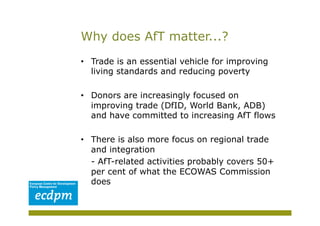
Why does AfT matter...?
•  Trade is an essential vehicle for improving
   living standards and reducing poverty

•  Donors are increasingly focused on
   improving trade (DfID, World Bank, ADB)
   and have committed to increasing AfT flows

•  There is also more focus on regional trade
   and integration
   - AfT-related activities probably covers 50+
   per cent of what the ECOWAS Commission
   does
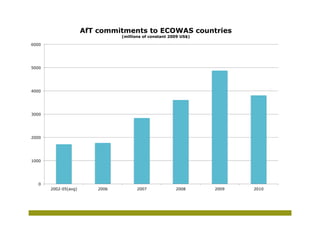
AfT commitments to ECOWAS countries
                                 (millions of constant 2009 US$)

6000


5000


4000


3000


2000


1000


  0
       2002-05(avg)       2006         2007              2008      2009   2010
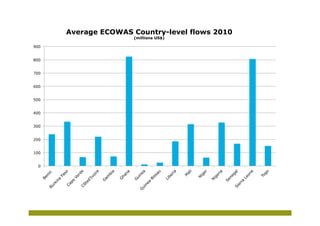
Average ECOWAS Country-level flows 2010
                     (millions US$)

900


800


700


600


500


400


300


200


100


 0
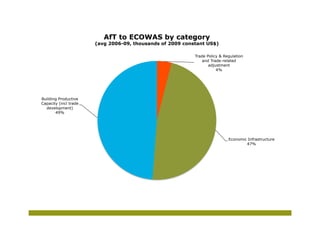
AfT to ECOWAS by category
                       (avg 2006-09, thousands of 2009 constant US$)

                                                           Trade Policy & Regulation
                                                               and Trade-related
                                                                  adjustment
                                                                      4%


Building Productive
Capacity (incl trade
  development)
       49%


                                                                            Economic Infrastructure
                                                                                    47%
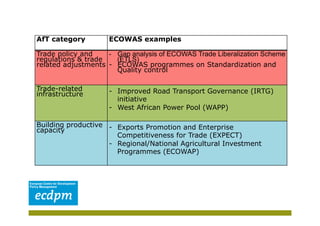
AfT category         ECOWAS examples

Trade policy and    -  Gap analysis of ECOWAS Trade Liberalization Scheme
regulations & trade    (ETLS)
related adjustments -  ECOWAS programmes on Standardization and
                       Quality control

Trade-related        -  Improved Road Transport Governance (IRTG)
infrastructure
                        initiative
                     -  West African Power Pool (WAPP)

Building productive -  Exports Promotion and Enterprise
capacity
                       Competitiveness for Trade (EXPECT)
                    -  Regional/National Agricultural Investment
                       Programmes (ECOWAP)
II. Aid for Trade Strategies
AfT strategies – state of play


   •  A few regional AfT strategies exist so far
     - e.g. COMESA, Indian Ocean Commission, Pacific
     & UEMOA


   •  Development partners with AfT strategies are
      more numerous
      - E.g World Bank, EU, UK, Finland,
      Netherlands,…

          some lessons to learn
Added value of regional AfT strategies

    1.  Guide how to use AfT in a strategic and
        focussed way to resolve regional bottlenecks

      E.g. objectives COMESA AfT strategy:
      1.  Coherent packages of inter-related investments,
          instruments and regulatory measures which allow
          the private sector to reduce the regional costs of
          doing business
      2.  MS have access to mechanisms to address trade
          and integration related adjustments
Added value of regional AfT strategies                    (cont)


      2.  Strengthen coordination & coherence
         –  between regional programmes (horizontal)
         –  Between regional and national levels (vertical)


      3.  Improve the effective and efficient
          utilization of resources

      4.  Provide a basis for resource mobilisation
Lessons learned - successes

1.  AfT strategy particularly helpful if provides
    approach to AfT & clear objectives, not list of
    projects

2.  AfT strategy as short, accessible and focused
    document
   - E.g. COMESA AfT strategy = 2½ pages + results
   matrix


3.  AfT strategy addresses issues that can best
    be addressed regionally
   - E.g. regional corridors, regional value chains,…
Lessons learned – successes                    (cont)


4.  Need for clarity about relationship between
    various regional policies, strategies and plans
    - AfT strategy contributes to inter-departmental
   coordination


5.  Communication is key
   - internally: to ensure ownership, as responsibility for
   implementation of AfT strategy lies with different
   divisions/ministries
   - externally: to mobilise development partners
Lessons learned – challenges


1.  Move beyond accounting exercise
   - EU AfT strategy monitoring focussed on AfT
   flows


2.  Mobilise sufficient funding and use (public
    & private) innovative funding mechanisms
   - delays in establishing COMESA Infrastructure
   fund
Lessons learned – challenges (2)

4.  Ensure sufficient human resources
   - E.g. COMESA Aid for Trade Unit not given the
   capacities to fulfill coordination mandate

5.  Strengthen linkages between regional and
    national level
   - E.g. through national AfT committees (UEMOA)


6.  Systematic M&E to facilitate adaptation and
    improvements to AfT programmes
   - possibly incorporated in broader M&E system
Characteristics of ECOWAS AfT Strategy
  to be informed by lessons learned

     •  Objectives

     •  Focus

     •  Role of AfT strategy in relation to other
        regional and national strategies, policies and
        plans

     •  Choice of implementation & monitoring
        mechanisms
Thank you!
Jeske van Seters
jvs@ecdpm.org
Resources
-  Dalleau, M. and J. van Seters. 2011.
   Operationalising the West African EPA
   Development Programme Moving beyond the
   paperwork. (ECDPM Discussion Paper 121)
   http://www.ecdpm.org/dp121
-  Lui, D., B. Byiers, and Jeske van Seters. 2012.
   Rethinking Aid for Trade in the context of
   innovative financing. (ECDPM Discussion Paper
   127). http://www.ecdpm.org/dp127
-  Seters, J. van, D. Afun-Ogidan, and F. Rampa. 2012.
   Regional approaches to food security in Africa:
   The CAADP and other relevant policies and
   programmes in ECOWAS (Discussion Paper 128d).
   http://www.ecdpm.org/dp128d
-  Lui, D. and J. Van Seters. 2012. Review of the
   COMESA Aid for Trade Strategy. (ECDPM
   Discussion Paper 130). http://www.ecdpm.org/dp130

Aid for trade in ECOWAS: Lessons to learn from existing regional Aid for Trade Strategies

  • 1.
    Aid for Tradein ECOWAS Lessons to learn from existing regional Aid for Trade Strategies Jeske van Seters ECOWAS Aid for Trade Working Group meeting, 9 October 2012
  • 2.
    Structure of thepresentation I.  Aid for Trade Agenda & ECOWAS II. Regional Aid for Trade Strategies
  • 3.
    I. Aid forTrade Agenda & West Africa
  • 4.
    What is Aidfor Trade and Why Does it Matter for ECOWAS? •  AfT has been defined globally (WTO) to refer to 5 categories: - Economic Infrastructure - Building Productive Capacity - Trade Development - Trade Policy and Regulations - Trade Related Adjustment + Other Trade Related Needs
  • 5.
    Why does AfTmatter...? •  Trade is an essential vehicle for improving living standards and reducing poverty •  Donors are increasingly focused on improving trade (DfID, World Bank, ADB) and have committed to increasing AfT flows •  There is also more focus on regional trade and integration - AfT-related activities probably covers 50+ per cent of what the ECOWAS Commission does
  • 6.
    AfT commitments toECOWAS countries (millions of constant 2009 US$) 6000 5000 4000 3000 2000 1000 0 2002-05(avg) 2006 2007 2008 2009 2010
  • 7.
    Average ECOWAS Country-levelflows 2010 (millions US$) 900 800 700 600 500 400 300 200 100 0
  • 8.
    AfT to ECOWASby category (avg 2006-09, thousands of 2009 constant US$) Trade Policy & Regulation and Trade-related adjustment 4% Building Productive Capacity (incl trade development) 49% Economic Infrastructure 47%
  • 9.
    AfT category ECOWAS examples Trade policy and -  Gap analysis of ECOWAS Trade Liberalization Scheme regulations & trade (ETLS) related adjustments -  ECOWAS programmes on Standardization and Quality control Trade-related -  Improved Road Transport Governance (IRTG) infrastructure initiative -  West African Power Pool (WAPP) Building productive -  Exports Promotion and Enterprise capacity Competitiveness for Trade (EXPECT) -  Regional/National Agricultural Investment Programmes (ECOWAP)
  • 10.
    II. Aid forTrade Strategies
  • 11.
    AfT strategies –state of play •  A few regional AfT strategies exist so far - e.g. COMESA, Indian Ocean Commission, Pacific & UEMOA •  Development partners with AfT strategies are more numerous - E.g World Bank, EU, UK, Finland, Netherlands,…  some lessons to learn
  • 12.
    Added value ofregional AfT strategies 1.  Guide how to use AfT in a strategic and focussed way to resolve regional bottlenecks E.g. objectives COMESA AfT strategy: 1.  Coherent packages of inter-related investments, instruments and regulatory measures which allow the private sector to reduce the regional costs of doing business 2.  MS have access to mechanisms to address trade and integration related adjustments
  • 13.
    Added value ofregional AfT strategies (cont) 2.  Strengthen coordination & coherence –  between regional programmes (horizontal) –  Between regional and national levels (vertical) 3.  Improve the effective and efficient utilization of resources 4.  Provide a basis for resource mobilisation
  • 14.
    Lessons learned -successes 1.  AfT strategy particularly helpful if provides approach to AfT & clear objectives, not list of projects 2.  AfT strategy as short, accessible and focused document - E.g. COMESA AfT strategy = 2½ pages + results matrix 3.  AfT strategy addresses issues that can best be addressed regionally - E.g. regional corridors, regional value chains,…
  • 15.
    Lessons learned –successes (cont) 4.  Need for clarity about relationship between various regional policies, strategies and plans - AfT strategy contributes to inter-departmental coordination 5.  Communication is key - internally: to ensure ownership, as responsibility for implementation of AfT strategy lies with different divisions/ministries - externally: to mobilise development partners
  • 16.
    Lessons learned –challenges 1.  Move beyond accounting exercise - EU AfT strategy monitoring focussed on AfT flows 2.  Mobilise sufficient funding and use (public & private) innovative funding mechanisms - delays in establishing COMESA Infrastructure fund
  • 17.
    Lessons learned –challenges (2) 4.  Ensure sufficient human resources - E.g. COMESA Aid for Trade Unit not given the capacities to fulfill coordination mandate 5.  Strengthen linkages between regional and national level - E.g. through national AfT committees (UEMOA) 6.  Systematic M&E to facilitate adaptation and improvements to AfT programmes - possibly incorporated in broader M&E system
  • 18.
    Characteristics of ECOWASAfT Strategy to be informed by lessons learned •  Objectives •  Focus •  Role of AfT strategy in relation to other regional and national strategies, policies and plans •  Choice of implementation & monitoring mechanisms
  • 19.
    Thank you! Jeske vanSeters jvs@ecdpm.org
  • 20.
    Resources -  Dalleau, M.and J. van Seters. 2011. Operationalising the West African EPA Development Programme Moving beyond the paperwork. (ECDPM Discussion Paper 121) http://www.ecdpm.org/dp121 -  Lui, D., B. Byiers, and Jeske van Seters. 2012. Rethinking Aid for Trade in the context of innovative financing. (ECDPM Discussion Paper 127). http://www.ecdpm.org/dp127 -  Seters, J. van, D. Afun-Ogidan, and F. Rampa. 2012. Regional approaches to food security in Africa: The CAADP and other relevant policies and programmes in ECOWAS (Discussion Paper 128d). http://www.ecdpm.org/dp128d -  Lui, D. and J. Van Seters. 2012. Review of the COMESA Aid for Trade Strategy. (ECDPM Discussion Paper 130). http://www.ecdpm.org/dp130