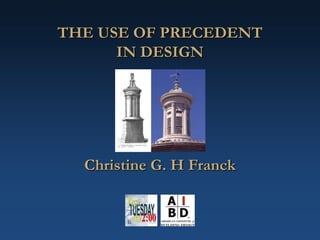


THE USE OF PRECEDENT
IN DESIGN
Christine G. H Franck
prec·e·dent (noun)
1: an earlier occurrence of something similar
2: a. something done or said that may serve as an example or
rule to authorize or justify a subsequent act of the same or
an analogous kind <a verdict that had no precedent>
b. the convention established by such a precedent or by
long practice
3: a person or thing that serves as a model
(Merriam Webster Dictionary)
pre·ce·dence (noun)
1: a. obsolete :ANTECEDENT
b. the fact of coming or occurring earlier in time
2: a. the right to superior honor on a ceremonial or formal
occasion
b. the order of ceremonial or formal preference
c. priority of importance <your safety takes precedence>
(Merriam Webster Dictionary)
PRECEDENT/PRECEDENTS
NOT
PRECEDENCE
WHY USE PRECEDENT AT ALL?
• Can lend AUTHORITY to your design, by equating
your design to something else
• Can create MEANING in your design, for you, the
public, or the client
• Helps the building COMMUNICATE to its users and
visitors, and to the future
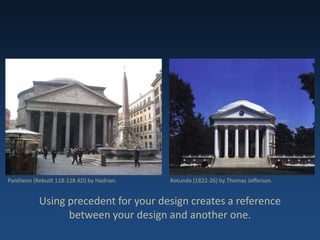
Using precedent for your design creates a reference
between your design and another one.
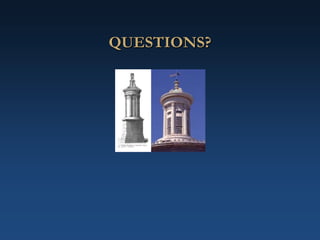
Pantheon (Rebuilt 118-128 AD) by Hadrian. Rotunda (1822-26) by Thomas Jefferson.
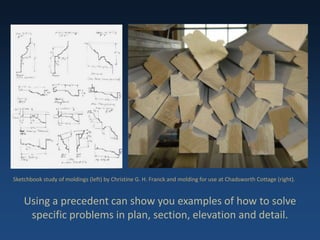
Using a precedent can show you examples of how to solve
specific problems in plan, section, elevation and detail.
Sketchbook study of moldings (left) by Christine G. H. Franck and molding for use at Chadsworth Cottage (right).
Using a precedent can teach you about the architecture of a
place and help you learn lessons for your own design work.
Rosenberg House in Galveston, Texas (left) and design for house in Beachtown (right) by Christine G. H. Franck.
Using a precedent can allow you and your client to see and
walk through something similar to what you are designing.
.
Walking through the Getty Villa with a client for whom I am using this as a precedent.
• Can lend AUTHORITY to your design, by equating
your design to something else
• Can create MEANING in your design, for you, the
public, or the client
• Helps the building COMMUNICATE to its users and
visitors, and to the future
HOW DO I SELECT THE RIGHT
PRECEDENT?
(or at least a good one)
• Understand the problem at hand, so you can
select a suitable and workable model or models.
• Look to known or important works of
architecture, to those things approved by history
and taste, don’t look to the latest magazine.
• Look for something which you can adequately
explore in detail.
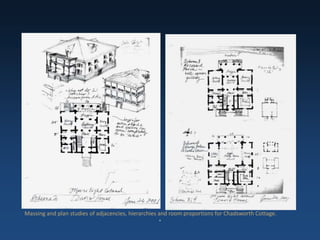
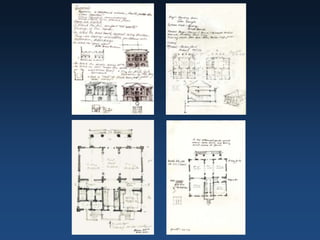
.Massing and plan studies of adjacencies, hierarchies and room proportions for Chadsworth Cottage.
Massing and plan of Palladio’s Villa Foscari (la Malcontenta), which served as precedent for cubic building on a
high base with porch.
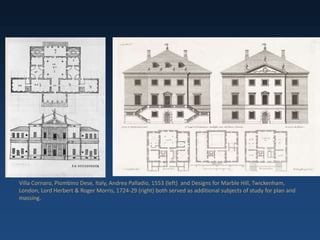
Villa Cornaro, Piombino Dese, Italy, Andrea Palladio, 1553 (left) and Designs for Marble Hill, Twickenham,
London, Lord Herbert & Roger Morris, 1724-29 (right) both served as additional subjects of study for plan and
massing.
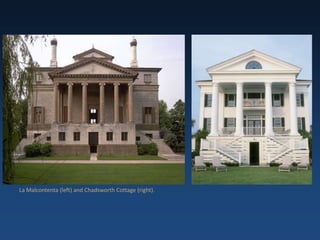
La Malcontenta (left) and Chadsworth Cottage (right).
• Understand the problem at hand, so you can
select a suitable and workable model or models.
• Look to known or important works of
architecture, to those things approved by history
and taste, don’t look to the latest magazine.
• Look for something which you can adequately
explore in detail.
WHERE DO I LOOK FOR
INFORMATION?
• HABS/HAER:
http://memory.loc.gov/ammem/collections/habs
_haer/
• Books like the White Pine Series:
http://www.cslib.org/whitepine.htm
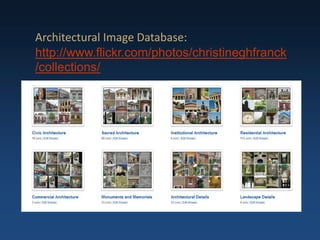
• Architectural Image Database:
http://www.flickr.com/photos/christineghfranck/c
ollections/
• Tour and survey yourself!
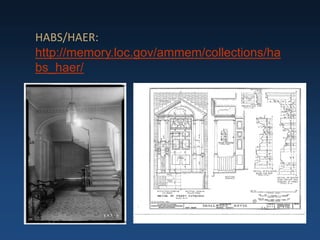
HABS/HAER:
http://memory.loc.gov/ammem/collections/ha
bs_haer/
Books like the White Pine Series:
http://www.cslib.org/whitepine.htm
Architectural Image Database:
http://www.flickr.com/photos/christineghfranck
/collections/
Tour and survey:
• HABS/HAER:
http://memory.loc.gov/ammem/collections/habs
_haer/
• Books like the White Pine Series:
http://www.cslib.org/whitepine.htm
• Architectural Image Database:
http://www.flickr.com/photos/christineghfranck/c
ollections/
• Tour and survey yourself!
HOW DO I ANALYZE THE
SELECTED PRECEDENT?
• Photographs and sketch it in plan, section,
elevation, profile
• Look for overall relationships and plan adjacencies
• Look for specific proportions or rooms, windows,
doors, etc.
• Study the exact profiles of moldings, angles of
roof slopes, etc.
• Study the exact measurements
Inner peristyle at Getty Villa.
Preliminary study of plan and details at Getty Villa for new peristyle.
Preliminary design of new peristyle based on Getty Vill and client preferences..
Plan studies for adaptation to new house.
Measured drawings of fireplace surround and moldings of existing room for use in new room.
• Photographs and sketch it in plan, section,
elevation, profile
• Look for overall relationships and plan adjacencies
• Look for specific proportions or rooms, windows,
doors, etc.
• Study the exact profiles of moldings, angles of
roof slopes, etc.
• Study the exact measurements
HOW DO I APPLY THE SELECTED
PRECEDENT?
• After understanding both your own design
problem, and selecting a precedent, and the n
studying the precedent, apply the precedent to
resolve the design problem
• It is better to be specific in your study and
application than general and loose
• Do not focus on an exact copy, rather look to learn
the lessons of your precedent: imitate, don’t copy
• Use your precedent to check yourself
• Precedents may be applied more or less directly
https://www.facebook.com/media/set/?set=a.490373454
345469.1073741826.185288074854010&type=3
Existing house to be renovated by Steve Mickley.
Images which Steve Mickley “found online that kind of inspired “ him. He also says, “because of the
desired location of our second floor, I was looking for examples with tall entryways.”
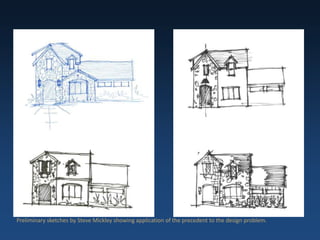
Preliminary sketches by Steve Mickley showing application of the precedent to the design problem.
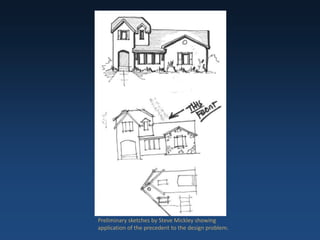
Preliminary sketches by Steve Mickley showing
application of the precedent to the design problem.
• After understanding both your own design
problem, and selecting a precedent, and the n
studying the precedent, apply the precedent to
resolve the design problem
• It is better to be specific in your study and
application than general and loose
• Do not focus on an exact copy, rather look to learn
the lessons of your precedent: imitate, don’t copy
• Use your precedent to check yourself
• Precedents may be applied more or less directly
prec·e·dent (noun)
1: an earlier occurrence of something similar
2: a. something done or said that may serve as an example or
rule to authorize or justify a subsequent act of the same or
an analogous kind <a verdict that had no precedent>
b. the convention established by such a precedent or by
long practice
3: a person or thing that serves as a model
(Merriam Webster Dictionary)
QUESTIONS?

The Use of Precedent in Design

  • 1.
    THE USE OFPRECEDENT IN DESIGN Christine G. H Franck
  • 2.
    prec·e·dent (noun) 1: anearlier occurrence of something similar 2: a. something done or said that may serve as an example or rule to authorize or justify a subsequent act of the same or an analogous kind <a verdict that had no precedent> b. the convention established by such a precedent or by long practice 3: a person or thing that serves as a model (Merriam Webster Dictionary)
  • 3.
    pre·ce·dence (noun) 1: a.obsolete :ANTECEDENT b. the fact of coming or occurring earlier in time 2: a. the right to superior honor on a ceremonial or formal occasion b. the order of ceremonial or formal preference c. priority of importance <your safety takes precedence> (Merriam Webster Dictionary)
  • 4.
  • 5.
  • 6.
    • Can lendAUTHORITY to your design, by equating your design to something else • Can create MEANING in your design, for you, the public, or the client • Helps the building COMMUNICATE to its users and visitors, and to the future
  • 7.
    Using precedent foryour design creates a reference between your design and another one. Pantheon (Rebuilt 118-128 AD) by Hadrian. Rotunda (1822-26) by Thomas Jefferson.
  • 8.
    Using a precedentcan show you examples of how to solve specific problems in plan, section, elevation and detail. Sketchbook study of moldings (left) by Christine G. H. Franck and molding for use at Chadsworth Cottage (right).
  • 9.
    Using a precedentcan teach you about the architecture of a place and help you learn lessons for your own design work. Rosenberg House in Galveston, Texas (left) and design for house in Beachtown (right) by Christine G. H. Franck.
  • 10.
    Using a precedentcan allow you and your client to see and walk through something similar to what you are designing. . Walking through the Getty Villa with a client for whom I am using this as a precedent.
  • 11.
    • Can lendAUTHORITY to your design, by equating your design to something else • Can create MEANING in your design, for you, the public, or the client • Helps the building COMMUNICATE to its users and visitors, and to the future
  • 12.
    HOW DO ISELECT THE RIGHT PRECEDENT? (or at least a good one)
  • 13.
    • Understand theproblem at hand, so you can select a suitable and workable model or models. • Look to known or important works of architecture, to those things approved by history and taste, don’t look to the latest magazine. • Look for something which you can adequately explore in detail.
  • 14.
    .Massing and planstudies of adjacencies, hierarchies and room proportions for Chadsworth Cottage.
  • 16.
    Massing and planof Palladio’s Villa Foscari (la Malcontenta), which served as precedent for cubic building on a high base with porch.
  • 17.
    Villa Cornaro, PiombinoDese, Italy, Andrea Palladio, 1553 (left) and Designs for Marble Hill, Twickenham, London, Lord Herbert & Roger Morris, 1724-29 (right) both served as additional subjects of study for plan and massing.
  • 18.
    La Malcontenta (left)and Chadsworth Cottage (right).
  • 19.
    • Understand theproblem at hand, so you can select a suitable and workable model or models. • Look to known or important works of architecture, to those things approved by history and taste, don’t look to the latest magazine. • Look for something which you can adequately explore in detail.
  • 20.
    WHERE DO ILOOK FOR INFORMATION?
  • 21.
    • HABS/HAER: http://memory.loc.gov/ammem/collections/habs _haer/ • Bookslike the White Pine Series: http://www.cslib.org/whitepine.htm • Architectural Image Database: http://www.flickr.com/photos/christineghfranck/c ollections/ • Tour and survey yourself!
  • 22.
  • 23.
    Books like theWhite Pine Series: http://www.cslib.org/whitepine.htm
  • 24.
  • 25.
  • 26.
    • HABS/HAER: http://memory.loc.gov/ammem/collections/habs _haer/ • Bookslike the White Pine Series: http://www.cslib.org/whitepine.htm • Architectural Image Database: http://www.flickr.com/photos/christineghfranck/c ollections/ • Tour and survey yourself!
  • 27.
    HOW DO IANALYZE THE SELECTED PRECEDENT?
  • 28.
    • Photographs andsketch it in plan, section, elevation, profile • Look for overall relationships and plan adjacencies • Look for specific proportions or rooms, windows, doors, etc. • Study the exact profiles of moldings, angles of roof slopes, etc. • Study the exact measurements
  • 29.
    Inner peristyle atGetty Villa.
  • 30.
    Preliminary study ofplan and details at Getty Villa for new peristyle.
  • 31.
    Preliminary design ofnew peristyle based on Getty Vill and client preferences..
  • 32.
    Plan studies foradaptation to new house.
  • 33.
    Plan studies foradaptation to new house.
  • 34.
    Plan studies foradaptation to new house.
  • 35.
    Measured drawings offireplace surround and moldings of existing room for use in new room.
  • 36.
    • Photographs andsketch it in plan, section, elevation, profile • Look for overall relationships and plan adjacencies • Look for specific proportions or rooms, windows, doors, etc. • Study the exact profiles of moldings, angles of roof slopes, etc. • Study the exact measurements
  • 37.
    HOW DO IAPPLY THE SELECTED PRECEDENT?
  • 38.
    • After understandingboth your own design problem, and selecting a precedent, and the n studying the precedent, apply the precedent to resolve the design problem • It is better to be specific in your study and application than general and loose • Do not focus on an exact copy, rather look to learn the lessons of your precedent: imitate, don’t copy • Use your precedent to check yourself • Precedents may be applied more or less directly
  • 39.
  • 40.
    Existing house tobe renovated by Steve Mickley.
  • 41.
    Images which SteveMickley “found online that kind of inspired “ him. He also says, “because of the desired location of our second floor, I was looking for examples with tall entryways.”
  • 42.
    Preliminary sketches bySteve Mickley showing application of the precedent to the design problem.
  • 43.
    Preliminary sketches bySteve Mickley showing application of the precedent to the design problem.
  • 44.
    • After understandingboth your own design problem, and selecting a precedent, and the n studying the precedent, apply the precedent to resolve the design problem • It is better to be specific in your study and application than general and loose • Do not focus on an exact copy, rather look to learn the lessons of your precedent: imitate, don’t copy • Use your precedent to check yourself • Precedents may be applied more or less directly
  • 45.
    prec·e·dent (noun) 1: anearlier occurrence of something similar 2: a. something done or said that may serve as an example or rule to authorize or justify a subsequent act of the same or an analogous kind <a verdict that had no precedent> b. the convention established by such a precedent or by long practice 3: a person or thing that serves as a model (Merriam Webster Dictionary)
  • 46.