Strategic Analysis And Growth Strategies Report
Executive Summary
Arzan DİLEK BOZKURT
AI-SUPPORTED
ERP SOFTWARE
Index
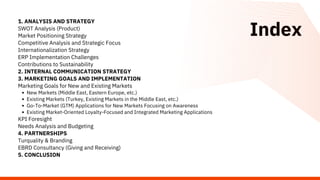
1. ANALYSIS AND STRATEGY
SWOT Analysis (Product)
Market Positioning Strategy
Competitive Analysis and Strategic Focus
Internationalization Strategy
ERP Implementation Challenges
Contributions to Sustainability
2. INTERNAL COMMUNICATION STRATEGY
3. MARKETING GOALS AND IMPLEMENTATION
Marketing Goals for New and Existing Markets
New Markets (Middle East, Eastern Europe, etc.)
Existing Markets (Turkey, Existing Markets in the Middle East, etc.)
Go-To-Market (GTM) Applications for New Markets Focusing on Awareness
Existing Market-Oriented Loyalty-Focused and Integrated Marketing Applications
KPI Foresight
Needs Analysis and Budgeting
4. PARTNERSHIPS
Turquality & Branding
EBRD Consultancy (Giving and Receiving)
5. CONCLUSION
Strategic
Analysis
Siskon is a company specializing in industrial
automation and software solutions, offering AI-
powered ERP systems. This section of the report
provides a strategic analysis of Siskon’s ERP
software, including a SWOT analysis, market
positioning strategy, competitive advantages
within the value discipline model, customer
challenges with ERP applications, contributions
to sustainability and the internationalization
strategy.
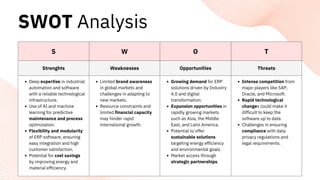
S W O T
Strenghts Weaknesses Opportunities Threats
Deep expertise in industrial
automation and software
with a reliable technological
infrastructure.
Use of AI and machine
learning for predictive
maintenance and process
optimization.
Flexibility and modularity
of ERP software, ensuring
easy integration and high
customer satisfaction.
Potential for cost savings
by improving energy and
material efficiency.
Limited brand awareness
in global markets and
challenges in adapting to
new markets.
Resource constraints and
limited financial capacity
may hinder rapid
international growth.
Growing demand for ERP
solutions driven by Industry
4.0 and digital
transformation.
Expansion opportunities in
rapidly growing markets
such as Asia, the Middle
East, and Latin America.
Potential to offer
sustainable solutions
targeting energy efficiency
and environmental goals.
Market access through
strategic partnerships.
Intense competition from
major players like SAP,
Oracle, and Microsoft.
Rapid technological
changes could make it
difficult to keep the
software up to date.
Challenges in ensuring
compliance with data
privacy regulations and
legal requirements.
SWOT Analysis
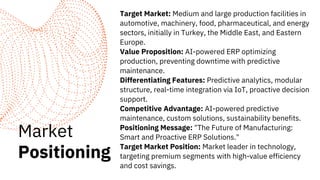
Market
Positioning
Target Market: Medium and large production facilities in
automotive, machinery, food, pharmaceutical, and energy
sectors, initially in Turkey, the Middle East, and Eastern
Europe.
Value Proposition: AI-powered ERP optimizing
production, preventing downtime with predictive
maintenance.
Differentiating Features: Predictive analytics, modular
structure, real-time integration via IoT, proactive decision
support.
Competitive Advantage: AI-powered predictive
maintenance, custom solutions, sustainability benefits.
Positioning Message: "The Future of Manufacturing:
Smart and Proactive ERP Solutions."
Target Market Position: Market leader in technology,
targeting premium segments with high-value efficiency
and cost savings.
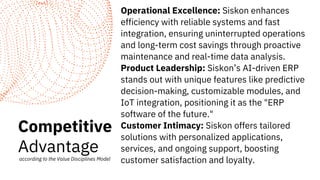
Competitive
Advantage
according to the Value Disciplines Model
Operational Excellence: Siskon enhances
efficiency with reliable systems and fast
integration, ensuring uninterrupted operations
and long-term cost savings through proactive
maintenance and real-time data analysis.
Product Leadership: Siskon’s AI-driven ERP
stands out with unique features like predictive
decision-making, customizable modules, and
IoT integration, positioning it as the "ERP
software of the future."
Customer Intimacy: Siskon offers tailored
solutions with personalized applications,
services, and ongoing support, boosting
customer satisfaction and loyalty.
Strategic
Recommendations
Highlight Innovation: Differentiate from competitors by detailing
unique features through technical articles and case studies.
Customer-Centric Service Models: Define application plans and
technical support processes tailored for each customer.
Foster Long-Term Partnerships: Develop joint projects with
customers aimed at sustainability goals.
Internationalization Strategy
Based on UPPSALA Model
Market Knowledge: Target Middle East and North Africa, collaborate with
local partners for low-risk entry.
Incremental Commitment: Start with pilot projects, then expand sales
and support teams.
Cultural and Geographical Proximity: Focus on culturally similar regions
like the Middle East and Eastern Europe.
Resource-Based Risk Management: Use a SaaS model for cost-effective
entry and scalability.
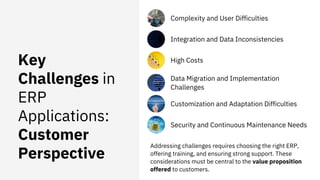
Key
Challenges in
ERP
Applications:
Customer
Perspective
Security and Continuous Maintenance Needs
Customization and Adaptation Difficulties
Data Migration and Implementation
Challenges
High Costs
Integration and Data Inconsistencies
Complexity and User Difficulties
Addressing challenges requires choosing the right ERP,
offering training, and ensuring strong support. These
considerations must be central to the value proposition
offered to customers.
Sustainability
Contributions
Siskon’s industrial automation solutions
contribute to environmental sustainability by
optimizing energy efficiency, waste
management, and material usage.
Integration of renewable energy, waste
reduction, and minimizing carbon footprint
are key aspects.
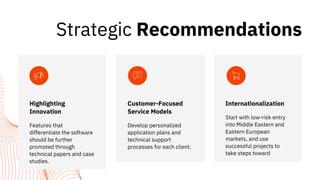
Highlighting
Innovation
Features that
differentiate the software
should be further
promoted through
technical papers and case
studies.
Strategic Recommendations
Customer-Focused
Service Models
Develop personalized
application plans and
technical support
processes for each client.
Internationalization
Start with low-risk entry
into Middle Eastern and
Eastern European
markets, and use
successful projects to
take steps toward
Through its AI-powered
ERP software
Siskon aims to establish a strong position in the global industry by
providing operational efficiency, sustainability, and innovation-
driven solutions.
This strategic analysis will help the company grow successfully in
international markets.
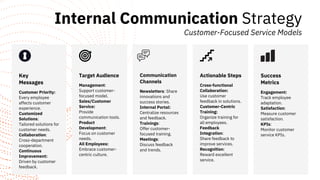
Internal Communication Strategy
Customer-Focused Service Models
Key
Messages
Customer Priority:
Every employee
affects customer
experience.
Customized
Solutions:
Tailored solutions for
customer needs.
Collaboration:
Cross-department
cooperation.
Continuous
Improvement:
Driven by customer
feedback.
Target Audience
Management:
Support customer-
focused model.
Sales/Customer
Service:
Provide
communication tools.
Product
Development:
Focus on customer
needs.
All Employees:
Embrace customer-
centric culture.
Communication
Channels
Newsletters: Share
innovations and
success stories.
Internal Portal:
Centralize resources
and feedback.
Trainings:
Offer customer-
focused training.
Meetings:
Discuss feedback
and trends.
Actionable Steps
Cross-functional
Collaboration:
Use customer
feedback in solutions.
Customer-Centric
Training:
Organize training for
all employees.
Feedback
Integration:
Share feedback to
improve services.
Recognition:
Reward excellent
service.
Success
Metrics
Engagement:
Track employee
adaptation.
Satisfaction:
Measure customer
satisfaction.
KPIs:
Monitor customer
service KPIs.
Marketing
Objectives &
Application
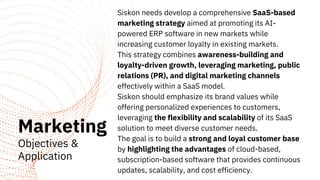
Siskon needs develop a comprehensive SaaS-based
marketing strategy aimed at promoting its AI-
powered ERP software in new markets while
increasing customer loyalty in existing markets.
This strategy combines awareness-building and
loyalty-driven growth, leveraging marketing, public
relations (PR), and digital marketing channels
effectively within a SaaS model.
Siskon should emphasize its brand values while
offering personalized experiences to customers,
leveraging the flexibility and scalability of its SaaS
solution to meet diverse customer needs.
The goal is to build a strong and loyal customer base
by highlighting the advantages of cloud-based,
subscription-based software that provides continuous
updates, scalability, and cost efficiency.
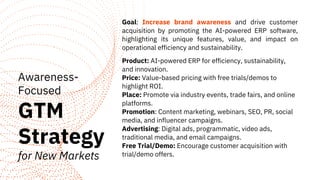
Awareness-
Focused
GTM
Strategy
for New Markets
Goal: Increase brand awareness and drive customer
acquisition by promoting the AI-powered ERP software,
highlighting its unique features, value, and impact on
operational efficiency and sustainability.
Product: AI-powered ERP for efficiency, sustainability,
and innovation.
Price: Value-based pricing with free trials/demos to
highlight ROI.
Place: Promote via industry events, trade fairs, and online
platforms.
Promotion: Content marketing, webinars, SEO, PR, social
media, and influencer campaigns.
Advertising: Digital ads, programmatic, video ads,
traditional media, and email campaigns.
Free Trial/Demo: Encourage customer acquisition with
trial/demo offers.
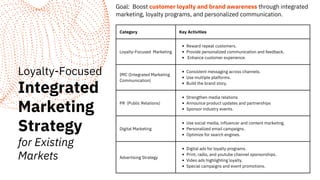
Category Key Activities
Loyalty-Focused Marketing
Reward repeat customers.
Provide personalized communication and feedback.
Enhance customer experience.
IMC (Integrated Marketing
Communication)
Consistent messaging across channels.
Use multiple platforms.
Build the brand story.
PR (Public Relations)
Strengthen media relations
Announce product updates and partnerships
Sponsor industry events.
Digital Marketing
Use social media, influencer and content marketing.
Personalized email campaigns.
Optimize for search engines.
Advertising Strategy
Digital ads for loyalty programs.
Print, radio, and youtube channel sponsorships.
Video ads highlighting loyalty.
Special campaigns and event promotions.
Loyalty-Focused
Integrated
Marketing
Strategy
for Existing
Markets
Goal: Boost customer loyalty and brand awareness through integrated
marketing, loyalty programs, and personalized communication.
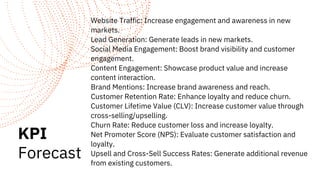
KPI
Forecast
Website Traffic: Increase engagement and awareness in new
markets.
Lead Generation: Generate leads in new markets.
Social Media Engagement: Boost brand visibility and customer
engagement.
Content Engagement: Showcase product value and increase
content interaction.
Brand Mentions: Increase brand awareness and reach.
Customer Retention Rate: Enhance loyalty and reduce churn.
Customer Lifetime Value (CLV): Increase customer value through
cross-selling/upselling.
Churn Rate: Reduce customer loss and increase loyalty.
Net Promoter Score (NPS): Evaluate customer satisfaction and
loyalty.
Upsell and Cross-Sell Success Rates: Generate additional revenue
from existing customers.
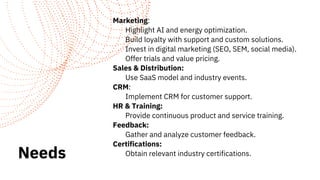
Needs
Marketing:
Highlight AI and energy optimization.
Build loyalty with support and custom solutions.
Invest in digital marketing (SEO, SEM, social media).
Offer trials and value pricing.
Sales & Distribution:
Use SaaS model and industry events.
CRM:
Implement CRM for customer support.
HR & Training:
Provide continuous product and service training.
Feedback:
Gather and analyze customer feedback.
Certifications:
Obtain relevant industry certifications.
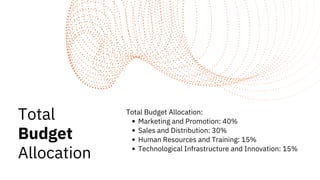
Total
Budget
Allocation
Total Budget Allocation:
Marketing and Promotion: 40%
Sales and Distribution: 30%
Human Resources and Training: 15%
Technological Infrastructure and Innovation: 15%
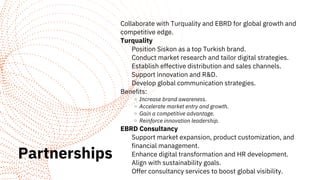
Partnerships
Collaborate with Turquality and EBRD for global growth and
competitive edge.
Turquality
Position Siskon as a top Turkish brand.
Conduct market research and tailor digital strategies.
Establish effective distribution and sales channels.
Support innovation and R&D.
Develop global communication strategies.
Benefits:
Increase brand awareness.
Accelerate market entry and growth.
Gain a competitive advantage.
Reinforce innovation leadership.
EBRD Consultancy
Support market expansion, product customization, and
financial management.
Enhance digital transformation and HR development.
Align with sustainability goals.
Offer consultancy services to boost global visibility.
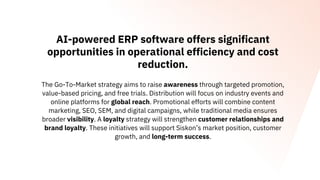
AI-powered ERP software offers significant
opportunities in operational efficiency and cost
reduction.
The Go-To-Market strategy aims to raise awareness through targeted promotion,
value-based pricing, and free trials. Distribution will focus on industry events and
online platforms for global reach. Promotional efforts will combine content
marketing, SEO, SEM, and digital campaigns, while traditional media ensures
broader visibility. A loyalty strategy will strengthen customer relationships and
brand loyalty. These initiatives will support Siskon’s market position, customer
growth, and long-term success.
Thank you
arzandilek@gmail.com
E-mail
https://www.linkedin.com/in/arzandilek/
Linkedin
0 532 456 41 31
Mobile

AI-SUPPORTED ERP SOFTWARE-EXECUTIVE SUMMARY .pdf

  • 1.
    Strategic Analysis AndGrowth Strategies Report Executive Summary Arzan DİLEK BOZKURT AI-SUPPORTED ERP SOFTWARE
  • 2.
    Index 1. ANALYSIS ANDSTRATEGY SWOT Analysis (Product) Market Positioning Strategy Competitive Analysis and Strategic Focus Internationalization Strategy ERP Implementation Challenges Contributions to Sustainability 2. INTERNAL COMMUNICATION STRATEGY 3. MARKETING GOALS AND IMPLEMENTATION Marketing Goals for New and Existing Markets New Markets (Middle East, Eastern Europe, etc.) Existing Markets (Turkey, Existing Markets in the Middle East, etc.) Go-To-Market (GTM) Applications for New Markets Focusing on Awareness Existing Market-Oriented Loyalty-Focused and Integrated Marketing Applications KPI Foresight Needs Analysis and Budgeting 4. PARTNERSHIPS Turquality & Branding EBRD Consultancy (Giving and Receiving) 5. CONCLUSION
  • 3.
    Strategic Analysis Siskon is acompany specializing in industrial automation and software solutions, offering AI- powered ERP systems. This section of the report provides a strategic analysis of Siskon’s ERP software, including a SWOT analysis, market positioning strategy, competitive advantages within the value discipline model, customer challenges with ERP applications, contributions to sustainability and the internationalization strategy.
  • 4.
    S W OT Strenghts Weaknesses Opportunities Threats Deep expertise in industrial automation and software with a reliable technological infrastructure. Use of AI and machine learning for predictive maintenance and process optimization. Flexibility and modularity of ERP software, ensuring easy integration and high customer satisfaction. Potential for cost savings by improving energy and material efficiency. Limited brand awareness in global markets and challenges in adapting to new markets. Resource constraints and limited financial capacity may hinder rapid international growth. Growing demand for ERP solutions driven by Industry 4.0 and digital transformation. Expansion opportunities in rapidly growing markets such as Asia, the Middle East, and Latin America. Potential to offer sustainable solutions targeting energy efficiency and environmental goals. Market access through strategic partnerships. Intense competition from major players like SAP, Oracle, and Microsoft. Rapid technological changes could make it difficult to keep the software up to date. Challenges in ensuring compliance with data privacy regulations and legal requirements. SWOT Analysis
  • 5.
    Market Positioning Target Market: Mediumand large production facilities in automotive, machinery, food, pharmaceutical, and energy sectors, initially in Turkey, the Middle East, and Eastern Europe. Value Proposition: AI-powered ERP optimizing production, preventing downtime with predictive maintenance. Differentiating Features: Predictive analytics, modular structure, real-time integration via IoT, proactive decision support. Competitive Advantage: AI-powered predictive maintenance, custom solutions, sustainability benefits. Positioning Message: "The Future of Manufacturing: Smart and Proactive ERP Solutions." Target Market Position: Market leader in technology, targeting premium segments with high-value efficiency and cost savings.
  • 6.
    Competitive Advantage according to theValue Disciplines Model Operational Excellence: Siskon enhances efficiency with reliable systems and fast integration, ensuring uninterrupted operations and long-term cost savings through proactive maintenance and real-time data analysis. Product Leadership: Siskon’s AI-driven ERP stands out with unique features like predictive decision-making, customizable modules, and IoT integration, positioning it as the "ERP software of the future." Customer Intimacy: Siskon offers tailored solutions with personalized applications, services, and ongoing support, boosting customer satisfaction and loyalty.
  • 7.
    Strategic Recommendations Highlight Innovation: Differentiatefrom competitors by detailing unique features through technical articles and case studies. Customer-Centric Service Models: Define application plans and technical support processes tailored for each customer. Foster Long-Term Partnerships: Develop joint projects with customers aimed at sustainability goals.
  • 8.
    Internationalization Strategy Based onUPPSALA Model Market Knowledge: Target Middle East and North Africa, collaborate with local partners for low-risk entry. Incremental Commitment: Start with pilot projects, then expand sales and support teams. Cultural and Geographical Proximity: Focus on culturally similar regions like the Middle East and Eastern Europe. Resource-Based Risk Management: Use a SaaS model for cost-effective entry and scalability.
  • 9.
    Key Challenges in ERP Applications: Customer Perspective Security andContinuous Maintenance Needs Customization and Adaptation Difficulties Data Migration and Implementation Challenges High Costs Integration and Data Inconsistencies Complexity and User Difficulties Addressing challenges requires choosing the right ERP, offering training, and ensuring strong support. These considerations must be central to the value proposition offered to customers.
  • 10.
    Sustainability Contributions Siskon’s industrial automationsolutions contribute to environmental sustainability by optimizing energy efficiency, waste management, and material usage. Integration of renewable energy, waste reduction, and minimizing carbon footprint are key aspects.
  • 11.
    Highlighting Innovation Features that differentiate thesoftware should be further promoted through technical papers and case studies. Strategic Recommendations Customer-Focused Service Models Develop personalized application plans and technical support processes for each client. Internationalization Start with low-risk entry into Middle Eastern and Eastern European markets, and use successful projects to take steps toward
  • 12.
    Through its AI-powered ERPsoftware Siskon aims to establish a strong position in the global industry by providing operational efficiency, sustainability, and innovation- driven solutions. This strategic analysis will help the company grow successfully in international markets.
  • 13.
    Internal Communication Strategy Customer-FocusedService Models Key Messages Customer Priority: Every employee affects customer experience. Customized Solutions: Tailored solutions for customer needs. Collaboration: Cross-department cooperation. Continuous Improvement: Driven by customer feedback. Target Audience Management: Support customer- focused model. Sales/Customer Service: Provide communication tools. Product Development: Focus on customer needs. All Employees: Embrace customer- centric culture. Communication Channels Newsletters: Share innovations and success stories. Internal Portal: Centralize resources and feedback. Trainings: Offer customer- focused training. Meetings: Discuss feedback and trends. Actionable Steps Cross-functional Collaboration: Use customer feedback in solutions. Customer-Centric Training: Organize training for all employees. Feedback Integration: Share feedback to improve services. Recognition: Reward excellent service. Success Metrics Engagement: Track employee adaptation. Satisfaction: Measure customer satisfaction. KPIs: Monitor customer service KPIs.
  • 14.
    Marketing Objectives & Application Siskon needsdevelop a comprehensive SaaS-based marketing strategy aimed at promoting its AI- powered ERP software in new markets while increasing customer loyalty in existing markets. This strategy combines awareness-building and loyalty-driven growth, leveraging marketing, public relations (PR), and digital marketing channels effectively within a SaaS model. Siskon should emphasize its brand values while offering personalized experiences to customers, leveraging the flexibility and scalability of its SaaS solution to meet diverse customer needs. The goal is to build a strong and loyal customer base by highlighting the advantages of cloud-based, subscription-based software that provides continuous updates, scalability, and cost efficiency.
  • 15.
    Awareness- Focused GTM Strategy for New Markets Goal:Increase brand awareness and drive customer acquisition by promoting the AI-powered ERP software, highlighting its unique features, value, and impact on operational efficiency and sustainability. Product: AI-powered ERP for efficiency, sustainability, and innovation. Price: Value-based pricing with free trials/demos to highlight ROI. Place: Promote via industry events, trade fairs, and online platforms. Promotion: Content marketing, webinars, SEO, PR, social media, and influencer campaigns. Advertising: Digital ads, programmatic, video ads, traditional media, and email campaigns. Free Trial/Demo: Encourage customer acquisition with trial/demo offers.
  • 16.
    Category Key Activities Loyalty-FocusedMarketing Reward repeat customers. Provide personalized communication and feedback. Enhance customer experience. IMC (Integrated Marketing Communication) Consistent messaging across channels. Use multiple platforms. Build the brand story. PR (Public Relations) Strengthen media relations Announce product updates and partnerships Sponsor industry events. Digital Marketing Use social media, influencer and content marketing. Personalized email campaigns. Optimize for search engines. Advertising Strategy Digital ads for loyalty programs. Print, radio, and youtube channel sponsorships. Video ads highlighting loyalty. Special campaigns and event promotions. Loyalty-Focused Integrated Marketing Strategy for Existing Markets Goal: Boost customer loyalty and brand awareness through integrated marketing, loyalty programs, and personalized communication.
  • 17.
    KPI Forecast Website Traffic: Increaseengagement and awareness in new markets. Lead Generation: Generate leads in new markets. Social Media Engagement: Boost brand visibility and customer engagement. Content Engagement: Showcase product value and increase content interaction. Brand Mentions: Increase brand awareness and reach. Customer Retention Rate: Enhance loyalty and reduce churn. Customer Lifetime Value (CLV): Increase customer value through cross-selling/upselling. Churn Rate: Reduce customer loss and increase loyalty. Net Promoter Score (NPS): Evaluate customer satisfaction and loyalty. Upsell and Cross-Sell Success Rates: Generate additional revenue from existing customers.
  • 18.
    Needs Marketing: Highlight AI andenergy optimization. Build loyalty with support and custom solutions. Invest in digital marketing (SEO, SEM, social media). Offer trials and value pricing. Sales & Distribution: Use SaaS model and industry events. CRM: Implement CRM for customer support. HR & Training: Provide continuous product and service training. Feedback: Gather and analyze customer feedback. Certifications: Obtain relevant industry certifications.
  • 19.
    Total Budget Allocation Total Budget Allocation: Marketingand Promotion: 40% Sales and Distribution: 30% Human Resources and Training: 15% Technological Infrastructure and Innovation: 15%
  • 20.
    Partnerships Collaborate with Turqualityand EBRD for global growth and competitive edge. Turquality Position Siskon as a top Turkish brand. Conduct market research and tailor digital strategies. Establish effective distribution and sales channels. Support innovation and R&D. Develop global communication strategies. Benefits: Increase brand awareness. Accelerate market entry and growth. Gain a competitive advantage. Reinforce innovation leadership. EBRD Consultancy Support market expansion, product customization, and financial management. Enhance digital transformation and HR development. Align with sustainability goals. Offer consultancy services to boost global visibility.
  • 21.
    AI-powered ERP softwareoffers significant opportunities in operational efficiency and cost reduction. The Go-To-Market strategy aims to raise awareness through targeted promotion, value-based pricing, and free trials. Distribution will focus on industry events and online platforms for global reach. Promotional efforts will combine content marketing, SEO, SEM, and digital campaigns, while traditional media ensures broader visibility. A loyalty strategy will strengthen customer relationships and brand loyalty. These initiatives will support Siskon’s market position, customer growth, and long-term success.
  • 22.