1
AI Perspectives and Challenges in
Developing Nations
By Shreedeep Rayamajhi
19th
January, 2025
2
What is AI ?
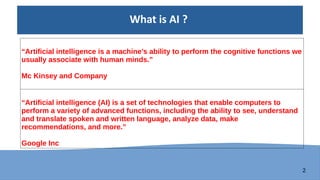
“Artificial intelligence is a machine’s ability to perform the cognitive functions we
usually associate with human minds.”
Mc Kinsey and Company
“Artificial intelligence (AI) is a set of technologies that enable computers to
perform a variety of advanced functions, including the ability to see, understand
and translate spoken and written language, analyze data, make
recommendations, and more.”
Google Inc
3
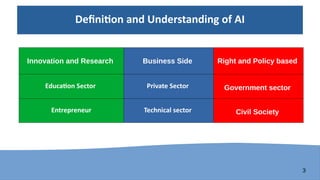
Definition and Understanding of AI
Innovation and Research Business Side Right and Policy based
Education Sector Private Sector Government sector
Entrepreneur Technical sector Civil Society
4
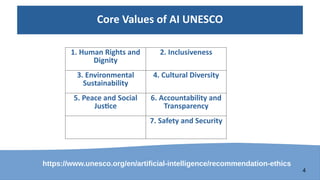
Core Values of AI UNESCO
https://www.unesco.org/en/artificial-intelligence/recommendation-ethics
1. Human Rights and
Dignity
2. Inclusiveness
3. Environmental
Sustainability
4. Cultural Diversity
5. Peace and Social
Justice
6. Accountability and
Transparency
7. Safety and Security
5
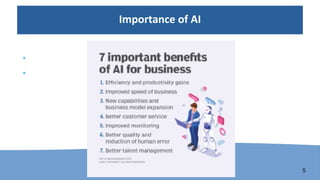
Importance of AI
●
●
6
Current AI Landscape
AI Integration: AI is utilized in sectors such as healthcare, finance, education, and
security to enhance growth and development.
➔
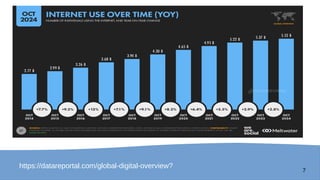
Global Internet Usage (2024): Current Statistics as of 2024, approximately 5.18 billion
people, or 65% of the global population, are using the internet.
➔
Growth Comparison: This marks significant growth from 51.2% in 2018, highlighting
increased global connectivity.
➔
Regional Disparities: Despite global improvements, developing nations still experience
lower penetration rates due to infrastructure challenges and affordability issues.
7
https://datareportal.com/global-digital-overview?
8
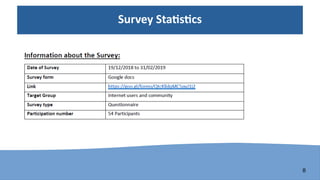
Survey Statistics
9
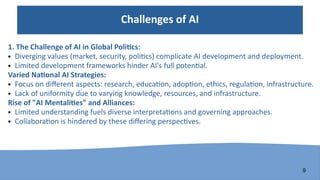
Challenges of AI
1. The Challenge of AI in Global Politics:
● Diverging values (market, security, politics) complicate AI development and deployment.
● Limited development frameworks hinder AI's full potential.
Varied National AI Strategies:
● Focus on different aspects: research, education, adoption, ethics, regulation, infrastructure.
● Lack of uniformity due to varying knowledge, resources, and infrastructure.
Rise of "AI Mentalities" and Alliances:
● Limited understanding fuels diverse interpretations and governing approaches.
● Collaboration is hindered by these differing perspectives.
10
Challenges of AI
Developed vs. Developing Nations
● A vacuum exists in cooperation between these groups.
Influence of Big Tech:
● Large IT companies manipulate policies to favor their own interests and create competitive
advantages.
Fueling of "AI Domination" Fears:
● Lack of resources and infrastructure contributes to fear-mongering and conspiracy theories.
Neglect of Fundamental Values:
● Focus on "AI domination" overshadows the critical need to establish core ethical and societal
values for AI.
11
Challenges of AI
Data and Information as Power Tools:
● Global politics is heavily influenced by the control of data, a key resource for AI development.
2. Adaptation Challenges for Developing Nations:
● Lack of knowledge, resources, and infrastructure significantly hinder AI adaptation.
● Difficulty in accepting and integrating new AI-related values into existing societal
frameworks.
● Lack of clarity and diversity in AI assumptions exacerbates the digital divide.
Need for Adaptation in Developing Nations:
● Fundamental understanding of data and information is crucial.
● Developing nations must actively participate in defining core AI values and principles.
12
Challenges of AI
Mitigation Strategies:
● Enhanced awareness and capacity building programs.
● Development of effective AI-related laws and policies.
● Comprehensive research on AI acceptance and other relevant indicators.
Addressing Mitigation Challenges:
● Technological gaps pose significant challenges in mitigation efforts.
● Socio-cultural values and economic factors require country-specific solutions.
13
Challenges of AI
3. Participation and inclusion:
● Lack of participation in value development, policymaking, and collaboration.
● Diverging national policies and values create gaps and potential for discrimination.
● AI governance frameworks often lack open and multi-stakeholder approaches.
Solutions:
● Increased participation and inclusion of developing nations in all aspects of AI development.
● Fostering a more collaborative and inclusive environment for AI governance.
● Emphasizing the importance of human and socio-cultural values in AI development.
14
Challenges of AI
4. AI standardization and Governance:
Standardization is crucial for addressing challenges related to autonomous systems and
algorithms, particularly regarding policy, legal, and ethical considerations.
It ensures transparency, accountability, and clarity within the AI ecosystem.
Multistakeholder Dialogue:
● A multistakeholder approach is necessary to develop effective governance mechanisms for AI
Prioritizing Human Values:
● AI standardization must prioritize human values such as openness, collaboration, and trust.
Focus on AI ethics, transparency, and public education is essential.
15
Challenges of AI
5. AI Vision:
Current AI Development is Lacking Direction: Current AI development lacks a clear vision and
defined values, leading to haphazard growth.
Complex Governance Landscape: The current governance structures for AI are complex and
multi-layered, creating legal and ethical challenges.
Need for a Broader AI Vision: A shared vision for AI, such as "AI for Humanity," is crucial to
foster trust, collaboration, and a unified approach among stakeholders.
Key Elements of the AI Vision: This vision should emphasize values like openness, equality,
inclusion, diversity, and human rights.
16
Recommendation of my Research
1. Better awareness & capacity campaigns about AI for developing and lower economies
2. Participation and inclusion for all
3. Various layers of governance model need to be adopted
4. Better research and surveys are required
5. Multistakeholder concept to be adopted
6. Standardization of core values for adaptation and mitigation strategy
7. AI needs proper vision with proper set of human values
8. AI requires collaborative vision
9. Trust is an important component which requires better commitment and collaboration
10. Collaborate towards lessening the digital divide
11. AI is in developing stage confining its limitation will hamper its growth and
development
17
18
QUESTIONS
19
References
1. AI Governance Framework for Nepal
https://www.researchgate.net/publication/371349829_AI_Governance_Framework_for
_Nepal_by_Shreedeep_Rayamajhi
2. Report on AI Perspective and Challenges of Developing Nations
https://www.researchgate.net/publication/331439532_Report_on_AI_Perspective_and
_Challenges_of_Developing_Nations

AI Perspectives and Challenges in Developing Nations

  • 1.
    1 AI Perspectives andChallenges in Developing Nations By Shreedeep Rayamajhi 19th January, 2025
  • 2.
    2 What is AI? “Artificial intelligence is a machine’s ability to perform the cognitive functions we usually associate with human minds.” Mc Kinsey and Company “Artificial intelligence (AI) is a set of technologies that enable computers to perform a variety of advanced functions, including the ability to see, understand and translate spoken and written language, analyze data, make recommendations, and more.” Google Inc
  • 3.
    3 Definition and Understandingof AI Innovation and Research Business Side Right and Policy based Education Sector Private Sector Government sector Entrepreneur Technical sector Civil Society
  • 4.
    4 Core Values ofAI UNESCO https://www.unesco.org/en/artificial-intelligence/recommendation-ethics 1. Human Rights and Dignity 2. Inclusiveness 3. Environmental Sustainability 4. Cultural Diversity 5. Peace and Social Justice 6. Accountability and Transparency 7. Safety and Security
  • 5.
  • 6.
    6 Current AI Landscape AIIntegration: AI is utilized in sectors such as healthcare, finance, education, and security to enhance growth and development. ➔ Global Internet Usage (2024): Current Statistics as of 2024, approximately 5.18 billion people, or 65% of the global population, are using the internet. ➔ Growth Comparison: This marks significant growth from 51.2% in 2018, highlighting increased global connectivity. ➔ Regional Disparities: Despite global improvements, developing nations still experience lower penetration rates due to infrastructure challenges and affordability issues.
  • 7.
  • 8.
  • 9.
    9 Challenges of AI 1.The Challenge of AI in Global Politics: ● Diverging values (market, security, politics) complicate AI development and deployment. ● Limited development frameworks hinder AI's full potential. Varied National AI Strategies: ● Focus on different aspects: research, education, adoption, ethics, regulation, infrastructure. ● Lack of uniformity due to varying knowledge, resources, and infrastructure. Rise of "AI Mentalities" and Alliances: ● Limited understanding fuels diverse interpretations and governing approaches. ● Collaboration is hindered by these differing perspectives.
  • 10.
    10 Challenges of AI Developedvs. Developing Nations ● A vacuum exists in cooperation between these groups. Influence of Big Tech: ● Large IT companies manipulate policies to favor their own interests and create competitive advantages. Fueling of "AI Domination" Fears: ● Lack of resources and infrastructure contributes to fear-mongering and conspiracy theories. Neglect of Fundamental Values: ● Focus on "AI domination" overshadows the critical need to establish core ethical and societal values for AI.
  • 11.
    11 Challenges of AI Dataand Information as Power Tools: ● Global politics is heavily influenced by the control of data, a key resource for AI development. 2. Adaptation Challenges for Developing Nations: ● Lack of knowledge, resources, and infrastructure significantly hinder AI adaptation. ● Difficulty in accepting and integrating new AI-related values into existing societal frameworks. ● Lack of clarity and diversity in AI assumptions exacerbates the digital divide. Need for Adaptation in Developing Nations: ● Fundamental understanding of data and information is crucial. ● Developing nations must actively participate in defining core AI values and principles.
  • 12.
    12 Challenges of AI MitigationStrategies: ● Enhanced awareness and capacity building programs. ● Development of effective AI-related laws and policies. ● Comprehensive research on AI acceptance and other relevant indicators. Addressing Mitigation Challenges: ● Technological gaps pose significant challenges in mitigation efforts. ● Socio-cultural values and economic factors require country-specific solutions.
  • 13.
    13 Challenges of AI 3.Participation and inclusion: ● Lack of participation in value development, policymaking, and collaboration. ● Diverging national policies and values create gaps and potential for discrimination. ● AI governance frameworks often lack open and multi-stakeholder approaches. Solutions: ● Increased participation and inclusion of developing nations in all aspects of AI development. ● Fostering a more collaborative and inclusive environment for AI governance. ● Emphasizing the importance of human and socio-cultural values in AI development.
  • 14.
    14 Challenges of AI 4.AI standardization and Governance: Standardization is crucial for addressing challenges related to autonomous systems and algorithms, particularly regarding policy, legal, and ethical considerations. It ensures transparency, accountability, and clarity within the AI ecosystem. Multistakeholder Dialogue: ● A multistakeholder approach is necessary to develop effective governance mechanisms for AI Prioritizing Human Values: ● AI standardization must prioritize human values such as openness, collaboration, and trust. Focus on AI ethics, transparency, and public education is essential.
  • 15.
    15 Challenges of AI 5.AI Vision: Current AI Development is Lacking Direction: Current AI development lacks a clear vision and defined values, leading to haphazard growth. Complex Governance Landscape: The current governance structures for AI are complex and multi-layered, creating legal and ethical challenges. Need for a Broader AI Vision: A shared vision for AI, such as "AI for Humanity," is crucial to foster trust, collaboration, and a unified approach among stakeholders. Key Elements of the AI Vision: This vision should emphasize values like openness, equality, inclusion, diversity, and human rights.
  • 16.
    16 Recommendation of myResearch 1. Better awareness & capacity campaigns about AI for developing and lower economies 2. Participation and inclusion for all 3. Various layers of governance model need to be adopted 4. Better research and surveys are required 5. Multistakeholder concept to be adopted 6. Standardization of core values for adaptation and mitigation strategy 7. AI needs proper vision with proper set of human values 8. AI requires collaborative vision 9. Trust is an important component which requires better commitment and collaboration 10. Collaborate towards lessening the digital divide 11. AI is in developing stage confining its limitation will hamper its growth and development
  • 17.
  • 18.
  • 19.
    19 References 1. AI GovernanceFramework for Nepal https://www.researchgate.net/publication/371349829_AI_Governance_Framework_for _Nepal_by_Shreedeep_Rayamajhi 2. Report on AI Perspective and Challenges of Developing Nations https://www.researchgate.net/publication/331439532_Report_on_AI_Perspective_and _Challenges_of_Developing_Nations