Closing financial books at the end of the month or quarter is often a stressful process. AI-powered Account-to-Report (A2R) automation is speeding up financial closings by eliminating manual bottlenecks.
1/31
AI in account-to-report:Scope, integration, use cases,
challenges and future outlook
zbrain.ai/ai-in-account-to-report
The account-to-report (A2R) domain, encompassing critical financial operations such as
journal entries, general ledger updates, and financial reporting, plays a vital role in
ensuring transparency, compliance, and strategic decision-making. However, traditional
A2R processes are often hindered by inefficiencies, errors, and long processing times,
limiting the accuracy and timeliness of financial data. These challenges are exacerbated
by the ever-growing volume of financial transactions and regulatory complexities.
The increasing complexity of financial operations and mounting regulatory requirements
have put significant pressure on the A2R process. To stay competitive, organizations
must embrace digital transformation, moving away from manual and error-prone tasks. AI
offers an efficient way forward, enabling automation, improving accuracy, and
accelerating reporting cycles. Recent KPMG studies reveal that 72% of organizations are
already piloting or using AI in financial reporting, with widespread adoption expected
within 2027. AI’s role in A2R is especially crucial in addressing inefficiencies—automating
manual tasks, detecting anomalies, and providing real-time insights into financial
performance. In fact, KPMG’s research shows that AI could revolutionize financial
reporting by speeding up tasks, enhancing audit accuracy, and reducing fraud.
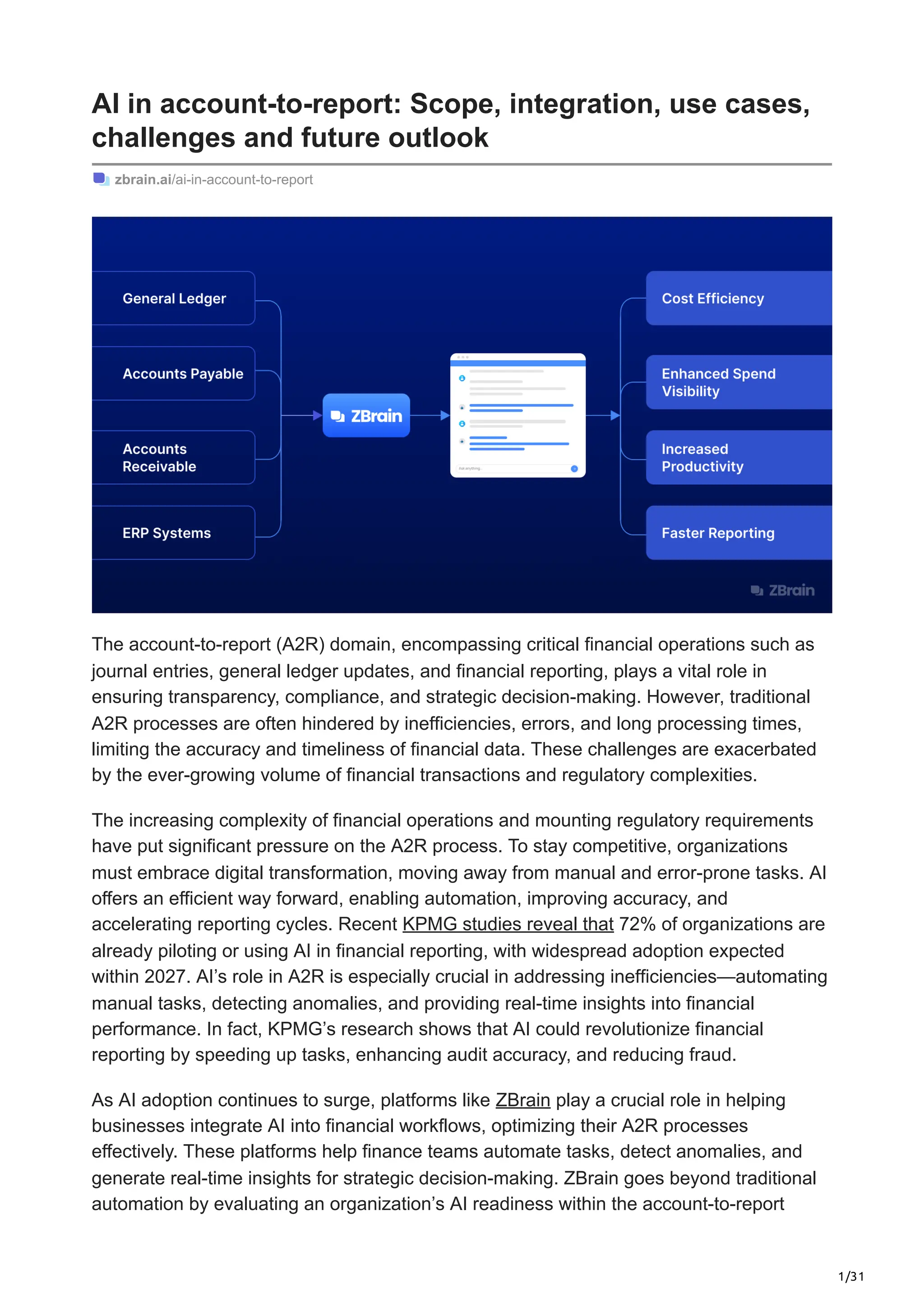
As AI adoption continues to surge, platforms like ZBrain play a crucial role in helping
businesses integrate AI into financial workflows, optimizing their A2R processes
effectively. These platforms help finance teams automate tasks, detect anomalies, and
generate real-time insights for strategic decision-making. ZBrain goes beyond traditional
automation by evaluating an organization’s AI readiness within the account-to-report
2.
2/31
process. It identifieskey opportunities for optimization across financial workflows, from
journal entries and ledger maintenance to regulatory reporting and financial consolidation.
ZBrain provides customized AI solutions to streamline A2R tasks, with the potential to
reduce manual effort and improve reporting cycles. The platform is designed to support
finance teams in enhancing efficiencies, improving data accuracy, and ensuring
compliance, which can drive smarter decision-making.
This article delves into how AI is transforming the account-to-report process, driving
efficiency, accuracy, and compliance. It also discusses how, with platforms like ZBrain,
businesses can harness AI to streamline A2R workflows, improve decision-making, and
stay competitive in a fast-changing financial landscape.
What is account-to-report(A2R)?
Account-to-report (A2R) is a critical financial process that governs the management and
reporting of accounting data within an organization. It encompasses the entire lifecycle of
accounting activities, from capturing financial transactions and maintaining the general
ledger to reconciling accounts and preparing trial balances. A2R acts as the backbone of
financial reporting, ensuring that data is accurate, reliable, and compliant with regulatory
standards.
Key stages of the A2R process include recording transactions, performing account
reconciliations, closing accounting periods, and preparing accurate inputs for financial
statements. By seamlessly integrating accounting activities, A2R provides organizations
with a structured and transparent framework to ensure financial accuracy and operational
efficiency.
Although A2R is a process framework rather than a technology, its stages can be
significantly enhanced through automation and Enterprise Resource Planning (ERP)
systems. Automating tasks such as journal entry creation, reconciliation, and adjustment
reduces manual errors, accelerates close cycles, and ensures the timely availability of
financial data. This integration empowers organizations to maintain data integrity, improve
compliance, and make well-informed business decisions.
By efficiently managing the A2R process, businesses can establish a robust foundation
for financial reporting, support strategic decision-making, and adapt to the growing
complexities of financial operations.
Why is A2R important?
Account-to-report plays a vital role in financial management by delivering a streamlined
and systematic approach to managing accounting and reporting activities. Its structured
framework ensures that all financial data is accurately recorded and reconciled, forming
the basis for generating reliable financial reports.
3.
3/31
One key benefitof A2R is its ability to standardize accounting tasks such as journal entry
management, account reconciliations, and period closings. This consistency minimizes
discrepancies, accelerates reporting timelines, and enhances overall data accuracy. By
providing real-time visibility into accounting activities, A2R enables businesses to detect
and rectify errors promptly, reducing the risk of financial misstatements.
A well-executed A2R process also fosters compliance with financial regulations and
standards. This ensures that organizations meet legal requirements and maintain
transparency in their financial reporting. Additionally, the insights derived from A2R data
support better forecasting, budgeting, and strategic planning, allowing businesses to
make informed decisions and achieve their financial goals.
Ultimately, A2R strengthens financial governance, improves operational efficiency, and
equips organizations to handle complex financial challenges effectively.
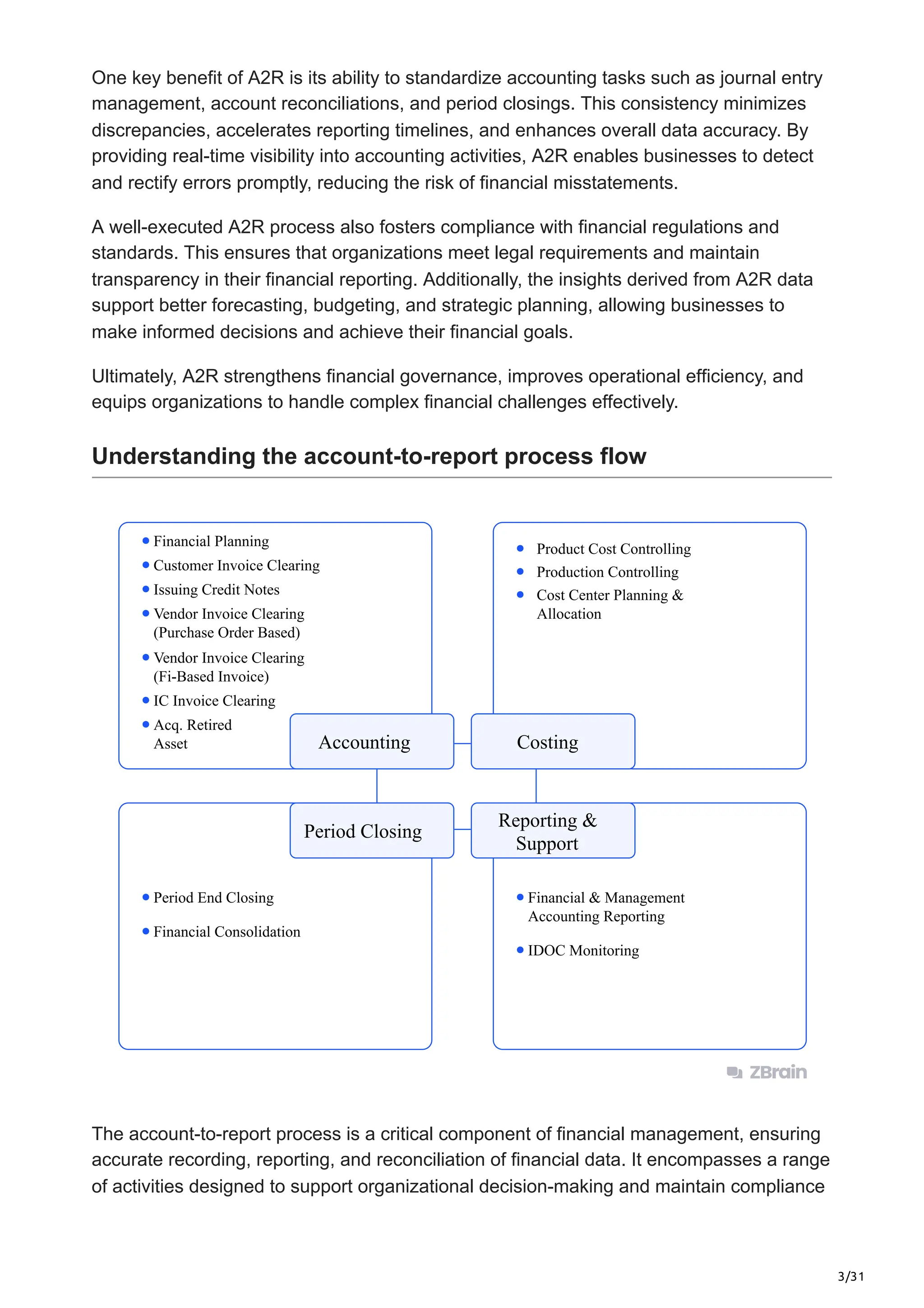
Understanding the account-to-report process flow
Accounting
Period Closing
Costing
Reporting &
Support
Financial Planning
Customer Invoice Clearing
Issuing Credit Notes
Vendor Invoice Clearing
(Purchase Order Based)
Vendor Invoice Clearing
(Fi-Based Invoice)
IC Invoice Clearing
Acq. Retired
Asset
Period End Closing Financial & Management
Accounting Reporting
Financial Consolidation
IDOC Monitoring
Product Cost Controlling
Production Controlling
Cost Center Planning &
Allocation
The account-to-report process is a critical component of financial management, ensuring
accurate recording, reporting, and reconciliation of financial data. It encompasses a range
of activities designed to support organizational decision-making and maintain compliance
4.
4/31
with regulatory standards.The process is structured into four key functional areas, each
playing a distinct role in the financial ecosystem:
Accounting
Costing
Period closing
Reporting and support
Below is a detailed breakdown of these activities:
Accounting (Finance and managerial)
This area involves:
Financial planning: Setting financial objectives, creating budgets, and forecasting
future financial needs.
Journal entry creation: Automating the creation and approval of journal entries to
reflect business transactions accurately.
General ledger maintenance: Maintaining an accurate General Ledger (GL) to
ensure the integrity of financial data.
Customer invoice clearing: Managing and reconciling customer invoices for
accurate records.
Issuing credit notes: Adjusting invoices by issuing credit for overpayments or
returns.
Vendor invoice clearing (Purchase order-based): Ensuring vendor payments
align with purchase orders.
Vendor invoice clearing (FI-based invoice): Managing vendor payments directly
in the financial system.
Intercompany (IC) invoice clearing: Handling intercompany transactions for
accurate internal records.
Acquisition of retired assets: Processing records related to acquiring assets that
were previously retired.
Costing
This area focuses on:
Product cost controlling: Monitoring and managing product costs to ensure
efficiency.
5.
5/31
Production controlling: Overseeingcosts and budgets related to manufacturing
processes.
Cost center planning and allocation: Allocating costs across departments or units
to track financial performance.
Period closing (Month, Quarter, Fiscal)
Key activities include:
Period-end closing: Finalizing financial records at the end of each period (monthly,
quarterly, or annually).
Trial balance preparation: Generating trial balances to confirm that debits and
credits are balanced, serving as the basis for preparing financial statements.
Reconciliation of accounts: Verifying account balances and resolving
discrepancies to ensure accuracy.
Financial consolidation/Reconcile: Combining financial statements from different
units or entities and ensuring they are accurate and reconciled.
Closing period management: Automating the closing of financial periods,
including posting adjustments.
Reporting and support
This area covers:
Financial and management accounting reporting: Preparing reports for internal
and external stakeholders, including financial statements and management
dashboards.
Consolidated financial reporting: Aggregating financial data from multiple entities
or business units into consolidated financial statements for comprehensive
reporting.
Regulatory compliance reporting: Ensuring that financial reports meet the
required legal and regulatory standards, including tax filings, audits, and industry-
specific compliance.
Financial statement analysis: Analyzing financial data to identify trends,
variances, and insights to guide strategic decision-making.
IDOC monitoring: Managing and tracking electronic data exchange (Intermediate
Documents) to ensure system transactions are processed correctly.
Audit trail and documentation: Maintaining an accurate audit trail of financial
transactions to facilitate external audits and internal reviews.
6.
6/31
These activities collectivelyensure the accuracy, integrity, and timeliness of financial data,
allowing organizations to make informed business decisions and comply with regulatory
requirements.
Optimize Your Operations With AI Agents
Our AI agents streamline your workflows, unlocking new levels of business efficiency!
Explore Our AI Agents
Transforming account-to-report: How AI solves traditional
challenges
The account-to-report process is essential for accurate financial reporting, regulatory
compliance, and strategic decision-making. However, traditional A2R processes often
encounter significant challenges, including inefficiencies, manual errors, and difficulties in
achieving real-time insights. Integrating Artificial Intelligence (AI) into the A2R cycle can
address these pain points, streamline workflows, and improve the overall effectiveness of
financial operations. Below is a breakdown of key A2R challenges, their impact, and how
AI helps overcome them:
Challenge
Impact of traditional
methods
How AI helps overcome the
challenge
Manual journal
entries
Increases errors, delays, and
inconsistencies in financial
records.
AI automates journal entry creation,
ensuring accuracy, consistency, and
speed.
Reconciliation
inefficiencies
Time-consuming manual
reconciliations lead to delays
in closing periods.
AI automates reconciliations,
identifies discrepancies, and
accelerates period-end closings.
Lack of real-
time data
visibility
Hinders timely decision-
making and increases risks of
errors in financial reporting.
AI provides real-time financial data
tracking and advanced dashboards
for better visibility.
Error-prone
consolidation
Manual consolidation
processes lead to
inconsistencies and reporting
delays.
AI automates consolidation,
ensuring faster, error-free, and
consistent reporting.
Approval
bottlenecks
Delays in approval workflows
slow down journal postings
and adjustments.
AI streamlines approval workflows
by automating routing and
prioritizing tasks.
7.
7/31
Compliance
risks
Increased risk ofnon-
compliance with accounting
standards and regulations.
AI monitors compliance rules, flags
potential violations, and ensures
adherence to standards.
Fraud and
anomaly
detection
Difficulty detecting fraudulent
transactions in large data
volumes.
AI detects anomalies and patterns
indicative of fraud, reducing financial
risks.
Period closing
delays
Manual processes cause
delays in completing monthly,
quarterly, and annual
closings.
AI automates closing tasks and
ensures all entries are posted on
time.
Limited
financial
insights
Lack of actionable insights
hampers strategic planning
and decision-making.
AI provides advanced analytics,
trend identification, and actionable
recommendations for better
decisions.
Audit trail and
documentation
gaps
Inefficient documentation
increases audit preparation
time and the risk of audit
failures.
AI creates a complete, automated
audit trail for faster and more
accurate reviews.
Approaches to integrating AI into account-to-report
AI is transforming the account-to-report process by automating tasks, improving accuracy,
and delivering valuable insights for better decision-making. Organizations seeking to
integrate AI into their A2R workflows can choose from several approaches, depending on
their specific requirements, resources, and long-term goals. Below is an overview of the
primary strategies for integrating AI into A2R.
Custom, in-house AI development
This approach involves developing a tailored AI solution to address specific challenges in
the A2R processes, such as journal entry automation, account reconciliation, and
financial consolidation. It requires building or fine-tuning AI models to align with a
company’s unique processes and data.
Advantages:
Customization: Offers flexibility to address specific A2R pain points, such as
tailored compliance checks or anomaly detection in financial data.
Full control: Enables control over data privacy, model training, and compliance with
internal and regulatory standards.
8.
8/31
Long-term fit: Ensuresthe solution evolves with the organization, adapting to
future needs and scaling with growth.
Using AI point solutions
This approach leverages pre-built, off-the-shelf AI tools designed to tackle specific tasks
in the A2R process, such as automated reconciliations, variance analysis, or financial
statement preparation.
Advantages:
Quick deployment: Point solutions are ready to deploy, offering immediate
improvements in areas like account reconciliation or journal entry processing.
Cost-effective: These tools typically require fewer resources to implement
compared to custom solutions.
Ease of use: Designed for non-technical users, these tools are often easy to
integrate into existing financial systems and workflows.
Adopting a comprehensive AI platform
A comprehensive AI platform provides an integrated environment with multiple AI
capabilities to address end-to-end A2R processes. Comprehensive AI enablement
platforms like ZBrain often combine AI models, data management capabilities, and
application-building frameworks to automate and optimize processes like period closings,
financial reporting, and compliance monitoring.
Advantages:
Centralized data and governance: Ensures consistent data management and
compliance with regulatory standards while maintaining data security.
End-to-end optimization: Supports automation and optimization across the entire
A2R lifecycle, from journal entries to financial reporting and audit preparation.
Scalability and flexibility: Easily scalable to meet growing reporting demands and
adaptable to future AI advancements.
Efficiency: Reduces manual intervention by automating repetitive tasks, increasing
speed, and enhancing accuracy.
Choosing the right approach
Selecting the best AI integration strategy for your A2R processes involves considering
several key factors:
9.
9/31
Specific business needs:Identify which aspects of the A2R cycle require AI
intervention, such as account reconciliation, journal entry creation, or compliance
monitoring.
Resources and expertise: Evaluate internal expertise, budget availability, and
technical infrastructure to support AI implementation.
Compliance and security requirements: Ensure the chosen AI solution meets
industry regulations and aligns with data security standards.
Scalability and long-term goals: Choose a strategy that supports future growth
and aligns with broader organizational objectives.
By aligning the integration approach with organizational priorities, businesses can unlock
the full potential of AI to enhance efficiency, compliance, and financial insights within the
A2R process.
AI solutions transforming account-to-report processes
Artificial intelligence is transforming A2R processes by automating repetitive tasks,
improving accuracy, and enhancing decision-making. AI solutions optimize financial
operations, from journal entry automation to period-end closing and real-time reporting.
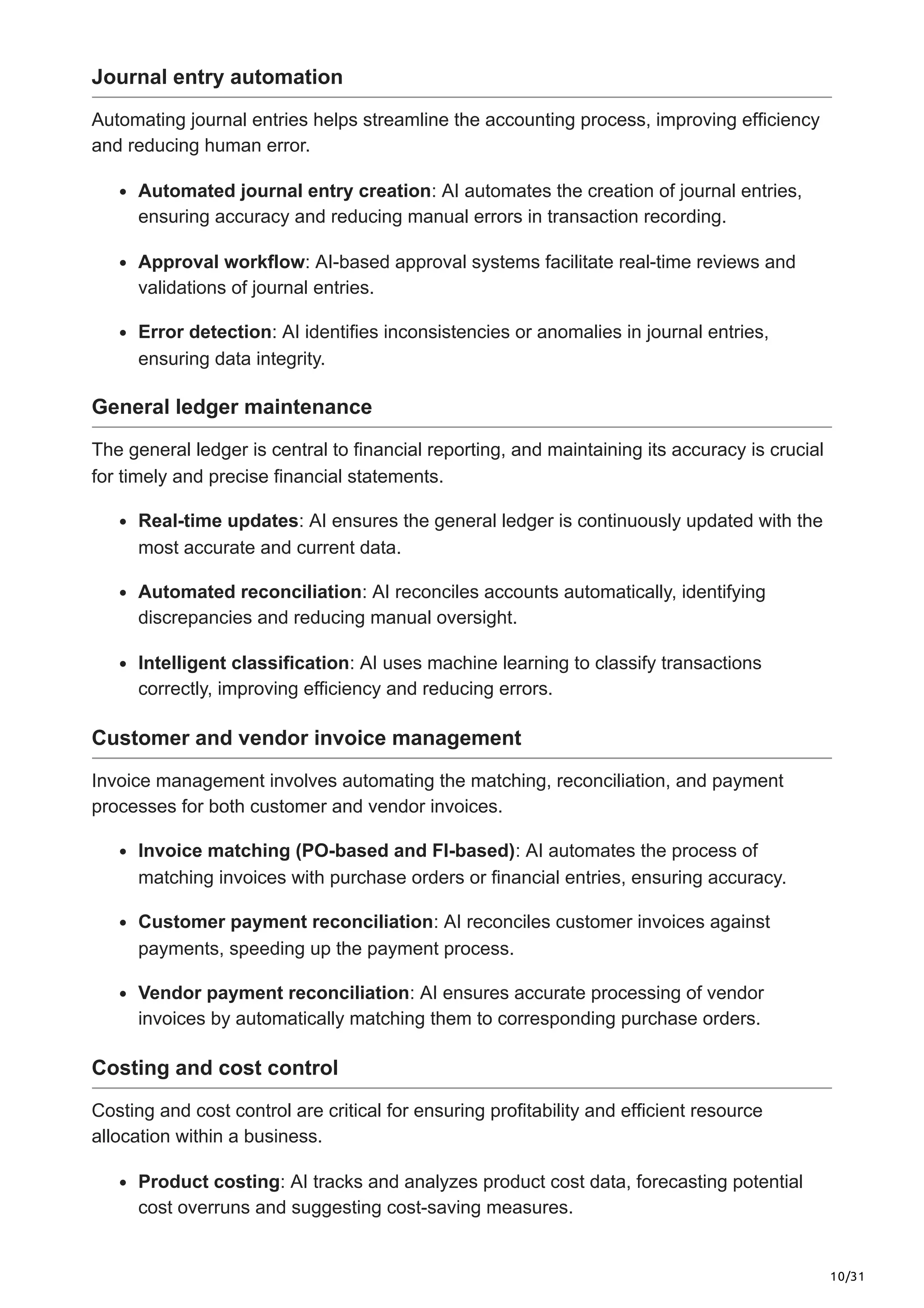
Below is a detailed explanation of AI applications across each core A2R process and the
associated sub-processes, highlighting how AI contributes to increased efficiency,
accuracy, and compliance at every stage of the workflow.
Journal Entry Automation 1
3
5
7
9
4
6
8
10
2
Invoice Management
Period-End Closing
Audit Trail And Compliance
Tax Accounting
General Ledger Maintenance
Costing And Cost Control
Financial Reporting
Credit Management
Asset Accounting
AI Applications Transforming the Account-to-report Processes
10.
10/31
Journal entry automation
Automatingjournal entries helps streamline the accounting process, improving efficiency
and reducing human error.
Automated journal entry creation: AI automates the creation of journal entries,
ensuring accuracy and reducing manual errors in transaction recording.
Approval workflow: AI-based approval systems facilitate real-time reviews and
validations of journal entries.
Error detection: AI identifies inconsistencies or anomalies in journal entries,
ensuring data integrity.
General ledger maintenance
The general ledger is central to financial reporting, and maintaining its accuracy is crucial
for timely and precise financial statements.
Real-time updates: AI ensures the general ledger is continuously updated with the
most accurate and current data.
Automated reconciliation: AI reconciles accounts automatically, identifying
discrepancies and reducing manual oversight.
Intelligent classification: AI uses machine learning to classify transactions
correctly, improving efficiency and reducing errors.
Customer and vendor invoice management
Invoice management involves automating the matching, reconciliation, and payment
processes for both customer and vendor invoices.
Invoice matching (PO-based and FI-based): AI automates the process of
matching invoices with purchase orders or financial entries, ensuring accuracy.
Customer payment reconciliation: AI reconciles customer invoices against
payments, speeding up the payment process.
Vendor payment reconciliation: AI ensures accurate processing of vendor
invoices by automatically matching them to corresponding purchase orders.
Costing and cost control
Costing and cost control are critical for ensuring profitability and efficient resource
allocation within a business.
Product costing: AI tracks and analyzes product cost data, forecasting potential
cost overruns and suggesting cost-saving measures.
11.
11/31
Production cost management:AI optimizes production costs by analyzing
production data in real time and recommending adjustments to processes.
Cost center allocation: AI automates cost allocations across different business
units, improving transparency and financial oversight.
Period-end closing
Period-end closing is a complex process that can benefit from AI automation to reduce
manual effort and ensure timely financial reporting.
Automated period closing: AI automates tasks like journal entry posting, account
reconciliation, and generating closing reports for faster and more accurate period-
end closure.
Trial balance preparation: AI prepares trial balances by automatically posting
entries and ensuring that debits and credits are balanced.
Financial consolidation: AI consolidates financial data from various subsidiaries or
business units to provide a unified and accurate financial statement.
Financial reporting
Financial reporting involves generating key statements that provide insights into an
organization’s financial performance and compliance.
Automated report generation: AI automatically generates financial reports such as
income statements and balance sheets, providing real-time insights into financial
health.
Management dashboards: AI-driven dashboards display key financial metrics and
trends, enabling data-driven decision-making with real-time access to financial data.
Regulatory compliance reporting: AI ensures reports are compliant with both
local and international regulations, reducing the risk of compliance errors.
Audit trail and compliance
Maintaining an audit trail and ensuring compliance with regulatory requirements is
essential for financial transparency and accountability.
Transaction monitoring: AI tracks financial transactions in real time, ensuring that
every movement is accurately recorded and easily retrievable for audits.
Audit trail generation: AI automatically creates an immutable audit trail, providing
clear documentation of all financial transactions for regulatory review.
Compliance reporting: AI automates the generation of regulatory compliance
reports, ensuring that all financial activities meet legal and industry standards.
12.
12/31
These AI applicationsimprove efficiency, reduce human error, and strengthen compliance
across the A2R process, ultimately supporting better financial decision-making and
performance tracking.
Credit management
Credit management focuses on assessing customer creditworthiness and managing
credit limits to minimize financial risk.
Credit risk assessment: AI can analyze historical data and external sources to
assess the creditworthiness of customers and manage credit limits.
Predictive credit modeling: AI could predict customer payment behavior based on
past transactions, industry trends, and external financial factors.
Automation of credit approvals: AI can automate the credit approval process by
verifying customer data and determining appropriate terms.
Tax accounting
Tax accounting involves the accurate calculation, reporting, and compliance of tax
liabilities in accordance with local and international regulations.
Tax compliance automation: AI can automate the calculation of tax liabilities,
ensuring compliance with local and international tax laws.
Tax reporting: AI can automatically generate tax reports, file documents, and
ensure correct deductions and credits.
Tax compliance validation: AI can validate tax on transactions, ensuring accurate
tax reporting and compliance within the Account-to-Report process.
Asset accounting
Asset accounting tracks the acquisition, depreciation, and disposal of fixed assets,
ensuring accurate financial reporting and asset management.
Depreciation calculation: AI can calculate asset depreciation automatically,
adjusting for changes in usage or market value.
Asset lifecycle management: AI could track assets through their lifecycle, from
acquisition to disposal, providing insights on asset utilization and potential write-offs.
Asset reconciliation: AI can automate the reconciliation of physical assets with
financial records to ensure accuracy.
Treasury – bank accounting
13.
13/31
Treasury – bankaccounting manages cash flow and reconciles bank statements to
ensure accurate financial records and liquidity.
Bank reconciliation: AI can automate the reconciliation of bank statements with
internal records, identifying discrepancies and reducing manual oversight.
Cash flow forecasting: AI can provide real-time cash flow forecasts by analyzing
historical transaction data and predicting future liquidity needs.
Bank statement automation: AI can automatically process incoming bank data,
match transactions to the appropriate accounts, and update the financial system.
Treasury – financial instruments
Treasury – financial instruments involve the valuation and management of various
financial assets and liabilities to mitigate risk and optimize returns.
Financial instruments valuation: AI can help automatically value financial
instruments such as stocks, bonds, and derivatives based on market data.
Portfolio risk management: AI can assess the risk exposure of financial portfolios
and suggest adjustments based on predictive analytics.
Trading automation: AI can assist in executing trades based on pre-set strategies
and real-time market conditions.
Treasury – risk management
Treasury – risk management focuses on identifying, assessing, and mitigating financial
risks that may impact the organization’s stability.
Risk identification and monitoring: AI can analyze data to identify potential
financial risks, including credit, liquidity, and market risks.
Predictive analytics: AI can use historical data to predict financial risks and
provide strategies to mitigate them.
Treasury – cash and liquidity management
Treasury – cash and liquidity management ensures that an organization has sufficient
cash flow to meet its obligations while optimizing cash reserves.
Liquidity forecasting: AI can predict future liquidity needs based on transaction
data, market conditions, and historical cash flows.
Cash position management: AI can optimize cash positioning by analyzing real-
time balances and forecasting cash requirements.
14.
14/31
Automated cash transfers:AI can suggest or automate internal cash transfers to
optimize cash reserves across business units.
Intercompany
Intercompany processes involve managing transactions and reconciliations between
different business units or subsidiaries within the same organization.
Intercompany reconciliation: AI can automate the reconciliation of intercompany
transactions, ensuring accurate and timely reporting.
Cross-border transaction processing: AI could streamline the processing of
intercompany transactions across multiple jurisdictions, factoring in currency
conversions and tax regulations.
Intercompany settlement: AI could assist in managing and automating the
settlement of intercompany balances, ensuring accurate financial reporting.
Financial planning and budgeting
Financial planning and budgeting encompass the forecasting and allocation of financial
resources to align with the organization’s strategic goals.
Budget forecasting: AI can automate the creation of budgets based on historical
data, future trends, and predictive analytics.
Scenario planning: AI can model various financial scenarios to assist in planning
for different business conditions.
Predictive budget monitoring: AI can track actual performance against budgeted
figures, offering early alerts for potential budget overruns.
Project accounting
Project accounting tracks the financial performance of specific projects, ensuring that
costs are managed and revenue is recognized appropriately.
Project cost tracking: AI can track project-related expenses and compare them to
budgets, helping to detect potential overruns early.
Automated billing: AI can generate invoices for project milestones or time-based
work, streamlining revenue recognition.
Resource allocation optimization: AI could optimize the allocation of resources
based on project timelines, costs, and priority, reducing inefficiencies.
ZBrain AI solutions for account-to-report use cases
15.
15/31
ZBrain is anend-to-end AI enablement platform that can help streamline and optimize
A2R processes. By leveraging its components—ZBrain XPLR for AI readiness
assessment and ZBrain Builder for designing and deploying customized solutions—
ZBrain helps organizations address A2R challenges effectively. Below is a breakdown of
key A2R use cases and how ZBrain can enhance each with AI-powered solutions:
A2R use case Description How ZBrain helps
Automated
journal
entries
Automating
creation,
approval, and
validation of
journal entries to
reduce manual
effort.
ZBrain Builder can help build agent which can
automate journal entry creation, detect errors, and
ensure validation for accuracy.
Real-time
ledger
updates
Ensuring the
general ledger
reflects the most
current and
accurate data.
ZBrain AI solutions can automatically update
ledgers, reconcile accounts, and maintain financial
data integrity.
Invoice
matching
Matching
customer/vendor
invoices with
POs or financial
records to
prevent
discrepancies.
ZBrain’s Purchase-Order-Invoice Matching agent
automates matching purchase orders and invoices
for accuracy in quantities, prices, and delivery
terms, ensuring timely and accurate payment
approvals.
Credit and
debit note
processing
Managing
adjustments in
invoices for
overpayments or
returns.
ZBrain’s Dispute Resolution AI Agent analyzes
contracts, delivery records, and shipping
information to resolve disputes and automate the
issuance of debit notes quickly.
Intercompany
invoice
reconciliation
Handling
transactions
between internal
entities to
ensure accurate
financial
reporting.
ZBrain Builder can help create AI agent that can
automate intercompany reconciliation, maintaining
balance and compliance across subsidiaries.
16.
16/31
Cost center
allocations
Allocating costs
across
departmentsor
business units
for accurate
financial
analysis.
ZBrain AI solutions can automate allocations,
enhance visibility, and track cost performance.
Product
costing
optimization
Tracking product
costs to identify
overruns and
improve cost
efficiency.
ZBrain AI solutions can analyze historical data and
recommend cost-saving measures for product
development.
Period-end
closing
Completing
financial
activities at the
end of each
reporting period.
ZBrain AI solutions can accelerate period-end
activities such as account reconciliation and trial
balance preparation.
Financial
data
consolidation
Combining data
from various
units for unified
reporting.
ZBrain AI solutions can automate data aggregation
and ensure consistency in consolidated financial
statements.
Regulatory
compliance
reporting
Generates
reports adhering
to local and
international
standards to
mitigate risks.
ZBrain’s Regulatory Compliance Monitoring Agent
automates the validation of financial reports
against local and international standards. It is
designed to reduce compliance risks, ensure
timely submission, and minimize errors in the
reporting process by streamlining compliance
checks.
Audit trail
generation
Tracking all
financial
transactions to
maintain
transparency
and facilitate
audits.
ZBrain AI solutions can create detailed, immutable
audit trails for easier regulatory reviews and
internal tracking.
Tax filing and
compliance
Preparing and
validating tax
filings in
adherence to
regulations.
ZBrain’s Corporate Tax Review Agent automates
corporate tax reviews, ensuring accurate
calculations and filings and reducing compliance
risks.
17.
17/31
Real-time
financial
analysis
Providing
insights into
profitability,
liquidity, and
operational
efficiency.
ZBrainAI solutions can deliver real-time analytics,
allowing businesses to adjust strategies
dynamically.
ZBrain’s AI-powered solutions are designed to help organizations automate complex A2R
workflows, improve data integrity, and provide actionable insights, potentially driving
better financial performance and strategic decision-making.
Optimize Your Operations With AI Agents
Our AI agents streamline your workflows, unlocking new levels of business efficiency!
Explore Our AI Agents
Why ZBrain is the ideal platform for account-to-report
ZBrain, with its AI capabilities, can help organizations optimize their account-to-report
processes. It provides a range of features aimed at improving automation, increasing
efficiency, and supporting informed decision-making.
AI readiness assessment: ZBrain’s AI readiness assessment framework, ZBrain
XPLR, can evaluate an organization’s current capabilities and preparedness for AI
adoption in A2R processes. It can provide actionable insights to help organizations
understand their strengths and areas for improvement, ensuring a smooth and
successful AI implementation.
Low-code development: ZBrain’s low-code platform ZBrain Builder simplifies the
creation of custom AI solutions to address unique A2R challenges, making it
accessible to business users without extensive technical expertise.
Proprietary data utilization: The platform enables organizations to leverage their
proprietary data effectively, ensuring AI solutions are tailored to the specific needs
and goals of their A2R operations.
Enterprise-ready: ZBrain is designed for enterprise environments, offering features
such as security, scalability, and integration with existing A2R systems, which can
benefit large organizations.
End-to-end support: ZBrain manages the end-to-end processes of A2R AI
applications—from initial development to deployment and ongoing support—
ensuring continuous optimization and smooth transitions.
Flexible data ingestion: ZBrain integrates data from multiple sources to support
A2R processes with real-time financial information, potentially improving decision-
making, financial reporting, and operational efficiency.
18.
18/31
Intelligent agent creation:AI agents built on Zbrain Builder can assist in
automating critical A2R tasks such as journal entries, ledger reconciliation, and
financial reporting, potentially reducing manual effort and enhancing operational
efficiency.
These capabilities position ZBrain as a tool that may assist organizations in optimizing
and automating their A2R processes, potentially improving efficiency, accuracy, and
scalability in financial operations.
Benefits of implementing AI in account-to-report (A2R)
Integrating AI into A2R processes offers transformative benefits for organizations,
employees, and other stakeholders. Here is a breakdown of how AI enhances A2R:
For organizations:
Cost efficiency: Automation reduces manual effort, saving costs on repetitive tasks
like journal entries and reconciliations.
Enhanced decision-making: Real-time, decision-ready data provides actionable
insights for better financial management.
Improved compliance: AI helps ensure regulatory compliance by automating
validation and reporting processes.
Data integration: Seamless integration with existing ERPs ensures up-to-date,
accurate data flows, reducing errors and inefficiencies.
Operational efficiency: AI optimizes financial operations, improving speed and
accuracy in tasks like period-end closing and financial reporting.
For employees:
Increased productivity: Routine tasks like data entry and reconciliation are
automated, enabling employees to focus on strategic tasks.
Skill development: Employees have opportunities to learn and grow by managing
more complex AI-driven tasks and data analysis.
Job satisfaction: Automation of monotonous tasks improves employee morale and
job satisfaction, allowing staff to engage in more meaningful work.
For customers:
Faster reporting: With AI handling key A2R processes, businesses can provide
quicker financial reporting and insights.
Enhanced transparency: Automated reporting and compliance monitoring provide
customers with clear, reliable financial information.
19.
19/31
Improved service delivery:The efficiency of A2R processes ensures timely
financial transactions, improving customer relations.
By implementing AI in A2R, organizations can achieve long-term cost savings, improved
financial accuracy, and strategic decision-making, contributing to overall business growth.
Measuring the ROI of AI in account-to-report
Implementing AI in accounting-to-reporting processes provides substantial returns by
enhancing accuracy, efficiency, and data-driven decision-making. ZBrain’s AI solutions
support key financial operations, from automating journal entries to aiding financial
reporting and compliance monitoring. Businesses may assess the impact of these
solutions by evaluating factors such as cost reduction, process efficiency, and financial
control to determine the value of their AI investments. Below are examples of how
ZBrain’s applications optimize A2R workflows, delivering measurable business benefits
and a clear ROI.
ZBrain implementation in A2R processes: Key ROI indicators
AI implementation in A2R processes using ZBrain can drive ROI by improving efficiency,
reducing errors, and enhancing decision-making. Here’s a breakdown of ROI for key A2R
use cases:
1. Automated journal entries
Use case: Automating the creation and approval of journal entries for accurate
financial records.
ROI metrics:
Reduced manual processing
Faster approvals
Improved accuracy
Example: ZBrain AI agents can automate journal entry creation, ensuring data integrity
and speeding up financial reporting with fewer errors.
2. General ledger maintenance
Use case: Automating the reconciliation and real-time updating of the general
ledger.
ROI metrics:
Lower reconciliation costs
Fewer errors
20.
20/31
Example: ZBrain AIagents can ensure continuous updates and support reconciliations,
enhancing the accuracy of the general ledger.
3. Cost center allocation
Use case: Automating cost allocation across different cost centers for efficient
financial management.
ROI metrics:
Efficient cost distribution
Improved transparency
Example: ZBrain AI agents can automate cost center allocations, streamlining financial
reporting and improving visibility.
4. Financial reporting
Use case: Automating financial report generation for faster and more accurate
reporting.
ROI metrics:
Faster report generation
Enhanced compliance
Real-time insights
Example: ZBrain AI agents can generate real-time financial reports, ensuring compliance
and providing timely insights for better decision-making.
5. Regulatory compliance reporting
Use case: Automating compliance checks to ensure financial reports meet
regulatory standards.
ROI metrics:
Improved accuracy
Reduced compliance risks
Example: ZBrain AI agents can automate the validation of reports, ensuring adherence to
local and international standards, minimizing errors, and reducing compliance risks.
These examples highlight the significant impact of AI in transforming A2R processes by
streamlining tasks, improving financial accuracy, and reducing operational costs.
Organizations can validate the effectiveness of their AI investments by measuring key
ROI metrics such as improved efficiency, reduced errors, and enhanced compliance.
21.
21/31
ZBrain offers toolsdesigned to support continuous optimization, real-time insights, and
automation, which may assist finance teams in focusing on strategic decision-making and
improving A2R processes.
Challenges and considerations in adopting AI for account-to-
report
While the integration of AI in account-to-report processes can bring transformative
benefits, organizations must address various challenges to ensure successful adoption.
These challenges include overcoming resistance to change, ensuring data quality and
security, managing integration with legacy systems, and addressing regulatory
compliance concerns. Additionally, companies must consider the costs of implementation,
the need for employee upskilling, and the potential complexities in managing AI-driven
decision-making processes. By understanding these considerations, businesses can
better navigate the path to effective AI adoption in A2R.
Aspect Challenge
How ZBrain addresses these
challenges
Data
integration
Integrating data from
various systems (ERP,
external databases,
spreadsheets) can be
challenging due to different
formats and technologies.
ZBrain Builder can integrate data from
multiple systems and formats, which
may help facilitate smoother integration
across diverse platforms.
Legacy
system
compatibility
Legacy systems may not be
compatible with AI tools,
requiring an AI maturity
evaluation to assess
readiness for AI adoption.
ZBrain XPLR provides an AI readiness
assessment to evaluate your systems’
ability to integrate with AI, ensuring that
your infrastructure can support AI
initiatives before full implementation.
High initial
investment
Initial costs for AI
implementation, including
software, system upgrades,
and training, can be
prohibitive, especially for
smaller organizations.
The ZBrain team can help assess the
feasibility and ROI of AI adoption,
enabling a phased implementation
approach. This can potentially reduce
initial costs and ensure strategic
planning for a smooth roll-out.
Ongoing
maintenance
costs
Regular updates and
monitoring of AI systems
can result in unforeseen
costs.
ZBrain ensures ongoing monitoring and
updation, minimizing manual
intervention and reducing maintenance
costs.
22.
22/31
Data
security
risks
AI systems handling
sensitivefinancial data may
expose businesses to data
breaches or unauthorized
access.
ZBrain implements access control
mechanisms, such as role-based
access, along with compliance checks,
to help mitigate data security risks.
Data privacy
compliance
Adhering to regional and
global data privacy
regulations for cross-border
financial data can be
complex.
ZBrain ensures compliance with
frameworks like ISO 27001:2022 and
SOC 2 Type II, adapting to regulatory
changes with AI-driven automation for
data security and privacy.
Lack of
skilled
personnel
Specialized expertise in
machine learning and AI
implementation may be
lacking, delaying AI
deployment.
ZBrain Builder’s low-code platform
facilitates seamless development and
deployment of AI solutions, potentially
reducing the need for advanced AI
expertise.
Training and
adoption
Employees may resist AI
adoption due to
unfamiliarity with the tools
or fear of job displacement.
ZBrain Builder’s user-friendly interface
with high customizability eases the
transition and fosters adoption.
Inaccurate
or
incomplete
data
Poor or inconsistent data
quality can lead to flawed AI
predictions and inaccurate
decision-making.
ZBrain Builder’s preprocessing and data
normalization features may help
improve data accuracy and
completeness, potentially reducing
errors before feeding data into AI
models.
Scalability
issues
Expanding AI tools to
different business units or
regions can be challenging,
especially if scalability
wasn’t considered in the
original implementation.
ZBrain’s cloud-native architecture and
modular design may support scalability,
potentially enabling gradual expansion
with fewer additional resources.
Optimize Your Operations With AI Agents
Our AI agents streamline your workflows, unlocking new levels of business efficiency!
Explore Our AI Agents
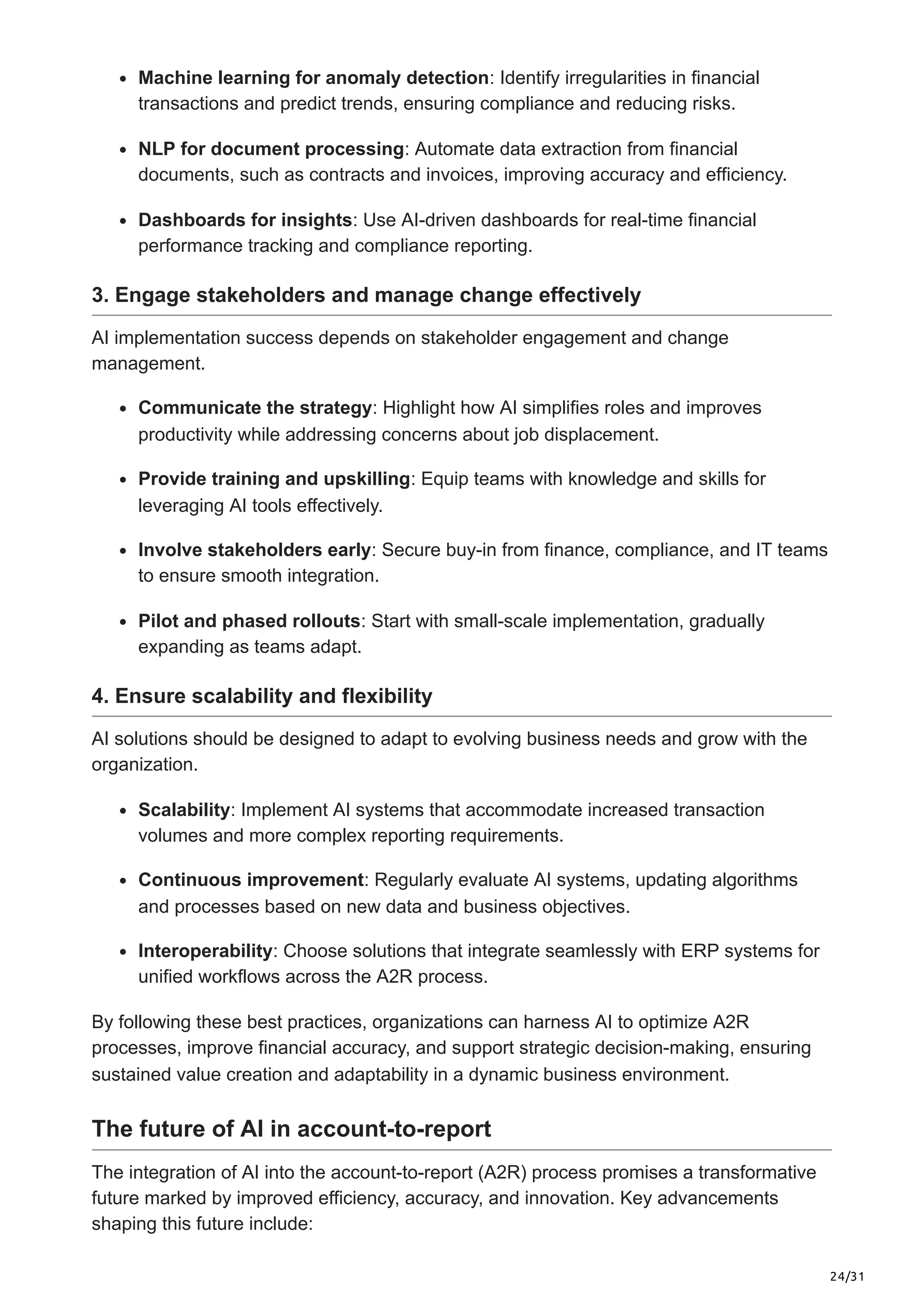
Best practices for implementing AI in account-to-report
Implementing AI in the account-to-report (A2R) processes can enhance financial
accuracy, streamline workflows, and improve decision-making. However, a successful
implementation requires thorough planning and strategic execution. Below are key best
23.
23/31
practices for implementingAI in A2R processes:
Best Practices for AI-Driven
A2R Transformation
Assess process readiness
for AI integration
Leverage the right AI
technologies
Engage stakeholders and
manage change effectively
Ensure scalability and
flexibility
Evaluate workflows, data quality, and
readiness for AI adoption
Choose AI tools like machine learning,
NLP, and RPA for maximum impact
Communicate strategy, train teams, and
secure buy-in for smooth AI rollout
Design AI solutions that scale, improve
continuously, and integrate seamlessly
1. Assess process readiness for AI integration
Before adopting AI, evaluate the current state of your A2R workflows to identify
optimization opportunities.
Map existing workflows: Conduct process discovery to understand bottlenecks
and areas for automation, such as journal entries and reconciliation.
Assess data quality and infrastructure: Ensure access to structured, clean data
and a robust infrastructure capable of supporting AI tools.
Gauge change readiness: Involve stakeholders to understand concerns and align
expectations.
Define clear goals: Establish measurable objectives like improved financial
reporting accuracy or reduced reconciliation time.
2. Leverage the right AI technologies
Selecting appropriate AI technologies ensures maximum impact on A2R processes.
24.
24/31
Machine learning foranomaly detection: Identify irregularities in financial
transactions and predict trends, ensuring compliance and reducing risks.
NLP for document processing: Automate data extraction from financial
documents, such as contracts and invoices, improving accuracy and efficiency.
Dashboards for insights: Use AI-driven dashboards for real-time financial
performance tracking and compliance reporting.
3. Engage stakeholders and manage change effectively
AI implementation success depends on stakeholder engagement and change
management.
Communicate the strategy: Highlight how AI simplifies roles and improves
productivity while addressing concerns about job displacement.
Provide training and upskilling: Equip teams with knowledge and skills for
leveraging AI tools effectively.
Involve stakeholders early: Secure buy-in from finance, compliance, and IT teams
to ensure smooth integration.
Pilot and phased rollouts: Start with small-scale implementation, gradually
expanding as teams adapt.
4. Ensure scalability and flexibility
AI solutions should be designed to adapt to evolving business needs and grow with the
organization.
Scalability: Implement AI systems that accommodate increased transaction
volumes and more complex reporting requirements.
Continuous improvement: Regularly evaluate AI systems, updating algorithms
and processes based on new data and business objectives.
Interoperability: Choose solutions that integrate seamlessly with ERP systems for
unified workflows across the A2R process.
By following these best practices, organizations can harness AI to optimize A2R
processes, improve financial accuracy, and support strategic decision-making, ensuring
sustained value creation and adaptability in a dynamic business environment.
The future of AI in account-to-report
The integration of AI into the account-to-report (A2R) process promises a transformative
future marked by improved efficiency, accuracy, and innovation. Key advancements
shaping this future include:
25.
25/31
1. AI andblockchain integration
The synergy of AI and blockchain technology could revolutionize financial data
management in A2R.
Data integrity and security: Blockchain ensures tamper-proof records, while AI
processes them in real time to minimize errors and fraud.
Streamlined reconciliation: AI accelerates transaction validation, enabling faster
financial close processes.
Cost-effective compliance: Automated ledger audits reduce manual efforts and
ensure regulatory adherence.
2. Advanced financial consolidation
AI simplifies the complexities of multi-entity reporting and consolidation for global
organizations.
Automated data harmonization: AI integrates financial data across systems,
minimizing manual errors.
Global adaptability: Advanced models manage multi-currency transactions and
align with diverse tax laws and accounting standards.
Faster closing cycles: AI-driven automation reduces financial closing times,
offering real-time insights.
3. NLP for dynamic financial reporting
Natural language processing (NLP) will shift A2R reporting from static to real-time,
actionable insights.
Automated report generation: NLP extracts key data from documents, enabling
accurate and timely reporting.
Sentiment analysis: AI assesses financial sentiment from news or market trends to
anticipate risks.
Compliance scanning: NLP ensures regulatory alignment by validating
documentation against compliance requirements.
4. AI-driven financial forecasting
AI leverages real-time data to transform financial forecasting, making it more precise and
relevant.
Real-time adaptability: Forecasts dynamically adjust using live inputs, improving
prediction accuracy.
26.
26/31
Scenario analysis: AIsimulates multiple outcomes to guide proactive risk
management and strategic planning.
Strategic insights: AI uncovers trends to support decisions on cash flow, revenue,
and costs.
5. Ethical AI in financial reporting
As AI adoption grows, maintaining ethical standards will be critical.
Transparent decision-making: AI models will provide explainable outputs, building
stakeholder trust.
Bias mitigation: Organizations will ensure algorithms are free from biases,
supported by diverse training data and audits.
Data privacy: Advanced security measures will protect sensitive financial
information, ensuring compliance with regulations like GDPR.
AI in A2R is set to redefine financial operations, providing organizations with tools to
improve transparency, accuracy, and efficiency while fostering responsible innovation.
Transform account-to-report operations with ZBrain
ZBrain aims to enhance account-to-report (A2R) operations by identifying potential
automation opportunities and streamlining workflows. It can support businesses in
optimizing their A2R processes with AI solutions designed to improve workflow efficiency,
reporting accuracy, and insights, from data collection to financial reporting.
ZBrain XPLR can empower businesses by assessing their AI readiness, preparing them
for successful AI integration. The comprehensive assessment uncovers areas for
improvement and helps align AI strategies with business objectives, ensuring a smooth
transition to AI-driven solutions and minimizing potential risks.
ZBrain Builder’s intuitive, low-code interface, enables users to create custom A2R
solutions to automate various financial tasks.
By integrating seamlessly with existing systems, offering scalable performance, and
ensuring security, ZBrain helps organizations transform their A2R operations, improve
efficiency, and stay competitive in today’s rapidly evolving business environment.
Endnote
The integration of AI into account-to-report (A2R) processes is transforming financial
operations by automating key tasks and delivering actionable insights that enhance
accuracy and decision-making. AI reduces manual effort, improves compliance, and
enables faster financial closes, aligning with strategic goals. As AI technology advances,
its ability to optimize A2R processes will expand, helping organizations remain
27.
27/31
competitive, agile, andprepared for evolving financial landscapes. Embracing AI-driven
solutions allows businesses to stay ahead, ensuring improved efficiency and sustained
innovation in their financial operations.
Ready to elevate your account-to-report processes with AI? Unlock the power of ZBrain’s
intelligent automation for streamlined workflows, improved compliance, and actionable
financial insights.
Listen to the article
Author’s Bio
Akash Takyar
CEO LeewayHertz
Akash Takyar, the founder and CEO of LeewayHertz and
ZBrain, is a pioneer in enterprise technology and AI-driven
solutions. With a proven track record of conceptualizing and
delivering more than 100 scalable, user-centric digital
products, Akash has earned the trust of Fortune 500
companies, including Siemens, 3M, P&G, and Hershey’s.
An early adopter of emerging technologies, Akash leads
innovation in AI, driving transformative solutions that
enhance business operations. With his entrepreneurial spirit,
technical acumen and passion for AI, Akash continues to explore new horizons,
empowering businesses with solutions that enable seamless automation, intelligent
decision-making, and next-generation digital experiences.
Table of content
Frequently Asked Questions
What is ZBrain, and how can it optimize the account-to-report (A2R) process with AI?
ZBrain is an end-to-end AI enablement platform designed to streamline the AI readiness
assessment, use case identification, development and deployment of AI solutions. From
data integration and model selection to solution development, deployment and continuous
optimization, ZBrain provides end-to-end support for AI implementation across business
functions, including A2R.
Here’s how ZBrain enhances A2R processes:
0:00
0:00 / 0:00
/ 0:00
28.
28/31
AI readiness assessmentwith ZBrain XPLR: ZBrain XPLR provides a
comprehensive AI readiness assessment, helping organizations evaluate their
current state and identify key opportunities for AI adoption in A2R processes. ZBrain
XPLR guides businesses toward informed, strategic AI adoption for enhanced
financial operations by assessing AI maturity and highlighting automation
possibilities.
Seamless data ingestion and integration: ZBrain Builder connects with various
financial systems, general ledger tools, and reporting platforms, enabling the
efficient ingestion of structured and unstructured data. This ensures the creation of
a unified data pipeline for accurate, real-time financial reporting.
Low-code development environment: ZBrain Builder’s intuitive, low-code
interface helps accounting and finance teams to create AI agents with minimal
programming knowledge, significantly reducing development cycles and
accelerating the deployment of AI tools to improve financial workflows.
Cloud and model flexibility: ZBrain supports various AI models such as GPT-4
and LLaMA and integrates seamlessly with cloud environments like AWS, Azure,
and GCP, providing flexibility in choosing the optimal infrastructure to balance cost,
performance, and scalability for A2R processes.
Enhanced compliance and governance: With ZBrain’s AI-powered capabilities,
organizations can track and ensure compliance with regulatory standards and
internal policies, flagging potential risks during financial reporting and closing
processes. This ensures continuous audit readiness and strengthens financial
governance.
By offering a flexible, low-code platform and robust data integration with custom AI
capabilities, ZBrain enables organizations to automate, optimize, and innovate across
their entire account-to-report process, transforming the way finance teams manage their
financial data and reporting requirements.
How does ZBrain ensure the security and privacy of sensitive data in account-to-report (A2R)
processes?
Can ZBrain agents be integrated with existing account-to-report (A2R) systems?
What kind of A2R agents can be built on ZBrain Builder?
How does ZBrain cater to diverse A2R needs across finance operations?
How can we measure the ROI of ZBrain in our account-to-report (A2R) processes?
How can I get started with ZBrain for my account-to-report (A2R) processes?
Insights