Cognitive & AI for
doctor augmentation
Jawad Jari
IBM Client & Innovation Center
jawadjari@ma.ibm.com
2
https://www.technologyreview.com/s/607965/a-reality-check-for-ibms-ai-ambitions/
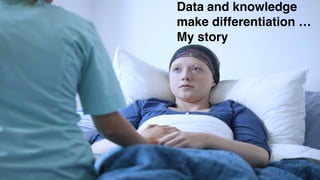
Data and knowledge
make differentiation …
My story
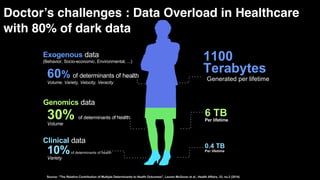
Doctor’s challenges : Data Overload in Healthcare
with 80% of dark data
60% of determinants of health
Volume, Variety, Velocity, Veracity
30% of determinants of health
Volume
10%of determinants of health
Variety
Clinical data
Genomics data
Exogenous data
(Behavior, Socio-economic, Environmental, ...)
1100
Terabytes
Generated per lifetime
6 TB
Per lifetime
0.4 TB
Per lifetime
Source: "The Relative Contribution of Multiple Determinants to Health Outcomes", Lauren McGover et al., Health Affairs, 33, no.2 (2014)
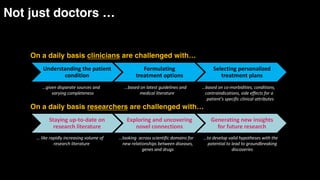
On a daily basis clinicians are challenged with…
…given disparate sources and
varying completeness
… like rapidly increasing volume of
research literature
…based on latest guidelines and
medical literature
…based on co-morbidities, conditions,
contraindications, side effects for a
patient’s specific clinical attributes
…to develop valid hypotheses with the
potential to lead to groundbreaking
discoveries
…looking across scientific domains for
new relationships between diseases,
genes and drugs
Understanding the patient
condition
Formulating
treatment options
Selecting personalized
treatment plans
On a daily basis researchers are challenged with…
Staying up-to-date on
research literature
Exploring and uncovering
novel connections
Generating new insights
for future research
4
© 2015 International Business Machines Corporation
Not just doctors …
5
https://www.technologyreview.com/s/607965/a-reality-check-for-ibms-ai-ambitions/
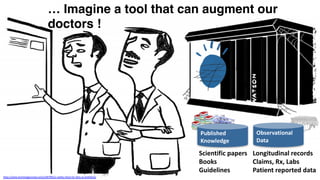
• Longitudinal records
• Claims, Rx, Labs
• Patient reported data
• Scientific papers
• Books
• Guidelines
Observational
Data
Published
Knowledge
… Imagine a tool that can augment our
doctors !
6
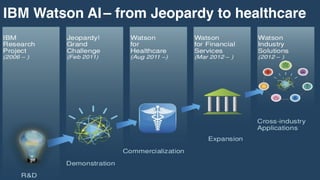
IBM Watson AI– from Jeopardy to healthcare
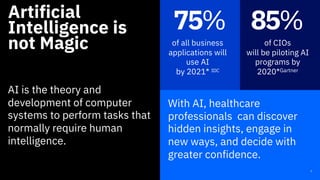
With AI, healthcare
professionals can discover
hidden insights, engage in
new ways, and decide with
greater confidence.
7
Artificial
Intelligence is
not Magic
AI is the theory and
development of computer
systems to perform tasks that
normally require human
intelligence.
75%
of all business
applications will
use AI
by 2021* IDC
85%
of CIOs
will be piloting AI
programs by
2020*Gartner
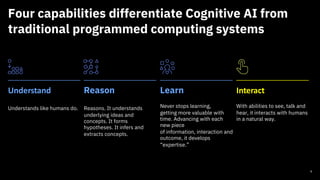
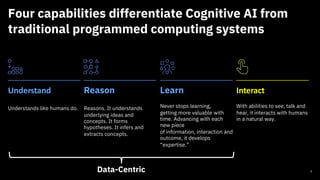
Four capabilities differentiate Cognitive AI from
traditional programmed computing systems
8
Reason
Reasons. It understands
underlying ideas and
concepts. It forms
hypotheses. It infers and
extracts concepts.
Interact
With abilities to see, talk and
hear, it interacts with humans
in a natural way.
Learn
Never stops learning,
getting more valuable with
time. Advancing with each
new piece
of information, interaction and
outcome, it develops
“expertise.”
Understand
Understands like humans do.
Four capabilities differentiate Cognitive AI from
traditional programmed computing systems
9
Reason
Reasons. It understands
underlying ideas and
concepts. It forms
hypotheses. It infers and
extracts concepts.
Interact
With abilities to see, talk and
hear, it interacts with humans
in a natural way.
Learn
Never stops learning,
getting more valuable with
time. Advancing with each
new piece
of information, interaction and
outcome, it develops
“expertise.”
Understand
Understands like humans do.
Data-Centric
80%
of data is either
inaccessible,
untrusted or
unanalyzed
81%
do not
understand the
data required
for AI
There is no AI
without an IA
(information architecture)
10
No amount of AI algorithmic sophistication will overcome a
lack of data [architecture] … bad data is simply paralyzing.
“
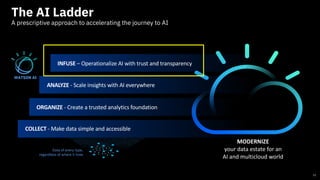
COLLECT - Make data simple and accessible
ORGANIZE - Create a trusted analytics foundation
ANALYZE - Scale insights with AI everywhere
Data of every type,
regardless of where it lives
MODERNIZE
your data estate for an
AI and multicloud world
INFUSE – Operationalize AI with trust and transparency
The AI Ladder
A prescriptive approach to accelerating the journey to AI
11
WATSON AI
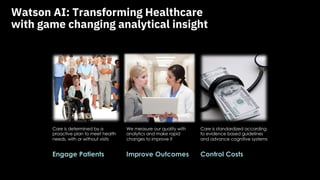
Watson AI: Transforming Healthcare
with game changing analytical insight
Engage Patients Improve Outcomes Control Costs
Care is determined by a
proactive plan to meet health
needs, with or without visits
We measure our quality with
analytics and make rapid
changes to improve it
Care is standardized according
to evidence based guidelines
and advance cognitive systems
1
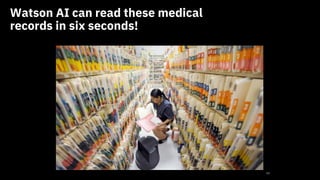
Watson AI can read these medical
records in six seconds!
13
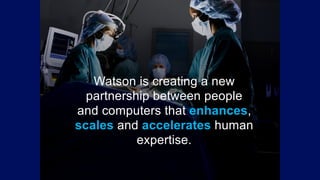
Watson is creating a new
partnership between people
and computers that enhances,
scales and accelerates human
expertise.
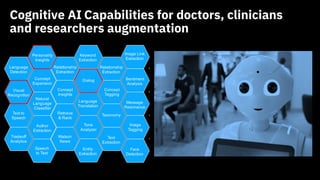
Cognitive AI Capabilities for doctors, clinicians
and researchers augmentation
15
Text to
Speech
Tradeoff
Analytics
Speech
to Text
Concept
Insights
Retrieve
& Rank
Watson
News
Dialog
Tone
Analyzer
Concept
Tagging
Image
Tagging
Relationship
Extraction
Personality
Insights
Natural
Language
Classifier
Visual
Recognition
Image Link
Extraction
Sentiment
Analysis
Message
Resonance
Face
Detection
Relationship
Extraction
Taxonomy
Author
Extraction
Keyword
Extraction
Language
Translation
Text
Extraction
Entity
Extraction
Language
Detection
Concept
Expansion
Easy
Adaptation
Knowledge
Studio
Service
Statistical
Dialog
Q&A
Qualification
Emotion
Analysis
Decision
Support
Criteria
Classification
Knowledge
Canvas
Decision
Optimization
Knowledge
Graph
Risk
Stratification
Policy
Identification
Answer
Generation
Usage
Insights
Fusion
Q&A
Video
Augmentation
Case
Evaluation
Factoid
Pipeline
Aujourd’hui Demain
20
16

AI For Healthcare : Doctors Augmentation

  • 1.
    Cognitive & AIfor doctor augmentation Jawad Jari IBM Client & Innovation Center jawadjari@ma.ibm.com
  • 2.
  • 3.
    Doctor’s challenges :Data Overload in Healthcare with 80% of dark data 60% of determinants of health Volume, Variety, Velocity, Veracity 30% of determinants of health Volume 10%of determinants of health Variety Clinical data Genomics data Exogenous data (Behavior, Socio-economic, Environmental, ...) 1100 Terabytes Generated per lifetime 6 TB Per lifetime 0.4 TB Per lifetime Source: "The Relative Contribution of Multiple Determinants to Health Outcomes", Lauren McGover et al., Health Affairs, 33, no.2 (2014)
  • 4.
    On a dailybasis clinicians are challenged with… …given disparate sources and varying completeness … like rapidly increasing volume of research literature …based on latest guidelines and medical literature …based on co-morbidities, conditions, contraindications, side effects for a patient’s specific clinical attributes …to develop valid hypotheses with the potential to lead to groundbreaking discoveries …looking across scientific domains for new relationships between diseases, genes and drugs Understanding the patient condition Formulating treatment options Selecting personalized treatment plans On a daily basis researchers are challenged with… Staying up-to-date on research literature Exploring and uncovering novel connections Generating new insights for future research 4 © 2015 International Business Machines Corporation Not just doctors …
  • 5.
    5 https://www.technologyreview.com/s/607965/a-reality-check-for-ibms-ai-ambitions/ • Longitudinal records •Claims, Rx, Labs • Patient reported data • Scientific papers • Books • Guidelines Observational Data Published Knowledge … Imagine a tool that can augment our doctors !
  • 6.
    6 IBM Watson AI–from Jeopardy to healthcare
  • 7.
    With AI, healthcare professionalscan discover hidden insights, engage in new ways, and decide with greater confidence. 7 Artificial Intelligence is not Magic AI is the theory and development of computer systems to perform tasks that normally require human intelligence. 75% of all business applications will use AI by 2021* IDC 85% of CIOs will be piloting AI programs by 2020*Gartner
  • 8.
    Four capabilities differentiateCognitive AI from traditional programmed computing systems 8 Reason Reasons. It understands underlying ideas and concepts. It forms hypotheses. It infers and extracts concepts. Interact With abilities to see, talk and hear, it interacts with humans in a natural way. Learn Never stops learning, getting more valuable with time. Advancing with each new piece of information, interaction and outcome, it develops “expertise.” Understand Understands like humans do.
  • 9.
    Four capabilities differentiateCognitive AI from traditional programmed computing systems 9 Reason Reasons. It understands underlying ideas and concepts. It forms hypotheses. It infers and extracts concepts. Interact With abilities to see, talk and hear, it interacts with humans in a natural way. Learn Never stops learning, getting more valuable with time. Advancing with each new piece of information, interaction and outcome, it develops “expertise.” Understand Understands like humans do. Data-Centric
  • 10.
    80% of data iseither inaccessible, untrusted or unanalyzed 81% do not understand the data required for AI There is no AI without an IA (information architecture) 10 No amount of AI algorithmic sophistication will overcome a lack of data [architecture] … bad data is simply paralyzing. “
  • 11.
    COLLECT - Makedata simple and accessible ORGANIZE - Create a trusted analytics foundation ANALYZE - Scale insights with AI everywhere Data of every type, regardless of where it lives MODERNIZE your data estate for an AI and multicloud world INFUSE – Operationalize AI with trust and transparency The AI Ladder A prescriptive approach to accelerating the journey to AI 11 WATSON AI
  • 12.
    Watson AI: TransformingHealthcare with game changing analytical insight Engage Patients Improve Outcomes Control Costs Care is determined by a proactive plan to meet health needs, with or without visits We measure our quality with analytics and make rapid changes to improve it Care is standardized according to evidence based guidelines and advance cognitive systems 1
  • 13.
    Watson AI canread these medical records in six seconds! 13
  • 14.
    Watson is creatinga new partnership between people and computers that enhances, scales and accelerates human expertise.
  • 15.
    Cognitive AI Capabilitiesfor doctors, clinicians and researchers augmentation 15 Text to Speech Tradeoff Analytics Speech to Text Concept Insights Retrieve & Rank Watson News Dialog Tone Analyzer Concept Tagging Image Tagging Relationship Extraction Personality Insights Natural Language Classifier Visual Recognition Image Link Extraction Sentiment Analysis Message Resonance Face Detection Relationship Extraction Taxonomy Author Extraction Keyword Extraction Language Translation Text Extraction Entity Extraction Language Detection Concept Expansion Easy Adaptation Knowledge Studio Service Statistical Dialog Q&A Qualification Emotion Analysis Decision Support Criteria Classification Knowledge Canvas Decision Optimization Knowledge Graph Risk Stratification Policy Identification Answer Generation Usage Insights Fusion Q&A Video Augmentation Case Evaluation Factoid Pipeline Aujourd’hui Demain
  • 16.