A I C O P Y R I G H T :
A U T H O R S H I P
D R A N D R E S G U A D A M U Z , U N I V E R S I T Y O F S U S S E X
S O M E I N T E R A C T I O N
F I R S T A G A M E
H T T P : / / E T C . C H / N D 4 E
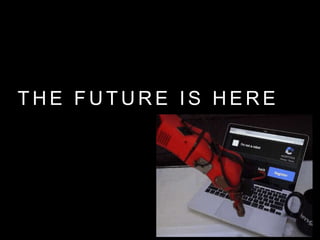
T H E F U T U R E I S H E R E
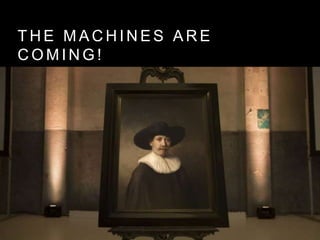
T H E M A C H I N E S A R E
C O M I N G !
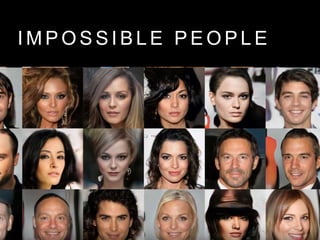
I M P O S S I B L E P E O P L E
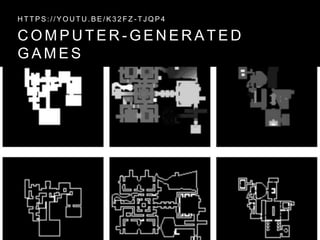
C O M P U T E R - G E N E R A T E D
G A M E S
H T T P S : / / Y O U T U . B E / K 3 2 F Z - T J Q P 4
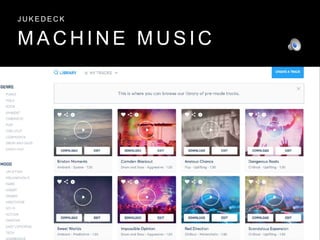
M A C H I N E M U S I C
J U K E D E C K
T R A N S L A T O R S
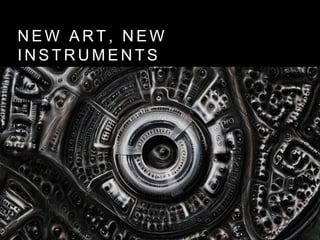
N E W A R T , N E W
I N S T R U M E N T S
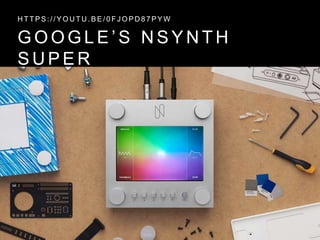
G O O G L E ’ S N S Y N T H
S U P E R
H T T P S : / / Y O U T U . B E / 0 F J O P D 8 7 P Y W
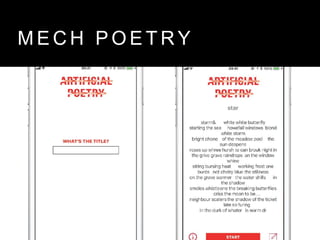
M E C H P O E T R Y
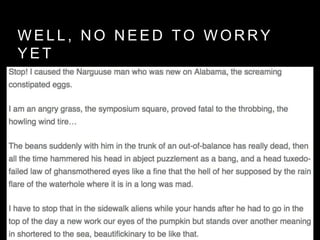
W E L L , N O N E E D T O W O R R Y
Y E T
A I I N C R E A T I V I T Y
D O U G L A S H O F F S T A T E R , G Ö D E L , E S C H E R , B A C H
“AI is whatever hasn't been done yet."
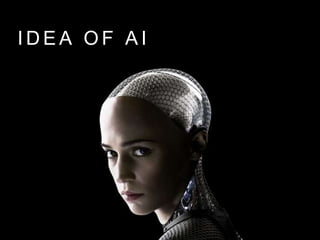
I D E A O F A I
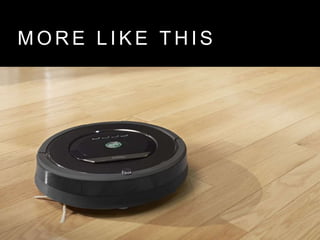
M O R E L I K E T H I S
D E F I N I N G
A R T I F I C I A L
I N T E L L I G E N C E
• “AI is the study of agents
that receive precepts from
the environment and
perform actions.” Russell
and Norvig (2016)
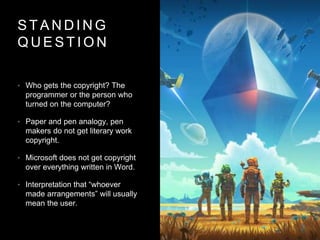
• Agency is the key operator,
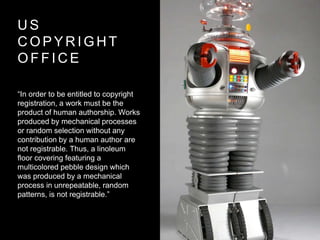
so in this talk I prefer to talk
about autonomous agents,
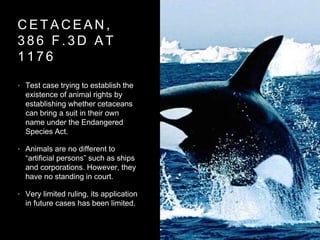
as the “smartness” of the
system becomes
secondary.
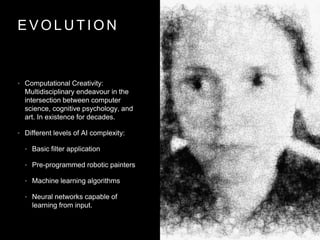
E V O L U T I O N
• Computational Creativity:
Multidisciplinary endeavour in the
intersection between computer
science, cognitive psychology, and
art. In existence for decades.
• Different levels of AI complexity:
• Basic filter application
• Pre-programmed robotic painters
• Machine learning algorithms
• Neural networks capable of
learning from input.
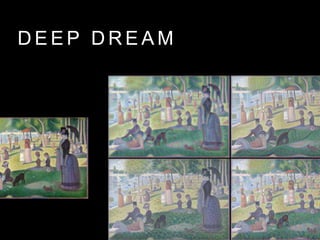
D E E P D R E A M
D E E P D R E A M
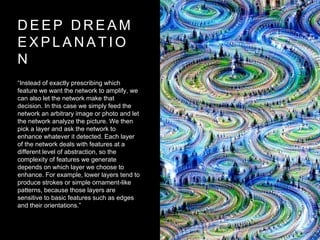
E X P L A N A T I O
N
“Instead of exactly prescribing which
feature we want the network to amplify, we
can also let the network make that
decision. In this case we simply feed the
network an arbitrary image or photo and let
the network analyze the picture. We then
pick a layer and ask the network to
enhance whatever it detected. Each layer
of the network deals with features at a
different level of abstraction, so the
complexity of features we generate
depends on which layer we choose to
enhance. For example, lower layers tend to
produce strokes or simple ornament-like
patterns, because those layers are
sensitive to basic features such as edges
and their orientations.”
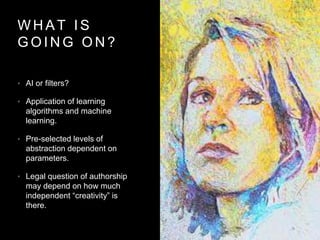
W H A T I S
G O I N G O N ?
• AI or filters?
• Application of learning
algorithms and machine
learning.
• Pre-selected levels of
abstraction dependent on
parameters.
• Legal question of authorship
may depend on how much
independent “creativity” is
there.
D O A N D R O I D S D R E A M
O F E L E C T R I C
A U T H O R S H I P ?
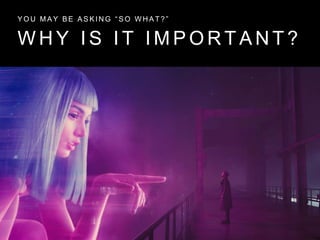
W H Y I S I T I M P O R T A N T ?
Y O U M A Y B E A S K I N G “ S O W H A T ? ”
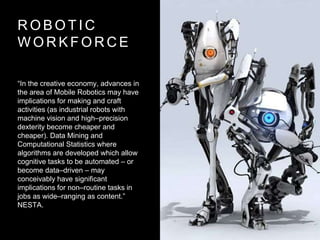
R O B O T I C
W O R K F O R C E
“In the creative economy, advances in
the area of Mobile Robotics may have
implications for making and craft
activities (as industrial robots with
machine vision and high–precision
dexterity become cheaper and
cheaper). Data Mining and
Computational Statistics where
algorithms are developed which allow
cognitive tasks to be automated – or
become data–driven – may
conceivably have significant
implications for non–routine tasks in
jobs as wide–ranging as content.”
NESTA.
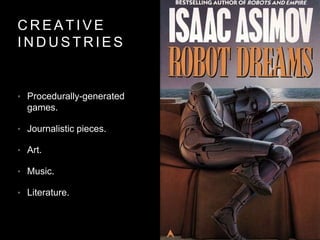
C R E A T I V E
I N D U S T R I E S
• Procedurally-generated
games.
• Journalistic pieces.
• Art.
• Music.
• Literature.
S C E N A R I O S
• Only humans can create
copyright: All AI works are
in the public domain.
• Machines can create
copyright: AI rights?
Programmer?
• Master AI: pre-empts all
possible pleasing melody
combinations, no originality
possible.
B A S I C R U L E S
O N
A U T H O R S H I P
• “Author in relation to a
work is the person who
creates it”.
CDPA s 9(1)
• Various similar
formulations seem to pre-
require personhood for
authorship.
W H O I S A N
A U T H O R ? ( U K
L A W )
• Producer in sound recordings
• Producer and director in film.
• Person making the broadcast in a
broadcast.
• The author of the typographical
arrangement in a published
edition.
• The person who made
arrangements for the work to be
made in a computer-generated
work.
S U B J E C T
M A T T E R
• Copyright protects original
literary, dramatic, musical
or artistic works;
• and [derivative] sound
recordings, films or
broadcasts, and the
typographical arrangement
of published editions.
• Software is a literary work.
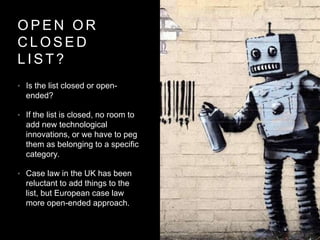
O P E N O R
C L O S E D
L I S T ?
• Is the list closed or open-
ended?
• If the list is closed, no room to
add new technological
innovations, or we have to peg
them as belonging to a specific
category.
• Case law in the UK has been
reluctant to add things to the
list, but European case law
more open-ended approach.
C R E A T I O N R E C O R D S V
N E W S G R O U P
N E W S P A P E R S [ 1 9 9 7 ]
E M L R 4 4 4
• Noel Gallagher arranged a series
of objects for the cover of Be Here
Now.
• Photographer for News Corp took
picture of setting. Oasis sued for
copyright infringement.
• “I do not see how the process of
assembling these disparate objects
together with the members of the
group can be regarded as having
anything in common with sculpture
or with artistic craftsmanship.”
N O V A P R O D U C T I O N S
L T D V M A Z O O M A G A M E S
L T D & O R S ( C A ) [ 2 0 0 7 ]
E W C A C I V 2 1 9
• In [2006] EWHC 24 (Ch), Kitchen J
dismissed idea of games being
dramatic works (“it is not a work of
action which is intended to be or is
capable of being performed before
an audience”). Appealed.
• Literary work, but it’s possible to
analyse other elements
independently.
• Individual frames are graphic works
(artistic works).
• Copyright is not extended to ideas…
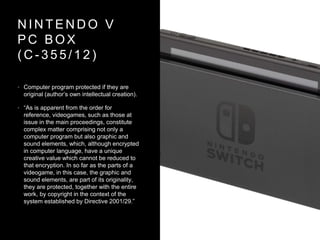
N I N T E N D O V
P C B O X
( C - 3 5 5 / 1 2 )
• Computer program protected if they are
original (author’s own intellectual creation).
• “As is apparent from the order for
reference, videogames, such as those at
issue in the main proceedings, constitute
complex matter comprising not only a
computer program but also graphic and
sound elements, which, although encrypted
in computer language, have a unique
creative value which cannot be reduced to
that encryption. In so far as the parts of a
videogame, in this case, the graphic and
sound elements, are part of its originality,
they are protected, together with the entire
work, by copyright in the context of the
system established by Directive 2001/29.”
A S S U M I N G S U B J E C T
M A T T E R …
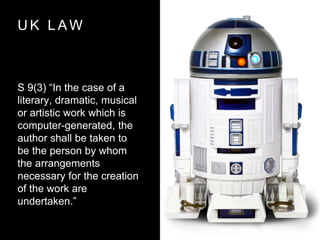
U K L A W
S 9(3) “In the case of a
literary, dramatic, musical
or artistic work which is
computer-generated, the
author shall be taken to
be the person by whom
the arrangements
necessary for the creation
of the work are
undertaken.”
S T A N D I N G
Q U E S T I O N
• Who gets the copyright? The
programmer or the person who
turned on the computer?
• Paper and pen analogy, pen
makers do not get literary work
copyright.
• Microsoft does not get copyright
over everything written in Word.
• Interpretation that “whoever
made arrangements” will usually
mean the user.
U S
C O P Y R I G H T
O F F I C E
“In order to be entitled to copyright
registration, a work must be the
product of human authorship. Works
produced by mechanical processes
or random selection without any
contribution by a human author are
not registrable. Thus, a linoleum
floor covering featuring a
multicolored pebble design which
was produced by a mechanical
process in unrepeatable, random
patterns, is not registrable.”
G H O S T I N
T H E S H E L L ?
• There used to be a relatively strong
case to be made towards the
recognition of non-human rights in some
US case law.
• Take Urantia Foundation v. Maaherra,
114 F.3d 955 (1997), where the spirit of
dead aliens dictated a book, and it was
argued that this work could have
copyright: “copyright laws . . . do not
expressly require ‘human’ authorship.”
• Also see Jap Herron case (Mark
Twain’s ghost).
• Artificial solutions to fix similar issues
involving spirit guides and mediums.
C E T A C E A N ,
3 8 6 F . 3 D A T
1 1 7 6
• Test case trying to establish the
existence of animal rights by
establishing whether cetaceans
can bring a suit in their own
name under the Endangered
Species Act.
• Animals are no different to
“artificial persons” such as ships
and corporations. However, they
have no standing in court.
• Very limited ruling, its application
in future cases has been limited.
N A R U T O V
S L A T E R
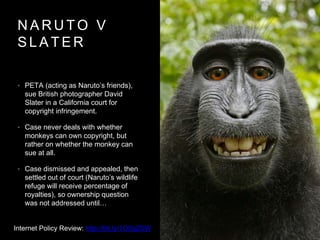
• PETA (acting as Naruto’s friends),
sue British photographer David
Slater in a California court for
copyright infringement.
• Case never deals with whether
monkeys can own copyright, but
rather on whether the monkey can
sue at all.
• Case dismissed and appealed, then
settled out of court (Naruto’s wildlife
refuge will receive percentage of
royalties), so ownership question
was not addressed until…
Internet Policy Review: http://bit.ly/1O0qZSW
N A R U T O V .
S L A T E R , N O . 1 6 -
1 5 4 6 9 ( 9 T H C I R .
2 0 1 8 )
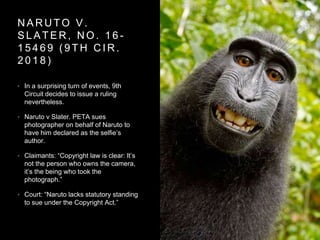
• In a surprising turn of events, 9th
Circuit decides to issue a ruling
nevertheless.
• Naruto v Slater. PETA sues
photographer on behalf of Naruto to
have him declared as the selfie’s
author.
• Claimants: “Copyright law is clear: It’s
not the person who owns the camera,
it’s the being who took the
photograph.”
• Court: “Naruto lacks statutory standing
to sue under the Copyright Act.”
E U R O P E A N
L A W
• In Europe a work is original if it
is “author’s own intellectual
creation reflecting his
personality”. Directive
2006/116/EC.
• Choice, selection of elements,
composition, all may prove
originality. (Infopaq, Painer
cases).
• Unclear if setting parameters
and algorithms would be
enough.
J A P A N
• “person” required under current
law.
• Intellectual Property Strategic
Program 2016 and 2017 includes
overhaul to copyright law (not
implemented yet).
• Computer-generated works given
similar treatment to UK.
• However, not all works to be
protected, only works with
significant economic impact to be
given protection.
A U S T R A L I A
• Acohs Pty Ltd v Ucorp Pty Ltd [2012]
FCAFC 16.
• HTML source code for some data
sheets were generated by a
computer program. Question arose
whether the code can be protected
by copyright as original work.
• In first instance judge found that the
code was “not the work of any one
human author”.
• Federal Court agrees that there’s no
copyright as there’s no human
author.
O P T I O N S F O R
A I
C O P Y R I G H T
• No copyright due to no
originality/creativity.
• No registration.
• Make UK’s approach more widely
used, programmer gets copyright.
• Japanese commercial test.
• Take a wider approach: nn-
human copyright?
• Artificial Intelligence rights?
@ T E C H N O L L A M A
A . G U A D A M U Z @ S U S S E X . A C . U K
The mech shall inherit the Earth

Ai copyright: Authorship

  • 1.
    A I CO P Y R I G H T : A U T H O R S H I P D R A N D R E S G U A D A M U Z , U N I V E R S I T Y O F S U S S E X
  • 2.
    S O ME I N T E R A C T I O N
  • 3.
    F I RS T A G A M E H T T P : / / E T C . C H / N D 4 E
  • 4.
    T H EF U T U R E I S H E R E
  • 5.
    T H EM A C H I N E S A R E C O M I N G !
  • 6.
    I M PO S S I B L E P E O P L E
  • 7.
    C O MP U T E R - G E N E R A T E D G A M E S H T T P S : / / Y O U T U . B E / K 3 2 F Z - T J Q P 4
  • 8.
    M A CH I N E M U S I C J U K E D E C K
  • 9.
    T R AN S L A T O R S
  • 10.
    N E WA R T , N E W I N S T R U M E N T S
  • 11.
    G O OG L E ’ S N S Y N T H S U P E R H T T P S : / / Y O U T U . B E / 0 F J O P D 8 7 P Y W
  • 12.
    M E CH P O E T R Y
  • 13.
    W E LL , N O N E E D T O W O R R Y Y E T
  • 14.
    A I IN C R E A T I V I T Y
  • 15.
    D O UG L A S H O F F S T A T E R , G Ö D E L , E S C H E R , B A C H “AI is whatever hasn't been done yet."
  • 16.
    I D EA O F A I
  • 17.
    M O RE L I K E T H I S
  • 18.
    D E FI N I N G A R T I F I C I A L I N T E L L I G E N C E • “AI is the study of agents that receive precepts from the environment and perform actions.” Russell and Norvig (2016) • Agency is the key operator, so in this talk I prefer to talk about autonomous agents, as the “smartness” of the system becomes secondary.
  • 19.
    E V OL U T I O N • Computational Creativity: Multidisciplinary endeavour in the intersection between computer science, cognitive psychology, and art. In existence for decades. • Different levels of AI complexity: • Basic filter application • Pre-programmed robotic painters • Machine learning algorithms • Neural networks capable of learning from input.
  • 20.
    D E EP D R E A M
  • 21.
    D E EP D R E A M E X P L A N A T I O N “Instead of exactly prescribing which feature we want the network to amplify, we can also let the network make that decision. In this case we simply feed the network an arbitrary image or photo and let the network analyze the picture. We then pick a layer and ask the network to enhance whatever it detected. Each layer of the network deals with features at a different level of abstraction, so the complexity of features we generate depends on which layer we choose to enhance. For example, lower layers tend to produce strokes or simple ornament-like patterns, because those layers are sensitive to basic features such as edges and their orientations.”
  • 22.
    W H AT I S G O I N G O N ? • AI or filters? • Application of learning algorithms and machine learning. • Pre-selected levels of abstraction dependent on parameters. • Legal question of authorship may depend on how much independent “creativity” is there.
  • 23.
    D O AN D R O I D S D R E A M O F E L E C T R I C A U T H O R S H I P ?
  • 24.
    W H YI S I T I M P O R T A N T ? Y O U M A Y B E A S K I N G “ S O W H A T ? ”
  • 25.
    R O BO T I C W O R K F O R C E “In the creative economy, advances in the area of Mobile Robotics may have implications for making and craft activities (as industrial robots with machine vision and high–precision dexterity become cheaper and cheaper). Data Mining and Computational Statistics where algorithms are developed which allow cognitive tasks to be automated – or become data–driven – may conceivably have significant implications for non–routine tasks in jobs as wide–ranging as content.” NESTA.
  • 26.
    C R EA T I V E I N D U S T R I E S • Procedurally-generated games. • Journalistic pieces. • Art. • Music. • Literature.
  • 27.
    S C EN A R I O S • Only humans can create copyright: All AI works are in the public domain. • Machines can create copyright: AI rights? Programmer? • Master AI: pre-empts all possible pleasing melody combinations, no originality possible.
  • 28.
    B A SI C R U L E S O N A U T H O R S H I P • “Author in relation to a work is the person who creates it”. CDPA s 9(1) • Various similar formulations seem to pre- require personhood for authorship.
  • 29.
    W H OI S A N A U T H O R ? ( U K L A W ) • Producer in sound recordings • Producer and director in film. • Person making the broadcast in a broadcast. • The author of the typographical arrangement in a published edition. • The person who made arrangements for the work to be made in a computer-generated work.
  • 30.
    S U BJ E C T M A T T E R • Copyright protects original literary, dramatic, musical or artistic works; • and [derivative] sound recordings, films or broadcasts, and the typographical arrangement of published editions. • Software is a literary work.
  • 31.
    O P EN O R C L O S E D L I S T ? • Is the list closed or open- ended? • If the list is closed, no room to add new technological innovations, or we have to peg them as belonging to a specific category. • Case law in the UK has been reluctant to add things to the list, but European case law more open-ended approach.
  • 32.
    C R EA T I O N R E C O R D S V N E W S G R O U P N E W S P A P E R S [ 1 9 9 7 ] E M L R 4 4 4 • Noel Gallagher arranged a series of objects for the cover of Be Here Now. • Photographer for News Corp took picture of setting. Oasis sued for copyright infringement. • “I do not see how the process of assembling these disparate objects together with the members of the group can be regarded as having anything in common with sculpture or with artistic craftsmanship.”
  • 33.
    N O VA P R O D U C T I O N S L T D V M A Z O O M A G A M E S L T D & O R S ( C A ) [ 2 0 0 7 ] E W C A C I V 2 1 9 • In [2006] EWHC 24 (Ch), Kitchen J dismissed idea of games being dramatic works (“it is not a work of action which is intended to be or is capable of being performed before an audience”). Appealed. • Literary work, but it’s possible to analyse other elements independently. • Individual frames are graphic works (artistic works). • Copyright is not extended to ideas…
  • 34.
    N I NT E N D O V P C B O X ( C - 3 5 5 / 1 2 ) • Computer program protected if they are original (author’s own intellectual creation). • “As is apparent from the order for reference, videogames, such as those at issue in the main proceedings, constitute complex matter comprising not only a computer program but also graphic and sound elements, which, although encrypted in computer language, have a unique creative value which cannot be reduced to that encryption. In so far as the parts of a videogame, in this case, the graphic and sound elements, are part of its originality, they are protected, together with the entire work, by copyright in the context of the system established by Directive 2001/29.”
  • 35.
    A S SU M I N G S U B J E C T M A T T E R …
  • 36.
    U K LA W S 9(3) “In the case of a literary, dramatic, musical or artistic work which is computer-generated, the author shall be taken to be the person by whom the arrangements necessary for the creation of the work are undertaken.”
  • 37.
    S T AN D I N G Q U E S T I O N • Who gets the copyright? The programmer or the person who turned on the computer? • Paper and pen analogy, pen makers do not get literary work copyright. • Microsoft does not get copyright over everything written in Word. • Interpretation that “whoever made arrangements” will usually mean the user.
  • 38.
    U S C OP Y R I G H T O F F I C E “In order to be entitled to copyright registration, a work must be the product of human authorship. Works produced by mechanical processes or random selection without any contribution by a human author are not registrable. Thus, a linoleum floor covering featuring a multicolored pebble design which was produced by a mechanical process in unrepeatable, random patterns, is not registrable.”
  • 39.
    G H OS T I N T H E S H E L L ? • There used to be a relatively strong case to be made towards the recognition of non-human rights in some US case law. • Take Urantia Foundation v. Maaherra, 114 F.3d 955 (1997), where the spirit of dead aliens dictated a book, and it was argued that this work could have copyright: “copyright laws . . . do not expressly require ‘human’ authorship.” • Also see Jap Herron case (Mark Twain’s ghost). • Artificial solutions to fix similar issues involving spirit guides and mediums.
  • 40.
    C E TA C E A N , 3 8 6 F . 3 D A T 1 1 7 6 • Test case trying to establish the existence of animal rights by establishing whether cetaceans can bring a suit in their own name under the Endangered Species Act. • Animals are no different to “artificial persons” such as ships and corporations. However, they have no standing in court. • Very limited ruling, its application in future cases has been limited.
  • 41.
    N A RU T O V S L A T E R • PETA (acting as Naruto’s friends), sue British photographer David Slater in a California court for copyright infringement. • Case never deals with whether monkeys can own copyright, but rather on whether the monkey can sue at all. • Case dismissed and appealed, then settled out of court (Naruto’s wildlife refuge will receive percentage of royalties), so ownership question was not addressed until… Internet Policy Review: http://bit.ly/1O0qZSW
  • 42.
    N A RU T O V . S L A T E R , N O . 1 6 - 1 5 4 6 9 ( 9 T H C I R . 2 0 1 8 ) • In a surprising turn of events, 9th Circuit decides to issue a ruling nevertheless. • Naruto v Slater. PETA sues photographer on behalf of Naruto to have him declared as the selfie’s author. • Claimants: “Copyright law is clear: It’s not the person who owns the camera, it’s the being who took the photograph.” • Court: “Naruto lacks statutory standing to sue under the Copyright Act.”
  • 43.
    E U RO P E A N L A W • In Europe a work is original if it is “author’s own intellectual creation reflecting his personality”. Directive 2006/116/EC. • Choice, selection of elements, composition, all may prove originality. (Infopaq, Painer cases). • Unclear if setting parameters and algorithms would be enough.
  • 44.
    J A PA N • “person” required under current law. • Intellectual Property Strategic Program 2016 and 2017 includes overhaul to copyright law (not implemented yet). • Computer-generated works given similar treatment to UK. • However, not all works to be protected, only works with significant economic impact to be given protection.
  • 45.
    A U ST R A L I A • Acohs Pty Ltd v Ucorp Pty Ltd [2012] FCAFC 16. • HTML source code for some data sheets were generated by a computer program. Question arose whether the code can be protected by copyright as original work. • In first instance judge found that the code was “not the work of any one human author”. • Federal Court agrees that there’s no copyright as there’s no human author.
  • 46.
    O P TI O N S F O R A I C O P Y R I G H T • No copyright due to no originality/creativity. • No registration. • Make UK’s approach more widely used, programmer gets copyright. • Japanese commercial test. • Take a wider approach: nn- human copyright? • Artificial Intelligence rights?
  • 47.
    @ T EC H N O L L A M A A . G U A D A M U Z @ S U S S E X . A C . U K The mech shall inherit the Earth

Editor's Notes

  • #6 The Next Rembrandt is a project by Microsoft research team that produced a new Rembrandt painting by a combination of data mining existing art and using machine learning algorithms.
  • #7 Nvidia trained a machine learning algorithm with thousands of celebrity photographs, and the system generated a number of fake people who have never existed. None of the people in this image are real.
  • #8 Researchers from Torino trained a machine-learning algorithm to generate DOOM levels by running 3700 iterations of the game through a neural network.
  • #9 Jukedeck, a website that allows you to create royalty-free AI music to download.
  • #11 Google art has been selling for $8,000 USD
  • #12 A Google neural network has generated new musical instruments.
  • #13 Google’s Deep Mind project published a paper called “Generating Sentences from a Continuous Space”, which produced some interesting poetry. Monique Grimord.
  • #17 One of the issues we are having is that we tend to frame the debate on the basis of AI as this incredibly powerful tool, almost super-human in speed and capabilities.
  • #18 The reality however is more mundane. So what interests me is perhaps not so much the killer robot kind, or the evil AI who will enslave humanity feared by so many, but the more mundane kind, which will be the most pervasive. What are the legal implications of a Roomba?
  • #21 While there is a This was a big moment for various reasons, while the works are basic from an artistic perspective, under the hood things are happening that make things more interesting. The algorithms are coming up with solutions on their own.
  • #25 I’ve presented and published on this subject to several audiences, and this question inevitably comes up time and time again. Who cares about robot copyright?.
  • #26 A report by NESTA (an innovation foundation based in the UK) warned that while creative industries are not under threat yet, there may be room for concern regarding mostly routine tasks, but even non-routine tasks may be at stake.
  • #37 There are a few questions here, particularly who is the person who made the arrangements necessary for the creation of the work, is it the programmer, or is it the person who “pushed the button” as it may.