Quality Knitwear Products
1
2
We give emerging
and established
sustainable
fashion designers
a high quality,
easy-to-work-
with solution for
small-batch
ethical knitwear
manufacturing.
Apparel companies are expected to be global players. It is
challenging for companies to meet performance & aesthetic expectations, while
addressing compliance and sustainability needs across markets.
Ignoring ethical standards has consequences for brands.
Failure to establish ethical business practices in a brand can result in unacceptable
consequences that include both human and operational risks.
Sourcing ethically is not easy. Designers want to capitalize on this trend
but often don’t have the bandwidth to ‘dig deeper’ to understand how their
manufacturers work.
Ethical manufacturers are generally ill-prepared. Designers have a
hard time finding ethical manufacturers that understand international quality
standards, that can easily translate made-to-order items, and that can
communicate in their own language.
3
Save
Money
Direct connection
to supplier, no
middle-men
Save Time
Excellent
communication,
in-house quality
control, wide
variety of knit
abilities
Satisfy
Customers
Ethically
manufactured,
relevant
products at a
fair price
4
!  AHA Bolivia allows knitwear designers to
satisfy their ethical interests quickly, easily,
and effectively.
!  Ethical Designers can:
5
6
Knit Items Crochet Items
7
!  “It’s so much easier in terms of product dev to deal directly with the AHA
team instead of going through a middle person” – Project 8
!  “We like that the knitters interpret our designs well and the team is really
easy to work with and very responsive. Definitely among the most
straightforward production we do – I don’t feel like we need to keep on
top of them [AHA]” – Project 8
!  “People want to shop good for their children – they don’t mind spending
money for their children as long as it’s going to a good place” –Tag NYC
!   ”We are really happy with quality and would like to develop more for
spring “ – Tag NYC
!  “Fair Trade is part of why I engaged with AHA and how I found them. I
enjoy working with AHA and products come out looking really nice.” –
Ellen Van Dusen
!  “We just knew that AHA Bolivia ‘got it’” – Estella
!  “Quality is second to none and everyone is responsive.” - Estella
8
Purchase Raw
Materials – alpaca,
cotton
Distribute to
Artisans – 15
leaders
Artisans Produce
@ Home – cottage
industry
Quality Control
Knitters –
members &
leaders
Quality Control
Office
Package & Ship
Client Payment &
Knitter Payment
9
!  In 2012 world apparel imports were USD 423
billion
◦  The EU accounted for 40% of these imports
◦  The United States accounted for 20%
◦  Japan accounted for 8.0%
!  Worldwide womenswear industry is expected
to pass $621 billion in 2014
!  Manhattanites spend the most on apparel at
$362/month
10
!  The development of ethical fashion is akin to the one in
'organic food' 25 years ago
!  In 2014 the total ‘ethical fashion' consumption (retail
sales) is estimated to be worth $10 billion in the USA
and € 1billion in the EU
!  In 2013 green apparel and accessories made up slightly
more than 2% of the $200 billion fashion business in
the U.S. (about $5 billion)
◦  A decade ago it was not even 1/2 a billion dollars
!  Germany, the UK, France and the northern EU countries
are steady growth markets for ethical fashion
!  The world market for textiles made from organically grown
cotton was worth over $5 billion in 2010
11
!  The sustainable fashion market is gaining traction
◦  Stella McCartney was founded in 2001
◦  Edun founded in 2005
◦  The first Ethical Fashion Show was in 2004 in Paris
◦  New York Fashion Week launched its first Eco Fashion Week in
2009
◦  London Fashion Week’s first sustainable-fashion show was in
2010
!  Big brands are getting on board
◦  H&M had a 21% increase in demand for sustainable fashion
between 2012-2013
◦  Puma launched biodegradable sneakers and T-shirts in 2013
◦  Timberland’s Earthkeepers, introduced in 2009, makes up 75%
of its footwear sales
12
!  An Edelman survey of 8,000 consumers in 16 markets found that
interest in sustainability through consumerism continues to rise
!  Since 2008, 86% of consumers report they believe companies should
focus as much on social impact as they do on their core business
!  While many people express interest in buying sustainably, Deloitte
found that only about 20% actually end up purchasing a sustainable
product
◦  This means significant market growth potential in the LOHAS
segment!
!  In 2008, 72% of British consumers thought that ethical
production of the clothes they buy is important, up from 59% in
2007
!  There are over 780 designers in the Not Just a Label directory
specifically looking for ethical production
13
14
Digital
Website SEO, Social Media
Sourcing Directories
Online PR/articles
Trade Shows
Ethical Fashion Show Berlin
Ethical Fashion & Sustainable
Design Summit FL
Copenhagen Fashion Summit
ECO Fashion Week Canada
The GreenShows NYC
Direct Sales
780 designers in Not
Just a Label
Eco Fashion World
British Association for
Fair Trade Shops
15
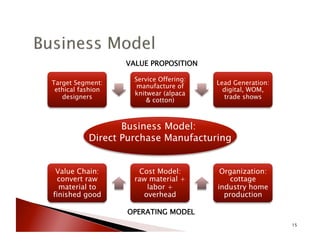
Business Model:
Direct Purchase Manufacturing
Target Segment:
ethical fashion
designers
Service Offering:
manufacture of
knitwear (alpaca
& cotton)
Lead Generation:
digital, WOM,
trade shows
VALUE PROPOSITION
Value Chain:
convert raw
material to
finished good
Cost Model:
raw material +
labor +
overhead
Organization:
cottage
industry home
production
OPERATING MODEL
16
Majority made-
to-order, no
ready-to-wear
Fair Trade or
Socially
Conscious
No Minimum
Quantity
Hand Knit
Capabilities
Website in
English
Cottage
Industry (vs.
factory work)
✔
both
both
✔ ✔ ✔ ✔
✔ ✔ both
✔ ✔ ✔ ✔
✔ ✔ ✔ ✔ ✔
✔ ✔
✔ ✔✔
!  Anna Aliaga Bio
17
Anna Aliaga
President
Ruben
Inventory
Raw Materials
Silvana
Assist Inventory,
Quality Control,
Knitter Interface
Jose
Client Manager
Order Processing
Knitter Interface
Mercedes
Accounting
Exports
Adriana
Bag Client Manager
Bag Order Processing
Irma
Quality Control
18
19
Berth
a Nelli
Irma
Marga
rita
Glady
s
Sandr
a G
Sandra
L
Sandra
D
Serafin
a
Amparo
Danitz
a
Felicida
dHermini
a
Ortenci
a
Lourde
s
Maria
A
Maria
V
Mario
Marisol
Pati
Ana
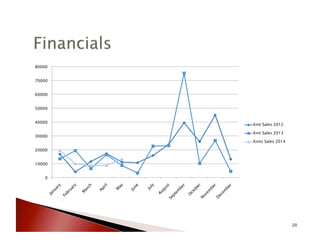
20
0
10000
20000
30000
40000
50000
60000
70000
80000
Knit Sales 2012
Knit Sales 2013
Knits Sales 2014
!  AHA Bolivia needs USD $97,000 in order to
scale to the next level*
!  Funds will be used for:
◦  Sales & marketing
!  Website improvements
!  Trade shows
!  Marketing materials
!  Direct International Sales
◦  Internal Operations Improvements
*This accounts for the knits AND bags LOB
21
www.ahabolivia.com
22

AHA Bolivia deck

  • 1.
  • 2.
    2 We give emerging andestablished sustainable fashion designers a high quality, easy-to-work- with solution for small-batch ethical knitwear manufacturing.
  • 3.
    Apparel companies areexpected to be global players. It is challenging for companies to meet performance & aesthetic expectations, while addressing compliance and sustainability needs across markets. Ignoring ethical standards has consequences for brands. Failure to establish ethical business practices in a brand can result in unacceptable consequences that include both human and operational risks. Sourcing ethically is not easy. Designers want to capitalize on this trend but often don’t have the bandwidth to ‘dig deeper’ to understand how their manufacturers work. Ethical manufacturers are generally ill-prepared. Designers have a hard time finding ethical manufacturers that understand international quality standards, that can easily translate made-to-order items, and that can communicate in their own language. 3
  • 4.
    Save Money Direct connection to supplier,no middle-men Save Time Excellent communication, in-house quality control, wide variety of knit abilities Satisfy Customers Ethically manufactured, relevant products at a fair price 4 !  AHA Bolivia allows knitwear designers to satisfy their ethical interests quickly, easily, and effectively. !  Ethical Designers can:
  • 5.
  • 6.
  • 7.
  • 8.
    !  “It’s somuch easier in terms of product dev to deal directly with the AHA team instead of going through a middle person” – Project 8 !  “We like that the knitters interpret our designs well and the team is really easy to work with and very responsive. Definitely among the most straightforward production we do – I don’t feel like we need to keep on top of them [AHA]” – Project 8 !  “People want to shop good for their children – they don’t mind spending money for their children as long as it’s going to a good place” –Tag NYC !   ”We are really happy with quality and would like to develop more for spring “ – Tag NYC !  “Fair Trade is part of why I engaged with AHA and how I found them. I enjoy working with AHA and products come out looking really nice.” – Ellen Van Dusen !  “We just knew that AHA Bolivia ‘got it’” – Estella !  “Quality is second to none and everyone is responsive.” - Estella 8
  • 9.
    Purchase Raw Materials –alpaca, cotton Distribute to Artisans – 15 leaders Artisans Produce @ Home – cottage industry Quality Control Knitters – members & leaders Quality Control Office Package & Ship Client Payment & Knitter Payment 9
  • 10.
    !  In 2012world apparel imports were USD 423 billion ◦  The EU accounted for 40% of these imports ◦  The United States accounted for 20% ◦  Japan accounted for 8.0% !  Worldwide womenswear industry is expected to pass $621 billion in 2014 !  Manhattanites spend the most on apparel at $362/month 10
  • 11.
    !  The developmentof ethical fashion is akin to the one in 'organic food' 25 years ago !  In 2014 the total ‘ethical fashion' consumption (retail sales) is estimated to be worth $10 billion in the USA and € 1billion in the EU !  In 2013 green apparel and accessories made up slightly more than 2% of the $200 billion fashion business in the U.S. (about $5 billion) ◦  A decade ago it was not even 1/2 a billion dollars !  Germany, the UK, France and the northern EU countries are steady growth markets for ethical fashion !  The world market for textiles made from organically grown cotton was worth over $5 billion in 2010 11
  • 12.
    !  The sustainablefashion market is gaining traction ◦  Stella McCartney was founded in 2001 ◦  Edun founded in 2005 ◦  The first Ethical Fashion Show was in 2004 in Paris ◦  New York Fashion Week launched its first Eco Fashion Week in 2009 ◦  London Fashion Week’s first sustainable-fashion show was in 2010 !  Big brands are getting on board ◦  H&M had a 21% increase in demand for sustainable fashion between 2012-2013 ◦  Puma launched biodegradable sneakers and T-shirts in 2013 ◦  Timberland’s Earthkeepers, introduced in 2009, makes up 75% of its footwear sales 12
  • 13.
    !  An Edelmansurvey of 8,000 consumers in 16 markets found that interest in sustainability through consumerism continues to rise !  Since 2008, 86% of consumers report they believe companies should focus as much on social impact as they do on their core business !  While many people express interest in buying sustainably, Deloitte found that only about 20% actually end up purchasing a sustainable product ◦  This means significant market growth potential in the LOHAS segment! !  In 2008, 72% of British consumers thought that ethical production of the clothes they buy is important, up from 59% in 2007 !  There are over 780 designers in the Not Just a Label directory specifically looking for ethical production 13
  • 14.
    14 Digital Website SEO, SocialMedia Sourcing Directories Online PR/articles Trade Shows Ethical Fashion Show Berlin Ethical Fashion & Sustainable Design Summit FL Copenhagen Fashion Summit ECO Fashion Week Canada The GreenShows NYC Direct Sales 780 designers in Not Just a Label Eco Fashion World British Association for Fair Trade Shops
  • 15.
    15 Business Model: Direct PurchaseManufacturing Target Segment: ethical fashion designers Service Offering: manufacture of knitwear (alpaca & cotton) Lead Generation: digital, WOM, trade shows VALUE PROPOSITION Value Chain: convert raw material to finished good Cost Model: raw material + labor + overhead Organization: cottage industry home production OPERATING MODEL
  • 16.
    16 Majority made- to-order, no ready-to-wear FairTrade or Socially Conscious No Minimum Quantity Hand Knit Capabilities Website in English Cottage Industry (vs. factory work) ✔ both both ✔ ✔ ✔ ✔ ✔ ✔ both ✔ ✔ ✔ ✔ ✔ ✔ ✔ ✔ ✔ ✔ ✔ ✔ ✔✔
  • 17.
  • 18.
    Anna Aliaga President Ruben Inventory Raw Materials Silvana AssistInventory, Quality Control, Knitter Interface Jose Client Manager Order Processing Knitter Interface Mercedes Accounting Exports Adriana Bag Client Manager Bag Order Processing Irma Quality Control 18
  • 19.
  • 20.
  • 21.
    !  AHA Bolivianeeds USD $97,000 in order to scale to the next level* !  Funds will be used for: ◦  Sales & marketing !  Website improvements !  Trade shows !  Marketing materials !  Direct International Sales ◦  Internal Operations Improvements *This accounts for the knits AND bags LOB 21
  • 22.