Agriscience Fundamentals and Applications 6th Edition Burton Solutions Manual
1.
Agriscience Fundamentals andApplications 6th
Edition Burton Solutions Manual install download
https://testbankfan.com/product/agriscience-fundamentals-and-
applications-6th-edition-burton-solutions-manual/
Download more testbank from https://testbankfan.com
2.
We believe theseproducts will be a great fit for you. Click
the link to download now, or visit testbankfan.com
to discover even more!
Agriscience Fundamentals and Applications 6th Edition
Burton Test Bank
https://testbankfan.com/product/agriscience-fundamentals-and-
applications-6th-edition-burton-test-bank/
Fundamentals of Nursing Care Concepts Connections and
Skills 2nd Edition Burton Test Bank
https://testbankfan.com/product/fundamentals-of-nursing-care-
concepts-connections-and-skills-2nd-edition-burton-test-bank/
Fluid Mechanics Fundamentals and Applications 4th
Edition Cengel Solutions Manual
https://testbankfan.com/product/fluid-mechanics-fundamentals-and-
applications-4th-edition-cengel-solutions-manual/
Agricultural Mechanics Fundamentals and Applications
7th Edition Herren Solutions Manual
https://testbankfan.com/product/agricultural-mechanics-
fundamentals-and-applications-7th-edition-herren-solutions-
manual/
3.
Fluid Mechanics Fundamentalsand Applications 3rd
Edition Cengel Solutions Manual
https://testbankfan.com/product/fluid-mechanics-fundamentals-and-
applications-3rd-edition-cengel-solutions-manual/
Management Fundamentals Concepts Applications and Skill
Development 6th Edition Lussier Test Bank
https://testbankfan.com/product/management-fundamentals-concepts-
applications-and-skill-development-6th-edition-lussier-test-bank/
Business Math Using Excel 2nd Edition Burton Solutions
Manual
https://testbankfan.com/product/business-math-using-excel-2nd-
edition-burton-solutions-manual/
Heat and Mass Transfer Fundamentals and Applications
5th Edition Cengel Solutions Manual
https://testbankfan.com/product/heat-and-mass-transfer-
fundamentals-and-applications-5th-edition-cengel-solutions-
manual/
Microeconomics Principles and Applications 6th Edition
Hall Solutions Manual
https://testbankfan.com/product/microeconomics-principles-and-
applications-6th-edition-hall-solutions-manual/
Begone! The wayis clear before you
When the old spring fret comes o’er you,
And the Red Gods call for you!
They will see the lakeside lilies where the bull moose meets the
cow,
Or maybe silver grizzlies nurse the sow.
They must climb the blue-roofed Rockies and observe that windy
rift
Where the baffling mountain eddies chop and change.
They will learn the long day’s patience, belly down on talus drift,
And hear the thud of bison on the range.
It is there that they are going where the bighorn and the ewes lie,
To a trusty, nimble ranger that they know;
They have sworn an oath to keep it on the brink of Mitsiadazi
For the Red Gods call them out and they must go.
Let them go, go, go, away from home!
On the summit of the world they’re overdue.
Be off! The trail is clear before you
When the old spring fret comes o’er you,
And the Red Gods make their medicine again.
“So it’s onward ponies, sally, this is not the place to dally!”
For the young men’s thoughts are turning to a camp of special
yearning,
Hidden in a hanging valley.
They must find that blackened timber, they must head that racing
stream,
With its raw, right-angled log jam at the end,
And a bar of sun-warmed gravel where a lad can bask and dream
To the click of shod canoe poles ’round the bend.
It is there that they are going with their rods and reels and traces,
With a silent, smoky packer that they know;
To their beds of fleecy fir-mat with the star light on their faces,
All are ready now to hold the evening show.
13.
So they go,go, go, away from here!
On the summit of the world they’re overdue.
So long! The trail is clear before you,
When the old spring fret comes o’er you,
And the Red Gods call you forth and you must go!
In the afterglow of twilight, tales of wonder find their voice,
Trapping, fighting, robbing, poaching yield a choice:
There’s John Colter’s mighty run and Jim Bridger’s towering fun,
There’s Everts’ five-week fast and Ed Trafton’s crimson past.
There’s George Cowan’s rugged vim; there’s Buckskin Charley,
Beaver Dick and Yankee Jim!
Nez Percé Joseph’s flight and capture will fill each soul with rapture
In this camp of keen desire and pure delight.
Let them go, go, go, away from home!
On the summit of the world they’re overdue.
Away! The trail is clear before you
When the old spring fret comes o’er you,
And the Red Gods mix their medicine again.
14.
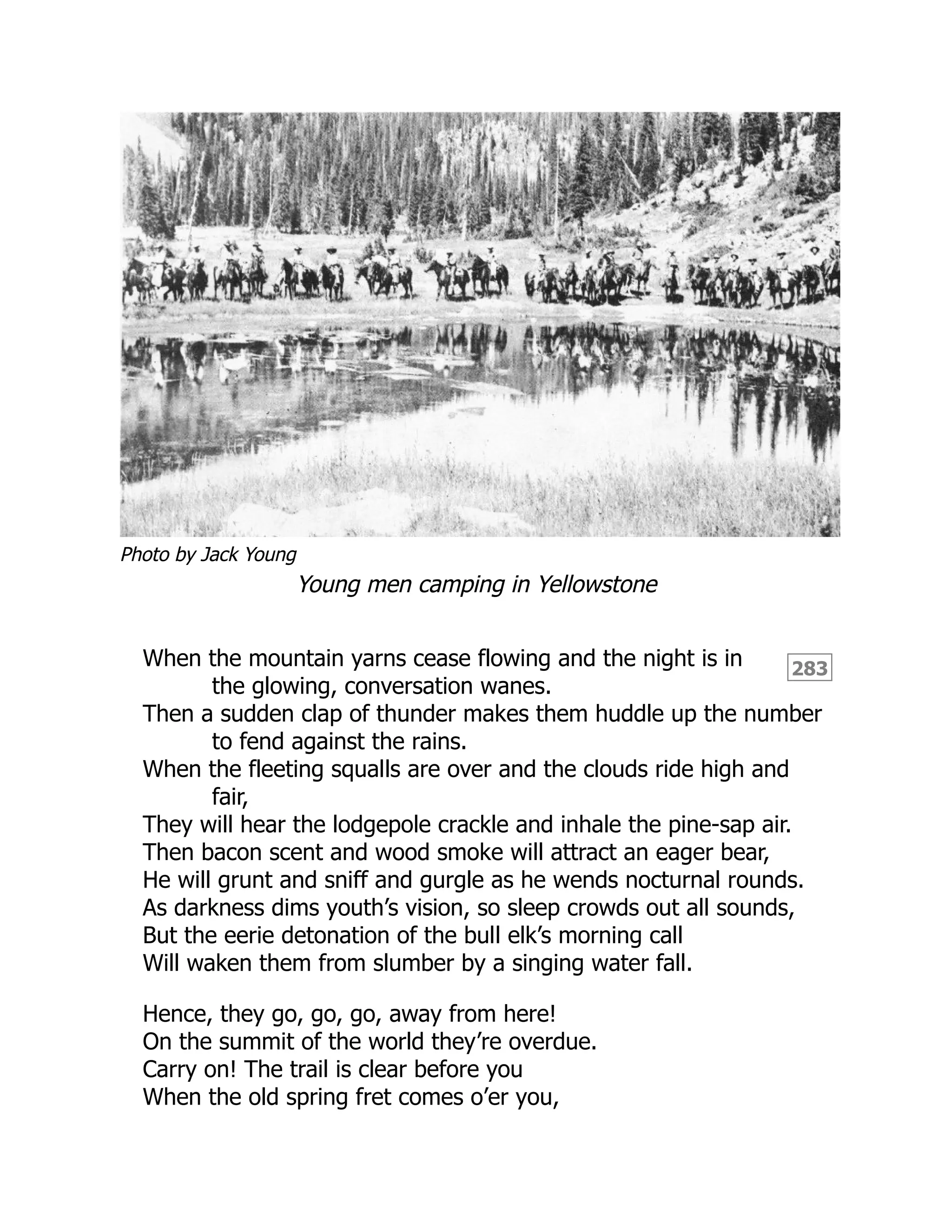
Photo by JackYoung
283
Young men camping in Yellowstone
When the mountain yarns cease flowing and the night is in
the glowing, conversation wanes.
Then a sudden clap of thunder makes them huddle up the number
to fend against the rains.
When the fleeting squalls are over and the clouds ride high and
fair,
They will hear the lodgepole crackle and inhale the pine-sap air.
Then bacon scent and wood smoke will attract an eager bear,
He will grunt and sniff and gurgle as he wends nocturnal rounds.
As darkness dims youth’s vision, so sleep crowds out all sounds,
But the eerie detonation of the bull elk’s morning call
Will waken them from slumber by a singing water fall.
Hence, they go, go, go, away from here!
On the summit of the world they’re overdue.
Carry on! The trail is clear before you
When the old spring fret comes o’er you,
15.
284
285
And the RedGods call for you!
Unto each the voice and vision, unto each his hunch and sign,
Lonely geyser in a basin, misty sweat bath ’neath a pine.
Unto each a lad who knows his naked soul!
Unto each a rainbow arching through a window in the sky,
While the blazoned, bird-winged butterflies flap by.
It is there that they are going to a region that they know,
Where the sign betrays the badger and the shaggy buffalo.
Where the trail runs out in breccia midst rock forests row on row.
It is there life glides serenely without conduct that’s unseemly,
In a land where thoughts and feelings overflow.
Quick! Ah, heave the camp kit over!
For the Red Gods call them forth and they must go.
Let them go, go, go, away from home!
On the summit of the world they’re overdue.
Farewell! The trail is clear before you
When the old spring fret comes o’er you,
And the Red Gods mix their medicine once more.
16.
286
Appendix II
THE PROBLEMOF “COLTER’S ROUTE IN 1807”
It may seem unfruitful at this time to attempt a solution of the
problem of John Colter’s 1807 route of discovery in Yellowstone.
Many people require no proof of anything cited in the records of such
great scouts as Jedediah S. Smith, Kit Carson, and John Colter. Their
integrity need not be questioned. Still, it is within the province of the
historian to sift and test all of the evidence until the truth falls into
place as elements in a jigsaw puzzle. Even myths and legends should
be examined for any implications and bearing they might have upon
a fact. It is in this light that the following discussion of the Colter
discovery problem is presented. This case is entirely hypothetical,
since no specific reference to his route has been found anywhere
among source material, except as it is approximated upon the Map of
1814.
Beyond the known facts of Colter’s journey in 1807, the Map of 1814,
and the “Colter’s Hell” legend, there is a complete hiatus, or vacuum.
However, the Map of 1814 is certainly a tangible thing; let it tell its
own story: It is known that William Clark had a friend in Philadelphia
named Nicholas Biddle who arranged for the publication of The Lewis
and Clark Journals. In order to properly depict the journey, Mr. Biddle
secured the services of a prominent Philadelphia cartographer named
Samuel Lewis. Twice in 1810 Clark sent sheets of map material to Mr.
Biddle.
[352]
John Colter reached St. Louis in May, 1810. It is certain
that he called upon Clark and gave him information, if not sheets,
depicting his famous journey of 1807. This data was undoubtedly
sent on to Mr. Biddle, either as Colter drew it or as it was accurately
redrawn by Clark. At least one of Colter’s sheets was
incorporated in the final Map of 1814.
[353]
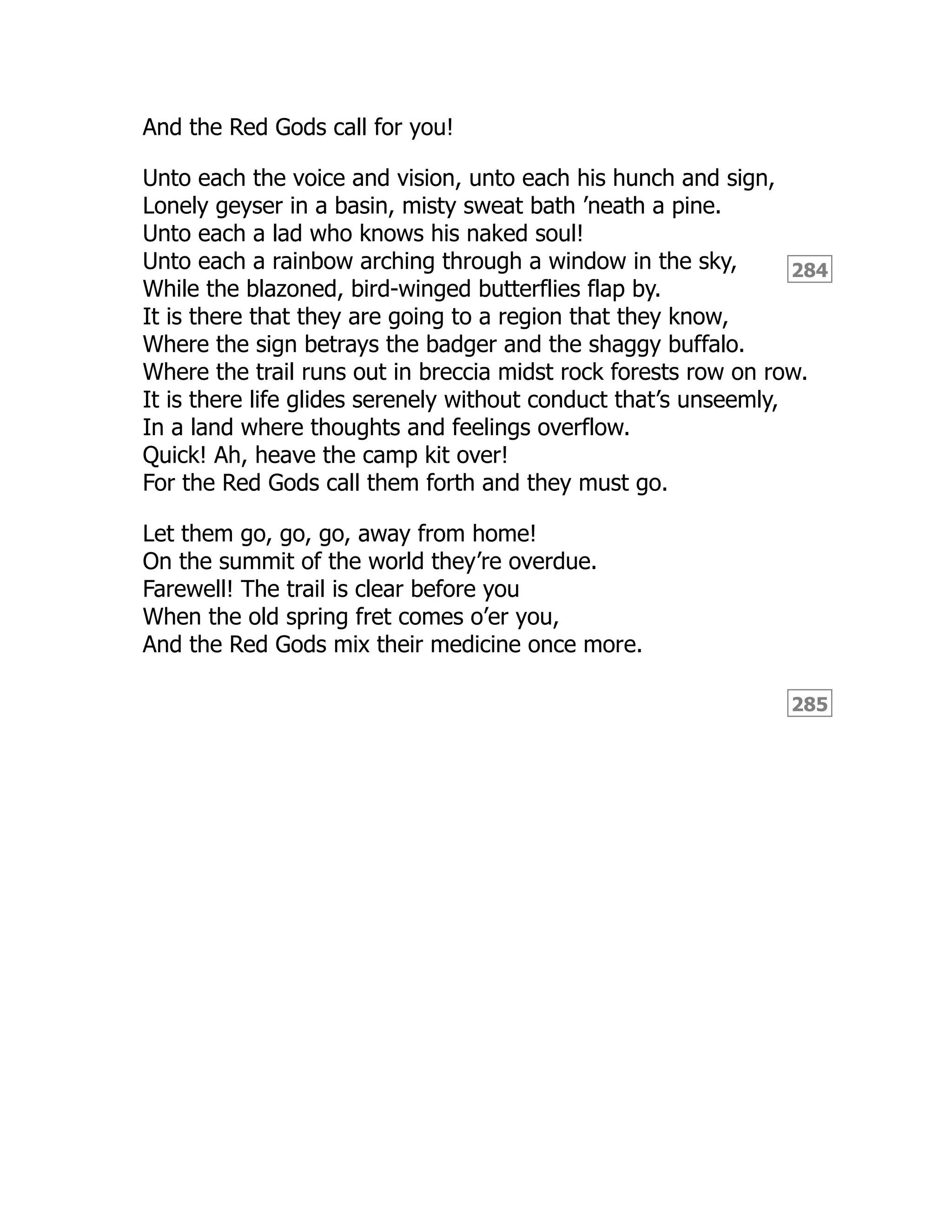
The first, or eastern
prairie, side of the Colter plat traced his journey up Pryors Fork,
17.
about fifty mileswest of Fort Manuel, through Pryors Gap. Then he
crossed over to Clarks Fork, which he ascended, probably to Dead
Indian Creek. From this creek Colter crossed over a divide to the
North Fork Shoshone River where he first smelled sulphur. This he
called Stinking Water River, most probably referring to the present De
Maris Mineral Springs near Cody, Wyoming.
On Stinking Water River he encountered the “Yep-pe Band of Snake
Indians 1000 souls.” This was evidently a clan of the Crow tribe. From
these Yep-pe Indians, denizens of both prairie and mountain, he
undoubtedly learned of the Yellowstone geysers and other marvels.
This accounts for his side trip which brought him back to the Yep-pe
camp. It is likely that some of these Indians directed Colter along
another route in returning to Manuel’s Fort. Obviously they went
down the North Fork Shoshone, or Colter’s Stinking Water River, to its
junction with Shoshone River. This, he followed to Gap Creek (now
Sage Creek) which he ascended to Pryors Gap.
[354]
By this alternate
route Colter again reached Pryors Fork where he crossed over to
return to Fort Manuel.
From this examination it is obvious that the western boundary of
Colter’s first map lies east of 110° longitude, and up to that point no
difficulty whatever is encountered with either the route or the map.
This line undoubtedly defines the west border of Colter’s first sheet.
It became a part of the Map of 1814 without change. Hence, it is a
correct representation of the “Buffalo Bill country” around Cody,
Wyoming. Published in 1814, it could only have been the work of
John Colter, because no other white man had visited that area.
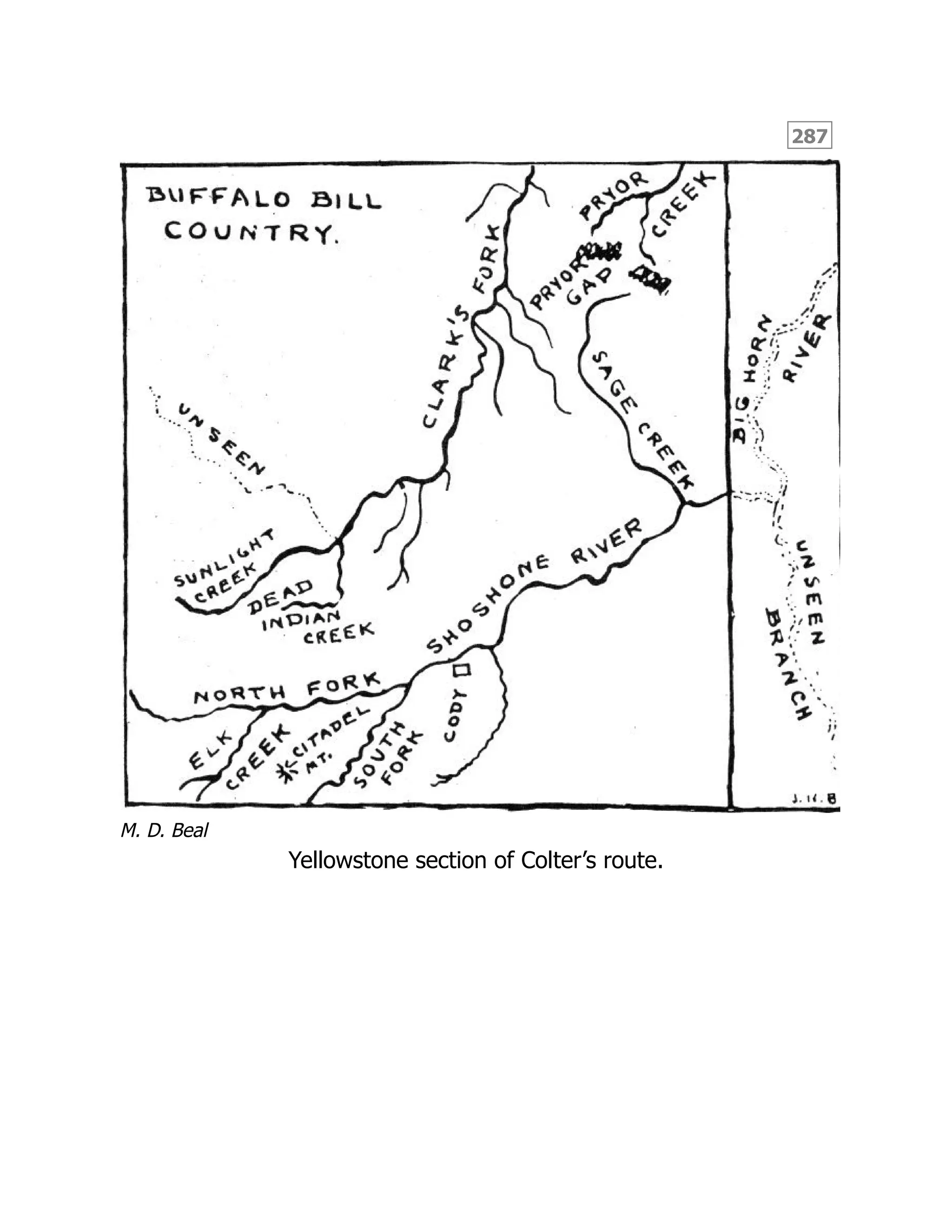
Because of the accuracy of Colter’s first plat, or east portion of the
map, his course to the Yep-pe Indian camp can be followed like
tracks in the snow. Just so, the return route east of 110° can be
identified as coming down Sunlight Creek and back up Dead Indian
Creek to the Yep-pe Indian camp. From there he followed a shorter
route, in returning to the eastern edge of the map sheet, that is to
say, the head of Pryors Fork.
288
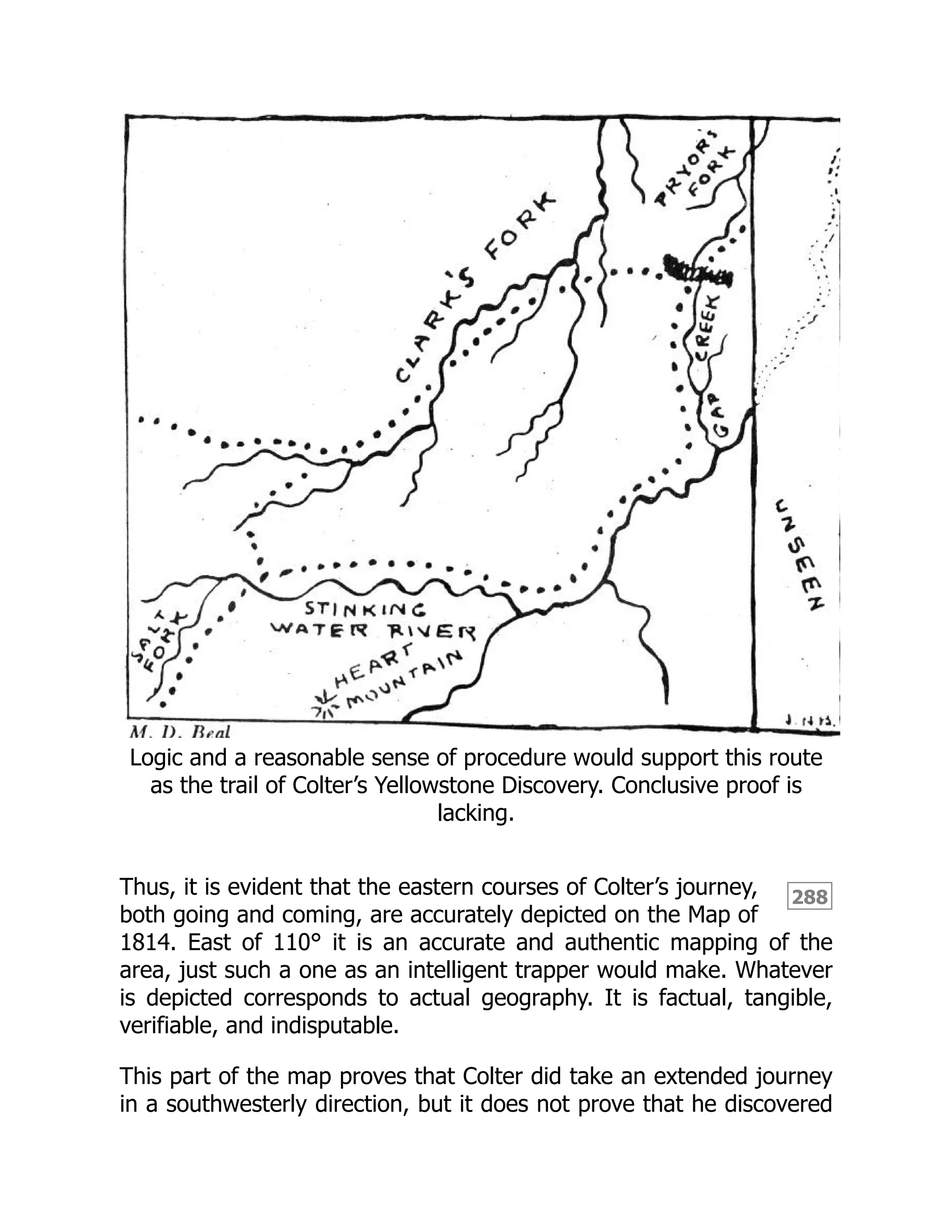
Logic and areasonable sense of procedure would support this route
as the trail of Colter’s Yellowstone Discovery. Conclusive proof is
lacking.
Thus, it is evident that the eastern courses of Colter’s journey,
both going and coming, are accurately depicted on the Map of
1814. East of 110° it is an accurate and authentic mapping of the
area, just such a one as an intelligent trapper would make. Whatever
is depicted corresponds to actual geography. It is factual, tangible,
verifiable, and indisputable.
This part of the map proves that Colter did take an extended journey
in a southwesterly direction, but it does not prove that he discovered
20.
289
Yellowstone Park. Thedependable part of the map simply accounts
for the eastern part of the figure eight which is essential to describe
the complete journey.
[355]
The reliable part leads him only to the
southeastern border of Yellowstone Park and brings him back from
farther north along its eastern boundary.
The western portion of the dotted line on the Map of 1814 is purely
fictitious and encompasses an area far beyond that occupied by
Yellowstone Park. Indeed, this part of Colter’s route winds among a
labyrinth of geographical unreality.
[356]
Therefore, Colter’s route, as
represented by the western loop of the dotted line, is likewise invalid.
Here, then, is the problem of Colter’s discovery: How could the map
of his exploration, which necessarily described a figure eight, be at
once so authentic in the east and so fictitious in the west? The
Yellowstone area of the Map of 1814 is certainly one of organized
confusion, but it does not follow that Colter drew that portion of the
map as it appears.
Actual geography and common sense prove that a trapper on foot
could not possibly have seen both the Arkansas and Platte rivers. Just
as surely, geography and common sense attest that in traveling a
normal western loop of the figure eight he would have seen precisely
what the map does not depict, namely: Upper Yellowstone River,
Snake River, Yellowstone Lake, and the thermal areas at Thumb of
Lake and near Hayden Valley.
Thus, by elimination, an obvious conclusion evolves, namely that the
western loop is not as Colter drew it. Instead of actuality, there is
fiction; nothing in this part of the map conforms to reality. That
geography only exists upon the Map of 1814. John Colter died in
1813 so he never even saw the route as depicted, to say nothing of
traveling along it.
21.
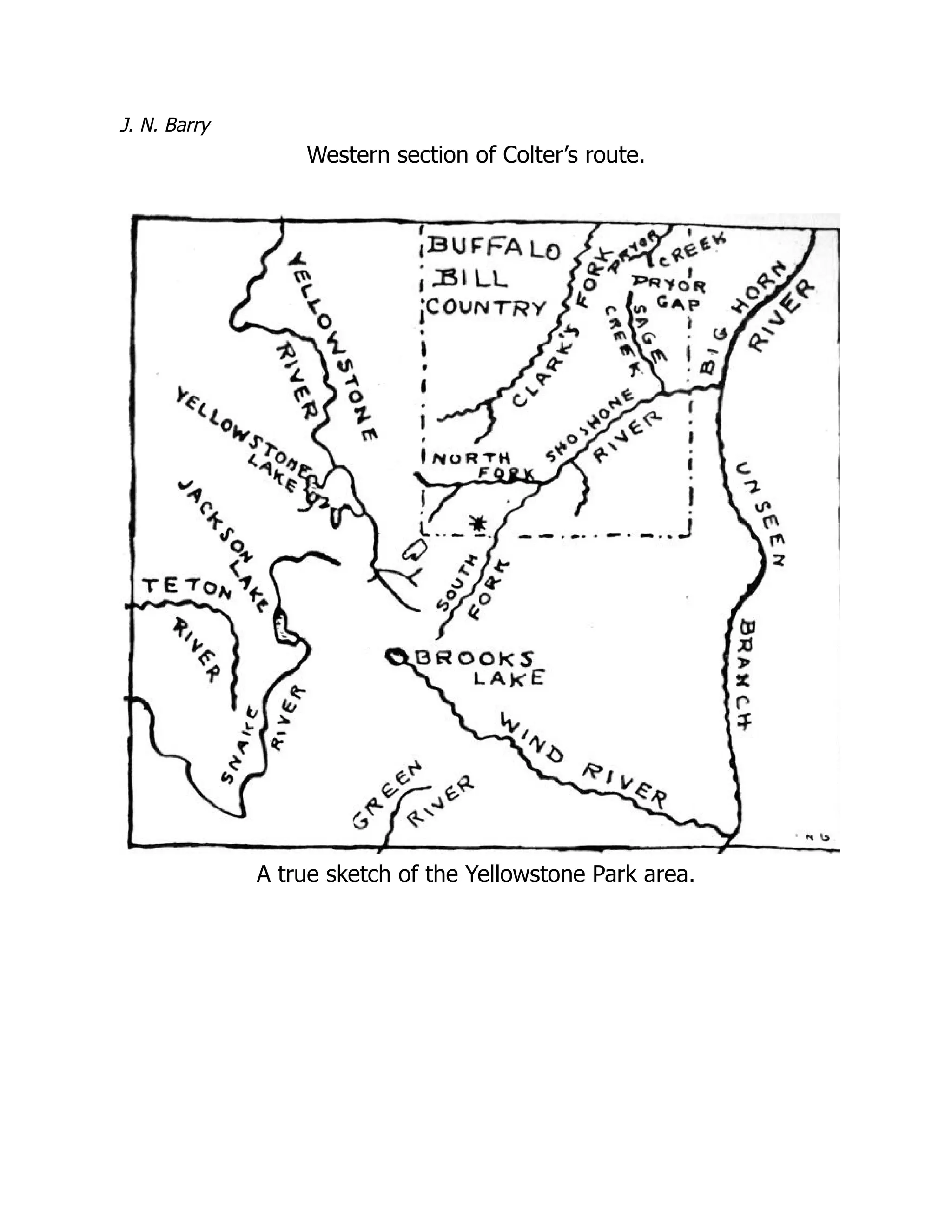
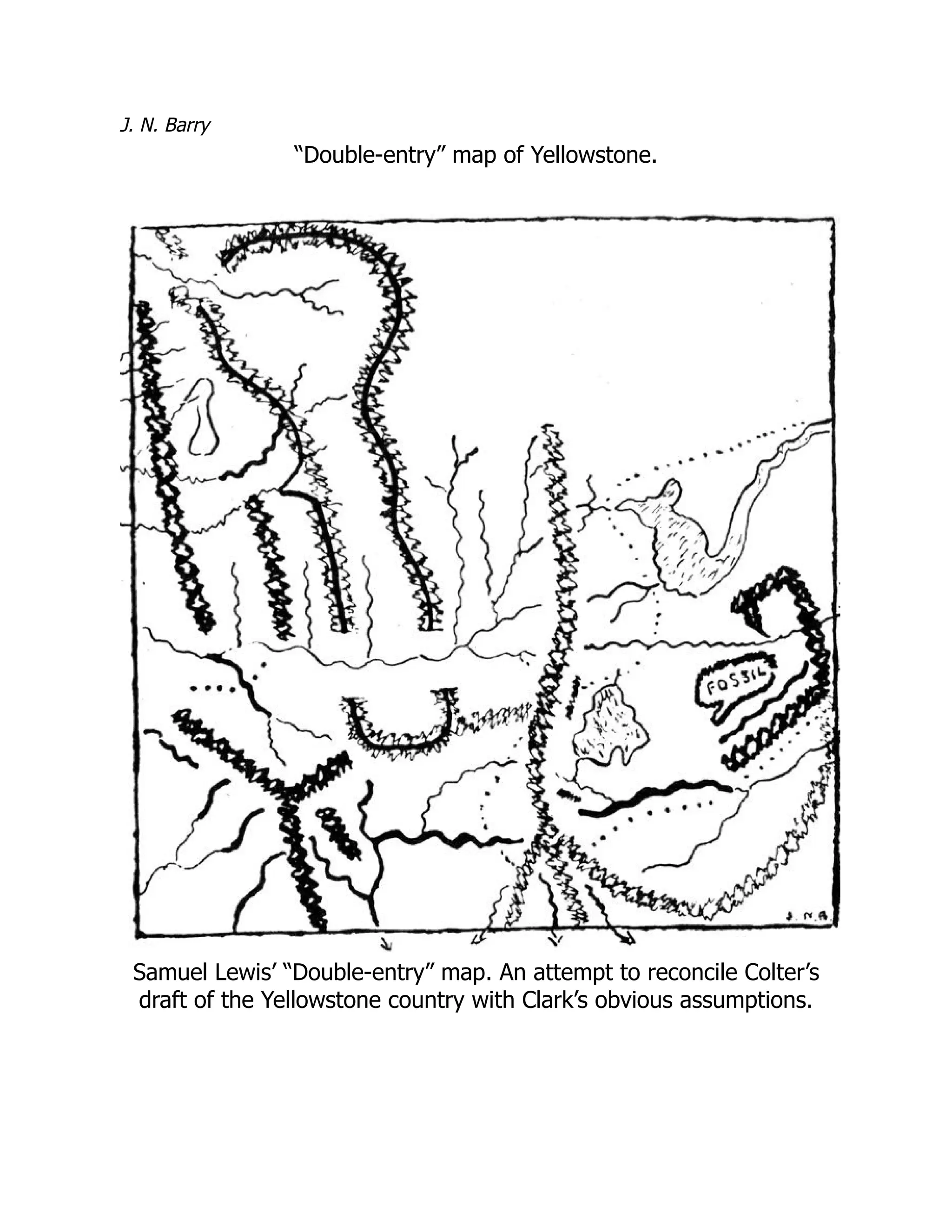
J. N. Barry
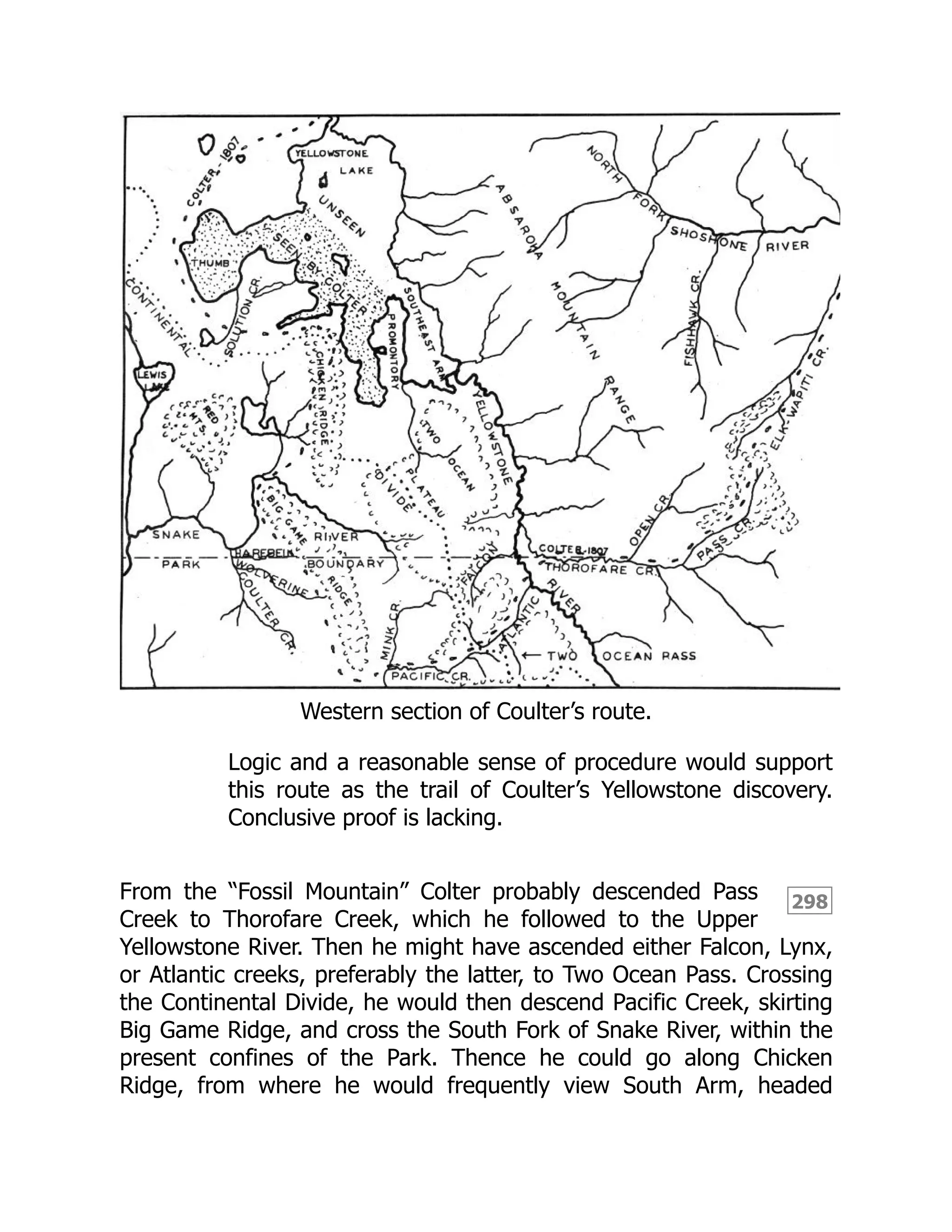
Westernsection of Colter’s route.
A true sketch of the Yellowstone Park area.
22.
290
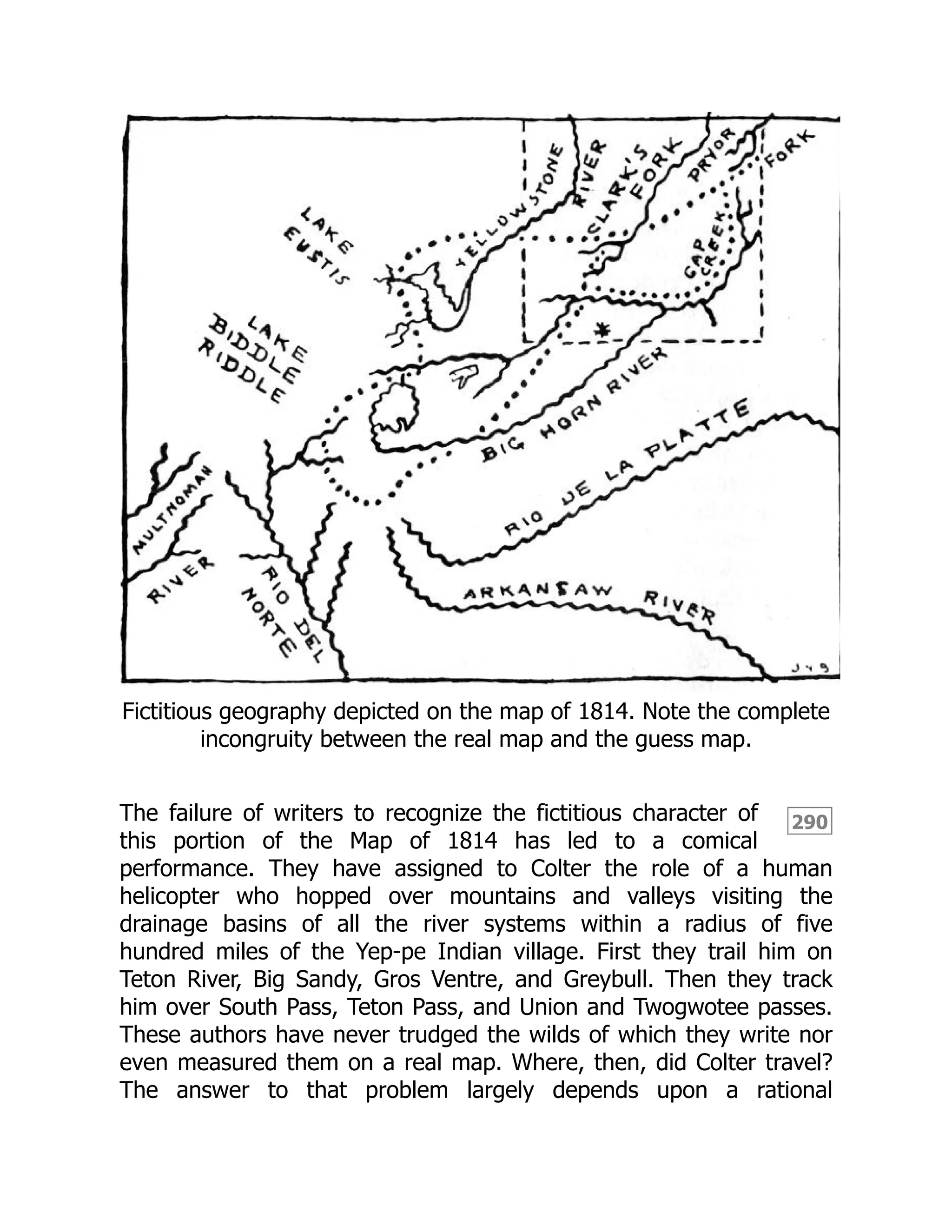
Fictitious geography depictedon the map of 1814. Note the complete
incongruity between the real map and the guess map.
The failure of writers to recognize the fictitious character of
this portion of the Map of 1814 has led to a comical
performance. They have assigned to Colter the role of a human
helicopter who hopped over mountains and valleys visiting the
drainage basins of all the river systems within a radius of five
hundred miles of the Yep-pe Indian village. First they trail him on
Teton River, Big Sandy, Gros Ventre, and Greybull. Then they track
him over South Pass, Teton Pass, and Union and Twogwotee passes.
These authors have never trudged the wilds of which they write nor
even measured them on a real map. Where, then, did Colter travel?
The answer to that problem largely depends upon a rational
23.
291
interpretation of thatfantastic map sheet. Perhaps an investigation of
the process by which the map was produced will offer a clue.
As stated before, Clark sent map materials to Biddle, who in turn
passed them on to Samuel Lewis, a professional cartographer, to be
worked into a map of the Trans-Mississippi West. This was a very
difficult assignment because the sheets were of various scales, which
necessitated overlapping, crowding, and uncertainty as to latitudes
and longitudes.
[357]
The manner in which Lewis fitted them into a
mosaic represents a remarkable work of art. Deficiencies are largely
attributable to the inadequate data received, but in the case of
Colter’s journey another element is involved.
In the course of compilation, between 1810 and 1814, Clark must
have sent a redrawing of the route of Colter’s journey.
[358]
By way of
review, let it be remembered that Colter reached St. Louis in May of
1810. He called on Clark and evidently presented several sheets of
trapper map to him. This was the material which depicted his journey
of 1807, and it seemed to be highly appreciated by Clark. That it was
given preference by Clark over the contemporary exploration of
Zebulon M. Pike simply substantiates the belief that Colter’s journey
made a profound impression upon Clark at that time.
[359]
On
December 20, 1810, Clark apparently sent the original Colter sheets,
or properly redrawn copies of them, to Nicholas Biddle. Clark also
inserted, or superimposed, two rivers upon the Colter drawing. They
were Clarks Fork and Bighorn rivers.
It is important to remember that Clark had full confidence in
Colter’s representation of his journey at this time, that is,
December, 1810. The following year Andrew Henry returned from his
exploration of the Madison and Snake river regions. He had seen only
ordinary country. This report seems to have destroyed Clark’s belief in
Colter’s story of marvels. Not wishing to deceive anyone by the
delusions of a deranged trapper’s mind, Clark apparently directed
Samuel Lewis to retain Colter’s east plat, that is, the Buffalo Bill
24.
292
country, but suppressthe western section, the Yellowstone Lake
region. In lieu of Colter’s depiction of the western loop of his figure
eight Clark evidently sent the draft that now appears on the Map of
1814.
What possible reason can be assigned for this action? It is anybody’s
guess; no one can now determine what Clark thought, but following
is a rational hypothesis: In the close of the year 1811, Andrew Henry
and his men returned from their trapping venture in the Upper Snake
River basin. They had skirted the western border of Wonderland
along the line of the Madison and Gallatin rivers and explored the
sources of Henrys Fork of the Snake River. Yet, Henry had not seen
any hot springs, geysers, or great lakes. No doubt Henry had heard
trappers joke about “Colter’s Hell.” Personally, he showed no
confidence in it. Evidently both he and Clark considered that Henry’s
and Colter’s journeys overlapped. Actually, the Gallatin Range
intervened between them. It is reasonable, therefore, that Henry’s
report and attitude affected Clark’s original belief in Colter’s story.
Where he first believed he now doubted. Perhaps Clark concluded
that Colter’s terrible experiences had deranged his mind. It is certain
that Clark sent his new knowledge of the Henrys Fork country to
Biddle in 1812 because it appears on the Map of 1814.
[360]
It was
undoubtedly at this time that Clark sent in his redrawn, guesswork
version of the western portion of Colter’s map. No one knows exactly
what changes Clark made, but the Map of 1814 proves conclusively
that Clark did not depict the “Colter’s Hell” country which contains the
wonders of Yellowstone Park as it was originally presented to him.
It was a valid reaction for Clark to have become suspicious of Colter’s
reliability, and the substitution of his own geographical
speculation for Colter’s Yellowstone sketch was probably
sincere. Clark was too honest to depict the delusions of an “insane”
man. Also he was very anxious to have a reasonably complete and
integrated map. The only alternatives were to allow the Colter marvel
sheet to appear or else to mark a considerable area “unexplored.” He
was caught in the bonds of uncertainty and made a compromise. The
25.
293
result was asheet of bogus geography which is entirely incongruous,
not only with the facts, but with Clark’s uniformly excellent map work.
[361]
Clark’s choice of alternatives only complicated the problem of his
cartographer. Lewis no doubt recognized the vast discrepancies
between Colter’s genuine depiction and Clark’s counterfeit so he
evidently decided upon a compromise of his own. How this expert
reconciled the conflicting data of the two map sheets into one pattern
is at once a masterpiece in cartography and psychology. The
technique he adopted might be called “double entry map making.” He
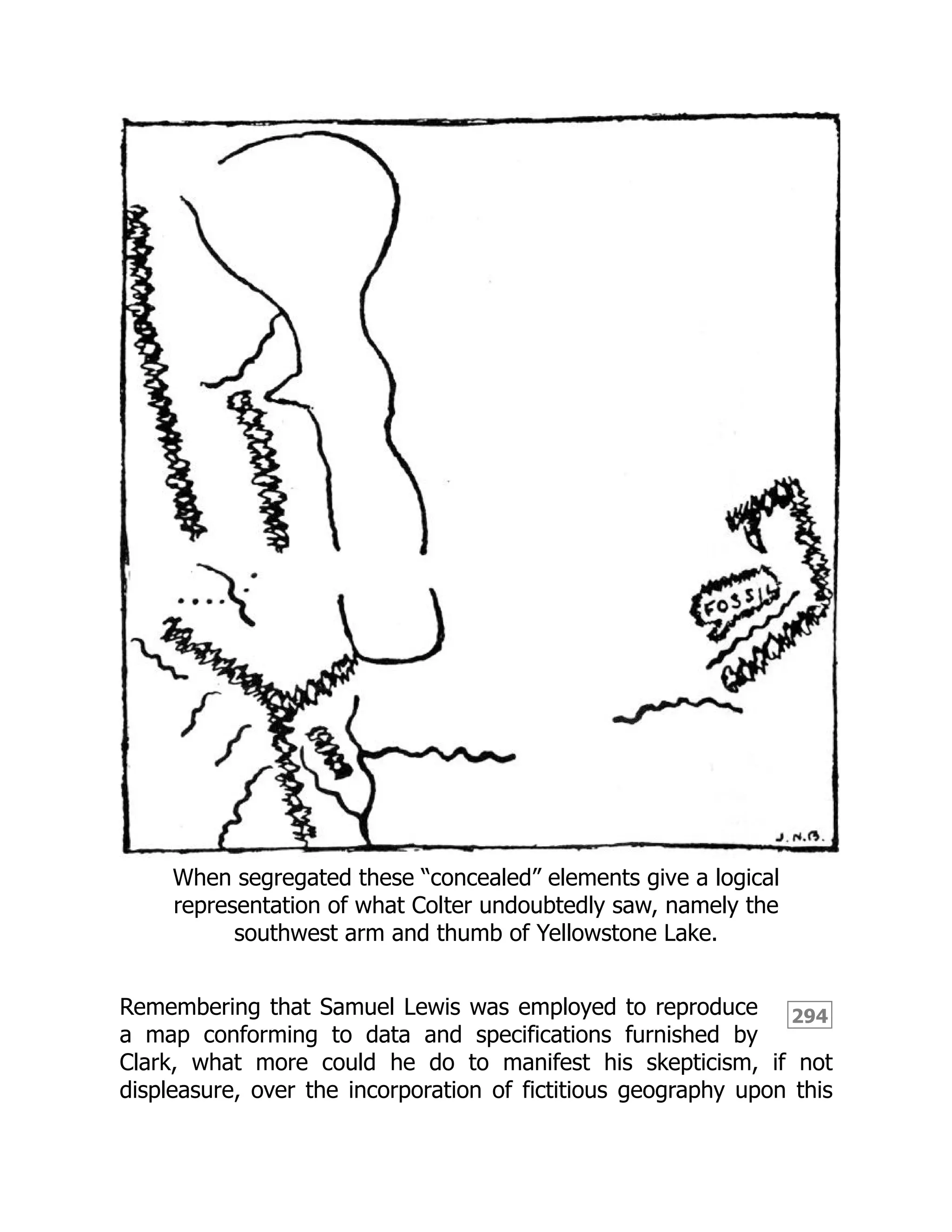
used the Yellowstone Lake part of Colter’s sketch as an element for a
concealed map; it appears as a mountain range. Such a grotesque
range cannot be found in any of the surrounding territory, but when
visualized as a lake it is amazing how it conforms to what a trapper
traveling a logical route would have seen of Yellowstone Lake,
namely, the South Arm and Thumb. Lewis shied away from any clear-
cut representation of the geyser region. However, besides including
the disguised lake portion of Colter’s map, he did other things to
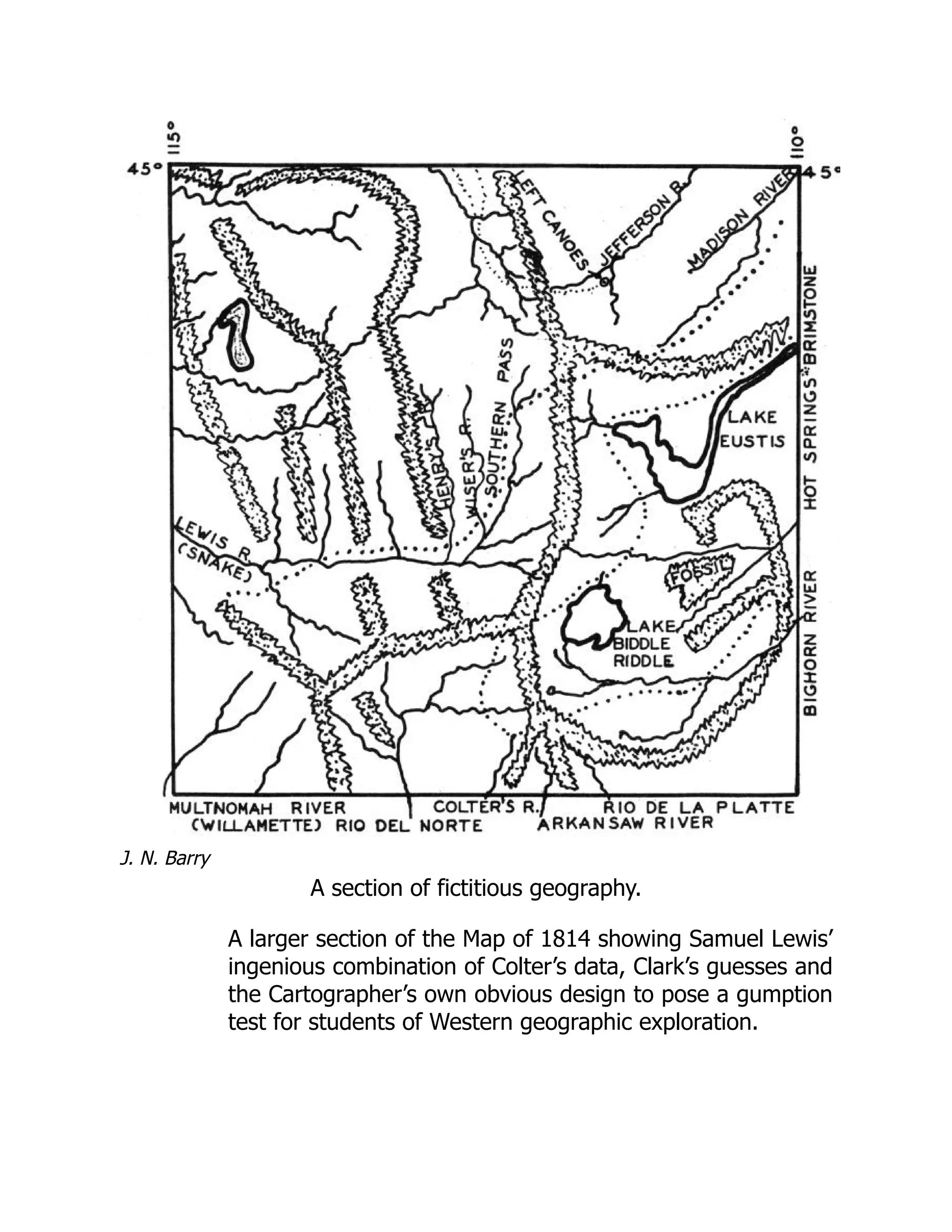
“poke fun” at Clark’s speculations. He drew Lake Eustis in the manner
of a gargoyle. It must have been deliberately “satanized.” Nothing
with such a preposterous shape was ever known among men. Why
didn’t Clark revolt at this representation? Surely he never drew
anything like that himself. That is not all of Lewis’ “fun making.” He
drew still another lake and gave it the shape of a deformed piece of
liver. Its appearance is ridiculous in the other extreme,
[362]
but, as if
to add insult to injury, Mr. Lewis raised a question as to this lake’s
legitimacy. Clark named it Biddle in honor of his patron, Nicholas
Biddle, whereas, upon the English version, the name appearing is
Riddle! Lewis was able to “get away” with this performance because
Clark did not see any proofs, only the published work.
26.
J. N. Barry
“Double-entry”map of Yellowstone.
Samuel Lewis’ “Double-entry” map. An attempt to reconcile Colter’s
draft of the Yellowstone country with Clark’s obvious assumptions.
27.
294
When segregated these“concealed” elements give a logical
representation of what Colter undoubtedly saw, namely the
southwest arm and thumb of Yellowstone Lake.
Remembering that Samuel Lewis was employed to reproduce
a map conforming to data and specifications furnished by
Clark, what more could he do to manifest his skepticism, if not
displeasure, over the incorporation of fictitious geography upon this
28.
295
super-important map ofthe West? Remember, Lewis was a
professional cartographer; he had seen, and had already drawn,
Colter’s sheet of real country. On the original draft the southwest Arm
and Thumb of Lake Yellowstone undoubtedly appeared. Now he was
asked to redraw it into counterfeit geography. Disturbed by the
substitution of Clark’s sheet of “Gulliver’s geography” for Colter’s
journey, he disguised a lake in a mountain range, drew a gargoylian
lake (Eustis), and raised the enigma of Biddle-Riddle.
[363]
After all,
cartography is simply a scientific refinement of pictography, or
storytelling. The message of Samuel Lewis, as revealed in the
Yellowstone segment of the Map of 1814, might reasonably be: “This
portion of the map is bogus. I do not know what the true conditions
are. Colter’s data appears all right; Clark’s later information says it
isn’t. It’s all a Riddle; I leave a clue.” Against this background, with
the fiction cut away, it may now be possible to explore the problem of
Colter’s route through the Yellowstone country.
Did Colter make a western loop trip beyond the Yep-pe Indian camp?
Of that there can be no doubt. Clark’s representation does not
impugn Colter’s word in respect to the reality of the journey itself but
only as to where he went and what he saw. If an approximation of
his route can be reproduced, the question of what he saw will
automatically fall into place like the pieces of a jigsaw puzzle. The
problem, then, is to correctly reconstruct the west loop of the figure
eight. This procedure has become possible by reason of the
proposition that has been established in this discussion, particularly
when it is remembered that Colter knew his way around and could be
relied upon to make a proper orientation to the total environment.
Now his course can be followed by segregating another feature from
what has been referred to as “Lewis’ Concealed Colter Map.”
29.
J. N. Barry
Asection of fictitious geography.
A larger section of the Map of 1814 showing Samuel Lewis’
ingenious combination of Colter’s data, Clark’s guesses and
the Cartographer’s own obvious design to pose a gumption
test for students of Western geographic exploration.
30.
296
297
West of longitude110° it will be noted that two features stand
out in bold relief, namely, a mitten-shaped mountain labeled
FOSSIL (probably the Trident) and the crude outline of South Arm
and Thumb of Yellowstone Lake. These two landmarks may be used
as guide posts in following Colter’s reconstructed loop through
Yellowstone. Colter’s authentic east loop journey, already described,
brought him approximately to the 110° meridian. Colter’s mitten-
shaped landmark lies about seventy-five miles due west of the border
on his second map sheet, but Clark’s dotted line depicts Colter’s route
fifty miles south of the mountain shaped like a mitten and marked
FOSSIL. It is valid to inquire how Colter could discern its shape or
know of its fossils from that distance. His Indian friends knew nothing
about fossils. The dotted line does not cross or even skirt this
mountain. To reach the “Fossil Mountain” from Salt Fork, Colter could
ascend by Elk-Wapiti or Fishhawk creeks. Each meets the
requirements of direction and distance, and there is a good chance
that somewhere along one of these routes a large petrified fish, or
something like a fish, was seen then and may be eventually found.
Such a discovery would remove all doubt about the direction in which
he traveled.
[364]
31.
298
Western section ofCoulter’s route.
Logic and a reasonable sense of procedure would support
this route as the trail of Coulter’s Yellowstone discovery.
Conclusive proof is lacking.
From the “Fossil Mountain” Colter probably descended Pass
Creek to Thorofare Creek, which he followed to the Upper
Yellowstone River. Then he might have ascended either Falcon, Lynx,
or Atlantic creeks, preferably the latter, to Two Ocean Pass. Crossing
the Continental Divide, he would then descend Pacific Creek, skirting
Big Game Ridge, and cross the South Fork of Snake River, within the
present confines of the Park. Thence he could go along Chicken
Ridge, from where he would frequently view South Arm, headed
32.
299
toward Flat MountainArm. After crossing Solution Creek he would
strike West Thumb.
[365]
The validity of this itinerary is wholly
sustained by the genuine features of this area as they appear upon
the Map of 1814. Indeed, the route seems obvious and indisputable
in view of the actual conditions existing. On a crude map, where
there are numerous, similar streams, various combinations are, of
course, possible.
Leaving West Thumb, Colter would have circled the lake to its outlet
and followed it to the Hayden Valley thermal area. Dragons Mouth
and Mud Volcano were undoubtedly features that contributed to the
vivid impression he carried away and transmitted to others. Even the
“Hot Spring Brimstone” characterization on the Map of 1814 mildly
suggests explosive thermal activity. The phrase also suggests that
Colter mapped a geyser basin.
[366]
Colter’s return route from the area near the outlet of Yellowstone
River supplies the final link in the figure eight. To reach the Yep-pe
Indian camp he might have veered to the northeast, crossed
Yellowstone River at the ford below Mud Volcano, and ascended
Pelican Creek or one of the tributaries of the Lamar River. After
crossing the Absarokas he evidently descended one of the creeks that
empty into Clarks Fork. No one on earth can be certain about this
part of his journey. There is no reference anywhere, and the Map of
1814 gives no clue. Still he did reach a tributary of Clarks Fork which
he followed to its junction with Dead Indian Creek, thence to the Yep-
pe band.
33.
BIBLIOGRAPHICAL NOTE
In thepreparation of the first four chapters the use of explorer and
trapper journals was imperative. The Journals of Lewis and Clark,
Patrick Gass’s Journal, and Robert Stuart’s Discovery of the Oregon
Trail are basic.
Trapper activities and Indian life are effectively treated by Stallo
Vinton in John Colter; Alexander Ross, The Fur Hunters of the Far
West; Hiram Chittenden, The American Fur Trade; John Neihardt, The
Splendid Wayfaring; J. Cecil Alter, Jim Bridger, Trapper, Frontiersman,
Scout and Guide; Bernard De Voto, Across the Wide Missouri; and
Robert Vaughn, Then and Now. A correct conception of original
Indian life and character will reward the student of Rudolph Kurz’s
Journal and Washington Irving’s two volumes: The Adventures of
Captain Bonneville and Astoria. George Catlin’s monumental treatise
on North American Indians is also a classic on that subject.
Important in the field of writings dealing with the partial and final
discovery of Yellowstone are Nathaniel P. Langford, Discovery of
Yellowstone Park 1870, together with the shorter accounts of his
companions as recorded in Louis C. Crampton’s Early History of
Yellowstone National Park and Its Relations to National Park Policies.
The Yellowstone explorations of James Stuart and Walter W. DeLacy
and others are found in Contributions to the Historical Society of
Montana, volumes one to five inclusive.
John G. White’s scholarly manuscript entitled “A Souvenir of
Wyoming” contains much material of a provocative character. Nice
points of detail are raised concerning John Colter’s route and other
trapper visitations.
The chapter on “Travel and Accommodations—New Businesses” was
the result of a search through the standard magazines covering the
34.
300
301
half century from1870 to 1920. The State College of
Washington collection was found adequate for this survey.
It would be impossible to write the story of the Park’s administration
without a review of all the Annual Reports of the Acting
Superintendents, and Superintendents of Yellowstone National Park.
The Park Library has a complete file from 1872 to the present time.
In addition, the Reports of the Secretary of the Interior and the
Reports of the Director of National Parks, covering the same period,
were essential cross references in this effort. A complete set of these
reports is available at the State College of Washington. A perusal of
the soldier (scout) diaries in the Park Library gave the substance for
the discussion of that interesting phase.
Among guide books The Haynes Guide is in a class by itself. It is not
only an invaluable hand book to the casual tourist, but it is an
excellent encyclopedia for research.
The Earl of Dunraven’s Hunting in the Yellowstone affords an
excellent narrative from the standpoint of measuring the progress of
all phases of Park activity.
Yellowstone Nature Notes is the best source for those sprightly
experiences that make life so interesting and pleasant in the Park.
35.
BIBLIOGRAPHY
MANUSCRIPT MATERIAL
Anderson, E.C. Diary 1909. Park Library, Mammoth, Wyoming.
Anderson, Henry. Diary 1910, 1911. Park Library.
Brown, Jesse R. Diary 1909, 1910. Park Library.
Burgess, Felix. Diary 1898, 1899. Park Library.
Cook, C. W. “Remarks of C. W. Cook, Last Survivor of the Original
Explorers of the Yellowstone Park Region.” Park Library.
Dorrity, Mrs. James. “Story of the Battle of Bear’s Paw.” M. D. Beal
Collection, Idaho State College, Pocatello, Idaho.
Fitzgerald, S. M. Diary 1907. Park Library, Mammoth, Wyoming.
Graham, S. D. Diary 1906, 1907, 1908. Park Library.
Harlan, W. B. “The Fiasco at Fort Fizzle—1936.” M. D. Beal Collection.
Holmes, W. H. Extracts from the Diary 1872, 1878. Park Library,
Mammoth, Wyoming.
Langford, Nathaniel P. Diary, Second Trip to Yellowstone 1872. Park
Library.
Little, Raymond G. Diary 1911, 1912. Park Library.
36.
302
Louck, D. J.Journal in Manuscript. State Historian’s Office, Laramie,
Wyoming.
Martin, Louis. Diary 1900, 1901. Park Library, Mammoth, Wyoming.
Mason, John E. Diary 1909. Park Library.
Matlock, Jesse M. “Dictation.” M. D. Beal Collection.
Morrison, James. Diary 1897, 1898, 1899. Park Library, Mammoth,
Wyoming.
McBride, James. Diary 1908, 1909, 1910, 1911, 1912. Park Library.
Peale, A. C. Diary of Field Operations, U. S. Geological Survey 1872.
(Three volumes.) Park Library.
Phillips, Ulrich B. “Lectures on Early America.” (Notes taken by
the author at the University of California in 1933.)
Rubin, Walter. Diary 1911. Park Library, Mammoth, Wyoming.
Shambow, Louie. “Story of the Battle of Bear’s Paw.” M. D. Beal
Collection.
Titus, N. C. “Story of Colonel Miles’ Attack on the Nez Percé Camp.”
M. D. Beal Collection.
Thompson, Captain. U. S. A. “Memorandum of a Trip from Fort Ellis,
Montana Territory to Yellowstone Park.” (Sept. 1882.) Park
Library, Mammoth, Wyoming.
Trischman, Harry. Diary 1909, 1910, 1912. Park Library, Mammoth,
Wyoming.
Wall, M. J. Diary. Park Library.
37.
White, John G.“A Souvenir of Wyoming.” (One of eight typed copies
of a trip made in 1916.) Park Library.
White, Mable McClain. “Dictation.” M. D. Beal Collection.
Wilson, Charley. Diary 1910. Park Library, Mammoth, Wyoming.
Wilson, James. Diary 1907, 1908. Park Library.
Whittaker, George. Diary 1897, 1898, 1899, 1900. Park Library.
PRINTED JOURNALS, DIARIES AND
AUTOBIOGRAPHIES
Bradbury, John. Travels in the Interior Of America, 1809, 1810, and
1811. London: Sherwood Neeley, and Jones, 1819.
Carson, Kit. Autobiography. Chicago: Lakeside Press, 1935.
Contributions, Historical Society of Montana, I, II, III, IV, V. Helena,
Montana: Rocky Mountain Publishing Co., 1876.
Dunraven, The Earl of. Hunting in the Yellowstone. New York: The
Macmillan Co., 1925.
Egan, Howard. Pioneering the West. Egan Estate. Richmond, Utah.
Ferris, Warren A. Life in the Rocky Mountains, 1830-35. Salt Lake
City: Rocky Mountain Book Shop, 1940.
Folsom, David E. The Folsom-Cook Exploration of the Upper
Yellowstone. St. Paul: H. L. Collins Co., 1894.
Gass, Patrick. Journal. Edited by James K. Hosmer, Chicago: A. C.
McClurg and Co., 1904.


![286
Appendix II
THE PROBLEM OF “COLTER’S ROUTE IN 1807”
It may seem unfruitful at this time to attempt a solution of the
problem of John Colter’s 1807 route of discovery in Yellowstone.
Many people require no proof of anything cited in the records of such
great scouts as Jedediah S. Smith, Kit Carson, and John Colter. Their
integrity need not be questioned. Still, it is within the province of the
historian to sift and test all of the evidence until the truth falls into
place as elements in a jigsaw puzzle. Even myths and legends should
be examined for any implications and bearing they might have upon
a fact. It is in this light that the following discussion of the Colter
discovery problem is presented. This case is entirely hypothetical,
since no specific reference to his route has been found anywhere
among source material, except as it is approximated upon the Map of
1814.
Beyond the known facts of Colter’s journey in 1807, the Map of 1814,
and the “Colter’s Hell” legend, there is a complete hiatus, or vacuum.
However, the Map of 1814 is certainly a tangible thing; let it tell its
own story: It is known that William Clark had a friend in Philadelphia
named Nicholas Biddle who arranged for the publication of The Lewis
and Clark Journals. In order to properly depict the journey, Mr. Biddle
secured the services of a prominent Philadelphia cartographer named
Samuel Lewis. Twice in 1810 Clark sent sheets of map material to Mr.
Biddle.
[352]
John Colter reached St. Louis in May, 1810. It is certain
that he called upon Clark and gave him information, if not sheets,
depicting his famous journey of 1807. This data was undoubtedly
sent on to Mr. Biddle, either as Colter drew it or as it was accurately
redrawn by Clark. At least one of Colter’s sheets was
incorporated in the final Map of 1814.
[353]
The first, or eastern
prairie, side of the Colter plat traced his journey up Pryors Fork,](https://image.slidesharecdn.com/10571-250418125305-86e027d4/75/Agriscience-Fundamentals-and-Applications-6th-Edition-Burton-Solutions-Manual-16-2048.jpg)
![about fifty miles west of Fort Manuel, through Pryors Gap. Then he
crossed over to Clarks Fork, which he ascended, probably to Dead
Indian Creek. From this creek Colter crossed over a divide to the
North Fork Shoshone River where he first smelled sulphur. This he
called Stinking Water River, most probably referring to the present De
Maris Mineral Springs near Cody, Wyoming.
On Stinking Water River he encountered the “Yep-pe Band of Snake
Indians 1000 souls.” This was evidently a clan of the Crow tribe. From
these Yep-pe Indians, denizens of both prairie and mountain, he
undoubtedly learned of the Yellowstone geysers and other marvels.
This accounts for his side trip which brought him back to the Yep-pe
camp. It is likely that some of these Indians directed Colter along
another route in returning to Manuel’s Fort. Obviously they went
down the North Fork Shoshone, or Colter’s Stinking Water River, to its
junction with Shoshone River. This, he followed to Gap Creek (now
Sage Creek) which he ascended to Pryors Gap.
[354]
By this alternate
route Colter again reached Pryors Fork where he crossed over to
return to Fort Manuel.
From this examination it is obvious that the western boundary of
Colter’s first map lies east of 110° longitude, and up to that point no
difficulty whatever is encountered with either the route or the map.
This line undoubtedly defines the west border of Colter’s first sheet.
It became a part of the Map of 1814 without change. Hence, it is a
correct representation of the “Buffalo Bill country” around Cody,
Wyoming. Published in 1814, it could only have been the work of
John Colter, because no other white man had visited that area.
Because of the accuracy of Colter’s first plat, or east portion of the
map, his course to the Yep-pe Indian camp can be followed like
tracks in the snow. Just so, the return route east of 110° can be
identified as coming down Sunlight Creek and back up Dead Indian
Creek to the Yep-pe Indian camp. From there he followed a shorter
route, in returning to the eastern edge of the map sheet, that is to
say, the head of Pryors Fork.](https://image.slidesharecdn.com/10571-250418125305-86e027d4/75/Agriscience-Fundamentals-and-Applications-6th-Edition-Burton-Solutions-Manual-17-2048.jpg)
![289
Yellowstone Park. The dependable part of the map simply accounts
for the eastern part of the figure eight which is essential to describe
the complete journey.
[355]
The reliable part leads him only to the
southeastern border of Yellowstone Park and brings him back from
farther north along its eastern boundary.
The western portion of the dotted line on the Map of 1814 is purely
fictitious and encompasses an area far beyond that occupied by
Yellowstone Park. Indeed, this part of Colter’s route winds among a
labyrinth of geographical unreality.
[356]
Therefore, Colter’s route, as
represented by the western loop of the dotted line, is likewise invalid.
Here, then, is the problem of Colter’s discovery: How could the map
of his exploration, which necessarily described a figure eight, be at
once so authentic in the east and so fictitious in the west? The
Yellowstone area of the Map of 1814 is certainly one of organized
confusion, but it does not follow that Colter drew that portion of the
map as it appears.
Actual geography and common sense prove that a trapper on foot
could not possibly have seen both the Arkansas and Platte rivers. Just
as surely, geography and common sense attest that in traveling a
normal western loop of the figure eight he would have seen precisely
what the map does not depict, namely: Upper Yellowstone River,
Snake River, Yellowstone Lake, and the thermal areas at Thumb of
Lake and near Hayden Valley.
Thus, by elimination, an obvious conclusion evolves, namely that the
western loop is not as Colter drew it. Instead of actuality, there is
fiction; nothing in this part of the map conforms to reality. That
geography only exists upon the Map of 1814. John Colter died in
1813 so he never even saw the route as depicted, to say nothing of
traveling along it.](https://image.slidesharecdn.com/10571-250418125305-86e027d4/75/Agriscience-Fundamentals-and-Applications-6th-Edition-Burton-Solutions-Manual-20-2048.jpg)
![291
interpretation of that fantastic map sheet. Perhaps an investigation of
the process by which the map was produced will offer a clue.
As stated before, Clark sent map materials to Biddle, who in turn
passed them on to Samuel Lewis, a professional cartographer, to be
worked into a map of the Trans-Mississippi West. This was a very
difficult assignment because the sheets were of various scales, which
necessitated overlapping, crowding, and uncertainty as to latitudes
and longitudes.
[357]
The manner in which Lewis fitted them into a
mosaic represents a remarkable work of art. Deficiencies are largely
attributable to the inadequate data received, but in the case of
Colter’s journey another element is involved.
In the course of compilation, between 1810 and 1814, Clark must
have sent a redrawing of the route of Colter’s journey.
[358]
By way of
review, let it be remembered that Colter reached St. Louis in May of
1810. He called on Clark and evidently presented several sheets of
trapper map to him. This was the material which depicted his journey
of 1807, and it seemed to be highly appreciated by Clark. That it was
given preference by Clark over the contemporary exploration of
Zebulon M. Pike simply substantiates the belief that Colter’s journey
made a profound impression upon Clark at that time.
[359]
On
December 20, 1810, Clark apparently sent the original Colter sheets,
or properly redrawn copies of them, to Nicholas Biddle. Clark also
inserted, or superimposed, two rivers upon the Colter drawing. They
were Clarks Fork and Bighorn rivers.
It is important to remember that Clark had full confidence in
Colter’s representation of his journey at this time, that is,
December, 1810. The following year Andrew Henry returned from his
exploration of the Madison and Snake river regions. He had seen only
ordinary country. This report seems to have destroyed Clark’s belief in
Colter’s story of marvels. Not wishing to deceive anyone by the
delusions of a deranged trapper’s mind, Clark apparently directed
Samuel Lewis to retain Colter’s east plat, that is, the Buffalo Bill](https://image.slidesharecdn.com/10571-250418125305-86e027d4/75/Agriscience-Fundamentals-and-Applications-6th-Edition-Burton-Solutions-Manual-23-2048.jpg)
![292
country, but suppress the western section, the Yellowstone Lake
region. In lieu of Colter’s depiction of the western loop of his figure
eight Clark evidently sent the draft that now appears on the Map of
1814.
What possible reason can be assigned for this action? It is anybody’s
guess; no one can now determine what Clark thought, but following
is a rational hypothesis: In the close of the year 1811, Andrew Henry
and his men returned from their trapping venture in the Upper Snake
River basin. They had skirted the western border of Wonderland
along the line of the Madison and Gallatin rivers and explored the
sources of Henrys Fork of the Snake River. Yet, Henry had not seen
any hot springs, geysers, or great lakes. No doubt Henry had heard
trappers joke about “Colter’s Hell.” Personally, he showed no
confidence in it. Evidently both he and Clark considered that Henry’s
and Colter’s journeys overlapped. Actually, the Gallatin Range
intervened between them. It is reasonable, therefore, that Henry’s
report and attitude affected Clark’s original belief in Colter’s story.
Where he first believed he now doubted. Perhaps Clark concluded
that Colter’s terrible experiences had deranged his mind. It is certain
that Clark sent his new knowledge of the Henrys Fork country to
Biddle in 1812 because it appears on the Map of 1814.
[360]
It was
undoubtedly at this time that Clark sent in his redrawn, guesswork
version of the western portion of Colter’s map. No one knows exactly
what changes Clark made, but the Map of 1814 proves conclusively
that Clark did not depict the “Colter’s Hell” country which contains the
wonders of Yellowstone Park as it was originally presented to him.
It was a valid reaction for Clark to have become suspicious of Colter’s
reliability, and the substitution of his own geographical
speculation for Colter’s Yellowstone sketch was probably
sincere. Clark was too honest to depict the delusions of an “insane”
man. Also he was very anxious to have a reasonably complete and
integrated map. The only alternatives were to allow the Colter marvel
sheet to appear or else to mark a considerable area “unexplored.” He
was caught in the bonds of uncertainty and made a compromise. The](https://image.slidesharecdn.com/10571-250418125305-86e027d4/75/Agriscience-Fundamentals-and-Applications-6th-Edition-Burton-Solutions-Manual-24-2048.jpg)
![293
result was a sheet of bogus geography which is entirely incongruous,
not only with the facts, but with Clark’s uniformly excellent map work.
[361]
Clark’s choice of alternatives only complicated the problem of his
cartographer. Lewis no doubt recognized the vast discrepancies
between Colter’s genuine depiction and Clark’s counterfeit so he
evidently decided upon a compromise of his own. How this expert
reconciled the conflicting data of the two map sheets into one pattern
is at once a masterpiece in cartography and psychology. The
technique he adopted might be called “double entry map making.” He
used the Yellowstone Lake part of Colter’s sketch as an element for a
concealed map; it appears as a mountain range. Such a grotesque
range cannot be found in any of the surrounding territory, but when
visualized as a lake it is amazing how it conforms to what a trapper
traveling a logical route would have seen of Yellowstone Lake,
namely, the South Arm and Thumb. Lewis shied away from any clear-
cut representation of the geyser region. However, besides including
the disguised lake portion of Colter’s map, he did other things to
“poke fun” at Clark’s speculations. He drew Lake Eustis in the manner
of a gargoyle. It must have been deliberately “satanized.” Nothing
with such a preposterous shape was ever known among men. Why
didn’t Clark revolt at this representation? Surely he never drew
anything like that himself. That is not all of Lewis’ “fun making.” He
drew still another lake and gave it the shape of a deformed piece of
liver. Its appearance is ridiculous in the other extreme,
[362]
but, as if
to add insult to injury, Mr. Lewis raised a question as to this lake’s
legitimacy. Clark named it Biddle in honor of his patron, Nicholas
Biddle, whereas, upon the English version, the name appearing is
Riddle! Lewis was able to “get away” with this performance because
Clark did not see any proofs, only the published work.](https://image.slidesharecdn.com/10571-250418125305-86e027d4/75/Agriscience-Fundamentals-and-Applications-6th-Edition-Burton-Solutions-Manual-25-2048.jpg)
![295
super-important map of the West? Remember, Lewis was a
professional cartographer; he had seen, and had already drawn,
Colter’s sheet of real country. On the original draft the southwest Arm
and Thumb of Lake Yellowstone undoubtedly appeared. Now he was
asked to redraw it into counterfeit geography. Disturbed by the
substitution of Clark’s sheet of “Gulliver’s geography” for Colter’s
journey, he disguised a lake in a mountain range, drew a gargoylian
lake (Eustis), and raised the enigma of Biddle-Riddle.
[363]
After all,
cartography is simply a scientific refinement of pictography, or
storytelling. The message of Samuel Lewis, as revealed in the
Yellowstone segment of the Map of 1814, might reasonably be: “This
portion of the map is bogus. I do not know what the true conditions
are. Colter’s data appears all right; Clark’s later information says it
isn’t. It’s all a Riddle; I leave a clue.” Against this background, with
the fiction cut away, it may now be possible to explore the problem of
Colter’s route through the Yellowstone country.
Did Colter make a western loop trip beyond the Yep-pe Indian camp?
Of that there can be no doubt. Clark’s representation does not
impugn Colter’s word in respect to the reality of the journey itself but
only as to where he went and what he saw. If an approximation of
his route can be reproduced, the question of what he saw will
automatically fall into place like the pieces of a jigsaw puzzle. The
problem, then, is to correctly reconstruct the west loop of the figure
eight. This procedure has become possible by reason of the
proposition that has been established in this discussion, particularly
when it is remembered that Colter knew his way around and could be
relied upon to make a proper orientation to the total environment.
Now his course can be followed by segregating another feature from
what has been referred to as “Lewis’ Concealed Colter Map.”](https://image.slidesharecdn.com/10571-250418125305-86e027d4/75/Agriscience-Fundamentals-and-Applications-6th-Edition-Burton-Solutions-Manual-28-2048.jpg)
![296
297
West of longitude 110° it will be noted that two features stand
out in bold relief, namely, a mitten-shaped mountain labeled
FOSSIL (probably the Trident) and the crude outline of South Arm
and Thumb of Yellowstone Lake. These two landmarks may be used
as guide posts in following Colter’s reconstructed loop through
Yellowstone. Colter’s authentic east loop journey, already described,
brought him approximately to the 110° meridian. Colter’s mitten-
shaped landmark lies about seventy-five miles due west of the border
on his second map sheet, but Clark’s dotted line depicts Colter’s route
fifty miles south of the mountain shaped like a mitten and marked
FOSSIL. It is valid to inquire how Colter could discern its shape or
know of its fossils from that distance. His Indian friends knew nothing
about fossils. The dotted line does not cross or even skirt this
mountain. To reach the “Fossil Mountain” from Salt Fork, Colter could
ascend by Elk-Wapiti or Fishhawk creeks. Each meets the
requirements of direction and distance, and there is a good chance
that somewhere along one of these routes a large petrified fish, or
something like a fish, was seen then and may be eventually found.
Such a discovery would remove all doubt about the direction in which
he traveled.
[364]](https://image.slidesharecdn.com/10571-250418125305-86e027d4/75/Agriscience-Fundamentals-and-Applications-6th-Edition-Burton-Solutions-Manual-30-2048.jpg)
![299
toward Flat Mountain Arm. After crossing Solution Creek he would
strike West Thumb.
[365]
The validity of this itinerary is wholly
sustained by the genuine features of this area as they appear upon
the Map of 1814. Indeed, the route seems obvious and indisputable
in view of the actual conditions existing. On a crude map, where
there are numerous, similar streams, various combinations are, of
course, possible.
Leaving West Thumb, Colter would have circled the lake to its outlet
and followed it to the Hayden Valley thermal area. Dragons Mouth
and Mud Volcano were undoubtedly features that contributed to the
vivid impression he carried away and transmitted to others. Even the
“Hot Spring Brimstone” characterization on the Map of 1814 mildly
suggests explosive thermal activity. The phrase also suggests that
Colter mapped a geyser basin.
[366]
Colter’s return route from the area near the outlet of Yellowstone
River supplies the final link in the figure eight. To reach the Yep-pe
Indian camp he might have veered to the northeast, crossed
Yellowstone River at the ford below Mud Volcano, and ascended
Pelican Creek or one of the tributaries of the Lamar River. After
crossing the Absarokas he evidently descended one of the creeks that
empty into Clarks Fork. No one on earth can be certain about this
part of his journey. There is no reference anywhere, and the Map of
1814 gives no clue. Still he did reach a tributary of Clarks Fork which
he followed to its junction with Dead Indian Creek, thence to the Yep-
pe band.](https://image.slidesharecdn.com/10571-250418125305-86e027d4/75/Agriscience-Fundamentals-and-Applications-6th-Edition-Burton-Solutions-Manual-32-2048.jpg)


![[Scholar.geology physical geography-botany] fundamentals of soil science (hen...](https://cdn.slidesharecdn.com/ss_thumbnails/scholar-geology-physicalgeography-botanyfundamentalsofsoilsciencehenryfoth-1990-8ed-380pp-ebook-121119041700-phpapp01-thumbnail.jpg?width=640&height=640&fit=bounds)


