Choosing Open Source system vs.
Vendor Specific
System - How Agile Can Help?
Zeeshan Haq
zeeshanhaq@delaon.ae
https://www.linkedin.com/in/zeeshanhaq
Project Manager – Dealson Holdings, LLC
UAE LONDON KARACHI
Lean
• Lean Thinking: Mura, Muri & Muda
• In 1990 the ideas developed by Taiichi Ohno
called as Lean Manufacturing
• These three concepts played a significant role in
the creation of some of the agile frameworks we
know today, and reflect the principles of the Agile
Manifesto
Lean 03 concepts
• Mura (Unnecessary variations)
• Muri (preventing overburden of any resource)
• Muda (Identifying wasteful activities)
Agile
• February 2001
• Based on 12 principle
• Definition:
1. Characterized by quickness, lightness, and ease of
movement; nimble.
2. Mentally quick or alert: an agile mind.
Ref:
http://www.thefreedictionary.com/agile
Agile Principle
1) Customer satisfaction by rapid delivery of useful software
2) Welcome changing requirements, even late in development
3) Working software is delivered frequently (weeks rather than months)
4) Working software is the principal measure of progress
5) Sustainable development, able to maintain a constant pace
6) Close, daily cooperation between business people and developers
7) Face-to-ace conversation is the best form of communication (co-location)
8) Projects are built around motivated individuals, who should be trusted
9) Continuous attention to technical excellence and good design
10) Simplicity—the art of maximizing the amount of work not done—is
essential
11) Self-organizing teams
12) Regular adaptation to changing circumstances
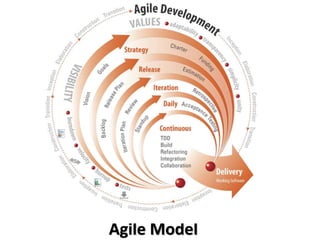
Agile Model
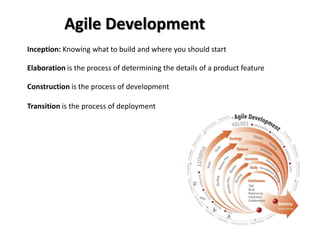
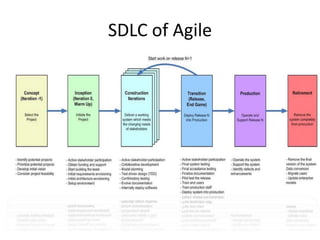
Inception: Knowing what to build and where you should start
Elaboration is the process of determining the details of a product feature
Construction is the process of development
Transition is the process of deployment
Agile Development
Agile visibility
Burn down is a work left to do versus time
Burn up chart shows how much work has been completed, and the total amount of work
Velocity tracking is the act of measuring said velocity. The velocity is calculated by
counting the number of units of work completed in a certain interval, the length of
which is determined at the start of the project
Agile Retrospective is an event that happens at the end of iteration. It is a tool that
shall help to plan and improve next iteration better.
Agile Retrospective is a
• time of reflection
• where You talk about what went well and what did not go well
• where You wonder what could be improved
Thee basic questions in Agile Retrospective:
• What did we do well?
• What did we do wrong?
• What could be improved?
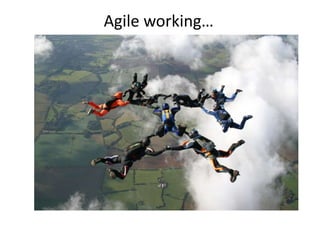
Agile working…
SDLC of Agile
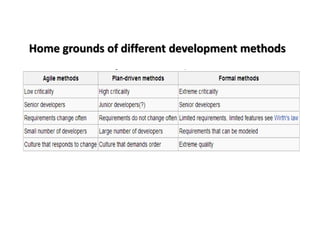
Home grounds of different development methods
Open Source
• Denoting software for which the original
source code is made freely available and may
be redistributed and modified
– Cheap
– Already built up engine
– May or May not fully available with
documentation
– Various flavors, platform
Vendor Specific
• Refer to the standard products covers legal
aspects of support, warranty, quality etc.
– Cost and price varies
– Highly competitive
– Support and Training availability
– Better versioning controlling
Conclusion
SO?
References
• http://agile.dzone.com/articles/what-retrospective
• http://agilemanifesto.org/principles.html
• http://h30507.www3.hp.com/t5/The-Next-Big-Thing/Agile-
development-is-it-right-for-you/ba-p/160396#.U2jKFPmSxe9
• http://www.ambysoft.com/essays/agileLifecycle.html#Develo
pment
• http://www.infoq.com/resource/minibooks/Agile-
Transition/en/pdf/AgileTransition_minibook1.pdf
Thank You

Agile way for choosing bbetween opensource & vendor

  • 1.
    Choosing Open Sourcesystem vs. Vendor Specific System - How Agile Can Help? Zeeshan Haq zeeshanhaq@delaon.ae https://www.linkedin.com/in/zeeshanhaq Project Manager – Dealson Holdings, LLC UAE LONDON KARACHI
  • 2.
    Lean • Lean Thinking:Mura, Muri & Muda • In 1990 the ideas developed by Taiichi Ohno called as Lean Manufacturing • These three concepts played a significant role in the creation of some of the agile frameworks we know today, and reflect the principles of the Agile Manifesto
  • 3.
    Lean 03 concepts •Mura (Unnecessary variations) • Muri (preventing overburden of any resource) • Muda (Identifying wasteful activities)
  • 4.
    Agile • February 2001 •Based on 12 principle • Definition: 1. Characterized by quickness, lightness, and ease of movement; nimble. 2. Mentally quick or alert: an agile mind. Ref: http://www.thefreedictionary.com/agile
  • 5.
    Agile Principle 1) Customersatisfaction by rapid delivery of useful software 2) Welcome changing requirements, even late in development 3) Working software is delivered frequently (weeks rather than months) 4) Working software is the principal measure of progress 5) Sustainable development, able to maintain a constant pace 6) Close, daily cooperation between business people and developers 7) Face-to-ace conversation is the best form of communication (co-location) 8) Projects are built around motivated individuals, who should be trusted 9) Continuous attention to technical excellence and good design 10) Simplicity—the art of maximizing the amount of work not done—is essential 11) Self-organizing teams 12) Regular adaptation to changing circumstances
  • 6.
  • 7.
    Inception: Knowing whatto build and where you should start Elaboration is the process of determining the details of a product feature Construction is the process of development Transition is the process of deployment Agile Development
  • 8.
    Agile visibility Burn downis a work left to do versus time Burn up chart shows how much work has been completed, and the total amount of work Velocity tracking is the act of measuring said velocity. The velocity is calculated by counting the number of units of work completed in a certain interval, the length of which is determined at the start of the project Agile Retrospective is an event that happens at the end of iteration. It is a tool that shall help to plan and improve next iteration better. Agile Retrospective is a • time of reflection • where You talk about what went well and what did not go well • where You wonder what could be improved Thee basic questions in Agile Retrospective: • What did we do well? • What did we do wrong? • What could be improved?
  • 9.
  • 10.
  • 11.
    Home grounds ofdifferent development methods
  • 12.
    Open Source • Denotingsoftware for which the original source code is made freely available and may be redistributed and modified – Cheap – Already built up engine – May or May not fully available with documentation – Various flavors, platform
  • 13.
    Vendor Specific • Referto the standard products covers legal aspects of support, warranty, quality etc. – Cost and price varies – Highly competitive – Support and Training availability – Better versioning controlling
  • 14.
  • 15.
    References • http://agile.dzone.com/articles/what-retrospective • http://agilemanifesto.org/principles.html •http://h30507.www3.hp.com/t5/The-Next-Big-Thing/Agile- development-is-it-right-for-you/ba-p/160396#.U2jKFPmSxe9 • http://www.ambysoft.com/essays/agileLifecycle.html#Develo pment • http://www.infoq.com/resource/minibooks/Agile- Transition/en/pdf/AgileTransition_minibook1.pdf
  • 16.