AGILE PROJECT
MANAGEMENT
Cici Conger – Portie
Certified Scrum Product Owner
PMI-ACP, PMP, PgMP
https://www.linkedin.com/in/cicicongerportie
WHAT IS AGILE?
2001
 Wikipedia, a Wiki free content encyclopedia, goes online
 Napster is closed down by court order following an injunction on
behalf of the Recording Industry Association of America (RIAA),
 The code red ( WORM ) virus attacks 1/4 million web sites running
on Microsoft's IIS web server
 Apple Computer releases the iPod.
 HP ( Hewlett Packard ) and Compaq Merge
 Microsoft releases Windows XP
AGILE: A SHORT HISTORY
 2001: 17 thought leaders in the software development industry
came together to discuss what had become “bureaucratic,
slow, and overly regimented” software development practices
 Goal: A new, Light-weight approach allowing for quick responses
to change and frequent delivery of working software
THE AGILE MANIFESTO
 Individuals and interactions
 Over processes and tools
 Working software
 Over comprehensive documentation
 Customer collaboration
 Over contract negotiation
 Responding to change
 Over following a plan
THE TWELVE PRINCIPLES OF AGILE
SOFTWARE DEVELOPMENT
We follow these principles:
 Our highest priority is to satisfy the customer through early and continuous
delivery of valuable software.
 Welcome changing requirements, even late in development. Agile
processes harness change for the customer's competitive advantage.
 Deliver working software frequently, from a couple of weeks to a couple of
months, with a preference to the shorter timescale.
 Business people and developers must work together daily throughout the
project.
 Build projects around motivated individuals. Give them the environment and
support they need, and trust them to get the job done.
 The most efficient and effective method of conveying information to and
within a development team is face-to-face conversation.
THE TWELVE PRINCIPLES OF AGILE
SOFTWARE
We follow these principles:
 Working software is the primary measure of progress.
 Agile processes promote sustainable development. The sponsors,
developers, and users should be able to maintain a constant pace
indefinitely.
 Continuous attention to technical excellence and good design enhances
agility.
 Simplicity--the art of maximizing the amount of work not done--is essential.
 The best architectures, requirements, and designs emerge from self-
organizing teams.
 At regular intervals, the team reflects on how to become more effective,
then tunes and adjusts its behavior accordingly.
SCRUM METHODOLOGY
5 EVENTS
 Sprints
 Daily Scrum Meeting AKA Standups
 Sprint Planning Meeting
 Sprint Review
 Sprint Retrospective
3 ARTIFACTS
 Product Backlog
 Sprint Backlog
 Definition of Done
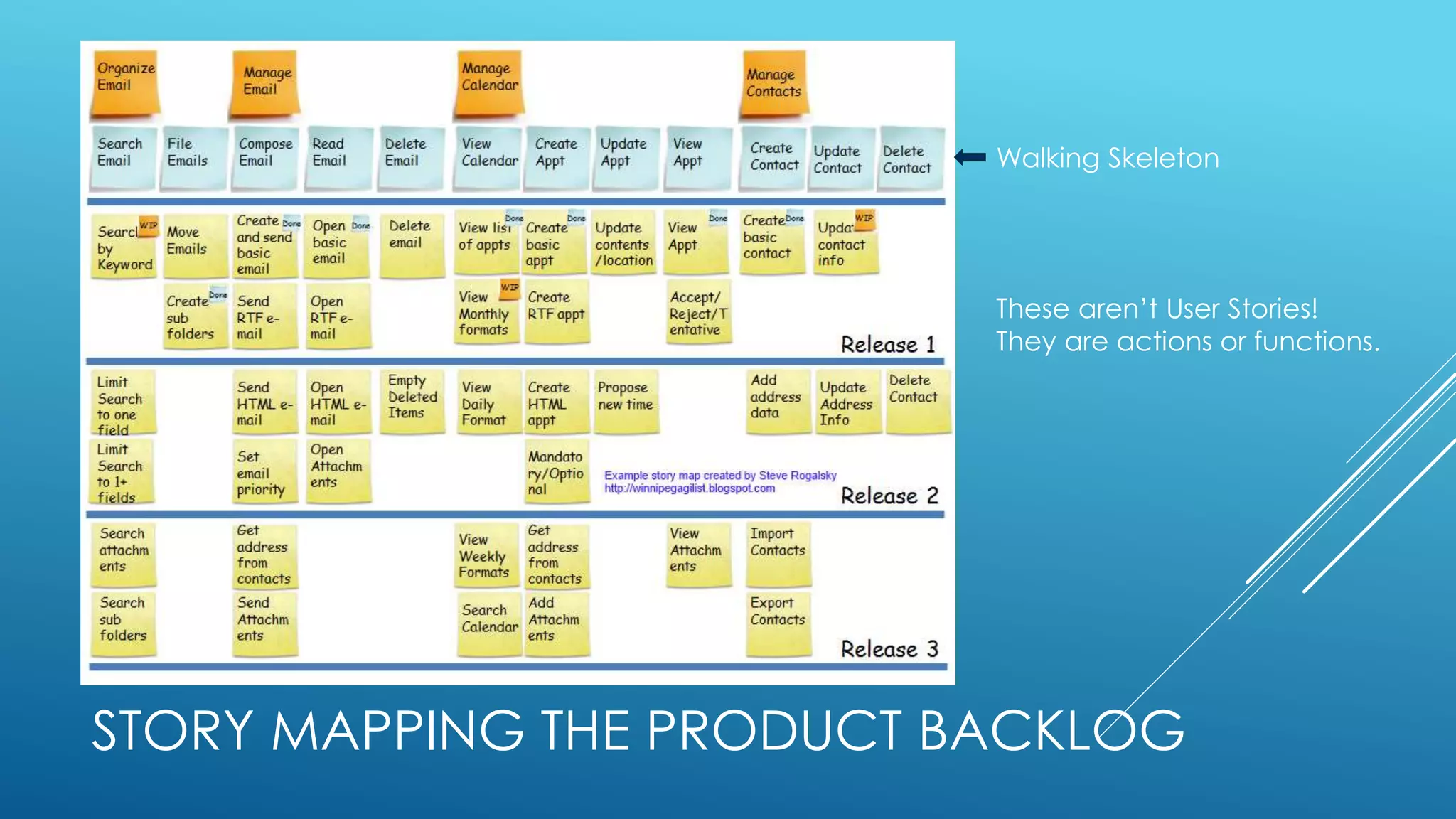
STORY MAPPING THE PRODUCT BACKLOG
These aren’t User Stories!
They are actions or functions.
Walking Skeleton
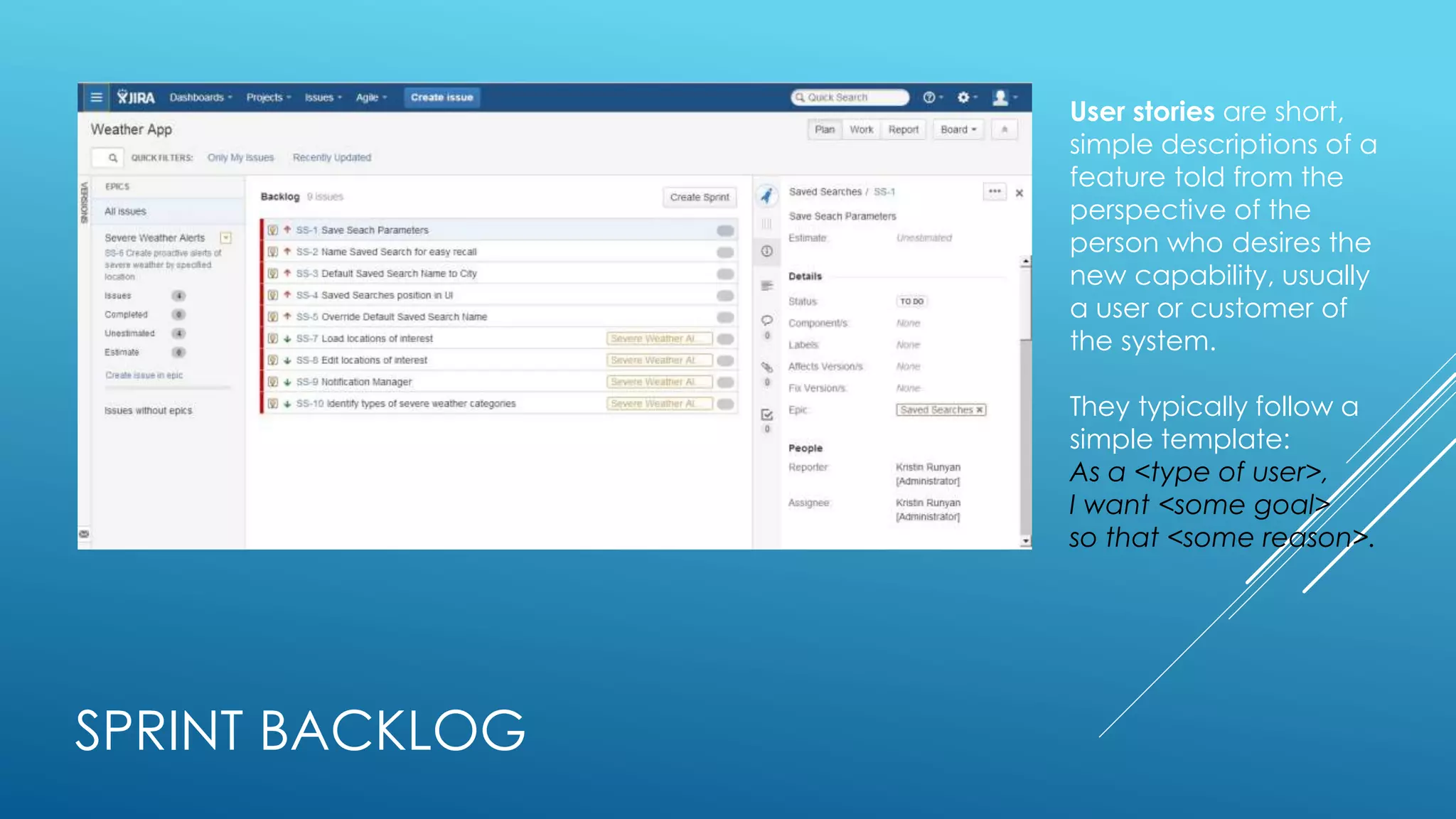
SPRINT BACKLOG
User stories are short,
simple descriptions of a
feature told from the
perspective of the
person who desires the
new capability, usually
a user or customer of
the system.
They typically follow a
simple template:
As a <type of user>,
I want <some goal>
so that <some reason>.
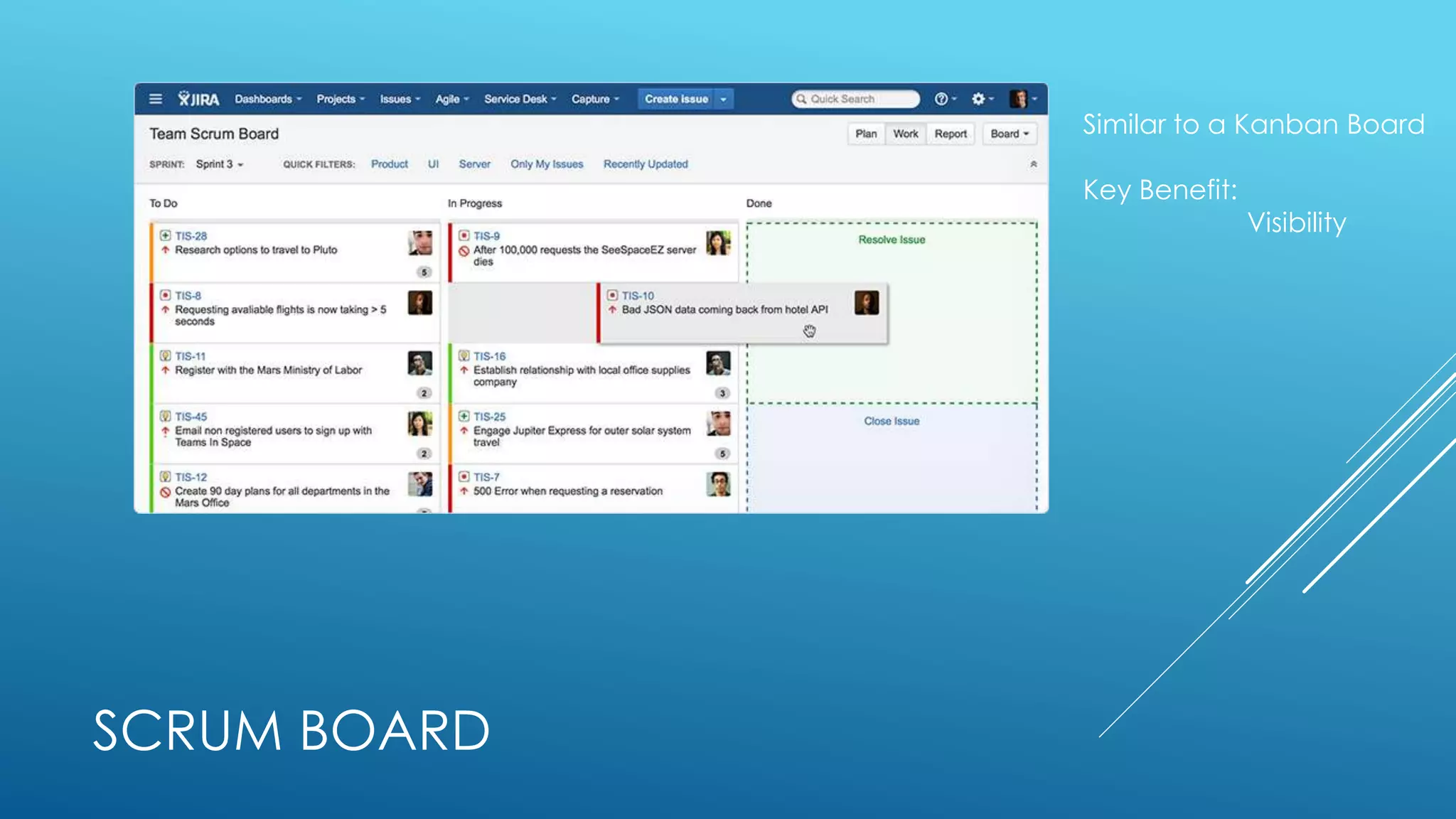
SCRUM BOARD
Similar to a Kanban Board
Key Benefit:
Visibility
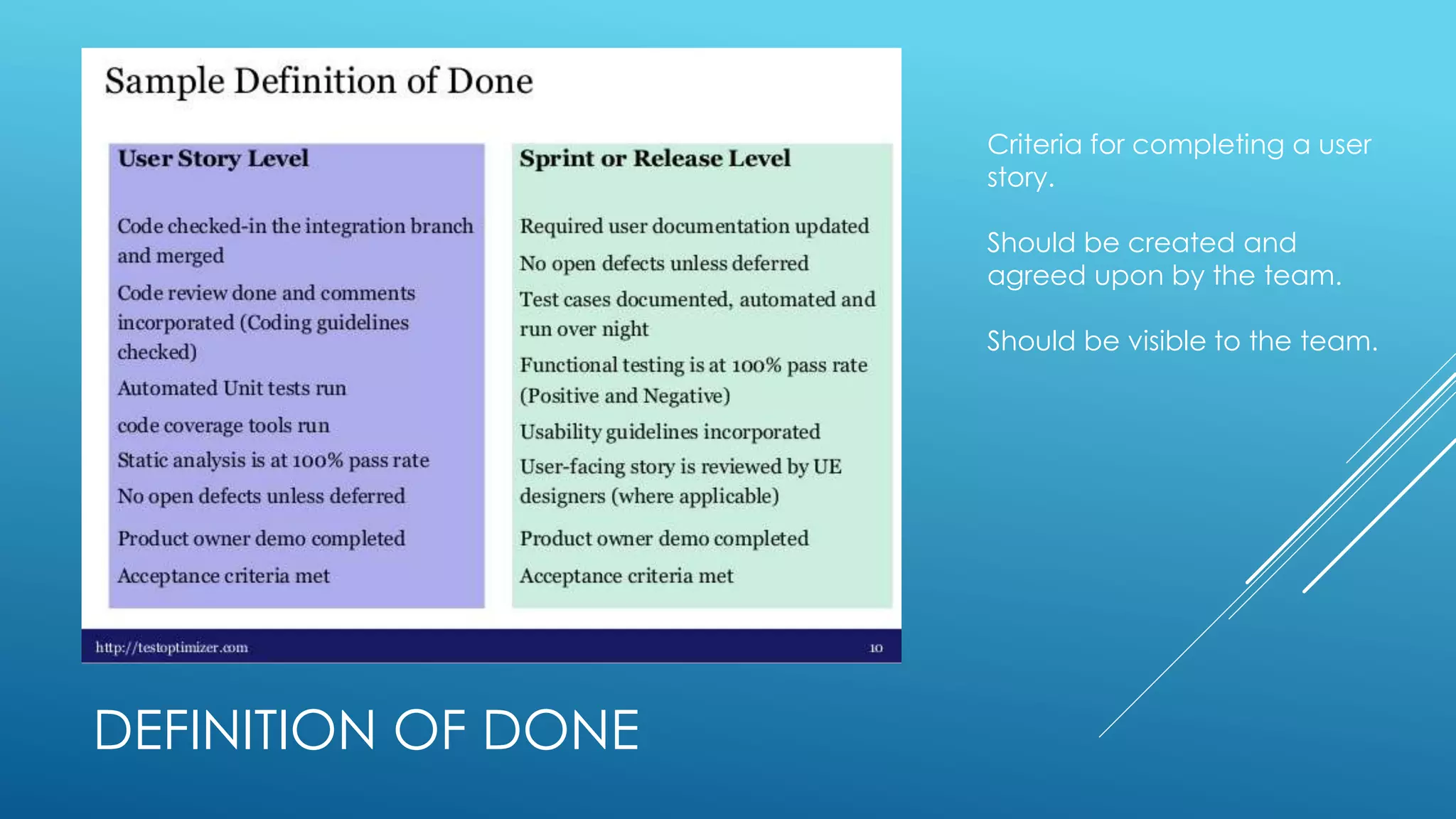
DEFINITION OF DONE
Criteria for completing a user
story.
Should be created and
agreed upon by the team.
Should be visible to the team.
3 TEAM ROLES
 Product Owner
 Responsible for maximizing the value of the product,
organizing/prioritizing backlog, sharing vision of the product
 Scrum Master
 Ensures Scrum is understood and used, removes impediments to
progress, facilitates events, servant leader
 Development Team
 Empowered to manage their own work, self organizing, cross-
functional, members can fulfill multiple roles on the team
Where is the project manager?
THE ROLE OF A PROJECT MANAGER
IN AN AGILE WORLD
 Facilitating Scrum of Scrums
 Driving issues to resolution
 Tracking and managing cross project / program dependencies
 Helping the teams stay focused
PLANNING A PROJECT WITHOUT A
“PLAN”
 Team with the Product Owner to plan releases
 Work with the Product Owner and Scrum Master to develop a
rough schedule – back from the release plan into a high level
view of the sprints
 With Multiple Customers – work to help define customer specific
filters of the backlog
 Ensure customer requirements make it into the product owner’s
list for inclusion in the backlog
THINGS TO LOOK FOR WHEN
CONSIDERING THE USE OF AGILE
 Management Stakeholder Buy-In
 Independent projects with high degree of change
 Teams that are co-located or that have and are comfortable
with virtual co-location tools
 DevOps teams
DISCUSSION:
NON-SOFTWARE DEVELOPMENT PROJECTS
THAT COULD USE AGILE
 Example: Infrastructure Projects with a high degree of change
AND that does not require a sequential approach:
 Data Center Shut-downs, Migrations
 Enterprise wide Database or OS Upgrades
 …what projects can you think of?
CASE STUDY – RIGHT SIZING
PROGRAM
 Right Sizing Program Goals
 Reduce the footprint consumed by a company’s server farm
 Reduce the amount of power consumed by a company’s server
farm
 BY: Reducing the infrastructure of all applications from the size
required to support 10 million customers to the minimum size
required to support approx. 3.3 million customers
APPROACH
 Identify exact infrastructure for all applications
 Web Servers
 App Servers
 Database Servers
 SAN Components
 Reduce all highly available components from 3 way to 2 way
 Consolidate like technologies on to smaller, more flexible hardware
 As hardware is freed up, decommission
 Provide daily reporting on changes, decommissions, and power
reduction
MAKING IT HAPPEN
 Set up virtual co-location for development and PM team
 Daily Live Bridgeline, all team members can open
 All team members have access to sharing software
 Phase 1: A Date for A Date: Preparing the Backlog
 Development team builds data management site with reporting to support the goals
 PgMs meet with SMEs across the org to gather the data and input to the data
management site
 Phase 2: Migration and Decommissions
 Additional PMs + development team + management hold daily standup to review what
happened yesterday, what plan is for the day, any issues or impediments to progress
 PgMs keep scrum board up to date and run sprint scenarios daily
 PgMs & development team create sprint backlog every 2 weeks
WHAT’S THE POINT?
 Scrum Perfection?
NOPE. EXCEPTIONAL DELIVERY.
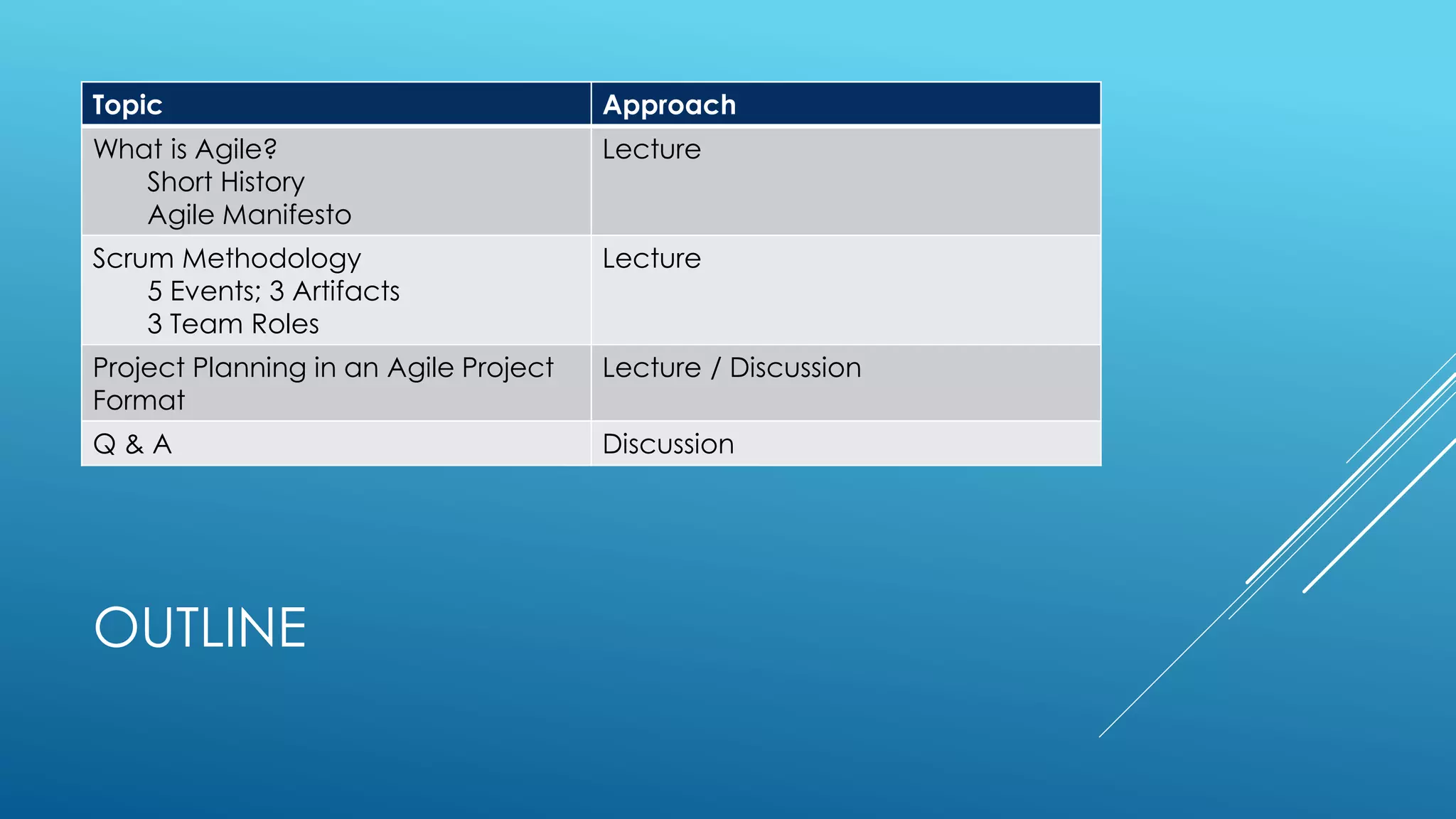
OUTLINE
Topic Approach
What is Agile?
Short History
Agile Manifesto
Lecture
Scrum Methodology
5 Events; 3 Artifacts
3 Team Roles
Lecture
Project Planning in an Agile Project
Format
Lecture / Discussion
Q & A Discussion
DESCRIPTION OF SESSION
 New to the concepts of the “Agile” approach to project
management?
 Wondering how project managers play into the Agile
methodologies?
 Wondering if your project can benefit from some of the Agile
concepts?
 This session will share the basics of Agile with you and provide you
with a forum in which to discuss issues or questions about the
application of Agile to any kind of project situation.
LEARNING OBJECTIVES
 By the end of this session the participant should:
 Know what the Agile Manifesto is and what it represents
 Understand the basics of one Agile methodology (Scrum)
 Understand the role of a project manager on an Agile team
 Have food for thought when considering the use of Agile
ABOUT CICI
 Cici Conger-Portie, PgMP, PMP, MBA has 19 years of program
and project management experience. Building her skill set began
with Big 4 training and consulting, Fortune 500 company
consulting, internet start-up management positions, graduate
school for business and PMP, PgMP, PMI-ACP + additional Agile
certifications.
 In her spare time, Cici enjoys painting, reading, spending time in
her flower garden and relaxing with friends.

Agile Project Management

  • 1.
    AGILE PROJECT MANAGEMENT Cici Conger– Portie Certified Scrum Product Owner PMI-ACP, PMP, PgMP https://www.linkedin.com/in/cicicongerportie
  • 2.
  • 3.
    2001  Wikipedia, aWiki free content encyclopedia, goes online  Napster is closed down by court order following an injunction on behalf of the Recording Industry Association of America (RIAA),  The code red ( WORM ) virus attacks 1/4 million web sites running on Microsoft's IIS web server  Apple Computer releases the iPod.  HP ( Hewlett Packard ) and Compaq Merge  Microsoft releases Windows XP
  • 4.
    AGILE: A SHORTHISTORY  2001: 17 thought leaders in the software development industry came together to discuss what had become “bureaucratic, slow, and overly regimented” software development practices  Goal: A new, Light-weight approach allowing for quick responses to change and frequent delivery of working software
  • 5.
    THE AGILE MANIFESTO Individuals and interactions  Over processes and tools  Working software  Over comprehensive documentation  Customer collaboration  Over contract negotiation  Responding to change  Over following a plan
  • 6.
    THE TWELVE PRINCIPLESOF AGILE SOFTWARE DEVELOPMENT We follow these principles:  Our highest priority is to satisfy the customer through early and continuous delivery of valuable software.  Welcome changing requirements, even late in development. Agile processes harness change for the customer's competitive advantage.  Deliver working software frequently, from a couple of weeks to a couple of months, with a preference to the shorter timescale.  Business people and developers must work together daily throughout the project.  Build projects around motivated individuals. Give them the environment and support they need, and trust them to get the job done.  The most efficient and effective method of conveying information to and within a development team is face-to-face conversation.
  • 7.
    THE TWELVE PRINCIPLESOF AGILE SOFTWARE We follow these principles:  Working software is the primary measure of progress.  Agile processes promote sustainable development. The sponsors, developers, and users should be able to maintain a constant pace indefinitely.  Continuous attention to technical excellence and good design enhances agility.  Simplicity--the art of maximizing the amount of work not done--is essential.  The best architectures, requirements, and designs emerge from self- organizing teams.  At regular intervals, the team reflects on how to become more effective, then tunes and adjusts its behavior accordingly.
  • 8.
  • 9.
    5 EVENTS  Sprints Daily Scrum Meeting AKA Standups  Sprint Planning Meeting  Sprint Review  Sprint Retrospective
  • 10.
    3 ARTIFACTS  ProductBacklog  Sprint Backlog  Definition of Done
  • 11.
    STORY MAPPING THEPRODUCT BACKLOG These aren’t User Stories! They are actions or functions. Walking Skeleton
  • 12.
    SPRINT BACKLOG User storiesare short, simple descriptions of a feature told from the perspective of the person who desires the new capability, usually a user or customer of the system. They typically follow a simple template: As a <type of user>, I want <some goal> so that <some reason>.
  • 13.
    SCRUM BOARD Similar toa Kanban Board Key Benefit: Visibility
  • 14.
    DEFINITION OF DONE Criteriafor completing a user story. Should be created and agreed upon by the team. Should be visible to the team.
  • 15.
    3 TEAM ROLES Product Owner  Responsible for maximizing the value of the product, organizing/prioritizing backlog, sharing vision of the product  Scrum Master  Ensures Scrum is understood and used, removes impediments to progress, facilitates events, servant leader  Development Team  Empowered to manage their own work, self organizing, cross- functional, members can fulfill multiple roles on the team Where is the project manager?
  • 16.
    THE ROLE OFA PROJECT MANAGER IN AN AGILE WORLD  Facilitating Scrum of Scrums  Driving issues to resolution  Tracking and managing cross project / program dependencies  Helping the teams stay focused
  • 17.
    PLANNING A PROJECTWITHOUT A “PLAN”  Team with the Product Owner to plan releases  Work with the Product Owner and Scrum Master to develop a rough schedule – back from the release plan into a high level view of the sprints  With Multiple Customers – work to help define customer specific filters of the backlog  Ensure customer requirements make it into the product owner’s list for inclusion in the backlog
  • 18.
    THINGS TO LOOKFOR WHEN CONSIDERING THE USE OF AGILE  Management Stakeholder Buy-In  Independent projects with high degree of change  Teams that are co-located or that have and are comfortable with virtual co-location tools  DevOps teams
  • 19.
    DISCUSSION: NON-SOFTWARE DEVELOPMENT PROJECTS THATCOULD USE AGILE  Example: Infrastructure Projects with a high degree of change AND that does not require a sequential approach:  Data Center Shut-downs, Migrations  Enterprise wide Database or OS Upgrades  …what projects can you think of?
  • 20.
    CASE STUDY –RIGHT SIZING PROGRAM  Right Sizing Program Goals  Reduce the footprint consumed by a company’s server farm  Reduce the amount of power consumed by a company’s server farm  BY: Reducing the infrastructure of all applications from the size required to support 10 million customers to the minimum size required to support approx. 3.3 million customers
  • 21.
    APPROACH  Identify exactinfrastructure for all applications  Web Servers  App Servers  Database Servers  SAN Components  Reduce all highly available components from 3 way to 2 way  Consolidate like technologies on to smaller, more flexible hardware  As hardware is freed up, decommission  Provide daily reporting on changes, decommissions, and power reduction
  • 22.
    MAKING IT HAPPEN Set up virtual co-location for development and PM team  Daily Live Bridgeline, all team members can open  All team members have access to sharing software  Phase 1: A Date for A Date: Preparing the Backlog  Development team builds data management site with reporting to support the goals  PgMs meet with SMEs across the org to gather the data and input to the data management site  Phase 2: Migration and Decommissions  Additional PMs + development team + management hold daily standup to review what happened yesterday, what plan is for the day, any issues or impediments to progress  PgMs keep scrum board up to date and run sprint scenarios daily  PgMs & development team create sprint backlog every 2 weeks
  • 23.
    WHAT’S THE POINT? Scrum Perfection?
  • 24.
  • 26.
    OUTLINE Topic Approach What isAgile? Short History Agile Manifesto Lecture Scrum Methodology 5 Events; 3 Artifacts 3 Team Roles Lecture Project Planning in an Agile Project Format Lecture / Discussion Q & A Discussion
  • 27.
    DESCRIPTION OF SESSION New to the concepts of the “Agile” approach to project management?  Wondering how project managers play into the Agile methodologies?  Wondering if your project can benefit from some of the Agile concepts?  This session will share the basics of Agile with you and provide you with a forum in which to discuss issues or questions about the application of Agile to any kind of project situation.
  • 28.
    LEARNING OBJECTIVES  Bythe end of this session the participant should:  Know what the Agile Manifesto is and what it represents  Understand the basics of one Agile methodology (Scrum)  Understand the role of a project manager on an Agile team  Have food for thought when considering the use of Agile
  • 29.
    ABOUT CICI  CiciConger-Portie, PgMP, PMP, MBA has 19 years of program and project management experience. Building her skill set began with Big 4 training and consulting, Fortune 500 company consulting, internet start-up management positions, graduate school for business and PMP, PgMP, PMI-ACP + additional Agile certifications.  In her spare time, Cici enjoys painting, reading, spending time in her flower garden and relaxing with friends.

Editor's Notes

  • #17 Leading Scrum of Scrums Identifying cross team dependencies; risks Managing timeline against which scrum teams work