Agile Mumbai 19-20 Sep 2025 | Local Wisdom, Global Impact by Shrawan Gaur
This Document Outlines how timeless Indian principles such as frugality, servant-leadership, contextual agility, collective intelligence, and sustainable scale are quietly reshaping global organizations.
Agile Mumbai 19-20 Sep 2025 | Local Wisdom, Global Impact by Shrawan Gaur
1.
* The opinions/viewsexpressed in this session are personal.
About Me
Shrawan Gaur
Vice President, JPMorganChase
With over 15 years in tech and agility, I’ve helped teams and organizations adapt, transform, and grow in dynamic environments.
Agile Mumbai Conference 2025 www.agilemumbai.com
Indian “way”
In aworld where agility is increasingly measured by
complexity and cost, India offers a different lens—a
frugal, value-oriented, deeply contextual approach to
leadership and innovation.
Let us explores how local Indian wisdom—rooted in
resilience, resourcefulness, and relational intelligence—
is quietly shaping global impact.
Agile Mumbai Conference 2025 www.agilemumbai.com
4.
Indian Uniqueness
India brings“timeless” civilizational wisdom to world.
These can be broadly put under below “categories”
Frugality “in-built mindset”
Leadership “as a service”
Contextual Agility “adaptative”
Collective Intelligence “community led”
Scale “with sustainability”
Agile Mumbai Conference 2025 www.agilemumbai.com
5.
Frugality
Frugality ≠ ScarcityThinking
Insight: Start lean. Experiment fast. Scale what works.
Practice: Recognize grassroots ideas and grow them into enterprise impact.
ISRO’s Mangalyaan Success Formula
ISRO’s $74M Mars mission—cheaper than NASA, ESA, or China—succeeded through clear goals, a tight
18-month schedule, and strict cost control. Indigenous tech replaced imports, PSLV reuse and modular
design cut development costs, lean skilled teams maximized resources, and a Hohmann Transfer Orbit
slingshot minimized fuel use.
जुगाड़ से जगरनॉट
Sutra: Local improvisation can evolve into global transformation — if nurtured
with vision.
Agile Mumbai Conference 2025 www.agilemumbai.com
6.
Frugality
Modular BankingInfrastructure:
Teams based out of JPMC Mumbai, Bangalore, and Hyderabad based
tech centers created reusable microservices that handle $10 trillion in
daily transactions while operating on optimized cloud infrastructure.
Cost-Efficient Scaling:
During the Silicon Valley Bank crisis, India-based teams handled
unprecedented client onboarding volumes without additional
infrastructure costs due to their modern technical stack.
जुगाड़ से जगरनॉट
Agile Mumbai Conference 2025 www.agilemumbai.com
7.
Leadership
Sutra: True leadersserve the team, not control it. Authority flows from humility.
Insight: Embody the servant-leadership mindset. Enable, don’t dictate.
Practice: Actively remove blockers, coach with compassion, and elevate others.
Amul – From Protest to Prosperity
In 1946, Gujarat’s Kaira farmers, exploited by Polson dairy, formed a co-operative under Sardar Patel and
Tribhuvandas Patel to own production and profits. In 1949, Dr. Verghese Kurien joined, modernizing
operations and turning it into Amul, a national symbol of rural empowerment. His approach blended
problem-driven innovation, farmer ownership, breakthrough buffalo milk technology, brand-led self-
reliance, and nationwide scaling without losing the principle: the producer must be the owner.
Agile Mumbai Conference 2025
सेवा भाव
Leadership as Seva (Service)
www.agilemumbai.com
8.
Agile Mumbai Conference2025
Leadership सेवा भाव
Cross-Border Mentorship Programs:
Senior engineers from India mentor teams across multiple
geographies through virtual "Ask Me Anything" sessions and
collaborative problem-solving.
Team Well Being:
Team leads regularly act as “blocker busters,” solving issues for new
joiners. Leadership is measured by team health, engagement, and
collective problem-solving—not authority.
www.agilemumbai.com
9.
Contextual Agility
Insight:Focus on “why” over rigid process adherence. Empower teams to make decisions
guided by values, not bureaucracy.
Practice: Cultivate clarity of intent and trust the team to adapt responsibly.
Indian IT Offshoring Industry
The $254B Indian IT offshoring industry leverages cultural fluency, time-zone alignment, and a 5M-
strong talent pool to power over 1,000 Fortune 500 firms. From Y2K to AI, it has thrived through crises
and tech shifts by continually reinventing, cementing its role as a global digital backbone.
Agile Mumbai Conference 2025
दार्शनिक
Long-Term Vision
Sutra: When the intention is clear and rooted in purpose, even
flexible rules can lead to meaningful outcomes.
www.agilemumbai.com
10.
Agile Mumbai Conference2025
Contextual Agility दार्शनिक
AI-Powered Risk Analysis:
JPMC India Teams developed machine learning models for
fraud detection and risk management that adjust to regional
patterns and regulatory requirements
Flexible Business Logic:
JPMC created systems that incorporate local requirements (like UPI
integration) while serving global banking platforms.
www.agilemumbai.com
11.
Collective Intelligence
Sutra: Inthe current era, strength lies not in individual prowess, but in
collective action.
Insight: Cross-functional collaboration outpaces siloed expertise
Practice: Design systems that reward team outcomes, not individual heroics.
India’s Vaccine Diplomacy
Amid COVID-19, India swiftly balanced domestic vaccination with global aid, sending doses to 90+
nations through Vaccine Maitri. This agile pivot reinforced humanitarian leadership, strategic
partnerships, and its role as the world’s vaccine hub.
Agile Mumbai Conference 2025
संघ शक्ति कलियुगे
Vasudhaiva Kutumbakam
www.agilemumbai.com
12.
Agile Mumbai Conference2025
Collective Intelligence संघ शक्ति कलियुगे
LLM Suite Development:
India teams contributed to building JPMorgan's Large
Language Model platform used by 200,000+ employees
globally.
Financial Inclusion Lab:
JPMC’s collaborative initiative with IIM Ahmedabad that incubated 50+
fintech companies, collectively serving 30+ million LMI customers and
generating $80 million in follow-on funding
www.agilemumbai.com
13.
Scale
Sutra: True growthis not in breadth alone, but in the harmony of dharma, balance,
and the welfare of generations yet to come. (Lokasangraha)
Insight: Reduce over-engineering. Simple, iterative progress often yields better value
Practice: Strip away clutter; foster clarity and flow in team collaboration.
UPI – Sustainable Scale
Launched in 2016, UPI now handles 14B+ monthly transactions, from rural shops to global
remittances. Built on low-cost, open APIs, it ensures inclusion, security, and resilience. Its agility—
adapting from demonetization to COVID-19—shows सतत विस्तार rooted in accessibility and public
good.
Agile Mumbai Conference 2025
From Gully to Globe
सतत विस्तार
www.agilemumbai.com
14.
Agile Mumbai Conference2025
Scale सतत विस्तार
Feature Priority / Discovery:
Adopt “flow optimization” retrospectives—stripping away
unused features and decluttering for long-term evolution.
Tech Development - Sustainability:
India teams in Mumbai, Bangalore, and Hyderabad built the Carbon
CompassSM methodology - a comprehensive system for measuring
clients' carbon intensity and integrating carbon performance into
business decision-making.
www.agilemumbai.com
15.
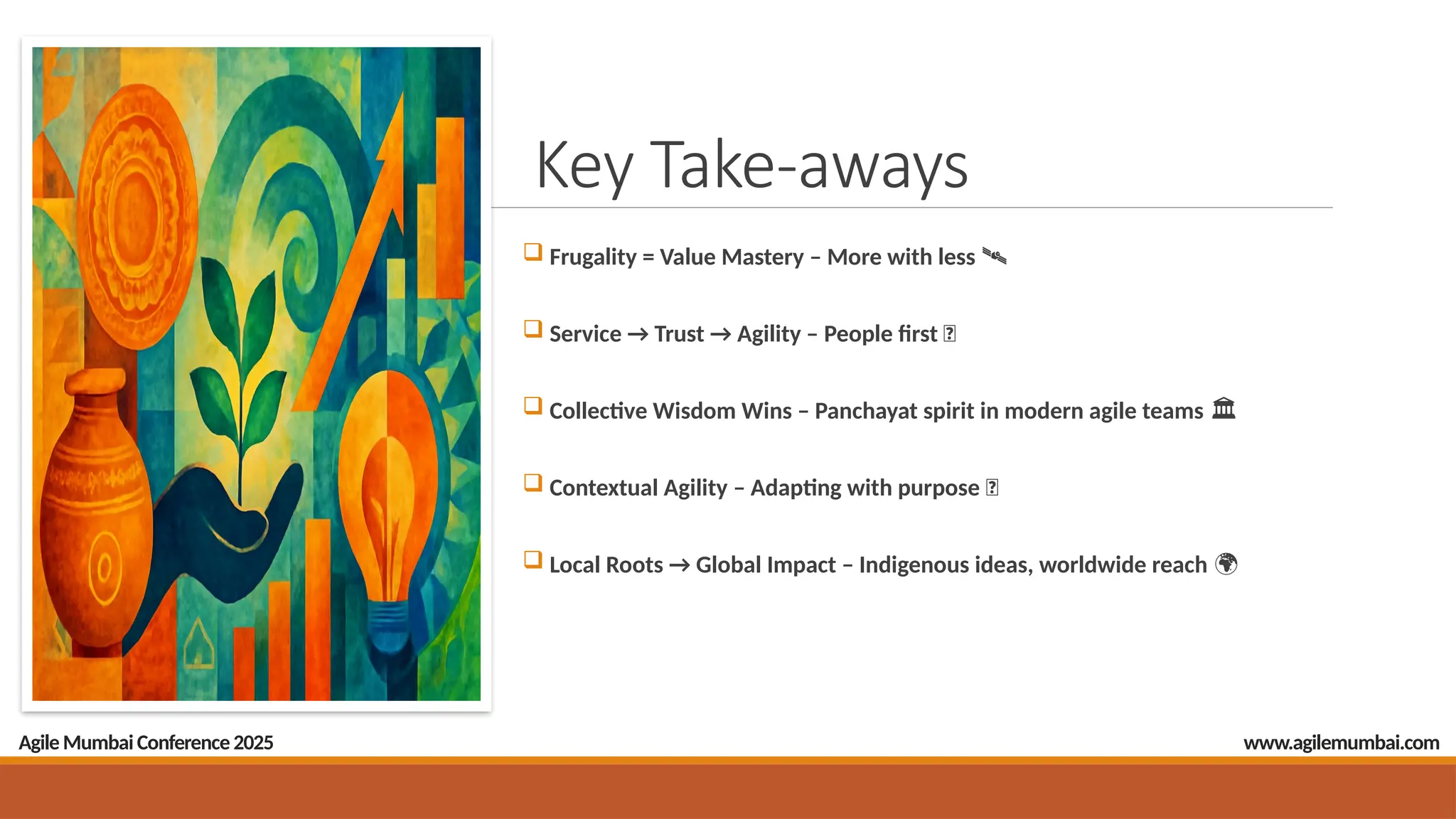
Key Take-aways
Frugality= Value Mastery – More with less
️ 🛰️
Service → Trust → Agility – People first 🤝
Collective Wisdom Wins – Panchayat spirit in modern agile teams
️ 🏛️
Contextual Agility – Adapting with purpose 🔄
Local Roots → Global Impact – Indigenous ideas, worldwide reach 🌍
Agile Mumbai Conference 2025 www.agilemumbai.com
#5 Here are 5 unique examples of innovation and budget optimization by ISRO in its Mars Orbiter Mission (Mangalyaan), proving its “planning on a shoestring”:
Lowest-Cost Mars Mission in History
Mangalyaan was completed for just $74 million—far less than similar missions by NASA, ESA, or China. ISRO achieved this by clear objectives, tight schedules (mission developed in just 18 months), and relentless cost control.
Indigenous Technology Development
To avoid expensive imports, ISRO focused on developing key technologies in-house, including flight systems, software, and payloads. Engineers designed and tested components using local resources and minimized reliance on foreign vendors.
Use of Existing Launch Vehicle (PSLV) and Modular Designs
Instead of creating a new rocket, ISRO leveraged the proven PSLV platform, modifying it for the interplanetary mission. Modular spacecraft design allowed reuse of components from previous missions, further saving costs and reducing risk.
Maximum Resource Utilization and Lean Teams
ISRO adopted zero-based budgeting and efficient management, with small, highly skilled teams working extended hours without overtime pay. Recycling components and simulation-based testing replaced expensive hardware evaluation, ensuring every rupee was optimized.
Hohmann Transfer Orbit/Gravity Assist
Rather than an energy-intensive direct launch, ISRO used the Hohmann Transfer Orbit (“minimum energy transfer”)—slingshotting the craft around Earth multiple times before sending it to Mars. This ingenious technique lowered fuel requirements and reduced mission costs dramatically.
These points showcase how Indian ingenuity and careful planning allowed ISRO to create a pioneering interplanetary mission with minimal resources, setting global benchmarks in frugal innovation and space technology.
#6 JPMorgan Chase: India talent helps transform the world’s biggest bank - The Times of India
#7 The Origin of Amul – From Protest to Prosperity
In 1946, farmers in Kaira district, Gujarat were at the mercy of a single private dairy (Polson) that paid them low prices and monopolized milk collection. Under Sardar Vallabhbhai Patel’s guidance, local leader Tribhuvandas Patel mobilized farmers to form a co-operative—so they could own the production, control pricing, and share profits.
Dr. Verghese Kurien, a young engineer posted to the Government Creamery in Anand in 1949 (reluctantly at first), was persuaded by Tribhuvandas Patel to help modernize the co-operative. Kurien’s engineering skills and marketing vision transformed the fledgling Kaira District Co-operative Milk Producers’ Union into a national symbol of rural empowerment—Amul.
Key Origin Insights from Dr. Kurien’s Journey
Problem-Driven Innovation – Amul’s birth wasn’t from a business plan; it was a direct response to farmer exploitation. Kurien always insisted solutions must start with a real, lived problem.
People Before Profit – By ensuring farmers owned the co-operative, he created in-built trust, which no corporate model could replicate.
Technology as an Equalizer – Introduced spray-drying and milk powder technology using buffalo milk—an innovation previously thought impossible—allowing farmers to store surplus and reach wider markets.
Brand as a Movement – “Amul” wasn’t just a dairy label; it became a rallying cry for self-reliance (Amulya means precious). The utterly butterly campaign later humanized it further.
Scaling Without Losing Soul – Operation Flood expanded the model nationally, but Kurien guarded the core principle: the producer must be the owner.
#8 Our teams in India are embedded in global squads, driving innovation across domains: Guru Thiagarajan, Deutsche Bank - Express Computer
#9 The Indian IT offshoring industry has mastered contextual agility by building delivery models attuned to global cultures, time zones, and compliance demands, while harnessing India’s vast talent pool and cost advantage. With over 5 million IT professionals and exports worth $254 billion in FY2024 (NASSCOM), it has become the backbone of global digital operations. Thriving in ambiguity, the sector has navigated Y2K, the dot-com bust, outsourcing backlash, shifting data privacy laws, and waves of technological disruption — from cloud to AI — by continually reinventing service portfolios. This adaptability has kept Indian IT indispensable to over 1,000 Fortune 500 companies, proving its resilience in volatile global markets.
#10 JP Morgan plans e-banking leap with its India-built AI - The Economic Times
Case Study: JP Morgan's $17 Billion Tech Push
How Is JP Morgan Supporting Fintechs & Industry Solutions In India's Payment Landscape?
#11 India’s Vaccine Diplomacy during COVID-19
India leveraged its pharmaceutical strength to launch “Vaccine Maitri” in January 2021, supplying COVID-19 vaccines to over 90 countries through grants, commercial sales, and the COVAX program. By producing affordable vaccines like Covishield and Covaxin, India positioned itself as the “pharmacy of the world.”
This diplomacy had three core impacts:
Humanitarian – Timely aid to nations in Asia, Africa, and Latin America, especially low-income countries.
Strategic – Strengthened bilateral ties and India’s global leadership image.
Economic – Boosted India’s vaccine manufacturing reputation and export potential.
#12 JPMorgan Chase Leads AI Revolution In Finance With Launch Of LLM Suite
Fintechs and financial health: How these startups empower communities
#13 UPI – Scale with Sustainability
India’s Unified Payments Interface (UPI) is a strong example of scaling with sustainability:
Scale: Since its 2016 launch, UPI has grown to handle over 14 billion transactions monthly (2025), covering rural kirana stores to global remittances.
Sustainability:
Low-cost infrastructure – Designed on an interoperable, open API model by NPCI, keeping transaction costs negligible.
Financial inclusion – Works on basic smartphones and supports local languages, empowering millions without heavy tech barriers.
Ecosystem resilience – Public-private collaboration ensures constant upgrades without monopolization.
Digital trust – Strong authentication and RBI oversight maintain security and user confidence.
Indian Contextual Agility Insight:
UPI adapted rapidly—from cashless drive post-demonetization to powering QR payments during COVID-19—while keeping the model inclusive, affordable, and future-ready. This reflects सतत विस्तार (sustainable scale) rooted in accessibility and public good.
#14 JPMorgan Chase Releases Carbon Reduction Targets for Paris-Aligned Financing Commitment – The Leading Solar Magazine In India
#15 As we stand in this Age of Peculiarity, India’s story reminds us that agility isn’t new—it’s woven into our DNA. We’ve always known that frugality is not about scarcity, it’s about seeing the true value in every resource, every moment. We’ve seen how service builds trust, and trust makes change possible. Our collective wisdom—whether in a village panchayat or a modern agile team—outshines individual brilliance when complexity knocks at the door.
From Krishna’s diplomacy to Ashoka’s transformation, our history shows that contextual agility turns uncertainty into opportunity. And most importantly, our local roots, when nourished, can power a global impact—just as Amul transformed rural India, or ISRO reached Mars on a shoestring budget.
So, as you return to your organizations, remember: lead with value, serve with intent, adapt with courage, and trust in the collective. That is the Indian frugal way—and it is how we can all flower in this peculiar age."*