Software Engineering - Agile
Methodologies
Agile methodologies revolutionized the software development industry by shifting from traditional
approaches to a more flexible, client-centric framework. In this document, we will explore popular
Agile methodologies, their benefits, challenges, and limitations.
The Agile Manifesto and Principles
The Agile Manifesto
The Agile Manifesto outlines four values and
twelve principles that prioritize the needs of
the customer, collaboration, and flexibility
over rigid processes and plans.
Twelve Principles
These principles offer guidance for
implementing Agile methodologies and
ensuring high-quality, customer-focused
software delivery.
Introduction to Agile Methodologies
Agile methodologies reject the traditional, cumbersome approach of software development in
favor of a flexible, iterative process.
They prioritize delivering software quickly while continuously improving the product based on user
feedback. Agile focuses on the customer's needs by breaking down development into small,
manageable components.
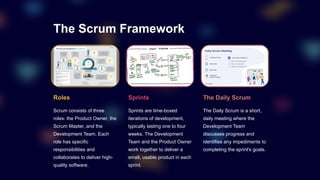
The Scrum Framework
Roles
Scrum consists of three
roles: the Product Owner, the
Scrum Master, and the
Development Team. Each
role has specific
responsibilities and
collaborates to deliver high-
quality software.
Sprints
Sprints are time-boxed
iterations of development,
typically lasting one to four
weeks. The Development
Team and the Product Owner
work together to deliver a
small, usable product in each
sprint.
The Daily Scrum
The Daily Scrum is a short,
daily meeting where the
Development Team
discusses progress and
identifies any impediments to
completing the sprint's goals.
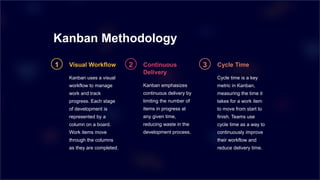
Kanban Methodology
1 Visual Workflow
Kanban uses a visual
workflow to manage
work and track
progress. Each stage
of development is
represented by a
column on a board.
Work items move
through the columns
as they are completed.
2 Continuous
Delivery
Kanban emphasizes
continuous delivery by
limiting the number of
items in progress at
any given time,
reducing waste in the
development process.
3 Cycle Time
Cycle time is a key
metric in Kanban,
measuring the time it
takes for a work item
to move from start to
finish. Teams use
cycle time as a way to
continuously improve
their workflow and
reduce delivery time.
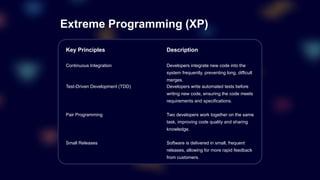
Extreme Programming (XP)
Key Principles Description
Continuous Integration Developers integrate new code into the
system frequently, preventing long, difficult
merges.
Test-Driven Development (TDD) Developers write automated tests before
writing new code, ensuring the code meets
requirements and specifications.
Pair Programming Two developers work together on the same
task, improving code quality and sharing
knowledge.
Small Releases Software is delivered in small, frequent
releases, allowing for more rapid feedback
from customers.
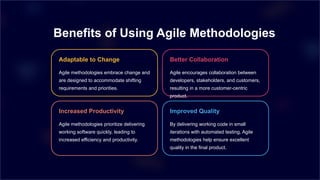
Benefits of Using Agile Methodologies
Adaptable to Change
Agile methodologies embrace change and
are designed to accommodate shifting
requirements and priorities.
Better Collaboration
Agile encourages collaboration between
developers, stakeholders, and customers,
resulting in a more customer-centric
product.
Increased Productivity
Agile methodologies prioritize delivering
working software quickly, leading to
increased efficiency and productivity.
Improved Quality
By delivering working code in small
iterations with automated testing, Agile
methodologies help ensure excellent
quality in the final product.
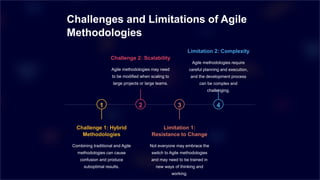
Challenges and Limitations of Agile
Methodologies
1
Challenge 1: Hybrid
Methodologies
Combining traditional and Agile
methodologies can cause
confusion and produce
suboptimal results.
2
Challenge 2: Scalability
Agile methodologies may need
to be modified when scaling to
large projects or large teams.
3
Limitation 1:
Resistance to Change
Not everyone may embrace the
switch to Agile methodologies
and may need to be trained in
new ways of thinking and
working.
4
Limitation 2: Complexity
Agile methodologies require
careful planning and execution,
and the development process
can be complex and
challenging.

Software-Engineering-Agile-Methodologies.pptx

  • 1.
    Software Engineering -Agile Methodologies Agile methodologies revolutionized the software development industry by shifting from traditional approaches to a more flexible, client-centric framework. In this document, we will explore popular Agile methodologies, their benefits, challenges, and limitations.
  • 2.
    The Agile Manifestoand Principles The Agile Manifesto The Agile Manifesto outlines four values and twelve principles that prioritize the needs of the customer, collaboration, and flexibility over rigid processes and plans. Twelve Principles These principles offer guidance for implementing Agile methodologies and ensuring high-quality, customer-focused software delivery.
  • 3.
    Introduction to AgileMethodologies Agile methodologies reject the traditional, cumbersome approach of software development in favor of a flexible, iterative process. They prioritize delivering software quickly while continuously improving the product based on user feedback. Agile focuses on the customer's needs by breaking down development into small, manageable components.
  • 4.
    The Scrum Framework Roles Scrumconsists of three roles: the Product Owner, the Scrum Master, and the Development Team. Each role has specific responsibilities and collaborates to deliver high- quality software. Sprints Sprints are time-boxed iterations of development, typically lasting one to four weeks. The Development Team and the Product Owner work together to deliver a small, usable product in each sprint. The Daily Scrum The Daily Scrum is a short, daily meeting where the Development Team discusses progress and identifies any impediments to completing the sprint's goals.
  • 5.
    Kanban Methodology 1 VisualWorkflow Kanban uses a visual workflow to manage work and track progress. Each stage of development is represented by a column on a board. Work items move through the columns as they are completed. 2 Continuous Delivery Kanban emphasizes continuous delivery by limiting the number of items in progress at any given time, reducing waste in the development process. 3 Cycle Time Cycle time is a key metric in Kanban, measuring the time it takes for a work item to move from start to finish. Teams use cycle time as a way to continuously improve their workflow and reduce delivery time.
  • 6.
    Extreme Programming (XP) KeyPrinciples Description Continuous Integration Developers integrate new code into the system frequently, preventing long, difficult merges. Test-Driven Development (TDD) Developers write automated tests before writing new code, ensuring the code meets requirements and specifications. Pair Programming Two developers work together on the same task, improving code quality and sharing knowledge. Small Releases Software is delivered in small, frequent releases, allowing for more rapid feedback from customers.
  • 7.
    Benefits of UsingAgile Methodologies Adaptable to Change Agile methodologies embrace change and are designed to accommodate shifting requirements and priorities. Better Collaboration Agile encourages collaboration between developers, stakeholders, and customers, resulting in a more customer-centric product. Increased Productivity Agile methodologies prioritize delivering working software quickly, leading to increased efficiency and productivity. Improved Quality By delivering working code in small iterations with automated testing, Agile methodologies help ensure excellent quality in the final product.
  • 8.
    Challenges and Limitationsof Agile Methodologies 1 Challenge 1: Hybrid Methodologies Combining traditional and Agile methodologies can cause confusion and produce suboptimal results. 2 Challenge 2: Scalability Agile methodologies may need to be modified when scaling to large projects or large teams. 3 Limitation 1: Resistance to Change Not everyone may embrace the switch to Agile methodologies and may need to be trained in new ways of thinking and working. 4 Limitation 2: Complexity Agile methodologies require careful planning and execution, and the development process can be complex and challenging.