Emergency Planning for
   At-Risk Groups

  How your agency can be
         involved
Outline
Importance of planning for at-risk groups
Personal preparedness
Organizational preparedness
Community and county preparedness
– How your organization can be involved
Who is at Risk
      During an Emergency?
Anyone with increased risk of severe
disaster-related consequences
– Economic disadvantage
– Absence of a support network
– Needing support to be independent in daily
  activities
– Difficulty reading, speaking, or understanding
  English
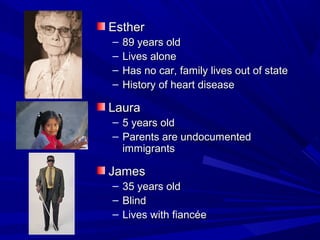
Esther
–   89 years old
–   Lives alone
–   Has no car, family lives out of state
–   History of heart disease

Laura
– 5 years old
– Parents are undocumented
  immigrants

James
–   35 years old
–   Blind
–   Lives with fiancée
Hurricane
                                                  Katrina - 2005


• 73% of Hurricane Katrina-related deaths in New
  Orleans area were among persons age 60 and
  over, although they comprised only 15 percent of
  the population in New Orleans

• Most had medical conditions and functional or
  sensory disabilities that made them more
  vulnerable
AARP, We Can Do Better: Lessons Learned for Protecting Older Persons in Disasters, 2006
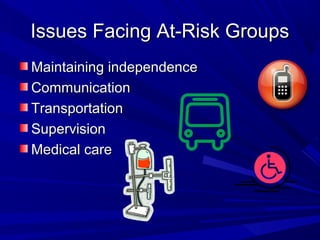
Issues Facing At-Risk Groups
Maintaining independence
Communication
Transportation
Supervision
Medical care
Emergency Preparedness
County, State, &
National Preparedness

                   Community
                  Preparedness

                  Organizational
                  Preparedness


               Personal Preparedness
Personal
      Preparedness

What Can You Do?
Who Needs to be Prepared?
You
Your family
Employees at your organization
People served by your organization
Personal Preparedness
Think ahead…make an emergency plan
–   Evacuation from your home
–   Communication during emergency
–   Plans for pets
Make an emergency kit
– Does not need to be complicated or expensive
Stay informed
– Local emergency plans and services
Get involved
– Know your neighbors and check on those at-risk
– Join Community Emergency Response Teams
Personal Preparedness for
        At-Risk Individuals
Learn basic homecare skills

Work with providers and social support networks to
develop contingency plans for an emergency

Develop food and fluid supply lists for special dietary
needs

Carry a wallet card with a list of medications

Maintain food and supplies for the health and well-
being of service animals and pets
Organizational
           Preparedness

Is Your Organization Ready?
Preparing your Organization
Make an emergency plan

Encourage personal
preparedness for
employees and clients

Determine how to continue
services during an
emergency
Continuity of Operations
       Planning (COOP)
Making sure your organization can
continue to operate during an emergency
– Under stressful conditions
– With fewer staff and other resources
– With increased demand for services
COOP Objectives
Ensure safety of employees
Ensure continuous performance of
essential operations
Protect essential equipment, records, and
other assets
Reduce disruption of operations
Minimize damage and losses
Achieve a timely and orderly recovery
Ensuring Safety
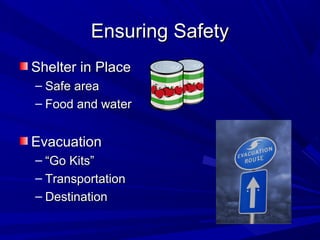
Shelter in Place
– Safe area
– Food and water


Evacuation
– “Go Kits”
– Transportation
– Destination
Continuing Essential Operations
 Prioritize key functions
 Identify minimum staff, equipment, and
 procedures necessary to operate
 Plan what to do if your building is not
 available
 Plan for payroll continuity
 Train people for emergency functions
 Create/update contact list
Community &
                     County
                  Preparedness
How Can Your Organization Get Involved?
[COUNTY NAME] County Special
  Needs Advisory Panel (SNAP)
A small advisory group of [social service
providers] representing various at-risk
populations.
SNAP Purpose
To ensure that the concerns and needs of
[older adults, persons with disabilities,
persons who are economically
disadvantaged, and/or persons with
limited English proficiency] are
appropriately considered and addressed
in public health emergency planning and
response in [COUNTY NAME] County.
SNAP Activities
Provide information and guidance to [LOCAL
HEALTH DEPARTMENT &/OR EMERGENCY
MANAGEMENT] about how to plan for and
communicate with at-risk populations before,
during, and after emergencies

Provide feedback on creating a Community
Communications Network to share messages
with agencies serving at-risk populations
Why get involved?
You know the people your organization
serves
You are in a unique position to advocate
for them
Planning before an emergency can save
lives, reduce illness and injury, and speed
recovery
Doing something NOW is better than
hoping for assistance during an
emergency
What are the benefits?
You can:
 Identify strategies that empower at-risk
 individuals to prepare for emergencies
 Share ideas and resources with other
 agencies
 Reduce duplication of efforts across
 agencies
 Influence public policy
SNAP Meetings

[DATE]
[TIME]
[LOCATION]
Come with ideas!
Contact Us!
YOUR CONTACT INFO
 [NAME]
 [TITLE]
 [EMAIL ADDRESS]
 [PHONE NUMBER]
Tools Available for COOP
NC Division of Public Health COOP
Template
http://www.epi.state.nc.us/epi/gcdc/pandemic/AppendixS1_2007.pdf


Nursing homes
www.hsem.state.mn.us/uploadedfile/COOP_Service_Continuation_
Planning.ppt


Agencies serving vulnerable populations
http://www.smhealth.org/vgn/images/portal/cit_609/19/7/898775681vulner
Resources
CARD. Prepare Your Business to Prosper!
9 Small Steps that Reap Huge Rewards.
http://www.cardcanhelp.org/downloads/Busine
. Accessed April 14, 2009.

Emergency Planning for At-Risk Groups

  • 1.
    Emergency Planning for At-Risk Groups How your agency can be involved
  • 2.
    Outline Importance of planningfor at-risk groups Personal preparedness Organizational preparedness Community and county preparedness – How your organization can be involved
  • 4.
    Who is atRisk During an Emergency? Anyone with increased risk of severe disaster-related consequences – Economic disadvantage – Absence of a support network – Needing support to be independent in daily activities – Difficulty reading, speaking, or understanding English
  • 5.
    Esther – 89 years old – Lives alone – Has no car, family lives out of state – History of heart disease Laura – 5 years old – Parents are undocumented immigrants James – 35 years old – Blind – Lives with fiancée
  • 8.
    Hurricane Katrina - 2005 • 73% of Hurricane Katrina-related deaths in New Orleans area were among persons age 60 and over, although they comprised only 15 percent of the population in New Orleans • Most had medical conditions and functional or sensory disabilities that made them more vulnerable AARP, We Can Do Better: Lessons Learned for Protecting Older Persons in Disasters, 2006
  • 9.
    Issues Facing At-RiskGroups Maintaining independence Communication Transportation Supervision Medical care
  • 10.
    Emergency Preparedness County, State,& National Preparedness Community Preparedness Organizational Preparedness Personal Preparedness
  • 11.
    Personal Preparedness What Can You Do?
  • 12.
    Who Needs tobe Prepared? You Your family Employees at your organization People served by your organization
  • 13.
    Personal Preparedness Think ahead…makean emergency plan – Evacuation from your home – Communication during emergency – Plans for pets Make an emergency kit – Does not need to be complicated or expensive Stay informed – Local emergency plans and services Get involved – Know your neighbors and check on those at-risk – Join Community Emergency Response Teams
  • 14.
    Personal Preparedness for At-Risk Individuals Learn basic homecare skills Work with providers and social support networks to develop contingency plans for an emergency Develop food and fluid supply lists for special dietary needs Carry a wallet card with a list of medications Maintain food and supplies for the health and well- being of service animals and pets
  • 15.
    Organizational Preparedness Is Your Organization Ready?
  • 16.
    Preparing your Organization Makean emergency plan Encourage personal preparedness for employees and clients Determine how to continue services during an emergency
  • 17.
    Continuity of Operations Planning (COOP) Making sure your organization can continue to operate during an emergency – Under stressful conditions – With fewer staff and other resources – With increased demand for services
  • 18.
    COOP Objectives Ensure safetyof employees Ensure continuous performance of essential operations Protect essential equipment, records, and other assets Reduce disruption of operations Minimize damage and losses Achieve a timely and orderly recovery
  • 19.
    Ensuring Safety Shelter inPlace – Safe area – Food and water Evacuation – “Go Kits” – Transportation – Destination
  • 20.
    Continuing Essential Operations Prioritize key functions Identify minimum staff, equipment, and procedures necessary to operate Plan what to do if your building is not available Plan for payroll continuity Train people for emergency functions Create/update contact list
  • 21.
    Community & County Preparedness How Can Your Organization Get Involved?
  • 22.
    [COUNTY NAME] CountySpecial Needs Advisory Panel (SNAP) A small advisory group of [social service providers] representing various at-risk populations.
  • 23.
    SNAP Purpose To ensurethat the concerns and needs of [older adults, persons with disabilities, persons who are economically disadvantaged, and/or persons with limited English proficiency] are appropriately considered and addressed in public health emergency planning and response in [COUNTY NAME] County.
  • 24.
    SNAP Activities Provide informationand guidance to [LOCAL HEALTH DEPARTMENT &/OR EMERGENCY MANAGEMENT] about how to plan for and communicate with at-risk populations before, during, and after emergencies Provide feedback on creating a Community Communications Network to share messages with agencies serving at-risk populations
  • 25.
    Why get involved? Youknow the people your organization serves You are in a unique position to advocate for them Planning before an emergency can save lives, reduce illness and injury, and speed recovery Doing something NOW is better than hoping for assistance during an emergency
  • 26.
    What are thebenefits? You can: Identify strategies that empower at-risk individuals to prepare for emergencies Share ideas and resources with other agencies Reduce duplication of efforts across agencies Influence public policy
  • 27.
  • 28.
    Contact Us! YOUR CONTACTINFO [NAME] [TITLE] [EMAIL ADDRESS] [PHONE NUMBER]
  • 29.
    Tools Available forCOOP NC Division of Public Health COOP Template http://www.epi.state.nc.us/epi/gcdc/pandemic/AppendixS1_2007.pdf Nursing homes www.hsem.state.mn.us/uploadedfile/COOP_Service_Continuation_ Planning.ppt Agencies serving vulnerable populations http://www.smhealth.org/vgn/images/portal/cit_609/19/7/898775681vulner
  • 30.
    Resources CARD. Prepare YourBusiness to Prosper! 9 Small Steps that Reap Huge Rewards. http://www.cardcanhelp.org/downloads/Busine . Accessed April 14, 2009.

Editor's Notes

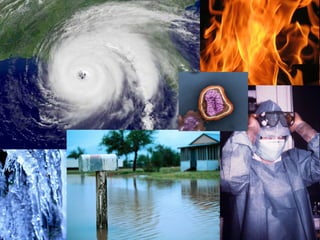
  • #4 Wide variety of emergencies in NC…
  • #5 Broad definition (ASTHO) Economically vulnerable - People may have too little money to stockpile supplies or to stay home from work Key is absence of support network because even have significant disability you are not necessarily at greater risk. - Some children; homeless; travelers; and the socially, culturally, or geographically isolated. Support to be independent in ADL might include Physical disability 􀂉 Developmental disability 􀂉 Substance abuse/dependence 􀂉 Mental Illness 􀂉 Difficulty seeing or hearing 􀂉 Medical conditions
  • #6 Examples of some people who might be at-risk during an emergency.
  • #7 Relatively high numbers of disabled people between the ages of 21 and 64 in NC, according to the 2000 Census. http://www.osbm.state.nc.us/ncosbm/facts_and_figures/census/maps/seniordisab.html
  • #8 As you would expect the percentages are even higher when considering people aged 65 and older. In some counties, over half of the civilian, non-institutionalized population aged 65 and older is disabled, according to the 2000 Census. http://www.osbm.state.nc.us/ncosbm/facts_and_figures/census/maps/seniordisab.html
  • #9 The issue really came to the forefront of our attention during Hurricane Katrina.
  • #10 Functional needs from FEMA National Response Framework definition Ask audience for examples of problems in each category during an emergency?
  • #11 Different levels of preparedness – each are important. The foundation is personal preparedness. This presentation will address personal and organizational preparedness.
  • #13 Emphasize that preparedness is for everyone, not just individuals at greater risk. If you work in an agency or organization serving at-risk groups, it’s even more important to have your own personal preparedness plan so you will be ready and able to help those at greater risk during an emergency. We’re not focusing on personal preparedness in this presentation, but because it’s so important, we’ll spend the next couple of slides talking briefing about it.
  • #14 The most important thing to do is think ahead about what you will do in different types of disasters and create an individual or family emergency plan. ADD explanation of CERTs
  • #15 In addition to creating an emergency plan and a disaster kit, individuals at greater risk should also consider these tips. [From ASTHO Ch. 4 planning tips for at-risk individuals.]
  • #16 Is your organization prepared for an emergency? How can you tell whether it is prepared or not? Does your organization have an emergency plan?
  • #17 Generic template for COOP (http://www.epi.state.nc.us/epi/gcdc/pandemic/AppendixS1_2007.pdf) encourage appropriate CBOs and FBOs to develop contracts or memoranda of understanding to provide essential or specialized supplies and services during a pandemic. Incorporate as much information as possible on potential weaknesses or strengths in the organizations’ supply chains or stockpiles.
  • #18 Ask audience whether they’ve ever heard of COOP or COOP plans.
  • #19 COOP objectives from the Federal Emergency Management Agency, or FEMA (Federal Preparedness Circular 65 - http://www.fas.org/irp/offdocs/pdd/fpc-65.htm)
  • #20 In most emergencies, there will be a choice whether to shelter-in-place or evacuate to a safer area. Decision depends on the disaster and recommendations from local and state government, ultimately about safety. Especially important for places like nursing homes and child care facilities that have residential populations Go-Kits http://www.cardcanhelp.org/downloads/Go%20Kits.pdf
  • #23 Special Needs Advisory Panel, Vulnerable Populations Action Team, At-Risk Planning Coalition…the name is not as important as the purpose and activities of the group. Choose whatever name best represents what you want the group to be in your community.
  • #30 San Mateo Health COOP checklist for agencies serving vulnerable populations (focused on pandemic but some parts applicable to all-hazards)