www.nicsa.org
After Brexit: What
happens next?
September 28, 2016
www.nicsa.org
Moderator:
Doug Dannemiller, Research Leader, Investment Management,
Deloitte
Doug is the head of investment management research at the Deloitte Center for Financial
Services in Deloitte Services LP. He is responsible for driving the Center's research platforms and
delivering world-class research for his clients. Doug has more than 20 years of experience in
research, strategy, and marketing in the investment management and wealth management
industries.
www.nicsa.org
Panelists:
Hermann Beythan, Partner, Linklaters LLP
Vincent Reinhart, Chief Economist, Standish Mellon Asset Management
Vincent is the Chief Economist at Standish Mellon Asset Management Company, the fixed income specialist for BNY
Mellon Investment Management. In this capacity, he coordinates research on both developed and emerging
market economies, presents the firm’s view on global economic developments, and contributes in the discussion of
investment strategies. Prior to joining Standish, he was Chief US Economist and managing director at Morgan
Stanley and a resident scholar at the American Enterprise Institute. Vincent worked at the Federal Reserve for
twenty-four years, most recently as Director of the Division of Monetary and Secretary and Economist of the
Federal Open Market Committee.
Hermann is the head of the Investment Management group of Linklaters Luxembourg where he has been a partner
since 1998. Besides his decades-long UCITS practice, he is renowned for his work on cross-border financial services
regulation, international private placements and outsourcing arrangements. He advises on the structuring of
complex alternative investment fund set-ups and socially responsible fund structures. He is further active in several
industry committees (ABBL/ALFI/CSSF) and a regular conference speaker.
www.nicsa.org
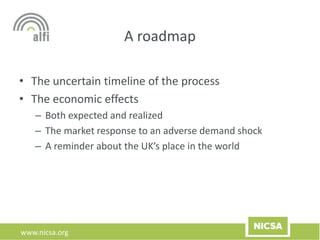
A roadmap
• The uncertain timeline of the process
• The economic effects
– Both expected and realized
– The market response to an adverse demand shock
– A reminder about the UK’s place in the world
www.nicsa.org
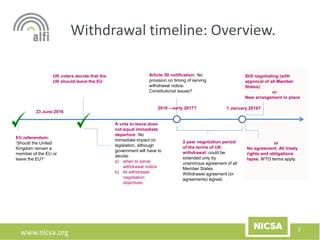
Withdrawal timeline: Overview.
A vote to leave does
not equal immediate
departure: No
immediate impact on
legislation, although
government will have to
decide:
a) when to serve
withdrawal notice
b) its withdrawal
negotiation
objectives
23 June 2016
EU referendum:
‘Should the United
Kingdom remain a
member of the EU or
leave the EU?’
UK voters decide that the
UK should leave the EU
Article 50 notification: No
provision on timing of serving
withdrawal notice.
Constitutional issues?
2016 – early 2017? 1 January 2019?
2-year negotiation period
of the terms of UK
withdrawal: could be
extended only by
unanimous agreement of all
Member States.
Withdrawal agreement (or
agreements) signed.
Still negotiating (with
approval of all Member
States)
or
New arrangement in place
or
No agreement. All treaty
rights and obligations
lapse. WTO terms apply.
2
www.nicsa.org
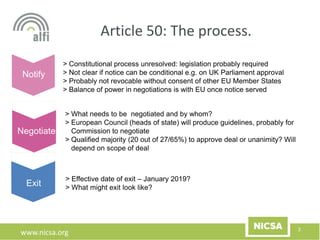
Article 50: The process.
> Constitutional process unresolved: legislation probably required
> Not clear if notice can be conditional e.g. on UK Parliament approval
> Probably not revocable without consent of other EU Member States
> Balance of power in negotiations is with EU once notice served
> What needs to be negotiated and by whom?
> European Council (heads of state) will produce guidelines, probably for
Commission to negotiate
> Qualified majority (20 out of 27/65%) to approve deal or unanimity? Will
depend on scope of deal
> Effective date of exit – January 2019?
> What might exit look like?
Notify
Negotiate
Exit
3
www.nicsa.org
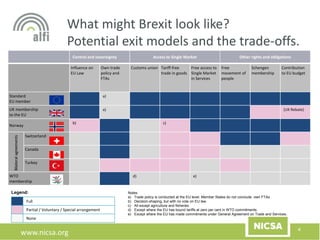
What might Brexit look like?
Potential exit models and the trade-offs.
Full
Partial / Voluntary / Special arrangement
None
Legend: Notes:
a) Trade policy is conducted at the EU level. Member States do not conclude own FTAs
b) Decision-shaping, but with no vote on EU law
c) All except agriculture and fisheries
d) Except where the EU has bound tariffs at zero per cent in WTO commitments.
e) Except where the EU has made commitments under General Agreement on Trade and Services.
Control and sovereignty Access to Single Market Other rights and obligations
Influence on
EU Law
Own trade
policy and
FTAs
Customs union Tariff-free
trade in goods
Free access to
Single Market
in Services
Free
movement of
people
Schengen
membership
Contribution
to EU budget
Standard
EU member
a)
UK membership
to the EU
a) (UK Rebate)
Norway
b) c)
Bilateralagreements
Switzerland
Canada
Turkey
WTO
membership
d) e)
4
www.nicsa.org
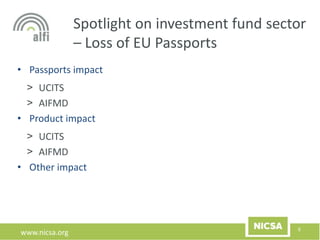
Spotlight on investment fund sector
– Loss of EU Passports
• Passports impact
> UCITS
> AIFMD
• Product impact
> UCITS
> AIFMD
• Other impact
5
www.nicsa.org
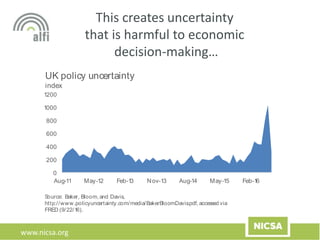
This creates uncertainty
that is harmful to economic
decision-making…
0
200
400
600
800
1000
1200
Aug-11 May-12 Feb-13 Nov-13 Aug-14 May-15 Feb-16
Source: Baker, Bloom, and Davis,
http://www.policyuncertainty.com/media/BakerBloomDavis.pdf, accessed via
FRED (9/22/16).
UK policy uncertainty
index
www.nicsa.org
Before the event, the official sector
offered warnings
about the economy…
• From the UK Treasury, “GDP may be 6.2% lower than it would otherwise
have been by 2030, an annual cost that works out at some £4,300 ($6,000)
per household.”
• From the Bank of England, “a vote to leave the EU could have material
economic effects – on the exchange rate, on demand and on the
economy’s supply potential.”
• From the IMF, “The Brexit vote implies a substantial increase in economic,
political, and institutional uncertainty, which is projected to have negative
macroeconomic consequences, especially in advanced European
economies.”
www.nicsa.org
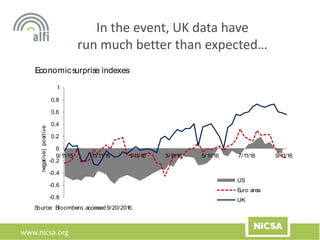
In the event, UK data have
run much better than expected…
-0.8
-0.6
-0.4
-0.2
0
0.2
0.4
0.6
0.8
1
9/11/15 11/11/15 1/11/16 3/11/16 5/11/16 7/11/16 9/11/16
negative|positive
Source: Bloomberg, accessed 9/20/2016.
Economicsurprise indexes
US
Euro area
UK
www.nicsa.org
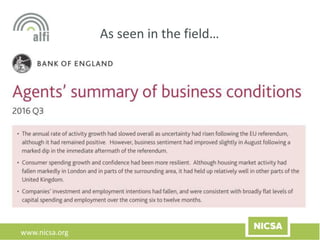
As seen in the field…
www.nicsa.org
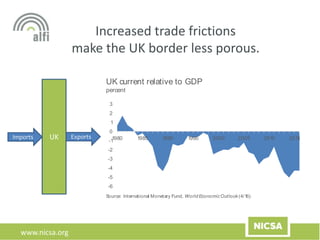
Increased trade frictions
make the UK border less porous.
UK ExportsImports
-6
-5
-4
-3
-2
-1
0
1
2
3
1980 1985 1990 1995 2000 2005 2010 2015
Source: International Monetary Fund, World EconomicOutlook (4/16)
UK current relative to GDP
percent
www.nicsa.org
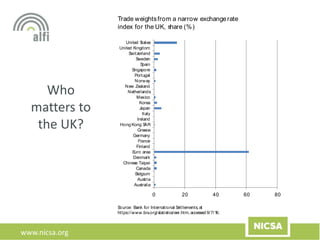
Who
matters to
the UK?
0 20 40 60 80
Australia
Austria
Belgium
Canada
Chinese Taipei
Denmark
Euro area
Finland
France
Germany
Greece
Hong Kong SAR
Ireland
Italy
Japan
Korea
Mexico
Netherlands
New Zealand
Norway
Portugal
Singapore
Spain
Sweden
Switzerland
United Kingdom
United States
Source: Bank for International Settlements, at
https://www.bis.org/statistics/eer.htm, accessed 9/7/16.
Trade weightsfrom a narrow exchangerate
index for the UK, share (%)
www.nicsa.org
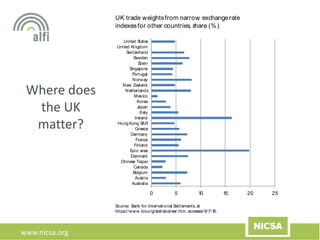
Where does
the UK
matter?
0 5 10 15 20 25
Australia
Austria
Belgium
Canada
Chinese Taipei
Denmark
Euro area
Finland
France
Germany
Greece
Hong Kong SAR
Ireland
Italy
Japan
Korea
Mexico
Netherlands
New Zealand
Norway
Portugal
Singapore
Spain
Sweden
Switzerland
United Kingdom
United States
Source: Bank for International Settlements, at
https://www.bis.org/statistics/eer.htm, accessed 9/7/16.
UK trade weightsfrom narrow exchangerate
indexesfor other countries, share (%)
www.nicsa.org
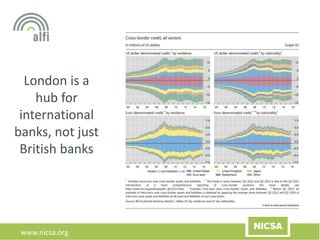
London is a
hub for
international
banks, not just
British banks
www.nicsa.org
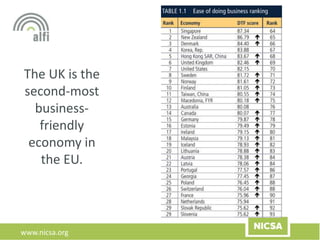
The UK is the
second-most
business-
friendly
economy in
the EU.
www.nicsa.org
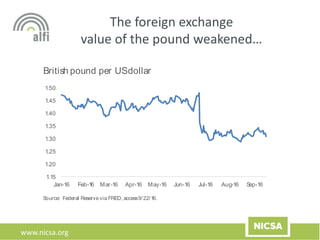
The foreign exchange
value of the pound weakened…
1.15
1.20
1.25
1.30
1.35
1.40
1.45
1.50
Jan-16 Feb-16 Mar-16 Apr-16 May-16 Jun-16 Jul-16 Aug-16 Sep-16
Source: Federal Reserve via FRED, access9/22/16.
British pound per USdollar
www.nicsa.org
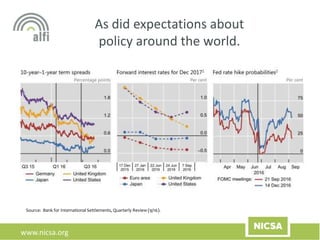
As did expectations about
policy around the world.
Source: Bank for International Settlements, Quarterly Review (9/16).
www.nicsa.org
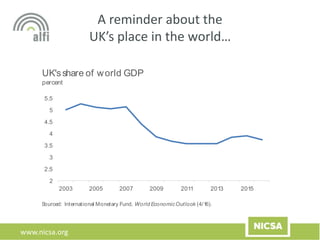
A reminder about the
UK’s place in the world…
2
2.5
3
3.5
4
4.5
5
5.5
2003 2005 2007 2009 2011 2013 2015
Sourced: International Monetary Fund, World EconomicOutlook (4/16).
UK'sshare of world GDP
percent
www.nicsa.org
QUESTIONS
ANSWERS
?
!
?
5

After Brexit: What Happens Next?

  • 1.
  • 2.
    www.nicsa.org Moderator: Doug Dannemiller, ResearchLeader, Investment Management, Deloitte Doug is the head of investment management research at the Deloitte Center for Financial Services in Deloitte Services LP. He is responsible for driving the Center's research platforms and delivering world-class research for his clients. Doug has more than 20 years of experience in research, strategy, and marketing in the investment management and wealth management industries.
  • 3.
    www.nicsa.org Panelists: Hermann Beythan, Partner,Linklaters LLP Vincent Reinhart, Chief Economist, Standish Mellon Asset Management Vincent is the Chief Economist at Standish Mellon Asset Management Company, the fixed income specialist for BNY Mellon Investment Management. In this capacity, he coordinates research on both developed and emerging market economies, presents the firm’s view on global economic developments, and contributes in the discussion of investment strategies. Prior to joining Standish, he was Chief US Economist and managing director at Morgan Stanley and a resident scholar at the American Enterprise Institute. Vincent worked at the Federal Reserve for twenty-four years, most recently as Director of the Division of Monetary and Secretary and Economist of the Federal Open Market Committee. Hermann is the head of the Investment Management group of Linklaters Luxembourg where he has been a partner since 1998. Besides his decades-long UCITS practice, he is renowned for his work on cross-border financial services regulation, international private placements and outsourcing arrangements. He advises on the structuring of complex alternative investment fund set-ups and socially responsible fund structures. He is further active in several industry committees (ABBL/ALFI/CSSF) and a regular conference speaker.
  • 4.
    www.nicsa.org A roadmap • Theuncertain timeline of the process • The economic effects – Both expected and realized – The market response to an adverse demand shock – A reminder about the UK’s place in the world
  • 5.
    www.nicsa.org Withdrawal timeline: Overview. Avote to leave does not equal immediate departure: No immediate impact on legislation, although government will have to decide: a) when to serve withdrawal notice b) its withdrawal negotiation objectives 23 June 2016 EU referendum: ‘Should the United Kingdom remain a member of the EU or leave the EU?’ UK voters decide that the UK should leave the EU Article 50 notification: No provision on timing of serving withdrawal notice. Constitutional issues? 2016 – early 2017? 1 January 2019? 2-year negotiation period of the terms of UK withdrawal: could be extended only by unanimous agreement of all Member States. Withdrawal agreement (or agreements) signed. Still negotiating (with approval of all Member States) or New arrangement in place or No agreement. All treaty rights and obligations lapse. WTO terms apply. 2
  • 6.
    www.nicsa.org Article 50: Theprocess. > Constitutional process unresolved: legislation probably required > Not clear if notice can be conditional e.g. on UK Parliament approval > Probably not revocable without consent of other EU Member States > Balance of power in negotiations is with EU once notice served > What needs to be negotiated and by whom? > European Council (heads of state) will produce guidelines, probably for Commission to negotiate > Qualified majority (20 out of 27/65%) to approve deal or unanimity? Will depend on scope of deal > Effective date of exit – January 2019? > What might exit look like? Notify Negotiate Exit 3
  • 7.
    www.nicsa.org What might Brexitlook like? Potential exit models and the trade-offs. Full Partial / Voluntary / Special arrangement None Legend: Notes: a) Trade policy is conducted at the EU level. Member States do not conclude own FTAs b) Decision-shaping, but with no vote on EU law c) All except agriculture and fisheries d) Except where the EU has bound tariffs at zero per cent in WTO commitments. e) Except where the EU has made commitments under General Agreement on Trade and Services. Control and sovereignty Access to Single Market Other rights and obligations Influence on EU Law Own trade policy and FTAs Customs union Tariff-free trade in goods Free access to Single Market in Services Free movement of people Schengen membership Contribution to EU budget Standard EU member a) UK membership to the EU a) (UK Rebate) Norway b) c) Bilateralagreements Switzerland Canada Turkey WTO membership d) e) 4
  • 8.
    www.nicsa.org Spotlight on investmentfund sector – Loss of EU Passports • Passports impact > UCITS > AIFMD • Product impact > UCITS > AIFMD • Other impact 5
  • 9.
    www.nicsa.org This creates uncertainty thatis harmful to economic decision-making… 0 200 400 600 800 1000 1200 Aug-11 May-12 Feb-13 Nov-13 Aug-14 May-15 Feb-16 Source: Baker, Bloom, and Davis, http://www.policyuncertainty.com/media/BakerBloomDavis.pdf, accessed via FRED (9/22/16). UK policy uncertainty index
  • 10.
    www.nicsa.org Before the event,the official sector offered warnings about the economy… • From the UK Treasury, “GDP may be 6.2% lower than it would otherwise have been by 2030, an annual cost that works out at some £4,300 ($6,000) per household.” • From the Bank of England, “a vote to leave the EU could have material economic effects – on the exchange rate, on demand and on the economy’s supply potential.” • From the IMF, “The Brexit vote implies a substantial increase in economic, political, and institutional uncertainty, which is projected to have negative macroeconomic consequences, especially in advanced European economies.”
  • 11.
    www.nicsa.org In the event,UK data have run much better than expected… -0.8 -0.6 -0.4 -0.2 0 0.2 0.4 0.6 0.8 1 9/11/15 11/11/15 1/11/16 3/11/16 5/11/16 7/11/16 9/11/16 negative|positive Source: Bloomberg, accessed 9/20/2016. Economicsurprise indexes US Euro area UK
  • 12.
  • 13.
    www.nicsa.org Increased trade frictions makethe UK border less porous. UK ExportsImports -6 -5 -4 -3 -2 -1 0 1 2 3 1980 1985 1990 1995 2000 2005 2010 2015 Source: International Monetary Fund, World EconomicOutlook (4/16) UK current relative to GDP percent
  • 14.
    www.nicsa.org Who matters to the UK? 020 40 60 80 Australia Austria Belgium Canada Chinese Taipei Denmark Euro area Finland France Germany Greece Hong Kong SAR Ireland Italy Japan Korea Mexico Netherlands New Zealand Norway Portugal Singapore Spain Sweden Switzerland United Kingdom United States Source: Bank for International Settlements, at https://www.bis.org/statistics/eer.htm, accessed 9/7/16. Trade weightsfrom a narrow exchangerate index for the UK, share (%)
  • 15.
    www.nicsa.org Where does the UK matter? 05 10 15 20 25 Australia Austria Belgium Canada Chinese Taipei Denmark Euro area Finland France Germany Greece Hong Kong SAR Ireland Italy Japan Korea Mexico Netherlands New Zealand Norway Portugal Singapore Spain Sweden Switzerland United Kingdom United States Source: Bank for International Settlements, at https://www.bis.org/statistics/eer.htm, accessed 9/7/16. UK trade weightsfrom narrow exchangerate indexesfor other countries, share (%)
  • 16.
    www.nicsa.org London is a hubfor international banks, not just British banks
  • 17.
    www.nicsa.org The UK isthe second-most business- friendly economy in the EU.
  • 18.
    www.nicsa.org The foreign exchange valueof the pound weakened… 1.15 1.20 1.25 1.30 1.35 1.40 1.45 1.50 Jan-16 Feb-16 Mar-16 Apr-16 May-16 Jun-16 Jul-16 Aug-16 Sep-16 Source: Federal Reserve via FRED, access9/22/16. British pound per USdollar
  • 19.
    www.nicsa.org As did expectationsabout policy around the world. Source: Bank for International Settlements, Quarterly Review (9/16).
  • 20.
    www.nicsa.org A reminder aboutthe UK’s place in the world… 2 2.5 3 3.5 4 4.5 5 5.5 2003 2005 2007 2009 2011 2013 2015 Sourced: International Monetary Fund, World EconomicOutlook (4/16). UK'sshare of world GDP percent
  • 21.