Affordable Online Access
A few benefits and challenges about OER materials
What are open educational
resources?
•Open educational resources are materials for
teaching or learning that are either in the public
domain or have been released under a license
that allows them to be freely used, changed, or
shared with others.
What are the benefits in using OER?
• Saves costs for students - The use of OERs instead of traditional textbooks
can substantially reduce the cost of course materials for students.
• Grants access to more quality choices - OERs can be improved quickly
through direct editing.
• Scalability - OERs are easy to distribute widely with little or no cost.
• Expanded access to learning - Students anywhere in the world can access
OERs at any time, and they can access the material repeatedly.
• Improves visibility of the course - Quick availability of material in many
subject areas increases the timeliness and/or relevance of the material
being presented.
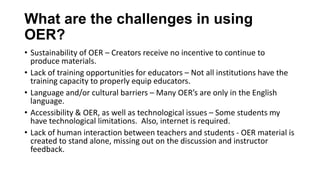
What are the challenges in using
OER?
• Sustainability of OER – Creators receive no incentive to continue to
produce materials.
• Lack of training opportunities for educators – Not all institutions have the
training capacity to properly equip educators.
• Language and/or cultural barriers – Many OER’s are only in the English
language.
• Accessibility & OER, as well as technological issues – Some students my
have technological limitations. Also, internet is required.
• Lack of human interaction between teachers and students - OER material is
created to stand alone, missing out on the discussion and instructor
feedback.
Thank
you!
Dion Alexander

Affordable Online Access.pptx

  • 1.
    Affordable Online Access Afew benefits and challenges about OER materials
  • 2.
    What are openeducational resources? •Open educational resources are materials for teaching or learning that are either in the public domain or have been released under a license that allows them to be freely used, changed, or shared with others.
  • 3.
    What are thebenefits in using OER? • Saves costs for students - The use of OERs instead of traditional textbooks can substantially reduce the cost of course materials for students. • Grants access to more quality choices - OERs can be improved quickly through direct editing. • Scalability - OERs are easy to distribute widely with little or no cost. • Expanded access to learning - Students anywhere in the world can access OERs at any time, and they can access the material repeatedly. • Improves visibility of the course - Quick availability of material in many subject areas increases the timeliness and/or relevance of the material being presented.
  • 4.
    What are thechallenges in using OER? • Sustainability of OER – Creators receive no incentive to continue to produce materials. • Lack of training opportunities for educators – Not all institutions have the training capacity to properly equip educators. • Language and/or cultural barriers – Many OER’s are only in the English language. • Accessibility & OER, as well as technological issues – Some students my have technological limitations. Also, internet is required. • Lack of human interaction between teachers and students - OER material is created to stand alone, missing out on the discussion and instructor feedback.
  • 5.