WELCOME
Why Arkansas?
Fred Stimpson | Canfor Southern Pine
Todd Mullis | Interfor
Chuck Watkins | West Fraser
Arkansas Forestry Association
Fayetteville Arkansas- October 2016
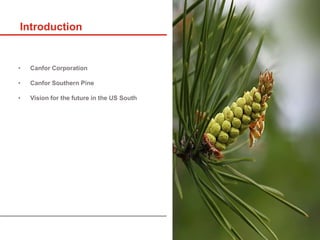
• Canfor Corporation
• Canfor Southern Pine
• Vision for the future in the US South
Introduction
Canfor Corporation
CFP
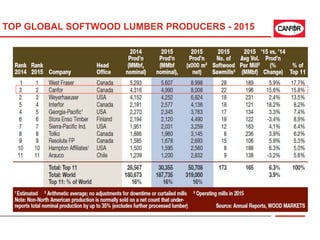
TOP GLOBAL SOFTWOOD LUMBER PRODUCERS - 2015
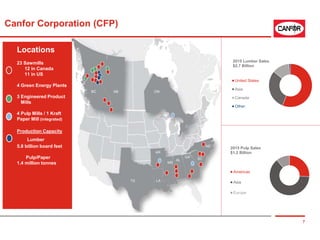
Canfor Corporation (CFP)
Locations
23 Sawmills
12 in Canada
11 in US
4 Green Energy Plants
3 Engineered Product
Mills
4 Pulp Mills / 1 Kraft
Paper Mill (integrated)
Production Capacity
Lumber
5.8 billion board feet
Pulp/Paper
1.4 million tonnes
7
2015 Lumber Sales
$2.7 Billion
United States
Asia
Canada
Other
2015 Pulp Sales
$1.2 Billion
Americas
Asia
Europe
BC AB ON
TX LA
AR
MS
AL
GA SC
NC
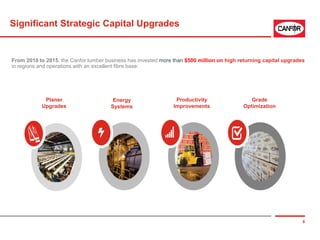
Significant Strategic Capital Upgrades
From 2010 to 2015, the Canfor lumber business has invested more than $500 million on high returning capital upgrades
in regions and operations with an excellent fibre base:
Planer
Upgrades
Energy
Systems
Productivity
Improvements
Grade
Optimization
8
Canfor
Southern
Pine
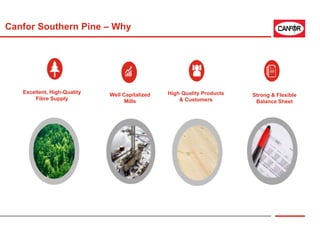
Excellent, High-Quality
Fibre Supply
High Quality Products
& Customers
Well Capitalized
Mills
Strong & Flexible
Balance Sheet
Canfor Southern Pine – Why
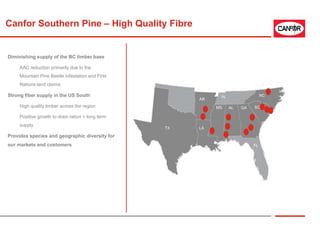
Canfor Southern Pine – High Quality Fibre
NC
SCGAALMS
FL
IN
AR
LATX
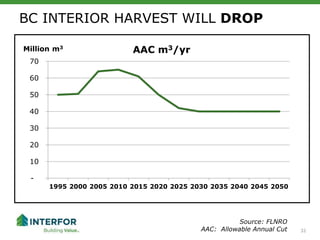
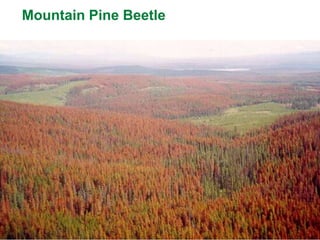
Diminishing supply of the BC timber base
AAC reduction primarily due to the
Mountain Pine Beetle infestation and First
Nations land claims
Strong fiber supply in the US South
High quality timber across the region
Positive growth to drain ration = long term
supply
Provides species and geographic diversity for
our markets and customers
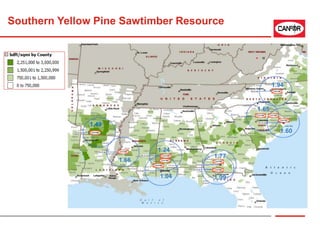
1.94
1.65
1.60
1.77
1.99
1.24
1.04
1.66
1.49
Southern Yellow Pine Sawtimber Resource
• =
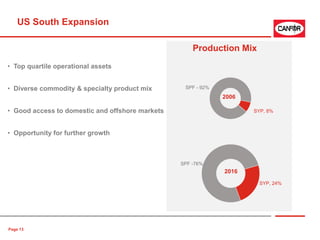
US South Expansion
• Top quartile operational assets
• Diverse commodity & specialty product mix
• Good access to domestic and offshore markets
• Opportunity for further growth
Page 13
SPF - 92%
SYP, 8%
2006
SPF -76%
SYP, 24%
2016
Production Mix
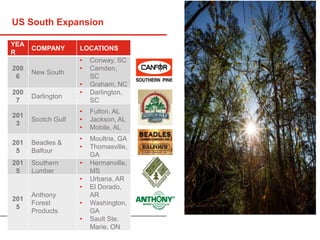
YEA
R
COMPANY LOCATIONS
200
6
New South
• Conway, SC
• Camden,
SC
• Graham, NC
200
7
Darlington
• Darlington,
SC
201
3
Scotch Gulf
• Fulton, AL
• Jackson, AL
• Mobile, AL
201
5
Beadles &
Balfour
• Moultrie, GA
• Thomasville,
GA
201
5
Southern
Lumber
• Hermanville,
MS
201
5
Anthony
Forest
Products
• Urbana, AR
• El Dorado,
AR
• Washington,
GA
• Sault Ste.
Marie, ON
US South Expansion
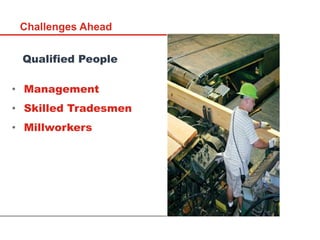
Qualified People
• Management
• Skilled Tradesmen
• Millworkers
Challenges Ahead
Southern
Pine
2020 Vision
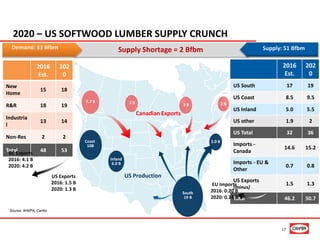
Supply Shortage = 2 Bfbm
2020 – US SOFTWOOD LUMBER SUPPLY CRUNCH
Source: WWPA, Canfor
Demand: 53 Bfbm Supply: 51 Bfbm
2016
Est.
202
0
New
Home
15 18
R&R 18 19
Industria
l
13 14
Non-Res 2 2
Total 48 53
2016
Est.
202
0
US South 17 19
US Coast 8.5 9.5
US Inland 5.0 5.5
US other 1.9 2
US Total 32 36
Imports -
Canada
14.6 15.2
Imports - EU &
Other
0.7 0.8
US Exports
(minus)
1.5 1.3
Total 46.2 50.7
2 B
7.7 B
3 B2 B
Canadian Exports
2.0 BCoast
10B
Inland
6.0 B
South
19 B
US Production
EU Imports
2016: 0.20 B
2020: 0.24 B
US Exports
2016: 1.5 B
2020: 1.3 B
BC Exports
2016: 4.1 B
2020: 4.2 B
17
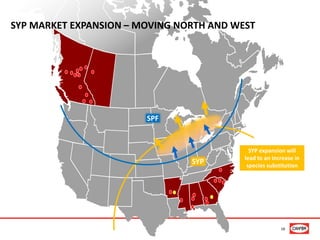
SYP MARKET EXPANSION – MOVING NORTH AND WEST
SYP
SPF
SYP expansion will
lead to an increase in
species substitution
18
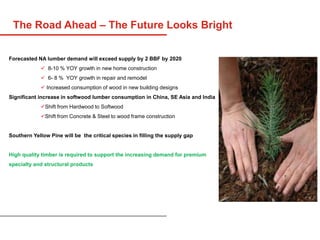
Forecasted NA lumber demand will exceed supply by 2 BBF by 2020
 8-10 % YOY growth in new home construction
 6- 8 % YOY growth in repair and remodel
 Increased consumption of wood in new building designs
Significant increase in softwood lumber consumption in China, SE Asia and India
Shift from Hardwood to Softwood
Shift from Concrete & Steel to wood frame construction
Southern Yellow Pine will be the critical species in filling the supply gap
High quality timber is required to support the increasing demand for premium
specialty and structural products
The Road Ahead – The Future Looks Bright
Arkansas Forestry Association
Fayetteville Arkansas- October 2016
Thank You
Investing in Arkansas ……… and
the US South
Arkansas Forestry Association 71st Annual Meeting
October 5, 2016
Todd Mullis
Vice President
US South Operations
22
This presentation contains information and statements that are forward-
looking in nature, including, but not limited to, statements containing the
words “will”, “is expected”, “forecast”, “annualized”, “target” and similar
expressions. Such statements involve known and unknown risks and
uncertainties that may cause Interfor’s actual results to be materially
different from those expressed or implied by those forward-looking
statements. Such risks and uncertainties include, among others: price
volatility; competition; availability and cost of log supply; natural or man-
made disasters; foreign currency exchange fluctuations; changes in
government regulation; export and other trade barriers; environmental and
community matters; labour disruptions; and other factors referenced herein
and in Interfor’s current Annual Report and Management’s Discussion &
Analysis, both available on www.sedar.com. The forward-looking
information and statements contained in this presentation are based on
Interfor’s current expectations and beliefs. Readers are cautioned not to
place undue reliance on forward-looking information or statements. Interfor
undertakes no obligation to update such forward-looking information or
statements, except where required by law.
FORWARD-LOOKING INFORMATION
22
23
• Interfor’s Platform
• North American Lumber Log Supply
• US Lumber Demand
• The Future of Southern Yellow Pine
• The Road Ahead
ITEMS FOR DISCUSSION
23
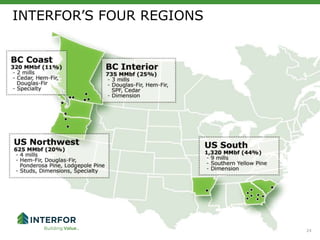
INTERFOR’S FOUR REGIONS
24
25
March 2013
Rayonier
Acquisition
• Baxley
• Eatonton
• Swainsboro
July 2013
Keadle
Acquisition
• Thomaston
Sept 2013
Swainsboro
second shift
March 2014
Tolleson
Acquisition
• Perry
• Preston
Jan 2014
Baxley
second shift
Nov 2014
PTC office
opening
March 2015
Simpson
Acquisition
• Georgetown
• Meldrim
June 2015
Price
Acquisition
• Monticello
2013 2014 2015
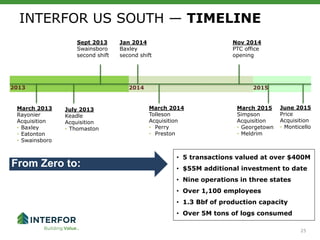
• 5 transactions valued at over $400M
• $55M additional investment to date
• Nine operations in three states
• Over 1,100 employees
• 1.3 Bbf of production capacity
• Over 5M tons of logs consumed
From Zero to:
INTERFOR US SOUTH — TIMELINE
26
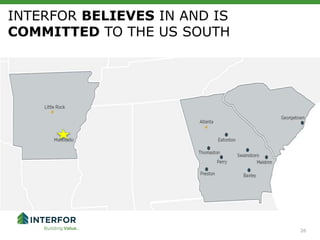
INTERFOR BELIEVES IN AND IS
COMMITTED TO THE US SOUTH
27
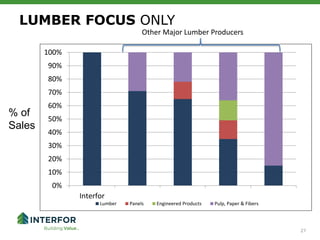
LUMBER FOCUS ONLY
0%
10%
20%
30%
40%
50%
60%
70%
80%
90%
100%
Interfor
Lumber Panels Engineered Products Pulp, Paper & Fibers
% of
Sales
Other Major Lumber Producers
28
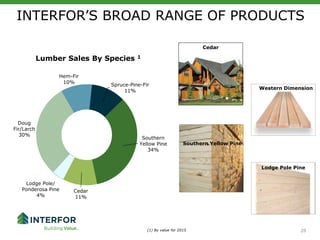
Doug
Fir/Larch
30%
Hem-Fir
10%
Spruce-Pine-Fir
11%
Southern
Yellow Pine
34%
Cedar
11%
Lodge Pole/
Ponderosa Pine
4%
INTERFOR’S BROAD RANGE OF PRODUCTS
(1) By value for 2015
Lumber Sales By Species 1
Western Dimension
Cedar
Southern Yellow Pine
Lodge Pole Pine
29
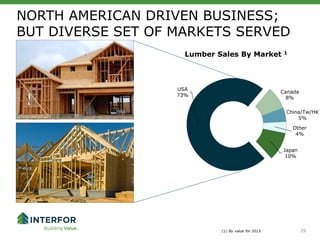
Canada
8%
China/Tw/HK
5%
Other
4%
Japan
10%
USA
73%
NORTH AMERICAN DRIVEN BUSINESS;
BUT DIVERSE SET OF MARKETS SERVED
(1) By value for 2015
Lumber Sales By Market 1
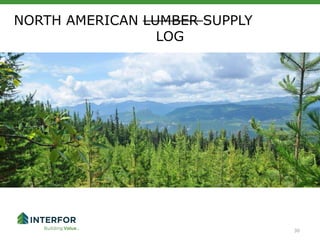
NORTH AMERICAN LUMBER SUPPLY
LOG
30
31
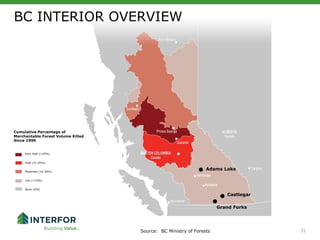
BC INTERIOR OVERVIEW
Cumulative Percentage of
Merchantable Forest Volume Killed
Since 1999
Very High (>45%)
High (31-45%)
Moderate (16-30%)
Low (<16%)
None (0%)
Adams Lake
Castlegar
Grand Forks
Source: BC Ministry of Forests
32
Source: FLNRO
AAC: Allowable Annual Cut
-
10
20
30
40
50
60
70
1995 2000 2005 2010 2015 2020 2025 2030 2035 2040 2045 2050
AAC m3/yrMillion m3
BC INTERIOR HARVEST WILL DROP
33
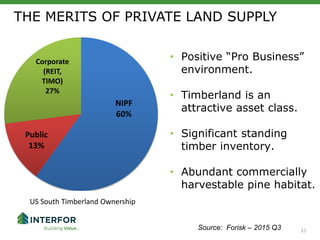
US South Timberland Ownership
THE MERITS OF PRIVATE LAND SUPPLY
• Positive “Pro Business”
environment.
• Timberland is an
attractive asset class.
• Significant standing
timber inventory.
• Abundant commercially
harvestable pine habitat.
NIPF
60%
Public
13%
Corporate
(REIT,
TIMO)
27%
Source: Forisk – 2015 Q3
343434
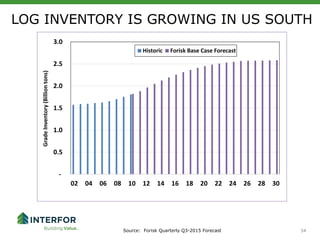
LOG INVENTORY IS GROWING IN US SOUTH
Source: Forisk Quarterly Q3-2015 Forecast
-
0.5
1.0
1.5
2.0
2.5
3.0
02 04 06 08 10 12 14 16 18 20 22 24 26 28 30
GradeInventory(Billiontons)
Historic Forisk Base Case Forecast
UNITED STATES LUMBER DEMAND
35
36
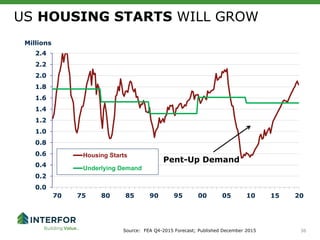
US HOUSING STARTS WILL GROW
36
0.0
0.2
0.4
0.6
0.8
1.0
1.2
1.4
1.6
1.8
2.0
2.2
2.4
Housing Starts
Underlying Demand
Pent-Up Demand
Millions
Source: FEA Q4-2015 Forecast; Published December 2015
37
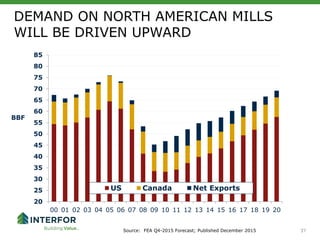
DEMAND ON NORTH AMERICAN MILLS
WILL BE DRIVEN UPWARD
37
BBF
Source: FEA Q4-2015 Forecast; Published December 2015
20
25
30
35
40
45
50
55
60
65
70
75
80
85
00 01 02 03 04 05 06 07 08 09 10 11 12 13 14 15 16 17 18 19 20
US Canada Net Exports
THE FUTURE OF SOUTHERN YELLOW PINE
38
39
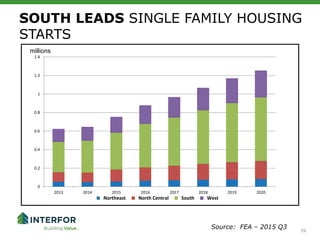
Source: FEA – 2015 Q3
SOUTH LEADS SINGLE FAMILY HOUSING
STARTS
0
0.2
0.4
0.6
0.8
1
1.2
1.4
2013 2014 2015 2016 2017 2018 2019 2020
Northeast North Central South West
millions
404040
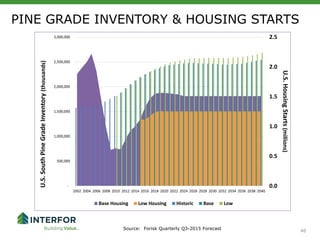
PINE GRADE INVENTORY & HOUSING STARTS
Source: Forisk Quarterly Q3-2015 Forecast
0.0
0.5
1.0
1.5
2.0
2.5
-
500,000
1,000,000
1,500,000
2,000,000
2,500,000
3,000,000
2002 2004 2006 2008 2010 2012 2014 2016 2018 2020 2022 2024 2026 2028 2030 2032 2034 2036 2038 2040
U.S.HousingStarts(millions)
U.S.SouthPineGradeInventory(thousands)
Base Housing Low Housing Historic Base Low
41
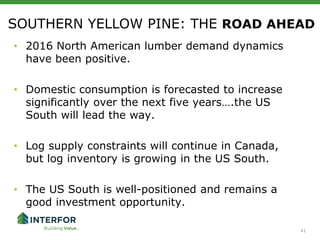
SOUTHERN YELLOW PINE: THE ROAD AHEAD
• 2016 North American lumber demand dynamics
have been positive.
• Domestic consumption is forecasted to increase
significantly over the next five years….the US
South will lead the way.
• Log supply constraints will continue in Canada,
but log inventory is growing in the US South.
• The US South is well-positioned and remains a
good investment opportunity.
42
THANK YOU
Arkansas Forestry Association
Annual Meeting
October 5th, 2016
44
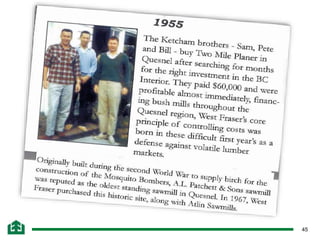
• Who is West Fraser? Our History
and Culture
• Why expand into Arkansas and
the US South?
• Investing in Capital and People
Outline
45
46
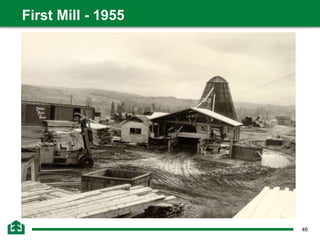
First Mill - 1955
47
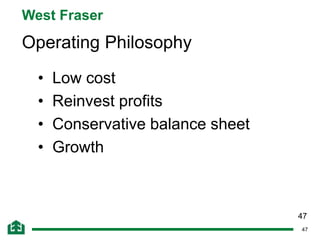
West Fraser
Operating Philosophy
• Low cost
• Reinvest profits
• Conservative balance sheet
• Growth
47
48
Our Values
• Frugality
• Humility
• Competitiveness
• Every employee is important
• Teamwork
Critical that this is throughout the
organization as we grow
49
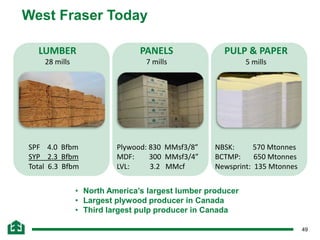
LUMBER
28 mills
PANELS
7 mills
PULP & PAPER
5 mills
SPF 4.0 Bfbm
SYP 2.3 Bfbm
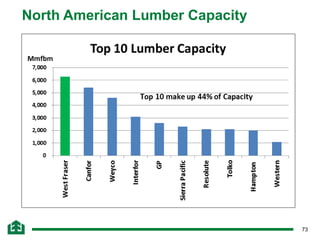
Total 6.3 Bfbm
Plywood: 830 MMsf3/8”
MDF: 300 MMsf3/4”
LVL: 3.2 MMcf
NBSK: 570 Mtonnes
BCTMP: 650 Mtonnes
Newsprint: 135 Mtonnes
West Fraser Today
• North America’s largest lumber producer
• Largest plywood producer in Canada
• Third largest pulp producer in Canada
50
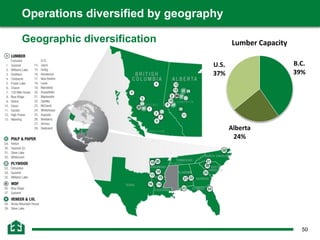
Operations diversified by geography
Geographic diversification
B.C.
39%
Alberta
24%
U.S.
37%
Lumber Capacity
51
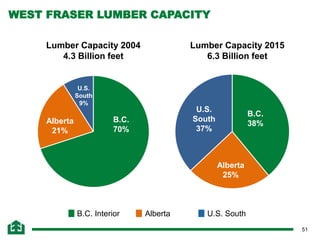
WEST FRASER LUMBER CAPACITY
B.C. Interior Alberta U.S. South
U.S.
South
37%
B.C.
38%
Lumber Capacity 2015
6.3 Billion feet
Alberta
25%
U.S.
South
9%
B.C.
70%
Alberta
21%
Lumber Capacity 2004
4.3 Billion feet
52
0
100
200
300
400
500
2011 2012 2013 2014 2015 2016
Lumber Pulp
$ Millions
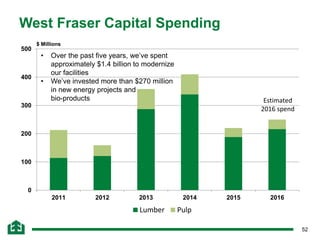
West Fraser Capital Spending
• Over the past five years, we’ve spent
approximately $1.4 billion to modernize
our facilities
• We’ve invested more than $270 million
in new energy projects and
bio-products Estimated
2016 spend
53
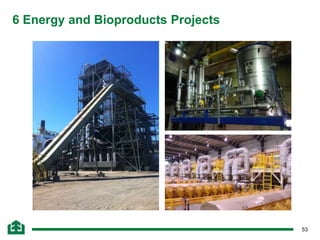
6 Energy and Bioproducts Projects
54
Energy Generation
0
20
40
60
80
100
120
140
160
2010 2011 2012 2013 2014 2015
140 megawatts of electricity
can power 100,000 homes
Megawatts
Our electrical generation capacity has
greatly increased over the last 5 years
55
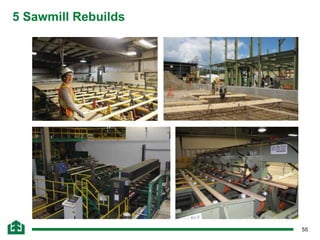
5 Sawmill Rebuilds
56
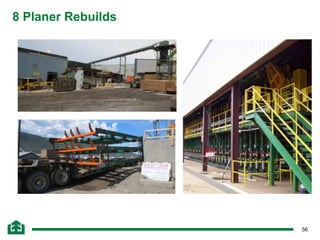
8 Planer Rebuilds
57
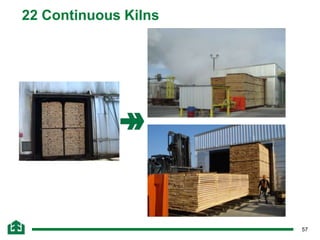
22 Continuous Kilns
58
Why South?
59
Mountain Pine Beetle
59
60
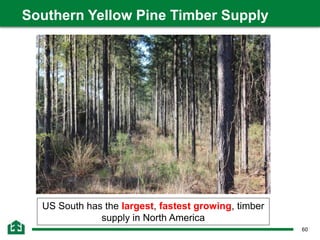
Southern Yellow Pine Timber Supply
US South has the largest, fastest growing, timber
supply in North America
61
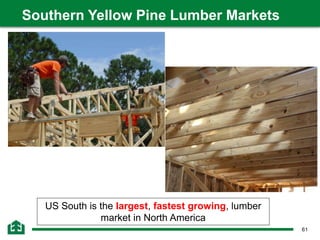
Southern Yellow Pine Lumber Markets
US South is the largest, fastest growing, lumber
market in North America
62
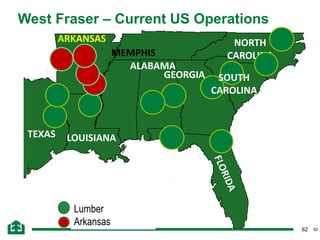
West Fraser – Current US Operations
62
Lumber
Arkansas
TEXAS LOUISIANA
ALABAMA
GEORGIA
ARKANSAS
TENNESSEE
MEMPHIS
NORTH
CAROLINA
SOUTH
CAROLINA
63
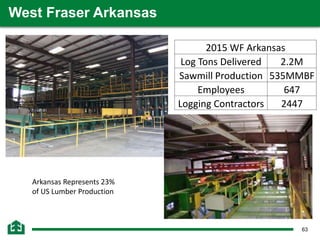
West Fraser Arkansas
2015 WF Arkansas
Log Tons Delivered 2.2M
Sawmill Production 535MMBF
Employees 647
Logging Contractors 2447
Arkansas Represents 23%
of US Lumber Production
64
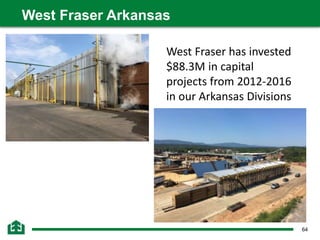
West Fraser Arkansas
West Fraser has invested
$88.3M in capital
projects from 2012-2016
in our Arkansas Divisions
65
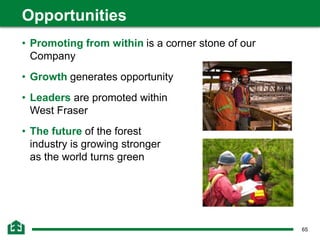
• Promoting from within is a corner stone of our
Company
• Growth generates opportunity
• Leaders are promoted within
West Fraser
• The future of the forest
industry is growing stronger
as the world turns green
Opportunities
66
67
North American Outlook
Appendix
68
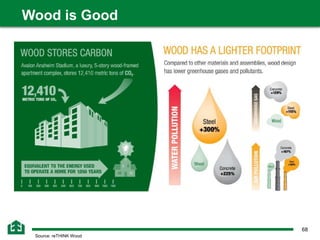
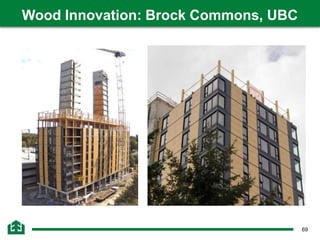
Wood is Good
Source: reTHINK Wood
69
Wood Innovation: Brock Commons, UBC
70
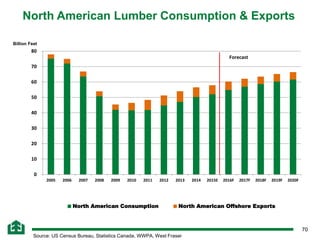
Source: US Census Bureau, Statistics Canada, WWPA, West Fraser
North American Lumber Consumption & Exports
0
10
20
30
40
50
60
70
80
2005 2006 2007 2008 2009 2010 2011 2012 2013 2014 2015E 2016F 2017F 2018F 2019F 2020F
Billion Feet
North American Consumption North American Offshore Exports
Forecast
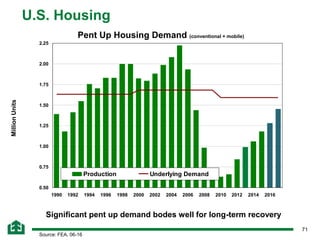
71
U.S. HousingMillionUnits
Source: FEA, 06-16
Significant pent up demand bodes well for long-term recovery
Pent Up Housing Demand (conventional + mobile)
0.50
0.75
1.00
1.25
1.50
1.75
2.00
2.25
1990 1992 1994 1996 1998 2000 2002 2004 2006 2008 2010 2012 2014 2016
Production Underlying Demand
72
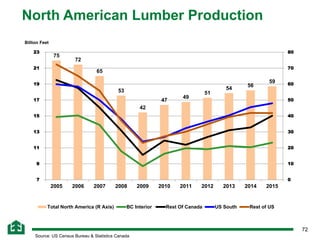
Source: US Census Bureau & Statistics Canada
North American Lumber Production
75
72
65
53
42
47
49
51
54
56
59
0
10
20
30
40
50
60
70
80
7
9
11
13
15
17
19
21
23
2005 2006 2007 2008 2009 2010 2011 2012 2013 2014 2015
Billion Feet
Total North America (R Axis) BC Interior Rest Of Canada US South Rest of US
73
North American Lumber Capacity
Why Arkansas?
Fred Stimpson | Canfor Southern Pine
Todd Mullis | Interfor
Chuck Watkins | West Fraser
Door Prizes
• Vera Lloyd Giveaway | Scott Meek (Claim at
registration table)
• Winthrop Rockefeller | Mike Price (Claim at
booth)
• International Forest Company | Kevin Tucker
THANK YOU TO OUR
PREMIER SPONSOR
LUNCHEON SPONSORED BY
FISH FRY SPONSORED BY
THANK YOU TO OUR
PLATINUM SPONSORS
THANK YOU TO OUR
GOLD SPONSORS
THANK YOU TO OUR
SPONSORS
THANK YOU TO OUR
EXHIBITORS
Located at the Silent Auction
Cover the Log Truck
All Donations go toward
Arkansas Log A Load
GRAVELY 50-INCH ZERO TURN MOWER
WITH SINGLE AXLE TRAILER
TICKETS | $10 EACH OR 3 FOR $20
Biomass Discussion
Dr. Matt Pelkki | UAM School of Forestry & Natural Resources
Donna Harman | American Forest & Paper Association
Dave Tenny | National Alliance of Forest Owners
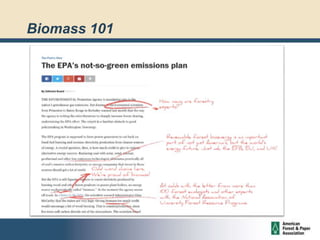
Biomass 101
Wood Supply Trends in the U.S. South
1995-2015
Dave Tenny
President & CEO
National Alliance of Forest Owners
Objective and Scope
Overall: Present factual information on the impact of the
export wood pellet market on American forests and other
forest products industries in the US South.
Three part study:
• Geographic Distribution of Operational and Closed
Wood Fiber Consumers: 1995-2015
• Wood Supply and Pricing Trends: 2000-2014
• Market Case Studies: 2006-2015
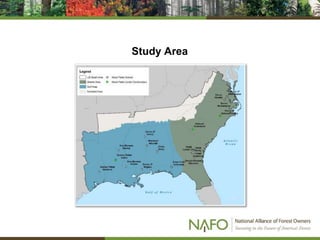
Study Area
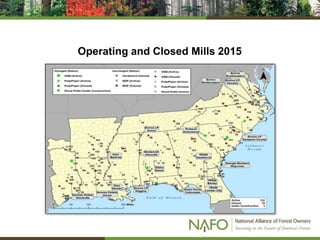
Operating and Closed Mills 2015
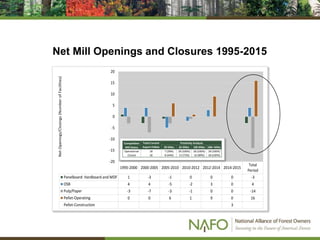
Net Mill Openings and Closures 1995-2015
1995-2000 2000-2005 2005-2010 2010-2012 2012-2014 2014-2015
Total
Period
Panelboard: Hardboard and MDF 1 -3 -1 0 0 0 -3
OSB 4 4 -5 -2 3 0 4
Pulp/Paper -3 -7 -3 -1 0 0 -14
Pellet-Operating 0 0 6 1 9 0 16
Pellet-Construction 3
-20
-15
-10
-5
0
5
10
15
20
NetOpenings/Closings(NumberofFacilities)
30 Miles 65 Miles 100 Miles 100+ Miles
Operational 18 7 (39%) 18 (100%) 18 (100%) 18 (100%)
Closed 18 8 (44%) 13 (72%) 16 (89%) 18 (100%)
Total Current
Export Pellets
Proximity AnalysisCompetitive
Mill Status
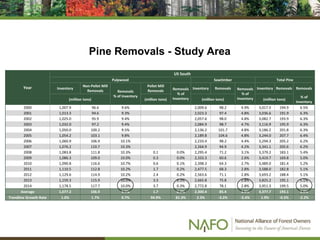
Pine Removals - Study Area
Year
US South
Pulpwood Sawtimber Total Pine
Inventory
Non-Pellet Mill
Removals Removals
% of Inventory
Pellet Mill
Removals Removals
% of
Inventory
Inventory Removals Removals
% of
Inventory
Inventory Removals Removals
(million tons) (million tons) (million tons) (million tons)
% of
Inventory
2000 1,007.9 96.6 9.6% 2,009.6 98.2 4.9% 3,017.5 194.9 6.5%
2001 1,013.3 94.6 9.3% 2,023.3 97.4 4.8% 3,036.6 191.9 6.3%
2002 1,025.0 95.9 9.4% 2,057.6 98.0 4.8% 3,082.7 193.9 6.3%
2003 1,032.0 97.2 9.4% 2,084.9 98.7 4.7% 3,116.9 195.9 6.3%
2004 1,050.0 100.2 9.5% 2,136.2 101.7 4.8% 3,186.2 201.8 6.3%
2005 1,054.2 103.1 9.8% 2,189.8 104.6 4.8% 3,244.0 207.7 6.4%
2006 1,060.9 106.9 10.1% 2,233.4 98.2 4.4% 3,294.3 205.2 6.2%
2007 1,076.2 110.7 10.3% 2,264.9 94.9 4.2% 3,341.1 205.6 6.2%
2008 1,083.8 111.8 10.3% 0.1 0.0% 2,295.4 71.2 3.1% 3,379.2 183.1 5.4%
2009 1,086.3 109.0 10.0% 0.3 0.0% 2,333.3 60.6 2.6% 3,419.7 169.8 5.0%
2010 1,090.8 116.6 10.7% 0.6 0.1% 2,398.3 64.3 2.7% 3,489.0 181.4 5.2%
2011 1,110.5 112.8 10.2% 1.7 0.2% 2,477.5 68.3 2.8% 3,588.0 182.8 5.1%
2012 1,129.6 114.9 10.2% 2.4 0.2% 2,563.6 71.1 2.8% 3,693.2 188.4 5.1%
2013 1,159.3 115.9 10.0% 3.3 0.3% 2,665.8 75.8 2.8% 3,825.2 195.1 5.1%
2014 1,178.5 117.7 10.0% 3.7 0.3% 2,772.8 78.1 2.8% 3,951.3 199.5 5.0%
Average 1,077.2 106.9 9.9% 1.7 0.2% 2,300.4 85.4 3.8% 3,377.7 193.1 5.8%
Trendline Growth Rate 1.0% 1.7% 0.7% 94.9% 81.3% 2.3% -3.2% -5.4% 1.9% -0.3% -2.2%
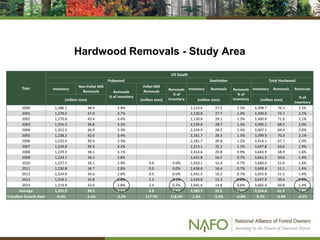
Hardwood Removals - Study Area
Year
US South
Pulpwood Sawtimber Total Hardwood
Inventory
Non-Pellet Mill
Removals Removals
% of Inventory
Pellet Mill
Removals Removals
% of
Inventory
Inventory Removals Removals
% of
Inventory
Inventory Removals Removals
(million tons) (million tons) (million tons) (million tons)
% of
Inventory
2000 1,286.1 48.9 3.8% 2,113.6 27.5 1.3% 3,399.7 76.3 2.2%
2001 1,279.0 47.0 3.7% 2,120.8 27.7 1.3% 3,399.8 74.7 2.2%
2002 1,270.8 43.4 3.4% 2,130.0 28.2 1.3% 3,400.8 71.6 2.1%
2003 1,255.3 39.8 3.2% 2,139.8 28.7 1.3% 3,395.1 68.5 2.0%
2004 1,252.3 40.9 3.3% 2,154.9 28.5 1.3% 3,407.1 69.4 2.0%
2005 1,238.2 42.0 3.4% 2,161.7 28.3 1.3% 3,399.9 70.3 2.1%
2006 1,232.4 40.9 3.3% 2,181.7 26.8 1.2% 3,414.1 67.7 2.0%
2007 1,234.8 39.4 3.2% 2,213.1 25.2 1.1% 3,447.8 64.6 1.9%
2008 1,229.3 38.1 3.1% 2,414.6 20.8 0.9% 3,643.9 58.9 1.6%
2009 1,229.7 34.1 2.8% 2,431.8 16.5 0.7% 3,661.5 50.6 1.4%
2010 1,227.5 36.1 2.9% 0.0 0.0% 2,433.1 16.4 0.7% 3,660.6 52.6 1.4%
2011 1,230.8 34.7 2.8% 0.0 0.0% 2,438.6 16.4 0.7% 3,669.4 51.1 1.4%
2012 1,224.4 34.6 2.8% 0.5 0.0% 2,431.5 16.3 0.7% 3,655.9 51.5 1.4%
2013 1,218.1 33.8 2.8% 1.3 0.1% 2,429.8 15.3 0.6% 3,647.9 50.4 1.4%
2014 1,219.9 33.6 2.8% 2.4 0.2% 2,445.6 14.8 0.6% 3,665.4 50.8 1.4%
Average 1,241.9 39.2 3.1% 0.8 0.1% 2,282.7 22.5 1.0% 3,524.6 61.9 1.8%
Trendline Growth Rate -0.4% -2.6% -2.2% 117.7% 118.0% 1.3% -5.5% -6.8% 0.7% -3.4% -4.2%
Total Removals - Study Area
Year
US South
Pulpwood Sawtimber Total Pine and Hardwood
Inventory
Non-Pellet Mill
Removals Removals
% of Inventory
Pellet Mill
Removals Removals
% of
Inventory
Inventory Removals Removals
% of
Inventory
Inventory Removals Removals
(million tons) (million tons) (million tons) (million tons)
% of
Inventory
2000 2,294.0 145.5 6.3% 4,123.3 125.7 3.0% 6,417.3 271.2 4.2%
2001 2,292.3 141.6 6.2% 4,144.1 125.0 3.0% 6,436.4 266.6 4.1%
2002 2,295.8 139.3 6.1% 4,187.7 126.2 3.0% 6,483.5 265.5 4.1%
2003 2,287.3 137.0 6.0% 4,224.7 127.4 3.0% 6,512.0 264.4 4.1%
2004 2,302.3 141.1 6.1% 4,291.1 130.2 3.0% 6,593.4 271.2 4.1%
2005 2,292.4 145.2 6.3% 4,351.5 132.9 3.1% 6,643.9 278.1 4.2%
2006 2,293.3 147.8 6.4% 4,415.1 125.0 2.8% 6,708.4 272.8 4.1%
2007 2,310.9 150.0 6.5% 4,478.0 120.1 2.7% 6,788.9 270.2 4.0%
2008 2,313.1 149.9 6.5% 0.1 0.0% 4,709.9 92.0 2.0% 7,023.1 242.0 3.4%
2009 2,316.0 143.1 6.2% 0.3 0.0% 4,765.1 77.1 1.6% 7,081.1 220.4 3.1%
2010 2,318.2 152.7 6.6% 0.6 0.0% 4,831.4 80.7 1.7% 7,149.7 234.0 3.3%
2011 2,341.3 147.5 6.3% 1.8 0.1% 4,916.1 84.7 1.7% 7,257.4 233.9 3.2%
2012 2,354.0 149.6 6.4% 2.9 0.1% 4,995.0 87.5 1.8% 7,349.1 239.9 3.3%
2013 2,377.5 149.7 6.3% 4.6 0.2% 5,095.6 91.1 1.8% 7,473.1 245.4 3.3%
2014 2,398.4 151.3 6.3% 6.0 0.3% 5,218.4 92.9 1.8% 7,616.7 250.2 3.3%
Average 2,319.1 146.1 6.3% 2.3 0.1% 4,583.1 107.9 2.4% 6,902.3 255.1 3.7%
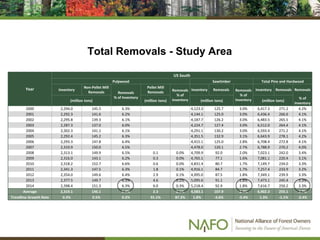
Trendline Growth Rate 0.3% 0.5% 0.2% 91.1% 87.2% 1.8% -3.6% -5.4% 1.3% -1.1% -2.4%
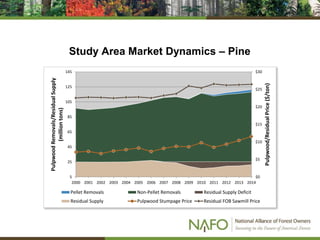
Study Area Market Dynamics – Pine
$0
$5
$10
$15
$20
$25
$30
5
25
45
65
85
105
125
145
2000 2001 2002 2003 2004 2005 2006 2007 2008 2009 2010 2011 2012 2013 2014
Pulpwood/ResidualPrice($/ton)
PulpwoodRemovals/ResidualSupply
(milliontons)
Pellet Removals Non-Pellet Removals Residual Supply Deficit
Residual Supply Pulpwood Stumpage Price Residual FOB Sawmill Price
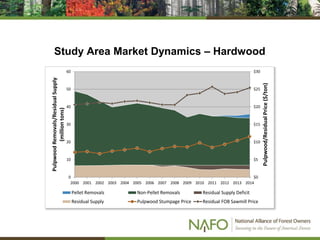
Study Area Market Dynamics – Hardwood
$0
$5
$10
$15
$20
$25
$30
0
10
20
30
40
50
60
2000 2001 2002 2003 2004 2005 2006 2007 2008 2009 2010 2011 2012 2013 2014
Pulpwood/ResidualPrice($/ton)
PulpwoodRemovals/ResidualSupply
(milliontons)
Pellet Removals Non-Pellet Removals Residual Supply Deficit
Residual Supply Pulpwood Stumpage Price Residual FOB Sawmill Price
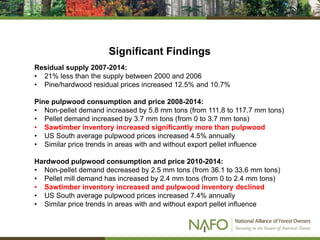
Significant Findings
Residual supply 2007-2014:
• 21% less than the supply between 2000 and 2006
• Pine/hardwood residual prices increased 12.5% and 10.7%
Pine pulpwood consumption and price 2008-2014:
• Non-pellet demand increased by 5.8 mm tons (from 111.8 to 117.7 mm tons)
• Pellet demand increased by 3.7 mm tons (from 0 to 3.7 mm tons)
• Sawtimber inventory increased significantly more than pulpwood
• US South average pulpwood prices increased 4.5% annually
• Similar price trends in areas with and without export pellet influence
Hardwood pulpwood consumption and price 2010-2014:
• Non-pellet demand decreased by 2.5 mm tons (from 36.1 to 33.6 mm tons)
• Pellet mill demand has increased by 2.4 mm tons (from 0 to 2.4 mm tons)
• Sawtimber inventory increased and pulpwood inventory declined
• US South average pulpwood prices increased 7.4% annually
• Similar price trends in areas with and without export pellet influence
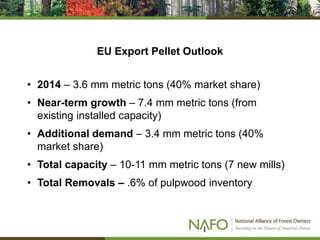
EU Export Pellet Outlook
• 2014 – 3.6 mm metric tons (40% market share)
• Near-term growth – 7.4 mm metric tons (from
existing installed capacity)
• Additional demand – 3.4 mm metric tons (40%
market share)
• Total capacity – 10-11 mm metric tons (7 new mills)
• Total Removals – .6% of pulpwood inventory
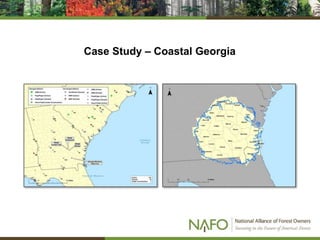
Case Study – Coastal Georgia
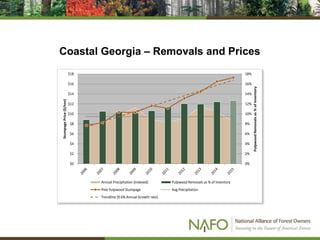
Coastal Georgia – Removals and Prices
0%
2%
4%
6%
8%
10%
12%
14%
16%
18%
$0
$2
$4
$6
$8
$10
$12
$14
$16
$18
PulpwoodRemovalsas%ofInventory
StumpagePrice($/ton)
Annual Precipitation (Indexed) Pulpwood Removals as % of Inventory
Pine Pulpwood Stumpage Avg Precipitation
Trendline (9.6% Annual Growth rate)
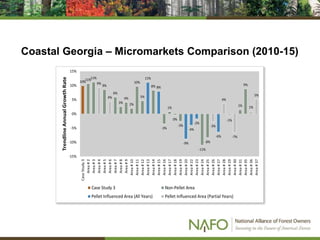
Coastal Georgia – Micromarkets Comparison (2010-15)
10%
11%11%
9%
6%
3%
4%
2%
10%
5%
8%
-3%
1%
0%
-3%
-11%
-8%
1%
9%
11%
8%
-9%
-4%
-2%
-6%
9%
4%
-3%
4%
-1%
-7%
1%
5%
-15%
-10%
-5%
0%
5%
10%
15%
CaseStudy3
Area#2
Area#3
Area#4
Area#5
Area#6
Area#7
Area#8
Area#9
Area#10
Area#11
Area#12
Area#13
Area#14
Area#15
Area#16
Area#17
Area#18
Area#19
Area#20
Area#22
Area#23
Area#24
Area#25
Area#26
Area#27
Area#28
Area#29
Area#30
Area#31
Area#35
Area#36
Area#37
TrendlineAnnualGrowthRate
Case Study 3 Non-Pellet Area
Pellet Influenced Area (All Years) Pellet Influenced Area (Partial Years)
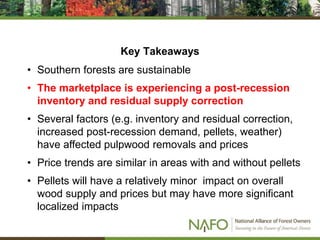
Key Takeaways
• Southern forests are sustainable
• The marketplace is experiencing a post-recession
inventory and residual supply correction
• Several factors (e.g. inventory and residual correction,
increased post-recession demand, pellets, weather)
have affected pulpwood removals and prices
• Price trends are similar in areas with and without pellets
• Pellets will have a relatively minor impact on overall
wood supply and prices but may have more significant
localized impacts
FISH FRY SPONSORED BY

AFA Annual Meeting | General Session | Afternoon

  • 1.
  • 2.
    Why Arkansas? Fred Stimpson| Canfor Southern Pine Todd Mullis | Interfor Chuck Watkins | West Fraser
  • 3.
  • 4.
    • Canfor Corporation •Canfor Southern Pine • Vision for the future in the US South Introduction
  • 5.
  • 6.
    TOP GLOBAL SOFTWOODLUMBER PRODUCERS - 2015
  • 7.
    Canfor Corporation (CFP) Locations 23Sawmills 12 in Canada 11 in US 4 Green Energy Plants 3 Engineered Product Mills 4 Pulp Mills / 1 Kraft Paper Mill (integrated) Production Capacity Lumber 5.8 billion board feet Pulp/Paper 1.4 million tonnes 7 2015 Lumber Sales $2.7 Billion United States Asia Canada Other 2015 Pulp Sales $1.2 Billion Americas Asia Europe BC AB ON TX LA AR MS AL GA SC NC
  • 8.
    Significant Strategic CapitalUpgrades From 2010 to 2015, the Canfor lumber business has invested more than $500 million on high returning capital upgrades in regions and operations with an excellent fibre base: Planer Upgrades Energy Systems Productivity Improvements Grade Optimization 8
  • 9.
  • 10.
    Excellent, High-Quality Fibre Supply HighQuality Products & Customers Well Capitalized Mills Strong & Flexible Balance Sheet Canfor Southern Pine – Why
  • 11.
    Canfor Southern Pine– High Quality Fibre NC SCGAALMS FL IN AR LATX Diminishing supply of the BC timber base AAC reduction primarily due to the Mountain Pine Beetle infestation and First Nations land claims Strong fiber supply in the US South High quality timber across the region Positive growth to drain ration = long term supply Provides species and geographic diversity for our markets and customers
  • 12.
  • 13.
    US South Expansion •Top quartile operational assets • Diverse commodity & specialty product mix • Good access to domestic and offshore markets • Opportunity for further growth Page 13 SPF - 92% SYP, 8% 2006 SPF -76% SYP, 24% 2016 Production Mix
  • 14.
    YEA R COMPANY LOCATIONS 200 6 New South •Conway, SC • Camden, SC • Graham, NC 200 7 Darlington • Darlington, SC 201 3 Scotch Gulf • Fulton, AL • Jackson, AL • Mobile, AL 201 5 Beadles & Balfour • Moultrie, GA • Thomasville, GA 201 5 Southern Lumber • Hermanville, MS 201 5 Anthony Forest Products • Urbana, AR • El Dorado, AR • Washington, GA • Sault Ste. Marie, ON US South Expansion
  • 15.
    Qualified People • Management •Skilled Tradesmen • Millworkers Challenges Ahead
  • 16.
  • 17.
    Supply Shortage =2 Bfbm 2020 – US SOFTWOOD LUMBER SUPPLY CRUNCH Source: WWPA, Canfor Demand: 53 Bfbm Supply: 51 Bfbm 2016 Est. 202 0 New Home 15 18 R&R 18 19 Industria l 13 14 Non-Res 2 2 Total 48 53 2016 Est. 202 0 US South 17 19 US Coast 8.5 9.5 US Inland 5.0 5.5 US other 1.9 2 US Total 32 36 Imports - Canada 14.6 15.2 Imports - EU & Other 0.7 0.8 US Exports (minus) 1.5 1.3 Total 46.2 50.7 2 B 7.7 B 3 B2 B Canadian Exports 2.0 BCoast 10B Inland 6.0 B South 19 B US Production EU Imports 2016: 0.20 B 2020: 0.24 B US Exports 2016: 1.5 B 2020: 1.3 B BC Exports 2016: 4.1 B 2020: 4.2 B 17
  • 18.
    SYP MARKET EXPANSION– MOVING NORTH AND WEST SYP SPF SYP expansion will lead to an increase in species substitution 18
  • 19.
    Forecasted NA lumberdemand will exceed supply by 2 BBF by 2020  8-10 % YOY growth in new home construction  6- 8 % YOY growth in repair and remodel  Increased consumption of wood in new building designs Significant increase in softwood lumber consumption in China, SE Asia and India Shift from Hardwood to Softwood Shift from Concrete & Steel to wood frame construction Southern Yellow Pine will be the critical species in filling the supply gap High quality timber is required to support the increasing demand for premium specialty and structural products The Road Ahead – The Future Looks Bright
  • 20.
    Arkansas Forestry Association FayettevilleArkansas- October 2016 Thank You
  • 21.
    Investing in Arkansas……… and the US South Arkansas Forestry Association 71st Annual Meeting October 5, 2016 Todd Mullis Vice President US South Operations
  • 22.
    22 This presentation containsinformation and statements that are forward- looking in nature, including, but not limited to, statements containing the words “will”, “is expected”, “forecast”, “annualized”, “target” and similar expressions. Such statements involve known and unknown risks and uncertainties that may cause Interfor’s actual results to be materially different from those expressed or implied by those forward-looking statements. Such risks and uncertainties include, among others: price volatility; competition; availability and cost of log supply; natural or man- made disasters; foreign currency exchange fluctuations; changes in government regulation; export and other trade barriers; environmental and community matters; labour disruptions; and other factors referenced herein and in Interfor’s current Annual Report and Management’s Discussion & Analysis, both available on www.sedar.com. The forward-looking information and statements contained in this presentation are based on Interfor’s current expectations and beliefs. Readers are cautioned not to place undue reliance on forward-looking information or statements. Interfor undertakes no obligation to update such forward-looking information or statements, except where required by law. FORWARD-LOOKING INFORMATION 22
  • 23.
    23 • Interfor’s Platform •North American Lumber Log Supply • US Lumber Demand • The Future of Southern Yellow Pine • The Road Ahead ITEMS FOR DISCUSSION 23
  • 24.
  • 25.
    25 March 2013 Rayonier Acquisition • Baxley •Eatonton • Swainsboro July 2013 Keadle Acquisition • Thomaston Sept 2013 Swainsboro second shift March 2014 Tolleson Acquisition • Perry • Preston Jan 2014 Baxley second shift Nov 2014 PTC office opening March 2015 Simpson Acquisition • Georgetown • Meldrim June 2015 Price Acquisition • Monticello 2013 2014 2015 • 5 transactions valued at over $400M • $55M additional investment to date • Nine operations in three states • Over 1,100 employees • 1.3 Bbf of production capacity • Over 5M tons of logs consumed From Zero to: INTERFOR US SOUTH — TIMELINE
  • 26.
    26 INTERFOR BELIEVES INAND IS COMMITTED TO THE US SOUTH
  • 27.
    27 LUMBER FOCUS ONLY 0% 10% 20% 30% 40% 50% 60% 70% 80% 90% 100% Interfor LumberPanels Engineered Products Pulp, Paper & Fibers % of Sales Other Major Lumber Producers
  • 28.
    28 Doug Fir/Larch 30% Hem-Fir 10% Spruce-Pine-Fir 11% Southern Yellow Pine 34% Cedar 11% Lodge Pole/ PonderosaPine 4% INTERFOR’S BROAD RANGE OF PRODUCTS (1) By value for 2015 Lumber Sales By Species 1 Western Dimension Cedar Southern Yellow Pine Lodge Pole Pine
  • 29.
    29 Canada 8% China/Tw/HK 5% Other 4% Japan 10% USA 73% NORTH AMERICAN DRIVENBUSINESS; BUT DIVERSE SET OF MARKETS SERVED (1) By value for 2015 Lumber Sales By Market 1
  • 30.
    NORTH AMERICAN LUMBERSUPPLY LOG 30
  • 31.
    31 BC INTERIOR OVERVIEW CumulativePercentage of Merchantable Forest Volume Killed Since 1999 Very High (>45%) High (31-45%) Moderate (16-30%) Low (<16%) None (0%) Adams Lake Castlegar Grand Forks Source: BC Ministry of Forests
  • 32.
    32 Source: FLNRO AAC: AllowableAnnual Cut - 10 20 30 40 50 60 70 1995 2000 2005 2010 2015 2020 2025 2030 2035 2040 2045 2050 AAC m3/yrMillion m3 BC INTERIOR HARVEST WILL DROP
  • 33.
    33 US South TimberlandOwnership THE MERITS OF PRIVATE LAND SUPPLY • Positive “Pro Business” environment. • Timberland is an attractive asset class. • Significant standing timber inventory. • Abundant commercially harvestable pine habitat. NIPF 60% Public 13% Corporate (REIT, TIMO) 27% Source: Forisk – 2015 Q3
  • 34.
    343434 LOG INVENTORY ISGROWING IN US SOUTH Source: Forisk Quarterly Q3-2015 Forecast - 0.5 1.0 1.5 2.0 2.5 3.0 02 04 06 08 10 12 14 16 18 20 22 24 26 28 30 GradeInventory(Billiontons) Historic Forisk Base Case Forecast
  • 35.
  • 36.
    36 US HOUSING STARTSWILL GROW 36 0.0 0.2 0.4 0.6 0.8 1.0 1.2 1.4 1.6 1.8 2.0 2.2 2.4 Housing Starts Underlying Demand Pent-Up Demand Millions Source: FEA Q4-2015 Forecast; Published December 2015
  • 37.
    37 DEMAND ON NORTHAMERICAN MILLS WILL BE DRIVEN UPWARD 37 BBF Source: FEA Q4-2015 Forecast; Published December 2015 20 25 30 35 40 45 50 55 60 65 70 75 80 85 00 01 02 03 04 05 06 07 08 09 10 11 12 13 14 15 16 17 18 19 20 US Canada Net Exports
  • 38.
    THE FUTURE OFSOUTHERN YELLOW PINE 38
  • 39.
    39 Source: FEA –2015 Q3 SOUTH LEADS SINGLE FAMILY HOUSING STARTS 0 0.2 0.4 0.6 0.8 1 1.2 1.4 2013 2014 2015 2016 2017 2018 2019 2020 Northeast North Central South West millions
  • 40.
    404040 PINE GRADE INVENTORY& HOUSING STARTS Source: Forisk Quarterly Q3-2015 Forecast 0.0 0.5 1.0 1.5 2.0 2.5 - 500,000 1,000,000 1,500,000 2,000,000 2,500,000 3,000,000 2002 2004 2006 2008 2010 2012 2014 2016 2018 2020 2022 2024 2026 2028 2030 2032 2034 2036 2038 2040 U.S.HousingStarts(millions) U.S.SouthPineGradeInventory(thousands) Base Housing Low Housing Historic Base Low
  • 41.
    41 SOUTHERN YELLOW PINE:THE ROAD AHEAD • 2016 North American lumber demand dynamics have been positive. • Domestic consumption is forecasted to increase significantly over the next five years….the US South will lead the way. • Log supply constraints will continue in Canada, but log inventory is growing in the US South. • The US South is well-positioned and remains a good investment opportunity.
  • 42.
  • 43.
    Arkansas Forestry Association AnnualMeeting October 5th, 2016
  • 44.
    44 • Who isWest Fraser? Our History and Culture • Why expand into Arkansas and the US South? • Investing in Capital and People Outline
  • 45.
  • 46.
  • 47.
    47 West Fraser Operating Philosophy •Low cost • Reinvest profits • Conservative balance sheet • Growth 47
  • 48.
    48 Our Values • Frugality •Humility • Competitiveness • Every employee is important • Teamwork Critical that this is throughout the organization as we grow
  • 49.
    49 LUMBER 28 mills PANELS 7 mills PULP& PAPER 5 mills SPF 4.0 Bfbm SYP 2.3 Bfbm Total 6.3 Bfbm Plywood: 830 MMsf3/8” MDF: 300 MMsf3/4” LVL: 3.2 MMcf NBSK: 570 Mtonnes BCTMP: 650 Mtonnes Newsprint: 135 Mtonnes West Fraser Today • North America’s largest lumber producer • Largest plywood producer in Canada • Third largest pulp producer in Canada
  • 50.
    50 Operations diversified bygeography Geographic diversification B.C. 39% Alberta 24% U.S. 37% Lumber Capacity
  • 51.
    51 WEST FRASER LUMBERCAPACITY B.C. Interior Alberta U.S. South U.S. South 37% B.C. 38% Lumber Capacity 2015 6.3 Billion feet Alberta 25% U.S. South 9% B.C. 70% Alberta 21% Lumber Capacity 2004 4.3 Billion feet
  • 52.
    52 0 100 200 300 400 500 2011 2012 20132014 2015 2016 Lumber Pulp $ Millions West Fraser Capital Spending • Over the past five years, we’ve spent approximately $1.4 billion to modernize our facilities • We’ve invested more than $270 million in new energy projects and bio-products Estimated 2016 spend
  • 53.
    53 6 Energy andBioproducts Projects
  • 54.
    54 Energy Generation 0 20 40 60 80 100 120 140 160 2010 20112012 2013 2014 2015 140 megawatts of electricity can power 100,000 homes Megawatts Our electrical generation capacity has greatly increased over the last 5 years
  • 55.
  • 56.
  • 57.
  • 58.
  • 59.
  • 60.
    60 Southern Yellow PineTimber Supply US South has the largest, fastest growing, timber supply in North America
  • 61.
    61 Southern Yellow PineLumber Markets US South is the largest, fastest growing, lumber market in North America
  • 62.
    62 West Fraser –Current US Operations 62 Lumber Arkansas TEXAS LOUISIANA ALABAMA GEORGIA ARKANSAS TENNESSEE MEMPHIS NORTH CAROLINA SOUTH CAROLINA
  • 63.
    63 West Fraser Arkansas 2015WF Arkansas Log Tons Delivered 2.2M Sawmill Production 535MMBF Employees 647 Logging Contractors 2447 Arkansas Represents 23% of US Lumber Production
  • 64.
    64 West Fraser Arkansas WestFraser has invested $88.3M in capital projects from 2012-2016 in our Arkansas Divisions
  • 65.
    65 • Promoting fromwithin is a corner stone of our Company • Growth generates opportunity • Leaders are promoted within West Fraser • The future of the forest industry is growing stronger as the world turns green Opportunities
  • 66.
  • 67.
  • 68.
  • 69.
  • 70.
    70 Source: US CensusBureau, Statistics Canada, WWPA, West Fraser North American Lumber Consumption & Exports 0 10 20 30 40 50 60 70 80 2005 2006 2007 2008 2009 2010 2011 2012 2013 2014 2015E 2016F 2017F 2018F 2019F 2020F Billion Feet North American Consumption North American Offshore Exports Forecast
  • 71.
    71 U.S. HousingMillionUnits Source: FEA,06-16 Significant pent up demand bodes well for long-term recovery Pent Up Housing Demand (conventional + mobile) 0.50 0.75 1.00 1.25 1.50 1.75 2.00 2.25 1990 1992 1994 1996 1998 2000 2002 2004 2006 2008 2010 2012 2014 2016 Production Underlying Demand
  • 72.
    72 Source: US CensusBureau & Statistics Canada North American Lumber Production 75 72 65 53 42 47 49 51 54 56 59 0 10 20 30 40 50 60 70 80 7 9 11 13 15 17 19 21 23 2005 2006 2007 2008 2009 2010 2011 2012 2013 2014 2015 Billion Feet Total North America (R Axis) BC Interior Rest Of Canada US South Rest of US
  • 73.
  • 74.
    Why Arkansas? Fred Stimpson| Canfor Southern Pine Todd Mullis | Interfor Chuck Watkins | West Fraser
  • 75.
    Door Prizes • VeraLloyd Giveaway | Scott Meek (Claim at registration table) • Winthrop Rockefeller | Mike Price (Claim at booth) • International Forest Company | Kevin Tucker
  • 76.
    THANK YOU TOOUR PREMIER SPONSOR
  • 77.
  • 78.
  • 79.
    THANK YOU TOOUR PLATINUM SPONSORS
  • 80.
    THANK YOU TOOUR GOLD SPONSORS
  • 81.
    THANK YOU TOOUR SPONSORS
  • 82.
    THANK YOU TOOUR EXHIBITORS
  • 86.
    Located at theSilent Auction Cover the Log Truck All Donations go toward Arkansas Log A Load
  • 87.
    GRAVELY 50-INCH ZEROTURN MOWER WITH SINGLE AXLE TRAILER TICKETS | $10 EACH OR 3 FOR $20
  • 88.
    Biomass Discussion Dr. MattPelkki | UAM School of Forestry & Natural Resources Donna Harman | American Forest & Paper Association Dave Tenny | National Alliance of Forest Owners
  • 90.
  • 91.
    Wood Supply Trendsin the U.S. South 1995-2015 Dave Tenny President & CEO National Alliance of Forest Owners
  • 92.
    Objective and Scope Overall:Present factual information on the impact of the export wood pellet market on American forests and other forest products industries in the US South. Three part study: • Geographic Distribution of Operational and Closed Wood Fiber Consumers: 1995-2015 • Wood Supply and Pricing Trends: 2000-2014 • Market Case Studies: 2006-2015
  • 93.
  • 94.
  • 95.
    Net Mill Openingsand Closures 1995-2015 1995-2000 2000-2005 2005-2010 2010-2012 2012-2014 2014-2015 Total Period Panelboard: Hardboard and MDF 1 -3 -1 0 0 0 -3 OSB 4 4 -5 -2 3 0 4 Pulp/Paper -3 -7 -3 -1 0 0 -14 Pellet-Operating 0 0 6 1 9 0 16 Pellet-Construction 3 -20 -15 -10 -5 0 5 10 15 20 NetOpenings/Closings(NumberofFacilities) 30 Miles 65 Miles 100 Miles 100+ Miles Operational 18 7 (39%) 18 (100%) 18 (100%) 18 (100%) Closed 18 8 (44%) 13 (72%) 16 (89%) 18 (100%) Total Current Export Pellets Proximity AnalysisCompetitive Mill Status
  • 96.
    Pine Removals -Study Area Year US South Pulpwood Sawtimber Total Pine Inventory Non-Pellet Mill Removals Removals % of Inventory Pellet Mill Removals Removals % of Inventory Inventory Removals Removals % of Inventory Inventory Removals Removals (million tons) (million tons) (million tons) (million tons) % of Inventory 2000 1,007.9 96.6 9.6% 2,009.6 98.2 4.9% 3,017.5 194.9 6.5% 2001 1,013.3 94.6 9.3% 2,023.3 97.4 4.8% 3,036.6 191.9 6.3% 2002 1,025.0 95.9 9.4% 2,057.6 98.0 4.8% 3,082.7 193.9 6.3% 2003 1,032.0 97.2 9.4% 2,084.9 98.7 4.7% 3,116.9 195.9 6.3% 2004 1,050.0 100.2 9.5% 2,136.2 101.7 4.8% 3,186.2 201.8 6.3% 2005 1,054.2 103.1 9.8% 2,189.8 104.6 4.8% 3,244.0 207.7 6.4% 2006 1,060.9 106.9 10.1% 2,233.4 98.2 4.4% 3,294.3 205.2 6.2% 2007 1,076.2 110.7 10.3% 2,264.9 94.9 4.2% 3,341.1 205.6 6.2% 2008 1,083.8 111.8 10.3% 0.1 0.0% 2,295.4 71.2 3.1% 3,379.2 183.1 5.4% 2009 1,086.3 109.0 10.0% 0.3 0.0% 2,333.3 60.6 2.6% 3,419.7 169.8 5.0% 2010 1,090.8 116.6 10.7% 0.6 0.1% 2,398.3 64.3 2.7% 3,489.0 181.4 5.2% 2011 1,110.5 112.8 10.2% 1.7 0.2% 2,477.5 68.3 2.8% 3,588.0 182.8 5.1% 2012 1,129.6 114.9 10.2% 2.4 0.2% 2,563.6 71.1 2.8% 3,693.2 188.4 5.1% 2013 1,159.3 115.9 10.0% 3.3 0.3% 2,665.8 75.8 2.8% 3,825.2 195.1 5.1% 2014 1,178.5 117.7 10.0% 3.7 0.3% 2,772.8 78.1 2.8% 3,951.3 199.5 5.0% Average 1,077.2 106.9 9.9% 1.7 0.2% 2,300.4 85.4 3.8% 3,377.7 193.1 5.8% Trendline Growth Rate 1.0% 1.7% 0.7% 94.9% 81.3% 2.3% -3.2% -5.4% 1.9% -0.3% -2.2%
  • 97.
    Hardwood Removals -Study Area Year US South Pulpwood Sawtimber Total Hardwood Inventory Non-Pellet Mill Removals Removals % of Inventory Pellet Mill Removals Removals % of Inventory Inventory Removals Removals % of Inventory Inventory Removals Removals (million tons) (million tons) (million tons) (million tons) % of Inventory 2000 1,286.1 48.9 3.8% 2,113.6 27.5 1.3% 3,399.7 76.3 2.2% 2001 1,279.0 47.0 3.7% 2,120.8 27.7 1.3% 3,399.8 74.7 2.2% 2002 1,270.8 43.4 3.4% 2,130.0 28.2 1.3% 3,400.8 71.6 2.1% 2003 1,255.3 39.8 3.2% 2,139.8 28.7 1.3% 3,395.1 68.5 2.0% 2004 1,252.3 40.9 3.3% 2,154.9 28.5 1.3% 3,407.1 69.4 2.0% 2005 1,238.2 42.0 3.4% 2,161.7 28.3 1.3% 3,399.9 70.3 2.1% 2006 1,232.4 40.9 3.3% 2,181.7 26.8 1.2% 3,414.1 67.7 2.0% 2007 1,234.8 39.4 3.2% 2,213.1 25.2 1.1% 3,447.8 64.6 1.9% 2008 1,229.3 38.1 3.1% 2,414.6 20.8 0.9% 3,643.9 58.9 1.6% 2009 1,229.7 34.1 2.8% 2,431.8 16.5 0.7% 3,661.5 50.6 1.4% 2010 1,227.5 36.1 2.9% 0.0 0.0% 2,433.1 16.4 0.7% 3,660.6 52.6 1.4% 2011 1,230.8 34.7 2.8% 0.0 0.0% 2,438.6 16.4 0.7% 3,669.4 51.1 1.4% 2012 1,224.4 34.6 2.8% 0.5 0.0% 2,431.5 16.3 0.7% 3,655.9 51.5 1.4% 2013 1,218.1 33.8 2.8% 1.3 0.1% 2,429.8 15.3 0.6% 3,647.9 50.4 1.4% 2014 1,219.9 33.6 2.8% 2.4 0.2% 2,445.6 14.8 0.6% 3,665.4 50.8 1.4% Average 1,241.9 39.2 3.1% 0.8 0.1% 2,282.7 22.5 1.0% 3,524.6 61.9 1.8% Trendline Growth Rate -0.4% -2.6% -2.2% 117.7% 118.0% 1.3% -5.5% -6.8% 0.7% -3.4% -4.2%
  • 98.
    Total Removals -Study Area Year US South Pulpwood Sawtimber Total Pine and Hardwood Inventory Non-Pellet Mill Removals Removals % of Inventory Pellet Mill Removals Removals % of Inventory Inventory Removals Removals % of Inventory Inventory Removals Removals (million tons) (million tons) (million tons) (million tons) % of Inventory 2000 2,294.0 145.5 6.3% 4,123.3 125.7 3.0% 6,417.3 271.2 4.2% 2001 2,292.3 141.6 6.2% 4,144.1 125.0 3.0% 6,436.4 266.6 4.1% 2002 2,295.8 139.3 6.1% 4,187.7 126.2 3.0% 6,483.5 265.5 4.1% 2003 2,287.3 137.0 6.0% 4,224.7 127.4 3.0% 6,512.0 264.4 4.1% 2004 2,302.3 141.1 6.1% 4,291.1 130.2 3.0% 6,593.4 271.2 4.1% 2005 2,292.4 145.2 6.3% 4,351.5 132.9 3.1% 6,643.9 278.1 4.2% 2006 2,293.3 147.8 6.4% 4,415.1 125.0 2.8% 6,708.4 272.8 4.1% 2007 2,310.9 150.0 6.5% 4,478.0 120.1 2.7% 6,788.9 270.2 4.0% 2008 2,313.1 149.9 6.5% 0.1 0.0% 4,709.9 92.0 2.0% 7,023.1 242.0 3.4% 2009 2,316.0 143.1 6.2% 0.3 0.0% 4,765.1 77.1 1.6% 7,081.1 220.4 3.1% 2010 2,318.2 152.7 6.6% 0.6 0.0% 4,831.4 80.7 1.7% 7,149.7 234.0 3.3% 2011 2,341.3 147.5 6.3% 1.8 0.1% 4,916.1 84.7 1.7% 7,257.4 233.9 3.2% 2012 2,354.0 149.6 6.4% 2.9 0.1% 4,995.0 87.5 1.8% 7,349.1 239.9 3.3% 2013 2,377.5 149.7 6.3% 4.6 0.2% 5,095.6 91.1 1.8% 7,473.1 245.4 3.3% 2014 2,398.4 151.3 6.3% 6.0 0.3% 5,218.4 92.9 1.8% 7,616.7 250.2 3.3% Average 2,319.1 146.1 6.3% 2.3 0.1% 4,583.1 107.9 2.4% 6,902.3 255.1 3.7% Trendline Growth Rate 0.3% 0.5% 0.2% 91.1% 87.2% 1.8% -3.6% -5.4% 1.3% -1.1% -2.4%
  • 99.
    Study Area MarketDynamics – Pine $0 $5 $10 $15 $20 $25 $30 5 25 45 65 85 105 125 145 2000 2001 2002 2003 2004 2005 2006 2007 2008 2009 2010 2011 2012 2013 2014 Pulpwood/ResidualPrice($/ton) PulpwoodRemovals/ResidualSupply (milliontons) Pellet Removals Non-Pellet Removals Residual Supply Deficit Residual Supply Pulpwood Stumpage Price Residual FOB Sawmill Price
  • 100.
    Study Area MarketDynamics – Hardwood $0 $5 $10 $15 $20 $25 $30 0 10 20 30 40 50 60 2000 2001 2002 2003 2004 2005 2006 2007 2008 2009 2010 2011 2012 2013 2014 Pulpwood/ResidualPrice($/ton) PulpwoodRemovals/ResidualSupply (milliontons) Pellet Removals Non-Pellet Removals Residual Supply Deficit Residual Supply Pulpwood Stumpage Price Residual FOB Sawmill Price
  • 101.
    Significant Findings Residual supply2007-2014: • 21% less than the supply between 2000 and 2006 • Pine/hardwood residual prices increased 12.5% and 10.7% Pine pulpwood consumption and price 2008-2014: • Non-pellet demand increased by 5.8 mm tons (from 111.8 to 117.7 mm tons) • Pellet demand increased by 3.7 mm tons (from 0 to 3.7 mm tons) • Sawtimber inventory increased significantly more than pulpwood • US South average pulpwood prices increased 4.5% annually • Similar price trends in areas with and without export pellet influence Hardwood pulpwood consumption and price 2010-2014: • Non-pellet demand decreased by 2.5 mm tons (from 36.1 to 33.6 mm tons) • Pellet mill demand has increased by 2.4 mm tons (from 0 to 2.4 mm tons) • Sawtimber inventory increased and pulpwood inventory declined • US South average pulpwood prices increased 7.4% annually • Similar price trends in areas with and without export pellet influence
  • 102.
    EU Export PelletOutlook • 2014 – 3.6 mm metric tons (40% market share) • Near-term growth – 7.4 mm metric tons (from existing installed capacity) • Additional demand – 3.4 mm metric tons (40% market share) • Total capacity – 10-11 mm metric tons (7 new mills) • Total Removals – .6% of pulpwood inventory
  • 103.
    Case Study –Coastal Georgia
  • 104.
    Coastal Georgia –Removals and Prices 0% 2% 4% 6% 8% 10% 12% 14% 16% 18% $0 $2 $4 $6 $8 $10 $12 $14 $16 $18 PulpwoodRemovalsas%ofInventory StumpagePrice($/ton) Annual Precipitation (Indexed) Pulpwood Removals as % of Inventory Pine Pulpwood Stumpage Avg Precipitation Trendline (9.6% Annual Growth rate)
  • 105.
    Coastal Georgia –Micromarkets Comparison (2010-15) 10% 11%11% 9% 6% 3% 4% 2% 10% 5% 8% -3% 1% 0% -3% -11% -8% 1% 9% 11% 8% -9% -4% -2% -6% 9% 4% -3% 4% -1% -7% 1% 5% -15% -10% -5% 0% 5% 10% 15% CaseStudy3 Area#2 Area#3 Area#4 Area#5 Area#6 Area#7 Area#8 Area#9 Area#10 Area#11 Area#12 Area#13 Area#14 Area#15 Area#16 Area#17 Area#18 Area#19 Area#20 Area#22 Area#23 Area#24 Area#25 Area#26 Area#27 Area#28 Area#29 Area#30 Area#31 Area#35 Area#36 Area#37 TrendlineAnnualGrowthRate Case Study 3 Non-Pellet Area Pellet Influenced Area (All Years) Pellet Influenced Area (Partial Years)
  • 106.
    Key Takeaways • Southernforests are sustainable • The marketplace is experiencing a post-recession inventory and residual supply correction • Several factors (e.g. inventory and residual correction, increased post-recession demand, pellets, weather) have affected pulpwood removals and prices • Price trends are similar in areas with and without pellets • Pellets will have a relatively minor impact on overall wood supply and prices but may have more significant localized impacts
  • 107.